Japan 3D Printing Ceramics Market Size & Growth Rate
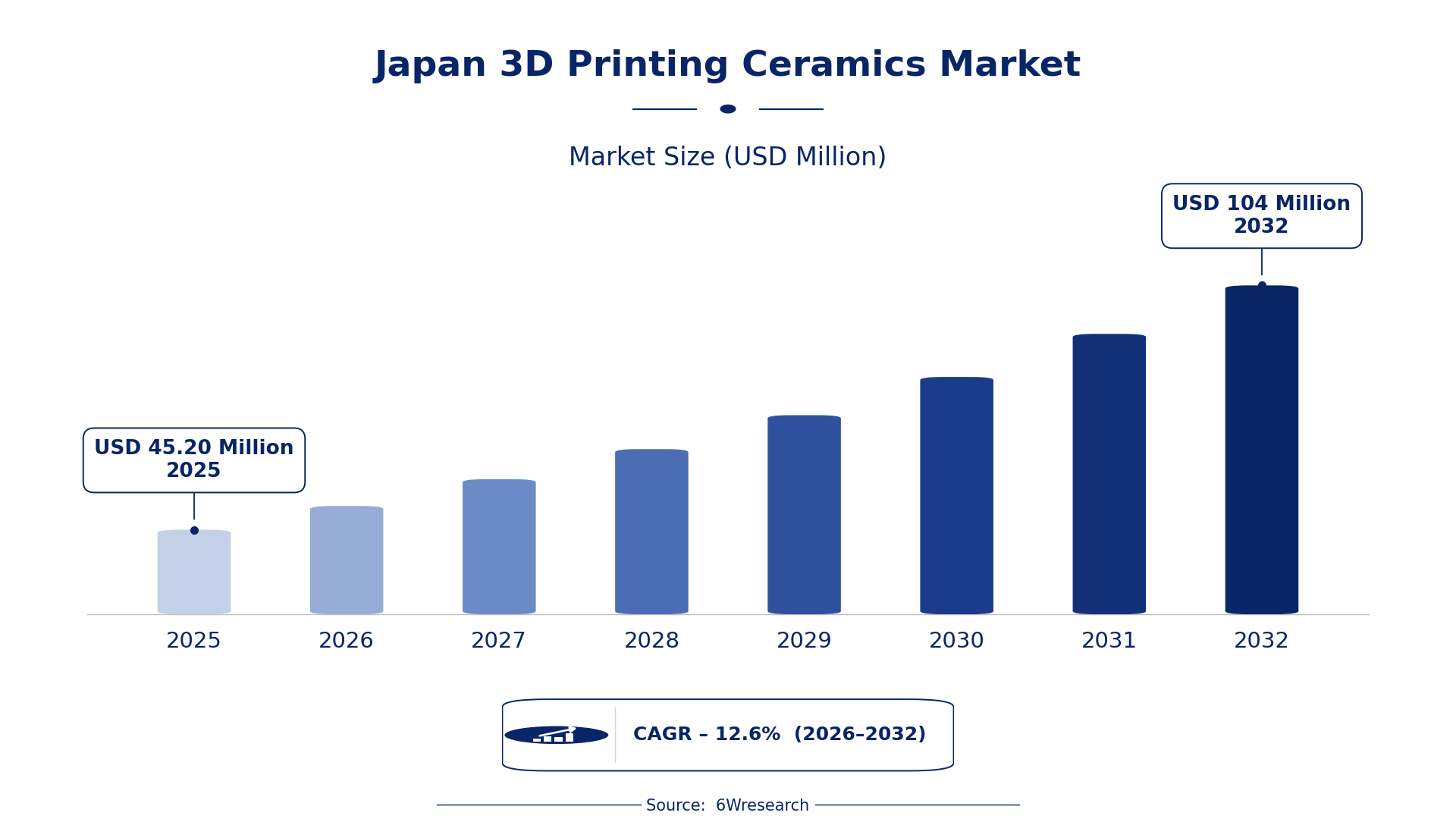
According to 6Wresearch internal database and industry insights, the Japan 3D Printing Ceramics Market was valued at USD 45.20 Million in 2025 and is projected to reach USD 104 Million by 2032, growing at a CAGR of approximately 12.6% during 2026–2032.
Japan 3D Printing Ceramics Market Highlights
| Report Metric | Details |
| Report Name | Japan 3D Printing Ceramics Market (2026-2032) |
| Market Size 2025 | USD 45.20 Million |
| Market Size 2032 | USD 104 Million |
| Absolute Growth 2025–2032 | USD 58.80 Million |
| CAGR 2026–2032 | 12.6% |
| Peak Annual Growth | 16.3% in 2030 |
| Forecast Period | 2026–2032 |
| Historical Data | 2022–2025 |
| Base Year | 2025 |
| Leading Type of Ceramic, 2025 | Oxide based (63% share) |
| Leading Application, 2025 | Prototyping and tooling (60% share) |
| Leading Form, 2025 | Powder (43% share) |
| Leading End Use Industry, 2025 | Aerospace & Defense (31% share) |
| Fastest-Growing Type of Ceramic | Non-oxide based (16.7% CAGR) |
| Fastest-Growing Application | Commercial/ Manufacturing (16.5% CAGR) |
| Fastest-Growing Form | Liquid/ slurry (17.3% CAGR) |
| Fastest-Growing End Use Industry | Healthcare (16.8% CAGR) |
| Growing Sector | Healthcare |
| Key End Users | Healthcare providers, Aerospace manufacturers, Construction firms, Automotive designers |
Japan 3D Printing Ceramics Market Year-wise Growth Rate and Key Drivers (2022–2032)
This graph illustrates the annual growth rates of the market from 2022 to 2032, highlighting a steady upward trajectory and projected market expansion over the forecast period.
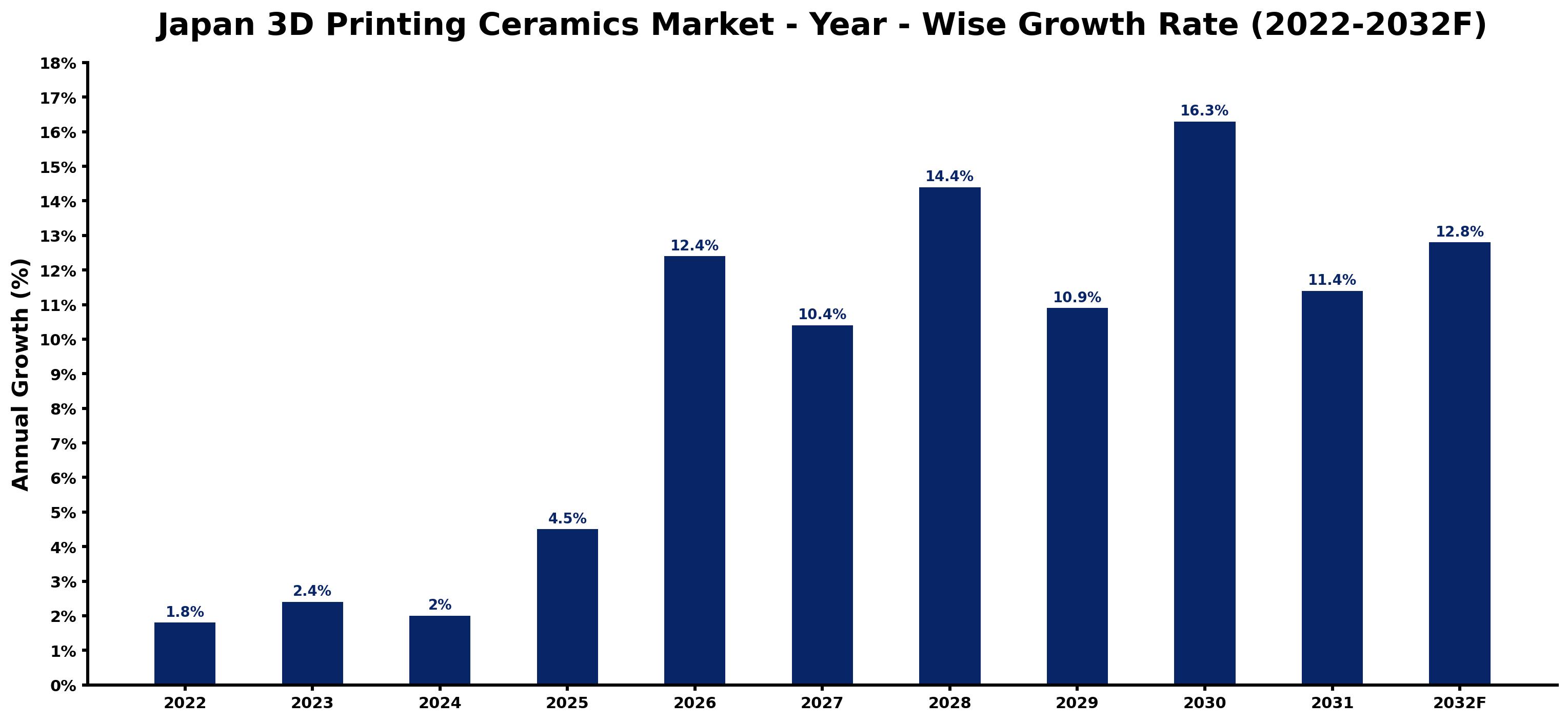
The yearly estimates that follow link every growth rate to its principal driver, so readers can see why the pace changed in each period.
| Year | Estimated Annual Growth (%) | Market Rationale |
| 2022 | 1.8 | The market exhibited steady growth, driven by increasing interest in advanced manufacturing technologies. |
| 2023 | 2.4 | Growth accelerated following the launch of new initiatives to support 3D printing. |
| 2024 | 2.0 | The growth rate slowed slightly due to market adjustments and increased competition. |
| 2025 | 4.5 | A surge in demand for prototyping and tooling contributed to faster growth. |
| 2026 | 12.4 | The market will grow rapidly as applications in healthcare expand. |
| 2027 | 10.4 | Growth is projected to slow as the market stabilises after previous surges. |
| 2028 | 14.4 | A resurgence in demand from aerospace and defense sectors is anticipated to boost growth. |
| 2029 | 10.9 | The market is expected to see a slowdown as competition intensifies among suppliers. |
| 2030 | 16.3 | A peak in growth is projected as new technologies improve production capabilities. |
| 2031 | 11.4 | Growth is expected to moderate as the market approaches maturity and stabilisation. |
| 2032 | 12.8 | The market is anticipated to continue expanding, driven by ongoing innovations in ceramics. |
Note: Market size estimations and growth projections presented in this report are based on 6Wresearch's proprietary forecasting methodology, utilizing the latest available industry data, government publications, and primary research inputs.
Japan 3D Printing Ceramics Market Synopsis
3D printing ceramics are advanced materials primarily composed of oxide and non-oxide ceramics, produced through methods like selective laser sintering. Their applications include prototyping, tooling, and manufacturing components for various industries. The Japan 3D Printing Ceramics Market is expanding due to rising demand from sectors such as healthcare and aerospace, supported by initiatives from the Tokyo Metropolitan Government and advancements in manufacturing technologies. With the healthcare sector projected to utilise over 10,000 medical devices, the need for custom implants is driving further growth.
Market Dynamics Impact Analysis (2026–2032)
| Factor | Type | Impact | Primary Segment Affected |
| Growing demand for custom implants in healthcare | Driver | High | Healthcare |
| Increasing use of 3D printing ceramics in aerospace applications | Driver | High | Aerospace & Defense |
| Rising interest in sustainable building materials | Opportunity | Medium | Construction |
| Expansion of R&D initiatives in advanced ceramic materials | Opportunity | High | Prototyping and tooling |
| High costs associated with advanced manufacturing technologies | Restraint | High | Commercial/ Manufacturing |
| Limited awareness of 3D printing ceramics among potential users | Restraint | Medium | Consumer Goods & Electronics |
| Challenges in meeting ISO 13485 standards for healthcare applications | Challenge | High | Healthcare |
| Competition from alternative manufacturing methods | Challenge | Medium | Prototyping and tooling |
Evaluation of Drivers in Japan 3D Printing Ceramics Market (2026–2032)
The following drivers explain most of the expected growth.
| Drivers | Primary Segment Affected | Why It Matters (Evidence) |
| Increased healthcare applications | Healthcare | The healthcare sector is projected to utilise over 10,000 medical devices, driving demand for custom implants. |
| Growing aerospace industry | Aerospace & Defense | Japan's aerospace industry is expanding at a rate of 5% annually, necessitating lightweight, high-strength components made from ceramics. |
| Government initiatives promoting advanced manufacturing | Prototyping and tooling | The Tokyo Metropolitan Government's 2023 initiative supports the adoption of 3D printing technologies with funding of USD 5 million. |
| R&D investments in advanced ceramics | Commercial/ Manufacturing | The Ministry of Economy, Trade and Industry's program has a budget of USD 10 million, fostering innovation in ceramic materials. |
| Sustainability trends in construction | Construction | The construction industry is exploring 3D printing ceramics for sustainable building materials, aligning with government goals to reduce carbon emissions. |
Most of the extra volume comes from the healthcare sector, which is utilising over 10,000 medical devices, increasing demand for custom implants. Growth in the aerospace industry is also notable, with a 5% annual expansion necessitating lightweight, high-strength components made from ceramics. Investments totalling USD 10 million are driving innovation in ceramic materials, while sustainability trends in construction are generating interest in 3D printing ceramics for eco-friendly solutions.
Evaluation of Restraints in Japan 3D Printing Ceramics Market
The main factors holding the market back are set out below.
| Market Restraint | Primary Segment Affected | Why It Matters (Evidence) |
| High costs of advanced manufacturing technologies | Commercial/ Manufacturing | The costs associated with advanced manufacturing technologies can deter potential buyers from adopting 3D printing ceramics. |
| Limited awareness of 3D printing ceramics | Consumer Goods & Electronics | Many potential users remain unaware of the benefits and applications of 3D printing ceramics, limiting market growth. |
| Challenges in achieving ISO 13485 compliance | Healthcare | Meeting ISO 13485 standards for quality management systems can be difficult for manufacturers in the healthcare sector. |
| Preference for traditional manufacturing methods | Prototyping and tooling | Established processes and lower costs of traditional manufacturing methods may lead buyers to favour them over 3D printing ceramics. |
| Slow adoption rates among some industries | Construction | The construction sector's slow adoption of 3D printing ceramics can hinder overall market growth. |
Japan 3D Printing Ceramics Market Challenges
Buyers in the healthcare sector encounter high costs due to strict ISO 13485 standards, which can delay the launch of new 3D printing ceramics for custom implants, affecting over 10,000 medical devices. Suppliers face rising production costs as demand for advanced ceramic materials increases, which can lead to higher prices for buyers. The aerospace industry's growth puts pressure on the supply chain, resulting in longer lead times for components and impacting timely delivery for producers. Limited skills in advanced manufacturing techniques hinder suppliers' ability to innovate, restricting their capacity to meet buyer demands in a rapidly evolving market.
Trends in the Japan 3D Printing Ceramics Market
Buyers and suppliers in the Japan 3D Printing Ceramics Market are adjusting to the following trends.
- Tokyo Emerging as a Centre for 3D Printing: Tokyo is establishing itself as a centre for 3D printing technology, with numerous startups focusing on ceramics. In 2023, the Japan 3D Printing Association organised a conference on ceramic materials, highlighting the region's active role in advancing this technology.
- Healthcare Sector Emphasising Custom Implants: The healthcare sector is increasingly prioritising the use of 3D printing ceramics for custom implants. With over 10,000 medical devices in use, this trend is reshaping how medical solutions are developed and delivered.
- Shift Towards Eco-Friendly Construction Materials: The construction industry is shifting towards eco-friendly building materials, exploring 3D printing ceramics for sustainable solutions. This aligns with government sustainability goals, indicating a growing market for new materials.
- Increased Focus on Aerospace Applications: The aerospace sector is placing greater emphasis on the use of 3D printing ceramics for lightweight components. As Japan's aerospace industry grows at 5% annually, this trend is expected to drive demand.
Investment Opportunities in the Japan 3D Printing Ceramics Market
The opportunities below stand out in the Japan 3D Printing Ceramics Market for new entrants and existing suppliers.
- Supply of Custom Implants for Healthcare: The healthcare sector's demand for custom implants is increasing, with over 10,000 medical devices expected. Suppliers can enter this market by collaborating with hospitals and medical device manufacturers to meet this need.
- Investment in R&D for Advanced Ceramics: There is a growing opportunity to invest in R&D for advanced ceramics, backed by government funding of USD 10 million. Collaborating with research institutions can improve product development and market entry.
- Development of Sustainable Building Materials: The construction industry is exploring sustainable building materials, with a focus on 3D printing ceramics. Suppliers can tap into this opportunity by aligning with government sustainability goals and local builders.
- Prototyping Services for Aerospace Components: The aerospace sector's demand for prototyping services is rising, particularly for lightweight components. Suppliers can establish partnerships with aerospace manufacturers to meet this growing need.
Government Initiatives in the Japan 3D Printing Ceramics Market
The Semiconductor and Digital Industry Strategy, established by METI in June 2021, aims to secure domestic semiconductor manufacturing, indirectly supporting the 3D printing ceramics market by promoting advanced manufacturing technologies. Additionally, the PMD Act regulates the quality of medical devices, ensuring that 3D printing ceramics meet necessary standards for healthcare applications.
In 2023, the Ministry of Economy, Trade and Industry launched a program to support R&D in advanced ceramic materials, with a budget of approximately USD 10 million. This initiative is administered by the National Institute of Advanced Industrial Science and Technology, which funds research projects aimed at improving the capabilities of 3D printing ceramics.
Future Insight of the Japan 3D Printing Ceramics Market
The Ministry of Economy, Trade and Industry's R&D programme will lead to breakthroughs in ceramic materials by 2032, improving quality and efficiency for suppliers. The Tokyo Metropolitan Government's initiative to promote advanced manufacturing technologies will drive innovation in 3D printing ceramics, boosting capabilities for custom implants and components. As the healthcare sector increasingly utilises 3D printing ceramics, buyers will benefit from enhanced product offerings. The construction industry's focus on sustainable building materials will create new opportunities for suppliers, aligning with government sustainability goals.
Market Segmentation Analysis
Japan 3D Printing Ceramics Market report covers a detailed analysis of the following market segments:
By Type of Ceramic – Oxide based Leads, Non-oxide based Expected to Grow Fastest
According to Sumit Sagar, AM at 6Wresearch, Oxide based accounted for 63% of the market by type of ceramic in 2025. Oxide-based ceramics dominate the market owing to their durability and thermal stability, making them ideal for high-temperature applications in sectors like aerospace. Their extensive use in critical aerospace components highlights their significance in demanding industrial environments. The quickest growth will come from Non-oxide based, forecast to expand at a CAGR of 16.7% between 2026 and 2032. Non-oxide ceramics are witnessing rapid growth as they cater to specialised applications, such as advanced tooling, which are increasingly sought after in niche markets. The rising interest in unique materials will likely drive this segment's expansion further. Suppliers should prioritise the development of non-oxide ceramics to seize emerging opportunities in specialised applications.
By Application – Prototyping and tooling Leads, Commercial/ Manufacturing Expected to Grow Fastest
The largest application category in 2025 was Prototyping and tooling, at 60% of revenue. Prototyping and tooling lead the market as they are vital for creating prototypes across various industries, notably in aerospace and automotive. This essential role in the manufacturing process ensures a robust and consistent demand for these services. Over 2026–2032, Commercial/ Manufacturing is expected to post the fastest growth, at a CAGR of 16.5%. The commercial/manufacturing segment is growing quickly due to the rising adoption of 3D printing for mass production of ceramic parts. The push for efficiency and cost-effectiveness in production processes is a primary factor driving this segment's growth. Buyers should invest in commercial/manufacturing capabilities to fully leverage the advantages of 3D printing in production.
By Form – Powder Leads, Liquid/ slurry Expected to Grow Fastest
Powder held 43% of the Japan 3D Printing Ceramics Market by form in 2025. Powder is the primary form used in 3D printing processes, establishing its leading position due to compatibility with various printing technologies. Its versatility allows for a wide range of applications across different industries, ensuring its continued dominance in the market. Liquid/ slurry is projected to grow fastest, at a CAGR of 17.3% during 2026–2032. Liquid/slurry forms are gaining traction in specific applications, particularly where intricate designs are required, such as in medical devices. As industries seek new methodologies, this segment is likely to experience accelerated growth as demand rises. Suppliers should consider diversifying their offerings to include liquid/slurry forms to meet the changing demands of the market.
By End Use Industry – Aerospace & Defense Leads, Healthcare Expected to Grow Fastest
With 31% of end use industry revenue in 2025, Aerospace & Defense was the largest category. Aerospace and defense lead the market as they require lightweight, high-strength components that 3D printing ceramics can provide. The critical nature of these applications ensures a steady demand for advanced materials, particularly in high-performance environments. Healthcare is set to record the highest CAGR in this split, 16.8% over 2026–2032. Healthcare is the fastest-growing segment, propelled by the rising need for custom implants and prosthetics. The continuous advancements in medical technology and personalised healthcare solutions are likely to further fuel this growth. Suppliers should prioritise partnerships with healthcare providers to capitalise on the rising demand for custom medical solutions.
Key Attractiveness of the Report
- 10 Years of Market Numbers
- Historical Data Starting from 2022 to 2025
- Base Year 2025
- Forecast Data until 2032
- Key Performance Indicators Impacting the Market
- Major Upcoming Developments and Projects
Key Highlights of the Report:
- Japan 3D Printing Ceramics Market Outlook
- Market Size of Japan 3D Printing Ceramics Market, 2025
- Forecast of Japan 3D Printing Ceramics Market, 2032
- Historical Data and Forecast of Japan 3D Printing Ceramics Revenues & Volume for the Period 2022-2032
- Japan 3D Printing Ceramics Market Trend Evolution
- Japan 3D Printing Ceramics Market Drivers and Challenges
- Japan 3D Printing Ceramics Price Trends
- Japan 3D Printing Ceramics Porter's Five Forces
- Japan 3D Printing Ceramics Industry Life Cycle
- Historical Data and Forecast of Japan 3D Printing Ceramics Market Revenues & Volume By Type of Ceramic for the Period 2022-2032
- Historical Data and Forecast of Japan 3D Printing Ceramics Market Revenues & Volume By Oxide based for the Period 2022-2032
- Historical Data and Forecast of Japan 3D Printing Ceramics Market Revenues & Volume By Non-oxide based for the Period 2022-2032
- Historical Data and Forecast of Japan 3D Printing Ceramics Market Revenues & Volume By Application for the Period 2022-2032
- Historical Data and Forecast of Japan 3D Printing Ceramics Market Revenues & Volume By Prototyping and tooling for the Period 2022-2032
- Historical Data and Forecast of Japan 3D Printing Ceramics Market Revenues & Volume By Commercial/ Manufacturing for the Period 2022-2032
- Historical Data and Forecast of Japan 3D Printing Ceramics Market Revenues & Volume By Form for the Period 2022-2032
- Historical Data and Forecast of Japan 3D Printing Ceramics Market Revenues & Volume By Powder for the Period 2022-2032
- Historical Data and Forecast of Japan 3D Printing Ceramics Market Revenues & Volume By Liquid/ slurry for the Period 2022-2032
- Historical Data and Forecast of Japan 3D Printing Ceramics Market Revenues & Volume By Filament for the Period 2022-2032
- Historical Data and Forecast of Japan 3D Printing Ceramics Market Revenues & Volume By End Use Industry for the Period 2022-2032
- Historical Data and Forecast of Japan 3D Printing Ceramics Market Revenues & Volume By Aerospace & Defense for the Period 2022-2032
- Historical Data and Forecast of Japan 3D Printing Ceramics Market Revenues & Volume By Healthcare for the Period 2022-2032
- Historical Data and Forecast of Japan 3D Printing Ceramics Market Revenues & Volume By Automotive for the Period 2022-2032
- Historical Data and Forecast of Japan 3D Printing Ceramics Market Revenues & Volume By Consumer Goods & Electronics for the Period 2022-2032
- Historical Data and Forecast of Japan 3D Printing Ceramics Market Revenues & Volume By Construction for the Period 2022-2032
- Historical Data and Forecast of Japan 3D Printing Ceramics Market Revenues & Volume By Others for the Period 2022-2032
- Japan 3D Printing Ceramics Import Export Trade Statistics
- Market Opportunity Assessment By Type of Ceramic
- Market Opportunity Assessment By Application
- Market Opportunity Assessment By Form
- Market Opportunity Assessment By End Use Industry
- Japan 3D Printing Ceramics Top Companies Market Share
- Japan 3D Printing Ceramics Competitive Benchmarking By Technical and Operational Parameters
- Japan 3D Printing Ceramics Company Profiles
- Japan 3D Printing Ceramics Key Strategic Recommendations
Market Covered
Coverage by segment is as follows.
By Type of Ceramic
- Oxide based
- Non-oxide based
By Application
- Prototyping and tooling
- Commercial/ Manufacturing
By Form
- Powder
- Liquid/ slurry
- Filament
By End Use Industry
- Aerospace & Defense
- Healthcare
- Automotive
- Consumer Goods & Electronics
- Construction
- Others































