Japan 5G Infrastructure Market Size & Growth Rate
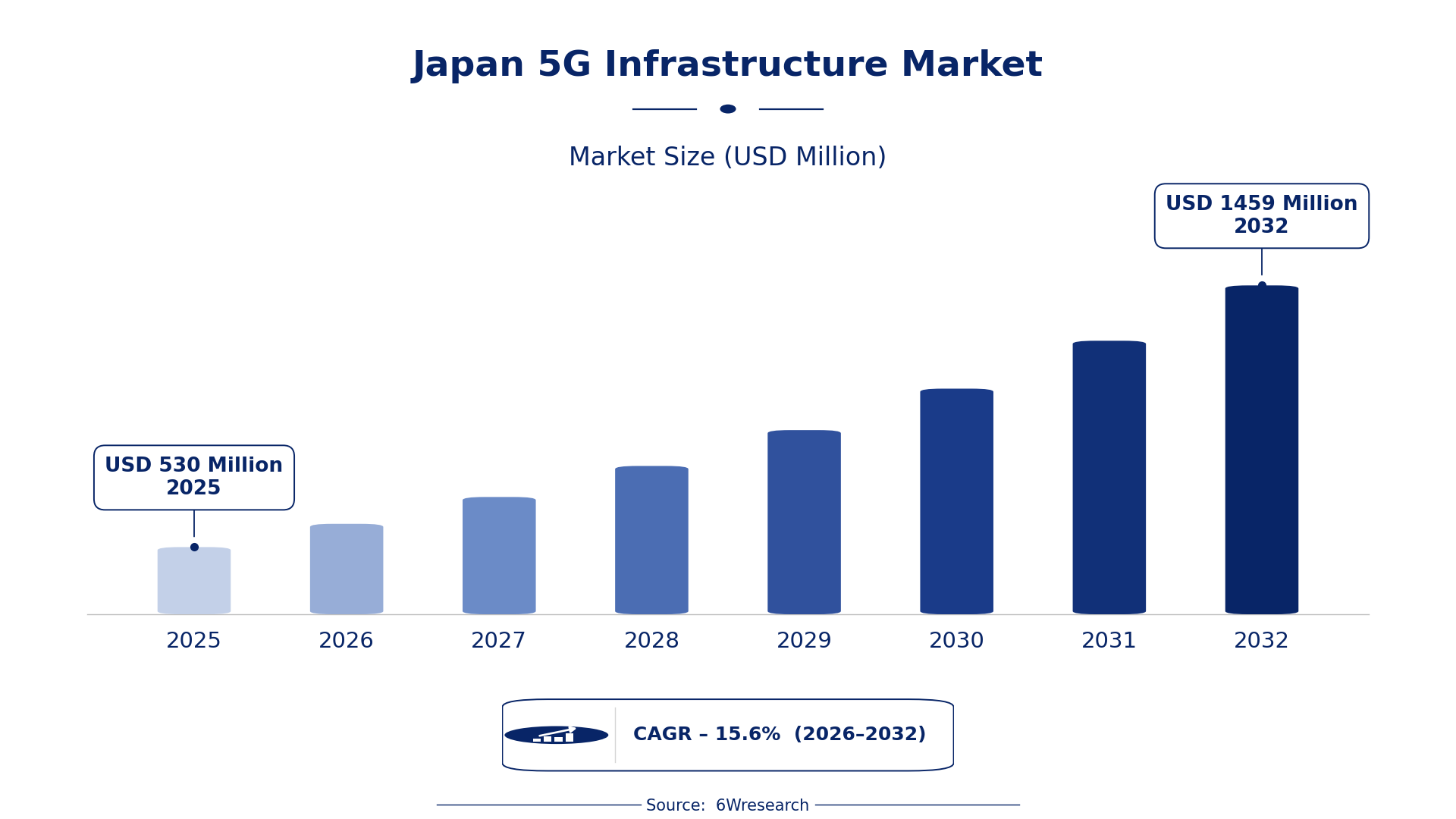
According to 6Wresearch internal database and industry insights, the Japan 5G Infrastructure Market was valued at USD 530 Million in 2025 and is projected to reach USD 1,459 Million by 2032, growing at a CAGR of approximately 15.6% during 2026–2032.
Japan 5G Infrastructure Market Highlights
| Report Metric | Details |
| Report Name | Japan 5G Infrastructure Market (2026-2032) |
| Market Size 2025 | USD 530 Million |
| Market Size 2032 | USD 1,459 Million |
| Absolute Growth 2025–2032 | USD 929 Million |
| CAGR 2026–2032 | 15.6% |
| Peak Annual Growth | 16.9% in 2028 |
| Forecast Period | 2026–2032 |
| Historical Data | 2022–2025 |
| Base Year | 2025 |
| Leading Communication Infrastructure, 2025 | Macro Cell (62% share) |
| Leading Core Network, 2025 | Network Function Virtualization (NFV) (56% share) |
| Leading Network Architecture, 2025 | 5G Standalone (NR + Core) (63% share) |
| Leading Operational Frequency, 2025 | Sub 6 GHz (60% share) |
| Leading End User, 2025 | Commercial (51% share) |
| Fastest-Growing Communication Infrastructure | Small Cell (19.0% CAGR) |
| Fastest-Growing Core Network | Software-Defined Networking (SDN) (17.8% CAGR) |
| Fastest-Growing Operational Frequency | Above 6 GHz (19.3% CAGR) |
| Fastest-Growing End User | Industrial (19.5% CAGR) |
| Growing Sector | Telecommunications |
| Key End Users | telecommunications providers, smart city developers, IoT solution providers, industrial automation firms |
Japan 5G Infrastructure Market Year-wise Growth Rate and Key Drivers (2022–2032)
This graph illustrates the annual growth rates of the market from 2022 to 2032, highlighting a steady upward trajectory and projected market expansion over the forecast period.
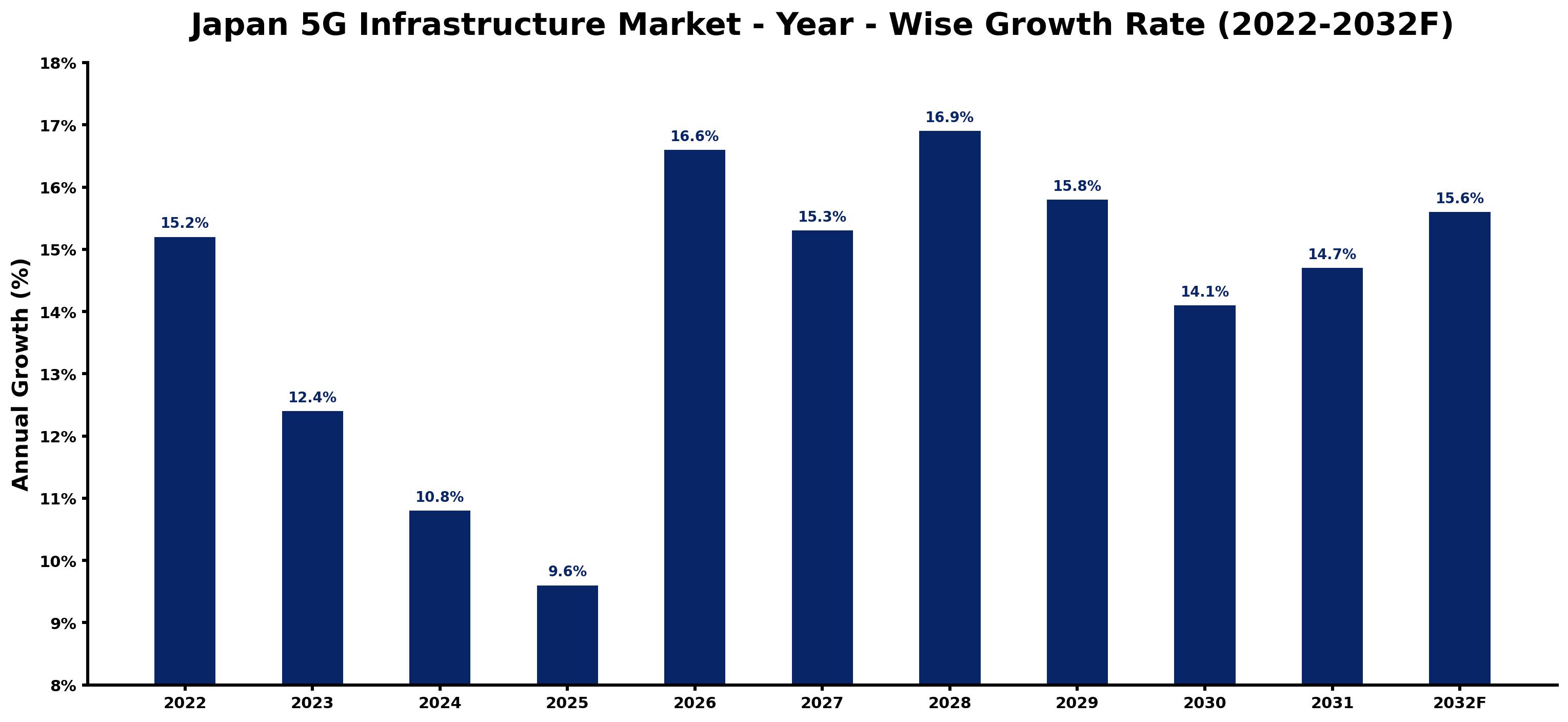
The table below sets out the estimated growth rate for each year and the main factor behind it.
| Year | Estimated Annual Growth (%) | Market Rationale |
| 2022 | 15.2 | The market experienced strong demand due to increased 5G subscriptions and infrastructure investments. |
| 2023 | 12.4 | Growth slowed as the market adjusted to earlier expansions and competition intensified. |
| 2024 | 10.8 | Continued investments in technology maintained market growth, though at a reduced pace. |
| 2025 | 9.6 | The market saw slower growth as saturation began in key urban areas. |
| 2026 | 16.6 | Growth is expected to accelerate again due to renewed investments in advanced 5G applications and infrastructure. |
| 2027 | 15.3 | The market will continue to expand, driven by rising demand for improved connectivity. |
| 2028 | 16.9 | A peak in growth will occur as 5G applications become mainstream across various sectors. |
| 2029 | 15.8 | Growth is projected to slow slightly as the market matures and competition increases. |
| 2030 | 14.1 | Demand will remain strong, but growth rates will normalise as infrastructure reaches saturation. |
| 2031 | 14.7 | The market will grow faster again as new applications and services emerge. |
| 2032 | 15.6 | Continued investments in smart city initiatives and IoT applications will support growth. |
Note: Market size estimations and growth projections presented in this report are based on 6Wresearch's proprietary forecasting methodology, utilizing the latest available industry data, government publications, and primary research inputs.
Japan 5G Infrastructure Market Synopsis
5G infrastructure represents advanced communication technologies that enable high-speed data transmission and low-latency connections, essential for mobile broadband and IoT applications. The Japan 5G Infrastructure Market is expanding rapidly, driven by investments projected to exceed ¥1 trillion by 2025 and a government commitment to achieve 100% 5G coverage by the same year. Key regions like Tokyo and Osaka are central to this growth, attracting diverse buyer groups including telecommunications providers and smart city developers.
Market Dynamics Impact Analysis (2026–2032)
| Factor | Type | Impact | Primary Segment Affected |
| Increased 5G subscriptions drive demand for infrastructure upgrades. | Driver | High | Macro Cell |
| Government initiatives promote 5G deployment across urban areas. | Driver | High | Government |
| Rising urbanisation creates a need for localized coverage solutions. | Opportunity | Medium | Small Cell |
| Investment in smart city projects boosts demand for advanced connectivity. | Opportunity | High | Commercial |
| High initial investment costs may deter smaller players from entering the market. | Restraint | High | Macro Cell |
| Technological complexity can slow down deployment timelines for new infrastructure. | Restraint | Medium | Network Function Virtualization (NFV) |
| Competition among providers can lead to price wars, affecting profitability. | Challenge | High | 5G Standalone (NR + Core) |
| Rapid technological advancements may outpace current infrastructure capabilities. | Challenge | Medium | Above 6 GHz |
Evaluation of Drivers in Japan 5G Infrastructure Market (2026–2032)
Demand rests on the following drivers, each shown with the segment it touches most.
| Drivers | Primary Segment Affected | Why It Matters (Evidence) |
| Rising 5G subscriptions encourage infrastructure investment. | Macro Cell | Japan's 5G subscriptions reached 10 million in 2023, prompting providers to upgrade their networks. |
| Government initiatives accelerate 5G deployment. | 5G Standalone (NR + Core) | The '5G Promotion Strategy' launched in 2020 aims to boost infrastructure across urban areas. |
| Urbanisation increases demand for localized coverage. | Small Cell | Tokyo, Osaka, and Nagoya are key regions where localized coverage is essential for connectivity. |
| Smart city projects drive advanced connectivity needs. | Commercial | The 'Smart City Development Program' supports 5G integration, improving urban infrastructure. |
| Technological advancements in network management boost efficiency. | Network Function Virtualization (NFV) | Investments in NFV enable flexible deployment of network services, improving operational efficiency. |
A wider customer base explains much of the growth, as Japan's 5G subscriptions reached 10 million in 2023, prompting increased infrastructure investments. The demand for localized coverage solutions is rising, particularly through small cell technology. Ongoing investments in infrastructure are supporting the increasing need for advanced connectivity. Technological advancements in network function virtualization are enabling more efficient network management, further boosting demand.
Evaluation of Restraints in Japan 5G Infrastructure Market
The table below lists the restraints and the evidence behind each.
| Market Restraint | Primary Segment Affected | Why It Matters (Evidence) |
| High initial investment costs limit market entry for smaller companies. | Macro Cell | Investment in infrastructure is projected to exceed ¥1 trillion by 2025, posing a barrier for new entrants. |
| Technological complexity can delay infrastructure deployment. | Network Function Virtualization (NFV) | The need for advanced skills and knowledge can slow down the implementation of new technologies. |
| Intense competition may lead to price wars, reducing profitability. | 5G Standalone (NR + Core) | As more providers enter the market, pricing pressures can impact margins. |
| Regulatory hurdles can complicate deployment timelines. | Above 6 GHz | Compliance with telecommunications regulations overseen by the Ministry of Internal Affairs and Communications can slow down processes. |
| Market saturation in urban areas can limit growth opportunities. | Small Cell | As coverage expands, finding new customers in saturated markets becomes more challenging. |
Japan 5G Infrastructure Market Challenges
Producers struggle with a shortage of skilled technicians for 5G infrastructure installation, which delays project timelines and raises costs for companies by 20%. Importers face rising expenses due to fluctuating prices of essential hardware, leading to a 15% increase in costs that ultimately affects pricing for buyers. Buyers encounter limited 5G coverage in rural areas, restricting access to high-speed services for about 30% of the population. Supply chain disruptions hinder the timely delivery of components, causing project delays that can extend timelines by six months for producers.
Trends in the Japan 5G Infrastructure Market
The shifts below are changing how Japan 5G Infrastructure Market products are bought and supplied.
- Shift from Macro to Small Cell Infrastructure: Tokyo is increasingly adopting small cell technology to improve urban connectivity, driven by the need for localized coverage. In 2023, small cell installations accounted for a significant portion of new infrastructure projects.
- Transition to 5G Standalone Networks: The shift towards 5G Standalone networks began in 2026, allowing for full 5G capabilities. This transition is expected to improve service delivery across various sectors, particularly in urban environments.
- Emergence of Above 6 GHz Frequencies: The use of Above 6 GHz frequencies is gaining traction, particularly in dense urban areas. By 2025, this segment is projected to grow substantially, driven by demand for high-speed data transfer.
- Focus on Smart City Development: The Smart City Development Program initiated in 2020 is driving 5G integration in urban planning. By 2025, this initiative aims to improve connectivity in major cities, supporting various applications.
Investment Opportunities in the Japan 5G Infrastructure Market
Investors looking at the Japan 5G Infrastructure Market should consider the following areas.
- Investment in Smart City Projects: Tokyo's Smart City Development Program presents an opportunity for investors, with projected funding exceeding ¥500 billion by 2025. Collaborating with local governments can facilitate entry into this growing market.
- Partnerships for Small Cell Deployment: The need for localized coverage in urban areas creates opportunities for partnerships. With 5G subscriptions reaching 10 million, collaborating with telecommunications providers can improve market access.
- Expansion of Above 6 GHz Infrastructure: The growing demand for high-speed data transfer in urban areas opens investment opportunities in Above 6 GHz infrastructure. Targeting metropolitan areas can yield substantial returns as coverage expands.
- Development of Network Function Virtualization Solutions: With NFV projected to lead the core network segment, investing in NFV solutions can meet rising demand. Collaborating with technology providers can facilitate market entry.
Government Initiatives in the Japan 5G Infrastructure Market
The 5G Promotion Strategy launched in 2020 impacts buyers by accelerating the deployment of 5G infrastructure across Japan. This strategy aims for 100% 5G coverage by 2025, improving connectivity for users in urban areas. The Digital Agency, established in 2021, oversees these initiatives, ensuring compliance with national standards and regulations.
The National Institute of Information and Communications Technology plays an important role in 5G research and development. With funding exceeding ¥300 billion allocated for 2025, this agency supports projects that improve 5G capabilities and infrastructure, benefiting both producers and buyers in the telecommunications sector.
Future Insight of the Japan 5G Infrastructure Market
Investment in 5G infrastructure will exceed ¥1 trillion by 2025, driving demand for connectivity solutions in urban areas. The '5G Promotion Strategy' will facilitate faster service adoption for consumers and businesses. By 2032, achieving 100% 5G coverage will improve connectivity options for buyers and create new opportunities for suppliers. The Smart City Development Program will support the integration of 5G technologies into urban planning, enhancing overall infrastructure efficiency.
Market Segmentation Analysis
Japan 5G Infrastructure Market report covers a detailed analysis of the following market segments:
By Communication Infrastructure – Macro Cell Leads, Small Cell Expected to Grow Fastest
According to Shubham Padhi, Research Analyst at 6Wresearch, Macro Cell took 62% of communication infrastructure revenue in 2025, more than any other category. Macro Cells are crucial for extensive coverage, particularly in densely populated regions like Tokyo and Osaka, where user demand for reliable connectivity is high. Their capacity to support numerous simultaneous connections solidifies their leading role in Japan's 5G infrastructure market. Over 2026–2032, Small Cell is expected to post the fastest growth, at a CAGR of 19.0%. Small Cells are experiencing rapid growth due to the increasing need for localized coverage in urban settings. Their deployment is essential for improving network performance in high-traffic areas, ensuring optimal user experiences. Suppliers should focus on developing solutions that cater to both Macro and Small Cell needs to seize market opportunities.
By Core Network – Network Function Virtualization (NFV) Leads, Software-Defined Networking (SDN) Expected to Grow Fastest
Network Function Virtualization (NFV) held 56% of the Japan 5G Infrastructure Market by core network in 2025. Network Function Virtualization (NFV) leads the Core Network segment as it allows flexible deployment of network services, which is vital for addressing the growing demands of 5G. This adaptability enables operators to optimise resources effectively in a competitive landscape. Software-Defined Networking (SDN) is projected to grow fastest, at a CAGR of 17.8% during 2026–2032. Software-Defined Networking (SDN) is rapidly advancing, propelled by the necessity for enhanced network management and resource allocation in complex 5G environments. The increasing complexity of network operations drives the demand for SDN solutions that streamline processes. Buyers should invest in NFV and SDN technologies to ensure their networks remain competitive and efficient.
By Network Architecture – 5G Standalone (NR + Core) Leads and Records the Fastest Growth
5G Standalone (NR + Core) accounted for 63% of the market by network architecture in 2025. 5G Standalone (NR + Core) is the dominant architecture, providing full 5G capabilities that are essential for advanced applications. This architecture is critical for operators seeking to fully leverage the benefits of 5G technology. Its lead should widen, with a projected CAGR of 17.0% during 2026–2032, the highest in this split. 5G Standalone (NR + Core) is also the fastest-growing segment, as it supports a wide range of applications that meet future demands. Its comprehensive capabilities are expected to further strengthen its market position as new use cases arise. Suppliers must focus on enhancing their offerings related to 5G Standalone solutions to align with emerging market trends.
By Operational Frequency – Sub 6 GHz Leads, Above 6 GHz Expected to Grow Fastest
The largest operational frequency category in 2025 was Sub 6 GHz, at 60% of revenue. Sub 6 GHz frequencies dominate the market as they provide extensive coverage and penetration, making them suitable for a variety of environments across Japan. This frequency range is essential for ensuring reliable connectivity for a large user base. Above 6 GHz is set to record the highest CAGR in this split, 19.3% over 2026–2032. Above 6 GHz frequencies are gaining traction as they enable high-speed data transfer in densely populated areas, addressing the increasing demand for bandwidth. The growth of applications requiring high data rates is propelling this segment forward. Suppliers should consider developing products that support both Sub 6 GHz and Above 6 GHz frequencies to meet diverse customer needs.
By End User – Commercial Leads, Industrial Expected to Grow Fastest
In 2025, Commercial led the end user split with a 51% share. The Commercial sector is the leader in the End User segment, as businesses increasingly depend on advanced connectivity to optimise operations and enhance customer engagement. The concentration of commercial enterprises in urban areas drives the demand for robust 5G infrastructure. Over 2026–2032, Industrial is expected to post the fastest growth, at a CAGR of 19.5%. The Industrial sector is experiencing the fastest growth, with industries adopting automation and IoT technologies that require reliable, high-speed connectivity. The push for smart manufacturing solutions significantly fuels this rapid expansion. Buyers in the Industrial sector should pursue tailored solutions that address their specific connectivity needs to maintain a competitive edge.
Key Attractiveness of the Report
- 10 Years of Market Numbers
- Historical Data Starting from 2022 to 2025
- Base Year 2025
- Forecast Data until 2032
- Key Performance Indicators Impacting the Market
- Major Upcoming Developments and Projects
Key Highlights of the Report:
- Japan 5G Infrastructure Market Outlook
- Market Size of Japan 5G Infrastructure Market, 2025
- Forecast of Japan 5G Infrastructure Market, 2032
- Historical Data and Forecast of Japan 5G Infrastructure Revenues & Volume for the Period 2022-2032
- Japan 5G Infrastructure Market Trend Evolution
- Japan 5G Infrastructure Market Drivers and Challenges
- Japan 5G Infrastructure Price Trends
- Japan 5G Infrastructure Porter's Five Forces
- Japan 5G Infrastructure Industry Life Cycle
- Historical Data and Forecast of Japan 5G Infrastructure Market Revenues & Volume By Communication Infrastructure for the Period 2022-2032
- Historical Data and Forecast of Japan 5G Infrastructure Market Revenues & Volume By Small Cell for the Period 2022-2032
- Historical Data and Forecast of Japan 5G Infrastructure Market Revenues & Volume By Macro Cell for the Period 2022-2032
- Historical Data and Forecast of Japan 5G Infrastructure Market Revenues & Volume By Core Network for the Period 2022-2032
- Historical Data and Forecast of Japan 5G Infrastructure Market Revenues & Volume By Software-Defined Networking (SDN) for the Period 2022-2032
- Historical Data and Forecast of Japan 5G Infrastructure Market Revenues & Volume By Network Function Virtualization (NFV) for the Period 2022-2032
- Historical Data and Forecast of Japan 5G Infrastructure Market Revenues & Volume By Network Architecture for the Period 2022-2032
- Historical Data and Forecast of Japan 5G Infrastructure Market Revenues & Volume By 5G NR Non-Standalone (LTE Combined) for the Period 2022-2032
- Historical Data and Forecast of Japan 5G Infrastructure Market Revenues & Volume By 5G Standalone (NR + Core) for the Period 2022-2032
- Historical Data and Forecast of Japan 5G Infrastructure Market Revenues & Volume By Operational Frequency for the Period 2022-2032
- Historical Data and Forecast of Japan 5G Infrastructure Market Revenues & Volume By Sub 6 GHz for the Period 2022-2032
- Historical Data and Forecast of Japan 5G Infrastructure Market Revenues & Volume By Above 6 GHz for the Period 2022-2032
- Historical Data and Forecast of Japan 5G Infrastructure Market Revenues & Volume By End User for the Period 2022-2032
- Historical Data and Forecast of Japan 5G Infrastructure Market Revenues & Volume By Residential for the Period 2022-2032
- Historical Data and Forecast of Japan 5G Infrastructure Market Revenues & Volume By Commercial for the Period 2022-2032
- Historical Data and Forecast of Japan 5G Infrastructure Market Revenues & Volume By Industrial for the Period 2022-2032
- Historical Data and Forecast of Japan 5G Infrastructure Market Revenues & Volume By Government for the Period 2022-2032
- Japan 5G Infrastructure Import Export Trade Statistics
- Market Opportunity Assessment By Communication Infrastructure
- Market Opportunity Assessment By Core Network
- Market Opportunity Assessment By Network Architecture
- Market Opportunity Assessment By Operational Frequency
- Market Opportunity Assessment By End User
- Japan 5G Infrastructure Top Companies Market Share
- Japan 5G Infrastructure Competitive Benchmarking By Technical and Operational Parameters
- Japan 5G Infrastructure Company Profiles
- Japan 5G Infrastructure Key Strategic Recommendations
Market Covered
Coverage by segment is as follows.
By Communication Infrastructure
- Small Cell
- Macro Cell
By Core Network
- Software-Defined Networking (SDN)
- Network Function Virtualization (NFV)
By Network Architecture
- 5G NR Non-Standalone (LTE Combined)
- 5G Standalone (NR + Core)
By Operational Frequency
- Sub 6 GHz
- Above 6 GHz
By End User
- Residential
- Commercial
- Industrial
- Government






































