Global 5G Infrastructure Market Size & Growth Rate
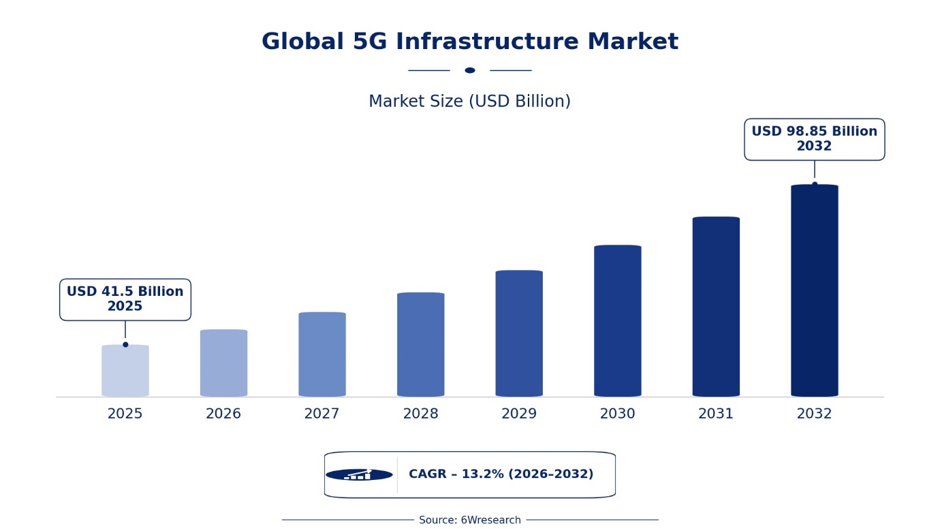
According to 6Wresearch internal database and industry insights, the Global 5G Infrastructure Market was valued at USD 41.5 billion in 2025 and is projected to reach USD 98.85 billion by 2032, growing at a CAGR of approximately 13.2% during 2026–2032.
Global 5G Infrastructure Market Highlights
| Report Metric | Details |
| Report Name | Global 5G Infrastructure Market (2026-2032) |
| Market Size 2025 | USD 41.5 billion |
| Market Size 2032 | USD 98.85 billion |
| Absolute Growth 2025–2032 | USD 57.35 billion |
| CAGR 2026–2032 | 13.2% |
| Peak Annual Growth | 15.8% in 2030 |
| Forecast Period | 2026–2032 |
| Historical Data | 2022–2025 |
| Base Year | 2025 |
| Leading Communication Infrastructure, 2025 | Radio Access Network (RAN), 36% share |
| Fastest-Growing Communication Infrastructure | Small Cell, 16.4% CAGR |
| Leading Network Technology, 2025 | Mobile Edge Computing (MEC), 30% share |
| Leading Applications, 2025 | Consumer Electronics, 22% share |
| Fastest-Growing Applications | Automotive, 15.7% CAGR |
| Leading Regions, 2025 | Asia Pacific, 41% share |
| Fastest-Growing Regions | ROW including Latin America and Africa, 15.1% CAGR |
| Growing Sector | Mobile Edge Computing and private enterprise networks |
| Key End Users or Key Procuring Entities | Mobile network operators, neutral-host and tower companies, manufacturing and logistics enterprises, automotive and mobility operators, hospitals and healthcare networks, utilities, public safety agencies, and smart building developers |
Global 5G Infrastructure Market Year-wise Growth Rate and Key Drivers (2022–2032)
This graph illustrates the annual growth rates of the market from 2022 to 2032, highlighting gradual market development in the historical period and stronger expansion during the forecast period.
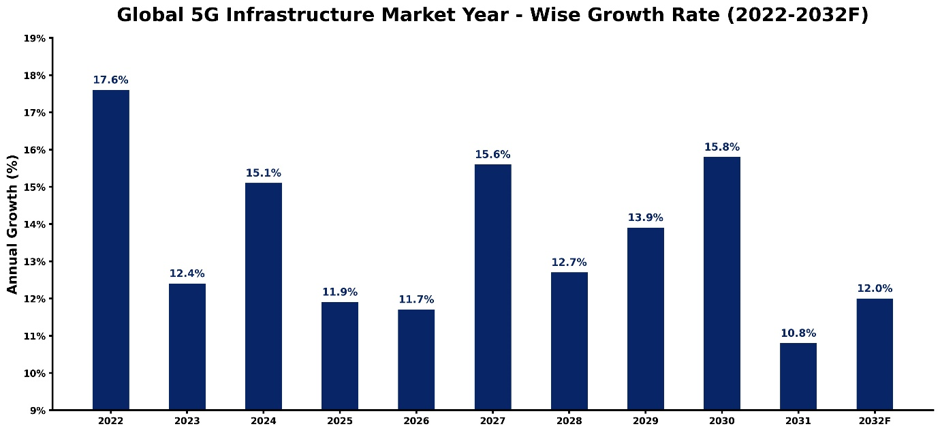
The following table presents the estimated annual growth rate for each year together with the principal factor influencing market performance.
| Year | Estimated Annual Growth (%) | Market Rationale |
| 2022 | 17.6% | Large-scale site additions in China and early commercial launches in India, Brazil and South Africa lifted equipment shipments sharply. |
| 2023 | 12.4% | Higher interest rates and inventory corrections at operators in Europe and North America moderated equipment orders after the build-out peak. |
| 2024 | 15.1% | India’s nationwide rollout and China’s commercial launch of 5G-Advanced services revived large radio and core procurement. |
| 2025 | 11.9% | Completion of first-phase coverage in India and China shifted spending towards optimisation and moderated annual growth. |
| 2026 | 11.7% | Cautious capital budgets at operators in mature markets are expected to hold growth just below the 2025 level. |
| 2027 | 15.6% | Wider migration to standalone cores and upgrades to advanced radio features are expected to raise orders sharply. |
| 2028 | 12.7% | Completion of the first wave of core upgrades is expected to normalise orders among leading operators. |
| 2029 | 13.9% | Densification of urban networks and release of additional mid-band spectrum are scheduled to renew radio and site investment. |
| 2030 | 15.8% | Pre-commercial sixth-generation trials and replacement of early radio equipment are expected to lift demand to its forecast peak. |
| 2031 | 10.8% | A high 2030 comparison base and lower post-trial spending are expected to moderate growth to the forecast low. |
| 2032 | 12% | Wider neutral-host sharing agreements and indoor coverage investment are expected to lift growth modestly from the forecast low. |
Note: Market size estimations and growth projections presented in this report are based on 6Wresearch’s proprietary forecasting methodology, utilizing the latest available industry data, government publications, and primary research inputs.
Global 5G Infrastructure Market Synopsis
The Global 5G Infrastructure Market growth is supported by over 4 million 5G base stations in China, India’s standalone rollout since October 2022, the European Union’s 2030 coverage target and USD 1.5 billion of United States Open RAN funding. 5G infrastructure consists of four primary building blocks: a Radio Access Network (RAN), a core computing network, an edge computing network, and a management and security framework. However, spectrum licence costs and dependence on a few equipment vendors constrain operator investment in new sites.
Market Dynamics Impact Analysis (2026–2032)
| Factor | Type | Impact | Primary Segment Affected |
| Migration of operators to standalone 5G cores | Driver | High | Network Functions Virtualization (NFV) |
| Continued coverage build-out in populous markets | Driver | High | Macro Cell |
| Multi-vendor sourcing through Open RAN | Opportunity | High | Radio Access Network (RAN) |
| Dedicated enterprise networks on local spectrum | Opportunity | High | Mobile Edge Computing (MEC) |
| High spectrum licence payments | Restraint | High | Macro Cell |
| Supplier exclusion rules and replacement programmes | Restraint | Medium | Radio Access Network (RAN) |
| Integration complexity across multiple vendors | Challenge | Medium | Software Defined Networking (SDN) |
| Short propagation range of millimetre-wave signals | Challenge | Medium | Small Cell |
Evaluation of Drivers in Global 5G Infrastructure Market (2026–2032)
Below mentioned are some major drivers and their influence on market dynamics.
| Drivers | Primary Segment Affected | Why It Matters (Evidence) |
| Standalone core migration | Network Functions Virtualization (NFV) | Standalone cores replace 4G anchors and need virtualised functions for slicing and low latency, so each migration creates software and infrastructure orders. China’s three major operators began commercial standalone networks in 2020. |
| Nationwide coverage build-out | Macro Cell | Competition and licence obligations push operators to add macro sites, each needing radios, antennas and baseband units. India’s networks covered over 99% of districts by early 2025 after the October 2022 launch. |
| Open RAN procurement | Radio Access Network (RAN) | Open interfaces let operators mix suppliers, which lowers lock-in and brings new radio and software vendors into tenders. AT&T’s December 2023 agreement with Ericsson moves a large share of its traffic onto open-capable platforms. |
| Local private network licences | Mobile Edge Computing (MEC) | Dedicated spectrum lets enterprises build their own networks with on-site processing, creating demand for compact radios and edge servers. Japan began issuing local 5G licences in December 2019. |
| Urban densification | Small Cell | Higher-frequency 5G signals cover shorter distances, so dense districts need many low-power nodes. US carriers hold millimetre-wave licences in the 24 GHz and 28 GHz bands for stadiums and city centres. |
Demand is being supported by the expanding 5G device ecosystem, with global connections passing 2 billion in 2025 as lower-priced smartphones raise network load and operator revenue potential. Growth in fibre backhaul and data centre capacity allows operators to connect new sites quickly, and hyperscaler participation in telecom networks adds software and infrastructure spending. Adoption of AI in network planning and operations is reducing the cost of each deployed site and shortening rollout cycles. Rising private capital in network automation firms is also widening the supplier base and accelerating product innovation.
Evaluation of Restraints in Global 5G Infrastructure Market
Below mentioned are some major restraints and their influence on market dynamics.
| Market Restraint | Primary Segment Affected | Why It Matters (Evidence) |
| High spectrum licence costs | Macro Cell | Large upfront licence payments reduce funds available for equipment, so operators phase rollouts and delay site additions. India’s July 2022 auction raised over INR 1.5 trillion. |
| Supplier exclusion rules | Radio Access Network (RAN) | Restrictions on named vendors force replacement and re-tendering, which raises project cost and delays coverage. The US Secure and Trusted Communications Networks Act of 2019 funds removal of covered equipment. |
| High power consumption of 5G sites | Macro Cell | Higher electricity use per site raises operating cost and limits the number of sites operators can add profitably. A 5G macro site is commonly estimated to draw two to three times the power of a 4G site. |
| Slow approvals for small sites | Small Cell | Municipal permits and pole access delay installation of street-level nodes, which stretches payback periods. The US Federal Communications Commission’s 2018 Small Cell Order set review deadlines of 60 and 90 days. |
| Parallel operation of legacy networks | Software Defined Networking (SDN) | Running 3G, 4G and 5G together duplicates operating cost and slows funding for network programmability. NTT Docomo’s plan to retire its 3G service in March 2026 shows the length of these transitions. |
Global 5G Infrastructure Market Challenges
There are a number of challenges that could affect its growth. Multi-vendor integration across at least three layers of radio, hardware and software lengthens commissioning cycles and raises operational risk for operators adopting open architectures. At the radio layer, millimetre-wave signals travel less than 500 metres in dense urban areas, so coverage economics remain unfavourable for buyers outside major city centres. Regulation is a separate hurdle, as differing national security rules across the 27 European Union member states complicate multi-country procurement and slow vendor qualification. Supply chains also remain exposed, as component shortages during 2021–2022 extended delivery times and inflated project budgets.
Trends in the Global 5G Infrastructure Market
Below mentioned are some of the trends shaping the Global 5G Infrastructure Market growth.
- Shift from Non-Standalone to Standalone 5G Cores: Early 5G networks relied on 4G cores, which limited slicing and latency gains. Operators in India and the United States now run standalone cores, with Reliance Jio operating a nationwide standalone network since its October 2022 launch. Suppliers benefit as spending moves from anchor radio upgrades towards cloud-native core software, orchestration and automation tools that monetise advanced services.
- Transition from Proprietary to Open and Virtualised RAN: Operators are replacing single-vendor radio stacks with open interfaces and virtualised baseband software. Rakuten Mobile in Japan runs a fully virtualised open network, and Vodafone has launched multi-vendor Open RAN programmes across Europe. Suppliers must now compete on software, integration and interoperability rather than on proprietary hardware.
- Private Networks Emerging as Mainstream Enterprise Connectivity: Factories, ports and campuses are choosing dedicated 5G networks over shared Wi-Fi and public coverage to secure latency and control. Germany’s local industrial spectrum licences, first issued in 2019, created a template that other regions are adopting. Suppliers gain recurring demand for packaged radio, core and on-site compute.
Investment Opportunities in the Global 5G Infrastructure Market
Some of the investment opportunities in the Global 5G Infrastructure Market are mentioned below.
- Open RAN Radio Units and Software: Operators in North America and Europe are diversifying supply for network resilience, which opens room for new vendors. Investors can fund radio units, virtualised distributed unit software and RAN intelligent controllers. Entry is through interoperability certification at open test labs and supply agreements with system integrators already serving large operators.
- Packaged Private 5G and On-Site Edge Compute: Enterprises in Germany, Japan and the United States are using local spectrum licences to build dedicated networks, creating demand for turnkey packages. Investors can back compact radios, lightweight cores and edge servers sold as managed services to manufacturers and logistics campuses. Partnering with industrial automation integrators and regional cloud providers is the fastest route to customer access.
- Neutral-Host Small Cell Networks: Stadiums, airports, transport hubs and dense city districts need indoor and street-level capacity that macro sites cannot supply. Capital can be placed in shared small cell, distributed antenna and fibre fronthaul infrastructure leased to several operators. Entry works best through joint ventures with tower companies such as American Tower or Indus Towers and municipal access agreements.
- Energy-Efficient Site Equipment: Electricity is a large share of mobile network operating cost, and operators are tightening efficiency targets. Suppliers can invest in gallium nitride power amplifiers, radio sleep-mode software, liquid-cooled baseband units and solar-hybrid power systems. Local assembly partnerships and operator pilot programmes in India, Africa and the Middle East reduce adoption risk.
Leading Players in Global 5G Infrastructure Market
Stated below are some of the leading companies contributing significantly to the Global 5G Infrastructure Market share.
1. Ericsson
|
Company Name |
Ericsson |
|
Headquarters |
Stockholm, Sweden |
|
Established Year |
1876 |
|
Official Website |
Ericsson supplies radio access, core network and transport solutions to mobile operators worldwide. It is a long-standing equipment provider across the major 5G markets of North America, Europe and Asia.
2. Nokia
|
Company Name |
Nokia |
|
Headquarters |
Espoo, Finland |
|
Established Year |
1865 |
|
Official Website |
Nokia provides mobile networks, fixed access, optical and core software to operators and enterprises. It plays a significant role in the global market, particularly in Europe, North America and India.
3. Huawei Technologies
|
Company Name |
Huawei Technologies |
|
Headquarters |
Shenzhen, China |
|
Established Year |
1987 |
|
Official Website |
Huawei Technologies develops wireless access, core network and transport equipment for telecom operators. It holds a leading position in the Chinese market and supplies networks across Asia, the Middle East, Africa and Latin America.
4. Samsung Electronics
|
Company Name |
Samsung Electronics |
|
Headquarters |
Suwon, South Korea |
|
Established Year |
1969 |
|
Official Website |
Samsung Electronics, through its networks business, supplies virtualised and open radio access solutions along with core software. It is an active supplier to operators in South Korea, the United States, Japan and India.
5. ZTE Corporation
|
Company Name |
ZTE Corporation |
|
Headquarters |
Shenzhen, China |
|
Established Year |
1985 |
|
Official Website |
ZTE Corporation offers wireless, core network, transport and private network solutions to operators and enterprises. It maintains a significant presence in China and in emerging markets across Asia, Africa and Latin America.
Government Initiatives in the Global 5G Infrastructure Market
The European Union’s Digital Decade Policy Programme targets 5G coverage in all populated areas by 2030, while India’s July 2022 spectrum auction raised over INR 1.5 trillion for the telecom sector. China’s 14th Five-Year Plan for information and communications sets a goal of 26 5G base stations per 10,000 people by 2025.
In the United States, the Public Wireless Supply Chain Innovation Fund allocated USD 1.5 billion under the CHIPS and Science Act 2022 to accelerate Open RAN development, and the Federal Communications Commission’s 2018 Small Cell Order set approval deadlines of 60 and 90 days. India’s Department of Telecommunications supports local manufacturing through a production-linked incentive scheme approved in 2021 with an outlay of INR 12,195 crore.
Future Insight of the Global 5G Infrastructure Market
Several developments will support long-term market expansion. Wider availability of major advanced fifth-generation features will encourage operators to upgrade existing radio and core platforms. Additional upper mid-band spectrum released for mobile services will create new capacity layers in urban networks. Artificial intelligence embedded in network operations will raise efficiency and encourage investment in automation tools. Sixth-generation standards work targets commercial launches around 2030, and the 2027 World Radiocommunication Conference is due to decide new spectrum allocations. Satellite integration will extend network reach and create new infrastructure demand.
Market Segmentation Analysis
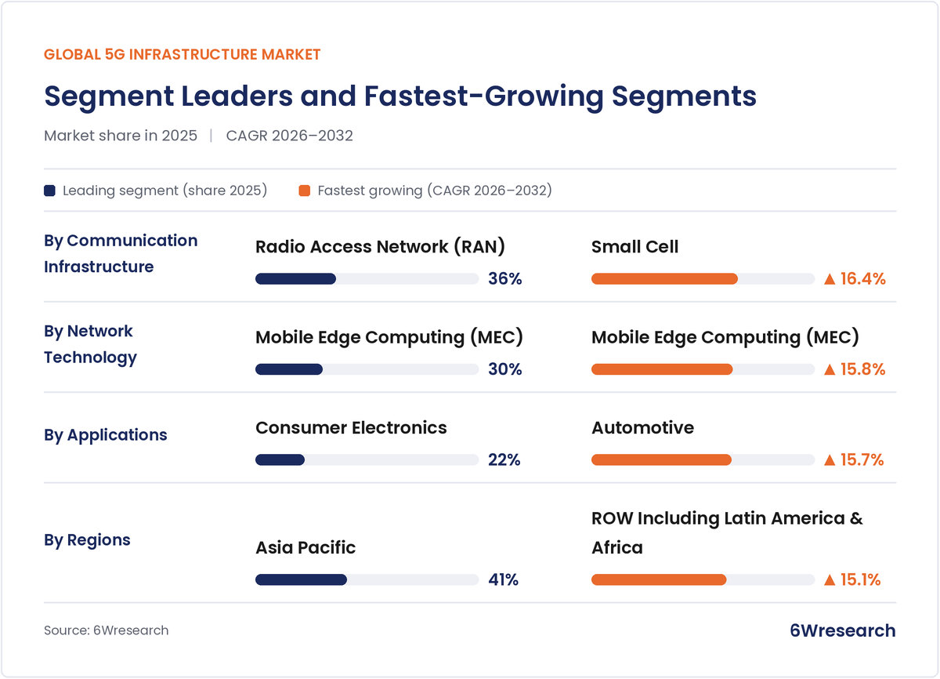
The report offers a comprehensive study of the market across its key segments. The chart below highlights the leading segment by market share in 2025 and the fastest-growing segment by CAGR over 2026–2032, followed by a detailed analysis of each segment.
By Communication Infrastructure – Radio Access Network (RAN) Leads, Small Cell Expected to Grow Fastest
According to Ravi Bhandari, Research Head at 6Wresearch, Radio Access Network (RAN) accounted for 36% of the market in 2025, as operators in China, India and the United States continued to upgrade radio sites and baseband software to serve growing subscriber bases. Small Cell is expected to grow fastest at a CAGR of 16.4% during 2026–2032, driven by densification of mid-band and millimetre-wave networks in city centres, stadiums and transport hubs.
By Network Technology – Mobile Edge Computing (MEC) Leads and Records the Fastest Growth
Mobile Edge Computing (MEC) held the largest share at 30% in 2025, as operators in Japan, South Korea and the United States placed compute nodes close to users to support low-latency video and gaming services. The same sub-segment is forecast to record the fastest CAGR of 15.8% during 2026–2032, as private network deployments at industrial sites in Germany, Japan and China require on-premise processing.
By Applications – Consumer Electronics Leads, Automotive Expected to Grow Fastest
Consumer Electronics led with a 22% share in 2025, because smartphone and fixed wireless device sales in China and India enlarged the connected user base and the network investment that follows it. Automotive is expected to grow fastest at a CAGR of 15.7% during 2026–2032, as connected vehicle programmes in Europe and China call for roadside 5G infrastructure along major corridors.
By Regions – Asia Pacific Leads, ROW Including Latin America and Africa Expected to Grow Fastest
Asia Pacific commanded a 41% share in 2025, underpinned by China’s installed base of more than 4 million 5G base stations and the standalone rollout of Indian operators. ROW including Latin America and Africa is projected to expand at a CAGR of 15.1% during 2026–2032, as Brazil, Nigeria and South Africa extend coverage following their spectrum awards.
Key Attractiveness of the Report
- 10 Years of Market Numbers
- Historical Data Starting from 2022 to 2025
- Base Year 2025
- Forecast Data until 2032
- Key Performance Indicators Impacting the Market
- Major Upcoming Developments and Projects
Key Highlights of the Report:
- Global 5G Infrastructure Market Overview
- Global 5G Infrastructure Market Outlook
- Global 5G Infrastructure Market Forecast
- Global 5G Infrastructure Market Size & Global 5G Infrastructure Market Forecast of Revenues for the period 2022-2032F
- Market Size & Forecast of Global 5G Infrastructure Market Revenues, By Regions, for the period 2022-2032F
- Market Size & Forecast of Asia Pacific 5G Infrastructure Market Revenues for the period 2022-2032F
- Market Size & Forecast of Asia Pacific 5G Infrastructure Market Revenues, By Communication Infrastructure, for the period 2022-2032F
- Market Size & Forecast of Asia Pacific 5G Infrastructure Market Revenues, By Network Technology, for the period 2022-2032F
- Market Size & Forecast of Asia Pacific 5G Infrastructure Market Revenues, By Applications, for the period 2022-2032F
- Market Size & Forecast of North America 5G Infrastructure Market Revenues for the period 2022-2032F
- Market Size & Forecast of North America 5G Infrastructure Market Revenues, By Communication Infrastructure, for the period 2022-2032F
- Market Size & Forecast of North America 5G Infrastructure Market Revenues, By Network Technology, for the period 2022-2032F
- Market Size & Forecast of North America 5G Infrastructure Market Revenues, By Applications, for the period 2022-2032F
- Market Size & Forecast of Europe 5G Infrastructure Market Revenues for the period 2022-2032F
- Market Size & Forecast of Europe 5G Infrastructure Market Revenues, By Communication Infrastructure, for the period 2022-2032F
- Market Size & Forecast of Europe 5G Infrastructure Market Revenues, By Network Technology, for the period 2022-2032F
- Market Size & Forecast of Europe 5G Infrastructure Market Revenues, By Applications, for the period 2022-2032F
- Market Size & Forecast of Middle East 5G Infrastructure Market Revenues for the period 2022-2032F
- Market Size & Forecast of Middle East 5G Infrastructure Market Revenues, By Communication Infrastructure, for the period 2022-2032F
- Market Size & Forecast of Middle East 5G Infrastructure Market Revenues, By Network Technology, for the period 2022-2032F
- Market Size & Forecast of Rest of the World 5G Infrastructure Market Revenues for the period 2022-2032F
- Market Drivers & Restraints
- Global 5G Infrastructure Markets and Industry Life Cycle
- Porter’s Five Force Analysis and Market Opportunity Assessment
- Global 5G Infrastructure Market Revenue Share, By players
- Global 5G Infrastructure Market Trends
- Global 5G Infrastructure Market Overview on Competitive Benchmarking
- Company Profiles
- Key Strategic Recommendations
Markets Covered:
The Global 5G Infrastructure market report provides a detailed analysis of the following market segments:
By Communication Infrastructure
- Small Cell
- Macro Cell
- Radio Access Network (RAN)
By Network Technology
- Software-Defined Networking (SDN)
- Network Functions Virtualization (NVF)
- Mobile Edge Computing (MEC)
- Fog Computing (FC)
By Applications
- Automotive
- Consumer Electronics
- Intelligent Building & Infrastructure
- Healthcare
- Energy & Utilities
- Industrial Automation
- Others (Public Safety & Surveillance, Retail, Home Automation, etc.)
By Regions
- North America
- Asia Pacific (APAC)
- Europe
- Middle East
- ROW (Latin America, Africa)
Other Key Reports Available:
- Asia Pacific 5G Infrastructure Market Report
- Middle East 5G Infrastructure Market Report
- Europe 5G Infrastructure Market Report
- North America 5G Infrastructure Market Report






































