Japan Acetate Yarn Market Growth Rate
According to 6Wresearch internal database and industry insights, the Japan Acetate Yarn Market is growing at a compound annual growth rate (CAGR) of 5.2% during the forecast period (2026-2032).
Japan Acetate Yarn Market Year-wise Growth Rate and Key Drivers (2022-2032)
This graph illustrates the annual growth rates of the Japan Acetate Yarn Market from 2022 to 2032, highlighting a gradual upward trajectory and projected market expansion over the forecast period.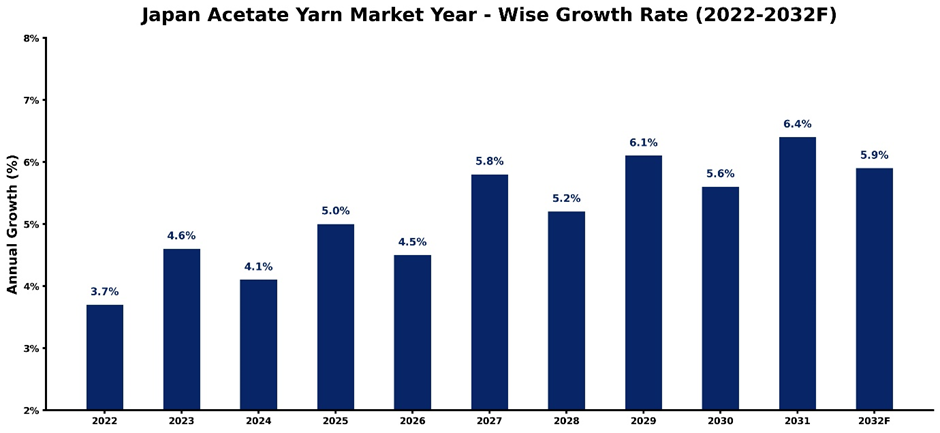
The table below represents the historical and projected growth rates for the Japan Acetate Yarn Market and the rationale behind each year's performance.
| Year | Estimated Annual Growth (%) | Market Rationale |
| 2022 | 3.7% | Premium apparel demand supported acetate yarn consumption in fashion textiles. |
| 2023 | 4.6% | Rising preference for lightweight and breathable fabrics strengthened market demand. |
| 2024 | 4.1% | Sustainable textile initiatives encouraged greater adoption of cellulose-based fibers. |
| 2025 | 5% | Luxury fashion production and export activities supported acetate yarn utilization. |
| 2026 | 4.5% | Demand for eco-conscious apparel increased adoption of specialty yarns. |
| 2027 | 5.8% | Innovation in textile processing enhanced acetate fiber applications. |
| 2028 | 5.2% | Premium garment manufacturing expanded demand for high-quality acetate yarn. |
| 2029 | 6.1% | Growth in functional and fashion textiles supported market expansion. |
| 2030 | 5.6% | Sustainable fiber investments accelerated production of advanced acetate yarns. |
| 2031 | 6.4% | Circular textile initiatives strengthened demand for regenerated cellulose fibers. |
| 2032 | 5.9% | Continuous innovation in premium fabrics supported long-term market growth. |
Topics Covered in the Japan Acetate Yarn Market Report
Japan Acetate Yarn Market report thoroughly covers the market by type and application. The market report provides an unbiased and detailed analysis of ongoing market trends, opportunities/high-growth areas, and market drivers, which would help stakeholders devise and align their market strategies according to the current and future market dynamics.
Japan Acetate Yarn Market Highlights
| Report Name | Japan Acetate Yarn Market |
| Forecast period | 2026-2032 |
| CAGR | 5.2% |
| Growing Sector | Textile & Apparel Manufacturing |
Japan Acetate Yarn Market Synopsis
Acetate Yarn is a semi-synthetic cellulose-based fiber known for its silk-like appearance and use in premium apparel, linings, and fashion textiles. The Japan Acetate Yarn Market is estimated to witness a steady growth owing to an increasing demand for premium textiles with rising consumer preference for sustainable cellulose-based fibers, and constant innovation in textile manufacturing technologies. In addition, the growing investments in environmentally friendly textile production, along with Japan's advanced fiber manufacturing capabilities and emphasis on high-quality apparel, are expected to support market expansion throughout the forecast period.
Evaluation of Growth Drivers in the Japan Acetate Yarn Market (2026-2032)
Below mentioned are some major growth drivers and their influence on market dynamics:
| Drivers | Primary Segments Affected | Why It Matters |
| Rising Demand for Premium Apparel | Ladies Clothing, Pajamas | Expands demand for high-quality acetate fabrics, improving garment appearance, comfort, softness, durability, and enhanced textile performance. |
| Growing Preference for Sustainable Fibers | Triacetate Fiber, Diacetate Fiber | Promotes the adoption of renewable cellulose-based yarns while reducing environmental impact and supporting sustainable methods in a textile manufacturing. |
| Expansion of Fashion and Luxury Textile Manufacturing | Ladies Clothing, Clothes Lining | Supports a premium fabric production by raising the demand for elegant, lightweight, and high-performance textile materials. |
| Innovation in Textile Processing Technologies | Textile Manufacturers | This improves the quality of yarn and the production effectivity by innovative manufacturing techniques with better finishing and optimized textile processing methods. |
| Increasing Demand for Comfortable Lightweight Fabrics | Apparel Industry | Raises the usage in premium garments by providing enhanced breathability, smooth texture, flexibility, and refined wearer comfort. |
The Japan Acetate Yarn Market is estimated to grow at a CAGR of 5.2% during 2026-2032. The Japan textile industry remains to highlight the high-value functional materials and environmentally responsible production. The government- verified initiatives under the Green Growth Strategy support the industrial decarbonization and sustainable manufacturing, while manufacturers mostly integrate regenerated cellulose fibers into premium textiles. Moreover, the country's globally recognized fashion and technical textile industries continue to support demand for specialty yarns across premium clothing and industrial applications.
Evaluation of Restraints in the Japan Acetate Yarn Market
Below mentioned are some major restraints and their influence on market dynamics:
| Restraints | Primary Segments Affected | What This Means |
| Volatility in Cellulose Raw Material Supply | Triacetate Fiber | Causes supply disruptions, price fluctuations, and uncertainty in maintaining consistent fiber production levels. |
| Competition from Synthetic Fibers | Apparel Manufacturing | Makes it harder for triacetate fibers to compete owing to the lower-cost synthetic alternatives. |
| High Production Costs | Textile Manufacturers | Raises high manufacturing expenses while lowering the profit margins and restricting the market competitiveness among producers. |
| Environmental Compliance Requirements | Fiber Producers | Requires additional investments in sustainable processes, technologies, and regulatory compliance measures. |
| Fluctuating Fashion Preferences | Ladies Clothing | Creates unpredictable demand patterns and challenges manufacturers in planning production and inventory. |
Japan Acetate Yarn Market Challenges
Japan’s acetate yarn market faces challenges that is due to rise in competition from polyester and other synthetic fibers, accompanied by changing consumer preferences toward the sustainable materials. Japan’s manufacturing sector continues to experience labor lacks, with the labor force participation gap and workforce restraints impacting the textile operations, while the country’s unemployment rate remained around 2.5% in 2025, representing limited labor availability. Additionally, Japan’s minimum wage increased by approximately 5% in 2025, raising production expenses for textile manufacturers. Furthermore, the compliance with sustainability standards and chemical processing regulations raises the operational complexity and investment requirements.
Japan Acetate Yarn Market Trends
Below are some major trends contributing to the Japan Acetate Yarn Market Growth:
- Increasing Demand for Sustainable Fashion: The growth in consumer preference for eco-friendly and responsible textiles is supporting the use of regenerated cellulose-based acetate yarn in premium apparel.
- Expansion of Premium Textile Manufacturing: Luxury apparel manufacturers are gradually selecting acetate yarn owing to its softness, elegant appearance, and excellent draping properties.
- Development of Advanced Fiber Processing Technologies: Continuous advancement in spinning and finishing technologies is enhancing the acetate yarn quality, color performance, and by allowing manufacturers to meet evolving premium textile demands.
Investment Opportunities in Japan Acetate Yarn Market
Below mentioned are some investment opportunities in the Japan Acetate Yarn Industry:
- Development of Sustainable Acetate Fibers: Investment in eco-friendly cellulose sourcing and advanced fiber production technologies can reinforce long-term competitiveness by lowering the environmental impact.
- High-Performance Textile Manufacturing: The premium apparel and functional textile production present opportunities for manufacturers producing specialty acetate yarn with improved performance characteristics.
- Advanced Textile Processing Technologies: Investment in automated spinning and finishing facilities enhances the product quality, reduce waste, and support consistent large-scale production capabilities.
Top Leading Players in the Japan Acetate Yarn Market
Here are some top companies contributing to Japan Acetate Yarn Market Share:
1. Mitsubishi Chemical Corporation
| Company Name | Mitsubishi Chemical Corporation |
|---|---|
| Established Year | 1933 |
| Headquarters | Tokyo, Japan |
| Official Website | Click Here |
Mitsubishi Chemical Corporation is a leading Japanese chemical manufacturer providing advanced materials, specialty chemicals, and performance solutions.
2. Toray Industries, Inc.
| Company Name | Toray Industries, Inc. |
|---|---|
| Established Year | 1926 |
| Headquarters | Tokyo, Japan |
| Official Website | Click Here |
Toray Industries, Inc. is a leading Japanese advanced materials company specializing in fibers, textiles, and high-performance materials.
3. Daicel Corporation
| Company Name | Daicel Corporation |
|---|---|
| Established Year | 1919 |
| Headquarters | Osaka, Japan |
| Official Website | Click Here |
Daicel Corporation is a Japanese chemical manufacturer specializing in cellulose chemistry, performance materials, and advanced fiber-related solutions.
Government Regulations Introduced in the Japan Acetate Yarn Market
According to Japanese government data, the textile manufacturers are gradually encouraged to adopt sustainable production methods through schemes like the Green Growth Strategy through Achieving Carbon Neutrality by 2050 introduced by the Ministry of Economy, Trade and Industry (METI). The strategy promotes low-carbon manufacturing, resource efficiency, and technological innovation across industries, including textiles. In addition, Japan’s Circular Economy Action Plan supports recycling, sustainable material utilization, and reduced environmental impact throughout manufacturing supply chains. Moreover, these initiatives support the acetate yarn producers to adopt a renewable cellulose sourcing, effective processing technologies, and eco-friendly textile production practices.
Future Insights of the Japan Acetate Yarn Market
The Japan Acetate Yarn Market is expected to witness continued growth as manufacturers increasingly focus on sustainable and high-performance textile materials. Japan’s advanced fashion industry, strong textile innovation ecosystem, and rising adoption of regenerated fibers are expected to create new opportunities for acetate yarn applications. The expanding emphasis on circular textile production and eco-friendly material development is supporting the companies to invest in enhanced acetate processing technologies. Additionally, the increasing demand for premium apparel and specialty textile applications will support a long-term market expansion.
Market Segmentation Analysis
This report presents a detailed analysis of the Japan Acetate Yarn Market segments along with their leading categories.
By Type – Triacetate Fiber Led the Market, Diacetate Fiber to Witness Steady Growth
According to Ravi Bhandari, Senior Research Analyst, 6Wresearch, Triacetate Fiber dominated the Japan Acetate Yarn Market in 2025 with an estimated 62% market share, driven by its superior wrinkle resistance and increasing adoption in high-quality apparel and garment lining applications. However, during 2026–2032, Diacetate Fiber is expected to witness steady growth with a CAGR of around 3%, supported by demand for lightweight fabrics and expanding applications in fashion garments and accessories.
By Application – Clothes Lining Led the Market, Ladies Clothing to Register Strong Growth
Clothes Lining dominated the Japan Acetate Yarn Market in 2025 with approximately 38% market share, attributed to the widespread use of acetate yarn in premium jackets and luxury garments due to its smooth feel and anti-static properties. However, during 2026–2032, Ladies Clothing is projected to be the fastest-growing application segment with a CAGR of around 3.5%, driven by rising demand for silk-like fabrics and premium lightweight clothing materials in Japan’s fashion industry.
Note: Market size estimations and growth projections presented in this report are based on 6Wresearch's proprietary forecasting methodology, utilizing the latest available industry data, government publications, and primary research inputs.
Key Attractiveness of the Report
- 10 Years Market Numbers.
- Historical Data Starting from 2022 to 2025.
- Base Year: 2025.
- Forecast Data until 2032.
- Key Performance Indicators Impacting the Market.
- Major Upcoming Developments and Projects.
Key Highlights of the Report:
- Japan Acetate Yarn Market Outlook
- Market Size of Japan Acetate Yarn Market, 2025
- Forecast of Japan Acetate Yarn Market, 2032
- Historical Data and Forecast of Japan Acetate Yarn Revenues & Volume for the Period 2022-2032
- Japan Acetate Yarn Market Trend Evolution
- Japan Acetate Yarn Market Drivers and Challenges
- Japan Acetate Yarn Price Trends
- Japan Acetate Yarn Porter's Five Forces
- Japan Acetate Yarn Industry Life Cycle
- Historical Data and Forecast of Japan Acetate Yarn Market Revenues & Volume By Type for the Period 2022-2032
- Historical Data and Forecast of Japan Acetate Yarn Market Revenues & Volume By Triacetate Fiber for the Period 2022-2032
- Historical Data and Forecast of Japan Acetate Yarn Market Revenues & Volume By Diacetate Fiber for the Period 2022-2032
- Historical Data and Forecast of Japan Acetate Yarn Market Revenues & Volume By Application for the Period 2022-2032
- Historical Data and Forecast of Japan Acetate Yarn Market Revenues & Volume By Ladies Clothing for the Period 2022-2032
- Historical Data and Forecast of Japan Acetate Yarn Market Revenues & Volume By Clothes Lining for the Period 2022-2032
- Historical Data and Forecast of Japan Acetate Yarn Market Revenues & Volume By Pajamas for the Period 2022-2032
- Historical Data and Forecast of Japan Acetate Yarn Market Revenues & Volume By Label for the Period 2022-2032
- Historical Data and Forecast of Japan Acetate Yarn Market Revenues & Volume By Others for the Period 2022-2032
- Japan Acetate Yarn Import Export Trade Statistics
- Market Opportunity Assessment By Type
- Market Opportunity Assessment By Application
- Japan Acetate Yarn Top Companies Market Share
- Japan Acetate Yarn Competitive Benchmarking By Technical and Operational Parameters
- Japan Acetate Yarn Company Profiles
- Japan Acetate Yarn Key Strategic Recommendations
Market Covered
The report subsequently covers the market by following segments and subsegments.
By Type
- Triacetate Fiber
- Diacetate Fiber
By Application
- Ladies Clothing
- Clothes Lining
- Pajamas
- Label
- Others






































