Japan Acrylate Polymers Market Size & Growth Rate
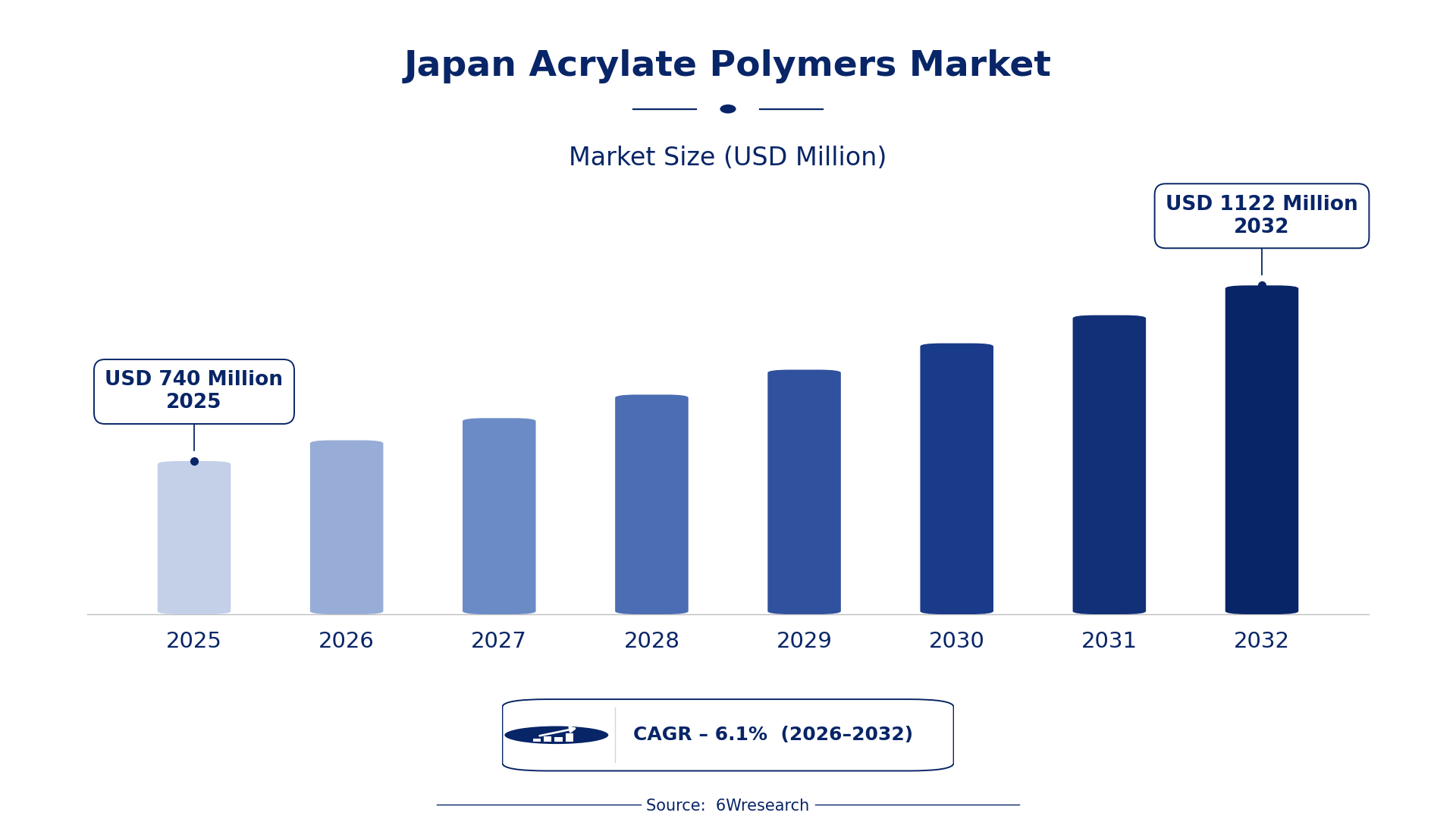
According to 6Wresearch internal database and industry insights, the Japan Acrylate Polymers Market was valued at USD 740 Million in 2025 and is projected to reach USD 1,122 Million by 2032, growing at a CAGR of approximately 6.1% during 2026–2032.
Japan Acrylate Polymers Market Highlights
| Report Metric | Details |
| Report Name | Japan Acrylate Polymers Market (2026-2032) |
| Market Size 2025 | USD 740 Million |
| Market Size 2032 | USD 1,122 Million |
| Absolute Growth 2025–2032 | USD 382 Million |
| CAGR 2026–2032 | 6.1% |
| Peak Annual Growth | 7.1% in 2030 |
| Forecast Period | 2026–2032 |
| Historical Data | 2022–2025 |
| Base Year | 2025 |
| Leading Product Type, 2025 | Water-based Polymers (41% share) |
| Leading Form Type, 2025 | Liquid (45% share) |
| Leading Distribution Channel, 2025 | Direct Sales (37% share) |
| Leading End User, 2025 | Paints & Coatings Industry (54% share) |
| Fastest-Growing Product Type | UV-Cured Polymers (8.6% CAGR) |
| Fastest-Growing Form Type | Emulsion (9.0% CAGR) |
| Fastest-Growing Distribution Channel | Online Platforms (8.2% CAGR) |
| Fastest-Growing End User | Adhesives & Sealants Sector (8.3% CAGR) |
| Growing Sector | paints and coatings |
| Key End Users | construction, automotive, electronics manufacturing |
Japan Acrylate Polymers Market Year-wise Growth Rate and Key Drivers (2022–2032)
This graph illustrates the annual growth rates of the market from 2022 to 2032, highlighting a steady upward trajectory and projected market expansion over the forecast period.
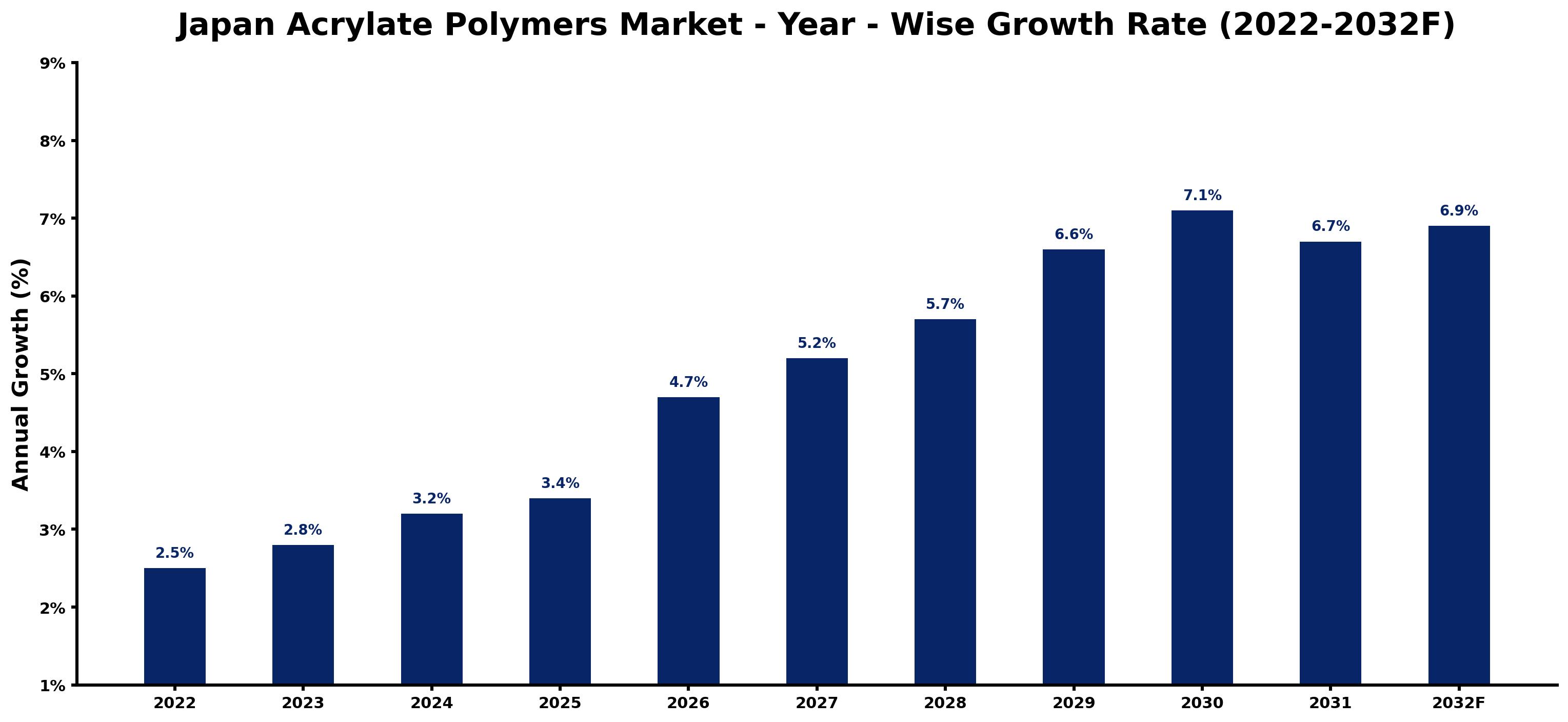
The following figures match every annual growth estimate with the main market development of that year, giving the reasoning behind each rise or slowdown.
| Year | Estimated Annual Growth (%) | Market Rationale |
| 2022 | 2.5 | The market experienced steady demand from the construction sector and automotive coatings. |
| 2023 | 2.8 | Growth accelerated due to increased adoption of water-based polymers in coatings. |
| 2024 | 3.2 | Demand rose as automotive manufacturers sought environmentally friendly materials. |
| 2025 | 3.4 | The paints and coatings sector expanded, driving further polymer usage. |
| 2026 | 4.7 | Investment in polymer innovation programmes is expected to increase production capacity. |
| 2027 | 5.2 | The automotive industry is projected to increase its use of acrylate polymers. |
| 2028 | 5.7 | Sustainable practices in construction are anticipated to boost market demand. |
| 2029 | 6.6 | The electronics sector will likely increase its consumption of UV-cured polymers. |
| 2030 | 7.1 | Peak growth is expected as demand from the adhesives sector surges. |
| 2031 | 6.7 | Growth slows slightly as the market stabilises after rapid expansion. |
| 2032 | 6.9 | Demand is projected to rise again, driven by new applications in construction. |
Note: Market size estimations and growth projections presented in this report are based on 6Wresearch's proprietary forecasting methodology, utilizing the latest available industry data, government publications, and primary research inputs.
Japan Acrylate Polymers Market Synopsis
Acrylate polymers are synthetic materials derived from acrylate monomers, widely used in coatings, adhesives, and sealants due to their excellent adhesion and flexibility. The Japan Acrylate Polymers Market is growing, driven by demand from the construction, automotive, and electronics sectors, particularly in the Tokyo region, a major hub for paints and coatings. In 2022, Japan produced 2 million tons of acrylate polymers, and the Ministry of Economy, Trade and Industry is supporting innovation programmes expected to stimulate demand in the coming years.
Market Dynamics Impact Analysis (2026–2032)
| Factor | Type | Impact | Primary Segment Affected |
| Rising demand for water-based polymers in environmentally friendly coatings | Driver | High | Water-based Polymers |
| Increased automotive production requiring high-performance coatings | Driver | High | Solvent-based Polymers |
| Growing construction sector seeking sustainable materials | Opportunity | High | Emulsion |
| Expansion of online sales channels for smaller orders | Opportunity | Medium | Online Platforms |
| Regulatory compliance costs for new chemical substances | Restraint | High | UV-Cured Polymers |
| Limited availability of skilled workforce in polymer manufacturing | Restraint | Medium | Thermoplastic Polymers |
| High raw material costs impacting production margins | Challenge | High | Liquid |
| Capacity constraints in meeting rising demand | Challenge | Medium | Granules |
Evaluation of Drivers in Japan Acrylate Polymers Market (2026–2032)
Below are the drivers that matter most for revenue growth, with supporting evidence.
| Drivers | Primary Segment Affected | Why It Matters (Evidence) |
| Increased adoption of water-based polymers | Water-based Polymers | Environmental regulations are pushing manufacturers to adopt water-based solutions, which now constitute a significant portion of coatings. |
| Rising production in the automotive sector | Solvent-based Polymers | With over 70% of automotive coatings using acrylate polymers, demand is surging as manufacturers ramp up output. |
| Sustainability initiatives in construction | Emulsion | The construction industry is increasingly using emulsion polymers for their eco-friendly properties, reflecting a growing trend towards sustainable materials. |
| Growth of e-commerce in industrial sales | Online Platforms | The rise of online platforms is facilitating access for smaller buyers, contributing to a projected growth in this distribution channel. |
| Technological advancements in polymer production | Thermoplastic Polymers | Innovations in production techniques are enabling manufacturers to improve quality and reduce costs, attracting new buyers. |
Behind the steady rise in orders sits increased demand from the construction sector, where water-based polymers have seen a rise due to sustainability efforts. The automotive industry, which utilizes acrylate polymers in over 70% of coatings, is also expanding production, further driving demand. E-commerce growth is facilitating access for smaller buyers, with online platforms expected to grow. Technological advancements in polymer production are improving quality and reducing costs, attracting new customers in the construction and automotive sectors. The construction industry is increasingly adopting emulsion polymers for their eco-friendly properties, reflecting a shift in material preferences.
Evaluation of Restraints in Japan Acrylate Polymers Market
The key brakes on demand, and where they bite hardest, are shown below.
| Market Restraint | Primary Segment Affected | Why It Matters (Evidence) |
| Regulatory compliance costs for new chemical substances | UV-Cured Polymers | Compliance with the Chemical Substances Control Law increases operational costs for manufacturers, affecting pricing. |
| Limited availability of skilled workforce | Thermoplastic Polymers | A shortage of skilled workers in Japan hampers production efficiency and capacity expansion. |
| High raw material costs impacting production margins | Liquid | Fluctuations in raw material prices are squeezing profit margins for producers, making it difficult to maintain competitive pricing. |
| Market saturation in certain polymer segments | Emulsion | An oversupply in specific polymer types is leading to price competition and reduced profitability. |
| Capacity constraints in meeting rising demand | Granules | Manufacturers face challenges in scaling production to meet the growing demand from various sectors. |
Japan Acrylate Polymers Market Challenges
High production costs hinder profitability for buyers, stemming from the expensive raw materials used in acrylate polymer manufacturing. This situation forces buyers to pay up to 20% more for finished products, impacting their budgets. Supply chain disruptions in the Tokyo region delay deliveries, resulting in lost sales opportunities for producers, with delays averaging two weeks. Technology adoption lags behind global standards, causing inefficiencies that increase operational costs by 15% for producers. Skills shortages in the workforce limit innovation and reduce output, costing the industry potential revenue of around 300 million dollars annually.
Trends in the Japan Acrylate Polymers Market
Below are the shifts with the largest effect on the Japan Acrylate Polymers Market.
- Shift from Solvent-based to Water-based Coatings: The paints and coatings industry is increasingly adopting water-based solutions, with the Tokyo region leading this trend. Water-based polymers now account for 41% of the market share in 2025, reflecting a shift towards environmentally friendly options.
- Emergence of Online Platforms for Industrial Sales: Online platforms are becoming a key channel for smaller orders, particularly in the Tokyo region. This channel is projected to grow by 8.2%, indicating a shift in purchasing behaviour among industrial customers.
- Transition to UV-Cured Polymers in Electronics Manufacturing: The electronics manufacturing sector is increasingly utilising UV-cured polymers for quick-drying applications. This trend is expected to grow as manufacturers seek efficient production processes, contributing to rising demand.
- Growing Emphasis on Sustainable Materials in Construction: The construction sector is prioritising sustainable materials, with emulsion polymers gaining traction. The Tokyo Metropolitan Government's initiatives for sustainable materials are expected to drive further adoption.
Investment Opportunities in the Japan Acrylate Polymers Market
Investors looking at the Japan Acrylate Polymers Market should consider the following areas.
- Current Demand for Eco-friendly Solutions: With increasing demand for water-based polymers, there is an opportunity for suppliers focusing on sustainable materials, particularly in the construction sector, where eco-friendly products are increasingly preferred.
- Forming Joint Ventures with Local Distributors: Establishing partnerships with local distributors can facilitate market entry, especially for online platforms, which are projected to grow.
- Investment in Emulsion Polymer Production: The adhesives and sealants sector is a key buyer group, with increasing demand for emulsion polymers, presenting an opportunity for investment in production capacity.
- Expansion in the Tokyo Region: With the Tokyo region being a major hub for paints and coatings, suppliers can benefit from establishing local partnerships to tap into the growing market.
Government Initiatives in the Japan Acrylate Polymers Market
The GX Basic Policy, adopted in 2023, aims for JPY 150 trillion in public-private decarbonisation investment over ten years, supporting sustainable materials in the acrylate polymers sector. This complements the Plastic Resource Circulation Act, which promotes recycling and alternatives to plastics, pushing producers towards greener practices.
The Chemical Substances Control Law mandates evaluation and control of new chemical substances, ensuring that manufacturers comply with safety standards. The Ministry of Economy, Trade and Industry oversees the approval of innovation programmes that support the development of new polymer technologies, crucial for maintaining competitiveness in the market.
Future Insight of the Japan Acrylate Polymers Market
Investment in polymer innovation programmes will create advancements in production technology, generating increased efficiency in manufacturing processes. By 2032, demand for acrylate polymers will rise significantly, driven by the construction and automotive sectors. The Tokyo Metropolitan Government's initiatives for sustainable materials will motivate suppliers to develop eco-friendly products. Quality standards, such as ISO 9001, will ensure better product consistency, enhancing trust and satisfaction for buyers.
Market Segmentation Analysis
Japan Acrylate Polymers Market report covers a detailed analysis of the following market segments:
By Product Type – Water-based Polymers Lead, UV-Cured Polymers Expected to Grow Fastest
According to Prakhar Dixit, Senior Research Analyst at 6Wresearch, Water-based Polymers held 41% of the Japan Acrylate Polymers Market by product type in 2025. Water-based polymers dominate the market due to their extensive application in environmentally friendly coatings and adhesives, appealing to eco-conscious consumers. They are particularly prevalent in the automotive sector, where they are used in over 70% of coatings, showcasing their importance. The quickest growth will come from UV-Cured Polymers, forecast to expand at a CAGR of 8.6% between 2026 and 2032. The growth of UV-cured polymers is driven by their efficiency in quick-drying applications, especially within the automotive and electronics sectors. As industries increasingly adopt these technologies, the demand for water-based polymers will continue to expand, reinforcing their market position. Suppliers should prioritise the development of water-based and UV-cured polymers to align with market trends.
By Form Type – Liquid Leads, Emulsion Expected to Grow Fastest
The largest form type category in 2025 was Liquid, at 45% of revenue. Liquid form polymers dominate the market as they are primarily used in coatings and adhesives, essential for various applications in multiple industries. Their versatility and ease of application make them a preferred choice among manufacturers in Japan. Emulsion is projected to grow fastest, at a CAGR of 9.0% during 2026–2032. Emulsion polymers are experiencing rapid growth due to their extensive use in paints and coatings, which are increasingly favoured for their environmental benefits. As the paints and coatings industry expands, the demand for emulsion polymers will likely accelerate further. Buyers should consider sourcing more emulsion polymers to align with industry trends towards sustainable materials.
By Distribution Channel – Direct Sales Leads, Online Platforms Expected to Grow Fastest
In 2025, Direct Sales led the distribution channel split with a 37% share. Direct sales serve as the primary distribution channel for industrial customers, ensuring tailored solutions and efficient order fulfilment. This method cultivates strong relationships between suppliers and key buyers, addressing their specific requirements effectively. Online Platforms are set to record the highest CAGR in this split, 8.2% over 2026–2032. Online platforms are rapidly gaining traction as a distribution channel, especially for smaller orders, reflecting a shift in consumer purchasing behaviour towards digital solutions. This trend presents a considerable opportunity for suppliers to broaden their market reach through online sales. Suppliers must enhance their online sales strategies to cater to the growing preference for digital purchasing among customers.
By End User – Paints & Coatings Industry Leads, Adhesives & Sealants Sector Expected to Grow Fastest
Paints & Coatings Industry accounted for 54% of the market by end user in 2025. The paints and coatings industry stands as the largest consumer of acrylate polymers, utilising their excellent adhesion and flexibility in various applications. This high demand from the sector plays a crucial role in shaping the overall market for acrylate polymers in Japan. Over 2026–2032, Adhesives & Sealants Sector is expected to post the fastest growth, at a CAGR of 8.3%. The adhesives and sealants sector is witnessing rapid growth as it increasingly incorporates acrylate polymers, particularly in construction and automotive applications. This trend underscores the industry's commitment to durable and efficient bonding solutions. Suppliers should prioritise the adhesives and sealants sector to capitalise on its swift growth and rising demand.
Key Attractiveness of the Report
- 10 Years of Market Numbers
- Historical Data Starting from 2022 to 2025
- Base Year 2025
- Forecast Data until 2032
- Key Performance Indicators Impacting the Market
- Major Upcoming Developments and Projects
Key Highlights of the Report:
- Japan Acrylate Polymers Market Outlook
- Market Size of Japan Acrylate Polymers Market, 2025
- Forecast of Japan Acrylate Polymers Market, 2032
- Historical Data and Forecast of Japan Acrylate Polymers Revenues & Volume for the Period 2022-2032F
- Japan Acrylate Polymers Market Trend Evolution
- Japan Acrylate Polymers Market Drivers and Challenges
- Japan Acrylate Polymers Price Trends
- Japan Acrylate Polymers Porter's Five Forces
- Japan Acrylate Polymers Industry Life Cycle
- Historical Data and Forecast of Japan Acrylate Polymers Market Revenues & Volume By Product Type for the Period 2022-2032F
- Historical Data and Forecast of Japan Acrylate Polymers Market Revenues & Volume By Water-based Polymers for the Period 2022-2032F
- Historical Data and Forecast of Japan Acrylate Polymers Market Revenues & Volume By Solvent-based Polymers for the Period 2022-2032F
- Historical Data and Forecast of Japan Acrylate Polymers Market Revenues & Volume By UV-Cured Polymers for the Period 2022-2032F
- Historical Data and Forecast of Japan Acrylate Polymers Market Revenues & Volume By Thermoplastic Polymers for the Period 2022-2032F
- Historical Data and Forecast of Japan Acrylate Polymers Market Revenues & Volume By Form Type for the Period 2022-2032F
- Historical Data and Forecast of Japan Acrylate Polymers Market Revenues & Volume By Liquid for the Period 2022-2032F
- Historical Data and Forecast of Japan Acrylate Polymers Market Revenues & Volume By Emulsion for the Period 2022-2032F
- Historical Data and Forecast of Japan Acrylate Polymers Market Revenues & Volume By Granules for the Period 2022-2032F
- Historical Data and Forecast of Japan Acrylate Polymers Market Revenues & Volume By Powder for the Period 2022-2032F
- Historical Data and Forecast of Japan Acrylate Polymers Market Revenues & Volume By Distribution Channel for the Period 2022-2032F
- Historical Data and Forecast of Japan Acrylate Polymers Market Revenues & Volume By Direct Sales for the Period 2022-2032F
- Historical Data and Forecast of Japan Acrylate Polymers Market Revenues & Volume By Online Platforms for the Period 2022-2032F
- Historical Data and Forecast of Japan Acrylate Polymers Market Revenues & Volume By Industrial Distributors for the Period 2022-2032F
- Historical Data and Forecast of Japan Acrylate Polymers Market Revenues & Volume By Specialty Stores for the Period 2022-2032F
- Historical Data and Forecast of Japan Acrylate Polymers Market Revenues & Volume By End User for the Period 2022-2032F
- Historical Data and Forecast of Japan Acrylate Polymers Market Revenues & Volume By Paints & Coatings Industry for the Period 2022-2032F
- Historical Data and Forecast of Japan Acrylate Polymers Market Revenues & Volume By Adhesives & Sealants Sector for the Period 2022-2032F
- Historical Data and Forecast of Japan Acrylate Polymers Market Revenues & Volume By Electronics Manufacturing for the Period 2022-2032F
- Historical Data and Forecast of Japan Acrylate Polymers Market Revenues & Volume By Textile Sector for the Period 2022-2032F
- Japan Acrylate Polymers Import Export Trade Statistics
- Market Opportunity Assessment By Product Type
- Market Opportunity Assessment By Form Type
- Market Opportunity Assessment By Distribution Channel
- Market Opportunity Assessment By End User
- Japan Acrylate Polymers Top Companies Market Share
- Japan Acrylate Polymers Competitive Benchmarking By Technical and Operational Parameters
- Japan Acrylate Polymers Company Profiles
- Japan Acrylate Polymers Key Strategic Recommendations
Market Covered
Segments analysed in this report are listed below.
By Product Type
- Water-based Polymers
- Solvent-based Polymers
- UV-Cured Polymers
- Thermoplastic Polymers
By Form Type
- Liquid
- Emulsion
- Granules
- Powder
By Distribution Channel
- Direct Sales
- Online Platforms
- Industrial Distributors
- Specialty Stores
By End User
- Paints & Coatings Industry
- Adhesives & Sealants Sector
- Electronics Manufacturing
- Textile Sector































