Japan Acrylonitrile Derivatives Market Size & Growth Rate
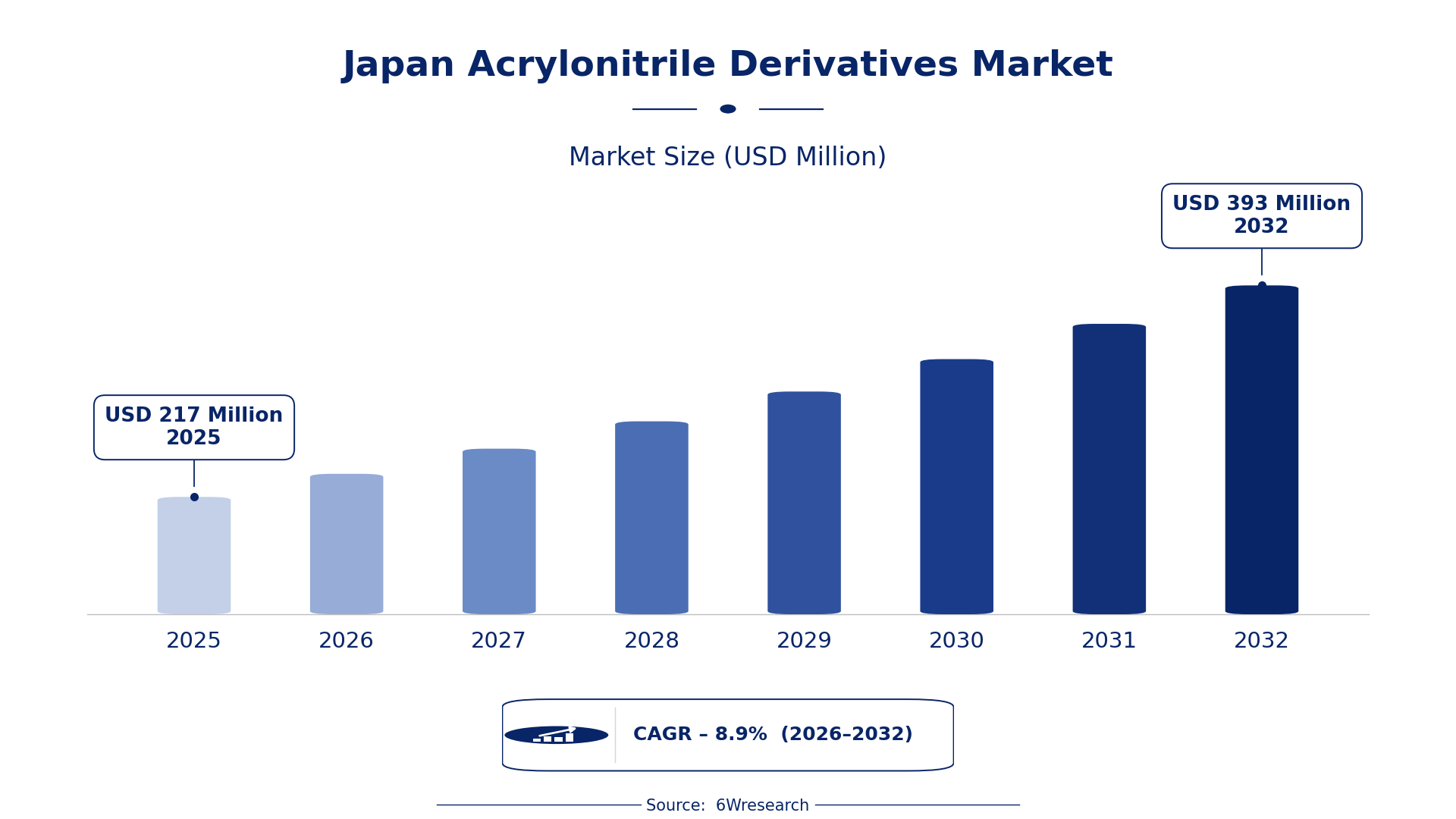
According to 6Wresearch internal database and industry insights, the Japan Acrylonitrile Derivatives Market was valued at USD 217 Million in 2025 and is projected to reach USD 393 Million by 2032, growing at a CAGR of approximately 8.9% during 2026–2032.
Japan Acrylonitrile Derivatives Market Highlights
| Report Metric | Details |
| Report Name | Japan Acrylonitrile Derivatives Market (2026-2032) |
| Market Size 2025 | USD 217 Million |
| Market Size 2032 | USD 393 Million |
| Absolute Growth 2025–2032 | USD 176 Million |
| CAGR 2026–2032 | 8.9% |
| Peak Annual Growth | 9.7% in 2032 |
| Forecast Period | 2026–2032 |
| Historical Data | 2022–2025 |
| Base Year | 2025 |
| Leading Product Type, 2025 | Acrylonitrile-Butadiene-Styrene (ABS) (45% share) |
| Leading Derivative Type, 2025 | ABS Polymer (39% share) |
| Leading Distribution Channel, 2025 | Direct Sales (50% share) |
| Leading End User, 2025 | Automotive Manufacturers (44% share) |
| Fastest-Growing Product Type | Acrylonitrile Styrene Acrylate (ASA) (12.5% CAGR) |
| Fastest-Growing Derivative Type | Water Treatment Chemicals (12.8% CAGR) |
| Fastest-Growing Distribution Channel | Industrial Distributors (11.8% CAGR) |
| Fastest-Growing End User | Municipal Water Plants (11.5% CAGR) |
| Growing Sector | automotive manufacturing |
| Key End Users | automotive manufacturers, consumer goods industry, municipal water plants, healthcare equipment |
Japan Acrylonitrile Derivatives Market Year-wise Growth Rate and Key Drivers (2022–2032)
This graph illustrates the annual growth rates of the market from 2022 to 2032, highlighting a steady upward trajectory and projected market expansion over the forecast period.
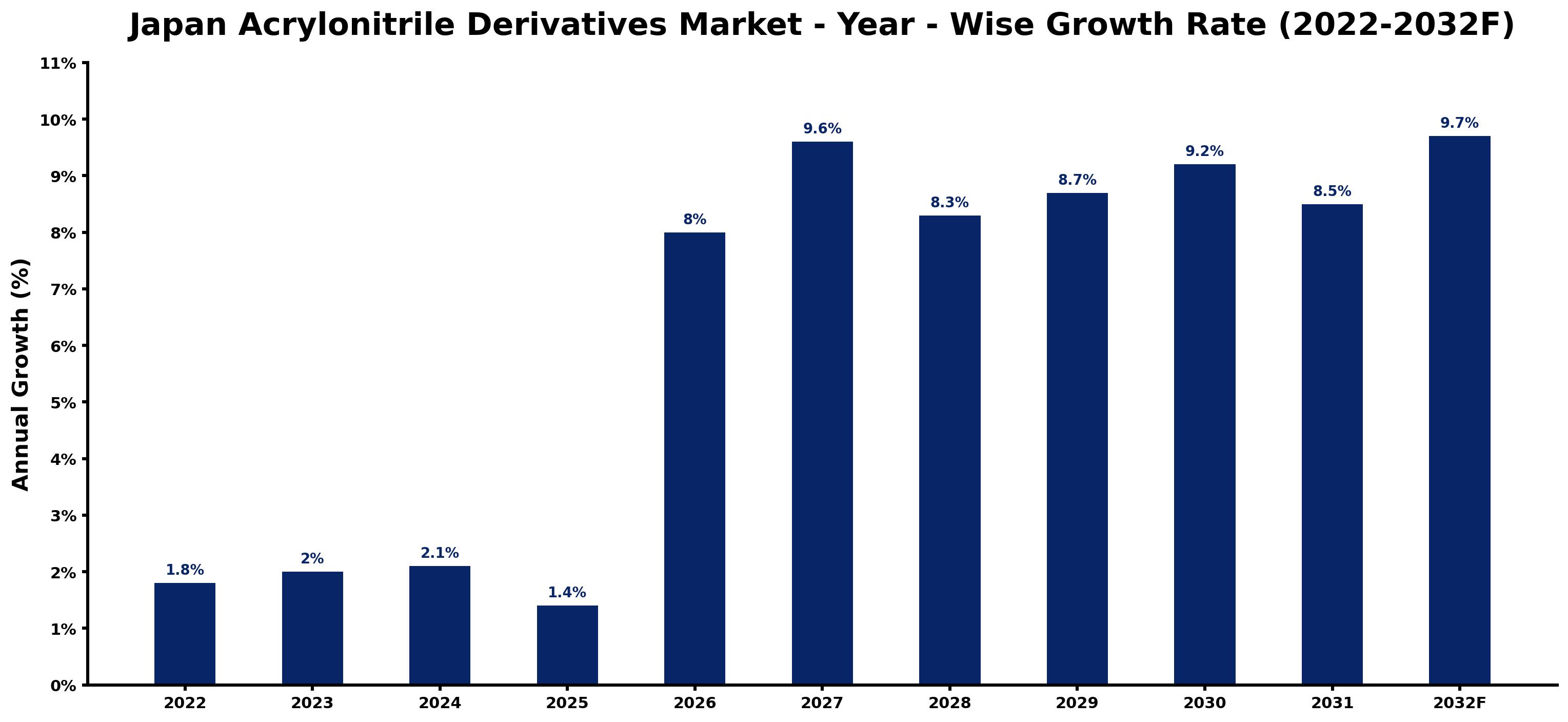
Year by year, the estimates below pair each growth rate with the development that shaped it.
| Year | Estimated Annual Growth (%) | Market Rationale |
| 2022 | 1.8 | The market experienced steady growth due to consistent demand from the automotive sector. |
| 2023 | 2.0 | Growth accelerated as manufacturers increased production of acrylonitrile derivatives for consumer goods. |
| 2024 | 2.1 | Demand continued to rise, driven by the automotive industry's recovery and expansion. |
| 2025 | 1.4 | Growth slowed as market conditions stabilised after previous increases in production capacity. |
| 2026 | 8.0 | A surge in demand is anticipated as new technologies are adopted in manufacturing. |
| 2027 | 9.6 | Demand is expected to rise sharply, supported by investments in advanced materials. |
| 2028 | 8.3 | Growth will moderate as the market adjusts to increased production capabilities. |
| 2029 | 8.7 | A rebound in demand is projected as the automotive sector expands further. |
| 2030 | 9.2 | Continued growth is anticipated as new applications for acrylonitrile derivatives emerge. |
| 2031 | 8.5 | Growth will slow slightly as the market approaches maturity in key applications. |
| 2032 | 9.7 | A peak in growth is expected as demand for sustainable materials increases. |
Note: Market size estimations and growth projections presented in this report are based on 6Wresearch's proprietary forecasting methodology, utilizing the latest available industry data, government publications, and primary research inputs.
Japan Acrylonitrile Derivatives Market Synopsis
Acrylonitrile derivatives are chemical compounds essential for producing plastics and synthetic rubber. They are made through polymerization and chemical reactions, with primary applications in automotive parts, consumer goods, and water treatment chemicals. The Japan Acrylonitrile Derivatives Market is expanding due to rising demand from the automotive sector, particularly in the Kanto region, and increasing investments in water treatment initiatives. The expected growth rate of 8.9% from 2026 to 2032 highlights the market's potential driven by technological advancements and a focus on sustainable materials.
Market Dynamics Impact Analysis (2026–2032)
| Factor | Type | Impact | Primary Segment Affected |
| Increasing demand from the automotive sector drives growth in acrylonitrile derivatives. | Driver | High | Acrylonitrile-Butadiene-Styrene (ABS) |
| Rising investments in water treatment technologies create opportunities for acrylonitrile derivatives. | Opportunity | High | Water Treatment Chemicals |
| Regulatory compliance for chemical production necessitates adherence to quality standards. | Restraint | Medium | Acrylonitrile-Butadiene-Styrene (ABS) |
| Technological advancements in production processes enhance efficiency and output. | Driver | High | Acrylonitrile Styrene Acrylate (ASA) |
| Market saturation in certain applications limits growth potential for existing products. | Challenge | Medium | Nitrile Rubber (NBR) |
| Growing competition from alternative materials poses a challenge to market growth. | Challenge | Medium | Acrylamide |
| Demand fluctuations in consumer goods impact the stability of acrylonitrile derivative sales. | Restraint | Medium | Acrylonitrile Styrene Acrylate (ASA) |
| Emerging applications in healthcare equipment present new opportunities for growth. | Opportunity | High | Healthcare Equipment |
Evaluation of Drivers in Japan Acrylonitrile Derivatives Market (2026–2032)
Below are the drivers that matter most for revenue growth, with supporting evidence.
| Drivers | Primary Segment Affected | Why It Matters (Evidence) |
| Rising automotive production increases demand for ABS derivatives. | Acrylonitrile-Butadiene-Styrene (ABS) | The Kanto region's automotive sector drives demand, with ABS usage expected to rise. |
| Investments in water treatment facilities boost the need for acrylonitrile derivatives. | Water Treatment Chemicals | Municipal water plants are expanding, increasing the demand for effective treatment chemicals. |
| Technological advancements in production processes improve efficiency. | Acrylonitrile Styrene Acrylate (ASA) | New production technologies enhance output and quality, attracting more buyers in consumer goods. |
| Growing consumer goods market drives the need for durable plastics. | Acrylonitrile Styrene Acrylate (ASA) | The Japanese consumer goods industry is a major end user, particularly for durable products. |
| Increased focus on sustainability encourages the use of eco-friendly materials. | Acrylonitrile-Butadiene-Styrene (ABS) | The national strategy for sustainable industrial development promotes the use of these materials. |
Spending rises as the automotive sector recovers, boosting production of acrylonitrile derivatives by approximately 200,000 tons annually. The expansion of municipal water treatment facilities is increasing the demand for acrylonitrile derivatives in effective treatment solutions. The consumer goods industry is increasingly relying on durable plastics, particularly ASA resin, to satisfy consumer needs. The projected production increase of 200,000 tons annually highlights the sector's dependence on these materials, prompting further investments in production capabilities.
Evaluation of Restraints in Japan Acrylonitrile Derivatives Market
The key brakes on demand, and where they bite hardest, are shown below.
| Market Restraint | Primary Segment Affected | Why It Matters (Evidence) |
| Compliance with stringent regulations increases production costs. | Acrylonitrile-Butadiene-Styrene (ABS) | The PRTR Law imposes compliance costs on producers, raising operational expenses. |
| Market saturation in certain applications limits growth potential. | Nitrile Rubber (NBR) | As demand stabilises, producers face challenges in expanding their market share. |
| Fluctuations in consumer demand affect production planning. | Acrylonitrile Styrene Acrylate (ASA) | The consumer goods industry's variability creates uncertainty for manufacturers. |
| Competition from alternative materials threatens market share. | Acrylamide | Innovations in substitutes may divert demand away from traditional acrylonitrile derivatives. |
| High production costs due to energy prices impact profitability. | Acrylonitrile-Butadiene-Styrene (ABS) | The Act on the Rational Use of Energy increases operational costs for manufacturers. |
Japan Acrylonitrile Derivatives Market Challenges
Producers in Japan's automotive sector face rising operational costs as local suppliers contend with expenses increasing by 15% due to stringent regulations. Competition from lower-cost alternatives in the market pressures domestic manufacturers, potentially leading to revenue losses of around 10% annually for those unable to adapt. Technological advancements require substantial investments, often exceeding 20 million yen, which can delay product development for smaller manufacturers. Clinics experience delays in receiving acrylonitrile derivatives, disrupting the timely production of medical devices and negatively impacting patient care.
Trends in the Japan Acrylonitrile Derivatives Market
Several trends are reshaping the Japan Acrylonitrile Derivatives Market; the most important are set out below.
- Shift towards Sustainable Materials: The Japanese market is prioritising sustainable materials, focusing on reducing environmental impact. The Green Growth Strategy Through Achieving Carbon Neutrality in 2050 aims to promote eco-friendly production practices, encouraging the adoption of acrylonitrile derivatives in sustainable applications.
- Expansion of Water Treatment Initiatives: Investment in water treatment facilities has surged, particularly in urban areas. Municipal water plants are projected to increase their use of acrylonitrile derivatives, with a focus on improving water quality and efficiency.
- Growth in Automotive Sector Demand: The automotive sector is experiencing a resurgence, particularly in the Kanto region, driving demand for acrylonitrile derivatives. The expected production increase of 200,000 tons annually highlights the sector's reliance on these materials.
- Technological Advancements in Production: Advancements in production technology are improving the efficiency of acrylonitrile derivatives manufacturing. The adoption of ISO 9001 standards is driving improvements in quality management across the industry.
Investment Opportunities in the Japan Acrylonitrile Derivatives Market
Below are the investment opportunities with the strongest case in the Japan Acrylonitrile Derivatives Market.
- Investment Gap in Water Treatment: With a projected increase in municipal water treatment facilities, there is an opportunity to supply acrylonitrile derivatives. The expected growth in this sector highlights the need for effective treatment chemicals.
- Demand for Durable Consumer Goods: The consumer goods industry is seeking high-quality acrylonitrile derivatives for durable products. Targeting manufacturers in this sector can lead to substantial business opportunities.
- Expansion of Automotive Manufacturing: The automotive sector's growth creates a demand for acrylonitrile derivatives, particularly in the Kanto region. Establishing partnerships with local manufacturers can facilitate market entry.
- Healthcare Sector Growth: The healthcare equipment sector is projected to increase its use of acrylonitrile derivatives. Focusing on medical applications can open new avenues for suppliers.
Government Initiatives in the Japan Acrylonitrile Derivatives Market
The regulatory framework for acrylonitrile derivatives is shaped by several key laws. The PRTR Law, established in 1999, mandates businesses to report chemical releases, ensuring transparency in production. The Industrial Safety and Health Act of 1972 outlines employer responsibilities for hazardous substances, while the Act on the Rational Use of Energy from 1979 obliges large energy users to improve efficiency. These regulations support the safe and sustainable production of acrylonitrile derivatives.
Investment in the chemical manufacturing sector is supported by government initiatives. The Ministry of the Environment promotes the use of water treatment chemicals through funding programs aimed at improving water quality. Additionally, the Japan Chemical Industry Association supports research initiatives to advance the development of acrylonitrile derivatives, ensuring compliance with national standards.
Future Insight of the Japan Acrylonitrile Derivatives Market
Investment in chemical manufacturing technology will increase, supported by government subsidies, creating demand for advanced acrylonitrile derivatives. By 2032, the healthcare sector will likely require 10% more acrylonitrile derivatives for medical applications, reflecting increased healthcare needs. The automotive industry will pursue new materials to improve vehicle performance and safety. Government initiatives focused on improving water quality will further drive the use of acrylonitrile derivatives in municipal water treatment facilities.
Market Segmentation Analysis
Japan Acrylonitrile Derivatives Market report covers a detailed analysis of the following market segments:
By Product Type – Acrylonitrile-Butadiene-Styrene (ABS) Leads, Acrylonitrile Styrene Acrylate (ASA) Expected to Grow Fastest
According to Saurav Kr Singh, Senior Research Analyst at 6Wresearch, the largest product type category in 2025 was Acrylonitrile-Butadiene-Styrene (ABS), at 45% of revenue. Acrylonitrile-Butadiene-Styrene is extensively utilised in the automotive sector, particularly in the Kanto region, due to its durability and versatility. Its prominent use in manufacturing high-quality automotive parts solidifies its leading share in the market. The quickest growth will come from Acrylonitrile Styrene Acrylate (ASA), forecast to expand at a CAGR of 12.5% between 2026 and 2032. Acrylonitrile Styrene Acrylate is experiencing rapid growth owing to its UV resistance, making it ideal for outdoor applications, especially in durable consumer goods. This surge is driven by the increasing consumer preference for products that withstand environmental conditions. Suppliers must focus on enhancing production for ASA to leverage its growing significance in the market.
By Derivative Type – ABS Polymer Leads, Water Treatment Chemicals Expected to Grow Fastest
ABS Polymer accounted for 39% of the market by derivative type in 2025. ABS Polymer commands the largest share as it is integral to the production of various plastic products across multiple sectors, ensuring steady demand from manufacturers. Its extensive use in automotive and consumer goods reinforces its market dominance. Water Treatment Chemicals are set to record the highest CAGR in this split, 12.8% over 2026–2032. Water Treatment Chemicals are experiencing the fastest growth, driven by government initiatives focused on improving municipal water quality. This increased emphasis on environmental standards is propelling demand for effective treatment solutions. Buyers in the water treatment sector may need to secure long-term contracts to ensure supply stability as demand rises.
By Distribution Channel – Direct Sales Leads, Industrial Distributors Expected to Grow Fastest
With 50% of distribution channel revenue in 2025, Direct Sales was the largest category. Direct Sales remains the primary distribution channel, effectively connecting manufacturers with suppliers and ensuring customised solutions for clients. This channel's efficiency in managing industrial transactions reinforces its dominant position in the market. Industrial Distributors are projected to grow fastest, at a CAGR of 11.8% during 2026–2032. Industrial Distributors are gaining momentum as they provide manufacturers with streamlined access to a diverse range of products, improving supply chain efficiency. This shift indicates a trend towards specialised distribution networks that enhance operational effectiveness. Suppliers should cultivate relationships with industrial distributors to expand their market reach and improve service delivery.
By End User – Automotive Manufacturers Lead, Municipal Water Plants Expected to Grow Fastest
Automotive Manufacturers took 44% of end user revenue in 2025, more than any other category. Automotive Manufacturers constitute the largest consumer group for acrylonitrile derivatives, primarily due to their extensive use in producing high-performance automotive components. The growth of this sector directly influences the demand for these chemical compounds. Over 2026–2032, Municipal Water Plants are expected to post the fastest growth, at a CAGR of 11.5%. Municipal Water Plants are experiencing the fastest growth as they adopt advanced water treatment technologies to meet regulatory requirements. This trend is supported by government initiatives focused on enhancing water quality across Japan. Suppliers should align their product offerings with the needs of municipal water facilities to capture new market opportunities.
Key Attractiveness of the Report
- 10 Years of Market Numbers
- Historical Data Starting from 2022 to 2025
- Base Year 2025
- Forecast Data until 2032
- Key Performance Indicators Impacting the Market
- Major Upcoming Developments and Projects
Key Highlights of the Report:
- Japan Acrylonitrile Derivatives Market Outlook
- Market Size of Japan Acrylonitrile Derivatives Market, 2025
- Forecast of Japan Acrylonitrile Derivatives Market, 2032
- Historical Data and Forecast of Japan Acrylonitrile Derivatives Revenues & Volume for the Period 2022-2032F
- Japan Acrylonitrile Derivatives Market Trend Evolution
- Japan Acrylonitrile Derivatives Market Drivers and Challenges
- Japan Acrylonitrile Derivatives Price Trends
- Japan Acrylonitrile Derivatives Porter's Five Forces
- Japan Acrylonitrile Derivatives Industry Life Cycle
- Historical Data and Forecast of Japan Acrylonitrile Derivatives Market Revenues & Volume By Product Type for the Period 2022-2032F
- Historical Data and Forecast of Japan Acrylonitrile Derivatives Market Revenues & Volume By Acrylonitrile-Butadiene-Styrene (ABS) for the Period 2022-2032F
- Historical Data and Forecast of Japan Acrylonitrile Derivatives Market Revenues & Volume By Acrylonitrile Styrene Acrylate (ASA) for the Period 2022-2032F
- Historical Data and Forecast of Japan Acrylonitrile Derivatives Market Revenues & Volume By Acrylamide for the Period 2022-2032F
- Historical Data and Forecast of Japan Acrylonitrile Derivatives Market Revenues & Volume By Nitrile Rubber (NBR) for the Period 2022-2032F
- Historical Data and Forecast of Japan Acrylonitrile Derivatives Market Revenues & Volume By Derivative Type for the Period 2022-2032F
- Historical Data and Forecast of Japan Acrylonitrile Derivatives Market Revenues & Volume By ABS Polymer for the Period 2022-2032F
- Historical Data and Forecast of Japan Acrylonitrile Derivatives Market Revenues & Volume By ASA Resin for the Period 2022-2032F
- Historical Data and Forecast of Japan Acrylonitrile Derivatives Market Revenues & Volume By Water Treatment Chemicals for the Period 2022-2032F
- Historical Data and Forecast of Japan Acrylonitrile Derivatives Market Revenues & Volume By Rubber Derivatives for the Period 2022-2032F
- Historical Data and Forecast of Japan Acrylonitrile Derivatives Market Revenues & Volume By Distribution Channel for the Period 2022-2032F
- Historical Data and Forecast of Japan Acrylonitrile Derivatives Market Revenues & Volume By Direct Sales for the Period 2022-2032F
- Historical Data and Forecast of Japan Acrylonitrile Derivatives Market Revenues & Volume By Online Platforms for the Period 2022-2032F
- Historical Data and Forecast of Japan Acrylonitrile Derivatives Market Revenues & Volume By Industrial Distributors for the Period 2022-2032F
- Historical Data and Forecast of Japan Acrylonitrile Derivatives Market Revenues & Volume By Specialty Suppliers for the Period 2022-2032F
- Historical Data and Forecast of Japan Acrylonitrile Derivatives Market Revenues & Volume By End User for the Period 2022-2032F
- Historical Data and Forecast of Japan Acrylonitrile Derivatives Market Revenues & Volume By Automotive Manufacturers for the Period 2022-2032F
- Historical Data and Forecast of Japan Acrylonitrile Derivatives Market Revenues & Volume By Consumer Goods Industry for the Period 2022-2032F
- Historical Data and Forecast of Japan Acrylonitrile Derivatives Market Revenues & Volume By Municipal Water Plants for the Period 2022-2032F
- Historical Data and Forecast of Japan Acrylonitrile Derivatives Market Revenues & Volume By Healthcare Equipment for the Period 2022-2032F
- Japan Acrylonitrile Derivatives Import Export Trade Statistics
- Market Opportunity Assessment By Product Type
- Market Opportunity Assessment By Derivative Type
- Market Opportunity Assessment By Distribution Channel
- Market Opportunity Assessment By End User
- Japan Acrylonitrile Derivatives Top Companies Market Share
- Japan Acrylonitrile Derivatives Competitive Benchmarking By Technical and Operational Parameters
- Japan Acrylonitrile Derivatives Company Profiles
- Japan Acrylonitrile Derivatives Key Strategic Recommendations
Market Covered
Coverage by segment is as follows.
By Product Type
- Acrylonitrile-Butadiene-Styrene (ABS)
- Acrylonitrile Styrene Acrylate (ASA)
- Acrylamide
- Nitrile Rubber (NBR)
By Derivative Type
- ABS Polymer
- ASA Resin
- Water Treatment Chemicals
- Rubber Derivatives
By Distribution Channel
- Direct Sales
- Online Platforms
- Industrial Distributors
- Specialty Suppliers
By End User
- Automotive Manufacturers
- Consumer Goods Industry
- Municipal Water Plants
- Healthcare Equipment































