Japan Activated Clay Market Size & Growth Rate
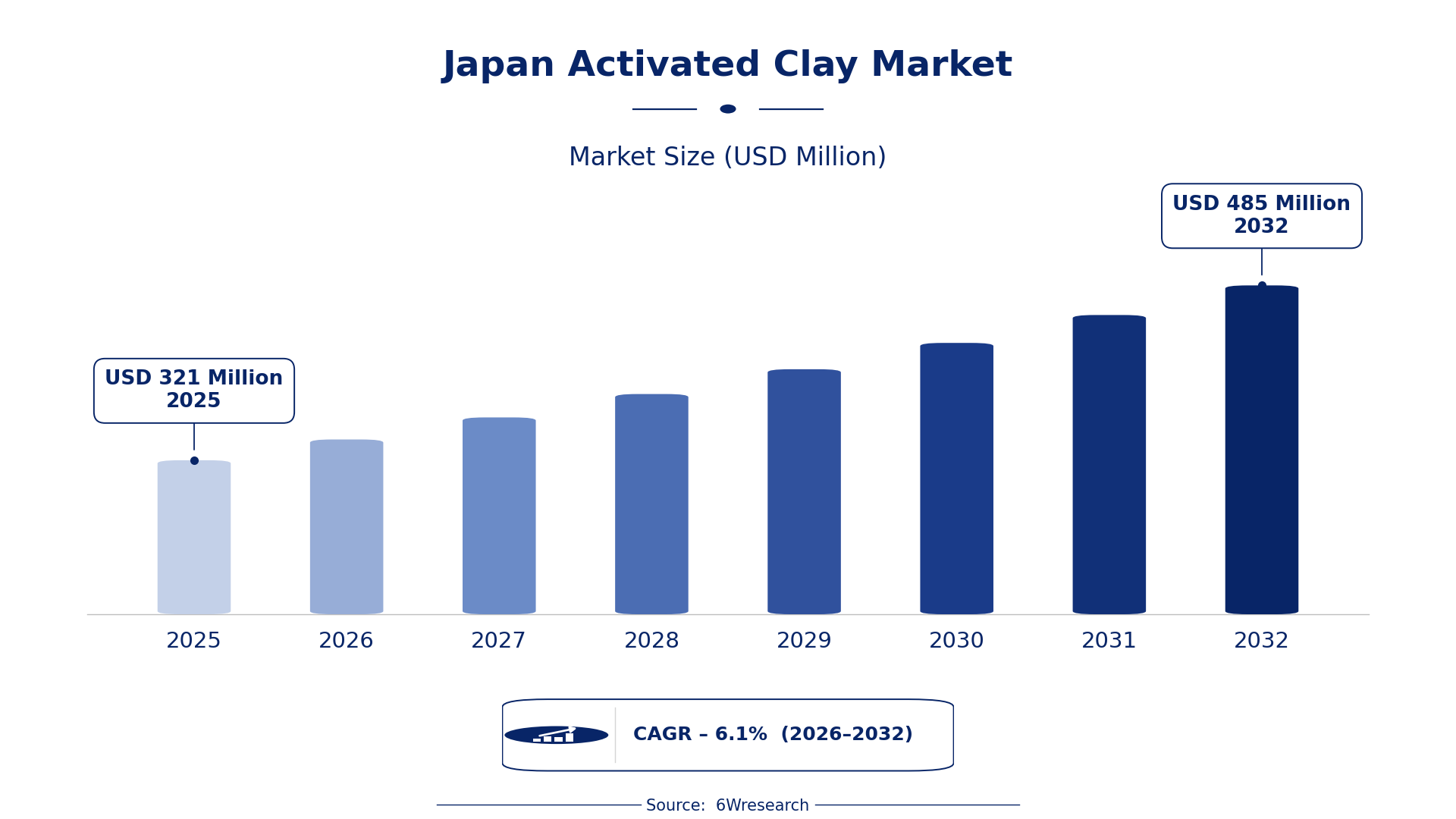
According to 6Wresearch internal database and industry insights, the Japan Activated Clay Market was valued at USD 321 Million in 2025 and is projected to reach USD 485 Million by 2032, growing at a CAGR of approximately 6.1% during 2026–2032.
Japan Activated Clay Market Highlights
| Report Metric | Details |
| Report Name | Japan Activated Clay Market (2026-2032) |
| Market Size 2025 | USD 321 Million |
| Market Size 2032 | USD 485 Million |
| Absolute Growth 2025–2032 | USD 164 Million |
| CAGR 2026–2032 | 6.1% |
| Peak Annual Growth | 7.4% in 2027 |
| Forecast Period | 2026–2032 |
| Historical Data | 2022–2025 |
| Base Year | 2025 |
| Leading Product Type, 2025 | Bleaching Earth (53% share) |
| Leading Material Type, 2025 | Natural Clay (41% share) |
| Leading Distribution Channel, 2025 | Direct Sales (36% share) |
| Leading End User, 2025 | Oil Refining Industry (48% share) |
| Fastest-Growing Product Type | Fuller's Earth (8.3% CAGR) |
| Fastest-Growing Material Type | Calcium Bentonite (8.8% CAGR) |
| Fastest-Growing Distribution Channel | Industrial Suppliers (7.9% CAGR) |
| Fastest-Growing End User | Food & Beverage Industry (7.8% CAGR) |
| Growing Sector | Oil Refining Industry |
| Key End Users | Oil Refining Industry, Food & Beverage Industry, Cosmetic Industry, Chemical Manufacturing |
Japan Activated Clay Market Year-wise Growth Rate and Key Drivers (2022–2032)
This graph illustrates the annual growth rates of the market from 2022 to 2032, highlighting a steady upward trajectory and projected market expansion over the forecast period.
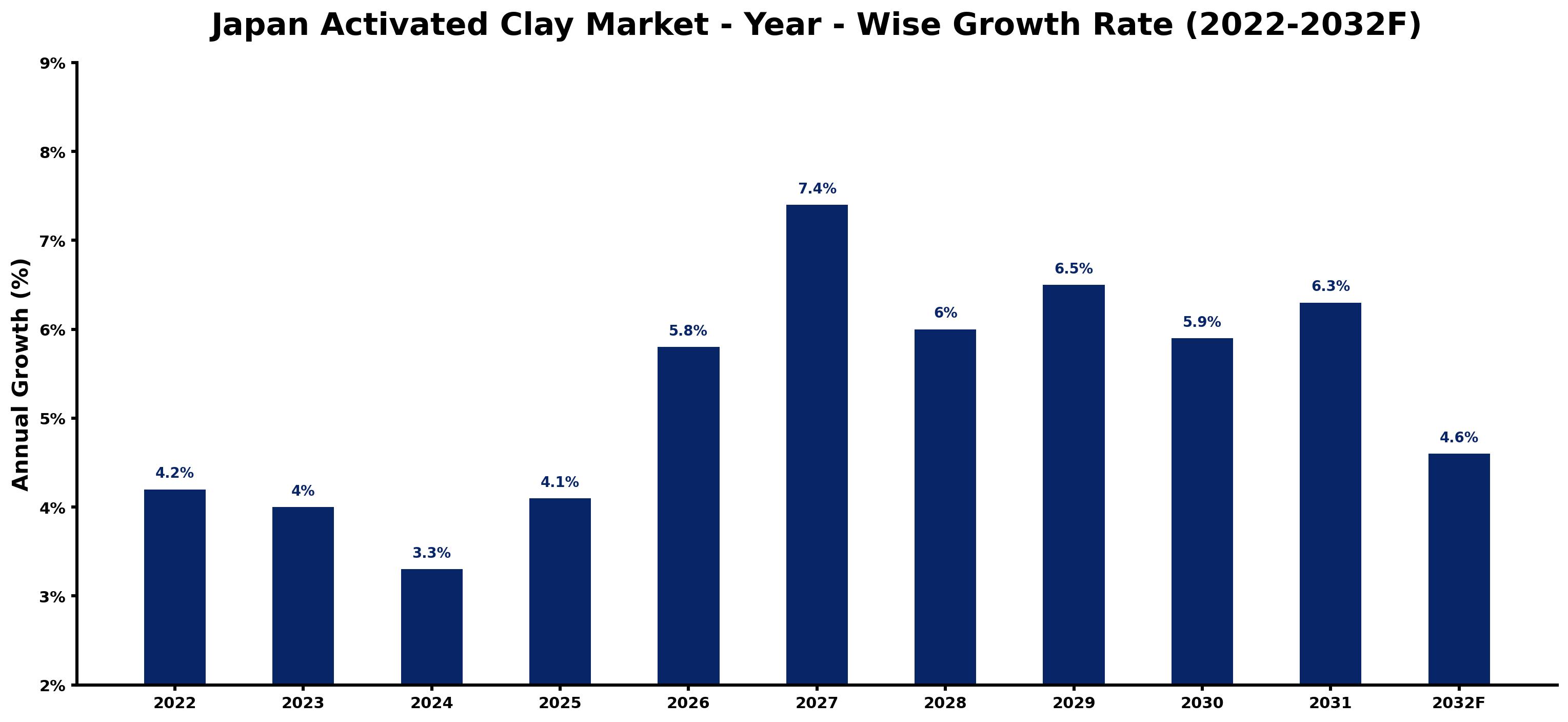
Below, each year's estimated growth is shown next to the factor that most influenced it.
| Year | Estimated Annual Growth (%) | Market Rationale |
| 2022 | 4.2 | The market experienced solid growth due to stable demand in the oil refining sector. |
| 2023 | 4.0 | Growth slowed slightly as the oil refining industry faced operational challenges. |
| 2024 | 3.3 | The market continued to grow, but at a slower pace amid competitive pressures. |
| 2025 | 4.1 | Growth accelerated as refiners increased their use of activated clay for oil purification. |
| 2026 | 5.8 | Demand is likely to rise sharply as investments in food processing technologies expand. |
| 2027 | 7.4 | The market is expected to peak due to heightened activity in the oil refining sector. |
| 2028 | 6.0 | Growth will decelerate as market saturation begins to affect purchasing patterns. |
| 2029 | 6.5 | Demand is anticipated to increase as the food and beverage sector expands production capabilities. |
| 2030 | 5.9 | Growth will moderate as refiners adjust to market conditions and supply chains. |
| 2031 | 6.3 | The market is set to see renewed growth driven by rising demand in the cosmetic industry. |
| 2032 | 4.6 | Growth is projected to slow again as market conditions stabilise with established players. |
Note: Market size estimations and growth projections presented in this report are based on 6Wresearch's proprietary forecasting methodology, utilizing the latest available industry data, government publications, and primary research inputs.
Japan Activated Clay Market Synopsis
Activated clay, produced from bentonite through drying and acid treatment, is essential for decolorizing liquids, refining oils, and filtration. The Japan Activated Clay Market is expanding due to strong demand from the oil refining and food processing sectors, with the oil refining industry valued at over 3 trillion JPY. The increasing focus on sustainable practices and the adoption of ISO 9001 standards are driving investments in production and technology, further boosting demand from domestic users.
Market Dynamics Impact Analysis (2026–2032)
| Factor | Type | Impact | Primary Segment Affected |
| Rising demand from the oil refining industry due to increased production capacity. | Driver | High | Bleaching Earth |
| Expansion of the food and beverage sector requiring high-quality purification processes. | Driver | High | Acid-Activated Clay |
| Growing interest in eco-friendly products among consumers in Japan. | Opportunity | Medium | Calcium Bentonite |
| Emerging applications of activated clay in the cosmetic industry driven by natural ingredient trends. | Opportunity | Medium | Natural Clay |
| High production costs due to stringent quality standards and regulations. | Restraint | High | Activated Bentonite |
| Limited availability of raw materials in certain regions affecting supply. | Restraint | Medium | Fuller's Earth |
| Intense competition among suppliers leading to price wars. | Challenge | High | Acid-Activated Clay |
| Technological advancements requiring significant investment for adaptation. | Challenge | Medium | Bleaching Earth |
Evaluation of Drivers in Japan Activated Clay Market (2026–2032)
Key forces behind demand, with the segment each one moves most, are listed below.
| Drivers | Primary Segment Affected | Why It Matters (Evidence) |
| Increased oil refining capacity requiring more activated clay for purification processes. | Bleaching Earth | The oil refining industry in Japan is valued at over 3 trillion JPY, driving demand for activated clay. |
| Expansion of food processing facilities necessitating high-quality filtration aids. | Acid-Activated Clay | The food and beverage sector employs over 1.5 million people, increasing the need for activated clay. |
| Growing consumer preference for natural ingredients in personal care products. | Calcium Bentonite | The cosmetic industry in Japan is projected to reach 3 trillion JPY by 2025, boosting demand. |
| Rising environmental awareness leading to sustainable mining practices. | Natural Clay | The Japanese government promotes eco-friendly materials, encouraging the use of activated clay. |
| Technological advancements in production methods improving efficiency. | Activated Bentonite | ISO 9001 standards are being adopted, improving production quality and increasing demand. |
Orders keep climbing as the oil refining sector expands, necessitating more activated clay for purification. The sector, valued at over 3 trillion JPY, drives demand. The food processing industry, employing over 1.5 million people, is increasing its use of activated clay for filtration. The cosmetic industry is expected to reach 3 trillion JPY by 2025, further boosting demand for natural ingredients. The promotion of sustainable mining practices is increasing the market's growth potential.
Evaluation of Restraints in Japan Activated Clay Market
The following restraints limit how fast demand can grow.
| Market Restraint | Primary Segment Affected | Why It Matters (Evidence) |
| High production costs due to stringent quality regulations. | Activated Bentonite | The activation process requires substantial investment, impacting profitability for producers. |
| Limited availability of quality raw materials in specific regions. | Fuller's Earth | Natural clay sourcing from regions like Akita Prefecture can restrict supply. |
| Intense competition leading to price wars among suppliers. | Acid-Activated Clay | Price reductions affect profit margins and threaten sustainability for smaller producers. |
| Technological advancements require substantial investment for adaptation. | Bleaching Earth | Staying competitive necessitates costly upgrades to production facilities. |
| Market saturation affecting new entrants' ability to compete. | Natural Clay | Established players dominate the market, making it difficult for newcomers. |
Japan Activated Clay Market Challenges
Japan's oil refining sector struggles with a shortage of skilled workers, causing production delays that increase operational costs for producers. Local suppliers face intense competition from imported products, compelling them to cut prices, which diminishes profit margins and restricts their ability to invest in improvements. Producers are unable to keep pace with rapid technological advancements in clay processing, resulting in inefficiencies that hinder their competitiveness. Rising costs associated with sourcing natural clay from the Akita Prefecture are burdening buyers, as the annual demand for bleaching earth is estimated at 100,000 tons, driving up overall expenses.
Trends in the Japan Activated Clay Market
The following changes are redrawing the Japan Activated Clay Market.
- Shift Towards Sustainable Practices: The GX Promotion Act, introduced in 2023, encourages eco-friendly materials in production. This initiative will drive demand for activated clay, aligning with sustainability goals and creating new market opportunities.
- Food Processing Sector Expansion: The food and beverage industry is increasingly adopting activated clay for oil purification, with over 1.5 million employees driving demand. This trend will elevate the market as companies seek quality assurance.
- Rising Demand in Cosmetics: The cosmetic industry is projected to reach 3 trillion JPY by 2025, resulting in a surge in demand for natural ingredients like calcium bentonite. This shift is reshaping supplier strategies to meet evolving consumer preferences.
- Technological Advancements in Production: The adoption of ISO 9001 standards is improving production quality in activated clay manufacturing. This trend will enhance operational efficiencies and attract more buyers seeking certified products.
Investment Opportunities in the Japan Activated Clay Market
Below are the investment opportunities with the strongest case in the Japan Activated Clay Market.
- Timing for Investment in Eco-Friendly Materials: With the GX Promotion Act encouraging sustainable practices, there is a growing market for eco-friendly activated clay. This presents an opportunity for suppliers to target the oil refining industry, valued at over 3 trillion JPY.
- Partnerships for Market Entry: Collaborating with local industrial suppliers can facilitate entry into the activated clay market. This strategy is particularly advantageous in regions like Kanto, where production is concentrated.
- Gap in Supply for High-Quality Products: The annual demand for bleaching earth in Japan is estimated at 100,000 tons, indicating a supply gap. Suppliers can capitalise on this by offering high-quality activated clay products to the food and beverage sector.
- Focus on Urban Specialty Stores: Specialty stores in urban areas are emerging as key distribution channels for activated clay products. Investing in these locations can help reach niche markets effectively.
Government Initiatives in the Japan Activated Clay Market
The GX Promotion Act, introduced in 2023, complements previous regulations by mandating eco-friendly practices in production. This law supports the Food Sanitation Act amendment from 2018, which established hygiene management standards for food businesses, ensuring safer products for consumers.
The Food Safety Commission of Japan oversees regulations for food-grade activated clay, ensuring compliance with safety standards. The Japan Clay Association supports research and development, funding projects aimed at improving clay technologies and promoting sustainable practices.
Future Insight of the Japan Activated Clay Market
Investment in eco-friendly materials will surge, creating strong demand for activated clay across various sectors. Processing technologies will evolve, improving the efficiency of clay activation and reducing production costs for suppliers. Stricter quality standards will be implemented, ensuring that buyers receive superior products. The government's initiative to promote sustainable mining practices will lead to more responsible sourcing, benefiting both producers and consumers.
Market Segmentation Analysis
Japan Activated Clay Market report covers a detailed analysis of the following market segments:
By Product Type – Bleaching Earth Leads, Fuller's Earth Expected to Grow Fastest
According to Saurav Kr Singh, Senior Research Analyst at 6Wresearch, in 2025, Bleaching Earth led the product type split with a 53% share. Bleaching Earth holds the largest share due to its essential role in decolorizing oils and fats, which is crucial for the oil refining industry. It is used in over 80% of oil refining processes in Japan, underscoring its importance in this sector. The quickest growth will come from Fuller's Earth, forecast to expand at a CAGR of 8.3% between 2026 and 2032. Fuller's Earth is witnessing rapid growth as it is increasingly utilised in various industrial applications, driven by a surge in demand for versatile materials. The expansion of industries requiring filtration aids is propelling its swift adoption in recent years. Suppliers should prioritise enhancing production capabilities to meet the rising demand for Fuller's Earth.
By Material Type – Natural Clay Leads, Calcium Bentonite Expected to Grow Fastest
With 41% of material type revenue in 2025, Natural Clay was the largest category. Natural Clay leads the market due to its extensive applications in construction and pottery, making it a fundamental resource across multiple sectors. Its abundant sourcing from regions like the Akita Prefecture supports its widespread use in Japan. Over 2026–2032, Calcium Bentonite is expected to post the fastest growth, at a CAGR of 8.8%. Calcium Bentonite is rapidly gaining traction owing to its direct applications in cosmetics and pharmaceuticals, sectors currently experiencing significant growth. The cosmetic industry's projected expansion to 3 trillion JPY by 2025 is a key factor driving this segment's rapid increase. Buyers in the cosmetics sector should consider establishing long-term contracts for Calcium Bentonite to ensure a stable supply.
By Distribution Channel – Direct Sales Leads, Industrial Suppliers Expected to Grow Fastest
The largest distribution channel category in 2025 was Direct Sales, at 36% of revenue. Direct Sales is the leading distribution channel as it enables direct interactions between suppliers and buyers, which is vital for industrial transactions. This method allows for tailored solutions that meet the specific needs of large-scale users in the activated clay market. Industrial Suppliers are projected to grow fastest, at a CAGR of 7.9% during 2026–2032. Industrial Suppliers are rapidly increasing their market presence as they serve as the primary source for businesses needing bulk materials. The growing reliance on these suppliers for dependable deliveries and consistent quality is accelerating their market share. Suppliers should focus on strengthening partnerships with industrial suppliers to enhance market access and customer service.
By End User – Oil Refining Industry Leads, Food & Beverage Industry Expected to Grow Fastest
Oil Refining Industry took 48% of end user revenue in 2025, more than any other category. The Oil Refining Industry is the largest end user of activated clay, consuming it extensively for oil purification processes. This sector's valuation at over 3 trillion JPY underscores its critical demand for activated clay products. Food & Beverage Industry is set to record the highest CAGR in this split, 7.8% over 2026–2032. The Food & Beverage Industry is the fastest-growing end user, utilising activated clay for oil purification in food processing. The employment of over 1.5 million people in this sector indicates its substantial scale and potential for growth. Suppliers should target the food and beverage sector to capitalise on its increasing demand for activated clay.
Key Attractiveness of the Report
- 10 Years of Market Numbers
- Historical Data Starting from 2022 to 2025
- Base Year 2025
- Forecast Data until 2032
- Key Performance Indicators Impacting the Market
- Major Upcoming Developments and Projects
Key Highlights of the Report:
- Japan Activated Clay Market Outlook
- Market Size of Japan Activated Clay Market, 2025
- Forecast of Japan Activated Clay Market, 2032
- Historical Data and Forecast of Japan Activated Clay Revenues & Volume for the Period 2022-2032F
- Japan Activated Clay Market Trend Evolution
- Japan Activated Clay Market Drivers and Challenges
- Japan Activated Clay Price Trends
- Japan Activated Clay Porter's Five Forces
- Japan Activated Clay Industry Life Cycle
- Historical Data and Forecast of Japan Activated Clay Market Revenues & Volume By Product Type for the Period 2022-2032F
- Historical Data and Forecast of Japan Activated Clay Market Revenues & Volume By Bleaching Earth for the Period 2022-2032F
- Historical Data and Forecast of Japan Activated Clay Market Revenues & Volume By Fuller's Earth for the Period 2022-2032F
- Historical Data and Forecast of Japan Activated Clay Market Revenues & Volume By Activated Bentonite for the Period 2022-2032F
- Historical Data and Forecast of Japan Activated Clay Market Revenues & Volume By Acid-Activated Clay for the Period 2022-2032F
- Historical Data and Forecast of Japan Activated Clay Market Revenues & Volume By Material Type for the Period 2022-2032F
- Historical Data and Forecast of Japan Activated Clay Market Revenues & Volume By Natural Clay for the Period 2022-2032F
- Historical Data and Forecast of Japan Activated Clay Market Revenues & Volume By Calcium Bentonite for the Period 2022-2032F
- Historical Data and Forecast of Japan Activated Clay Market Revenues & Volume By Sodium Bentonite for the Period 2022-2032F
- Historical Data and Forecast of Japan Activated Clay Market Revenues & Volume By Montmorillonite for the Period 2022-2032F
- Historical Data and Forecast of Japan Activated Clay Market Revenues & Volume By Distribution Channel for the Period 2022-2032F
- Historical Data and Forecast of Japan Activated Clay Market Revenues & Volume By Direct Sales for the Period 2022-2032F
- Historical Data and Forecast of Japan Activated Clay Market Revenues & Volume By Industrial Suppliers for the Period 2022-2032F
- Historical Data and Forecast of Japan Activated Clay Market Revenues & Volume By Online Platforms for the Period 2022-2032F
- Historical Data and Forecast of Japan Activated Clay Market Revenues & Volume By Specialty Stores for the Period 2022-2032F
- Historical Data and Forecast of Japan Activated Clay Market Revenues & Volume By End User for the Period 2022-2032F
- Historical Data and Forecast of Japan Activated Clay Market Revenues & Volume By Oil Refining Industry for the Period 2022-2032F
- Historical Data and Forecast of Japan Activated Clay Market Revenues & Volume By Food & Beverage Industry for the Period 2022-2032F
- Historical Data and Forecast of Japan Activated Clay Market Revenues & Volume By Cosmetic Industry for the Period 2022-2032F
- Historical Data and Forecast of Japan Activated Clay Market Revenues & Volume By Chemical Manufacturing for the Period 2022-2032F
- Japan Activated Clay Import Export Trade Statistics
- Market Opportunity Assessment By Product Type
- Market Opportunity Assessment By Material Type
- Market Opportunity Assessment By Distribution Channel
- Market Opportunity Assessment By End User
- Japan Activated Clay Top Companies Market Share
- Japan Activated Clay Competitive Benchmarking By Technical and Operational Parameters
- Japan Activated Clay Company Profiles
- Japan Activated Clay Key Strategic Recommendations
Market Covered
Segments analysed in this report are listed below.
By Product Type
- Bleaching Earth
- Fuller's Earth
- Activated Bentonite
- Acid-Activated Clay
By Material Type
- Natural Clay
- Calcium Bentonite
- Sodium Bentonite
- Montmorillonite
By Distribution Channel
- Direct Sales
- Industrial Suppliers
- Online Platforms
- Specialty Stores
By End User
- Oil Refining Industry
- Food & Beverage Industry
- Cosmetic Industry
- Chemical Manufacturing































