Japan Actuator Feedback Control Market Size & Growth Rate
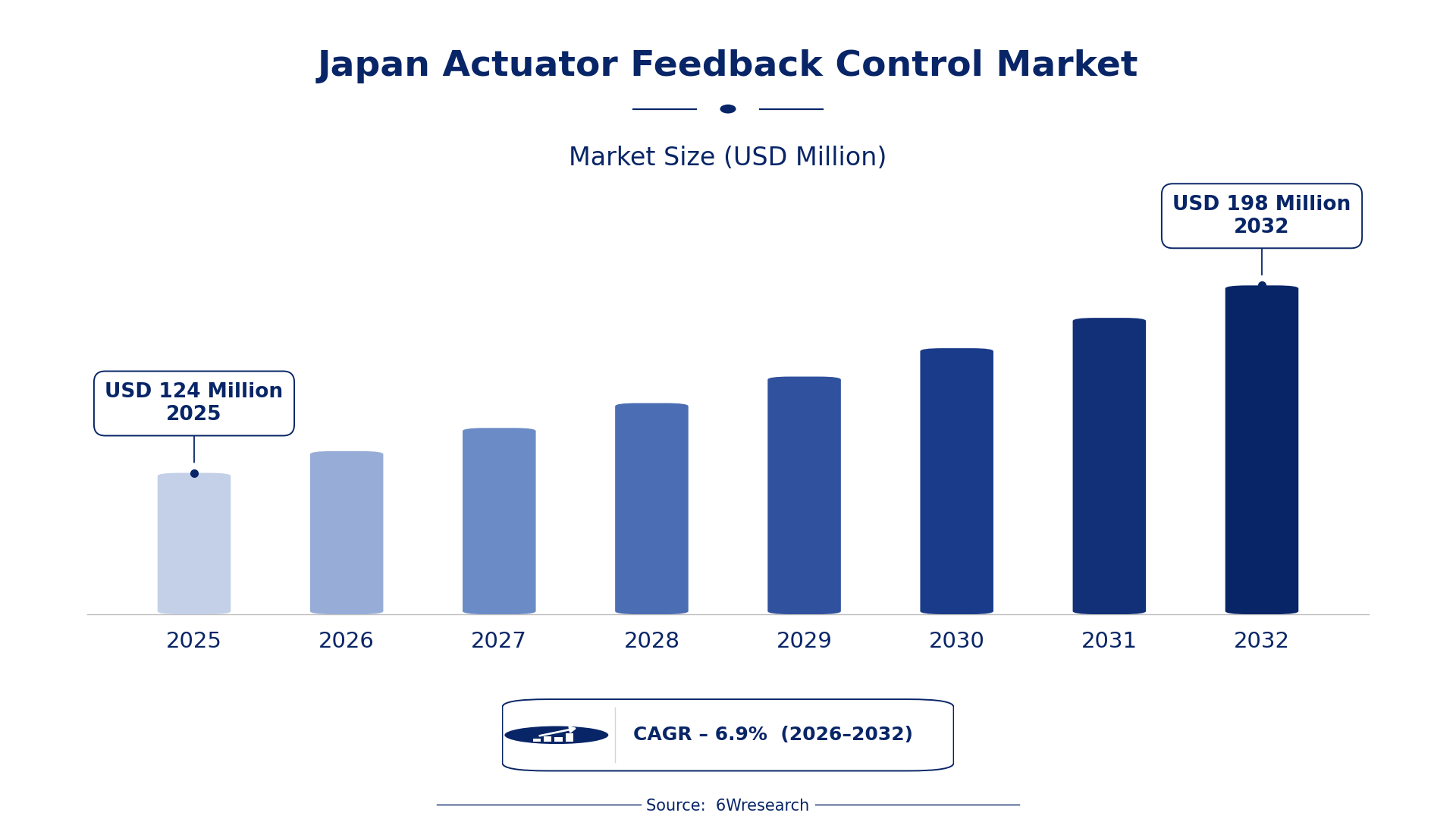
According to 6Wresearch internal database and industry insights, the Japan Actuator Feedback Control Market was valued at USD 124 Million in 2025 and is projected to reach USD 198 Million by 2032, growing at a CAGR of approximately 6.9% during 2026–2032.
Japan Actuator Feedback Control Market Highlights
| Report Metric | Details |
| Report Name | Japan Actuator Feedback Control Market (2026-2032) |
| Market Size 2025 | USD 124 Million |
| Market Size 2032 | USD 198 Million |
| Absolute Growth 2025–2032 | USD 74 Million |
| CAGR 2026–2032 | 6.9% |
| Peak Annual Growth | 7.8% in 2032 |
| Forecast Period | 2026–2032 |
| Historical Data | 2022–2025 |
| Base Year | 2025 |
| Leading Actuator Type, 2025 | Linear Actuators (38% share) |
| Leading Feedback System, 2025 | Sensor-Based (45% share) |
| Leading Distribution Channel, 2025 | Direct Sales (47% share) |
| Leading End User, 2025 | Industrial Robotics (52% share) |
| Fastest-Growing Actuator Type | Servo Actuators (10.2% CAGR) |
| Fastest-Growing Feedback System | Closed Loop System (9.9% CAGR) |
| Fastest-Growing Distribution Channel | Online Platforms (9.2% CAGR) |
| Fastest-Growing End User | Mechatronic Systems (9.3% CAGR) |
| Growing Sector | Industrial Robotics |
| Key End Users | Manufacturers, Robotics Engineers, Industrial Suppliers, Automation Firms |
Japan Actuator Feedback Control Market Year-wise Growth Rate and Key Drivers (2022–2032)
This graph illustrates the annual growth rates of the market from 2022 to 2032, highlighting a steady upward trajectory and projected market expansion over the forecast period.
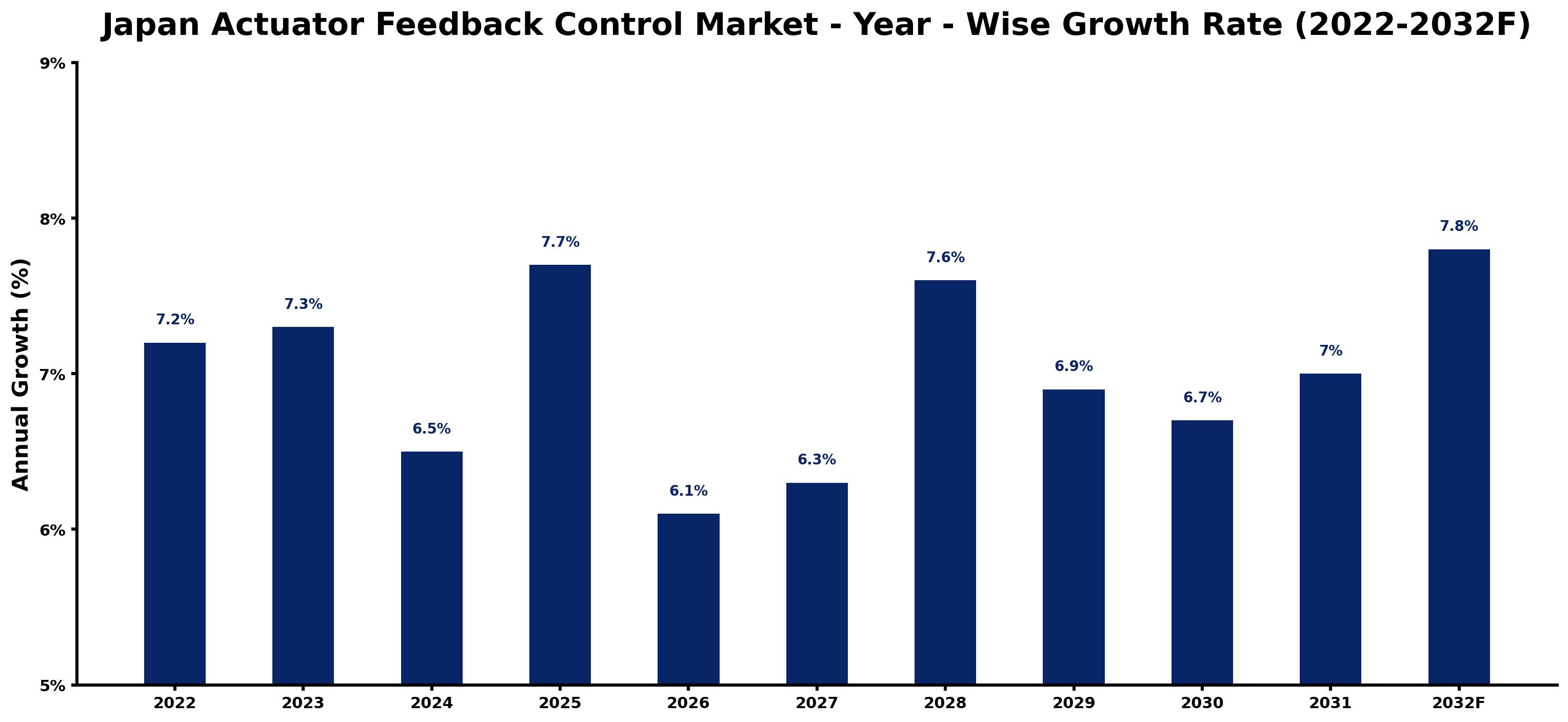
Year by year, the estimates below pair each growth rate with the development that shaped it.
| Year | Estimated Annual Growth (%) | Market Rationale |
| 2022 | 7.2 | The market experienced solid demand from industrial robotics and automation sectors. |
| 2023 | 7.3 | Growth continued, supported by increased investments in manufacturing technologies. |
| 2024 | 6.5 | A slowdown occurred as investments stabilised, but demand remained strong. |
| 2025 | 7.7 | The market rebounded with heightened interest in automation and robotics. |
| 2026 | 6.1 | Growth is expected to slow as the market adjusts to previous peaks in demand. |
| 2027 | 6.3 | An increase in investments is projected to revitalise growth in automation technologies. |
| 2028 | 7.6 | Demand is expected to surge as companies adopt advanced robotics solutions. |
| 2029 | 6.9 | Growth is projected to slow again as market saturation begins to take effect. |
| 2030 | 6.7 | The market is expected to continue growing, albeit at a slower pace due to maturity. |
| 2031 | 7.0 | Increased investments in smart factories will boost market activity. |
| 2032 | 7.8 | The market is projected to peak as demand for automation reaches new heights. |
Note: Market size estimations and growth projections presented in this report are based on 6Wresearch's proprietary forecasting methodology, utilizing the latest available industry data, government publications, and primary research inputs.
Japan Actuator Feedback Control Market Synopsis
Actuator feedback control systems are essential components in automation technology, utilising sensors and controllers for precise movement and positioning. The Japan Actuator Feedback Control Market is expanding due to rising investments in automation, particularly from the industrial robotics sector valued at approximately ¥1 trillion. The Tokyo region is a hub for electronics manufacturing, contributing significantly to actuator demand, supported by government initiatives aimed at increasing automation by 30% by 2025. This growth results from strong domestic demand and continuous advancements in manufacturing processes.
Market Dynamics Impact Analysis (2026–2032)
| Factor | Type | Impact | Primary Segment Affected |
| Increased investments in automation technologies drive demand for actuator feedback control systems. | Driver | High | Sensor-Based |
| The growing need for precision in robotics applications creates opportunities for actuator systems. | Driver | High | Servo Actuators |
| Rising energy efficiency concerns lead to increased demand for electric actuators. | Opportunity | High | Electric Actuators |
| The push for smart factories opens avenues for advanced actuator technologies. | Opportunity | High | Closed Loop System |
| Market saturation in certain sectors limits growth potential for manufacturers. | Restraint | Medium | Linear Actuators |
| High initial costs of automation systems can deter small manufacturers from investing. | Restraint | Medium | Industrial Robotics |
| Shortages of skilled robotics engineers hinder project timelines and innovation. | Challenge | High | Industrial Robotics |
| Competition from international manufacturers pressures local pricing strategies. | Challenge | High | Servo Actuators |
Evaluation of Drivers in Japan Actuator Feedback Control Market (2026–2032)
Key forces behind demand, with the segment each one moves most, are listed below.
| Drivers | Primary Segment Affected | Why It Matters (Evidence) |
| Rising investments in manufacturing technologies increase actuator demand. | Electric Actuators | The Japanese government aims to boost automation in manufacturing by 30% by 2025. |
| Growing industrial robotics sector drives actuator system purchases. | Servo Actuators | Japan had over 200,000 industrial robots in operation in 2022. |
| Adoption of ISO 9001 standards improves actuator quality and reliability. | Sensor-Based | This standard enhances quality assurance in actuator manufacturing processes. |
| Increased focus on energy efficiency promotes electric actuator use. | Electric Actuators | The demand for electric actuators is rising due to energy efficiency concerns. |
| The expansion of smart factories boosts actuator feedback control system requirements. | Closed Loop System | In 2023, Japan launched a new initiative to promote smart factories. |
Spending rises because investments in manufacturing technologies are increasing, leading to higher demand for electric actuators. The industrial robotics sector, with over 200,000 robots in operation, drives actuator system purchases, particularly in servo actuators. The adoption of quality standards is improving actuator reliability, encouraging further investments in automation technology. These developments support a thriving actuator feedback control market.
Evaluation of Restraints in Japan Actuator Feedback Control Market
The main factors holding the market back are set out below.
| Market Restraint | Primary Segment Affected | Why It Matters (Evidence) |
| Market saturation limits growth potential for actuator manufacturers. | Linear Actuators | The Japanese market is experiencing saturation in certain actuator segments. |
| High initial costs deter small manufacturers from investing in automation. | Industrial Robotics | Investment barriers prevent smaller firms from adopting new technologies. |
| Shortages of skilled robotics engineers delay project timelines. | Servo Actuators | The average annual salary for robotics engineers is around ¥6 million. |
| Intense competition from international manufacturers pressures pricing strategies. | Sensor-Based | Local manufacturers face challenges from lower-cost foreign competitors. |
| Regulatory compliance costs can be burdensome for small producers. | Closed Loop System | Compliance with JIS standards increases operational costs for manufacturers. |
Japan Actuator Feedback Control Market Challenges
High demand for skilled robotics engineers creates a talent shortage, as the average annual salary of ¥6 million deters new entrants. Local producers face fierce competition from international markets, compelling them to lower prices and squeeze profit margins. Rising material costs due to inflation pressure budgets for manufacturers, resulting in project delays for buyers. Compliance with JIS standards incurs additional costs, prolonging product launch timelines for suppliers by several months and reducing their market competitiveness.
Trends in the Japan Actuator Feedback Control Market
Below are the shifts with the largest effect on the Japan Actuator Feedback Control Market.
- Shift towards Smart Factories: Japan launched a new initiative in 2023 to promote smart factories, aiming to improve automation across sectors. This initiative is expected to drive the adoption of advanced actuator systems, with projected funding of ¥50 billion.
- Transition from Traditional to Energy-Efficient Actuators: The demand for electric actuators is increasing due to energy efficiency concerns, particularly in manufacturing. This shift is evident in the growing use of electric actuators across various sectors, including automotive manufacturing.
- Emergence of Closed Loop Systems: Closed loop systems are gaining popularity as manufacturers seek greater precision and control in automation. The growth rate for this segment is projected at 9.9% between 2026 and 2032, driven by technological advancements.
- Increased Adoption of ISO 9001 Standards: More manufacturers are embracing ISO 9001 standards to enhance actuator quality. This trend is particularly noticeable in the electronics manufacturing sector, which employs over 1 million workers in Japan.
Investment Opportunities in the Japan Actuator Feedback Control Market
The openings below show where demand in the Japan Actuator Feedback Control Market is visible and how suppliers can enter.
- Supply Electric Actuators: The rising demand for electric actuators presents a strong opportunity, with the market expected to grow significantly. Collaborating with industrial robotics firms in the Tokyo region could ease entry into this expanding market.
- Invest in Closed Loop Systems: The growing interest in precision control systems creates an opportunity for investment in closed loop systems. Targeting the automation systems sector, particularly in the Tokyo metropolitan area, can yield substantial returns.
- Provide Sensor-Based Solutions: The increasing need for high-quality actuator systems opens avenues for supplying sensor-based solutions. Engaging with industrial suppliers can facilitate penetration into this promising market segment.
- Develop Advanced Manufacturing Technologies: The Japanese government's allocation of ¥50 billion for advanced manufacturing technologies indicates a strong opportunity. Partnering with local firms can improve market entry and collaboration.
Government Initiatives in the Japan Actuator Feedback Control Market
The Industrial Standardization Act, amended and renamed in 2019, governs JIS product and test standards for actuator feedback control systems. Compliance with these standards ensures safety and quality in actuator manufacturing, which is important for buyers seeking reliable products. The Electrical Appliance and Material Safety Act regulates the safety of electrical appliances and materials, ensuring that manufacturers adhere to safety protocols and standards.
The Ministry of Economy, Trade and Industry oversees various funding programs that support automation initiatives. In 2023, the ministry allocated ¥50 billion to promote advanced manufacturing technologies, benefiting producers and improving the overall market.
Future Insight of the Japan Actuator Feedback Control Market
Manufacturers will increasingly concentrate on smart factory initiatives, improving automation capabilities for buyers. The government aims to elevate automation in manufacturing by 30% by 2025, creating new opportunities for suppliers. A projected 15% increase in robotics investments will stimulate advancements in actuator technology. As the demand for energy-efficient actuators grows, the electronics manufacturing sector will adapt, benefiting both buyers and suppliers.
Market Segmentation Analysis
Japan Actuator Feedback Control Market report covers a detailed analysis of the following market segments:
By Actuator Type – Linear Actuators Lead, Servo Actuators Expected to Grow Fastest
According to Saurav Kr Singh, Senior Research Analyst at 6Wresearch, Linear Actuators took 38% of actuator type revenue in 2025, more than any other category. Linear actuators hold a dominant position in the market due to their critical role in providing precise linear motion for automation applications. Their extensive deployment in Japan's manufacturing sector, especially in the Tokyo region, underscores their importance and widespread acceptance. Servo Actuators are projected to grow fastest, at a CAGR of 10.2% during 2026–2032. The rapid growth of servo actuators is fuelled by the increasing need for high-precision control in advanced automation applications. Their adoption in automotive manufacturing processes is a key factor driving this growth, indicating a trend that will likely continue. Suppliers should prioritise the development of servo actuator technologies to meet the rising demand in precision applications.
By Feedback System – Sensor-Based Leads, Closed Loop System Expected to Grow Fastest
The largest feedback system category in 2025 was Sensor-Based, at 45% of revenue. Sensor-based feedback systems are crucial for ensuring precise control in automation, making them essential components in actuator applications. Their widespread implementation across various industries, particularly in robotics, reinforces their leading position in the market. Closed Loop System is set to record the highest CAGR in this split, 9.9% over 2026–2032. The growth of closed loop systems is propelled by their effectiveness in maintaining control accuracy, which is vital in dynamic operational environments. This is particularly relevant in sectors that prioritise precision, driving their rapid adoption. Buyers should integrate closed loop systems into their processes to improve control accuracy and operational efficiency.
By Distribution Channel – Direct Sales Leads, Online Platforms Expected to Grow Fastest
Direct Sales held 47% of the Japan Actuator Feedback Control Market by distribution channel in 2025. Direct sales remain the primary distribution channel for industrial actuators, enabling direct interaction between manufacturers and large-scale buyers. This method fosters strong relationships and a deeper understanding of customer needs within the industrial sector. The quickest growth will come from Online Platforms, forecast to expand at a CAGR of 9.2% between 2026 and 2032. Online platforms are emerging as a rapidly growing distribution channel, allowing suppliers to reach a broader customer base efficiently. The increasing preference for digital purchasing options is driving this trend as more buyers seek convenience. Suppliers must enhance their online sales strategies to capture the growing segment of customers who prefer digital purchasing.
By End User – Industrial Robotics Lead, Mechatronic Systems Expected to Grow Fastest
In 2025, Industrial Robotics led the end user split with a 52% share. Industrial robotics is the leading end user of actuator systems, primarily due to the sector's heavy reliance on automation technology for efficiency. The presence of over 200,000 operational industrial robots in Japan highlights the robust demand from this segment. Over 2026–2032, Mechatronic Systems are expected to post the fastest growth, at a CAGR of 9.3%. Mechatronic systems are experiencing significant growth as industries integrate mechanical and electronic systems for enhanced functionality. This trend is supported by increasing investments in robotics and automation technologies, indicating a strong future for this segment. Suppliers should tailor their product offerings to meet the specific needs of mechatronic systems to capitalise on this growth.
Key Attractiveness of the Report
- 10 Years of Market Numbers
- Historical Data Starting from 2022 to 2025
- Base Year 2025
- Forecast Data until 2032
- Key Performance Indicators Impacting the Market
- Major Upcoming Developments and Projects
Key Highlights of the Report:
- Japan Actuator Feedback Control Market Outlook
- Market Size of Japan Actuator Feedback Control Market, 2025
- Forecast of Japan Actuator Feedback Control Market, 2032
- Historical Data and Forecast of Japan Actuator Feedback Control Revenues & Volume for the Period 2022-2032F
- Japan Actuator Feedback Control Market Trend Evolution
- Japan Actuator Feedback Control Market Drivers and Challenges
- Japan Actuator Feedback Control Price Trends
- Japan Actuator Feedback Control Porter's Five Forces
- Japan Actuator Feedback Control Industry Life Cycle
- Historical Data and Forecast of Japan Actuator Feedback Control Market Revenues & Volume By Actuator Type for the Period 2022-2032F
- Historical Data and Forecast of Japan Actuator Feedback Control Market Revenues & Volume By Linear Actuators for the Period 2022-2032F
- Historical Data and Forecast of Japan Actuator Feedback Control Market Revenues & Volume By Rotary Actuators for the Period 2022-2032F
- Historical Data and Forecast of Japan Actuator Feedback Control Market Revenues & Volume By Servo Actuators for the Period 2022-2032F
- Historical Data and Forecast of Japan Actuator Feedback Control Market Revenues & Volume By Electric Actuators for the Period 2022-2032F
- Historical Data and Forecast of Japan Actuator Feedback Control Market Revenues & Volume By Feedback System for the Period 2022-2032F
- Historical Data and Forecast of Japan Actuator Feedback Control Market Revenues & Volume By Sensor-Based for the Period 2022-2032F
- Historical Data and Forecast of Japan Actuator Feedback Control Market Revenues & Volume By Encoder Feedback for the Period 2022-2032F
- Historical Data and Forecast of Japan Actuator Feedback Control Market Revenues & Volume By Closed Loop System for the Period 2022-2032F
- Historical Data and Forecast of Japan Actuator Feedback Control Market Revenues & Volume By PLC Integration for the Period 2022-2032F
- Historical Data and Forecast of Japan Actuator Feedback Control Market Revenues & Volume By Distribution Channel for the Period 2022-2032F
- Historical Data and Forecast of Japan Actuator Feedback Control Market Revenues & Volume By Direct Sales for the Period 2022-2032F
- Historical Data and Forecast of Japan Actuator Feedback Control Market Revenues & Volume By Online Platforms for the Period 2022-2032F
- Historical Data and Forecast of Japan Actuator Feedback Control Market Revenues & Volume By Industrial Suppliers for the Period 2022-2032F
- Historical Data and Forecast of Japan Actuator Feedback Control Market Revenues & Volume By Specialty Stores for the Period 2022-2032F
- Historical Data and Forecast of Japan Actuator Feedback Control Market Revenues & Volume By End User for the Period 2022-2032F
- Historical Data and Forecast of Japan Actuator Feedback Control Market Revenues & Volume By Industrial Robotics for the Period 2022-2032F
- Historical Data and Forecast of Japan Actuator Feedback Control Market Revenues & Volume By Automation Systems for the Period 2022-2032F
- Historical Data and Forecast of Japan Actuator Feedback Control Market Revenues & Volume By Electronics Manufacturing for the Period 2022-2032F
- Historical Data and Forecast of Japan Actuator Feedback Control Market Revenues & Volume By Mechatronic Systems for the Period 2022-2032F
- Japan Actuator Feedback Control Import Export Trade Statistics
- Market Opportunity Assessment By Actuator Type
- Market Opportunity Assessment By Feedback System
- Market Opportunity Assessment By Distribution Channel
- Market Opportunity Assessment By End User
- Japan Actuator Feedback Control Top Companies Market Share
- Japan Actuator Feedback Control Competitive Benchmarking By Technical and Operational Parameters
- Japan Actuator Feedback Control Company Profiles
- Japan Actuator Feedback Control Key Strategic Recommendations
Market Covered
Segments analysed in this report are listed below.
By Actuator Type
- Linear Actuators
- Rotary Actuators
- Servo Actuators
- Electric Actuators
By Feedback System
- Sensor-Based
- Encoder Feedback
- Closed Loop System
- PLC Integration
By Distribution Channel
- Direct Sales
- Online Platforms
- Industrial Suppliers
- Specialty Stores
By End User
- Industrial Robotics
- Automation Systems
- Electronics Manufacturing
- Mechatronic Systems































