Japan Actuators Market Size & Growth Rate
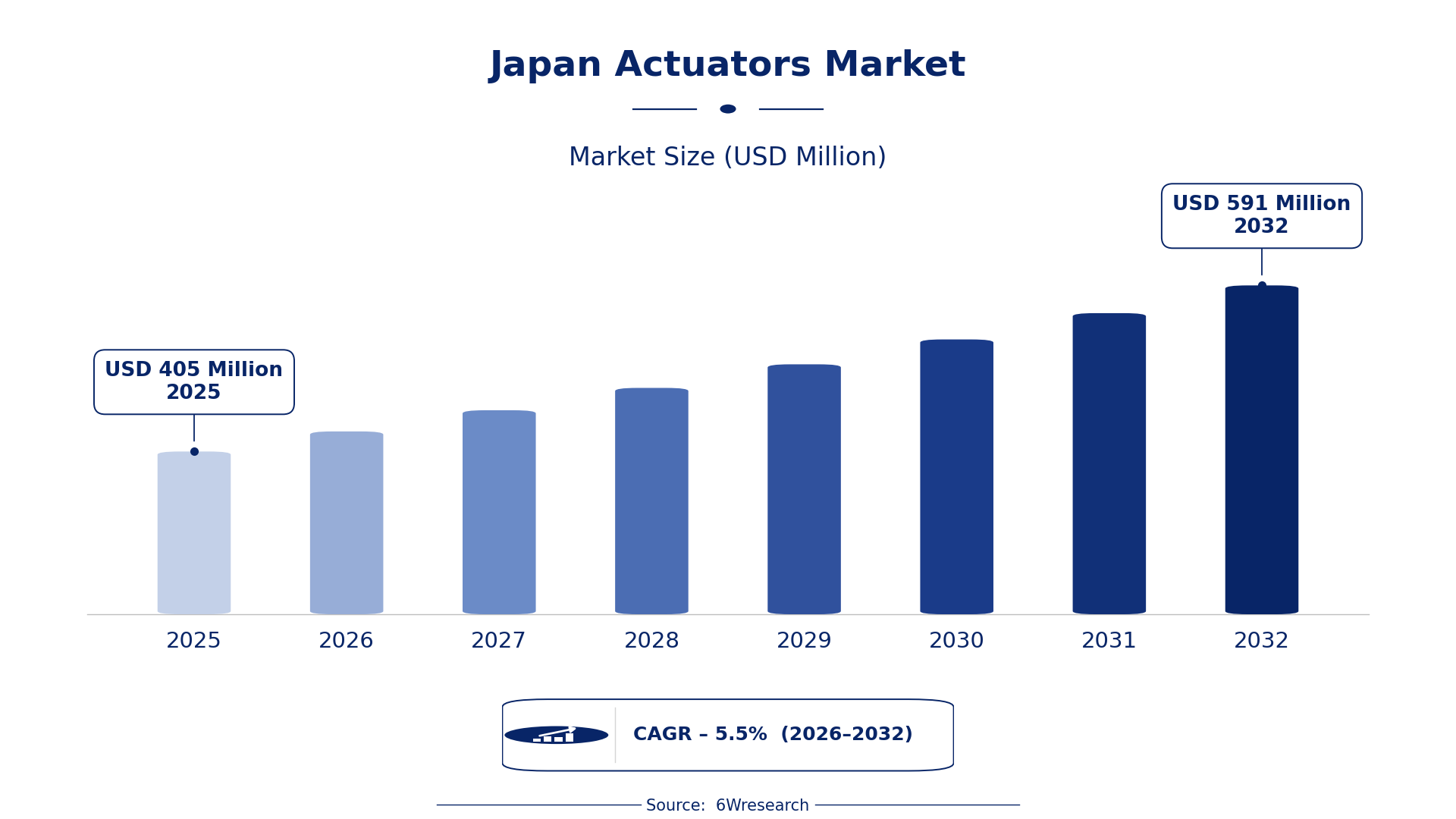
According to 6Wresearch internal database and industry insights, the Japan Actuators Market was valued at USD 405 Million in 2025 and is projected to reach USD 591 Million by 2032, growing at a CAGR of approximately 5.5% during 2026–2032.
Japan Actuators Market Highlights
| Report Metric | Details |
| Report Name | Japan Actuators Market (2026-2032) |
| Market Size 2025 | USD 405 Million |
| Market Size 2032 | USD 591 Million |
| Absolute Growth 2025–2032 | USD 186 Million |
| CAGR 2026–2032 | 5.5% |
| Peak Annual Growth | 6.4% in 2028 |
| Forecast Period | 2026–2032 |
| Historical Data | 2022–2025 |
| Base Year | 2025 |
| Leading Actuation, 2025 | Electrical (45% share) |
| Leading Application, 2025 | Industrial automation (48% share) |
| Leading Type, 2025 | Linear Actuator (67% share) |
| Leading Vertical, 2025 | Automotive (15% share) |
| Fastest-Growing Actuation | Pneumatic (7.0% CAGR) |
| Fastest-Growing Application | Robotics (7.3% CAGR) |
| Fastest-Growing Type | Rotary Actuator (7.2% CAGR) |
| Fastest-Growing Vertical | Pharmaceutical & Healthcare (7.5% CAGR) |
| Growing Sector | Industrial automation |
| Key End Users | Manufacturers, automotive sector, food and beverage producers, robotics developers |
Japan Actuators Market Year-wise Growth Rate and Key Drivers (2022–2032)
This graph illustrates the annual growth rates of the market from 2022 to 2032, highlighting a steady upward trajectory and projected market expansion over the forecast period.
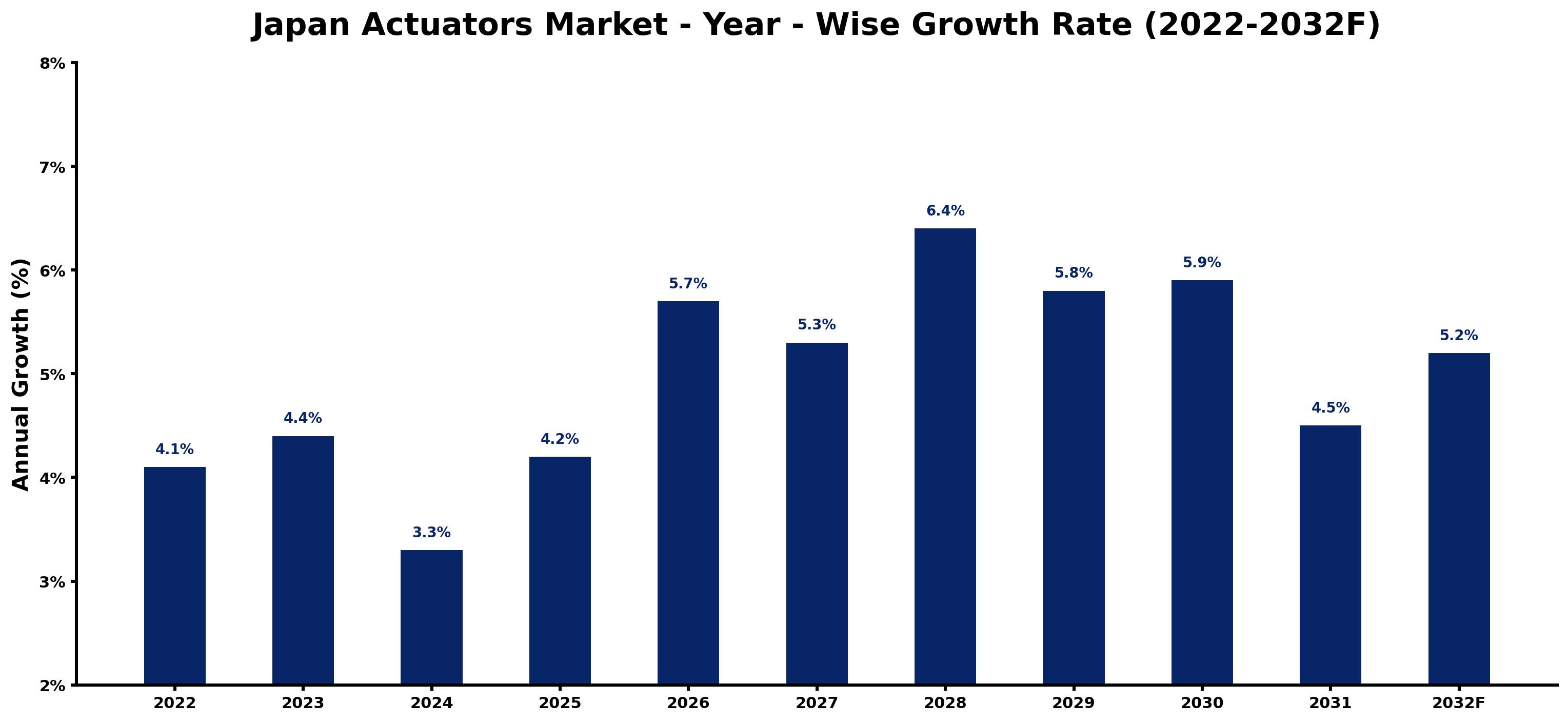
The table below sets out the estimated growth rate for each year and the main factor behind it.
| Year | Estimated Annual Growth (%) | Market Rationale |
| 2022 | 4.1 | The market showed steady growth, driven by industrial automation demand. |
| 2023 | 4.4 | Growth accelerated due to increased automation investments across sectors. |
| 2024 | 3.3 | Growth slowed slightly as some sectors adjusted to market conditions. |
| 2025 | 4.2 | Demand rose again as automation projects gained momentum in manufacturing. |
| 2026 | 5.7 | The market will expand further due to rising automation in robotics. |
| 2027 | 5.3 | Growth will moderate as some industries face supply chain challenges. |
| 2028 | 6.4 | The market will peak with substantial investments in smart manufacturing. |
| 2029 | 5.8 | Growth will decelerate as the market adjusts after the peak year. |
| 2030 | 5.9 | Demand will increase again, driven by ongoing automation initiatives. |
| 2031 | 4.5 | The market will experience a slowdown as growth stabilises. |
| 2032 | 5.2 | Demand is projected to rise as automation in healthcare expands. |
Note: Market size estimations and growth projections presented in this report are based on 6Wresearch's proprietary forecasting methodology, utilizing the latest available industry data, government publications, and primary research inputs.
Japan Actuators Market Synopsis
Actuators convert energy into motion and are essential in automation and control systems across various sectors. The Japan Actuators Market is supported by the industrial automation sector, which has a strong installed base. The automotive sector, with over 40 million vehicles, and the robotics industry, expected to reach 1 trillion yen by 2025, are key drivers of actuator demand. The food and beverage sector, valued at approximately 3 trillion yen, also contributes to market growth.
Market Dynamics Impact Analysis (2026–2032)
| Factor | Type | Impact | Primary Segment Affected |
| Increasing automation in manufacturing processes | Driver | High | Industrial automation |
| Rising demand for robotics in various applications | Driver | High | Robotics |
| Growing investments in automation technologies | Opportunity | High | Industrial automation |
| Expansion of the food and beverage sector | Opportunity | Medium | Food & Beverages |
| Supply chain disruptions affecting actuator availability | Restraint | High | Electrical |
| High costs associated with advanced actuator technologies | Restraint | Medium | Hydraulic |
| Competition from alternative automation solutions | Challenge | High | Robotics |
| Technological advancements leading to rapid changes | Challenge | Medium | Electrical |
Evaluation of Drivers in Japan Actuators Market (2026–2032)
The following drivers explain most of the expected growth.
| Drivers | Primary Segment Affected | Why It Matters (Evidence) |
| Rising investments in automation technologies | Industrial automation | The industrial automation sector is expanding, driving actuator demand with a significant installed base. |
| Expansion of the robotics industry | Robotics | Japan's robotics industry is projected to reach a market size of 1 trillion yen by 2025, increasing actuator usage. |
| Growth in the automotive sector | Vehicles and Equipment | The automotive sector, being one of the largest globally, contributes to actuator demand with over 40 million vehicles in operation. |
| Increasing automation in food and beverage processing | Food & Beverages | The food and beverage sector in Japan has a market size of approximately 3 trillion yen, driving actuator usage. |
| Demand for precision applications in manufacturing | Linear Actuator | Linear actuators are essential for CNC machines, which are integral to Japan's manufacturing processes. |
A wider customer base explains much of the growth, as the industrial automation sector is expanding, with a significant installed base. The robotics industry is expected to reach a market size of 1 trillion yen by 2025, which will increase actuator usage. The automotive sector contributes to actuator demand, with over 40 million vehicles relying on these devices. The food and beverage sector, valued at approximately 3 trillion yen, drives actuator usage in processing applications. Linear actuators are critical for precision applications in CNC machines, improving manufacturing efficiency.
Evaluation of Restraints in Japan Actuators Market
These restraints slow adoption and weigh on supplier margins.
| Market Restraint | Primary Segment Affected | Why It Matters (Evidence) |
| Supply chain disruptions affecting actuator availability | Electrical | Supply chain issues have led to delays in actuator availability, impacting production timelines for manufacturers. |
| High costs associated with advanced actuator technologies | Hydraulic | The high costs of hydraulic actuators limit their adoption in smaller manufacturing setups, affecting overall market growth. |
| Competition from emerging automation technologies | Robotics | Alternative automation technologies are gaining traction, which may divert investments away from traditional actuators. |
| Technological complexity in actuator integration | Pneumatic | The complexity of integrating pneumatic actuators into existing systems can deter potential buyers from investing. |
| Regulatory compliance costs for actuator manufacturers | Hydraulic | Manufacturers face costs to comply with testing standards, impacting their pricing strategies. |
Japan Actuators Market Challenges
High production costs challenge producers, arising from Japan's elevated labour and material prices, which can inflate actuator costs by up to 15%. Regulatory requirements, particularly the JIS B 8412 standard, complicate operations for importers, resulting in product launch delays that may last several months. Buyers encounter rising expenses due to increased demand from the expanding pharmaceutical sector, projected to grow to 1 trillion yen by 2025, necessitating budget adjustments for automation solutions. Intense competition among suppliers leads to price wars, eroding margins and potentially compromising the quality of actuators available in the market.
Trends in the Japan Actuators Market
Four trends stand out in the Japan Actuators Market.
- Shift towards Automation in Manufacturing: Manufacturers are increasingly adopting automation technologies, driven by the New Robot Strategy initiated in 2015. This shift is set to boost actuator demand, with the government targeting a 30% increase in automation by 2030.
- Transition from Traditional to Smart Robotics: The robotics sector is transitioning towards smart technologies, focusing on automation. By 2025, the robotics market is expected to reach 1 trillion yen, indicating a growing demand for advanced actuators.
- Emergence of Precision Applications in Manufacturing: Precision applications in manufacturing are gaining traction, particularly in CNC machining. The demand for linear actuators is rising as manufacturers seek improved accuracy and efficiency in production processes.
- Prioritisation of Energy Efficiency in Automation: There is a growing emphasis on energy efficiency within automation technologies. The Act on the Rational Use of Energy mandates improvements, driving demand for energy-efficient actuators.
Investment Opportunities in the Japan Actuators Market
The opportunities below stand out in the Japan Actuators Market for new entrants and existing suppliers.
- Automotive Sector Expansion: The automotive sector is set for growth, with over 40 million vehicles requiring actuators. Suppliers can enter this market by forming partnerships with local manufacturers to meet rising demand.
- Investment in Food and Beverage Automation: The food and beverage sector, valued at approximately 3 trillion yen, presents a strong opportunity. Suppliers can provide automation solutions by collaborating with processing facilities to improve efficiency.
- Growth in Pharmaceutical Automation: The expanding pharmaceutical sector is increasing the need for automation solutions. Suppliers can invest in actuator technologies to cater to this growing market, especially in production and laboratory settings.
- Investment in Robotics Technologies: The robotics industry is expected to reach 1 trillion yen by 2025, creating opportunities for actuator suppliers. Collaborating with robotics manufacturers can facilitate market entry and growth.
Government Initiatives in the Japan Actuators Market
The GX Promotion Act, introduced in 2023, aims to strengthen Japan's automation capabilities, building on the New Robot Strategy from 2015. This measure focuses on energy efficiency and sustainability in automation technologies, benefiting actuator manufacturers by promoting the adoption of advanced solutions.
The Ministry of Economy, Trade and Industry oversees the implementation of various automation initiatives, including funding for automation technologies. This agency supports projects that improve actuator usage in manufacturing, ensuring compliance with relevant standards and promoting innovation in the sector.
Future Insight of the Japan Actuators Market
By 2032, manufacturers will experience a shift towards advanced automation technologies, driven by government subsidies that aim to boost automation in manufacturing by 30% by 2030. The food and beverage sector will increasingly adopt precision automation, driving actuator demand and improving efficiency. Standards like ISO 9001 will gain traction, ensuring higher quality products for buyers. As Japan's robotics industry approaches a market size of 1 trillion yen by 2025, actuator usage will rise, improving operational capabilities across multiple sectors.
Market Segmentation Analysis
Japan Actuators Market report covers a detailed analysis of the following market segments:
By Actuation – Electrical Leads, Pneumatic Expected to Grow Fastest
According to Vasudha, AM at 6Wresearch, in 2025, Electrical led the actuation split with a 45% share. Electrical actuators command the largest share owing to their vital role in automation and control systems across diverse sectors. Their extensive use in industrial automation and robotics highlights their importance in enhancing operational efficiency. Pneumatic is projected to grow fastest, at a CAGR of 7.0% during 2026–2032. Pneumatic actuators are growing rapidly as they are essential for applications demanding quick movement and force, particularly in manufacturing environments. The increasing emphasis on automation within Japan's manufacturing sector is a significant factor propelling this growth. Suppliers should concentrate on enhancing pneumatic actuator offerings to capitalise on the burgeoning opportunities in this area.
By Application – Industrial automation Leads, Robotics Expected to Grow Fastest
Industrial automation held 48% of the Japan Actuators Market by application in 2025. Industrial automation holds the largest share as it is a major sector that utilises actuators for process control in various manufacturing processes. The strong installed base of automation technologies in Japan reinforces the dominance of this application. The quickest growth will come from Robotics, forecast to expand at a CAGR of 7.3% between 2026 and 2032. Robotics is the fastest-growing application due to its critical need for precise movement and control, particularly with the anticipated growth of Japan's robotics industry. This trend indicates a shift towards more sophisticated automation solutions. Buyers in the robotics sector should seek advanced actuator solutions to meet their evolving automation needs.
By Type – Linear Actuator Leads, Rotary Actuator Expected to Grow Fastest
Linear Actuator accounted for 67% of the market by type in 2025. Linear actuators lead the market as they are commonly employed in positioning and movement tasks, especially in CNC machines and various automation applications. Their precision and dependability make them a preferred choice in multiple industries. Rotary Actuator is set to record the highest CAGR in this split, 7.2% over 2026–2032. Rotary actuators are witnessing notable growth due to their critical function in applications needing rotational movement, which is increasingly sought in automation and robotics. This trend aligns with the wider shift towards automation across various sectors. Suppliers should prioritise the advancement of rotary actuator technologies to address the rising demand for rotational movement applications.
By Vertical – Automotive Leads, Pharmaceutical & Healthcare Expected to Grow Fastest
Automotive took 15% of vertical revenue in 2025, more than any other category. The automotive sector is the primary user of actuators, with their extensive use in vehicle systems for control and automation functions. The large vehicle population in Japan highlights the critical importance of actuators in this industry. Over 2026–2032, Pharmaceutical & Healthcare is expected to post the fastest growth, at a CAGR of 7.5%. The pharmaceutical and healthcare sectors are rapidly increasing their actuator usage, driven by the need for automation in production and laboratory environments. This growth is propelled by the ongoing expansion of the pharmaceutical industry in Japan. Suppliers should concentrate on the pharmaceutical sector to capitalise on the rising demand for automation solutions.
Key Attractiveness of the Report
- 10 Years of Market Numbers
- Historical Data Starting from 2022 to 2025
- Base Year 2025
- Forecast Data until 2032
- Key Performance Indicators Impacting the Market
- Major Upcoming Developments and Projects
Key Highlights of the Report:
- Japan Actuators Market Outlook
- Market Size of Japan Actuators Market, 2025
- Forecast of Japan Actuators Market, 2032
- Historical Data and Forecast of Japan Actuators Revenues & Volume for the Period 2022-2032
- Japan Actuators Market Trend Evolution
- Japan Actuators Market Drivers and Challenges
- Japan Actuators Price Trends
- Japan Actuators Porter's Five Forces
- Japan Actuators Industry Life Cycle
- Historical Data and Forecast of Japan Actuators Market Revenues & Volume By Actuation for the Period 2022-2032
- Historical Data and Forecast of Japan Actuators Market Revenues & Volume By Electrical for the Period 2022-2032
- Historical Data and Forecast of Japan Actuators Market Revenues & Volume By Pneumatic for the Period 2022-2032
- Historical Data and Forecast of Japan Actuators Market Revenues & Volume By Hydraulic for the Period 2022-2032
- Historical Data and Forecast of Japan Actuators Market Revenues & Volume By Others for the Period 2022-2032
- Historical Data and Forecast of Japan Actuators Market Revenues & Volume By Application for the Period 2022-2032
- Historical Data and Forecast of Japan Actuators Market Revenues & Volume By Industrial automation for the Period 2022-2032
- Historical Data and Forecast of Japan Actuators Market Revenues & Volume By Robotics for the Period 2022-2032
- Historical Data and Forecast of Japan Actuators Market Revenues & Volume By Vehicles and Equipment for the Period 2022-2032
- Historical Data and Forecast of Japan Actuators Market Revenues & Volume By Type for the Period 2022-2032
- Historical Data and Forecast of Japan Actuators Market Revenues & Volume By Linear Actuator for the Period 2022-2032
- Historical Data and Forecast of Japan Actuators Market Revenues & Volume By Rotary Actuator for the Period 2022-2032
- Historical Data and Forecast of Japan Actuators Market Revenues & Volume By Vertical for the Period 2022-2032
- Historical Data and Forecast of Japan Actuators Market Revenues & Volume By Food & Beverages for the Period 2022-2032
- Historical Data and Forecast of Japan Actuators Market Revenues & Volume By Oil & Gas for the Period 2022-2032
- Historical Data and Forecast of Japan Actuators Market Revenues & Volume By Metals, Mining, and Machinery for the Period 2022-2032
- Historical Data and Forecast of Japan Actuators Market Revenues & Volume By Power Generation for the Period 2022-2032
- Historical Data and Forecast of Japan Actuators Market Revenues & Volume By Chemicals, Paper, and Plastics for the Period 2022-2032
- Historical Data and Forecast of Japan Actuators Market Revenues & Volume By Pharmaceutical & Healthcare for the Period 2022-2032
- Historical Data and Forecast of Japan Actuators Market Revenues & Volume By Automotive for the Period 2022-2032
- Japan Actuators Import Export Trade Statistics
- Market Opportunity Assessment By Actuation
- Market Opportunity Assessment By Application
- Market Opportunity Assessment By Type
- Market Opportunity Assessment By Vertical
- Japan Actuators Top Companies Market Share
- Japan Actuators Competitive Benchmarking By Technical and Operational Parameters
- Japan Actuators Company Profiles
- Japan Actuators Key Strategic Recommendations
Market Covered
The study includes the following segmentation.
By Actuation
- Electrical
- Pneumatic
- Hydraulic
- Others
By Application
- Industrial automation
- Robotics
- Vehicles and Equipment
By Type
- Linear Actuator
- Rotary Actuator
By Vertical
- Food & Beverages
- Oil & Gas
- Metals
- Mining
- Machinery
- Power Generation
- Chemicals
- Paper
- Plastics
- Pharmaceutical & Healthcare
- Automotive































