Japan Acute Care Services Market Size & Growth Rate
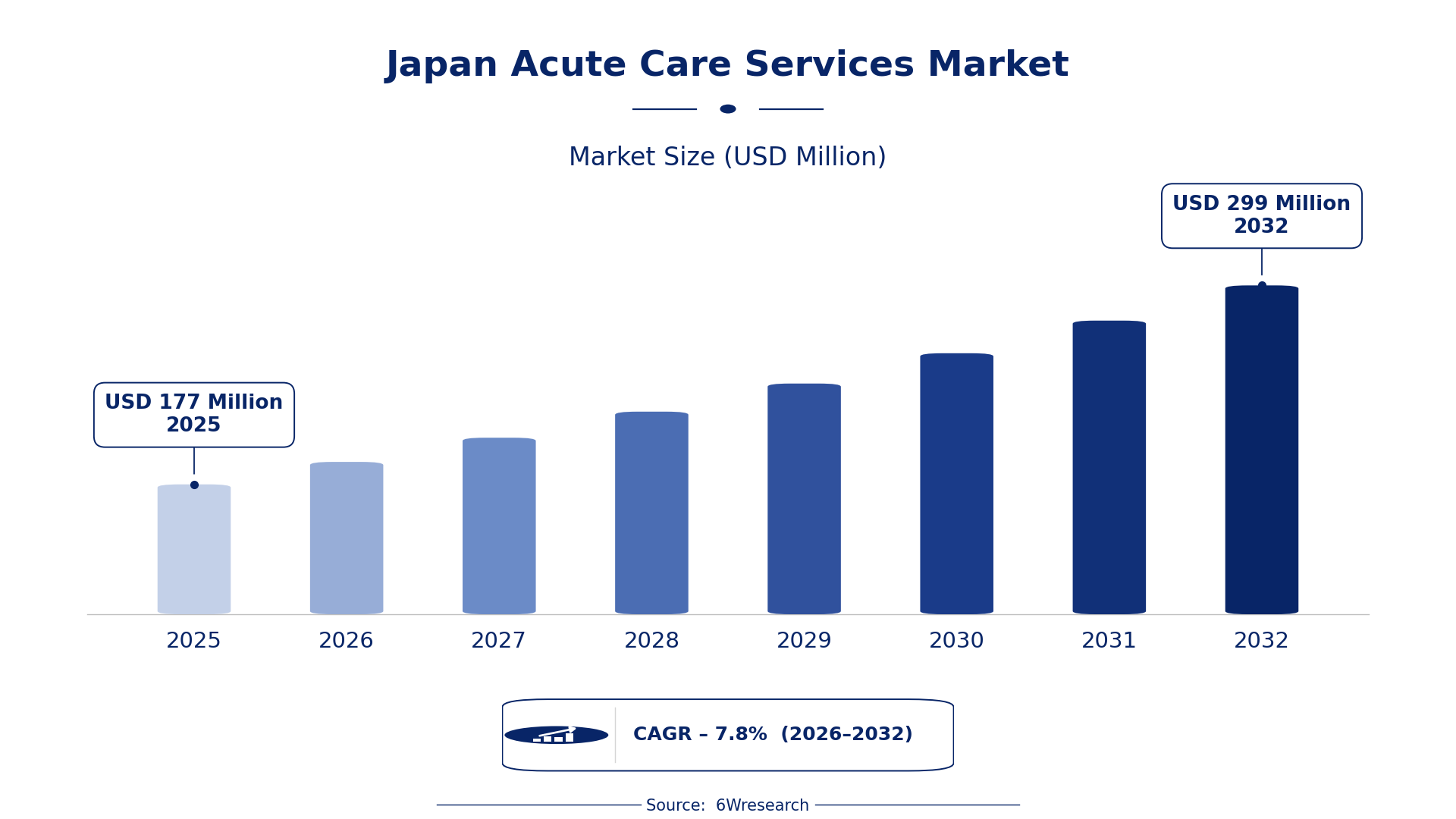
According to 6Wresearch internal database and industry insights, the Japan Acute Care Services Market was valued at USD 177 Million in 2025 and is projected to reach USD 299 Million by 2032, growing at a CAGR of approximately 7.8% during 2026–2032.
Japan Acute Care Services Market Highlights
| Report Metric | Details |
| Report Name | Japan Acute Care Services Market (2026-2032) |
| Market Size 2025 | USD 177 Million |
| Market Size 2032 | USD 299 Million |
| Absolute Growth 2025–2032 | USD 122 Million |
| CAGR 2026–2032 | 7.8% |
| Peak Annual Growth | 9.0% in 2026 |
| Forecast Period | 2026–2032 |
| Historical Data | 2022–2025 |
| Base Year | 2025 |
| Leading Product Type, 2025 | Emergency Care (36% share) |
| Leading Service Setting, 2025 | Hospital-Based (48% share) |
| Leading Distribution Channel, 2025 | Direct Sales (39% share) |
| Leading End User, 2025 | Hospitals (51% share) |
| Leading Service Type, 2025 | Life-Saving Care (41% share) |
| Fastest-Growing Product Type | Trauma Services (10.9% CAGR) |
| Fastest-Growing Service Setting | Urgent Care Centers (11.0% CAGR) |
| Fastest-Growing Distribution Channel | Government Contracts (10.1% CAGR) |
| Fastest-Growing End User | Trauma Centers (10.0% CAGR) |
| Fastest-Growing Service Type | Emergency Procedures (10.4% CAGR) |
| Growing Sector | Trauma Centers |
| Key End Users | Hospitals, Trauma Centers, Surgical Centers, Clinics |
Japan Acute Care Services Market Year-wise Growth Rate and Key Drivers (2022–2032)
This graph illustrates the annual growth rates of the market from 2022 to 2032, highlighting a steady upward trajectory and projected market expansion over the forecast period.
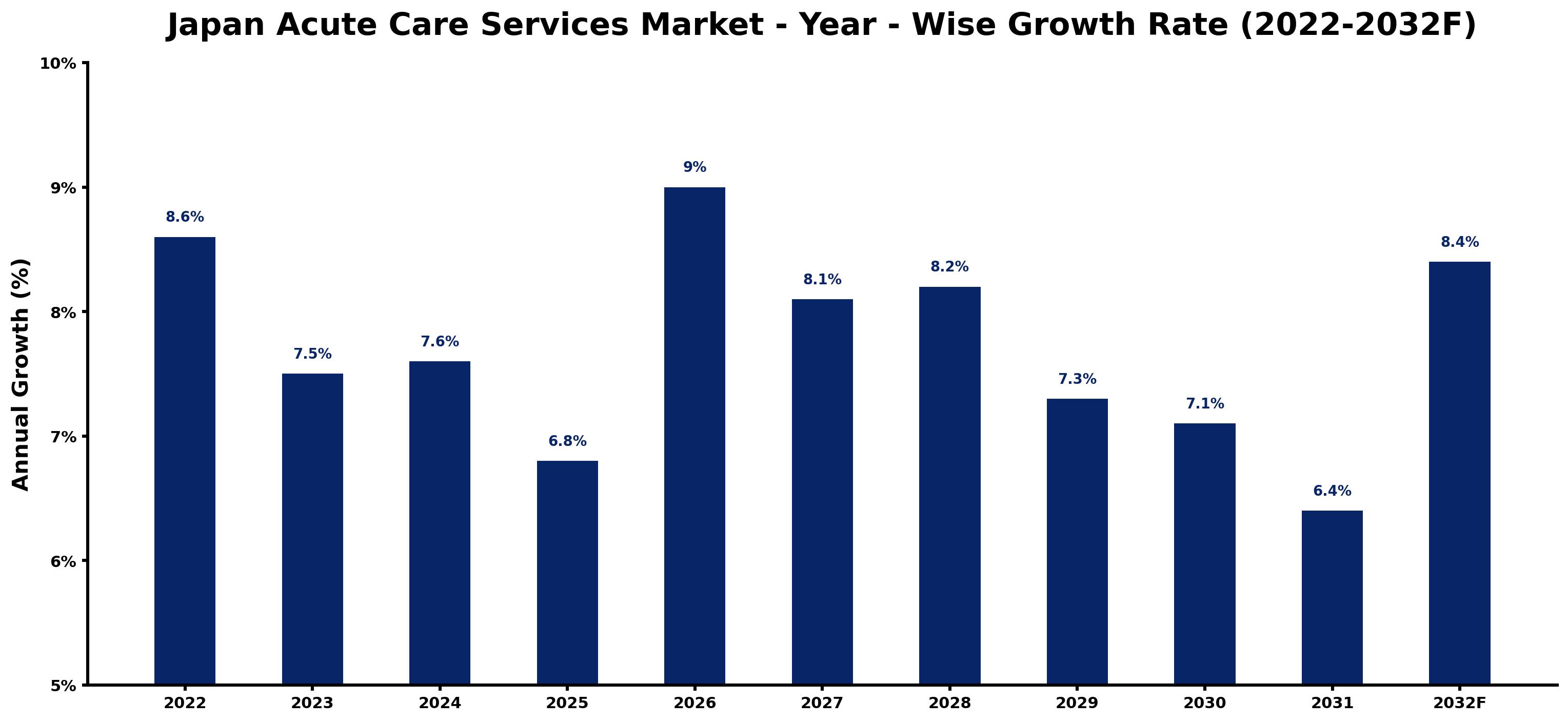
The following figures match every annual growth estimate with the main market development of that year, giving the reasoning behind each rise or slowdown.
| Year | Estimated Annual Growth (%) | Market Rationale |
| 2022 | 8.6 | The market was characterised by strong demand from hospitals and clinics. |
| 2023 | 7.5 | Growth slowed as hospitals faced staffing shortages impacting service delivery. |
| 2024 | 7.6 | Demand increased due to improvements in emergency care response times. |
| 2025 | 6.8 | Growth is expected to slow as healthcare facilities adjust to new regulations. |
| 2026 | 9.0 | Demand surged with the introduction of advanced trauma care initiatives. |
| 2027 | 8.1 | Growth is projected to slow as hospitals face challenges in resource allocation. |
| 2028 | 8.2 | Demand is anticipated to increase as new facilities are established in urban areas. |
| 2029 | 7.3 | Growth is expected to slow due to rising operational costs in healthcare services. |
| 2030 | 7.1 | Demand is projected to stabilise as hospitals adapt to changing patient needs. |
| 2031 | 6.4 | Growth is expected to slow as competition intensifies among healthcare providers. |
| 2032 | 8.4 | Demand is projected to increase due to advancements in life-saving technologies. |
Note: Market size estimations and growth projections presented in this report are based on 6Wresearch's proprietary forecasting methodology, utilizing the latest available industry data, government publications, and primary research inputs.
Japan Acute Care Services Market Synopsis
Acute Care Services in Japan encompass emergency care, intensive care, and trauma services, primarily delivered in hospitals and specialized units. The Japan Acute Care Services Market is expanding due to a growing elderly population, which accounted for 29.3% of the population in September 2024, and increasing healthcare expenditure, reaching JPY 46.7 trillion in fiscal 2022. New trauma care initiatives aimed at improving response times are driving demand for these services across the country.
Market Dynamics Impact Analysis (2026–2032)
| Factor | Type | Impact | Primary Segment Affected |
| Rising elderly population | Driver | High | Emergency Care |
| Advancements in trauma care | Driver | High | Trauma Services |
| Expansion of trauma centers | Opportunity | High | Trauma Services |
| Growing need for intensive care beds | Opportunity | High | Intensive Care |
| Staffing shortages in healthcare facilities | Restraint | High | Intensive Care |
| High operational costs for hospitals | Restraint | High | Emergency Care |
| Increasing competition among healthcare providers | Challenge | Medium | Trauma Services |
| Regulatory changes affecting service delivery | Challenge | Medium | Emergency Care |
Evaluation of Drivers in Japan Acute Care Services Market (2026–2032)
The table below links each growth driver to the segment it affects and the evidence for it.
| Drivers | Primary Segment Affected | Why It Matters (Evidence) |
| Growing elderly population | Emergency Care | 29.3% of Japan's population was aged 65 or older in September 2024, increasing demand for emergency services. |
| Increased healthcare expenditure | Intensive Care | Japan's national medical care expenditure reached about JPY 46.7 trillion in fiscal 2022, supporting more intensive care services. |
| New trauma care initiatives | Trauma Services | The 2023 initiative to improve trauma care response times is enhancing service availability. |
| Expansion of hospitals and trauma centers | Trauma Services | Japan has over 8,000 hospitals and approximately 1,200 trauma centers, increasing access to acute care. |
| Technological advancements in medical equipment | Intensive Care | The adoption of ISO 9001 standards in acute care facilities ensures higher quality and safety in intensive care. |
Spending rises because the elderly population is increasing, leading to greater demand for emergency services. In fiscal 2022, Japan's national medical care expenditure reached about JPY 46.7 trillion, enabling healthcare facilities to expand their capabilities. The presence of over 8,000 hospitals and approximately 1,200 trauma centers ensures that acute care remains accessible to the population, while technological advancements in medical equipment are improving service delivery and patient outcomes across the sector.
Evaluation of Restraints in Japan Acute Care Services Market
Several factors work against faster growth; the main ones are summarised below.
| Market Restraint | Primary Segment Affected | Why It Matters (Evidence) |
| Limited funding for healthcare improvements | Emergency Care | Budget constraints restrict hospitals from upgrading emergency facilities, impacting service quality and response times. |
| Supply chain disruptions | Trauma Services | Reliance on imported medical equipment delays critical service delivery for trauma patients, affecting timely care. |
| Outdated technology in facilities | Intensive Care | Many hospitals struggle with old equipment, increasing the average length of stay in intensive care to around 10 days. |
| Skills shortages in specialized medical fields | Trauma Services | A lack of trained professionals hinders timely trauma care, risking patient outcomes and increasing recovery times. |
| High operational costs | Emergency Care | Rising costs strain budgets, limiting hospitals' ability to invest in advanced technologies and improve service delivery. |
Japan Acute Care Services Market Challenges
In 2022, Japan's national medical care expenditure reached about JPY 46.7 trillion, straining hospital budgets and limiting their ability to invest in advanced acute services. Hospitals face supply chain disruptions due to reliance on imported medical equipment, delaying critical service delivery. Outdated technology hampers efficiency, increasing the average length of stay in intensive care units to around 10 days, which impacts patient turnover. Clinics encounter skills shortages in specialised medical fields, hindering their ability to provide timely trauma services and risking patient outcomes in emergencies.
Trends in the Japan Acute Care Services Market
Buyers and suppliers in the Japan Acute Care Services Market are adjusting to the following trends.
- Launch of Trauma Care Improvement Initiative: In 2023, Japan initiated a programme to enhance trauma care response times, aiming to reduce delays in urban hospitals. This initiative is expected to improve patient outcomes in critical situations.
- Shift Towards Advanced Emergency Procedures: Emergency procedures are evolving as hospitals adopt new protocols and technologies to improve patient outcomes. The Japan Society of Emergency Medicine supports these advancements, ensuring better preparedness for emergencies.
- Growth of Urgent Care Centers: Urgent care centers are expanding rapidly, driven by the need for immediate care for non-life-threatening conditions. This shift allows hospitals to focus on critical cases while providing accessible options for patients.
- Increased Focus on Life-Saving Technologies: Life-saving technologies are prioritised in acute care services, with hospitals investing in advanced medical equipment. This trend is seen in the adoption of ISO 9001 standards, ensuring higher quality and safety.
Investment Opportunities in the Japan Acute Care Services Market
The following opportunities in the Japan Acute Care Services Market pair current demand with a clear way in.
- Investment in Trauma Care Facilities: With Japan's population ageing and trauma cases rising, there is a pressing need for new trauma care facilities. The government allocated ¥500 billion in 2023 for healthcare improvements, presenting a substantial opportunity for investment.
- Expansion of Emergency Care Services: The average response time for emergency services in urban areas is under 10 minutes, indicating a demand for enhanced emergency care services. Hospitals can invest in training and equipment to meet this growing need.
- Technological Upgrades in Intensive Care Units: The increasing average length of stay in intensive care units highlights the need for technological upgrades. Hospitals can partner with suppliers to modernise equipment and improve patient care.
- Development of Online Health Platforms: The rise of telemedicine presents an opportunity to improve patient access to acute care services. Hospitals can invest in online platforms to provide remote consultations and follow-up care.
Government Initiatives in the Japan Acute Care Services Market
The Medical Care Act of 1948 sets essential standards for hospitals and clinics, ensuring adequate facilities and staffing for acute care services. This law has been foundational in shaping Japan's healthcare system, facilitating the provision of emergency and intensive care. The Long-Term Care Insurance Act, enacted in 1997 and enforced from 2000, provides funding for nursing care and support services, addressing the needs of the ageing population and enhancing the overall capacity of acute care services in the country.
In 2023, the government allocated ¥500 billion towards healthcare improvements, administered by the Ministry of Health, Labour and Welfare. This funding aims to enhance trauma care response times and improve the infrastructure of acute care facilities. Additionally, the Japan Society of Emergency Medicine plays a significant role in supporting advancements in emergency care, ensuring that healthcare providers meet the necessary standards and can effectively respond to critical health issues.
Future Insight of the Japan Acute Care Services Market
By 2032, telemedicine will transform demand for acute services, enabling hospitals to conduct remote consultations and manage patient loads more effectively. The introduction of AI-driven diagnostic tools will improve decision-making processes and treatment accuracy. New trauma care initiatives will significantly reduce response times, benefiting urban facilities. With government funding of ¥500 billion allocated for healthcare improvements, infrastructure upgrades will expand access to acute services, ensuring better health outcomes for the ageing population.
Market Segmentation Analysis
Japan Acute Care Services Market report covers a detailed analysis of the following market segments:
By Product Type – Emergency Care Leads, Trauma Services Expected to Grow Fastest
According to Saurav Kr Singh, Senior Research Analyst at 6Wresearch, Emergency Care held 36% of the Japan Acute Care Services Market by product type in 2025. Emergency care services are vital for the immediate treatment of life-threatening conditions, making them the most utilised segment in Japan's healthcare system. With over 8,000 hospitals providing these services, this segment's extensive reach reinforces its leading position. Over 2026–2032, Trauma Services are expected to post the fastest growth, at a CAGR of 10.9%. The growth of trauma services is driven by the increasing number of trauma centers, which total approximately 1,200 across Japan. This expansion directly correlates with the rising demand for specialised treatment of severe injuries from accidents, ensuring that emergency care remains a priority. Suppliers should prioritise enhancing their offerings in emergency care to align with the high demand from hospitals.
By Service Setting – Hospital-Based Leads, Urgent Care Centers Expected to Grow Fastest
In 2025, Hospital-Based led the service setting split with a 48% share. Hospital-based services are the primary setting for acute care, accommodating the majority of patients requiring urgent medical attention. The vast network of over 8,000 hospitals in Japan solidifies this segment's dominance in delivering critical healthcare services. The quickest growth will come from Urgent Care Centers, forecast to expand at a CAGR of 11.0% between 2026 and 2032. Urgent care centers are experiencing rapid growth as they provide an alternative for non-life-threatening emergencies, catering to the increasing need for immediate care without hospitalisation. This trend reflects changing patient preferences towards more accessible healthcare options, indicating a shift in service delivery. Buyers may benefit from expanding partnerships with urgent care centers to improve service accessibility and patient satisfaction.
By Distribution Channel – Direct Sales Leads, Government Contracts Expected to Grow Fastest
Direct Sales took 39% of distribution channel revenue in 2025, more than any other category. Direct sales dominate the distribution of medical equipment and supplies, as hospitals and clinics prefer this method for procurement. The established relationships between suppliers and healthcare facilities further reinforce this channel's leading position. Government Contracts are set to record the highest CAGR in this split, 10.1% over 2026–2032. Government contracts are increasingly becoming a vital source of funding for public healthcare services, reflecting the government's commitment to improving healthcare access. This trend is expected to accelerate as healthcare demands continue to rise. Suppliers should consider strategies to engage with government entities to secure contracts and ensure steady revenue streams.
By End User – Hospitals Lead, Trauma Centers Expected to Grow Fastest
With 51% of end user revenue in 2025, Hospitals was the largest category. Hospitals are the main providers of acute care services, addressing the majority of patients with severe conditions. Their extensive infrastructure and resources are crucial in managing critical health issues across Japan, making them indispensable in the healthcare system. Trauma Centers are projected to grow fastest, at a CAGR of 10.0% during 2026–2032. Trauma centers are witnessing rapid growth as specialised facilities dedicated to severe injuries gain recognition for their importance in emergency care. The rising number of trauma centers corresponds with the increasing incidence of accidents and related injuries, highlighting the need for focused services. Focusing on trauma centers may present suppliers with opportunities to cater to a niche but essential segment of the healthcare market.
By Service Type – Life-Saving Care Leads, Emergency Procedures Expected to Grow Fastest
Life-Saving Care accounted for 41% of the market by service type in 2025. Life-saving care is essential for survival in critical situations, making it the most important service type in acute care. The high stakes associated with this type of care ensure its prioritisation within healthcare facilities. Over 2026–2032, Emergency Procedures are expected to post the fastest growth, at a CAGR of 10.4%. Emergency procedures are critical for immediate intervention, leading to their rapid growth in response to rising patient needs for urgent care. This growth is indicative of the increasing focus on timely medical responses in acute care settings. Providers should prioritise the development and training of staff in emergency procedures to meet the escalating demand.
Key Attractiveness of the Report
- 10 Years of Market Numbers
- Historical Data Starting from 2022 to 2025
- Base Year 2025
- Forecast Data until 2032
- Key Performance Indicators Impacting the Market
- Major Upcoming Developments and Projects
Key Highlights of the Report:
- Japan Acute Care Services Market Outlook
- Market Size of Japan Acute Care Services Market, 2025
- Forecast of Japan Acute Care Services Market, 2032
- Historical Data and Forecast of Japan Acute Care Services Revenues & Volume for the Period 2022-2032F
- Japan Acute Care Services Market Trend Evolution
- Japan Acute Care Services Market Drivers and Challenges
- Japan Acute Care Services Price Trends
- Japan Acute Care Services Porter's Five Forces
- Japan Acute Care Services Industry Life Cycle
- Historical Data and Forecast of Japan Acute Care Services Market Revenues & Volume By Product Type for the Period 2022-2032F
- Historical Data and Forecast of Japan Acute Care Services Market Revenues & Volume By Emergency Care for the Period 2022-2032F
- Historical Data and Forecast of Japan Acute Care Services Market Revenues & Volume By Intensive Care for the Period 2022-2032F
- Historical Data and Forecast of Japan Acute Care Services Market Revenues & Volume By Trauma Services for the Period 2022-2032F
- Historical Data and Forecast of Japan Acute Care Services Market Revenues & Volume By Post-Operative Care for the Period 2022-2032F
- Historical Data and Forecast of Japan Acute Care Services Market Revenues & Volume By Coronary Care for the Period 2022-2032F
- Historical Data and Forecast of Japan Acute Care Services Market Revenues & Volume By Service Setting for the Period 2022-2032F
- Historical Data and Forecast of Japan Acute Care Services Market Revenues & Volume By Hospital-Based for the Period 2022-2032F
- Historical Data and Forecast of Japan Acute Care Services Market Revenues & Volume By Ambulatory Services for the Period 2022-2032F
- Historical Data and Forecast of Japan Acute Care Services Market Revenues & Volume By Urgent Care Centers for the Period 2022-2032F
- Historical Data and Forecast of Japan Acute Care Services Market Revenues & Volume By Specialty Clinics for the Period 2022-2032F
- Historical Data and Forecast of Japan Acute Care Services Market Revenues & Volume By Multi-Specialty Units for the Period 2022-2032F
- Historical Data and Forecast of Japan Acute Care Services Market Revenues & Volume By Distribution Channel for the Period 2022-2032F
- Historical Data and Forecast of Japan Acute Care Services Market Revenues & Volume By Direct Sales for the Period 2022-2032F
- Historical Data and Forecast of Japan Acute Care Services Market Revenues & Volume By Government Contracts for the Period 2022-2032F
- Historical Data and Forecast of Japan Acute Care Services Market Revenues & Volume By Online Platforms for the Period 2022-2032F
- Historical Data and Forecast of Japan Acute Care Services Market Revenues & Volume By Referrals for the Period 2022-2032F
- Historical Data and Forecast of Japan Acute Care Services Market Revenues & Volume By Insurance Partnerships for the Period 2022-2032F
- Historical Data and Forecast of Japan Acute Care Services Market Revenues & Volume By End User for the Period 2022-2032F
- Historical Data and Forecast of Japan Acute Care Services Market Revenues & Volume By Hospitals for the Period 2022-2032F
- Historical Data and Forecast of Japan Acute Care Services Market Revenues & Volume By Clinics for the Period 2022-2032F
- Historical Data and Forecast of Japan Acute Care Services Market Revenues & Volume By Trauma Centers for the Period 2022-2032F
- Historical Data and Forecast of Japan Acute Care Services Market Revenues & Volume By Surgical Centers for the Period 2022-2032F
- Historical Data and Forecast of Japan Acute Care Services Market Revenues & Volume By Cardiology Units for the Period 2022-2032F
- Historical Data and Forecast of Japan Acute Care Services Market Revenues & Volume By Service Type for the Period 2022-2032F
- Historical Data and Forecast of Japan Acute Care Services Market Revenues & Volume By Short-Term Treatment for the Period 2022-2032F
- Historical Data and Forecast of Japan Acute Care Services Market Revenues & Volume By Life-Saving Care for the Period 2022-2032F
- Historical Data and Forecast of Japan Acute Care Services Market Revenues & Volume By Emergency Procedures for the Period 2022-2032F
- Historical Data and Forecast of Japan Acute Care Services Market Revenues & Volume By Recovery Support for the Period 2022-2032F
- Historical Data and Forecast of Japan Acute Care Services Market Revenues & Volume By Heart Care Services for the Period 2022-2032F
- Japan Acute Care Services Import Export Trade Statistics
- Market Opportunity Assessment By Product Type
- Market Opportunity Assessment By Service Setting
- Market Opportunity Assessment By Distribution Channel
- Market Opportunity Assessment By End User
- Market Opportunity Assessment By Service Type
- Japan Acute Care Services Top Companies Market Share
- Japan Acute Care Services Competitive Benchmarking By Technical and Operational Parameters
- Japan Acute Care Services Company Profiles
- Japan Acute Care Services Key Strategic Recommendations
Market Covered
Coverage by segment is as follows.
By Product Type
- Emergency Care
- Intensive Care
- Trauma Services
- Post-Operative Care
- Coronary Care
By Service Setting
- Hospital-Based
- Ambulatory Services
- Urgent Care Centers
- Specialty Clinics
- Multi-Specialty Units
By Distribution Channel
- Direct Sales
- Government Contracts
- Online Platforms
- Referrals
- Insurance Partnerships
By End User
- Hospitals
- Clinics
- Trauma Centers
- Surgical Centers
- Cardiology Units
By Service Type
- Short-Term Treatment
- Life-Saving Care
- Emergency Procedures
- Recovery Support
- Heart Care Services































