Japan Ad Targeting AI Market Size & Growth Rate
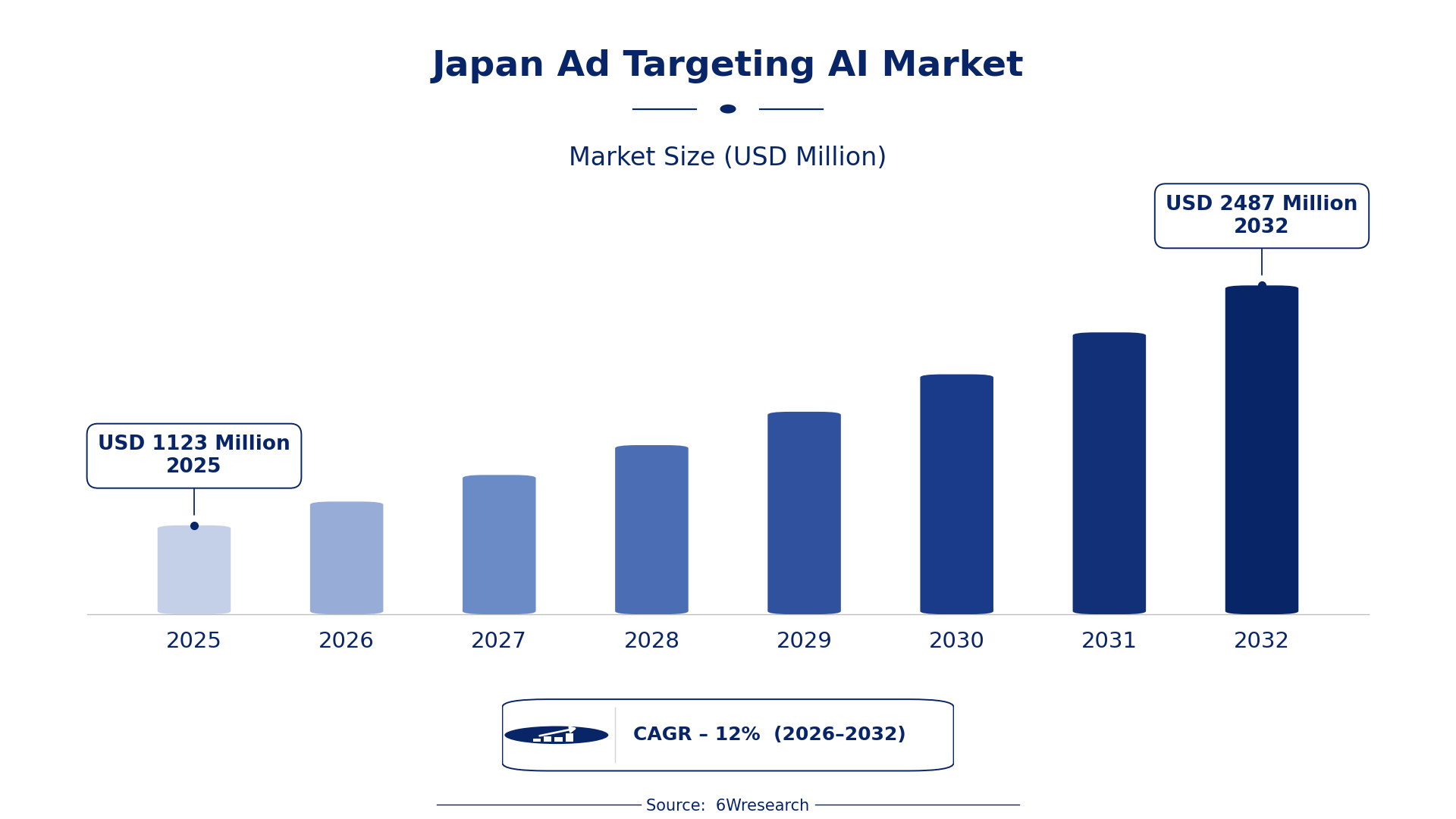
According to 6Wresearch internal database and industry insights, the Japan Ad Targeting AI Market was valued at USD 1,123 Million in 2025 and is projected to reach USD 2,487 Million by 2032, growing at a CAGR of approximately 12% during 2026–2032.
Japan Ad Targeting AI Market Highlights
| Report Metric | Details |
| Report Name | Japan Ad Targeting AI Market (2026-2032) |
| Market Size 2025 | USD 1,123 Million |
| Market Size 2032 | USD 2,487 Million |
| Absolute Growth 2025–2032 | USD 1,364 Million |
| CAGR 2026–2032 | 12% |
| Peak Annual Growth | 13.0% in 2032 |
| Forecast Period | 2026–2032 |
| Historical Data | 2022–2025 |
| Base Year | 2025 |
| Leading Technology Type, 2025 | Machine Learning-Based (38% share) |
| Leading Deployment Mode, 2025 | Cloud (48% share) |
| Leading Distribution Channel, 2025 | SaaS Platforms (45% share) |
| Leading End User Segment, 2025 | Digital Advertisers (44% share) |
| Leading Application Area, 2025 | Behavioral Targeting (36% share) |
| Fastest-Growing Technology Type | Predictive Analytics (17.8% CAGR) |
| Fastest-Growing Deployment Mode | Hybrid (13.8% CAGR) |
| Fastest-Growing End User Segment | E-commerce Companies (16.0% CAGR) |
| Fastest-Growing Application Area | Campaign Optimization (14.6% CAGR) |
| Growing Sector | E-commerce Companies |
| Key End Users | Digital Advertisers, E-commerce Companies, Media Agencies, Social Media Platforms |
Japan Ad Targeting AI Market Year-wise Growth Rate and Key Drivers (2022–2032)
This graph illustrates the annual growth rates of the market from 2022 to 2032, highlighting a steady upward trajectory and projected market expansion over the forecast period.
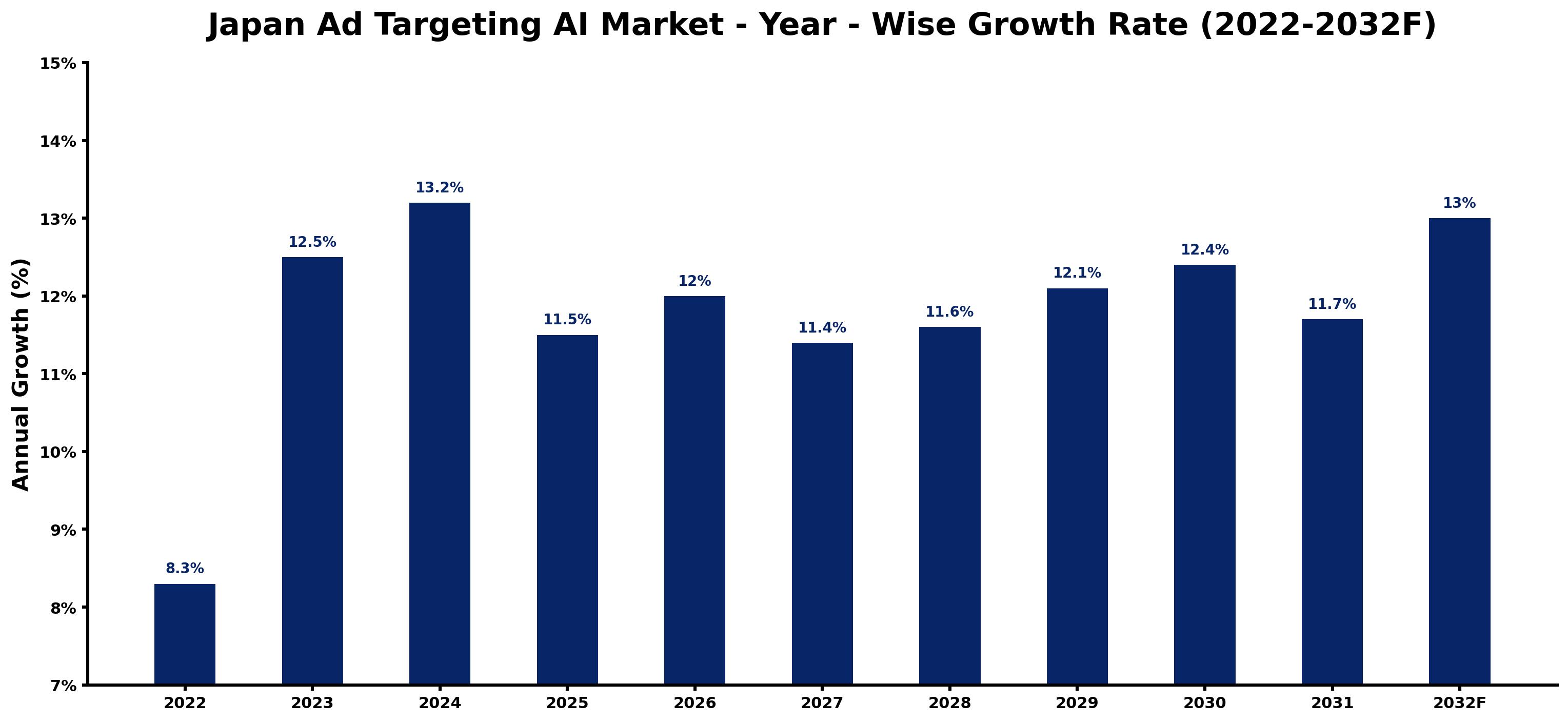
Year by year, the estimates below pair each growth rate with the development that shaped it.
| Year | Estimated Annual Growth (%) | Market Rationale |
| 2022 | 8.3 | The market showed a steady growth rate as digital advertising continued to expand. |
| 2023 | 12.5 | Growth accelerated due to increased investment in targeted advertising strategies. |
| 2024 | 13.2 | Demand surged as more businesses adopted advanced ad targeting technologies. |
| 2025 | 11.5 | Growth slowed slightly as the market began to stabilise after rapid expansion. |
| 2026 | 12.0 | The market rebounded with renewed interest in AI-driven advertising solutions. |
| 2027 | 11.4 | Growth moderated as companies focused on optimising existing campaigns. |
| 2028 | 11.6 | Demand increased again as new technologies emerged in ad targeting. |
| 2029 | 12.1 | The market continued to grow as more advertisers recognised the benefits of AI. |
| 2030 | 12.4 | Growth remained strong with ongoing advancements in targeting capabilities. |
| 2031 | 11.7 | A slight slowdown occurred as the market matured and competition intensified. |
| 2032 | 13.0 | The market is expected to peak as AI adoption reaches its highest levels. |
Note: Market size estimations and growth projections presented in this report are based on 6Wresearch's proprietary forecasting methodology, utilizing the latest available industry data, government publications, and primary research inputs.
Japan Ad Targeting AI Market Synopsis
Ad Targeting AI employs algorithms and data analytics to refine advertising strategies, improving ad relevance and customer engagement. Japan's digital advertising market, valued at approximately 1.5 trillion JPY, is experiencing robust growth, driven by over 100,000 digital advertisers and a surge in e-commerce. The introduction of new standards and guidelines in 2023 further fuels demand, particularly from digital advertisers and media agencies, as they seek to maximise advertising ROI through advanced targeting techniques.
Market Dynamics Impact Analysis (2026–2032)
| Factor | Type | Impact | Primary Segment Affected |
| Growing investment in AI technologies | Driver | High | Machine Learning-Based |
| Rising e-commerce activities | Driver | High | Digital Advertisers |
| Expansion of digital advertising standards | Opportunity | High | Marketing Agencies |
| Increased demand for personalized advertising | Opportunity | High | E-commerce Companies |
| Challenges in data privacy compliance | Restraint | High | Contextual AI |
| Limited awareness of ad targeting benefits | Restraint | Medium | Predictive Analytics |
| High operational costs for AI implementation | Challenge | High | Real-Time Bidding AI |
| Capacity constraints in data processing infrastructure | Challenge | Medium | Cloud |
Evaluation of Drivers in Japan Ad Targeting AI Market (2026–2032)
The main growth drivers and the segments they affect most are set out below.
| Drivers | Primary Segment Affected | Why It Matters (Evidence) |
| Increased adoption of machine learning | Machine Learning-Based | This technology improves ad relevance, leading to higher engagement rates, with the average click-through rate for targeted ads around 2.5%. |
| Growth in e-commerce | Digital Advertisers | As e-commerce companies expand, they increasingly rely on targeted ads to drive sales, contributing to the market's growth. |
| Rising number of active social media users | SaaS Platforms | With around 100 million active users, social media platforms are vital for targeted advertising, boosting demand for SaaS solutions. |
| Emergence of new advertising standards | Marketing Agencies | The 2023 guidelines introduced by the Japan Marketing Association promote ethical practices, encouraging more agencies to adopt AI targeting. |
| Demand for real-time bidding solutions | Real-Time Bidding AI | Automated ad buying processes are becoming essential for advertisers, driving investments in real-time bidding technologies. |
Spending rises because digital advertisers increasingly adopt machine learning technologies to improve ad relevance, reflected in the average click-through rate for targeted ads around 2.5%. E-commerce companies are investing heavily in targeted advertising to drive sales, supported by a growing number of active social media users, estimated at around 100 million. These factors contribute to a vibrant market for Ad Targeting AI in Japan.
Evaluation of Restraints in Japan Ad Targeting AI Market
These restraints slow adoption and weigh on supplier margins.
| Market Restraint | Primary Segment Affected | Why It Matters (Evidence) |
| Data privacy compliance challenges | Contextual AI | Strict data privacy regulations require substantial resources for compliance, limiting effective targeting strategies. |
| Limited understanding of AI benefits | Predictive Analytics | Many advertisers lack awareness of how predictive analytics can improve their targeting efforts, resulting in slower adoption. |
| High costs associated with AI implementation | Real-Time Bidding AI | The operational costs of integrating AI technologies deter smaller advertisers from adopting these solutions. |
| Capacity limitations in data processing | Cloud | Insufficient infrastructure restricts the ability to process large volumes of data for effective ad targeting. |
| Slow adoption of new technologies | Machine Learning-Based | Some advertisers remain hesitant to invest in advanced technologies, limiting market growth. |
Japan Ad Targeting AI Market Challenges
A shortage of skilled data analysts limits the ability of producers to effectively utilise ad targeting AI, resulting in delayed campaign launches that hinder competitiveness. Many technology firms struggle with outdated systems, preventing them from integrating modern algorithms, which leads to suboptimal ad performance and lost revenue opportunities for buyers. Regulatory standards from the Japan Marketing Association impose additional compliance costs, slowing down technology adoption and innovation for producers. Disruptions in data sourcing restrict access to vital analytics, causing buyers to miss timely insights and reducing their effectiveness in the fast-paced digital advertising market.
Trends in the Japan Ad Targeting AI Market
The trends below show where the Japan Ad Targeting AI Market is heading.
- Shift from Traditional to AI-Driven Advertising: Since 2023, digital advertisers have increasingly moved towards AI-driven strategies, improving ad relevance and engagement. This shift is reflected in the growing average click-through rate of approximately 2.5%.
- Transition from On-Premise to Cloud Solutions: As of 2023, many businesses are adopting cloud-based ad targeting solutions, driven by the need for scalability and efficiency. This transition is evidenced by the 48% market share held by cloud solutions in 2025.
- Emergence of New Advertising Standards: The introduction of guidelines by the Japan Marketing Association in 2023 is reshaping how advertisers approach targeting. These standards are expected to enhance consumer trust and engagement in the digital advertising space.
- Growing Demand for Personalized Campaigns: The trend towards personalized advertising has gained momentum, particularly among e-commerce companies. With a projected CAGR of 16.0% for e-commerce companies, this demand is reshaping advertising strategies.
Investment Opportunities in the Japan Ad Targeting AI Market
Where to invest in the Japan Ad Targeting AI Market: the main openings are set out below.
- Gap in AI-Driven Solutions: With a projected market size of 2,487 million USD by 2032, there is a significant opportunity for suppliers to invest in AI-driven ad targeting solutions, particularly for digital advertisers.
- Investment in Cloud-Based Services: As cloud solutions dominate the market, suppliers should focus on developing scalable cloud-based ad targeting services to meet the needs of marketing agencies.
- Partnerships with E-commerce Firms: With e-commerce companies projected to grow at a CAGR of 16.0%, forming partnerships with these firms can help suppliers tailor their offerings to meet specific advertising needs.
- Expansion into Social Media Platforms: Given the large user base of around 100 million active social media users, suppliers can explore opportunities to enhance targeting capabilities on these platforms.
Government Initiatives in the Japan Ad Targeting AI Market
The AI Promotion Act (2025) establishes a national framework for AI research, development and use, impacting producers and buyers of Ad Targeting AI by setting standards for ethical practices and data usage. This law aims to improve the overall effectiveness of advertising strategies while ensuring compliance with privacy regulations.
The Ministry of Internal Affairs and Communications oversees the implementation of digital advertising standards, approving initiatives that enhance the quality and effectiveness of advertising practices. In 2023, the government allocated 500 million JPY for digital advertising innovation initiatives, supporting projects that improve targeting capabilities and compliance with new guidelines.
Future Insight of the Japan Ad Targeting AI Market
A government initiative focused on enhancing digital advertising standards will drive technological advancements by 2032, prompting suppliers to invest in new algorithms. The introduction of ISO 27001 will improve data security practices, addressing privacy concerns for buyers. With the number of active social media users currently around 100 million, targeted ads will become increasingly relevant, leading to improved engagement rates. The government's allocation of 500 million JPY for digital advertising innovation initiatives will stimulate the development of solutions tailored to the specific needs of advertisers.
Market Segmentation Analysis
Japan Ad Targeting AI Market report covers a detailed analysis of the following market segments:
By Technology Type – Machine Learning-Based Leads, Predictive Analytics Expected to Grow Fastest
According to Saurav Kr Singh, Senior Research Analyst at 6Wresearch, Machine Learning-Based held 38% of the Japan Ad Targeting AI Market by technology type in 2025. Machine Learning-Based technology holds the largest share due to its crucial role in analysing user data and optimising ad placements. This method is widely adopted across various sectors, particularly in e-commerce, where effective ad targeting is essential for success. Predictive Analytics is projected to grow fastest, at a CAGR of 17.8% during 2026–2032. Predictive Analytics is witnessing rapid growth as it effectively forecasts user behaviour, which is increasingly important for targeted advertising strategies. The rising demand for precise targeting in the digital landscape propels this segment forward, ensuring its continued expansion. Suppliers should focus on developing advanced predictive analytics tools to meet the growing demand from advertisers.
By Deployment Mode – Cloud Leads, Hybrid Expected to Grow Fastest
In 2025, Cloud led the deployment mode split with a 48% share. Cloud deployment leads the market as it provides scalable solutions essential for effective ad targeting. Its flexibility allows digital advertisers to adapt quickly to changing market conditions and user preferences, making it a preferred choice. Hybrid is set to record the highest CAGR in this split, 13.8% over 2026–2032. Hybrid deployment is gaining traction as businesses seek a balance between cloud and local processing capabilities. This trend is driven by the need for enhanced data security and operational efficiency in ad targeting, indicating a shift in deployment preferences. Providers must consider hybrid solutions to cater to the diverse needs of businesses seeking both flexibility and security.
By Distribution Channel – SaaS Platforms Lead and Record the Fastest Growth
SaaS Platforms accounted for 45% of the market by distribution channel in 2025. SaaS Platforms dominate the market as they serve as the primary mode of delivery for ad targeting solutions, facilitating access for digital advertisers. This model supports the growing number of digital advertisers in Japan, exceeding 100,000, ensuring widespread adoption. Its lead should widen, with a projected CAGR of 14.0% during 2026–2032, the highest in this split. SaaS Platforms are also the fastest-growing channel due to their scalability and ease of integration, appealing to a wide range of users. As more advertisers seek efficient solutions, this segment's growth is expected to accelerate further, reinforcing its market position. Vendors should prioritise enhancing their SaaS offerings to maintain competitiveness in a rapidly evolving market.
By End User Segment – Digital Advertisers Lead, E-commerce Companies Expected to Grow Fastest
Digital Advertisers took 44% of end user segment revenue in 2025, more than any other category. Digital Advertisers represent the largest user group for ad targeting AI, as they are the primary consumers of these technologies. Their substantial presence in the market drives demand for advanced targeting solutions. The quickest growth will come from E-commerce Companies, forecast to expand at a CAGR of 16.0% between 2026 and 2032. E-commerce Companies are experiencing the fastest growth as they heavily rely on targeted advertising to drive sales in a competitive online environment. The increasing shift towards online shopping fuels this demand for precise targeting capabilities. Suppliers should tailor their solutions to meet the specific needs of e-commerce companies to capture this growing segment.
By Application Area – Behavioral Targeting Leads, Campaign Optimization Expected to Grow Fastest
The largest application area category in 2025 was Behavioral Targeting, at 36% of revenue. Behavioral Targeting is the leading application area as it represents a primary use of ad targeting technology, enabling advertisers to effectively engage users. This approach is critical for improving ad relevance and driving customer engagement across various platforms. Campaign Optimization is projected to grow fastest, at a CAGR of 14.6% during 2026–2032. Campaign Optimization is the fastest-growing application area, as advertisers increasingly focus on enhancing ad performance through data-driven strategies. The need for measurable results in advertising campaigns propels this segment's rapid growth, indicating a shift in advertiser priorities. Providers should invest in tools that facilitate campaign optimisation to align with advertisers' increasing demand for performance improvement.
Key Attractiveness of the Report
- 10 Years of Market Numbers
- Historical Data Starting from 2022 to 2025
- Base Year 2025
- Forecast Data until 2032
- Key Performance Indicators Impacting the Market
- Major Upcoming Developments and Projects
Key Highlights of the Report:
- Japan Ad Targeting AI Market Outlook
- Market Size of Japan Ad Targeting AI Market, 2025
- Forecast of Japan Ad Targeting AI Market, 2032
- Historical Data and Forecast of Japan Ad Targeting AI Revenues & Volume for the Period 2022-2032F
- Japan Ad Targeting AI Market Trend Evolution
- Japan Ad Targeting AI Market Drivers and Challenges
- Japan Ad Targeting AI Price Trends
- Japan Ad Targeting AI Porter's Five Forces
- Japan Ad Targeting AI Industry Life Cycle
- Historical Data and Forecast of Japan Ad Targeting AI Market Revenues & Volume By Technology Type for the Period 2022-2032F
- Historical Data and Forecast of Japan Ad Targeting AI Market Revenues & Volume By Machine Learning-Based for the Period 2022-2032F
- Historical Data and Forecast of Japan Ad Targeting AI Market Revenues & Volume By Contextual AI for the Period 2022-2032F
- Historical Data and Forecast of Japan Ad Targeting AI Market Revenues & Volume By Predictive Analytics for the Period 2022-2032F
- Historical Data and Forecast of Japan Ad Targeting AI Market Revenues & Volume By NLP-based Systems for the Period 2022-2032F
- Historical Data and Forecast of Japan Ad Targeting AI Market Revenues & Volume By Real-Time Bidding AI for the Period 2022-2032F
- Historical Data and Forecast of Japan Ad Targeting AI Market Revenues & Volume By Deployment Mode for the Period 2022-2032F
- Historical Data and Forecast of Japan Ad Targeting AI Market Revenues & Volume By Cloud for the Period 2022-2032F
- Historical Data and Forecast of Japan Ad Targeting AI Market Revenues & Volume By On-Premise for the Period 2022-2032F
- Historical Data and Forecast of Japan Ad Targeting AI Market Revenues & Volume By Hybrid for the Period 2022-2032F
- Historical Data and Forecast of Japan Ad Targeting AI Market Revenues & Volume By Cloud for the Period 2022-2032F
- Historical Data and Forecast of Japan Ad Targeting AI Market Revenues & Volume By Cloud for the Period 2022-2032F
- Historical Data and Forecast of Japan Ad Targeting AI Market Revenues & Volume By Distribution Channel for the Period 2022-2032F
- Historical Data and Forecast of Japan Ad Targeting AI Market Revenues & Volume By SaaS Platforms for the Period 2022-2032F
- Historical Data and Forecast of Japan Ad Targeting AI Market Revenues & Volume By Direct Sales for the Period 2022-2032F
- Historical Data and Forecast of Japan Ad Targeting AI Market Revenues & Volume By Marketing Agencies for the Period 2022-2032F
- Historical Data and Forecast of Japan Ad Targeting AI Market Revenues & Volume By Online Subscriptions for the Period 2022-2032F
- Historical Data and Forecast of Japan Ad Targeting AI Market Revenues & Volume By AdTech Vendors for the Period 2022-2032F
- Historical Data and Forecast of Japan Ad Targeting AI Market Revenues & Volume By End User Segment for the Period 2022-2032F
- Historical Data and Forecast of Japan Ad Targeting AI Market Revenues & Volume By Digital Advertisers for the Period 2022-2032F
- Historical Data and Forecast of Japan Ad Targeting AI Market Revenues & Volume By E-commerce Companies for the Period 2022-2032F
- Historical Data and Forecast of Japan Ad Targeting AI Market Revenues & Volume By Media Agencies for the Period 2022-2032F
- Historical Data and Forecast of Japan Ad Targeting AI Market Revenues & Volume By Social Media Platforms for the Period 2022-2032F
- Historical Data and Forecast of Japan Ad Targeting AI Market Revenues & Volume By Streaming Services for the Period 2022-2032F
- Historical Data and Forecast of Japan Ad Targeting AI Market Revenues & Volume By Application Area for the Period 2022-2032F
- Historical Data and Forecast of Japan Ad Targeting AI Market Revenues & Volume By Behavioral Targeting for the Period 2022-2032F
- Historical Data and Forecast of Japan Ad Targeting AI Market Revenues & Volume By Personalized Ads for the Period 2022-2032F
- Historical Data and Forecast of Japan Ad Targeting AI Market Revenues & Volume By Audience Segmentation for the Period 2022-2032F
- Historical Data and Forecast of Japan Ad Targeting AI Market Revenues & Volume By Sentiment Analysis for the Period 2022-2032F
- Historical Data and Forecast of Japan Ad Targeting AI Market Revenues & Volume By Campaign Optimization for the Period 2022-2032F
- Japan Ad Targeting AI Import Export Trade Statistics
- Market Opportunity Assessment By Technology Type
- Market Opportunity Assessment By Deployment Mode
- Market Opportunity Assessment By Distribution Channel
- Market Opportunity Assessment By End User Segment
- Market Opportunity Assessment By Application Area
- Japan Ad Targeting AI Top Companies Market Share
- Japan Ad Targeting AI Competitive Benchmarking By Technical and Operational Parameters
- Japan Ad Targeting AI Company Profiles
- Japan Ad Targeting AI Key Strategic Recommendations
Market Covered
The report covers the following segments.
By Technology Type
- Machine Learning-Based
- Contextual AI
- Predictive Analytics
- NLP-based Systems
- Real-Time Bidding AI
By Deployment Mode
- Cloud
- On-Premise
- Hybrid
By Distribution Channel
- SaaS Platforms
- Direct Sales
- Marketing Agencies
- Online Subscriptions
- AdTech Vendors
By End User Segment
- Digital Advertisers
- E-commerce Companies
- Media Agencies
- Social Media Platforms
- Streaming Services
By Application Area
- Behavioral Targeting
- Personalized Ads
- Audience Segmentation
- Sentiment Analysis
- Campaign Optimization































