Japan Adaptive Lighting Market Size & Growth Rate
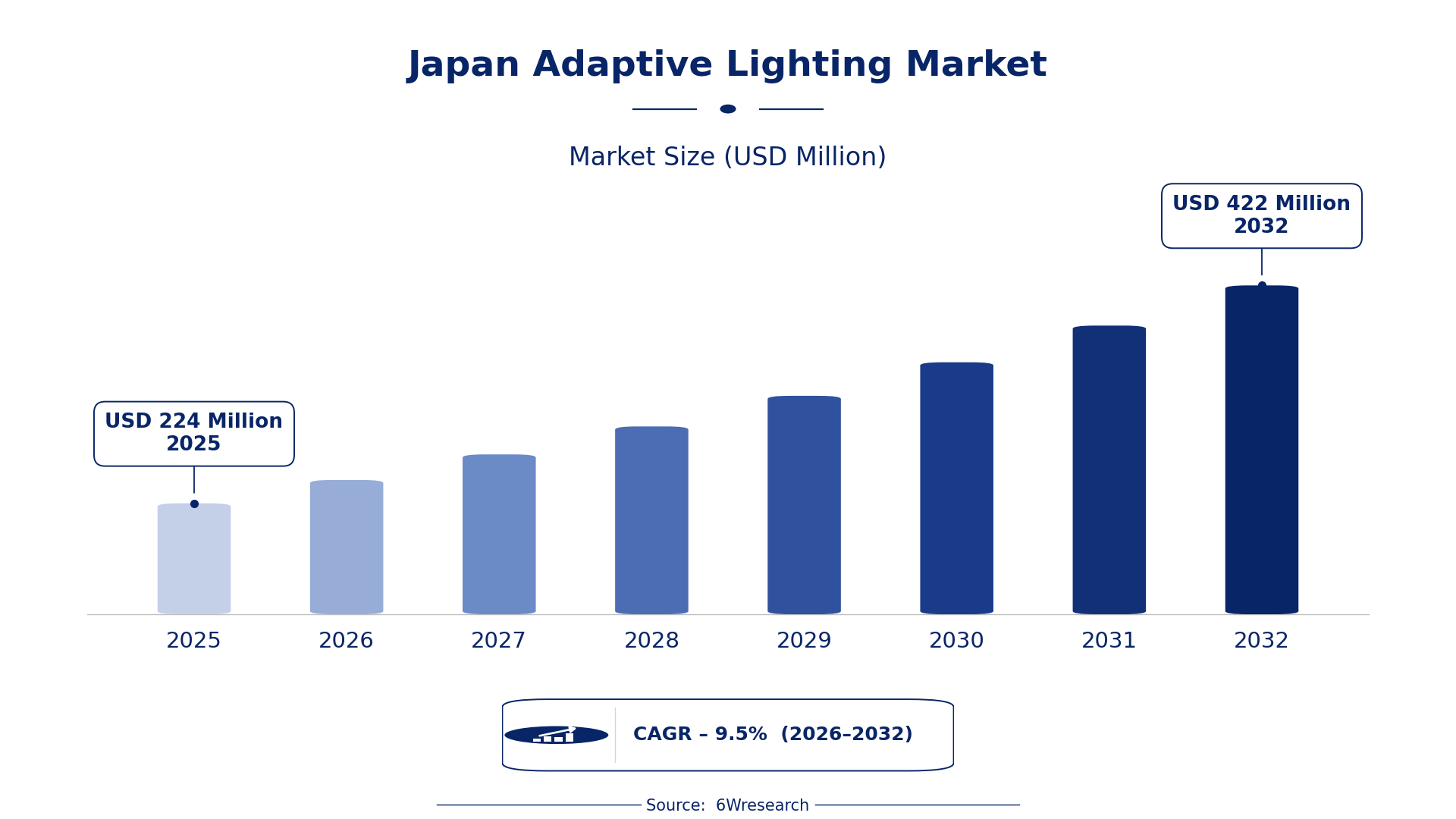
According to 6Wresearch internal database and industry insights, the Japan Adaptive Lighting Market was valued at USD 224 Million in 2025 and is projected to reach USD 422 Million by 2032, growing at a CAGR of approximately 9.5% during 2026–2032.
Japan Adaptive Lighting Market Highlights
| Report Metric | Details |
| Report Name | Japan Adaptive Lighting Market (2026-2032) |
| Market Size 2025 | USD 224 Million |
| Market Size 2032 | USD 422 Million |
| Absolute Growth 2025–2032 | USD 198 Million |
| CAGR 2026–2032 | 9.5% |
| Peak Annual Growth | 10.8% in 2030 |
| Forecast Period | 2026–2032 |
| Historical Data | 2022–2025 |
| Base Year | 2025 |
| Leading Lighting Type, 2025 | Matrix LED Lights (48% share) |
| Leading Vehicle Type, 2025 | Passenger Cars (43% share) |
| Leading Technology Type, 2025 | LED (40% share) |
| Leading Distribution Channel, 2025 | OEMs (40% share) |
| Leading Application, 2025 | Road Illumination (39% share) |
| Fastest-Growing Lighting Type | Laser Adaptive Lights (13.7% CAGR) |
| Fastest-Growing Vehicle Type | Electric Cars (14.1% CAGR) |
| Fastest-Growing Technology Type | Sensor-Based (13.9% CAGR) |
| Fastest-Growing Distribution Channel | Aftermarket (12.6% CAGR) |
| Fastest-Growing Application | Adaptive Vision (12.8% CAGR) |
| Growing Sector | automotive lighting |
| Key End Users | automotive manufacturers, aftermarket suppliers, vehicle dealerships, consumers |
Japan Adaptive Lighting Market Year-wise Growth Rate and Key Drivers (2022–2032)
This graph illustrates the annual growth rates of the market from 2022 to 2032, highlighting a steady upward trajectory and projected market expansion over the forecast period.
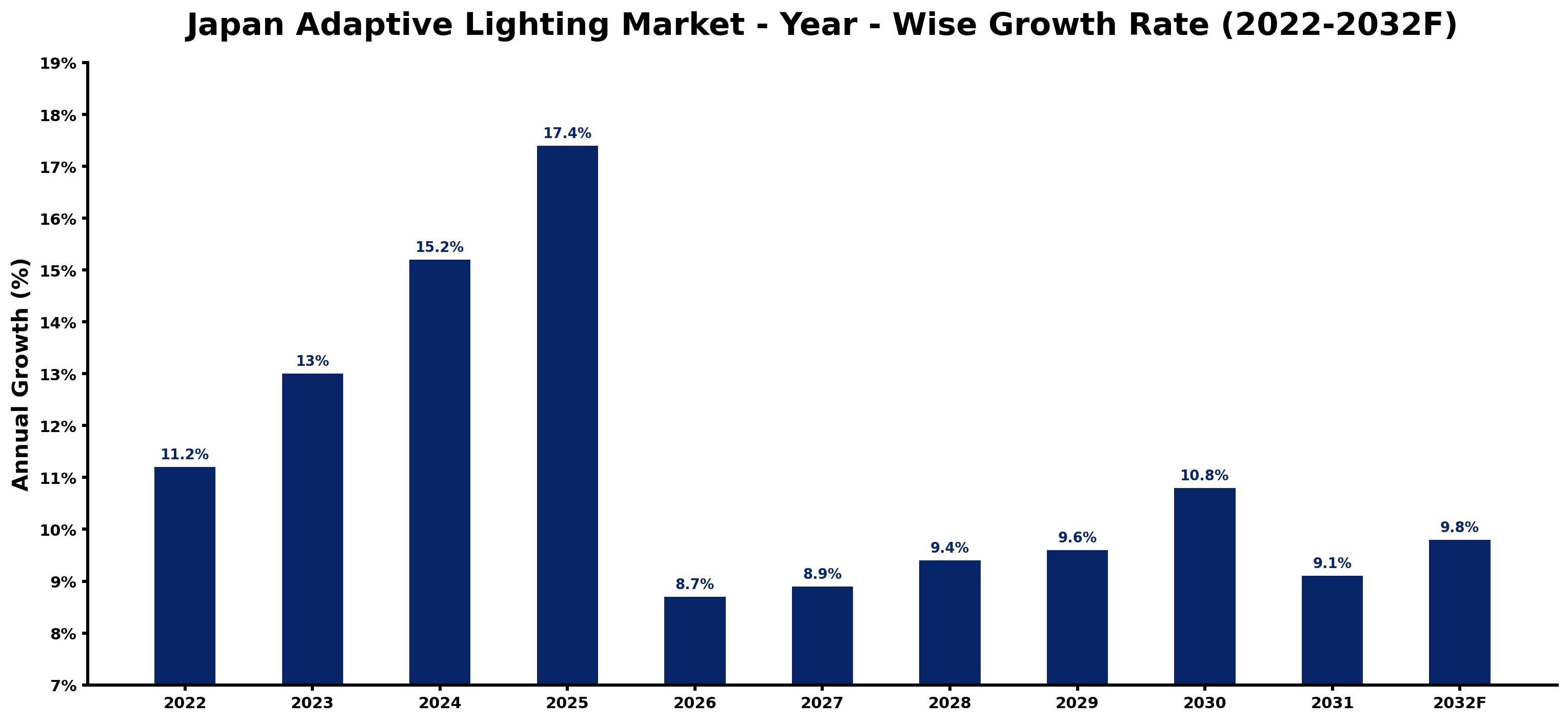
Year by year, the estimates below pair each growth rate with the development that shaped it.
| Year | Estimated Annual Growth (%) | Market Rationale |
| 2022 | 11.2 | The market showed strong performance with increasing consumer interest in advanced vehicle lighting systems. |
| 2023 | 13.0 | Demand accelerated as urban areas adopted more adaptive lighting systems for safety. |
| 2024 | 15.2 | The introduction of new models with improved lighting features spurred growth. |
| 2025 | 17.4 | High sales of luxury vehicles with adaptive lighting drove market peak performance. |
| 2026 | 8.7 | Growth is projected to slow as the market begins to stabilise after rapid expansion in previous years. |
| 2027 | 8.9 | Increased adoption of sensor-based technologies is expected to contribute to a slight rise in growth. |
| 2028 | 9.4 | Demand for energy-efficient lighting solutions is projected to support continued market expansion. |
| 2029 | 9.6 | The introduction of new regulations will encourage further adoption of adaptive lighting. |
| 2030 | 10.8 | Technological advancements in lighting systems will lead to a peak in growth rates. |
| 2031 | 9.1 | Growth is anticipated to slow as the market adjusts to new standards and consumer preferences. |
| 2032 | 9.8 | Continued investment in electric vehicles will sustain demand for adaptive lighting. |
Note: Market size estimations and growth projections presented in this report are based on 6Wresearch's proprietary forecasting methodology, utilizing the latest available industry data, government publications, and primary research inputs.
Japan Adaptive Lighting Market Synopsis
Adaptive lighting refers to advanced vehicle lighting systems that adjust based on driving conditions and surroundings, primarily using LED and laser technologies. The Japan Adaptive Lighting Market is growing due to rising demand from urban areas, where luxury vehicles equipped with adaptive lighting account for 40% of sales. With the average age of vehicles in Japan at 11.5 years, the need for upgrades is increasing, creating opportunities for manufacturers and suppliers to meet evolving consumer preferences.
Market Dynamics Impact Analysis (2026–2032)
| Factor | Type | Impact | Primary Segment Affected |
| Growing adoption of adaptive lighting in luxury vehicles enhances road safety and visibility. | Driver | High | Luxury Vehicles |
| Increased focus on energy-efficient technologies drives demand for adaptive lighting solutions. | Driver | High | Electric Cars |
| Rising urban traffic density creates a need for advanced vehicle lighting systems. | Opportunity | High | Passenger Cars |
| The growing aftermarket for automotive upgrades presents opportunities for adaptive lighting suppliers. | Opportunity | Medium | Aftermarket |
| High costs associated with advanced lighting technologies may deter some buyers. | Restraint | Medium | Luxury Vehicles |
| Limited awareness of adaptive lighting benefits among consumers can hinder market growth. | Restraint | Medium | Passenger Cars |
| Technological challenges in integrating adaptive lighting systems can delay product launches. | Challenge | High | Electric Cars |
| Competition from traditional lighting systems may limit market penetration of adaptive technologies. | Challenge | Medium | Passenger Cars |
Evaluation of Drivers in Japan Adaptive Lighting Market (2026–2032)
The table below links each growth driver to the segment it affects and the evidence for it.
| Drivers | Primary Segment Affected | Why It Matters (Evidence) |
| Increasing safety regulations for vehicle lighting systems drive demand for adaptive lighting. | Luxury Vehicles | As regulations tighten, manufacturers are adopting adaptive lighting to comply with safety standards. |
| The shift towards electric vehicles boosts demand for advanced lighting technologies. | Electric Cars | Electric vehicle manufacturers are integrating adaptive lighting to improve energy efficiency and safety. |
| Consumer preference for high-end features in vehicles increases sales of luxury models with adaptive lighting. | Passenger Cars | Luxury vehicles accounted for 40% of sales, reflecting strong demand for advanced lighting solutions. |
| Urbanisation and high traffic density in cities raise the need for improved road visibility. | Passenger Cars | With over 14 million registered vehicles in the Tokyo metropolitan area, adaptive lighting is essential. |
| Technological advancements in LED and sensor-based systems are improving product offerings. | Luxury Vehicles | The adoption rate of LED technology in vehicles reached 70% in 2022, driving innovation. |
Urban areas with high traffic density are experiencing a critical need for improved road visibility. The shift towards electric vehicles is also notable, as manufacturers integrate adaptive lighting to improve energy efficiency and safety. The adoption rate of LED technology reached 70% in 2022, reflecting consumer preference for high-end features. This trend is supported by the growing demand for automotive upgrades, creating opportunities for suppliers.
Evaluation of Restraints in Japan Adaptive Lighting Market
The following restraints limit how fast demand can grow.
| Market Restraint | Primary Segment Affected | Why It Matters (Evidence) |
| High costs of advanced adaptive lighting systems can deter potential buyers. | Luxury Vehicles | The average price for luxury vehicles with adaptive lighting is approximately ¥8 million, limiting access. |
| Limited consumer awareness of adaptive lighting benefits hinders market growth. | Passenger Cars | Many consumers remain unaware of how adaptive lighting improves safety and visibility. |
| Technological challenges in integrating adaptive lighting systems can delay product launches. | Electric Cars | Manufacturers face difficulties in developing compatible systems for new electric models. |
| Competition from traditional lighting systems may limit market penetration of adaptive technologies. | Passenger Cars | Established lighting solutions are often preferred due to familiarity and lower costs. |
| The average age of vehicles in Japan is 11.5 years, affecting upgrade cycles. | Luxury Vehicles | Older vehicles may not be compatible with new adaptive lighting technologies. |
Japan Adaptive Lighting Market Challenges
High production costs stem from expensive raw materials for adaptive lighting, leading to price increases of up to ¥8 million for buyers of luxury vehicles. A shortage of skilled technicians hampers the installation and maintenance of these systems, causing delays that can extend project timelines by 20%. Compliance with JIS safety standards requires producers to invest significantly, pushing up costs that buyers ultimately bear. Supply chain disruptions in sourcing essential components can delay vehicle availability, resulting in lost sales opportunities for producers and limited options for buyers in urban areas.
Trends in the Japan Adaptive Lighting Market
Below are the shifts with the largest effect on the Japan Adaptive Lighting Market.
- Shift towards LED Technology: The adoption of LED technology in vehicles reached 70% in 2022, reflecting a move towards energy-efficient lighting solutions. This trend is evident in luxury vehicles, which increasingly feature advanced LED systems.
- Transition to Sensor-Based Systems: The growing preference for sensor-based technologies is transforming the adaptive lighting market. By 2032, this segment is projected to grow at a CAGR of 13.9%, driven by demand for enhanced functionality in mid-range vehicles.
- Emergence of Adaptive Vision Applications: Adaptive Vision is gaining traction as a critical application for modern vehicles, with a projected CAGR of 12.8% from 2026 to 2032. Innovations showcased at the Tokyo Motor Show in 2023 highlight this trend.
- Increased Focus on Energy Efficiency: The government launched a program in 2023 to promote energy-efficient vehicles, highlighting the shift towards sustainability. This initiative is set to drive demand for adaptive lighting systems that enhance energy efficiency.
Investment Opportunities in the Japan Adaptive Lighting Market
Investors looking at the Japan Adaptive Lighting Market should consider the following areas.
- Partnerships with Local Manufacturers: Establishing joint ventures with local manufacturers can facilitate entry into the adaptive lighting market. With the automotive aftermarket valued at ¥4 trillion, there is a notable gap for innovative solutions.
- Investment in Aftermarket Upgrades: The growing aftermarket for automotive upgrades presents a valuable opportunity, valued at ¥4 trillion in 2022. Suppliers can target dealerships and online platforms to reach consumers effectively.
- Supply of Advanced Lighting Technologies: Investing in advanced lighting technologies, such as sensor-based systems, is crucial. The Electric Vehicle Promotion Strategy aims for 1 million EVs by 2030, creating demand for innovative lighting solutions.
- Focus on Urban Areas: Targeting urban areas with high traffic density can yield substantial returns. The Tokyo metropolitan area, with over 14 million registered vehicles, is a prime market for adaptive lighting solutions.
Government Initiatives in the Japan Adaptive Lighting Market
The Long-Term Care Insurance Act, enacted in 1997 and enforced since 2000, has established a framework for funding nursing care and support services. This law reflects Japan's commitment to improving safety standards in various sectors, including automotive lighting. Additionally, the Economic Security Promotion Act of 2022 supports supply-chain resilience for critical products, which indirectly benefits the adaptive lighting market by ensuring a stable supply of components.
In 2023, the government initiated a program promoting energy-efficient vehicles, overseen by the Ministry of Land, Infrastructure, Transport and Tourism. This initiative aims to improve vehicle safety and environmental sustainability. The ministry also enforces regulations requiring all new vehicles to comply with safety standards by 2025, ensuring that adaptive lighting systems are integrated into future vehicle designs.
Future Insight of the Japan Adaptive Lighting Market
Urban buyers will increasingly demand adaptive lighting systems by 2032, driven by rising safety awareness and government initiatives promoting energy-efficient vehicles. The adoption of advanced technologies will expand to mid-range models, enhancing accessibility for a broader audience. By 2030, the Electric Vehicle Promotion Strategy aims for 1 million electric vehicles, many equipped with adaptive lighting, diversifying market choices. The Tokyo Motor Show will showcase ongoing advancements, prompting suppliers to innovate in response to changing consumer preferences.
Market Segmentation Analysis
Japan Adaptive Lighting Market report covers a detailed analysis of the following market segments:
By Lighting Type – Matrix LED Lights Lead, Laser Adaptive Lights Expected to Grow Fastest
According to Saurav Kr Singh, Senior Research Analyst at 6Wresearch, in 2025, Matrix LED Lights led the lighting type split with a 48% share. Matrix LED Lights dominate the market as they are widely used in vehicles, providing improved visibility and energy efficiency. Their adoption is particularly high in urban areas, where reliable lighting is essential for safe navigation. Laser Adaptive Lights are set to record the highest CAGR in this split, 13.7% over 2026–2032. Laser Adaptive Lights are growing quickly due to their ability to offer enhanced illumination and safety features, attracting consumers who prioritise advanced technology. As safety becomes increasingly important in vehicle design, this segment's growth will likely continue to accelerate. Suppliers should focus on advancing lighting technologies to cater to the rising demand for safety and efficiency.
By Vehicle Type – Passenger Cars Lead, Electric Cars Expected to Grow Fastest
Passenger Cars took 43% of vehicle type revenue in 2025, more than any other category. Passenger Cars represent the largest segment utilising adaptive lighting, driven by the high volume of vehicles produced and sold in Japan. With 30% of new passenger cars equipped with adaptive lighting systems, this segment is crucial for market performance. Over 2026–2032, Electric Cars are expected to post the fastest growth, at a CAGR of 14.1%. Electric Cars are rapidly gaining traction as they emphasise technology and sustainability, aligning with government initiatives promoting energy-efficient vehicles. The goal of 1 million EVs by 2030 significantly contributes to this segment's swift growth. Buyers can anticipate a broader selection of adaptive lighting options in electric vehicles as manufacturers respond to market trends.
By Technology Type – LED Leads, Sensor-Based Expected to Grow Fastest
The largest technology type category in 2025 was LED, at 40% of revenue. LED technology leads the adaptive lighting market, capturing a substantial share due to its energy efficiency and longevity. The 70% adoption rate in vehicles highlights its critical role in modern automotive lighting solutions. Sensor-Based is projected to grow fastest, at a CAGR of 13.9% during 2026–2032. Sensor-Based technologies are increasingly vital as they enable the adaptive functionality of lighting systems. As manufacturers incorporate these technologies more frequently, this segment is set for notable growth. Suppliers should invest in sensor technologies to remain competitive in the adaptive lighting market.
By Distribution Channel – OEMs Lead, Aftermarket Expected to Grow Fastest
OEMs accounted for 40% of the market by distribution channel in 2025. OEMs are the primary channel for vehicle manufacturers, ensuring that adaptive lighting systems are integrated into new vehicle models. This channel's strong presence is essential for maintaining quality and compliance with safety standards. The quickest growth will come from Aftermarket, forecast to expand at a CAGR of 12.6% between 2026 and 2032. The Aftermarket is experiencing rapid growth as vehicle owners seek to upgrade older models, influenced by the average vehicle age of 11.5 years. This trend creates significant opportunities for suppliers to meet the demand for enhanced lighting solutions. Suppliers should devise strategies to penetrate the aftermarket segment to maximise revenue opportunities.
By Application – Road Illumination Leads, Adaptive Vision Expected to Grow Fastest
Road Illumination held 39% of the Japan Adaptive Lighting Market by application in 2025. Road Illumination is the foremost application for adaptive lighting, directly addressing the need for improved visibility under various driving conditions. This application is essential for ensuring safety in urban environments with heavy traffic. Adaptive Vision is set to record the highest CAGR in this split, 12.8% over 2026–2032. Adaptive Vision is becoming increasingly important, integral to modern vehicle safety systems that adjust to changing road conditions. The heightened focus on safety features in vehicle design is propelling this segment's rapid growth. Manufacturers should prioritise the development of adaptive vision technologies to comply with safety regulations and meet consumer expectations.
Key Attractiveness of the Report
- 10 Years of Market Numbers
- Historical Data Starting from 2022 to 2025
- Base Year 2025
- Forecast Data until 2032
- Key Performance Indicators Impacting the Market
- Major Upcoming Developments and Projects
Key Highlights of the Report:
- Japan Adaptive Lighting Market Outlook
- Market Size of Japan Adaptive Lighting Market, 2025
- Forecast of Japan Adaptive Lighting Market, 2032
- Historical Data and Forecast of Japan Adaptive Lighting Revenues & Volume for the Period 2022-2032F
- Japan Adaptive Lighting Market Trend Evolution
- Japan Adaptive Lighting Market Drivers and Challenges
- Japan Adaptive Lighting Price Trends
- Japan Adaptive Lighting Porter's Five Forces
- Japan Adaptive Lighting Industry Life Cycle
- Historical Data and Forecast of Japan Adaptive Lighting Market Revenues & Volume By Lighting Type for the Period 2022-2032F
- Historical Data and Forecast of Japan Adaptive Lighting Market Revenues & Volume By Matrix LED Lights for the Period 2022-2032F
- Historical Data and Forecast of Japan Adaptive Lighting Market Revenues & Volume By Laser Adaptive Lights for the Period 2022-2032F
- Historical Data and Forecast of Japan Adaptive Lighting Market Revenues & Volume By Automatic Dimming for the Period 2022-2032F
- Historical Data and Forecast of Japan Adaptive Lighting Market Revenues & Volume By Curve Lighting for the Period 2022-2032F
- Historical Data and Forecast of Japan Adaptive Lighting Market Revenues & Volume By High Beam Assist for the Period 2022-2032F
- Historical Data and Forecast of Japan Adaptive Lighting Market Revenues & Volume By Vehicle Type for the Period 2022-2032F
- Historical Data and Forecast of Japan Adaptive Lighting Market Revenues & Volume By Passenger Cars for the Period 2022-2032F
- Historical Data and Forecast of Japan Adaptive Lighting Market Revenues & Volume By Luxury Vehicles for the Period 2022-2032F
- Historical Data and Forecast of Japan Adaptive Lighting Market Revenues & Volume By Electric Cars for the Period 2022-2032F
- Historical Data and Forecast of Japan Adaptive Lighting Market Revenues & Volume By SUVs for the Period 2022-2032F
- Historical Data and Forecast of Japan Adaptive Lighting Market Revenues & Volume By Sports Cars for the Period 2022-2032F
- Historical Data and Forecast of Japan Adaptive Lighting Market Revenues & Volume By Technology Type for the Period 2022-2032F
- Historical Data and Forecast of Japan Adaptive Lighting Market Revenues & Volume By LED for the Period 2022-2032F
- Historical Data and Forecast of Japan Adaptive Lighting Market Revenues & Volume By Laser for the Period 2022-2032F
- Historical Data and Forecast of Japan Adaptive Lighting Market Revenues & Volume By Sensor-Based for the Period 2022-2032F
- Historical Data and Forecast of Japan Adaptive Lighting Market Revenues & Volume By Dynamic Bending for the Period 2022-2032F
- Historical Data and Forecast of Japan Adaptive Lighting Market Revenues & Volume By AFS System for the Period 2022-2032F
- Historical Data and Forecast of Japan Adaptive Lighting Market Revenues & Volume By Distribution Channel for the Period 2022-2032F
- Historical Data and Forecast of Japan Adaptive Lighting Market Revenues & Volume By OEMs for the Period 2022-2032F
- Historical Data and Forecast of Japan Adaptive Lighting Market Revenues & Volume By Aftermarket for the Period 2022-2032F
- Historical Data and Forecast of Japan Adaptive Lighting Market Revenues & Volume By Dealerships for the Period 2022-2032F
- Historical Data and Forecast of Japan Adaptive Lighting Market Revenues & Volume By Online Platforms for the Period 2022-2032F
- Historical Data and Forecast of Japan Adaptive Lighting Market Revenues & Volume By Retailers for the Period 2022-2032F
- Historical Data and Forecast of Japan Adaptive Lighting Market Revenues & Volume By Application for the Period 2022-2032F
- Historical Data and Forecast of Japan Adaptive Lighting Market Revenues & Volume By Road Illumination for the Period 2022-2032F
- Historical Data and Forecast of Japan Adaptive Lighting Market Revenues & Volume By Long Distance Vision for the Period 2022-2032F
- Historical Data and Forecast of Japan Adaptive Lighting Market Revenues & Volume By Glare Reduction for the Period 2022-2032F
- Historical Data and Forecast of Japan Adaptive Lighting Market Revenues & Volume By Night Driving Safety for the Period 2022-2032F
- Historical Data and Forecast of Japan Adaptive Lighting Market Revenues & Volume By Adaptive Vision for the Period 2022-2032F
- Japan Adaptive Lighting Import Export Trade Statistics
- Market Opportunity Assessment By Lighting Type
- Market Opportunity Assessment By Vehicle Type
- Market Opportunity Assessment By Technology Type
- Market Opportunity Assessment By Distribution Channel
- Market Opportunity Assessment By Application
- Japan Adaptive Lighting Top Companies Market Share
- Japan Adaptive Lighting Competitive Benchmarking By Technical and Operational Parameters
- Japan Adaptive Lighting Company Profiles
- Japan Adaptive Lighting Key Strategic Recommendations
Market Covered
Coverage by segment is as follows.
By Lighting Type
- Matrix LED Lights
- Laser Adaptive Lights
- Automatic Dimming
- Curve Lighting
- High Beam Assist
By Vehicle Type
- Passenger Cars
- Luxury Vehicles
- Electric Cars
- SUVs
- Sports Cars
By Technology Type
- LED
- Laser
- Sensor-Based
- Dynamic Bending
- AFS System
By Distribution Channel
- OEMs
- Aftermarket
- Dealerships
- Online Platforms
- Retailers
By Application
- Road Illumination
- Long Distance Vision
- Glare Reduction
- Night Driving Safety
- Adaptive Vision































