Japan Adaptive Suspension Market Size & Growth Rate
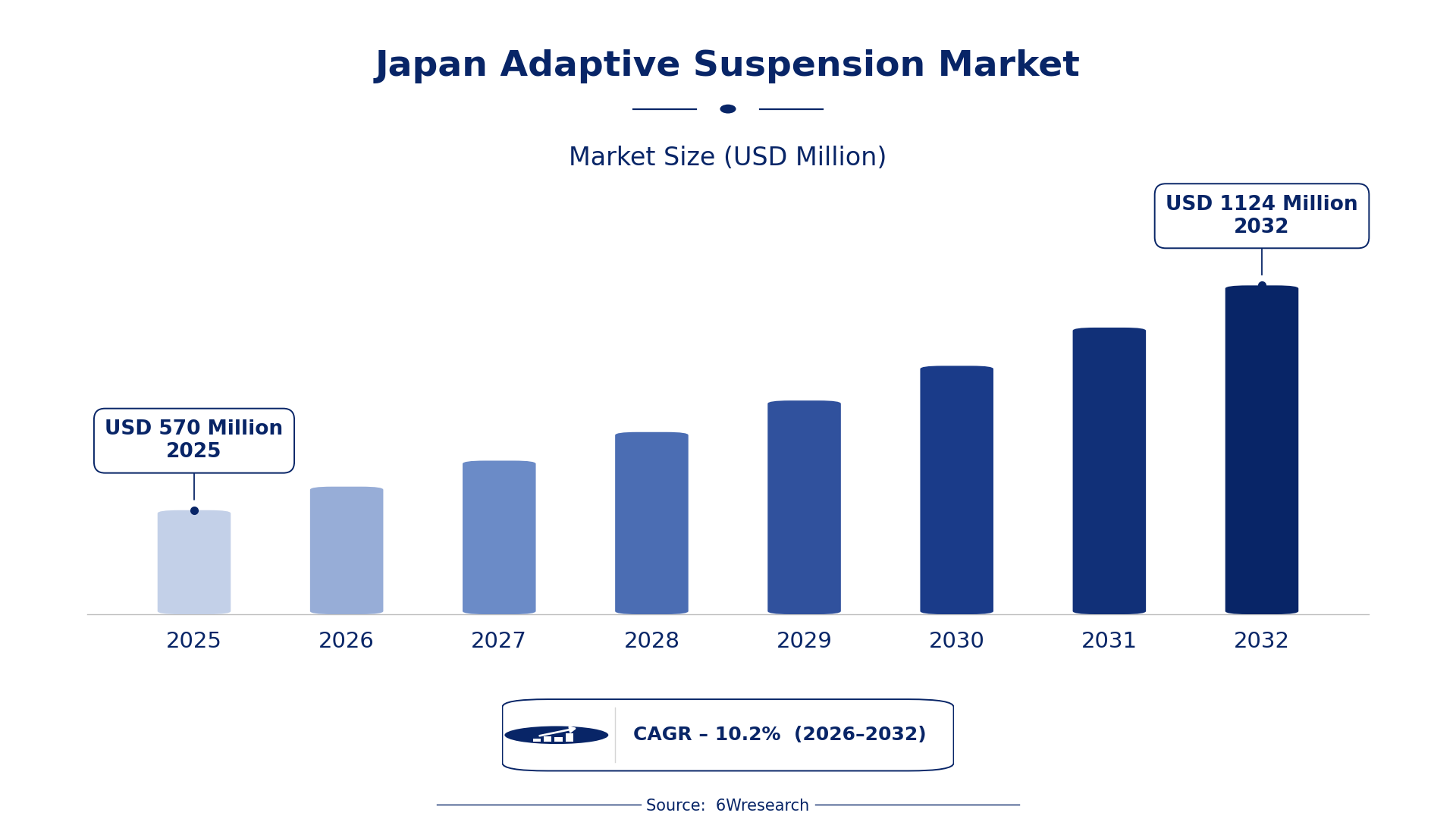
According to 6Wresearch internal database and industry insights, the Japan Adaptive Suspension Market was valued at USD 570 Million in 2025 and is projected to reach USD 1,124 Million by 2032, growing at a CAGR of approximately 10.2% during 2026–2032.
Japan Adaptive Suspension Market Highlights
| Report Metric | Details |
| Report Name | Japan Adaptive Suspension Market (2026-2032) |
| Market Size 2025 | USD 570 Million |
| Market Size 2032 | USD 1,124 Million |
| Absolute Growth 2025–2032 | USD 554 Million |
| CAGR 2026–2032 | 10.2% |
| Peak Annual Growth | 12.4% in 2032 |
| Forecast Period | 2026–2032 |
| Historical Data | 2022–2025 |
| Base Year | 2025 |
| Leading Suspension Type, 2025 | Active Suspension (40% share) |
| Leading Vehicle Segment, 2025 | Luxury Vehicles (41% share) |
| Leading Technology Type, 2025 | Electronic Control (42% share) |
| Leading Distribution Channel, 2025 | OEMs (36% share) |
| Leading End User, 2025 | Vehicle Manufacturers (41% share) |
| Fastest-Growing Suspension Type | Magnetorheological Damper (14.6% CAGR) |
| Fastest-Growing Vehicle Segment | Electric Vehicles (14.0% CAGR) |
| Fastest-Growing Technology Type | Magnetorheological (14.5% CAGR) |
| Fastest-Growing Distribution Channel | Aftermarket (13.6% CAGR) |
| Fastest-Growing End User | EV Manufacturers (13.9% CAGR) |
| Growing Sector | automotive |
| Key End Users | vehicle manufacturers, car enthusiasts, performance vehicle owners, aftermarket retailers |
Japan Adaptive Suspension Market Year-wise Growth Rate and Key Drivers (2022–2032)
This graph illustrates the annual growth rates of the market from 2022 to 2032, highlighting a steady upward trajectory and projected market expansion over the forecast period.
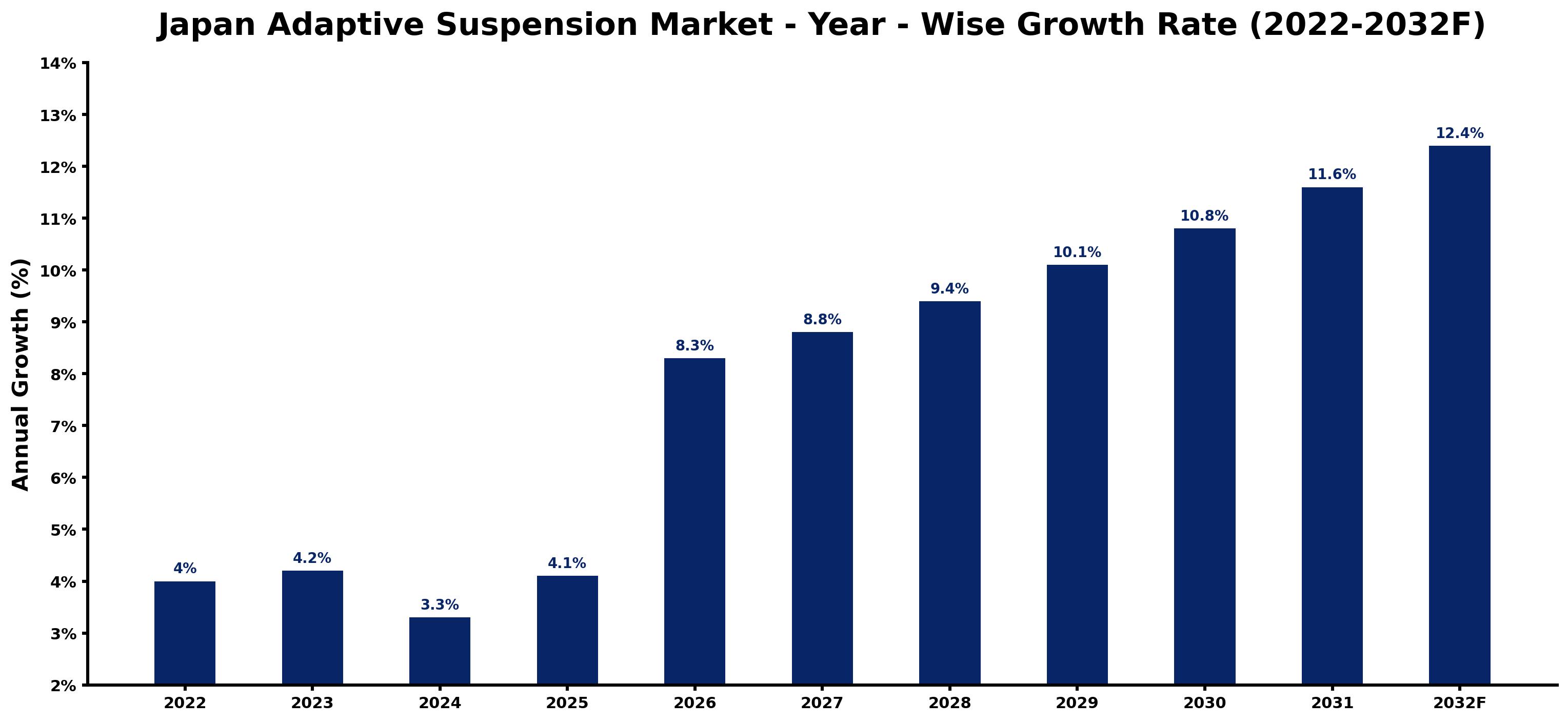
The yearly estimates that follow link every growth rate to its principal driver, so readers can see why the pace changed in each period.
| Year | Estimated Annual Growth (%) | Market Rationale |
| 2022 | 4.0 | The market showed steady growth with increasing interest in adaptive technologies. |
| 2023 | 4.2 | Demand rose due to heightened focus on vehicle comfort and performance. |
| 2024 | 3.3 | Growth slowed as manufacturers faced supply chain challenges impacting production. |
| 2025 | 4.1 | The market regained momentum with renewed investments in advanced suspension systems. |
| 2026 | 8.3 | Consumer preference for luxury vehicles is expected to drive demand increases. |
| 2027 | 8.8 | Growth will continue as electric vehicle adoption surges, increasing suspension needs. |
| 2028 | 9.4 | The market is projected to expand further with technological advancements in suspension systems. |
| 2029 | 10.1 | Demand will increase as performance vehicles gain popularity among enthusiasts. |
| 2030 | 10.8 | The trend towards enhanced ride quality will lead to further market growth. |
| 2031 | 11.6 | The market will continue to grow as manufacturers innovate with new technologies. |
| 2032 | 12.4 | Peak growth is expected through widespread adoption of adaptive systems. |
Note: Market size estimations and growth projections presented in this report are based on 6Wresearch's proprietary forecasting methodology, utilizing the latest available industry data, government publications, and primary research inputs.
Japan Adaptive Suspension Market Synopsis
Adaptive suspension systems improve vehicle ride quality and handling by adjusting characteristics in real-time. These technologies are primarily utilised in luxury and performance vehicles, with demand driven by domestic manufacturers and performance vehicle enthusiasts. The Japan Adaptive Suspension Market is growing due to increasing consumer preferences for comfort and advancements in electric vehicle technologies. The automotive industry, valued at approximately 50 trillion yen, supports ongoing innovation and investment in adaptive suspension solutions, propelling market growth. In 2023, the Tokyo Motor Show highlighted the latest innovations in adaptive suspension technologies, further stimulating interest.
Market Dynamics Impact Analysis (2026–2032)
| Factor | Type | Impact | Primary Segment Affected |
| Growing demand for luxury vehicles | Driver | High | Luxury Vehicles |
| Increased adoption of electric vehicles | Driver | High | Electric Vehicles |
| Rising aftermarket upgrades | Opportunity | High | Aftermarket |
| Expansion of electric vehicle market | Opportunity | High | Electric Vehicles |
| Supply chain disruptions | Restraint | Medium | Active Suspension |
| High costs of advanced technologies | Restraint | Medium | Active Suspension |
| Limited consumer awareness of benefits | Challenge | Medium | Performance Vehicles |
| Competition from traditional suspension systems | Challenge | Medium | Active Suspension |
Evaluation of Drivers in Japan Adaptive Suspension Market (2026–2032)
The following drivers explain most of the expected growth.
| Drivers | Primary Segment Affected | Why It Matters (Evidence) |
| Increased production of luxury vehicles | Luxury Vehicles | Japan's automotive industry produces over 10 million vehicles annually, boosting demand for adaptive suspension. |
| Rising electric vehicle registrations | Electric Vehicles | With over 300,000 registered electric vehicles, demand for advanced suspension systems is increasing. |
| Technological advancements in suspension systems | Magnetorheological Damper | Innovation is driving growth as performance requirements increase for adaptive systems. |
| Growing automotive aftermarket | Aftermarket | The automotive aftermarket is projected to reach 3 trillion yen by 2025, driving demand for upgrades. |
| Consumer preference for performance enhancements | Performance Vehicles | Car enthusiasts actively seek advanced suspension systems for improved driving experiences. |
Buyers are increasing capacity as the automotive industry in Japan expands, producing over 10 million vehicles annually. The rising number of registered electric vehicles, exceeding 300,000 units, fuels demand for advanced suspension technologies. The automotive aftermarket is expected to reach 3 trillion yen by 2025, encouraging upgrades. Performance vehicle enthusiasts are pursuing advanced suspension systems to enhance their driving experience, further driving market demand. Technological advancements are evident in the growing interest in adaptive systems that improve vehicle handling and comfort.
Evaluation of Restraints in Japan Adaptive Suspension Market
The table below lists the restraints and the evidence behind each.
| Market Restraint | Primary Segment Affected | Why It Matters (Evidence) |
| Supply chain disruptions affecting production timelines | Active Suspension | Supply chain issues have delayed the availability of components, impacting production schedules. |
| High costs associated with advanced suspension technologies | Active Suspension | The investment required for advanced systems can deter some manufacturers from adoption. |
| Limited consumer awareness of adaptive suspension benefits | Performance Vehicles | Many consumers remain unaware of the advantages of adaptive systems over traditional options. |
| Competition from traditional suspension systems | Active Suspension | Established traditional systems continue to dominate due to lower costs and familiarity. |
| Slow adoption rates in specific vehicle segments | Electric Vehicles | Some electric vehicle manufacturers are hesitant to invest in advanced suspension technologies. |
Japan Adaptive Suspension Market Challenges
Buyers encounter a shortage of skilled technicians for installing advanced suspension systems, resulting in delays for vehicle upgrades that can extend timelines by several weeks. Intense competition from traditional suspension systems pressures suppliers, leading to reduced profit margins and market share for adaptive solutions. Supply chain disruptions hinder the availability of essential components, causing production delays for manufacturers that can last up to three months. Rising raw material costs, influenced by inflation, compel suppliers to increase prices, which may deter buyers from investing in adaptive suspension technologies.
Trends in the Japan Adaptive Suspension Market
The trends below show where the Japan Adaptive Suspension Market is heading.
- Shift towards Electric Vehicles: The shift towards electric vehicles began in 2022, with over 300,000 units registered in Japan. This trend drives demand for adaptive suspension systems that improve performance and efficiency.
- Transition to Advanced Suspension Technologies: The Tokyo Motor Show showcases innovations in adaptive suspension technologies, highlighting a growing focus on performance. This shift reflects manufacturers' investments in systems that improve ride quality.
- Emergence of Aftermarket Upgrades: The automotive aftermarket is projected to reach 3 trillion yen by 2025, reflecting a growing trend among car enthusiasts seeking upgrades. This trend indicates strong demand for advanced suspension systems.
- Rising Interest in Performance Vehicles: Car enthusiasts are increasingly interested in performance vehicles, driving demand for advanced suspension technologies. This trend is supported by the growing number of luxury vehicles produced annually.
Investment Opportunities in the Japan Adaptive Suspension Market
Where to invest in the Japan Adaptive Suspension Market: the main openings are set out below.
- Supply advanced adaptive suspension systems: With the automotive aftermarket projected to reach 3 trillion yen by 2025, there is an opportunity to supply advanced adaptive suspension systems to vehicle manufacturers and aftermarket retailers.
- Invest in electric vehicle suspension technologies: The electric vehicle market is expanding rapidly, with over 300,000 registered units. Investing in suspension technologies tailored for electric vehicles can meet this growing demand.
- Collaborate with automotive manufacturers: Forming partnerships with vehicle manufacturers can facilitate entry into the adaptive suspension market, especially as luxury vehicles gain popularity.
- Provide aftermarket installation services: With the automotive aftermarket projected to grow, offering installation services for adaptive suspension systems can capture demand from car modification shops and enthusiasts.
Government Initiatives in the Japan Adaptive Suspension Market
The Waste Management and Public Cleansing Act requires manufacturers of adaptive suspension systems to manage waste effectively, ensuring compliance with environmental standards. This law influences production processes and encourages sustainable practices within the industry, impacting over 10 million vehicles produced annually.
The Economic Security Promotion Act supports supply-chain resilience for critical products, including automotive components. The Ministry of Economy, Trade and Industry oversees this act, which aims to strengthen domestic production capabilities and ensure a stable supply of essential materials for adaptive suspension systems, benefiting manufacturers across Japan.
Future Insight of the Japan Adaptive Suspension Market
Investment in electric vehicle technologies will stimulate demand for adaptive suspension systems, creating new opportunities for suppliers. By 2032, the automotive aftermarket is projected to reach 4 trillion yen, reflecting a robust market for upgrades. The Tokyo Motor Show will continue to showcase advancements in adaptive suspension, influencing buyer preferences. As vehicles age beyond 13 years, the need for aftermarket solutions will rise, prompting suppliers to expand their product offerings.
Market Segmentation Analysis
Japan Adaptive Suspension Market report covers a detailed analysis of the following market segments:
By Suspension Type – Active Suspension Leads, Magnetorheological Damper Expected to Grow Fastest
According to Saurav Kr Singh, Senior Research Analyst at 6Wresearch, the largest suspension type category in 2025 was Active Suspension, at 40% of revenue. Active suspension systems lead the market due to their ability to provide real-time adjustments that enhance ride quality, particularly in luxury vehicles. The adoption of the JIS D 5015 standard by many Japanese automotive manufacturers further solidifies their market position. Magnetorheological Damper is set to record the highest CAGR in this split, 14.6% over 2026–2032. The magnetorheological damper segment is rapidly expanding as it employs magnetic fields for real-time damping control, attracting performance-focused vehicle enthusiasts. This technology's increasing integration into new vehicle models is likely to further elevate its market presence. Suppliers should focus on developing advanced active suspension technologies to meet rising market demands.
By Vehicle Segment – Luxury Vehicles Lead, Electric Vehicles Expected to Grow Fastest
Luxury Vehicles accounted for 41% of the market by vehicle segment in 2025. Luxury vehicles hold the largest market share due to their strong demand for superior comfort and performance, especially in Japan's competitive automotive sector. The Tokyo region's emphasis on automotive innovation supports the prevalence of luxury models equipped with advanced suspension systems. Electric Vehicles are projected to grow fastest, at a CAGR of 14.0% during 2026–2032. Electric vehicles are the fastest-growing segment, driven by increasing adoption for improved efficiency and performance as manufacturers shift towards electrification. Local automotive associations' initiatives to promote electric vehicle technologies are expected to further accelerate this growth. Buyers in the luxury segment should consider adaptive suspension systems to enhance their vehicle's performance and comfort.
By Technology Type – Electronic Control Leads, Magnetorheological Expected to Grow Fastest
In 2025, Electronic Control led the technology type split with a 42% share. Electronic control technology dominates the market as it integrates seamlessly with vehicle systems, optimising performance and making it essential for modern adaptive suspension systems. Its widespread application across various vehicle types reinforces its leading market position. The quickest growth will come from Magnetorheological, forecast to expand at a CAGR of 14.5% between 2026 and 2032. Magnetorheological technology is gaining rapid traction due to its quick response to changing road conditions, appealing particularly to performance-oriented consumers. The growing adoption of this technology by vehicle manufacturers is likely to boost its market share further. Suppliers must invest in magnetorheological technology to remain competitive in the automotive industry.
By Distribution Channel – OEMs Lead, Aftermarket Expected to Grow Fastest
OEMs held 36% of the Japan Adaptive Suspension Market by distribution channel in 2025. OEMs are the primary source for adaptive suspension systems, providing integrated solutions directly to vehicle manufacturers, which ensures quality and compatibility. Their established relationships with automotive manufacturers further strengthen their leading position in the market. Over 2026–2032, Aftermarket is expected to post the fastest growth, at a CAGR of 13.6%. The aftermarket channel is experiencing the fastest growth as vehicle owners increasingly seek upgrades for older vehicles, particularly those with ageing suspension systems. The projected growth of the automotive aftermarket in Japan indicates a rising demand for such enhancements. Suppliers should explore opportunities to expand their aftermarket offerings to capitalise on this growing segment.
By End User – Vehicle Manufacturers Lead, EV Manufacturers Expected to Grow Fastest
Vehicle Manufacturers took 41% of end user revenue in 2025, more than any other category. Vehicle manufacturers dominate the market as the main developers and users of adaptive suspension technology, driving innovation and integration into new models. Their focus on improving vehicle performance and comfort directly influences the market's direction. EV Manufacturers are set to record the highest CAGR in this split, 13.9% over 2026–2032. EV manufacturers are quickly adopting adaptive suspension systems to enhance performance and efficiency, reflecting the industry's shift towards electric mobility. This trend is expected to accelerate as more manufacturers enter the EV market, increasing the demand for advanced suspension solutions. Suppliers should align their product development strategies with the needs of EV manufacturers to seize emerging opportunities.
Key Attractiveness of the Report
- 10 Years of Market Numbers
- Historical Data Starting from 2022 to 2025
- Base Year 2025
- Forecast Data until 2032
- Key Performance Indicators Impacting the Market
- Major Upcoming Developments and Projects
Key Highlights of the Report:
- Japan Adaptive Suspension Market Outlook
- Market Size of Japan Adaptive Suspension Market, 2025
- Forecast of Japan Adaptive Suspension Market, 2032
- Historical Data and Forecast of Japan Adaptive Suspension Revenues & Volume for the Period 2022-2032F
- Japan Adaptive Suspension Market Trend Evolution
- Japan Adaptive Suspension Market Drivers and Challenges
- Japan Adaptive Suspension Price Trends
- Japan Adaptive Suspension Porter's Five Forces
- Japan Adaptive Suspension Industry Life Cycle
- Historical Data and Forecast of Japan Adaptive Suspension Market Revenues & Volume By Suspension Type for the Period 2022-2032F
- Historical Data and Forecast of Japan Adaptive Suspension Market Revenues & Volume By Active Suspension for the Period 2022-2032F
- Historical Data and Forecast of Japan Adaptive Suspension Market Revenues & Volume By Semi-Active Suspension for the Period 2022-2032F
- Historical Data and Forecast of Japan Adaptive Suspension Market Revenues & Volume By Air Suspension for the Period 2022-2032F
- Historical Data and Forecast of Japan Adaptive Suspension Market Revenues & Volume By Magnetorheological Damper for the Period 2022-2032F
- Historical Data and Forecast of Japan Adaptive Suspension Market Revenues & Volume By Adjustable Coilovers for the Period 2022-2032F
- Historical Data and Forecast of Japan Adaptive Suspension Market Revenues & Volume By Vehicle Segment for the Period 2022-2032F
- Historical Data and Forecast of Japan Adaptive Suspension Market Revenues & Volume By Luxury Vehicles for the Period 2022-2032F
- Historical Data and Forecast of Japan Adaptive Suspension Market Revenues & Volume By SUVs for the Period 2022-2032F
- Historical Data and Forecast of Japan Adaptive Suspension Market Revenues & Volume By Electric Vehicles for the Period 2022-2032F
- Historical Data and Forecast of Japan Adaptive Suspension Market Revenues & Volume By Sports Cars for the Period 2022-2032F
- Historical Data and Forecast of Japan Adaptive Suspension Market Revenues & Volume By Passenger Cars for the Period 2022-2032F
- Historical Data and Forecast of Japan Adaptive Suspension Market Revenues & Volume By Technology Type for the Period 2022-2032F
- Historical Data and Forecast of Japan Adaptive Suspension Market Revenues & Volume By Electrohydraulic for the Period 2022-2032F
- Historical Data and Forecast of Japan Adaptive Suspension Market Revenues & Volume By Magnetorheological for the Period 2022-2032F
- Historical Data and Forecast of Japan Adaptive Suspension Market Revenues & Volume By Electronic Control for the Period 2022-2032F
- Historical Data and Forecast of Japan Adaptive Suspension Market Revenues & Volume By Magnetic Fluid for the Period 2022-2032F
- Historical Data and Forecast of Japan Adaptive Suspension Market Revenues & Volume By Mechanical-Electronic for the Period 2022-2032F
- Historical Data and Forecast of Japan Adaptive Suspension Market Revenues & Volume By Distribution Channel for the Period 2022-2032F
- Historical Data and Forecast of Japan Adaptive Suspension Market Revenues & Volume By OEMs for the Period 2022-2032F
- Historical Data and Forecast of Japan Adaptive Suspension Market Revenues & Volume By Aftermarket for the Period 2022-2032F
- Historical Data and Forecast of Japan Adaptive Suspension Market Revenues & Volume By Online Retailers for the Period 2022-2032F
- Historical Data and Forecast of Japan Adaptive Suspension Market Revenues & Volume By Authorized Dealers for the Period 2022-2032F
- Historical Data and Forecast of Japan Adaptive Suspension Market Revenues & Volume By Auto Parts Distributors for the Period 2022-2032F
- Historical Data and Forecast of Japan Adaptive Suspension Market Revenues & Volume By End User for the Period 2022-2032F
- Historical Data and Forecast of Japan Adaptive Suspension Market Revenues & Volume By Vehicle Manufacturers for the Period 2022-2032F
- Historical Data and Forecast of Japan Adaptive Suspension Market Revenues & Volume By Car Modification Shops for the Period 2022-2032F
- Historical Data and Forecast of Japan Adaptive Suspension Market Revenues & Volume By EV Manufacturers for the Period 2022-2032F
- Historical Data and Forecast of Japan Adaptive Suspension Market Revenues & Volume By Performance Vehicles for the Period 2022-2032F
- Historical Data and Forecast of Japan Adaptive Suspension Market Revenues & Volume By Car Enthusiasts for the Period 2022-2032F
- Japan Adaptive Suspension Import Export Trade Statistics
- Market Opportunity Assessment By Suspension Type
- Market Opportunity Assessment By Vehicle Segment
- Market Opportunity Assessment By Technology Type
- Market Opportunity Assessment By Distribution Channel
- Market Opportunity Assessment By End User
- Japan Adaptive Suspension Top Companies Market Share
- Japan Adaptive Suspension Competitive Benchmarking By Technical and Operational Parameters
- Japan Adaptive Suspension Company Profiles
- Japan Adaptive Suspension Key Strategic Recommendations
Market Covered
Coverage by segment is as follows.
By Suspension Type
- Active Suspension
- Semi-Active Suspension
- Air Suspension
- Magnetorheological Damper
- Adjustable Coilovers
By Vehicle Segment
- Luxury Vehicles
- SUVs
- Electric Vehicles
- Sports Cars
- Passenger Cars
By Technology Type
- Electrohydraulic
- Magnetorheological
- Electronic Control
- Magnetic Fluid
- Mechanical-Electronic
By Distribution Channel
- OEMs
- Aftermarket
- Online Retailers
- Authorized Dealers
- Auto Parts Distributors
By End User
- Vehicle Manufacturers
- Car Modification Shops
- EV Manufacturers
- Performance Vehicles
- Car Enthusiasts































