Japan Adaptive Technology Market Size & Growth Rate
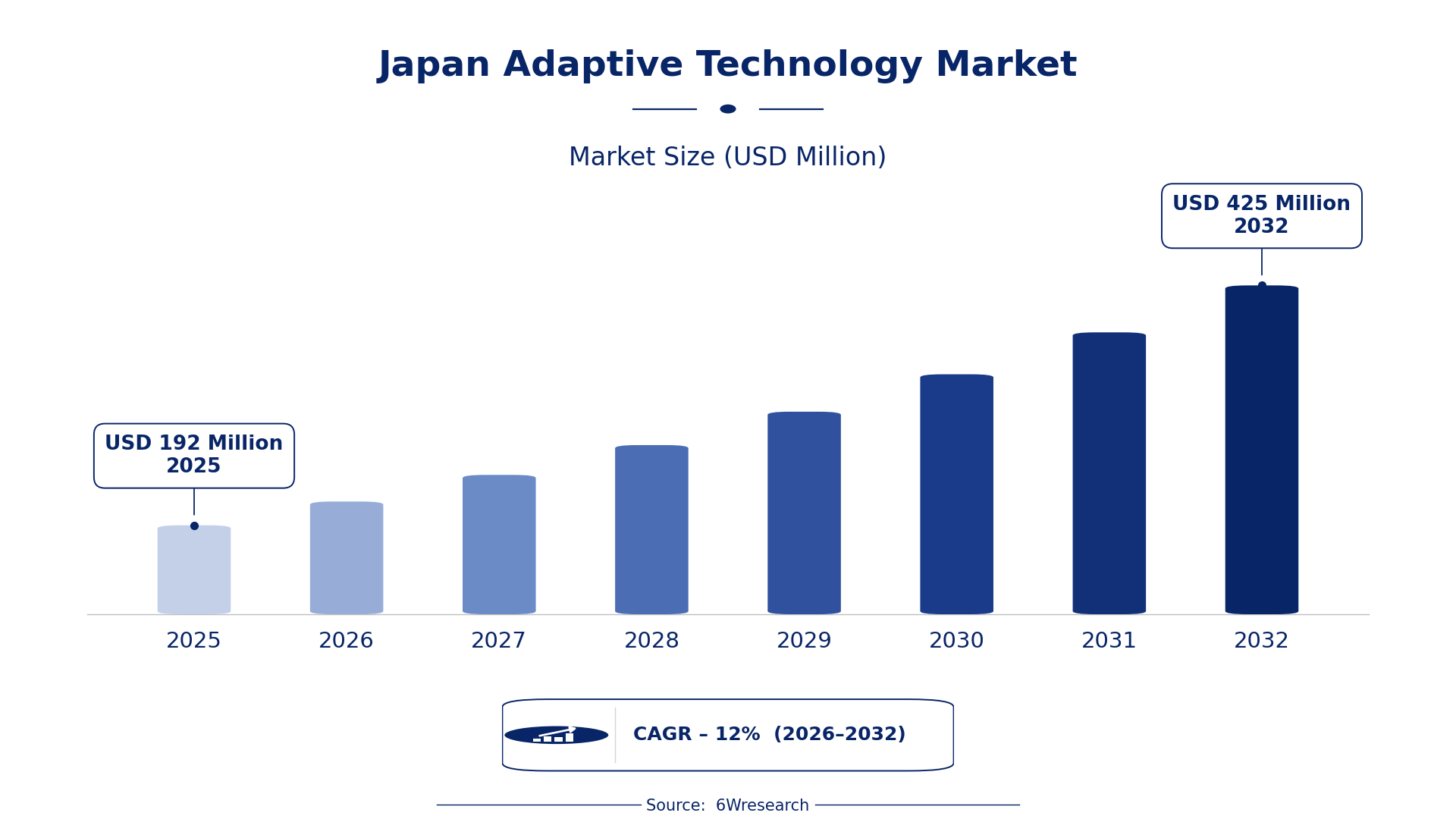
According to 6Wresearch internal database and industry insights, the Japan Adaptive Technology Market was valued at USD 192 Million in 2025 and is projected to reach USD 425 Million by 2032, growing at a CAGR of approximately 12% during 2026–2032.
Japan Adaptive Technology Market Highlights
| Report Metric | Details |
| Report Name | Japan Adaptive Technology Market (2026-2032) |
| Market Size 2025 | USD 192 Million |
| Market Size 2032 | USD 425 Million |
| Absolute Growth 2025–2032 | USD 233 Million |
| CAGR 2026–2032 | 12% |
| Peak Annual Growth | 13.1% in 2030 |
| Forecast Period | 2026–2032 |
| Historical Data | 2022–2025 |
| Base Year | 2025 |
| Leading Adaptive Technology, 2025 | Screen Readers (49% share) |
| Leading Product Type, 2025 | Assistive Software (49% share) |
| Leading Distribution Channel, 2025 | Online Platforms (46% share) |
| Leading End User, 2025 | Visually Impaired Users (47% share) |
| Fastest-Growing Adaptive Technology | Adaptive Keyboards (16.4% CAGR) |
| Fastest-Growing Product Type | Hardware Devices (17.2% CAGR) |
| Fastest-Growing Distribution Channel | Direct Sales (15.3% CAGR) |
| Fastest-Growing End User | Physically Disabled Users (15.0% CAGR) |
| Growing Sector | Assistive Technology |
| Key End Users | Visually Impaired Users, Physically Disabled Users, Hearing Impaired, Healthcare Institutions |
Japan Adaptive Technology Market Year-wise Growth Rate and Key Drivers (2022–2032)
This graph illustrates the annual growth rates of the market from 2022 to 2032, highlighting a steady upward trajectory and projected market expansion over the forecast period.
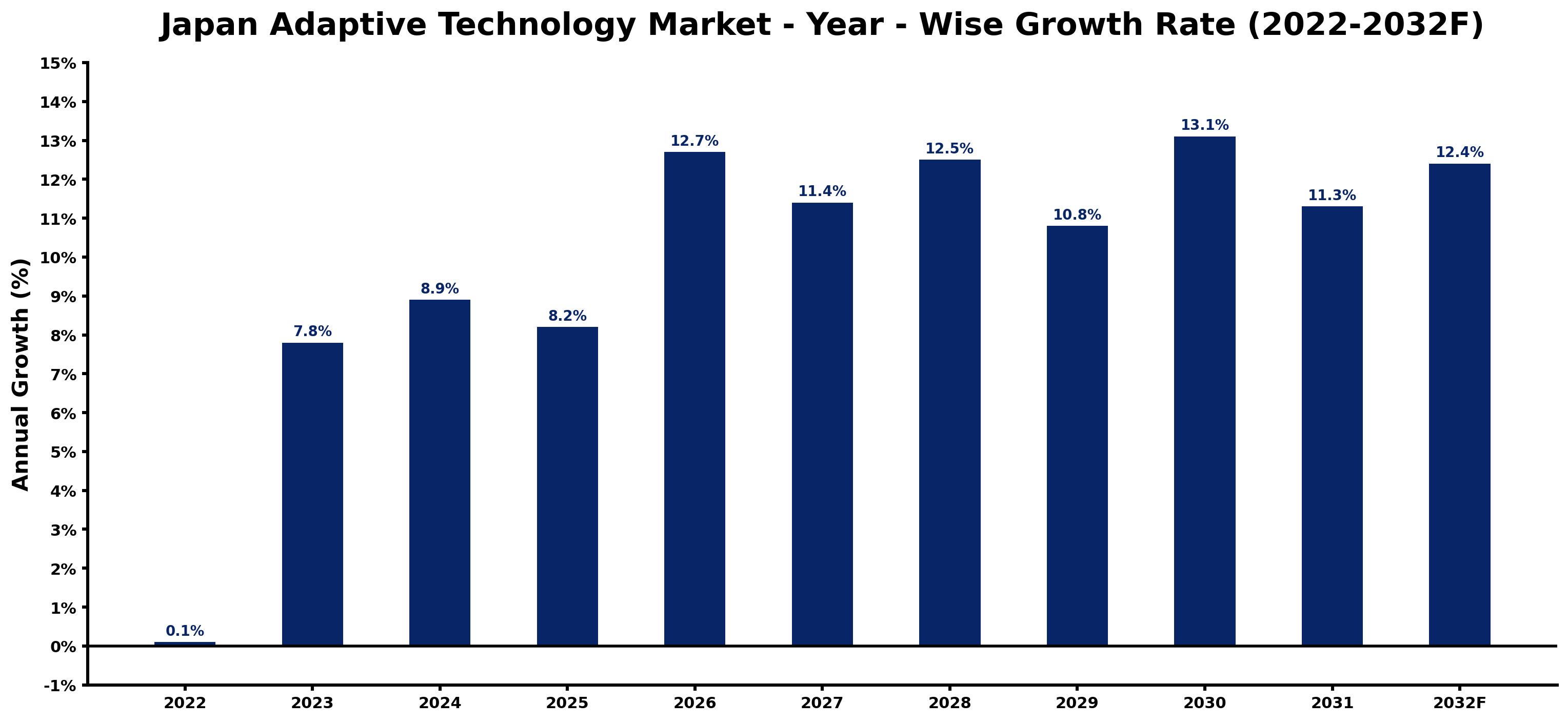
Below, each year's estimated growth is shown next to the factor that most influenced it.
| Year | Estimated Annual Growth (%) | Market Rationale |
| 2022 | 0.1 | The market showed minimal growth due to limited awareness of available technologies. |
| 2023 | 7.8 | Increased visibility of adaptive technologies led to faster adoption rates. |
| 2024 | 8.9 | The rise in healthcare investments boosted demand for assistive devices. |
| 2025 | 8.2 | Growth slowed as market saturation began to affect new purchases. |
| 2026 | 12.7 | Technological advancements in adaptive devices spur renewed interest and demand. |
| 2027 | 11.4 | Market growth is expected to slow slightly as competition intensifies among suppliers. |
| 2028 | 12.5 | Product launches are projected to revitalise consumer interest and purchasing. |
| 2029 | 10.8 | Growth is expected to decelerate as the market reaches a more mature stage. |
| 2030 | 13.1 | The peak growth rate will be driven by heightened demand from healthcare facilities. |
| 2031 | 11.3 | Growth is projected to slow as the market stabilises following previous peaks. |
| 2032 | 12.4 | Continued advancements in technology are expected to sustain demand. |
Note: Market size estimations and growth projections presented in this report are based on 6Wresearch's proprietary forecasting methodology, utilizing the latest available industry data, government publications, and primary research inputs.
Japan Adaptive Technology Market Synopsis
Adaptive technology includes devices and software that assist individuals with disabilities in daily tasks, facilitating communication, mobility, and digital interaction. The Japan Adaptive Technology Market is expanding, driven by a large population of visually impaired individuals and increasing adoption in healthcare settings. With approximately 1.2 million visually impaired users and over 500 hospitals utilising assistive software, the market is projected to grow steadily, supported by government programmes and technological advancements.
Market Dynamics Impact Analysis (2026–2032)
| Factor | Type | Impact | Primary Segment Affected |
| Growing population of visually impaired individuals | Driver | High | Screen Readers |
| Increased healthcare spending on assistive devices | Driver | High | Assistive Software |
| Rising demand for adaptive keyboards in educational settings | Opportunity | Medium | Adaptive Keyboards |
| Expansion of online sales platforms for accessibility | Opportunity | Medium | Online Platforms |
| High costs associated with advanced adaptive technologies | Restraint | High | Hearing Aids |
| Limited awareness among potential users about available products | Restraint | Medium | Eye-Tracking Devices |
| Technological integration challenges in healthcare systems | Challenge | High | Assistive Software |
| Competition from low-cost alternatives in the market | Challenge | Medium | Hardware Devices |
Evaluation of Drivers in Japan Adaptive Technology Market (2026–2032)
The main growth drivers and the segments they affect most are set out below.
| Drivers | Primary Segment Affected | Why It Matters (Evidence) |
| Rising number of visually impaired individuals | Screen Readers | Approximately 1.2 million visually impaired individuals in Japan drive demand for screen readers, enhancing their daily communication. |
| Increased healthcare investments | Assistive Software | Over 500 hospitals in Japan utilise assistive software, leading to higher demand for adaptive technology. |
| Educational initiatives promoting adaptive technology | Adaptive Keyboards | Schools are increasingly adopting adaptive keyboards, essential for over 200,000 physically disabled users. |
| Government support for accessibility initiatives | Hearing Aids | Around 3 million people use hearing aids, supported by government programs enhancing access to these devices. |
| Growth of online sales channels | Online Platforms | Online platforms account for 60% of adaptive technology sales, facilitating easier access for users. |
Behind the steady rise in orders sits a growing number of visually impaired individuals, approximately 1.2 million in Japan, driving demand for screen readers. Increased healthcare investments have led to over 500 hospitals utilising assistive software, boosting market growth. Online platforms account for 60% of adaptive technology sales, facilitating easier access for users.
Evaluation of Restraints in Japan Adaptive Technology Market
Below are the constraints most often cited by buyers and suppliers, with the segment each affects.
| Market Restraint | Primary Segment Affected | Why It Matters (Evidence) |
| High costs of advanced adaptive technologies | Hearing Aids | The high price of hearing aids limits access for many potential users, affecting market penetration. |
| Limited awareness of adaptive technology | Eye-Tracking Devices | Many potential users are unaware of eye-tracking devices, hindering market growth. |
| Integration challenges in healthcare systems | Assistive Software | Technological integration issues within healthcare systems slow down the adoption of assistive software. |
| Competition from low-cost alternatives | Hardware Devices | The presence of low-cost alternatives in the market pressures prices and affects sales of premium devices. |
| Saturation of the market for certain products | Adaptive Keyboards | As the market matures, saturation affects new purchases, slowing growth in adaptive keyboards. |
Japan Adaptive Technology Market Challenges
Buyers of adaptive technology encounter fierce competition, with numerous domestic and international firms vying for market share, which can diminish profit margins by 15% for local manufacturers. Many hospitals find it challenging to keep pace with technological advancements, as 30% are unable to offer the latest assistive devices, ultimately impacting patient care. Regulatory hurdles from the Ministry of Health, Labour and Welfare can extend product approval times by six months, delaying access for healthcare providers. Supply chain disruptions in sourcing essential components can inflate production costs by 20%, affecting pricing for buyers.
Trends in the Japan Adaptive Technology Market
Several trends are reshaping the Japan Adaptive Technology Market; the most important are set out below.
- Shift towards Digital Assistive Solutions: The trend is moving towards digital assistive solutions, with the Digital Agency leading initiatives to improve accessibility. In 2023, the government launched a program to enhance public space accessibility, reflecting this shift.
- Transition from Hardware to Software Solutions: Japan is experiencing a transition from hardware to software solutions in adaptive technology. The rise of assistive software is evident, with over 500 hospitals adopting these tools to improve patient care.
- Emergence of AI-Based Adaptive Devices: AI-based adaptive devices are emerging as a trend, with the AI Promotion Act of 2025 encouraging research in this area. This shift is expected to improve user experience and functionality.
- Growing Importance of Online Sales Channels: Online sales channels are becoming increasingly important, accounting for 60% of adaptive technology sales. This shift is evident in urban areas where accessibility to products is critical.
Investment Opportunities in the Japan Adaptive Technology Market
The following opportunities in the Japan Adaptive Technology Market pair current demand with a clear way in.
- Urban Areas as Key Markets: Urban regions in Japan offer significant opportunities for adaptive technology, with around 1.2 million visually impaired individuals. Suppliers can penetrate this market through collaborations with local healthcare institutions.
- Investment in Assistive Software: With over 500 hospitals employing assistive software, a supply gap is emerging. Investing in software development can meet this demand and enhance patient outcomes.
- Expansion of Online Platforms: Online platforms, which account for 60% of sales, present a growth opportunity. Companies can strengthen their online presence to effectively reach a broader user base.
- Targeting Educational Institutions: Educational institutions are increasingly integrating adaptive technologies, generating demand for adaptive keyboards. Suppliers can concentrate on schools and universities to satisfy this growing need.
Government Initiatives in the Japan Adaptive Technology Market
The AI Promotion Act of 2025 supports the development and utilisation of adaptive technologies, complementing existing legislation such as the Long-Term Care Insurance Act, which funds support services for the elderly. This framework improves accessibility for users of adaptive technology.
The Digital Agency manages the implementation of digital transformation initiatives, enabling healthcare facilities to secure funding for adaptive technologies. This support allows hospitals to enhance their services and improve care quality for individuals with disabilities.
Future Insight of the Japan Adaptive Technology Market
By 2032, healthcare institutions will benefit from improved accessibility due to a government programme focused on enhancing public space adaptations, which will increase user engagement. The adoption of ISO 9999 standards will elevate quality and consistency in assistive devices, benefiting both buyers and suppliers. Technological advancements will streamline purchasing processes, with online sales expected to constitute 60% of the market. Local government initiatives will extend support to an additional 10 prefectures, increasing the availability of adaptive technology.
Market Segmentation Analysis
Japan Adaptive Technology Market report covers a detailed analysis of the following market segments:
By Adaptive Technology – Screen Readers Lead, Adaptive Keyboards Expected to Grow Fastest
According to Saurav Kr Singh, Senior Research Analyst at 6Wresearch, Screen Readers held 49% of the Japan Adaptive Technology Market by adaptive technology in 2025. Screen readers hold the largest share as they are essential for the approximately 1.2 million visually impaired individuals in Japan. Their critical role in facilitating communication and interaction with digital content makes them indispensable, particularly in urban areas like Tokyo. The quickest growth will come from Adaptive Keyboards, forecast to expand at a CAGR of 16.4% between 2026 and 2032. The growth of adaptive keyboards is fuelled by their specific design for physically disabled users, with over 200,000 individuals relying on them. This targeted functionality aligns with the increasing focus on accessibility, ensuring continued demand. Suppliers should prioritise the development of adaptive keyboards to capitalise on the growing market.
By Product Type – Assistive Software Leads, Hardware Devices Expected to Grow Fastest
In 2025, Assistive Software led the product type split with a 49% share. Assistive software dominates the market as it supports various disabilities in digital environments, making it indispensable for users across multiple sectors. Its integration in over 500 hospitals highlights its critical role in healthcare. Hardware Devices are set to record the highest CAGR in this split, 17.2% over 2026–2032. Hardware devices are experiencing rapid growth as they include essential tools for daily living, which are increasingly recognised as vital for independence. The push for improved accessibility in public spaces further fuels this demand. Buyers will benefit from a wider range of hardware options as suppliers respond to the growing need for essential daily living tools.
By Distribution Channel – Online Platforms Lead, Direct Sales Expected to Grow Fastest
Online Platforms took 46% of distribution channel revenue in 2025, more than any other category. Online platforms dominate the distribution of adaptive technology, accounting for 60% of sales in Japan. Their convenience and accessibility cater to a diverse range of users seeking adaptive solutions, especially in urban environments. Over 2026–2032, Direct Sales is expected to post the fastest growth, at a CAGR of 15.3%. Direct sales are gaining traction as they provide a personalised purchasing experience, appealing to customers who prefer direct interaction. This trend suggests a shift towards more tailored service in the adaptive technology sector. Suppliers should enhance their direct sales approaches to better engage with customers and complement online strategies.
By End User – Visually Impaired Users Lead, Physically Disabled Users Expected to Grow Fastest
With 47% of end user revenue in 2025, Visually Impaired Users was the largest category. Visually impaired users represent the largest end user group, significantly shaping the demand for adaptive technology tailored to their specific needs. Their considerable population in Japan ensures a consistent market for products designed for this demographic. Physically Disabled Users are projected to grow fastest, at a CAGR of 15.0% during 2026–2032. The segment of physically disabled users is rapidly expanding, driven by their increasing reliance on adaptive technology for daily tasks. Local government initiatives promoting accessibility further support this user base's growth. Suppliers must refine their marketing strategies to effectively reach the growing segment of physically disabled users.
Key Attractiveness of the Report
- 10 Years of Market Numbers
- Historical Data Starting from 2022 to 2025
- Base Year 2025
- Forecast Data until 2032
- Key Performance Indicators Impacting the Market
- Major Upcoming Developments and Projects
Key Highlights of the Report:
- Japan Adaptive Technology Market Outlook
- Market Size of Japan Adaptive Technology Market, 2025
- Forecast of Japan Adaptive Technology Market, 2032
- Historical Data and Forecast of Japan Adaptive Technology Revenues & Volume for the Period 2022-2032F
- Japan Adaptive Technology Market Trend Evolution
- Japan Adaptive Technology Market Drivers and Challenges
- Japan Adaptive Technology Price Trends
- Japan Adaptive Technology Porter's Five Forces
- Japan Adaptive Technology Industry Life Cycle
- Historical Data and Forecast of Japan Adaptive Technology Market Revenues & Volume By Adaptive Technology for the Period 2022-2032F
- Historical Data and Forecast of Japan Adaptive Technology Market Revenues & Volume By Screen Readers for the Period 2022-2032F
- Historical Data and Forecast of Japan Adaptive Technology Market Revenues & Volume By Adaptive Keyboards for the Period 2022-2032F
- Historical Data and Forecast of Japan Adaptive Technology Market Revenues & Volume By Hearing Aids for the Period 2022-2032F
- Historical Data and Forecast of Japan Adaptive Technology Market Revenues & Volume By Eye-Tracking Devices for the Period 2022-2032F
- Historical Data and Forecast of Japan Adaptive Technology Market Revenues & Volume By Product Type for the Period 2022-2032F
- Historical Data and Forecast of Japan Adaptive Technology Market Revenues & Volume By Assistive Software for the Period 2022-2032F
- Historical Data and Forecast of Japan Adaptive Technology Market Revenues & Volume By Hardware Devices for the Period 2022-2032F
- Historical Data and Forecast of Japan Adaptive Technology Market Revenues & Volume By Wearable Devices for the Period 2022-2032F
- Historical Data and Forecast of Japan Adaptive Technology Market Revenues & Volume By AI-Based Devices for the Period 2022-2032F
- Historical Data and Forecast of Japan Adaptive Technology Market Revenues & Volume By Distribution Channel for the Period 2022-2032F
- Historical Data and Forecast of Japan Adaptive Technology Market Revenues & Volume By Online Platforms for the Period 2022-2032F
- Historical Data and Forecast of Japan Adaptive Technology Market Revenues & Volume By Direct Sales for the Period 2022-2032F
- Historical Data and Forecast of Japan Adaptive Technology Market Revenues & Volume By Specialty Stores for the Period 2022-2032F
- Historical Data and Forecast of Japan Adaptive Technology Market Revenues & Volume By Medical Suppliers for the Period 2022-2032F
- Historical Data and Forecast of Japan Adaptive Technology Market Revenues & Volume By End User for the Period 2022-2032F
- Historical Data and Forecast of Japan Adaptive Technology Market Revenues & Volume By Visually Impaired Users for the Period 2022-2032F
- Historical Data and Forecast of Japan Adaptive Technology Market Revenues & Volume By Physically Disabled Users for the Period 2022-2032F
- Historical Data and Forecast of Japan Adaptive Technology Market Revenues & Volume By Hearing Impaired for the Period 2022-2032F
- Historical Data and Forecast of Japan Adaptive Technology Market Revenues & Volume By Neurological Patients for the Period 2022-2032F
- Japan Adaptive Technology Import Export Trade Statistics
- Market Opportunity Assessment By Adaptive Technology
- Market Opportunity Assessment By Product Type
- Market Opportunity Assessment By Distribution Channel
- Market Opportunity Assessment By End User
- Japan Adaptive Technology Top Companies Market Share
- Japan Adaptive Technology Competitive Benchmarking By Technical and Operational Parameters
- Japan Adaptive Technology Company Profiles
- Japan Adaptive Technology Key Strategic Recommendations
Market Covered
The study includes the following segmentation.
By Adaptive Technology
- Screen Readers
- Adaptive Keyboards
- Hearing Aids
- Eye-Tracking Devices
By Product Type
- Assistive Software
- Hardware Devices
- Wearable Devices
- AI-Based Devices
By Distribution Channel
- Online Platforms
- Direct Sales
- Specialty Stores
- Medical Suppliers
By End User
- Visually Impaired Users
- Physically Disabled Users
- Hearing Impaired
- Neurological Patients































