Japan ADAS Camera Market Size & Growth Rate
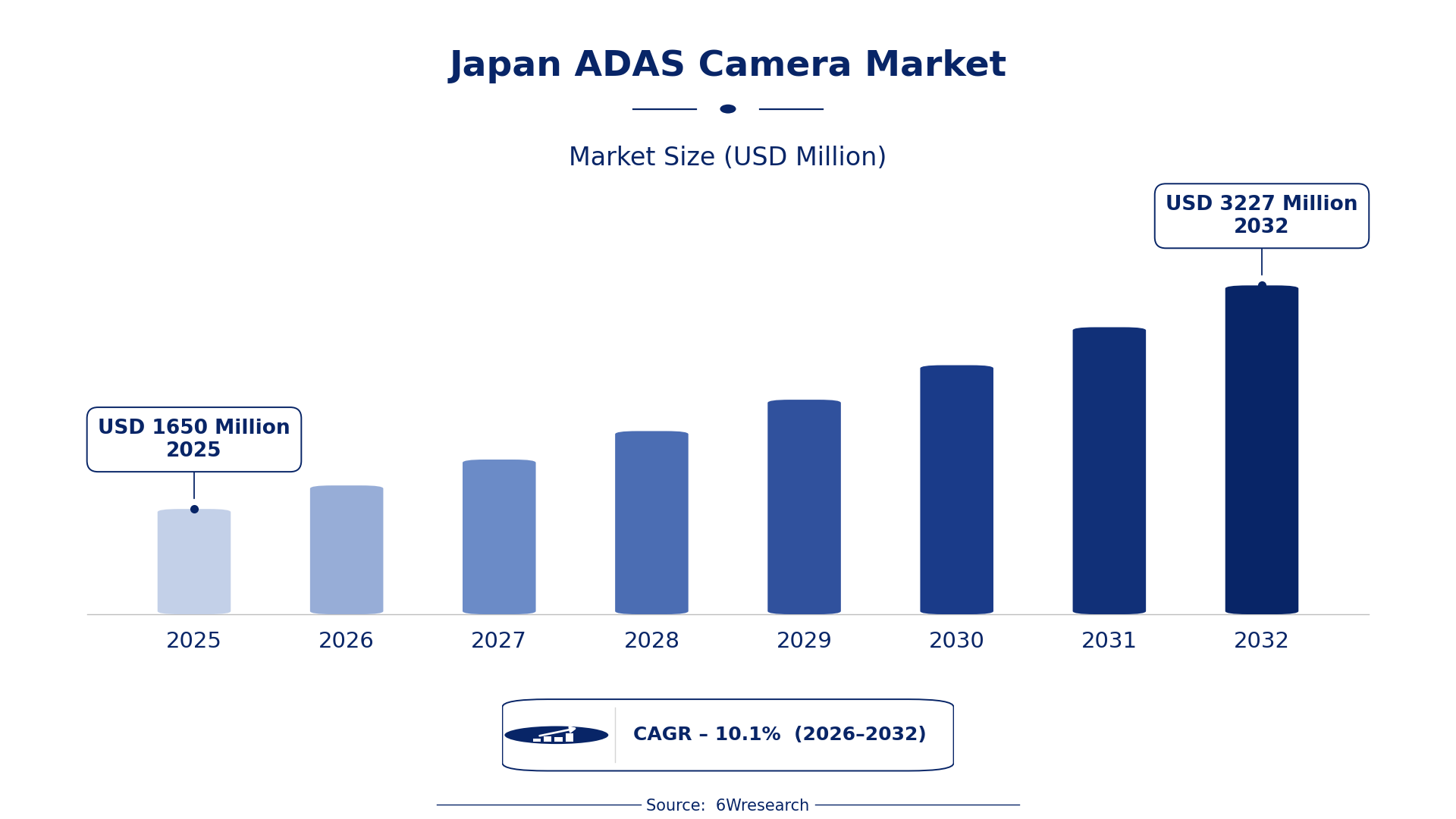
According to 6Wresearch internal database and industry insights, the Japan ADAS Camera Market was valued at USD 1,650 Million in 2025 and is projected to reach USD 3,227 Million by 2032, growing at a CAGR of approximately 10.1% during 2026–2032.
Japan ADAS Camera Market Highlights
| Report Metric | Details |
| Report Name | Japan ADAS Camera Market (2026-2032) |
| Market Size 2025 | USD 1,650 Million |
| Market Size 2032 | USD 3,227 Million |
| Absolute Growth 2025–2032 | USD 1,577 Million |
| CAGR 2026–2032 | 10.1% |
| Peak Annual Growth | 11.1% in 2031 |
| Forecast Period | 2026–2032 |
| Historical Data | 2022–2025 |
| Base Year | 2025 |
| Leading ADAS Camera, 2025 | Mono Cameras (52% share) |
| Leading Product Type, 2025 | Single-Lens Cameras (40% share) |
| Leading Distribution Channel, 2025 | OEMs (49% share) |
| Leading End User, 2025 | Mid-range Vehicles (42% share) |
| Fastest-Growing ADAS Camera | Stereo Cameras (13.0% CAGR) |
| Fastest-Growing Product Type | Dual-Lens Cameras (14.0% CAGR) |
| Fastest-Growing Distribution Channel | Auto Component Dealers (13.1% CAGR) |
| Fastest-Growing End User | High-End Vehicles (13.4% CAGR) |
| Growing Sector | automotive safety |
| Key End Users | automotive manufacturers, aftermarket service providers, vehicle owners |
Japan ADAS Camera Market Year-wise Growth Rate and Key Drivers (2022–2032)
This graph illustrates the annual growth rates of the market from 2022 to 2032, highlighting a steady upward trajectory and projected market expansion over the forecast period.
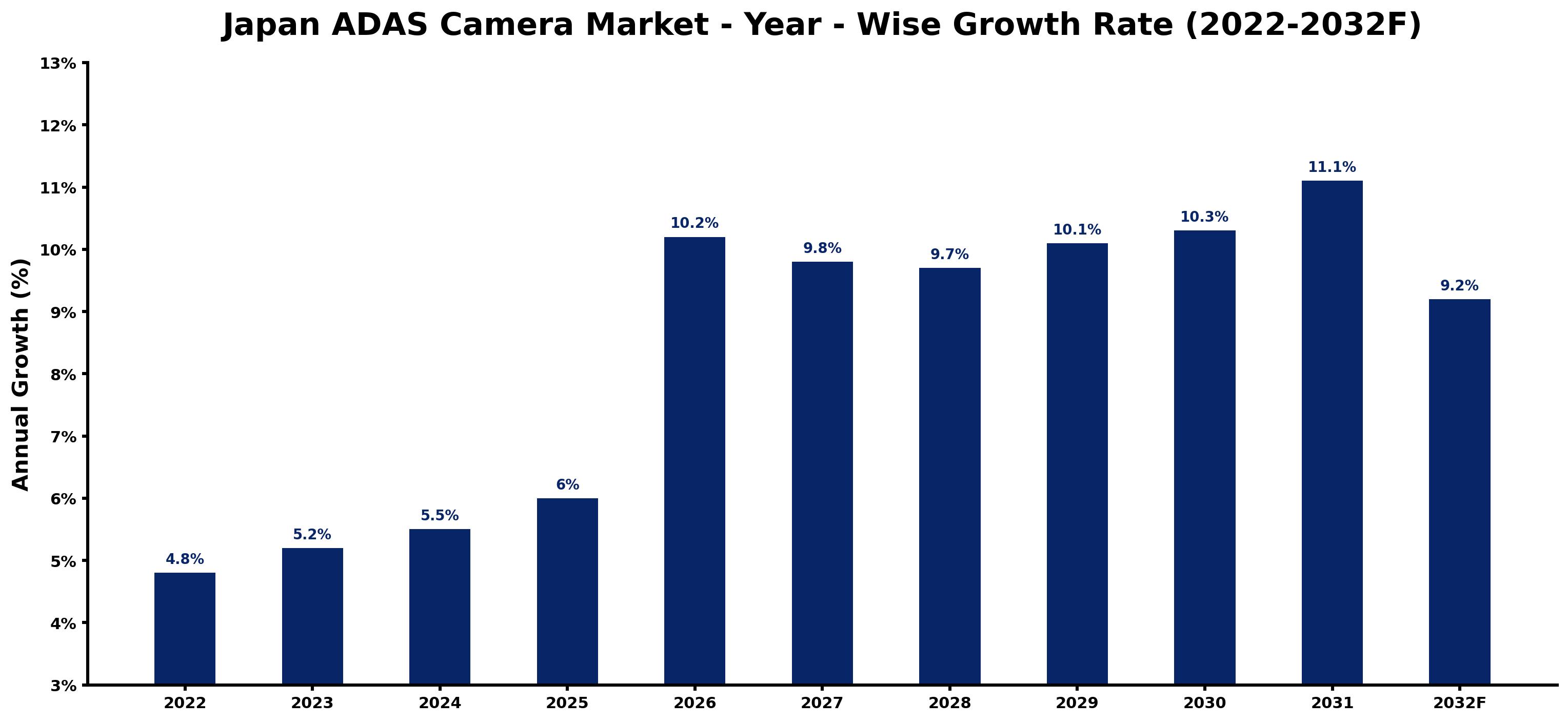
The table below sets out the estimated growth rate for each year and the main factor behind it.
| Year | Estimated Annual Growth (%) | Market Rationale |
| 2022 | 4.8 | The market showed steady demand with a growth rate reflecting ongoing technological advancements. |
| 2023 | 5.2 | Growth accelerated due to increased consumer interest in vehicle safety features and automation. |
| 2024 | 5.5 | Demand continued to rise as manufacturers integrated more ADAS technologies into new models. |
| 2025 | 6.0 | The market reached a historical peak as production of advanced vehicles increased. |
| 2026 | 10.2 | Growth is expected to be driven by a national strategy promoting autonomous driving technologies and safety. |
| 2027 | 9.8 | A slight slowdown is projected as the market adjusts to prior rapid advancements in technology. |
| 2028 | 9.7 | Continued growth is expected to be supported by sustained investments in vehicle safety and automation technologies. |
| 2029 | 10.1 | Demand is projected to surge again as the adoption of ADAS features becomes more widespread among consumers. |
| 2030 | 10.3 | Growth is expected to remain strong with rising consumer expectations for safety and automation in vehicles. |
| 2031 | 11.1 | The market is projected to peak as manufacturers launch new models equipped with advanced ADAS features. |
| 2032 | 9.2 | A slowdown in growth is expected as the market stabilises after rapid expansion. |
Note: Market size estimations and growth projections presented in this report are based on 6Wresearch's proprietary forecasting methodology, utilizing the latest available industry data, government publications, and primary research inputs.
Japan ADAS Camera Market Synopsis
ADAS cameras are advanced driver-assistance systems that improve vehicle safety and automation through high-resolution imaging sensors and sophisticated algorithms for object detection. The Japan ADAS Camera Market is propelled by the production of over 8 million vehicles in 2022, alongside a national strategy initiated in 2023 that aims for 50% of new vehicles to incorporate ADAS by 2025. This initiative is backed by substantial investments in automotive safety research and development, reflecting the rising demand for advanced vehicle technologies.
Market Dynamics Impact Analysis (2026–2032)
| Factor | Type | Impact | Primary Segment Affected |
| Increasing integration of ADAS in new vehicle models | Driver | High | Mono Cameras |
| Growing consumer demand for enhanced vehicle safety features | Driver | High | Mono Cameras |
| Expansion of retrofitting services for older vehicles | Opportunity | High | Mono Cameras |
| Rising interest in autonomous vehicle technologies | Opportunity | Medium | Mono Cameras |
| High costs associated with advanced camera systems | Restraint | High | Mono Cameras |
| Limited availability of skilled technicians for installation | Restraint | Medium | Mono Cameras |
| Supply chain disruptions affecting component availability | Challenge | High | Mono Cameras |
| Intense competition among manufacturers for market share | Challenge | Medium | Mono Cameras |
Evaluation of Drivers in Japan ADAS Camera Market (2026–2032)
Demand rests on the following drivers, each shown with the segment it touches most.
| Drivers | Primary Segment Affected | Why It Matters (Evidence) |
| Rising production of vehicles equipped with ADAS | Mono Cameras | Japan's automotive market produced over 8 million vehicles in 2022, increasing demand for ADAS cameras. |
| Consumer preference for safety features in vehicles | Mono Cameras | The average age of vehicles in Japan is 11.5 years, pushing demand for retrofitting ADAS. |
| Government initiatives promoting autonomous driving | Mono Cameras | The national strategy aims for 50% of new vehicles to have ADAS by 2025, driving adoption. |
| Technological advancements in imaging sensors | Mono Cameras | The JIS D 0203 standard governs camera specifications, ensuring high-quality production. |
| Expansion of the automotive aftermarket | Mono Cameras | The Tokyo region accounts for 30% of Japan's automotive production, supporting aftermarket growth. |
A wider customer base accounts for much of the growth, as the automotive market produced over 8 million vehicles in 2022, fuelling demand for ADAS cameras. The average age of vehicles in Japan is 11.5 years, increasing the necessity for retrofitting ADAS features. Technological advancements in imaging sensors guarantee high-quality production, attracting more manufacturers. The Tokyo region, which represents 30% of automotive production, supports a burgeoning aftermarket for advanced safety technologies.
Evaluation of Restraints in Japan ADAS Camera Market
The key brakes on demand, and where they bite hardest, are shown below.
| Market Restraint | Primary Segment Affected | Why It Matters (Evidence) |
| High costs associated with advanced camera systems | Mono Cameras | The average cost of ADAS installations can deter some consumers, limiting market growth. |
| Limited availability of skilled technicians for installation | Mono Cameras | A shortage of qualified technicians can delay the installation of advanced systems in vehicles. |
| Supply chain disruptions affecting component availability | Mono Cameras | Recent supply chain issues have led to delays in the production of essential components. |
| Regulatory hurdles in vehicle safety compliance | Mono Cameras | Compliance with safety regulations can increase the time and cost of bringing products to market. |
| Market saturation in high-end vehicle segments | High-End Vehicles | As high-end vehicles become saturated with advanced features, growth opportunities may diminish. |
Japan ADAS Camera Market Challenges
Annual demand for ADAS cameras in Japan reaches 3 million units, yet buyers encounter delays due to a shortage of skilled technicians for installation and maintenance, which can prolong project timelines by up to six months. Suppliers face rising production costs because of strict compliance with the JIS D 0203 standard, resulting in increased prices for manufacturers. Many suppliers struggle to satisfy the growing demand from the automotive sector, as Japan produced over 8 million vehicles in 2022, leading to potential stock shortages. The average age of vehicles is 11.5 years, creating a backlog in retrofitting ADAS technologies for older models, which delays upgrades for consumers.
Trends in the Japan ADAS Camera Market
The shifts below are changing how Japan ADAS Camera Market products are bought and supplied.
- Shift towards Improved Safety Features in Vehicles: The Tokyo Motor Show 2023 showcased advancements in ADAS technologies, reflecting a shift towards improved safety features. With an annual demand for 3 million ADAS cameras, manufacturers are focusing on innovation to meet consumer expectations.
- Transition from Basic to Advanced Driver Assistance Systems: In 2023, the introduction of stereo cameras marked a transition from basic to advanced driver assistance systems. This shift is driven by a projected CAGR of 13.0% for stereo cameras, highlighting growing consumer demand for enhanced safety.
- Emergence of Retrofitting Services for Older Vehicles: The increasing average vehicle age in Japan has led to the emergence of retrofitting services for older vehicles. With over 1 million registered autonomous vehicles, demand for ADAS retrofitting is expected to rise significantly.
- Focus on Autonomous Vehicle Technologies: The national strategy launched in 2023 prioritises the development of autonomous vehicle technologies. With a target of 50% of new vehicles equipped with ADAS by 2025, this focus is reshaping the automotive sector.
Investment Opportunities in the Japan ADAS Camera Market
Below are the investment opportunities with the strongest case in the Japan ADAS Camera Market.
- Investment in Retrofitting Services for Older Vehicles: With the average vehicle age in Japan at 11.5 years, there is a strong opportunity for retrofitting services. This demand arises from the need for safety upgrades in older models, especially in urban areas.
- Expansion of ADAS in Mid-range Vehicles: Mid-range vehicles represent a growing segment for ADAS features, with a market share of 42% in 2025. Investing in this segment can capture a larger customer base as safety becomes a priority.
- Development of Advanced Imaging Technologies: The JIS D 0203 standard encourages the development of advanced imaging technologies. Suppliers can invest in high-resolution sensors to meet the increasing demand for improved safety features.
- Collaboration with Automotive Manufacturers: Partnering with automotive manufacturers can facilitate entry into the ADAS market. Collaborations can utilise existing networks and expertise, especially in regions with high automotive production.
Government Initiatives in the Japan ADAS Camera Market
The GX Promotion Act of 2023 establishes a legal framework to support the Green Growth Strategy, promoting advanced technologies in the automotive sector. This act aims to improve the safety and efficiency of vehicles, aligning with the national goal of carbon neutrality by 2050, which directly impacts ADAS camera production and its buyers.
The Digital Agency oversees the approval of digital transformation initiatives in the automotive sector. With a focus on enhancing common system standards, the agency supports projects that improve vehicle safety and efficiency.
Future Insight of the Japan ADAS Camera Market
The launch of the national strategy for promoting autonomous driving technologies will enhance the development of ADAS camera systems by 2032. With over 1 million registered autonomous vehicles in Japan, the demand for retrofitting existing vehicles with ADAS is expected to grow significantly. Suppliers will need to adapt to evolving standards, as advancements in imaging technology are showcased at events like the Tokyo Motor Show. By 2032, buyers can anticipate more reliable systems and improved safety features as a result of increased investment in automotive safety research.
Market Segmentation Analysis
Japan ADAS Camera Market report covers a detailed analysis of the following market segments:
By ADAS Camera – Mono Cameras Lead, Stereo Cameras Expected to Grow Fastest
According to Saurav Kr Singh, Senior Research Analyst at 6Wresearch, the largest adas camera category in 2025 was Mono Cameras, at 52% of revenue. Mono cameras hold the largest share as they are integral for basic driver assistance functions, widely adopted across many vehicle types. This is evident from the production of over 8 million vehicles in Japan in 2022, which supports a robust installed base. Over 2026–2032, Stereo Cameras are expected to post the fastest growth, at a CAGR of 13.0%. Stereo cameras are experiencing rapid growth since they provide depth perception, which is crucial for enhancing safety features. The national strategy launched in 2023 to promote autonomous driving technologies is likely to accelerate the adoption of stereo camera systems. Suppliers should focus on developing stereo camera technologies to meet the increasing demand for advanced safety features.
By Product Type – Single-Lens Cameras Lead, Dual-Lens Cameras Expected to Grow Fastest
Single-Lens Cameras held 40% of the Japan ADAS Camera Market by product type in 2025. Single-lens cameras lead the market due to their frequent use in less complex applications, making them a popular choice among vehicle manufacturers. Their simplicity aligns well with the production of over 8 million vehicles in Japan in 2022, ensuring a strong market presence. Dual-Lens Cameras are projected to grow fastest, at a CAGR of 14.0% during 2026–2032. Dual-lens cameras are rapidly gaining traction as they offer enhanced functionality, essential for advanced driver-assistance systems. The rising average age of vehicles in Japan is expected to drive demand for retrofitting with dual-lens systems. Buyers should consider investing in dual-lens camera systems to comply with evolving safety standards.
By Distribution Channel – OEMs Lead, Auto Component Dealers Expected to Grow Fastest
OEMs accounted for 49% of the market by distribution channel in 2025. OEMs are the leading distribution channel as they play a crucial role in integrating ADAS cameras into new vehicles. The Tokyo region, responsible for 30% of Japan's automotive production, underscores the significance of OEMs in the supply chain. The quickest growth will come from Auto Component Dealers, forecast to expand at a CAGR of 13.1% between 2026 and 2032. Auto component dealers are witnessing rapid growth as they support aftermarket installations, catering to the increasing demand for retrofitting ADAS technologies. The government's target for 50% of new vehicles to have ADAS by 2025 is expected to further boost this channel's growth. Suppliers should strengthen collaborations with auto component dealers to capitalise on the expanding aftermarket segment.
By End User – Mid-range Vehicles Lead, High-End Vehicles Expected to Grow Fastest
With 42% of end user revenue in 2025, Mid-range Vehicles was the largest category. Mid-range vehicles represent the largest segment as they increasingly incorporate safety features to attract buyers. This trend is driven by the average age of vehicles in Japan being 11.5 years, leading to a growing demand for ADAS. High-End Vehicles are set to record the highest CAGR in this split, 13.4% over 2026–2032. High-end vehicles are experiencing the fastest growth as they standardise advanced safety features, appealing to luxury consumers. The Tokyo Motor Show 2023 showcased numerous high-end models equipped with the latest ADAS technologies, indicating strong market potential. Manufacturers should prioritise high-end vehicle features to capitalise on the increasing demand for advanced safety systems.
Key Attractiveness of the Report
- 10 Years of Market Numbers
- Historical Data Starting from 2022 to 2025
- Base Year 2025
- Forecast Data until 2032
- Key Performance Indicators Impacting the Market
- Major Upcoming Developments and Projects
Key Highlights of the Report:
- Japan ADAS Camera Market Outlook
- Market Size of Japan ADAS Camera Market, 2025
- Forecast of Japan ADAS Camera Market, 2032
- Historical Data and Forecast of Japan ADAS Camera Revenues & Volume for the Period 2022-2032F
- Japan ADAS Camera Market Trend Evolution
- Japan ADAS Camera Market Drivers and Challenges
- Japan ADAS Camera Price Trends
- Japan ADAS Camera Porter's Five Forces
- Japan ADAS Camera Industry Life Cycle
- Historical Data and Forecast of Japan ADAS Camera Market Revenues & Volume By ADAS Camera for the Period 2022-2032F
- Historical Data and Forecast of Japan ADAS Camera Market Revenues & Volume By Mono Cameras for the Period 2022-2032F
- Historical Data and Forecast of Japan ADAS Camera Market Revenues & Volume By Stereo Cameras for the Period 2022-2032F
- Historical Data and Forecast of Japan ADAS Camera Market Revenues & Volume By Surround View Cameras for the Period 2022-2032F
- Historical Data and Forecast of Japan ADAS Camera Market Revenues & Volume By Rear View Cameras for the Period 2022-2032F
- Historical Data and Forecast of Japan ADAS Camera Market Revenues & Volume By Product Type for the Period 2022-2032F
- Historical Data and Forecast of Japan ADAS Camera Market Revenues & Volume By Single-Lens Cameras for the Period 2022-2032F
- Historical Data and Forecast of Japan ADAS Camera Market Revenues & Volume By Dual-Lens Cameras for the Period 2022-2032F
- Historical Data and Forecast of Japan ADAS Camera Market Revenues & Volume By 360-Degree Vision for the Period 2022-2032F
- Historical Data and Forecast of Japan ADAS Camera Market Revenues & Volume By Reversing Systems for the Period 2022-2032F
- Historical Data and Forecast of Japan ADAS Camera Market Revenues & Volume By Distribution Channel for the Period 2022-2032F
- Historical Data and Forecast of Japan ADAS Camera Market Revenues & Volume By OEMs for the Period 2022-2032F
- Historical Data and Forecast of Japan ADAS Camera Market Revenues & Volume By Auto Component Dealers for the Period 2022-2032F
- Historical Data and Forecast of Japan ADAS Camera Market Revenues & Volume By Online Platforms for the Period 2022-2032F
- Historical Data and Forecast of Japan ADAS Camera Market Revenues & Volume By Retail Channels for the Period 2022-2032F
- Historical Data and Forecast of Japan ADAS Camera Market Revenues & Volume By End User for the Period 2022-2032F
- Historical Data and Forecast of Japan ADAS Camera Market Revenues & Volume By Mid-range Vehicles for the Period 2022-2032F
- Historical Data and Forecast of Japan ADAS Camera Market Revenues & Volume By High-End Vehicles for the Period 2022-2032F
- Historical Data and Forecast of Japan ADAS Camera Market Revenues & Volume By Autonomous Cars for the Period 2022-2032F
- Historical Data and Forecast of Japan ADAS Camera Market Revenues & Volume By Passenger Cars for the Period 2022-2032F
- Japan ADAS Camera Import Export Trade Statistics
- Market Opportunity Assessment By ADAS Camera
- Market Opportunity Assessment By Product Type
- Market Opportunity Assessment By Distribution Channel
- Market Opportunity Assessment By End User
- Japan ADAS Camera Top Companies Market Share
- Japan ADAS Camera Competitive Benchmarking By Technical and Operational Parameters
- Japan ADAS Camera Company Profiles
- Japan ADAS Camera Key Strategic Recommendations
Market Covered
This report examines the market across the segments below.
By ADAS Camera
- Mono Cameras
- Stereo Cameras
- Surround View Cameras
- Rear View Cameras
By Product Type
- Single-Lens Cameras
- Dual-Lens Cameras
- 360-Degree Vision
- Reversing Systems
By Distribution Channel
- OEMs
- Auto Component Dealers
- Online Platforms
- Retail Channels
By End User
- Mid-range Vehicles
- High-End Vehicles
- Autonomous Cars
- Passenger Cars































