Japan ADAS Camera Module Market Size & Growth Rate
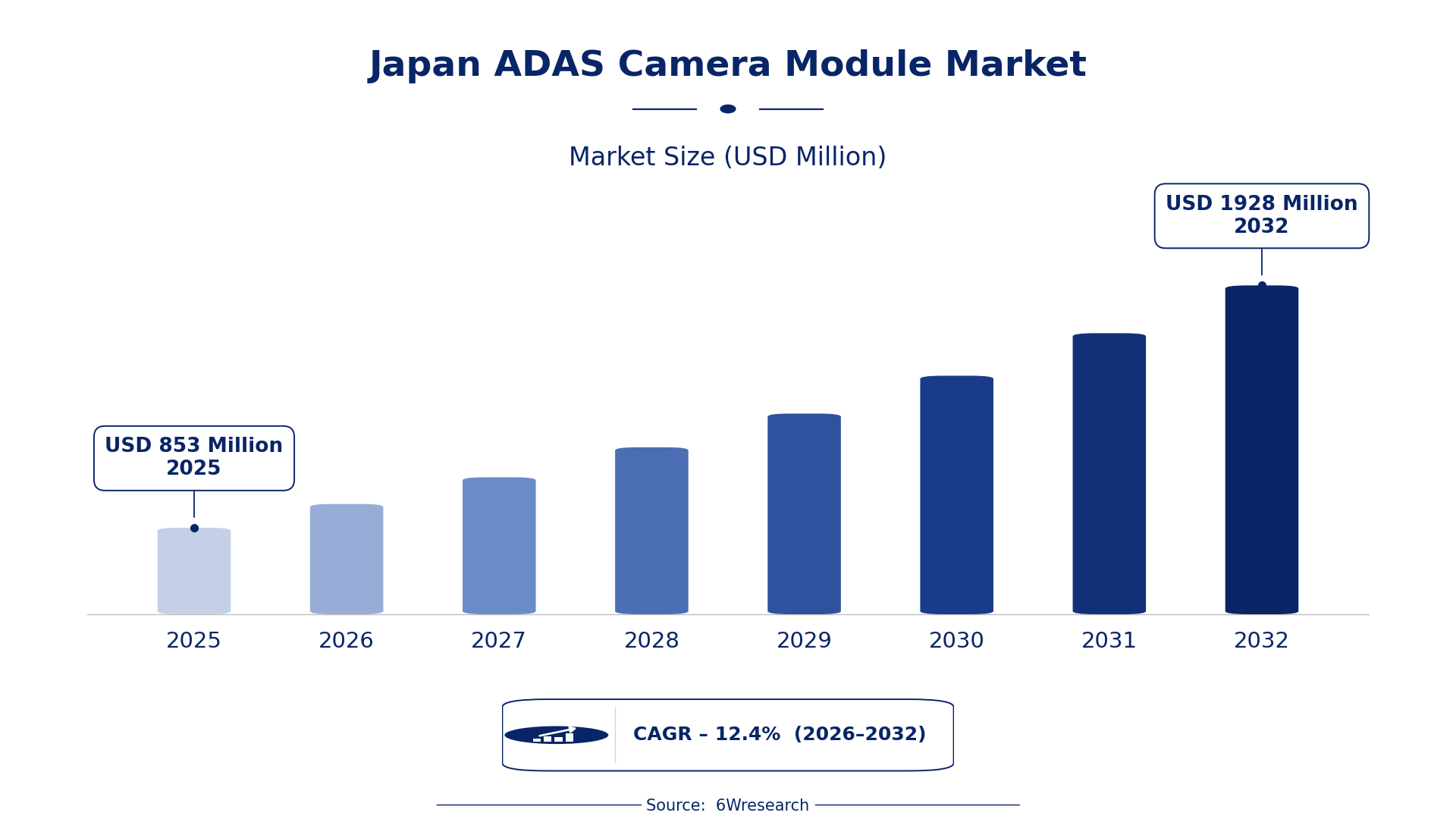
According to 6Wresearch internal database and industry insights, the Japan ADAS Camera Module Market was valued at USD 853 Million in 2025 and is projected to reach USD 1,928 Million by 2032, growing at a CAGR of approximately 12.4% during 2026–2032.
Japan ADAS Camera Module Market Highlights
| Report Metric | Details |
| Report Name | Japan ADAS Camera Module Market (2026-2032) |
| Market Size 2025 | USD 853 Million |
| Market Size 2032 | USD 1,928 Million |
| Absolute Growth 2025–2032 | USD 1,075 Million |
| CAGR 2026–2032 | 12.4% |
| Peak Annual Growth | 13.6% in 2028 |
| Forecast Period | 2026–2032 |
| Historical Data | 2022–2025 |
| Base Year | 2025 |
| Leading ADAS Camera Modules, 2025 | Multi-Camera Modules (43% share) |
| Leading Product Type, 2025 | Integrated Lens System (50% share) |
| Leading Distribution Channel, 2025 | OEMs (40% share) |
| Leading End User, 2025 | Car Manufacturers (48% share) |
| Fastest-Growing Product Type | Blind Spot Detection (16.7% CAGR) |
| Fastest-Growing Distribution Channel | Online Platforms (15.8% CAGR) |
| Fastest-Growing End User | EV Segment (16.2% CAGR) |
| Growing Sector | automotive safety technology |
| Key End Users | car manufacturers, luxury vehicle market, EV segment, safety system providers |
Japan ADAS Camera Module Market Year-wise Growth Rate and Key Drivers (2022–2032)
This graph illustrates the annual growth rates of the market from 2022 to 2032, highlighting a steady upward trajectory and projected market expansion over the forecast period.
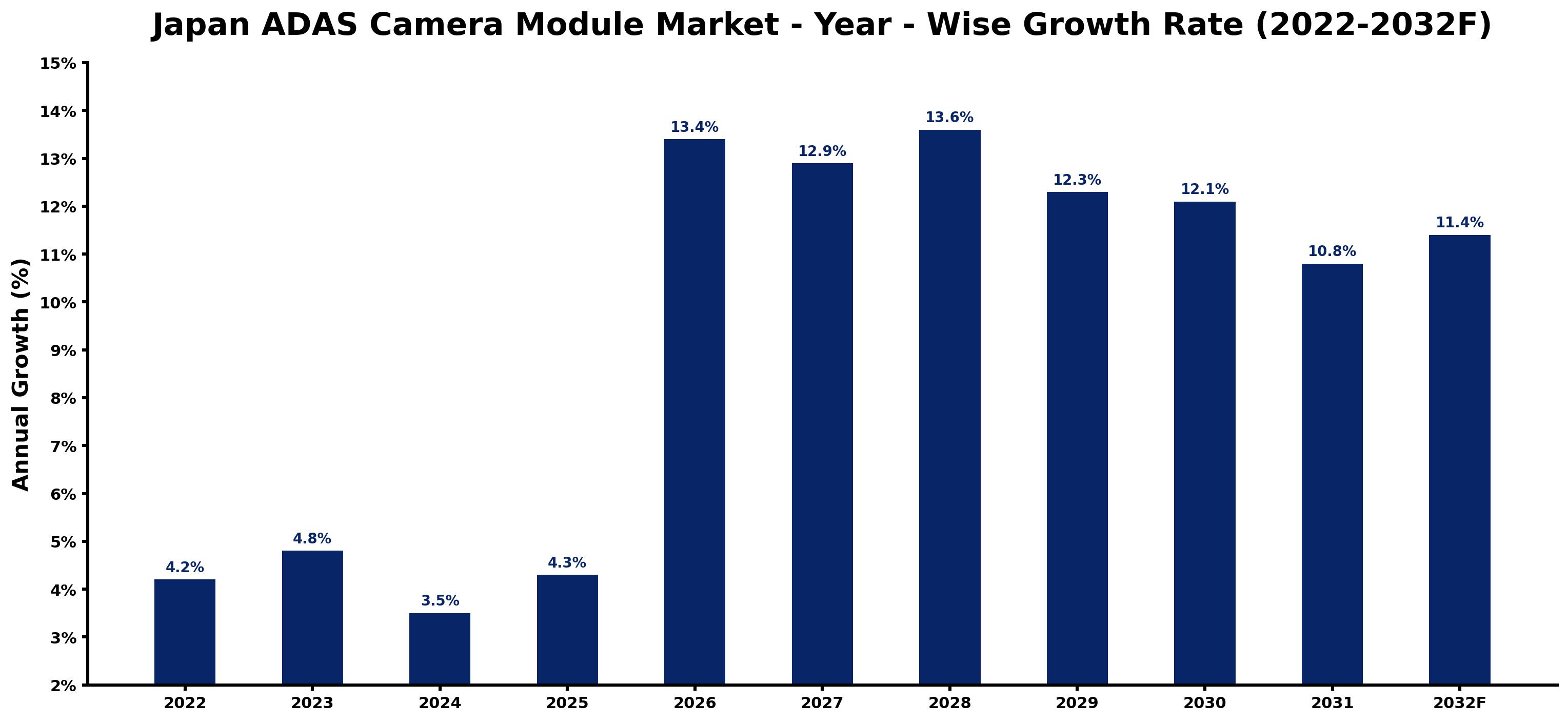
Annual growth estimates for each year appear below with the principal reason behind them, explaining the shifts that set the pace of the market.
| Year | Estimated Annual Growth (%) | Market Rationale |
| 2022 | 4.2 | The market showed steady growth with increasing adoption of safety technologies among car manufacturers. |
| 2023 | 4.8 | Growth accelerated as more vehicles integrated advanced driver-assistance systems, reflecting rising consumer demand. |
| 2024 | 3.5 | The growth rate slowed slightly due to market saturation in certain segments, yet demand remained strong. |
| 2025 | 4.3 | A resurgence in growth occurred as new models featuring advanced ADAS technology were introduced. |
| 2026 | 13.4 | Demand is expected to surge significantly as investments in ADAS technology reach new heights, driven by innovation. |
| 2027 | 12.9 | Growth is projected to decelerate slightly as the market begins to stabilise after a period of rapid expansion. |
| 2028 | 13.6 | The market is expected to peak in growth due to heightened investments in safety features across all vehicle segments. |
| 2029 | 12.3 | A slowdown in growth is anticipated as the market adjusts to previous peaks and competitive pressures. |
| 2030 | 12.1 | Growth will continue to slow as the market matures, with steady demand from established buyer groups. |
| 2031 | 10.8 | The market is projected to experience a further slowdown as saturation in certain segments begins to take effect. |
| 2032 | 11.4 | Growth is expected to rebound slightly as new technologies and applications emerge, revitalising interest in ADAS. |
Note: Market size estimations and growth projections presented in this report are based on 6Wresearch's proprietary forecasting methodology, utilizing the latest available industry data, government publications, and primary research inputs.
Japan ADAS Camera Module Market Synopsis
ADAS Camera Modules are advanced driver-assistance systems that utilise high-resolution imaging sensors and sophisticated software algorithms to improve vehicle safety and automation. The Japan ADAS Camera Module Market is driven by strong demand from domestic car manufacturers, with approximately 8 million vehicles produced annually. Over 70% of new vehicles are equipped with ADAS, supported by initiatives from the Ministry of Land, Infrastructure, Transport and Tourism and the Japan Automobile Manufacturers Association that promote safety technologies and innovation in the sector.
Market Dynamics Impact Analysis (2026–2032)
| Factor | Type | Impact | Primary Segment Affected |
| Growing adoption of ADAS technologies among car manufacturers | Driver | High | Front-Facing Camera Modules |
| Increasing demand for safety features in luxury vehicles | Driver | High | Multi-Camera Modules |
| Expansion of online sales channels for ADAS products | Opportunity | Medium | Online Platforms |
| Rising consumer preference for electric vehicles with advanced safety features | Opportunity | High | EV Segment |
| Regulatory compliance costs for manufacturers | Restraint | High | Integrated Lens System |
| Market saturation in certain ADAS segments | Restraint | Medium | Side Camera Modules |
| Competition from international suppliers | Challenge | High | Multi-Camera Modules |
| Technological advancements requiring continuous investment | Challenge | Medium | Night Vision Modules |
Evaluation of Drivers in Japan ADAS Camera Module Market (2026–2032)
The following drivers explain most of the expected growth.
| Drivers | Primary Segment Affected | Why It Matters (Evidence) |
| Rising vehicle production in Japan | Front-Facing Camera Modules | Approximately 8 million vehicles were produced in 2022, increasing demand for safety technologies significantly. |
| High adoption rates of ADAS in new vehicles | Multi-Camera Modules | Over 70% of new vehicles in Japan are equipped with ADAS, driving demand for advanced camera systems considerably. |
| Growth in the luxury vehicle market | Blind Spot Detection | The luxury vehicle market is projected to grow by 5% annually through 2025, boosting demand for advanced safety features. |
| Increased integration of ADAS in EVs | EV Segment | The EV segment is expected to see a 20% increase in ADAS adoption by 2025, promoting safety technologies significantly. |
| Support from government initiatives | Integrated Lens System | The Ministry of Land, Infrastructure, Transport and Tourism promotes ADAS technology adoption, encouraging manufacturers to invest. |
Volumes grow on the back of Japan's automotive production, which reached approximately 8 million vehicles in 2022, driving demand for safety technologies. More than 70% of new vehicles are equipped with ADAS, reflecting consumer preference for advanced safety features. The luxury vehicle market is projected to grow by 5% annually through 2025, increasing demand for sophisticated camera systems. The EV segment is set to see a 20% increase in ADAS adoption by 2025, further boosting interest in these technologies.
Evaluation of Restraints in Japan ADAS Camera Module Market
These are the pressures that could keep growth below its potential.
| Market Restraint | Primary Segment Affected | Why It Matters (Evidence) |
| High compliance costs associated with regulatory standards | Integrated Lens System | Manufacturers must adhere to JIS D 0203 standards, increasing production costs significantly. |
| Market saturation in established segments | Side Camera Modules | As vehicle integration of these systems increases, growth potential diminishes in mature segments, limiting opportunities. |
| Intense competition from international suppliers | Multi-Camera Modules | Local manufacturers face pressure from global players, impacting market share and pricing strategies across the board. |
| Technological advancements necessitating ongoing investment | Night Vision Modules | Continuous innovation in ADAS technologies requires substantial R&D expenditure from manufacturers, straining budgets. |
| Limited consumer awareness of ADAS benefits | Blind Spot Detection | Many consumers remain unaware of the advantages of advanced safety features, hindering market growth and adoption. |
Japan ADAS Camera Module Market Challenges
Intense competition among producers drives down prices, compelling manufacturers to reduce profit margins and allocate more resources to R&D, which can delay product launches for buyers. Stringent compliance with JIS D 0203 safety standards raises testing expenses, potentially postponing market entry for new models by up to six months. A shortage of skilled technicians in the automotive sector hampers production efficiency, resulting in extended lead times for suppliers and stock shortages for buyers. Escalating material costs can increase the overall price of ADAS camera modules, making them less accessible for consumers and impacting sales for producers.
Trends in the Japan ADAS Camera Module Market
Four trends stand out in the Japan ADAS Camera Module Market.
- Shift towards Advanced Safety Features: Japanese car manufacturers are increasingly focusing on integrating advanced safety features into their vehicles. The Tokyo Motor Show showcases these advancements every two years, reflecting a growing commitment to safety technologies and innovation.
- Growing Adoption of ADAS in Electric Vehicles: The EV segment is rapidly adopting ADAS technologies, with a projected 20% increase by 2025. This trend is driven by consumer demand for improved safety features in electric vehicles.
- Transition from Traditional to Online Sales Channels: Online platforms are becoming a significant distribution channel for ADAS products, with a projected growth rate of 15.8% through 2032. This shift allows consumers easier access to advanced safety technologies and products.
- Increase in Luxury Vehicle Safety Standards: The luxury vehicle market is prioritising advanced safety features, with over 50% of luxury vehicles sold in Japan equipped with ADAS. This trend is expected to grow as consumer expectations rise and demand for safety increases.
Investment Opportunities in the Japan ADAS Camera Module Market
Several openings in the Japan ADAS Camera Module Market merit attention from investors.
- Invest in Online Sales Channels: Partnerships with online platforms can improve market reach, tapping into the growing consumer base. The online sales channel is expected to grow at a rate of 15.8% through 2032.
- Focus on EV Segment Development: With a 20% increase in ADAS adoption anticipated in the EV segment by 2025, investment in this area presents significant opportunities for suppliers. Collaborating with car manufacturers can facilitate entry into this expanding market.
- Develop Advanced Safety Technologies: As the luxury vehicle market expands, there is a need for advanced safety technologies. Suppliers should target this market to meet the rising demand for high-end safety features and innovations.
- Engage with Government Support Programs: The Economic Security Promotion Act supports supply-chain resilience for critical products. Participating in this initiative can provide funding opportunities for ADAS producers and enhance their market position.
Government Initiatives in the Japan ADAS Camera Module Market
The Economic Security Promotion Act, enacted in 2022, supports supply-chain resilience for critical products, including ADAS technologies. This law encourages manufacturers to invest in safety systems, ensuring compliance with national standards and improving production capabilities. The Act aims to strengthen the domestic supply chain, which is vital for maintaining competitiveness in the automotive market and securing funding for innovative projects.
The Ministry of Land, Infrastructure, Transport and Tourism oversees the implementation of safety technology standards. This agency promotes ADAS integration in public transport, funding projects that improve vehicle safety and efficiency, thereby increasing the adoption of these technologies among manufacturers and enhancing overall market growth.
Future Insight of the Japan ADAS Camera Module Market
Investment in ADAS technology will surge as government initiatives focus on improving safety in public transport, driving demand for advanced camera systems. By 2032, the integration of AI will elevate functionality, enhancing user experience and attracting more buyers. The luxury vehicle segment is expected to experience a 5% annual growth, prompting suppliers to innovate and broaden their product lines. With the Tokyo Motor Show highlighting advancements, suppliers must remain agile to sustain competitiveness in the evolving market.
Market Segmentation Analysis
Japan ADAS Camera Module Market report covers a detailed analysis of the following market segments:
By ADAS Camera Modules – Multi-Camera Modules Lead and Record the Fastest Growth
According to Saurav Kr Singh, Senior Research Analyst at 6Wresearch, with 43% of adas camera modules revenue in 2025, Multi-Camera Modules was the largest category. Multi-Camera Modules dominate the market because they provide essential 360-degree awareness, crucial for vehicle safety. Their widespread use in new vehicle models, particularly in the Tokyo region, highlights their importance in automotive innovation. Multi-Camera Modules are also forecast to expand faster than any other category, at a CAGR of 15.4% over 2026–2032. The demand for Multi-Camera Modules will continue to rise as they are integral to safety features, with over 70% of new vehicles in Japan incorporating ADAS. This trend will further solidify their leading position in the market. Suppliers should prioritise the development of Multi-Camera Modules to align with the increasing safety regulations in the automotive industry.
By Product Type – Integrated Lens System Leads, Blind Spot Detection Expected to Grow Fastest
Integrated Lens System took 50% of product type revenue in 2025, more than any other category. The Integrated Lens System leads the market as it supports a variety of essential functionalities for different ADAS applications. This versatility makes it a top choice for manufacturers aiming to enhance safety features in their vehicles. Blind Spot Detection is set to record the highest CAGR in this split, 16.7% over 2026–2032. Blind Spot Detection is witnessing rapid growth due to its critical role in vehicle safety, particularly as the luxury vehicle market expands by 5% annually. This emphasis on safety will drive further adoption of this product type. Buyers will benefit from investing in advanced safety features, especially in vehicles that prioritise driver assistance technologies.
By Distribution Channel – OEMs Lead, Online Platforms Expected to Grow Fastest
OEMs held 40% of the Japan ADAS Camera Module Market by distribution channel in 2025. OEMs are the primary distribution channel for ADAS Camera Modules, directly integrating these systems into new vehicles. This direct connection ensures that the latest technological advancements are readily available in the automotive sector. Online Platforms are projected to grow fastest, at a CAGR of 15.8% during 2026–2032. Online Platforms are experiencing significant growth as a distribution channel, reflecting the rising consumer demand for ADAS technologies. This shift signifies changing purchasing habits, particularly among consumers seeking convenience and accessibility. Suppliers should enhance their online presence to capture the growing market of consumers purchasing ADAS technologies.
By End User – Car Manufacturers Lead, EV Segment Expected to Grow Fastest
In 2025, Car Manufacturers led the end user split with a 48% share. Car Manufacturers represent the largest end users of ADAS technology, incorporating these systems into their vehicle offerings. Their commitment to safety and technological advancement drives the demand for sophisticated driver-assistance systems in the market. Over 2026–2032, EV Segment is expected to post the fastest growth, at a CAGR of 16.2%. The EV Segment is rapidly increasing its integration of ADAS, with a projected 20% rise by 2025. This trend highlights the growing significance of safety technologies in the electric vehicle sector. Suppliers must align their products with the evolving needs of manufacturers focusing on electric vehicles to remain competitive.
Key Attractiveness of the Report
- 10 Years of Market Numbers
- Historical Data Starting from 2022 to 2025
- Base Year 2025
- Forecast Data until 2032
- Key Performance Indicators Impacting the Market
- Major Upcoming Developments and Projects
Key Highlights of the Report:
- Japan ADAS Camera Module Market Outlook
- Market Size of Japan ADAS Camera Module Market, 2025
- Forecast of Japan ADAS Camera Module Market, 2032
- Historical Data and Forecast of Japan ADAS Camera Module Revenues & Volume for the Period 2022-2032F
- Japan ADAS Camera Module Market Trend Evolution
- Japan ADAS Camera Module Market Drivers and Challenges
- Japan ADAS Camera Module Price Trends
- Japan ADAS Camera Module Porter's Five Forces
- Japan ADAS Camera Module Industry Life Cycle
- Historical Data and Forecast of Japan ADAS Camera Module Market Revenues & Volume By ADAS Camera Modules for the Period 2022-2032F
- Historical Data and Forecast of Japan ADAS Camera Module Market Revenues & Volume By Front-Facing Camera Modules for the Period 2022-2032F
- Historical Data and Forecast of Japan ADAS Camera Module Market Revenues & Volume By Side Camera Modules for the Period 2022-2032F
- Historical Data and Forecast of Japan ADAS Camera Module Market Revenues & Volume By Night Vision Modules for the Period 2022-2032F
- Historical Data and Forecast of Japan ADAS Camera Module Market Revenues & Volume By Multi-Camera Modules for the Period 2022-2032F
- Historical Data and Forecast of Japan ADAS Camera Module Market Revenues & Volume By Product Type for the Period 2022-2032F
- Historical Data and Forecast of Japan ADAS Camera Module Market Revenues & Volume By Integrated Lens System for the Period 2022-2032F
- Historical Data and Forecast of Japan ADAS Camera Module Market Revenues & Volume By Blind Spot Detection for the Period 2022-2032F
- Historical Data and Forecast of Japan ADAS Camera Module Market Revenues & Volume By Infrared Camera Systems for the Period 2022-2032F
- Historical Data and Forecast of Japan ADAS Camera Module Market Revenues & Volume By Multi-Lens System for the Period 2022-2032F
- Historical Data and Forecast of Japan ADAS Camera Module Market Revenues & Volume By Distribution Channel for the Period 2022-2032F
- Historical Data and Forecast of Japan ADAS Camera Module Market Revenues & Volume By OEMs for the Period 2022-2032F
- Historical Data and Forecast of Japan ADAS Camera Module Market Revenues & Volume By Industrial Suppliers for the Period 2022-2032F
- Historical Data and Forecast of Japan ADAS Camera Module Market Revenues & Volume By Specialty Stores for the Period 2022-2032F
- Historical Data and Forecast of Japan ADAS Camera Module Market Revenues & Volume By Online Platforms for the Period 2022-2032F
- Historical Data and Forecast of Japan ADAS Camera Module Market Revenues & Volume By End User for the Period 2022-2032F
- Historical Data and Forecast of Japan ADAS Camera Module Market Revenues & Volume By Safety System Providers for the Period 2022-2032F
- Historical Data and Forecast of Japan ADAS Camera Module Market Revenues & Volume By Car Manufacturers for the Period 2022-2032F
- Historical Data and Forecast of Japan ADAS Camera Module Market Revenues & Volume By Luxury Vehicle Market for the Period 2022-2032F
- Historical Data and Forecast of Japan ADAS Camera Module Market Revenues & Volume By EV Segment for the Period 2022-2032F
- Japan ADAS Camera Module Import Export Trade Statistics
- Market Opportunity Assessment By ADAS Camera Modules
- Market Opportunity Assessment By Product Type
- Market Opportunity Assessment By Distribution Channel
- Market Opportunity Assessment By End User
- Japan ADAS Camera Module Top Companies Market Share
- Japan ADAS Camera Module Competitive Benchmarking By Technical and Operational Parameters
- Japan ADAS Camera Module Company Profiles
- Japan ADAS Camera Module Key Strategic Recommendations
Market Covered
The study includes the following segmentation.
By ADAS Camera Modules
- Front-Facing Camera Modules
- Side Camera Modules
- Night Vision Modules
- Multi-Camera Modules
By Product Type
- Integrated Lens System
- Blind Spot Detection
- Infrared Camera Systems
- Multi-Lens System
By Distribution Channel
- OEMs
- Industrial Suppliers
- Specialty Stores
- Online Platforms
By End User
- Safety System Providers
- Car Manufacturers
- Luxury Vehicle Market
- EV Segment































