Japan ADAS Camera Systems Market Size & Growth Rate
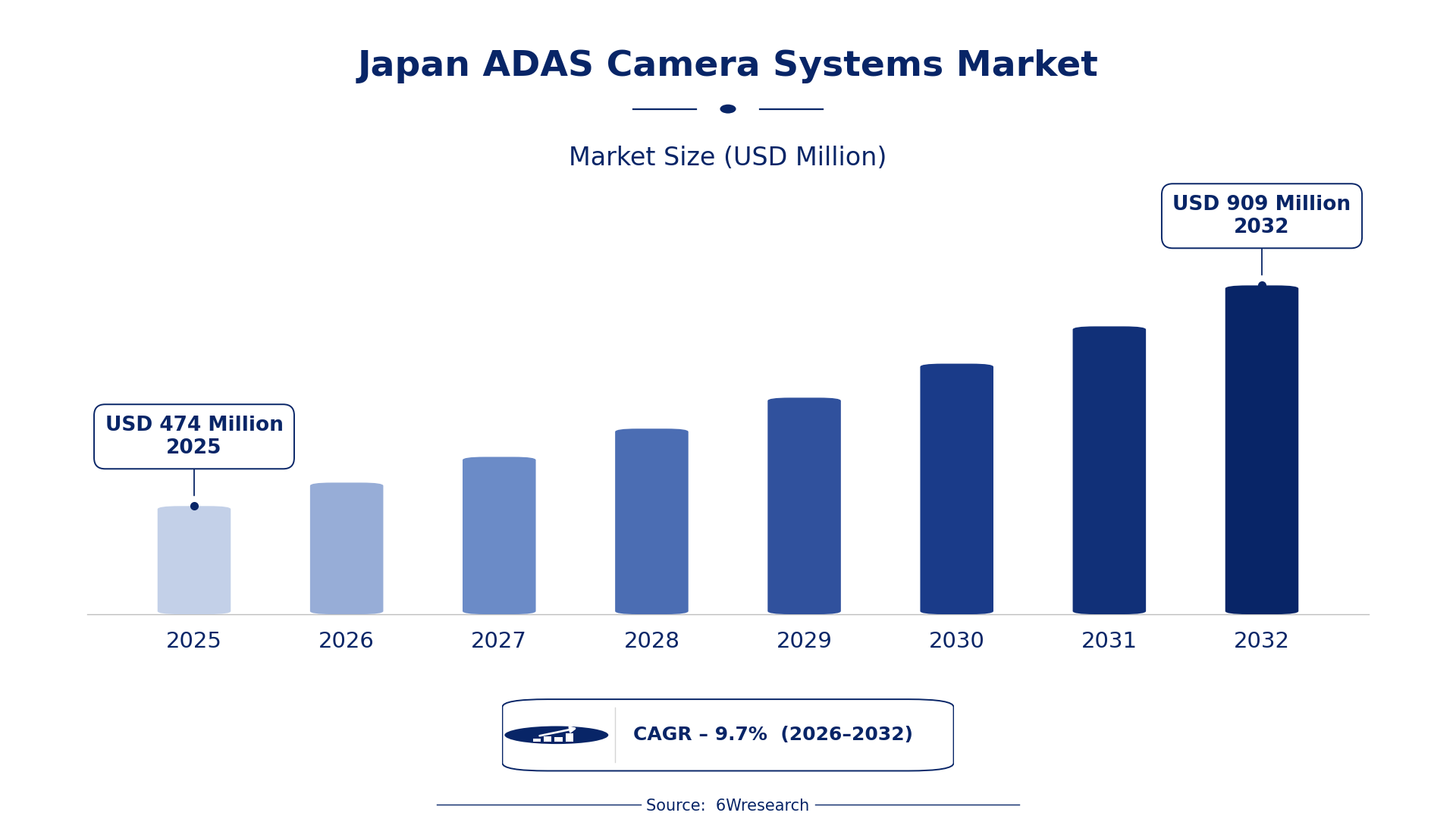
According to 6Wresearch internal database and industry insights, the Japan ADAS Camera Systems Market was valued at USD 474 Million in 2025 and is projected to reach USD 909 Million by 2032, growing at a CAGR of approximately 9.7% during 2026–2032.
Japan ADAS Camera Systems Market Highlights
| Report Metric | Details |
| Report Name | Japan ADAS Camera Systems Market (2026-2032) |
| Market Size 2025 | USD 474 Million |
| Market Size 2032 | USD 909 Million |
| Absolute Growth 2025–2032 | USD 435 Million |
| CAGR 2026–2032 | 9.7% |
| Peak Annual Growth | 10.8% in 2026 |
| Forecast Period | 2026–2032 |
| Historical Data | 2022–2025 |
| Base Year | 2025 |
| Leading ADAS Camera Systems Market, 2025 | Vision-Based ADAS (42% share) |
| Leading Product Type, 2025 | Camera + AI (51% share) |
| Leading Distribution Channel, 2025 | OEMs (45% share) |
| Leading End User, 2025 | Electric Vehicles (45% share) |
| Fastest-Growing ADAS Camera Systems Market | Integrated Camera Systems (14.5% CAGR) |
| Fastest-Growing Product Type | Sensor Fusion Modules (13.9% CAGR) |
| Fastest-Growing Distribution Channel | Automotive Suppliers (12.6% CAGR) |
| Fastest-Growing End User | Smart Transportation (12.7% CAGR) |
| Growing Sector | Electric Vehicles |
| Key End Users | OEMs, Automotive Suppliers, Electric Vehicle Manufacturers, Smart Transportation Providers |
Japan ADAS Camera Systems Market Year-wise Growth Rate and Key Drivers (2022–2032)
This graph illustrates the annual growth rates of the market from 2022 to 2032, highlighting a steady upward trajectory and projected market expansion over the forecast period.
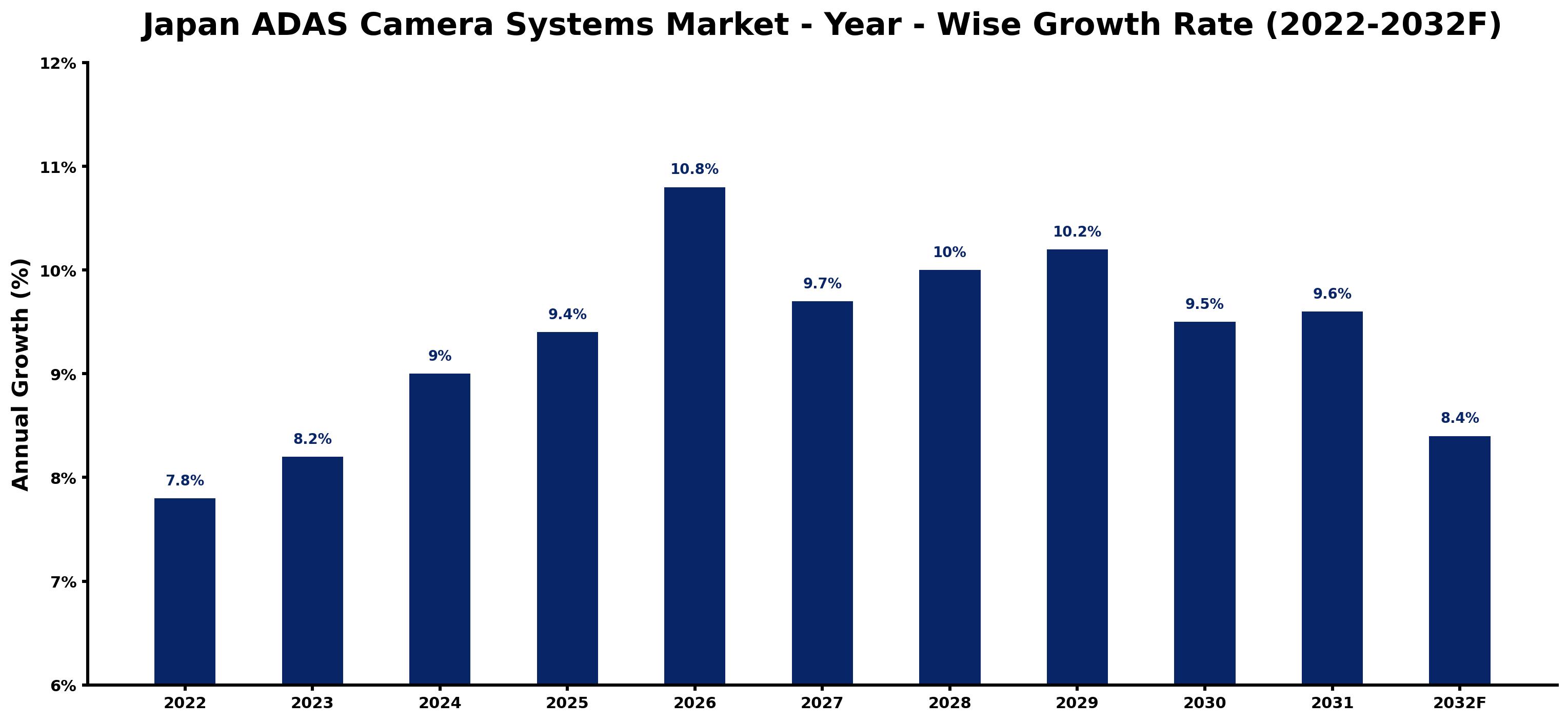
The following figures match every annual growth estimate with the main market development of that year, giving the reasoning behind each rise or slowdown.
| Year | Estimated Annual Growth (%) | Market Rationale |
| 2022 | 7.8 | The market experienced steady growth, reflecting ongoing advancements in automotive technology. |
| 2023 | 8.2 | Growth accelerated as consumer interest in safety features increased. |
| 2024 | 9.0 | Demand continued to rise due to heightened awareness of road safety and automation. |
| 2025 | 9.4 | The market reached a historical peak, driven by strong sales in electric vehicles. |
| 2026 | 10.8 | The peak annual growth was achieved as manufacturers invested heavily in ADAS technologies. |
| 2027 | 9.7 | Growth slowed slightly as the market began to stabilise after rapid expansion. |
| 2028 | 10.0 | The market rebounded with renewed consumer interest in smart transportation solutions. |
| 2029 | 10.2 | Demand increased as more manufacturers adopted advanced safety features in new models. |
| 2030 | 9.5 | Growth moderated as the market adjusted to previous high levels of expansion. |
| 2031 | 9.6 | The market experienced a slight uptick as electric vehicle sales continued to rise. |
| 2032 | 8.4 | Growth slowed again as the market stabilised, reflecting a mature phase. |
Note: Market size estimations and growth projections presented in this report are based on 6Wresearch's proprietary forecasting methodology, utilizing the latest available industry data, government publications, and primary research inputs.
Japan ADAS Camera Systems Market Synopsis
ADAS Camera Systems improve vehicle safety and automation through high-resolution cameras and AI algorithms. The Japan ADAS Camera Systems Market is growing due to a rise in electric vehicle registrations, with over 1 million registered in 2023, and strong domestic demand, highlighted by an installed base of 5 million ADAS units in consumer vehicles by 2022. The emphasis on smart transportation initiatives further drives this growth, supported by government strategies that promote advanced automotive technologies.
Market Dynamics Impact Analysis (2026–2032)
| Factor | Type | Impact | Primary Segment Affected |
| Increasing adoption of electric vehicles drives demand for advanced safety features. | Driver | High | Electric Vehicles |
| Integration of AI and sensor fusion technologies enhances system capabilities. | Driver | High | Camera + AI |
| Growing consumer demand for enhanced vehicle safety presents opportunities for suppliers. | Opportunity | High | Consumer Vehicles |
| Investment in smart transportation infrastructure creates demand for ADAS solutions. | Opportunity | High | Smart Transportation |
| High costs associated with advanced technology integration may limit some manufacturers. | Restraint | Medium | OEMs |
| Regulatory compliance requirements can slow down product development timelines. | Restraint | Medium | Automotive Suppliers |
| Supply chain disruptions can delay the availability of critical components. | Challenge | High | Integrated Camera Systems |
| Competition among manufacturers can lead to pricing pressures in the market. | Challenge | High | Vision-Based ADAS |
Evaluation of Drivers in Japan ADAS Camera Systems Market (2026–2032)
The table below links each growth driver to the segment it affects and the evidence for it.
| Drivers | Primary Segment Affected | Why It Matters (Evidence) |
| Rising electric vehicle registrations | Electric Vehicles | In 2023, over 1 million electric vehicles were registered, increasing demand for ADAS. |
| Integration of AI technologies | Camera + AI | The promotion of AI integration boosts system capabilities, enhancing vehicle safety. |
| Growing consumer safety awareness | Consumer Vehicles | The average age of vehicles in Japan is 13 years, prompting upgrades to ADAS features. |
| Government support for smart mobility initiatives | Smart Transportation | Promoting smart mobility enhances ADAS adoption in urban areas. |
| Development of advanced sensor fusion technologies | Sensor Fusion Modules | The adoption of sensor fusion technology is increasing, improving accuracy and reliability in ADAS. |
The primary driver of demand is the increase in electric vehicle registrations, with over 1 million vehicles registered in 2023. The promotion of AI technologies enhances system capabilities and improves vehicle safety. Consumer awareness regarding safety leads to upgrades in vehicles, as the average age of cars in Japan is 13 years. The advancement of sensor fusion technologies enhances accuracy, resulting in greater demand from automotive suppliers.
Evaluation of Restraints in Japan ADAS Camera Systems Market
The main factors holding the market back are set out below.
| Market Restraint | Primary Segment Affected | Why It Matters (Evidence) |
| High costs of advanced technology integration | OEMs | The average consumer vehicle price in Japan is approximately 3 million JPY, impacting affordability. |
| Regulatory compliance requirements | Automotive Suppliers | The JIS D 0203 standard governs automotive camera specifications, affecting development timelines. |
| Supply chain disruptions | Integrated Camera Systems | Recent global supply chain issues have delayed the availability of critical components. |
| Intense competition among manufacturers | Vision-Based ADAS | Competition can lead to pricing pressures, impacting profitability for suppliers. |
| Limited awareness of ADAS benefits | Consumer Vehicles | Some consumers remain unaware of the advantages of advanced safety features. |
Japan ADAS Camera Systems Market Challenges
Manufacturers of ADAS camera systems in Japan face supply chain disruptions, as dependence on specific component suppliers can delay production timelines by up to three months, affecting delivery schedules for automakers. Regulatory challenges arise from the JIS D 0203 standard, which requires strict compliance, leading to increased testing costs that can reach 50 million JPY for manufacturers. Continuous investment is necessary for technological advancements in sensor fusion, with R&D expenses potentially exceeding 200 million JPY annually, placing a burden on smaller firms. Competition from international markets intensifies, compelling local suppliers to reduce prices, which can erode profit margins by 15%.
Trends in the Japan ADAS Camera Systems Market
Below are the shifts with the largest effect on the Japan ADAS Camera Systems Market.
- Shift from Traditional to Integrated Camera Systems: Since 2023, the automotive industry has shifted towards integrated camera systems that combine multiple functions. This trend is evident in the Tokyo metropolitan area, where smart transportation systems increasingly adopt these technologies, enhancing vehicle safety.
- Transition from Manual to Automated Driving Features: The move towards automated driving features began in 2023, with electric vehicles at the forefront. This shift influences consumers seeking advanced safety solutions, as the adoption rate of ADAS in new vehicles is around 70%.
- Smart Transportation Prioritised over Conventional Systems: In 2023, smart transportation systems became a priority in urban planning initiatives. The goal of achieving 100% electric vehicle sales by 2035 drives demand for ADAS technologies.
- Emergence of AI-Driven Safety Solutions: The integration of AI in automotive systems has been a focus since 2021. Research by the National Institute of Advanced Industrial Science and Technology is contributing to improved safety features in vehicles.
Investment Opportunities in the Japan ADAS Camera Systems Market
Investors looking at the Japan ADAS Camera Systems Market should consider the following areas.
- Investment in Electric Vehicle Infrastructure: With 300 billion JPY allocated for EV infrastructure development in 2023, suppliers can invest in charging stations and related technologies, targeting electric vehicle manufacturers in urban areas.
- Supply of Advanced Sensor Fusion Modules: The increasing adoption of sensor fusion technology presents an opportunity to supply advanced modules, particularly to automotive suppliers focusing on accuracy in ADAS systems.
- Development of Modular ADAS Systems: The demand for flexibility in vehicle design creates an opportunity to develop modular ADAS systems, targeting OEMs looking to improve their product offerings.
- Partnerships for Smart Mobility Solutions: The growing emphasis on smart transportation provides an opportunity for partnerships with local governments, focusing on integrated solutions for urban mobility.
Government Initiatives in the Japan ADAS Camera Systems Market
The Electrical Appliance and Material Safety Act of 1961 ensures that ADAS Camera Systems meet safety standards for electrical appliances and materials sold in Japan. The Economic Security Promotion Act of 2022 supports supply-chain resilience for critical automotive technologies, ensuring stability in the ADAS market.
In 2023, the Japanese government allocated 300 billion JPY for EV infrastructure development, overseen by the Ministry of Land, Infrastructure, Transport and Tourism. This funding aims to promote the integration of ADAS technologies in electric vehicles, supporting safer transportation systems.
Future Insight of the Japan ADAS Camera Systems Market
By 2032, a shift towards smart mobility will reshape the market, compelling suppliers to innovate in response to government initiatives. Demand for ADAS systems will grow, with installations projected to reach 10 million units. Connectivity through IoT in transportation will transform vehicle interactions, fostering new business models. The integration of AI in automotive systems will enable advanced functionalities, positioning Japan as a leader in ADAS technology.
Market Segmentation Analysis
Japan ADAS Camera Systems Market report covers a detailed analysis of the following market segments:
By ADAS Camera Systems Market – Vision-Based ADAS Leads, Integrated Camera Systems Expected to Grow Fastest
According to Saurav Kr Singh, Senior Research Analyst at 6Wresearch, Vision-Based ADAS accounted for 42% of the market by adas camera systems market in 2025. Vision-Based ADAS maintains the largest share owing to its critical role in visual recognition for vehicle safety features, such as lane departure warnings. The installed base of 5 million units in consumer vehicles exemplifies its widespread adoption across the market. The quickest growth will come from Integrated Camera Systems, forecast to expand at a CAGR of 14.5% between 2026 and 2032. Integrated Camera Systems are experiencing rapid growth due to their ability to consolidate multiple functions into a single unit, thereby enhancing vehicle capabilities. The increasing demand for multifunctional systems in the automotive sector is propelling this segment forward. Suppliers should prioritise the development of integrated solutions to align with the rising demand for multifunctional ADAS.
By Product Type – Camera + AI Leads, Sensor Fusion Modules Expected to Grow Fastest
In 2025, Camera + AI led the product type split with a 51% share. Camera + AI leads the market as it is essential for processing visual data, enabling advanced features like collision avoidance and adaptive cruise control. Its integration into the majority of new vehicles, with an adoption rate of around 70%, highlights its importance in the industry. Sensor Fusion Modules are set to record the highest CAGR in this split, 13.9% over 2026–2032. Sensor Fusion Modules are witnessing rapid growth owing to their capability to merge data from various sensors, which enhances accuracy and reliability in ADAS applications. The increasing focus on precise and responsive systems in vehicles is driving this segment's expansion. Buyers should consider investing in advanced sensor fusion technologies to improve vehicle safety and performance.
By Distribution Channel – OEMs Lead, Automotive Suppliers Expected to Grow Fastest
OEMs took 45% of distribution channel revenue in 2025, more than any other category. OEMs dominate the distribution channel as they are the primary manufacturers of vehicles, ensuring that ADAS systems are seamlessly integrated into new models. Their established connections with automotive suppliers facilitate the incorporation of advanced technologies into the production process. Over 2026–2032, Automotive Suppliers are expected to post the fastest growth, at a CAGR of 12.6%. Automotive Suppliers are experiencing the fastest growth as they provide essential components that support the increasing complexity of ADAS systems. The rise in electric vehicles and smart transportation initiatives is driving higher demand for these suppliers' offerings. Suppliers should strengthen collaborations with OEMs to secure their position in the changing automotive landscape.
By End User – Electric Vehicles Lead, Smart Transportation Expected to Grow Fastest
Electric Vehicles held 45% of the Japan ADAS Camera Systems Market by end user in 2025. Electric Vehicles represent the largest end-user segment as they increasingly utilise ADAS for enhanced safety and automation features. The Tokyo Electric Vehicle Strategy aims for 100% electric vehicle sales by 2035, further propelling this segment's growth. Smart Transportation is projected to grow fastest, at a CAGR of 12.7% during 2026–2032. Smart Transportation is the fastest-growing end-user segment as it integrates ADAS with urban mobility solutions, improving the efficiency of transportation systems. The emphasis on smart mobility initiatives is accelerating the adoption of these technologies in urban environments. Investing in smart transportation solutions will be vital for suppliers seeking to capture emerging market opportunities.
Key Attractiveness of the Report
- 10 Years of Market Numbers
- Historical Data Starting from 2022 to 2025
- Base Year 2025
- Forecast Data until 2032
- Key Performance Indicators Impacting the Market
- Major Upcoming Developments and Projects
Key Highlights of the Report:
- Japan ADAS Camera Systems Market Outlook
- Market Size of Japan ADAS Camera Systems Market, 2025
- Forecast of Japan ADAS Camera Systems Market, 2032
- Historical Data and Forecast of Japan ADAS Camera Systems Revenues & Volume for the Period 2022-2032F
- Japan ADAS Camera Systems Market Trend Evolution
- Japan ADAS Camera Systems Market Drivers and Challenges
- Japan ADAS Camera Systems Price Trends
- Japan ADAS Camera Systems Porter's Five Forces
- Japan ADAS Camera Systems Industry Life Cycle
- Historical Data and Forecast of Japan ADAS Camera Systems Market Revenues & Volume By ADAS Camera Systems Market for the Period 2022-2032F
- Historical Data and Forecast of Japan ADAS Camera Systems Market Revenues & Volume By Vision-Based ADAS for the Period 2022-2032F
- Historical Data and Forecast of Japan ADAS Camera Systems Market Revenues & Volume By Integrated Camera Systems for the Period 2022-2032F
- Historical Data and Forecast of Japan ADAS Camera Systems Market Revenues & Volume By Cloud-Connected Camera Systems for the Period 2022-2032F
- Historical Data and Forecast of Japan ADAS Camera Systems Market Revenues & Volume By Modular ADAS Systems for the Period 2022-2032F
- Historical Data and Forecast of Japan ADAS Camera Systems Market Revenues & Volume By Product Type for the Period 2022-2032F
- Historical Data and Forecast of Japan ADAS Camera Systems Market Revenues & Volume By Camera + AI for the Period 2022-2032F
- Historical Data and Forecast of Japan ADAS Camera Systems Market Revenues & Volume By Sensor Fusion Modules for the Period 2022-2032F
- Historical Data and Forecast of Japan ADAS Camera Systems Market Revenues & Volume By IoT-Based Systems for the Period 2022-2032F
- Historical Data and Forecast of Japan ADAS Camera Systems Market Revenues & Volume By Plug & Play Hardware for the Period 2022-2032F
- Historical Data and Forecast of Japan ADAS Camera Systems Market Revenues & Volume By Distribution Channel for the Period 2022-2032F
- Historical Data and Forecast of Japan ADAS Camera Systems Market Revenues & Volume By OEMs for the Period 2022-2032F
- Historical Data and Forecast of Japan ADAS Camera Systems Market Revenues & Volume By Automotive Suppliers for the Period 2022-2032F
- Historical Data and Forecast of Japan ADAS Camera Systems Market Revenues & Volume By Direct Sales for the Period 2022-2032F
- Historical Data and Forecast of Japan ADAS Camera Systems Market Revenues & Volume By Online Platforms for the Period 2022-2032F
- Historical Data and Forecast of Japan ADAS Camera Systems Market Revenues & Volume By End User for the Period 2022-2032F
- Historical Data and Forecast of Japan ADAS Camera Systems Market Revenues & Volume By Electric Vehicles for the Period 2022-2032F
- Historical Data and Forecast of Japan ADAS Camera Systems Market Revenues & Volume By Smart Transportation for the Period 2022-2032F
- Historical Data and Forecast of Japan ADAS Camera Systems Market Revenues & Volume By Fleet Management for the Period 2022-2032F
- Historical Data and Forecast of Japan ADAS Camera Systems Market Revenues & Volume By Consumer Vehicles for the Period 2022-2032F
- Japan ADAS Camera Systems Import Export Trade Statistics
- Market Opportunity Assessment By ADAS Camera Systems Market
- Market Opportunity Assessment By Product Type
- Market Opportunity Assessment By Distribution Channel
- Market Opportunity Assessment By End User
- Japan ADAS Camera Systems Top Companies Market Share
- Japan ADAS Camera Systems Competitive Benchmarking By Technical and Operational Parameters
- Japan ADAS Camera Systems Company Profiles
- Japan ADAS Camera Systems Key Strategic Recommendations
Market Covered
The report covers the following segments.
By ADAS Camera Systems Market
- Vision-Based ADAS
- Integrated Camera Systems
- Cloud-Connected Camera Systems
- Modular ADAS Systems
By Product Type
- Camera + AI
- Sensor Fusion Modules
- IoT-Based Systems
- Plug & Play Hardware
By Distribution Channel
- OEMs
- Automotive Suppliers
- Direct Sales
- Online Platforms
By End User
- Electric Vehicles
- Smart Transportation
- Fleet Management
- Consumer Vehicles































