Japan ADAS Chipsets Market Size & Growth Rate
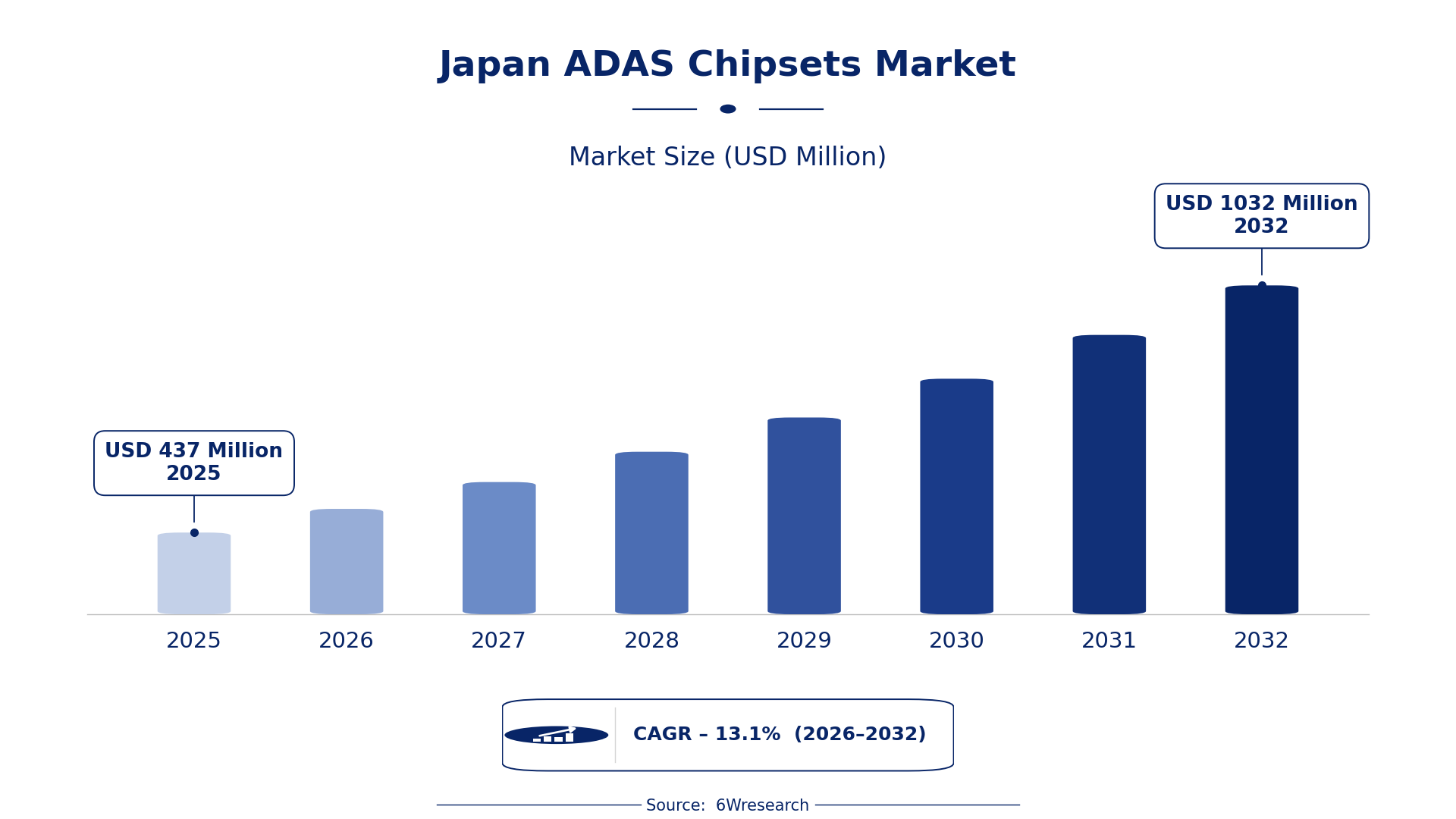
According to 6Wresearch internal database and industry insights, the Japan ADAS Chipsets Market was valued at USD 437 Million in 2025 and is projected to reach USD 1,032 Million by 2032, growing at a CAGR of approximately 13.1% during 2026–2032.
Japan ADAS Chipsets Market Highlights
| Report Metric | Details |
| Report Name | Japan ADAS Chipsets Market (2026-2032) |
| Market Size 2025 | USD 437 Million |
| Market Size 2032 | USD 1,032 Million |
| Absolute Growth 2025–2032 | USD 595 Million |
| CAGR 2026–2032 | 13.1% |
| Peak Annual Growth | 14.6% in 2027 |
| Forecast Period | 2026–2032 |
| Historical Data | 2022–2025 |
| Base Year | 2025 |
| Leading ADAS Chipsets, 2025 | Image Processing Chipsets (45% share) |
| Leading Product Type, 2025 | ASIC/SoC (48% share) |
| Leading Distribution Channel, 2025 | OEMs (48% share) |
| Leading End User, 2025 | ADAS Manufacturers (43% share) |
| Fastest-Growing ADAS Chipsets | Neural Processing Units (17.2% CAGR) |
| Fastest-Growing Product Type | AI-Based Chipsets (18.8% CAGR) |
| Fastest-Growing End User | Self-Driving Cars (17.1% CAGR) |
| Growing Sector | Self-Driving Cars |
| Key End Users | ADAS Manufacturers, Self-Driving Cars, Tier 1 Automotive Suppliers, Advanced ADAS Developers |
Japan ADAS Chipsets Market Year-wise Growth Rate and Key Drivers (2022–2032)
This graph illustrates the annual growth rates of the market from 2022 to 2032, highlighting a steady upward trajectory and projected market expansion over the forecast period.
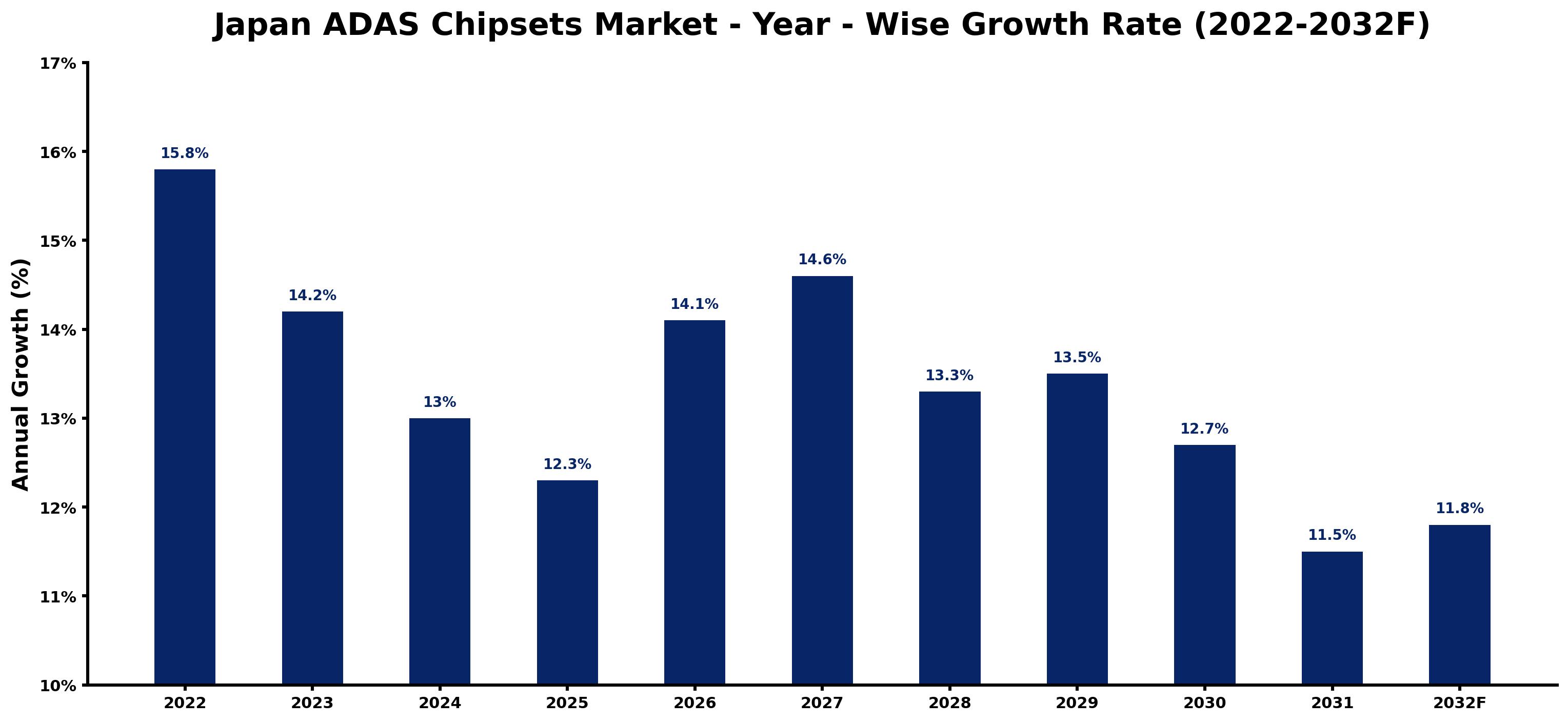
Each row of the following table gives one year's estimated growth and the event or demand shift that explains it.
| Year | Estimated Annual Growth (%) | Market Rationale |
| 2022 | 15.8 | The market experienced a strong demand due to high vehicle registrations equipped with ADAS features. |
| 2023 | 14.2 | Growth slowed as the market adjusted to previous high adoption rates in new vehicles. |
| 2024 | 13.0 | Market expansion continued but at a slower pace as manufacturers focused on refining existing technologies. |
| 2025 | 12.3 | The growth rate declined further as the market stabilised after rapid increases in prior years. |
| 2026 | 14.1 | Demand is expected to rise as manufacturers invest in next-generation ADAS technologies. |
| 2027 | 14.6 | Growth is projected to peak as new models with advanced features are launched. |
| 2028 | 13.3 | The market will see a slight slowdown as saturation in certain segments begins to occur. |
| 2029 | 13.5 | Demand is anticipated to increase again as new safety regulations come into effect. |
| 2030 | 12.7 | Growth is expected to moderate as the market approaches full adoption of ADAS in new vehicles. |
| 2031 | 11.5 | A further slowdown is projected as the market stabilises post-peak growth. |
| 2032 | 11.8 | Demand is expected to rise again due to advancements in AI-based chipsets. |
Note: Market size estimations and growth projections presented in this report are based on 6Wresearch's proprietary forecasting methodology, utilizing the latest available industry data, government publications, and primary research inputs.
Japan ADAS Chipsets Market Synopsis
ADAS chipsets are advanced semiconductor devices essential for automotive applications, enabling features such as adaptive cruise control and lane-keeping assistance. In Japan, the automotive industry, valued at approximately 60 trillion yen, drives the demand for these technologies, with over 8 million registered vehicles equipped with ADAS in 2022. The government's target of 100% adoption of ADAS in new vehicles by 2030 and investments exceeding 1 trillion yen in automotive R&D are key factors propelling market growth.
Market Dynamics Impact Analysis (2026–2032)
| Factor | Type | Impact | Primary Segment Affected |
| Strong demand from domestic manufacturers for advanced safety features | Driver | High | Image Processing Chipsets |
| Increasing investment in automotive R&D to develop next-gen technologies | Driver | High | Image Processing Chipsets |
| Growing need for enhanced vehicle safety features in consumer vehicles | Opportunity | High | ADAS Manufacturers |
| Rising demand for AI-based chipsets to support autonomous driving | Opportunity | High | Neural Processing Units |
| Supply chain disruptions affecting semiconductor availability | Restraint | High | ASIC/SoC |
| High costs associated with advanced semiconductor manufacturing | Restraint | Medium | AI-Based Chipsets |
| Intense competition among manufacturers driving prices down | Challenge | High | ADAS Manufacturers |
| Rapid technological advancements requiring constant updates | Challenge | Medium | Image Processing Chipsets |
Evaluation of Drivers in Japan ADAS Chipsets Market (2026–2032)
Key forces behind demand, with the segment each one moves most, are listed below.
| Drivers | Primary Segment Affected | Why It Matters (Evidence) |
| High adoption rate of ADAS in new vehicles | Image Processing Chipsets | The adoption rate reached 70% in 2023, prompting manufacturers to integrate more chipsets. |
| Investment in automotive R&D | Neural Processing Units | Over 1 trillion yen was invested in automotive R&D in 2022, driving demand for advanced chipsets. |
| Government initiatives promoting vehicle safety | Image Processing Chipsets | A program was launched in 2023 to enhance vehicle safety through ADAS technologies. |
| Growing exports of vehicles equipped with ADAS | Radar Signal Processors | Japan's automotive exports reached 15 trillion yen in 2022, increasing demand for advanced chipsets. |
| Development of smart mobility solutions in urban areas | Vision Sensor Chips | Tokyo's initiatives to promote smart mobility solutions are increasing demand for ADAS technologies. |
What keeps demand rising is the high adoption rate of ADAS in new vehicles, which reached 70% in 2023, prompting manufacturers to integrate more chipsets. Investment in automotive R&D, exceeding 1 trillion yen in 2022, drives demand for advanced chipsets, particularly Neural Processing Units. Japan's automotive exports, valued at 15 trillion yen in 2022, create a strong market for Radar Signal Processors. The focus on smart mobility solutions in urban areas, especially in Tokyo, increases the need for Vision Sensor Chips.
Evaluation of Restraints in Japan ADAS Chipsets Market
Several factors work against faster growth; the main ones are summarised below.
| Market Restraint | Primary Segment Affected | Why It Matters (Evidence) |
| Intense competition from global manufacturers | Image Processing Chipsets | This pressure forces local producers to innovate rapidly, potentially reducing market share for domestic suppliers. |
| Supply chain disruptions due to natural disasters | Neural Processing Units | These disruptions can delay the delivery of critical semiconductor components, causing production halts for automotive manufacturers. |
| High production costs from advanced fabrication processes | Radar Signal Processors | Increased costs can raise vehicle prices for buyers, limiting adoption rates. |
| Delays in accessing the latest ADAS technologies | Vision Sensor Chips | Stringent regulatory approvals can slow down the rollout of new vehicle models equipped with these features. |
| Limited availability of skilled workforce | ASIC/SoC | A shortage of talent can hinder the development and production of advanced chipsets. |
Japan ADAS Chipsets Market Challenges
Japan's ADAS chipsets market faces intense competition from global manufacturers, compelling local producers to innovate rapidly and potentially eroding market share for domestic suppliers. Supply chain disruptions, often caused by natural disasters, can delay essential semiconductor component deliveries, resulting in production halts for automotive manufacturers, which impacts their output. High production costs, driven by advanced fabrication processes, can increase vehicle prices for buyers, limiting adoption rates, which currently stand at 70%. Buyers may experience delays in accessing the latest ADAS technologies due to stringent regulatory approvals, hindering the rollout of new vehicle models equipped with these features.
Trends in the Japan ADAS Chipsets Market
These developments are changing demand patterns in the Japan ADAS Chipsets Market.
- Shift Towards AI-Based Chipsets: The adoption of AI-based chipsets is gaining traction in Japan's automotive sector, with usage projected to rise significantly by 2025. This shift is driven by the need for improved safety features and autonomous driving capabilities.
- Focus on Smart Mobility Solutions: Tokyo is prioritising smart mobility solutions to improve urban transport efficiency. Initiatives launched in 2023 aim to integrate ADAS technologies into public transport systems, enhancing overall safety and convenience.
- Increase in Vehicle Exports: Japan's automotive exports, valued at 15 trillion yen in 2022, increasingly include vehicles equipped with advanced ADAS technologies. This trend reflects the growing global demand for safer and more efficient vehicles.
- Expansion of ADAS in New Vehicle Models: With a target of 100% ADAS adoption in new vehicles by 2030, manufacturers are incorporating these technologies into their latest models. This trend is expected to reshape the automotive market significantly.
Investment Opportunities in the Japan ADAS Chipsets Market
The following areas offer the clearest openings for investors and suppliers in the Japan ADAS Chipsets Market.
- Rising Demand for AI-Based Chipsets: With the projected increase in AI-based chipsets by 2025, there is a strong opportunity for suppliers to invest in this technology, especially among ADAS manufacturers in Japan.
- Investment in Smart Mobility Solutions: The Tokyo Metropolitan Government's initiatives to promote smart mobility solutions create a demand for advanced chipsets. Suppliers can enter this market by collaborating with local partners.
- Growing Market for Safety Features: The government's target for 100% ADAS adoption by 2030 presents an opportunity for investment in safety technologies, particularly for automotive manufacturers in Japan.
- Expansion of R&D in Automotive Technologies: The substantial investment in automotive R&D, exceeding 1 trillion yen in 2022, indicates a strong opportunity for suppliers to engage with automotive manufacturers focusing on next-gen technologies.
Government Initiatives in the Japan ADAS Chipsets Market
The Economic Security Promotion Act, enacted in 2022, strengthens supply-chain resilience for critical products, including ADAS chipsets. This measure builds on the Semiconductor and Digital Industry Strategy from June 2021, which aimed to secure domestic semiconductor manufacturing and ensure a stable supply for automotive applications.
The Japan Automobile Manufacturers Association (JAMA) utilises the Semiconductor and Digital Industry Strategy to support its members in securing semiconductor supplies. This initiative helps manufacturers meet the rising demand for ADAS technologies and ensures compliance with industry standards.
Future Insight of the Japan ADAS Chipsets Market
Consumers will see improved vehicle functionalities and safety features with the growing adoption of advanced chipsets by 2025, as the government aims for 100% ADAS adoption in new vehicles by 2030. The total investment in automotive R&D exceeded 1 trillion yen in 2022, indicating strong support for innovation in semiconductor technologies. JIS standards will streamline production processes, enabling suppliers to meet quality benchmarks more efficiently. By 2032, the integration of smart mobility solutions will reshape urban transport, creating new opportunities for buyers and suppliers in the automotive sector.
Market Segmentation Analysis
Japan ADAS Chipsets Market report covers a detailed analysis of the following market segments:
By ADAS Chipsets – Image Processing Chipsets Lead, Neural Processing Units Expected to Grow Fastest
According to Saurav Kr Singh, Senior Research Analyst at 6Wresearch, Image Processing Chipsets took 45% of adas chipsets revenue in 2025, more than any other category. Image processing chipsets hold the largest market share as they are essential for processing visual data from cameras, crucial for features like lane-keeping assistance. With over 8 million registered vehicles equipped with ADAS in Japan, their importance in enhancing vehicle safety is evident. The quickest growth will come from Neural Processing Units, forecast to expand at a CAGR of 17.2% between 2026 and 2032. Neural processing units are experiencing rapid growth due to their critical role in computations necessary for advanced ADAS functionalities. The anticipated rise in adoption of AI-based chipsets by 2025 further underscores the increasing reliance on these technologies, allowing image processing chipsets to maintain their lead. Suppliers should focus on advancing their image processing technologies to meet the growing demands of the automotive sector.
By Product Type – ASIC/SoC Leads, AI-Based Chipsets Expected to Grow Fastest
In 2025, ASIC/SoC led the product type split with a 48% share. ASIC/SoC chipsets dominate the market as they are fundamental for integrating multiple functions into a single chip, enhancing the efficiency of ADAS applications. Their extensive use across the automotive sector, supported by over 300 companies in semiconductor manufacturing, reinforces their dominant position. Over 2026–2032, AI-Based Chipsets are expected to post the fastest growth, at a CAGR of 18.8%. AI-based chipsets are set for rapid growth as they are crucial for implementing advanced functionalities in ADAS applications. The government's target of achieving 100% ADAS adoption by 2030 will further drive the demand for these chipsets, ensuring ASIC/SoC chipsets maintain their lead. Buyers should prioritise sourcing ASIC/SoC chipsets to ensure compatibility with future ADAS developments.
By Distribution Channel – OEMs Lead and Record the Fastest Growth
OEMs accounted for 48% of the market by distribution channel in 2025. OEMs are the leading distribution channel as they integrate ADAS chipsets directly into vehicles, ensuring that the latest technologies reach consumers efficiently. The robust automotive industry in Japan, valued at approximately 60 trillion yen, highlights the critical role OEMs play in this market. The same category are also set to grow fastest, at a CAGR of 14.2% during 2026–2032. OEMs are also the fastest-growing distribution channel, benefiting from the increasing adoption of ADAS features in new vehicles, which reached 70% in 2023. Their ability to swiftly adapt to technological advancements will help maintain their leading position in the market. Suppliers should strengthen their collaborations with OEMs to ensure effective integration of their chipsets into new vehicle models.
By End User – ADAS Manufacturers Lead, Self-Driving Cars Expected to Grow Fastest
ADAS Manufacturers held 43% of the Japan ADAS Chipsets Market by end user in 2025. ADAS manufacturers are the primary users of chipsets, relying on them to develop essential safety and driving assistance features. Their pivotal role in the automotive supply chain, supported by government initiatives aimed at enhancing vehicle safety, solidifies their leading position. Self-Driving Cars are set to record the highest CAGR in this split, 17.1% over 2026–2032. Self-driving cars represent the fastest-growing end user segment as they are integral to the advancement of autonomous vehicle technology. The government's goal to reduce traffic accidents by 50% by 2030 will drive further investment in self-driving capabilities, enhancing the demand for chipsets. Suppliers must align their product development strategies with the needs of self-driving car manufacturers to capitalise on this growth opportunity.
Key Attractiveness of the Report
- 10 Years of Market Numbers
- Historical Data Starting from 2022 to 2025
- Base Year 2025
- Forecast Data until 2032
- Key Performance Indicators Impacting the Market
- Major Upcoming Developments and Projects
Key Highlights of the Report:
- Japan ADAS Chipsets Market Outlook
- Market Size of Japan ADAS Chipsets Market, 2025
- Forecast of Japan ADAS Chipsets Market, 2032
- Historical Data and Forecast of Japan ADAS Chipsets Revenues & Volume for the Period 2022-2032F
- Japan ADAS Chipsets Market Trend Evolution
- Japan ADAS Chipsets Market Drivers and Challenges
- Japan ADAS Chipsets Price Trends
- Japan ADAS Chipsets Porter's Five Forces
- Japan ADAS Chipsets Industry Life Cycle
- Historical Data and Forecast of Japan ADAS Chipsets Market Revenues & Volume By ADAS Chipsets for the Period 2022-2032F
- Historical Data and Forecast of Japan ADAS Chipsets Market Revenues & Volume By Image Processing Chipsets for the Period 2022-2032F
- Historical Data and Forecast of Japan ADAS Chipsets Market Revenues & Volume By Neural Processing Units for the Period 2022-2032F
- Historical Data and Forecast of Japan ADAS Chipsets Market Revenues & Volume By Radar Signal Processors for the Period 2022-2032F
- Historical Data and Forecast of Japan ADAS Chipsets Market Revenues & Volume By Vision Sensor Chips for the Period 2022-2032F
- Historical Data and Forecast of Japan ADAS Chipsets Market Revenues & Volume By Product Type for the Period 2022-2032F
- Historical Data and Forecast of Japan ADAS Chipsets Market Revenues & Volume By ASIC/SoC for the Period 2022-2032F
- Historical Data and Forecast of Japan ADAS Chipsets Market Revenues & Volume By AI-Based Chipsets for the Period 2022-2032F
- Historical Data and Forecast of Japan ADAS Chipsets Market Revenues & Volume By Radar-Focused ICs for the Period 2022-2032F
- Historical Data and Forecast of Japan ADAS Chipsets Market Revenues & Volume By CMOS Image Sensors for the Period 2022-2032F
- Historical Data and Forecast of Japan ADAS Chipsets Market Revenues & Volume By Distribution Channel for the Period 2022-2032F
- Historical Data and Forecast of Japan ADAS Chipsets Market Revenues & Volume By Semiconductor Distributors for the Period 2022-2032F
- Historical Data and Forecast of Japan ADAS Chipsets Market Revenues & Volume By OEMs for the Period 2022-2032F
- Historical Data and Forecast of Japan ADAS Chipsets Market Revenues & Volume By Online Platforms for the Period 2022-2032F
- Historical Data and Forecast of Japan ADAS Chipsets Market Revenues & Volume By Direct Sales for the Period 2022-2032F
- Historical Data and Forecast of Japan ADAS Chipsets Market Revenues & Volume By End User for the Period 2022-2032F
- Historical Data and Forecast of Japan ADAS Chipsets Market Revenues & Volume By ADAS Manufacturers for the Period 2022-2032F
- Historical Data and Forecast of Japan ADAS Chipsets Market Revenues & Volume By Self-Driving Cars for the Period 2022-2032F
- Historical Data and Forecast of Japan ADAS Chipsets Market Revenues & Volume By Tier 1 Automotive Suppliers for the Period 2022-2032F
- Historical Data and Forecast of Japan ADAS Chipsets Market Revenues & Volume By Advanced ADAS Developers for the Period 2022-2032F
- Japan ADAS Chipsets Import Export Trade Statistics
- Market Opportunity Assessment By ADAS Chipsets
- Market Opportunity Assessment By Product Type
- Market Opportunity Assessment By Distribution Channel
- Market Opportunity Assessment By End User
- Japan ADAS Chipsets Top Companies Market Share
- Japan ADAS Chipsets Competitive Benchmarking By Technical and Operational Parameters
- Japan ADAS Chipsets Company Profiles
- Japan ADAS Chipsets Key Strategic Recommendations
Market Covered
Segments analysed in this report are listed below.
By ADAS Chipsets
- Image Processing Chipsets
- Neural Processing Units
- Radar Signal Processors
- Vision Sensor Chips
By Product Type
- ASIC/SoC
- AI-Based Chipsets
- Radar-Focused ICs
- CMOS Image Sensors
By Distribution Channel
- Semiconductor Distributors
- OEMs
- Online Platforms
- Direct Sales
By End User
- ADAS Manufacturers
- Self-Driving Cars
- Tier 1 Automotive Suppliers
- Advanced ADAS Developers































