Japan ADAS in Defense Vehicles Market Size & Growth Rate
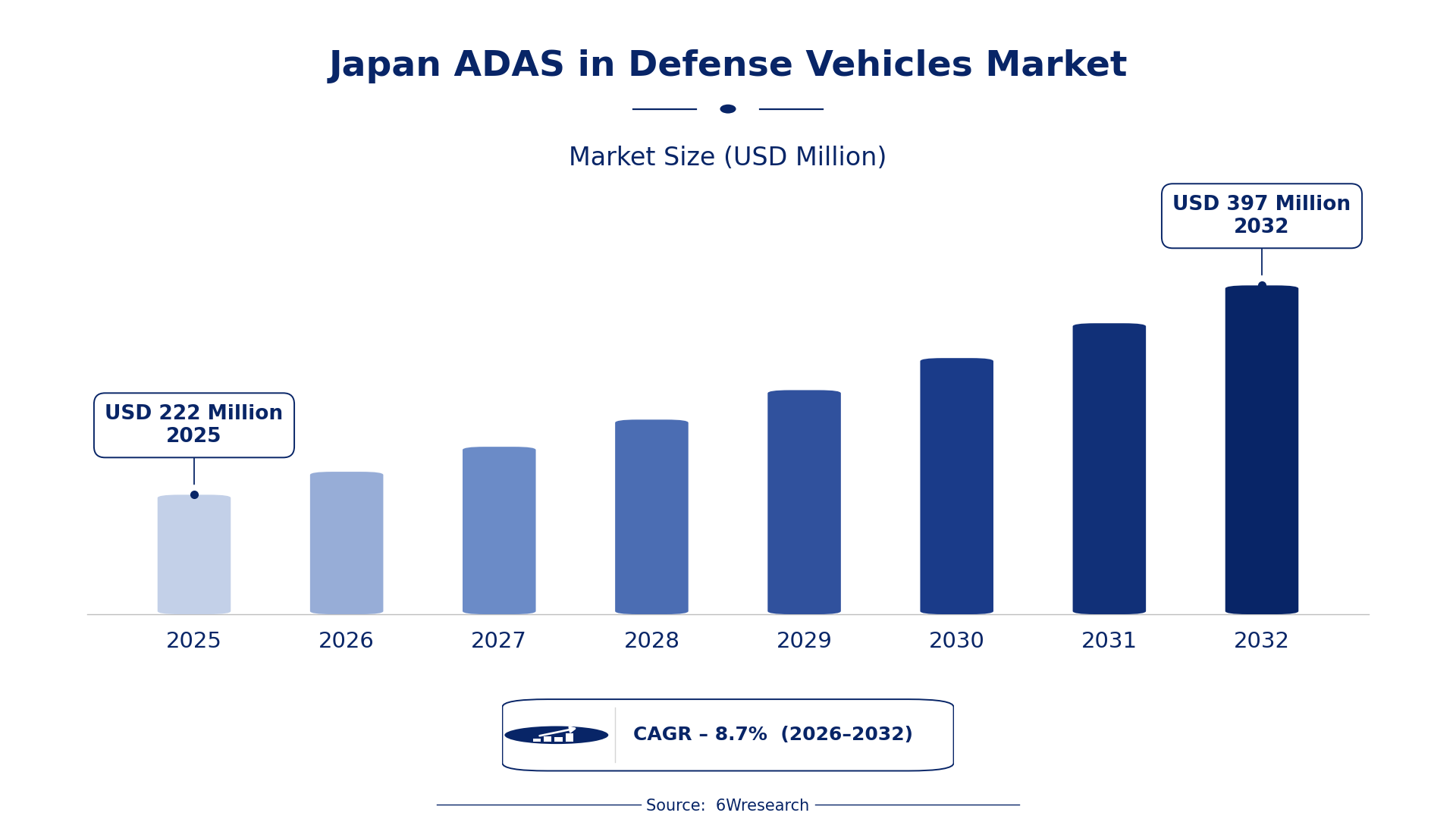
According to 6Wresearch internal database and industry insights, the Japan ADAS in Defense Vehicles Market was valued at USD 222 Million in 2025 and is projected to reach USD 397 Million by 2032, growing at a CAGR of approximately 8.7% during 2026–2032.
Japan ADAS in Defense Vehicles Market Highlights
| Report Metric | Details |
| Report Name | Japan ADAS in Defense Vehicles Market (2026-2032) |
| Market Size 2025 | USD 222 Million |
| Market Size 2032 | USD 397 Million |
| Absolute Growth 2025–2032 | USD 175 Million |
| CAGR 2026–2032 | 8.7% |
| Peak Annual Growth | 9.6% in 2027 |
| Forecast Period | 2026–2032 |
| Historical Data | 2022–2025 |
| Base Year | 2025 |
| Leading ADAS in Defense Vehicles, 2025 | Military-Grade Sensors (47% share) |
| Leading Product Type, 2025 | Rugged Sensor Systems (45% share) |
| Leading Distribution Channel, 2025 | Government Contracts (47% share) |
| Leading End User, 2025 | Armored Vehicle Manufacturers (46% share) |
| Fastest-Growing ADAS in Defense Vehicles | Tactical Driving Assistance (11.5% CAGR) |
| Fastest-Growing Product Type | AI-Enhanced ADAS Systems (12.5% CAGR) |
| Fastest-Growing Distribution Channel | Defense Contractors (11.0% CAGR) |
| Fastest-Growing End User | Army Vehicle Fleets (11.2% CAGR) |
| Growing Sector | military technology |
| Key End Users | Armored Vehicle Manufacturers, Defense Contractors, Government Agencies |
Japan ADAS in Defense Vehicles Market Year-wise Growth Rate and Key Drivers (2022–2032)
This graph illustrates the annual growth rates of the market from 2022 to 2032, highlighting a steady upward trajectory and projected market expansion over the forecast period.
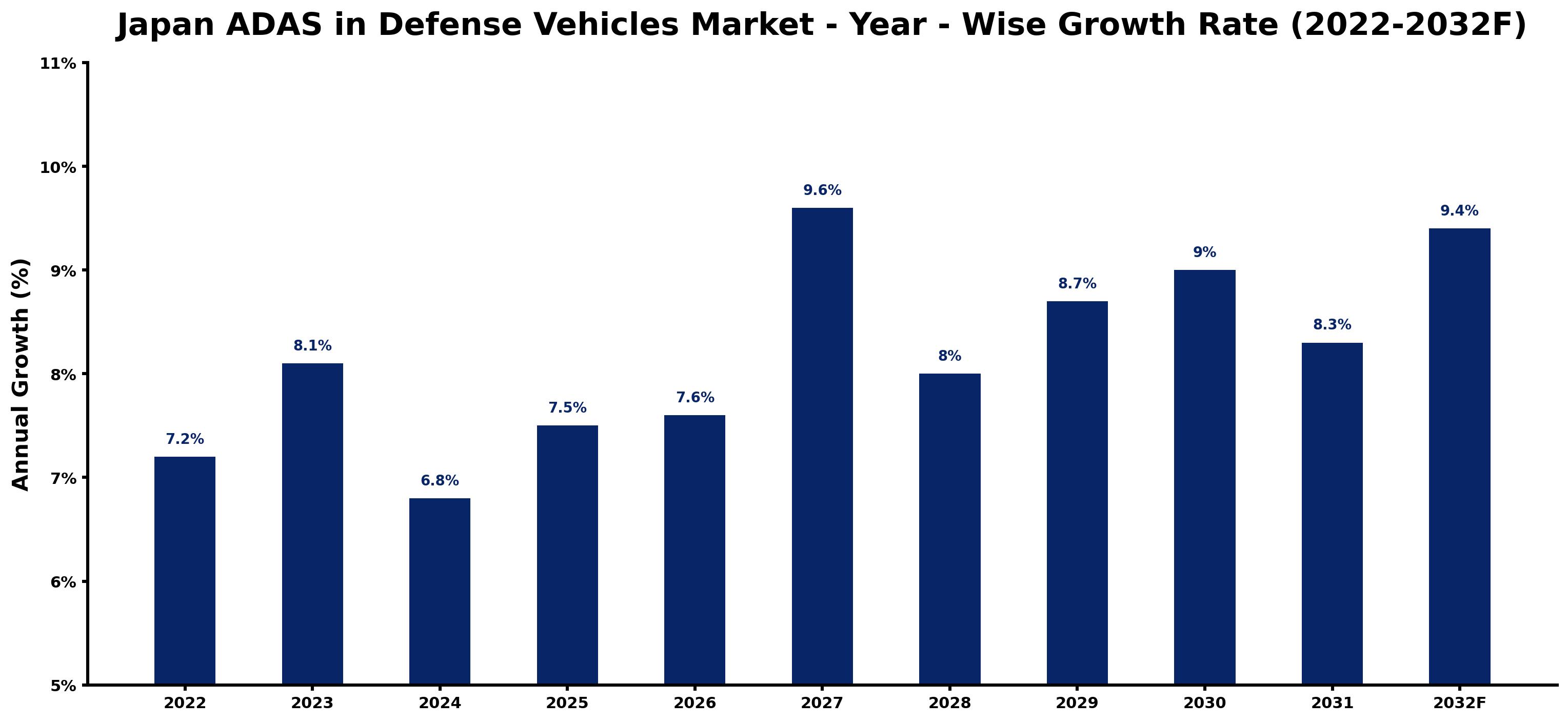
The yearly estimates that follow link every growth rate to its principal driver, so readers can see why the pace changed in each period.
| Year | Estimated Annual Growth (%) | Market Rationale |
| 2022 | 7.2 | The market showed steady growth due to ongoing military investments. |
| 2023 | 8.1 | Demand increased as the defense budget rose this year. |
| 2024 | 6.8 | Growth slowed as procurement processes faced delays in approvals. |
| 2025 | 7.5 | The market rebounded with renewed focus on military modernization initiatives. |
| 2026 | 7.6 | Demand is expected to rise as new technologies are integrated into vehicles. |
| 2027 | 9.6 | Heightened investments in advanced systems will drive peak growth. |
| 2028 | 8.0 | Growth will decelerate as the market stabilizes after the peak period. |
| 2029 | 8.7 | Demand is projected to rise as military needs continue evolving. |
| 2030 | 9.0 | Increased focus on sustainability will drive further investments in technology. |
| 2031 | 8.3 | Growth will moderate as the market adjusts to new technological standards. |
| 2032 | 9.4 | Demand is expected to rise again as modernization efforts continue. |
Note: Market size estimations and growth projections presented in this report are based on 6Wresearch's proprietary forecasting methodology, utilizing the latest available industry data, government publications, and primary research inputs.
Japan ADAS in Defense Vehicles Market Synopsis
ADAS in Defense Vehicles are advanced driver-assistance systems tailored for military applications, utilising specialized sensors and software to enhance vehicle safety and performance. The Japan ADAS in Defense Vehicles Market is expanding due to increased defense budgets, technological advancements, and a focus on military modernization. With a defense budget of approximately 6.8 trillion yen in 2023, demand is driven by the integration of AI-based ADAS solutions and other advanced technologies, ensuring sustained growth in this sector.
Market Dynamics Impact Analysis (2026–2032)
| Factor | Type | Impact | Primary Segment Affected |
| Increased defense budget allocations | Driver | High | Military-Grade Sensors |
| Integration of AI-Enhanced systems | Driver | High | Military-Grade Sensors |
| Growing demand for military vehicle modernization | Opportunity | High | Military-Grade Sensors |
| Expansion of government contracts for defense technology | Opportunity | Medium | Government Contracts |
| Supply chain disruptions affecting component availability | Restraint | High | Military-Grade Sensors |
| Regulatory compliance costs for new technologies | Restraint | Medium | Military-Grade Sensors |
| Limited domestic production capacity for advanced systems | Challenge | High | Military-Grade Sensors |
| Competition from international defense technology providers | Challenge | Medium | Military-Grade Sensors |
Evaluation of Drivers in Japan ADAS in Defense Vehicles Market (2026–2032)
Key forces behind demand, with the segment each one moves most, are listed below.
| Drivers | Primary Segment Affected | Why It Matters (Evidence) |
| Increased defense budget allocations | Military-Grade Sensors | Japan's defense budget for 2023 is approximately 6.8 trillion yen, leading to higher procurement of advanced systems. |
| Integration of AI-based systems | AI-Enhanced ADAS Systems | Integration of AI-based ADAS solutions into next-generation military vehicles improves operational capabilities. |
| Focus on military modernization initiatives | Military-Grade Sensors | The Ministry of Defense's allocation of 200 billion yen for military modernization boosts demand. |
| Rising need for enhanced situational awareness | Military-Grade Sensors | Over 1,000 armored vehicles operated by the Self-Defense Forces require advanced driver-assistance technologies. |
| Development of secure communication systems | Secure ECUs | Secure ECUs are mandated for all new military vehicle designs, driving demand for secure systems. |
Orders keep climbing as Japan's defense budget reached approximately 6.8 trillion yen in 2023, boosting procurement of advanced systems. The integration of AI-based ADAS solutions into next-generation military vehicles improves operational capabilities, increasing demand from the Self-Defense Forces. The allocation of 200 billion yen for military modernization is driving investments in advanced technologies. With over 1,000 armored vehicles requiring upgraded systems, the need for improved situational awareness is paramount. The mandate for Secure ECUs in new military designs further accelerates demand for these solutions.
Evaluation of Restraints in Japan ADAS in Defense Vehicles Market
The following restraints limit how fast demand can grow.
| Market Restraint | Primary Segment Affected | Why It Matters (Evidence) |
| Supply chain disruptions affecting component availability | Military-Grade Sensors | Delays in component deliveries have impacted production timelines, affecting procurement schedules. |
| Regulatory compliance costs for new technologies | Military-Grade Sensors | Compliance with JIS Q 9100 standards increases costs for manufacturers, impacting pricing strategies. |
| Limited domestic production capacity for advanced systems | Military-Grade Sensors | Japan aims to increase domestic defense production by 30% by 2025, yet capacity remains constrained. |
| High competition from international suppliers | Military-Grade Sensors | International defense technology providers offer competitive solutions, challenging local manufacturers. |
| Complex integration processes for new technologies | Military-Grade Sensors | Integrating advanced systems into existing vehicles requires considerable time and resources. |
Japan ADAS in Defense Vehicles Market Challenges
Strict regulations on military vehicle designs create compliance hurdles for buyers, often delaying project timelines by up to six months for defense contractors. Intense competition among suppliers drives down prices, which erodes profit margins and limits investment in essential technology. A shortage of skilled engineers in advanced technologies restricts producers' ability to innovate, potentially resulting in a 20% reduction in product offerings for buyers. Rising costs of raw materials and components can inflate prices by 15%, impacting budgets for military modernization initiatives.
Trends in the Japan ADAS in Defense Vehicles Market
Below are the shifts with the largest effect on the Japan ADAS in Defense Vehicles Market.
- Shift towards AI-based Systems in Military Vehicles: Tokyo is witnessing a shift towards the integration of AI-based ADAS solutions in military vehicles, improving decision-making processes. In 2023, the Japanese Ground Self-Defense Force began implementing these systems to enhance operational efficiency.
- Transition from Traditional to Advanced Night Vision Systems: The Japanese Ground Self-Defense Force is transitioning from traditional night vision to advanced systems, enhancing capabilities in low-light conditions. The increased use of Thermal Imaging Cameras has become vital for surveillance operations.
- Emergence of Secure Communication Technologies: The focus on secure communication technologies is growing within Japan's defense sector. In 2023, Secure ECUs were mandated for all new military vehicle designs, ensuring secure data transmission.
- Prioritisation of Tactical Driving Assistance: Armored Vehicle Manufacturers are prioritising Tactical Driving Assistance systems to enhance driver safety and vehicle maneuverability. This trend is evident as the segment is projected to grow at an 11.5% CAGR from 2026 to 2032.
Investment Opportunities in the Japan ADAS in Defense Vehicles Market
The openings below show where demand in the Japan ADAS in Defense Vehicles Market is visible and how suppliers can enter.
- Increased focus on military modernization initiatives: Now is an opportune time for investment as Japan allocated 200 billion yen for military modernization. Suppliers can engage with the Ministry of Defense to align with upcoming projects.
- Growing demand for secure communication systems: The need for Secure ECUs presents an opportunity for suppliers. Collaborating with defense contractors can facilitate entry into this expanding market segment.
- Rising procurement of AI-based systems: With the integration of AI-based ADAS solutions, suppliers can target Armored Vehicle Manufacturers. Establishing partnerships with local firms can enhance market entry.
- Expansion of government contracts for defense technology: The current environment supports investment in government contracts, which held a 47% share in 2025. Engaging with the Japan Defense Industry Association can provide valuable insights.
Government Initiatives in the Japan ADAS in Defense Vehicles Market
The Battery Industry Strategy, initiated by the Ministry of Economy, Trade and Industry in August 2022, aims to strengthen domestic battery manufacturing capacity by 2030. This strategy supports the development of advanced technologies, including those used in military applications. The GX Promotion Act, enacted in 2023, establishes a framework for promoting green technologies, impacting defense vehicle manufacturing processes.
In 2023, substantial funding for military modernization initiatives was allocated, overseen by the Ministry of Defense. This funding supports the enhancement of military vehicle capabilities, ensuring that defense contractors can meet evolving technological demands.
Future Insight of the Japan ADAS in Defense Vehicles Market
The upcoming military modernization initiatives will streamline the integration of advanced systems into defense vehicles by 2025, improving operational capabilities for the Self-Defense Forces. By 2032, the implementation of JIS Q 9100 standards will ensure higher quality and reliability in defense manufacturing. Increased domestic production aims to boost local supply chains, reducing reliance on foreign components. The focus on advanced technologies will improve situational awareness and navigation in combat scenarios, benefiting both buyers and suppliers.
Market Segmentation Analysis
Japan ADAS in Defense Vehicles Market report covers a detailed analysis of the following market segments:
By ADAS in Defense Vehicles – Military-Grade Sensors Lead, Tactical Driving Assistance Expected to Grow Fastest
According to Saurav Kr Singh, Senior Research Analyst at 6Wresearch, Military-Grade Sensors held 47% of the Japan ADAS in Defense Vehicles Market by adas in defense vehicles in 2025. Military-Grade Sensors command the largest share due to their essential role in ensuring operational reliability in defense vehicles. The extensive deployment of over 1,000 armored vehicles by the Self-Defense Forces highlights the critical reliance on these sensors for effective performance in combat situations. The quickest growth will come from Tactical Driving Assistance, forecast to expand at a CAGR of 11.5% between 2026 and 2032. Tactical Driving Assistance is rapidly gaining traction as it significantly improves driver safety and vehicle manoeuvrability in complex environments. The Ministry of Defense's initiative to enhance military vehicle capabilities by 2025 is a key factor propelling this segment's growth. Suppliers should prioritise the development of advanced Tactical Driving Assistance features to meet the rising demand from military buyers.
By Product Type – Rugged Sensor Systems Lead, AI-Enhanced ADAS Systems Expected to Grow Fastest
Rugged Sensor Systems took 45% of product type revenue in 2025, more than any other category. Rugged Sensor Systems dominate the market because they are specifically engineered to withstand the harsh conditions faced in military operations. Their robustness and reliability are vital for various defense applications, particularly within Japan's active defense sector. AI-Enhanced ADAS Systems are projected to grow fastest, at a CAGR of 12.5% during 2026–2032. AI-Enhanced ADAS Systems are experiencing rapid growth as they significantly improve decision-making through advanced analytics, which is crucial for contemporary military operations. The integration of these systems into next-generation military vehicles is expected to accelerate their adoption in the near future. Buyers will gain substantial advantages by investing in AI-Enhanced ADAS Systems to improve operational efficiency and effectiveness.
By Distribution Channel – Government Contracts Lead, Defense Contractors Expected to Grow Fastest
With 47% of distribution channel revenue in 2025, Government Contracts was the largest category. Government Contracts account for the largest share as they serve as the primary procurement method for acquiring defense systems in Japan. The substantial defense budget of approximately 6.8 trillion yen for 2023 emphasises the reliance on government contracts for funding military technology advancements. Defense Contractors are set to record the highest CAGR in this split, 11.0% over 2026–2032. Defense Contractors are experiencing the fastest growth as they are pivotal in developing and supplying military technology solutions. The collaboration fostered by the Japan Defense Industry Association is creating increased opportunities for these contractors in the market. Suppliers should strengthen their relationships with defense contractors to secure contracts and expand their market presence.
By End User – Armored Vehicle Manufacturers Lead, Army Vehicle Fleets Expected to Grow Fastest
Armored Vehicle Manufacturers accounted for 46% of the market by end user in 2025. Armored Vehicle Manufacturers lead the market as they are the primary users of ADAS technologies, integrating these systems into their vehicles to enhance safety and performance. The demand for advanced systems is driven by the necessity for improved operational capabilities within the Japanese Self-Defense Forces. Over 2026–2032, Army Vehicle Fleets are expected to post the fastest growth, at a CAGR of 11.2%. Army Vehicle Fleets are witnessing the fastest growth as they increasingly adopt ADAS for enhanced operational capability in various mission scenarios. The emphasis on modernising military capabilities aligns with the growing need for advanced driver-assistance technologies. Manufacturers should customise their ADAS offerings to address the specific needs of army vehicle fleets to capture this expanding segment.
Key Attractiveness of the Report
- 10 Years of Market Numbers
- Historical Data Starting from 2022 to 2025
- Base Year 2025
- Forecast Data until 2032
- Key Performance Indicators Impacting the Market
- Major Upcoming Developments and Projects
Key Highlights of the Report:
- Japan ADAS in Defense Vehicles Market Outlook
- Market Size of Japan ADAS in Defense Vehicles Market, 2025
- Forecast of Japan ADAS in Defense Vehicles Market, 2032
- Historical Data and Forecast of Japan ADAS in Defense Vehicles Revenues & Volume for the Period 2022-2032F
- Japan ADAS in Defense Vehicles Market Trend Evolution
- Japan ADAS in Defense Vehicles Market Drivers and Challenges
- Japan ADAS in Defense Vehicles Price Trends
- Japan ADAS in Defense Vehicles Porter's Five Forces
- Japan ADAS in Defense Vehicles Industry Life Cycle
- Historical Data and Forecast of Japan ADAS in Defense Vehicles Market Revenues & Volume By ADAS in Defense Vehicles for the Period 2022-2032F
- Historical Data and Forecast of Japan ADAS in Defense Vehicles Market Revenues & Volume By Military-Grade Sensors for the Period 2022-2032F
- Historical Data and Forecast of Japan ADAS in Defense Vehicles Market Revenues & Volume By Tactical Driving Assistance for the Period 2022-2032F
- Historical Data and Forecast of Japan ADAS in Defense Vehicles Market Revenues & Volume By Night Vision Systems for the Period 2022-2032F
- Historical Data and Forecast of Japan ADAS in Defense Vehicles Market Revenues & Volume By Secure ECUs for the Period 2022-2032F
- Historical Data and Forecast of Japan ADAS in Defense Vehicles Market Revenues & Volume By Product Type for the Period 2022-2032F
- Historical Data and Forecast of Japan ADAS in Defense Vehicles Market Revenues & Volume By Rugged Sensor Systems for the Period 2022-2032F
- Historical Data and Forecast of Japan ADAS in Defense Vehicles Market Revenues & Volume By AI-Enhanced ADAS Systems for the Period 2022-2032F
- Historical Data and Forecast of Japan ADAS in Defense Vehicles Market Revenues & Volume By Thermal Imaging Cameras for the Period 2022-2032F
- Historical Data and Forecast of Japan ADAS in Defense Vehicles Market Revenues & Volume By Encrypted Control Units for the Period 2022-2032F
- Historical Data and Forecast of Japan ADAS in Defense Vehicles Market Revenues & Volume By Distribution Channel for the Period 2022-2032F
- Historical Data and Forecast of Japan ADAS in Defense Vehicles Market Revenues & Volume By Government Contracts for the Period 2022-2032F
- Historical Data and Forecast of Japan ADAS in Defense Vehicles Market Revenues & Volume By Defense Contractors for the Period 2022-2032F
- Historical Data and Forecast of Japan ADAS in Defense Vehicles Market Revenues & Volume By Direct Procurement for the Period 2022-2032F
- Historical Data and Forecast of Japan ADAS in Defense Vehicles Market Revenues & Volume By Industrial Suppliers for the Period 2022-2032F
- Historical Data and Forecast of Japan ADAS in Defense Vehicles Market Revenues & Volume By End User for the Period 2022-2032F
- Historical Data and Forecast of Japan ADAS in Defense Vehicles Market Revenues & Volume By Armored Vehicle Manufacturers for the Period 2022-2032F
- Historical Data and Forecast of Japan ADAS in Defense Vehicles Market Revenues & Volume By Army Vehicle Fleets for the Period 2022-2032F
- Historical Data and Forecast of Japan ADAS in Defense Vehicles Market Revenues & Volume By Surveillance Vehicles for the Period 2022-2032F
- Historical Data and Forecast of Japan ADAS in Defense Vehicles Market Revenues & Volume By Defense Tech Integrators for the Period 2022-2032F
- Japan ADAS in Defense Vehicles Import Export Trade Statistics
- Market Opportunity Assessment By ADAS in Defense Vehicles
- Market Opportunity Assessment By Product Type
- Market Opportunity Assessment By Distribution Channel
- Market Opportunity Assessment By End User
- Japan ADAS in Defense Vehicles Top Companies Market Share
- Japan ADAS in Defense Vehicles Competitive Benchmarking By Technical and Operational Parameters
- Japan ADAS in Defense Vehicles Company Profiles
- Japan ADAS in Defense Vehicles Key Strategic Recommendations
Market Covered
The report covers the following segments.
By ADAS in Defense Vehicles
- Military-Grade Sensors
- Tactical Driving Assistance
- Night Vision Systems
- Secure ECUs
By Product Type
- Rugged Sensor Systems
- AI-Enhanced ADAS Systems
- Thermal Imaging Cameras
- Encrypted Control Units
By Distribution Channel
- Government Contracts
- Defense Contractors
- Direct Procurement
- Industrial Suppliers
By End User
- Armored Vehicle Manufacturers
- Army Vehicle Fleets
- Surveillance Vehicles
- Defense Tech Integrators































