Japan ADAS Lane Assist Market Size & Growth Rate
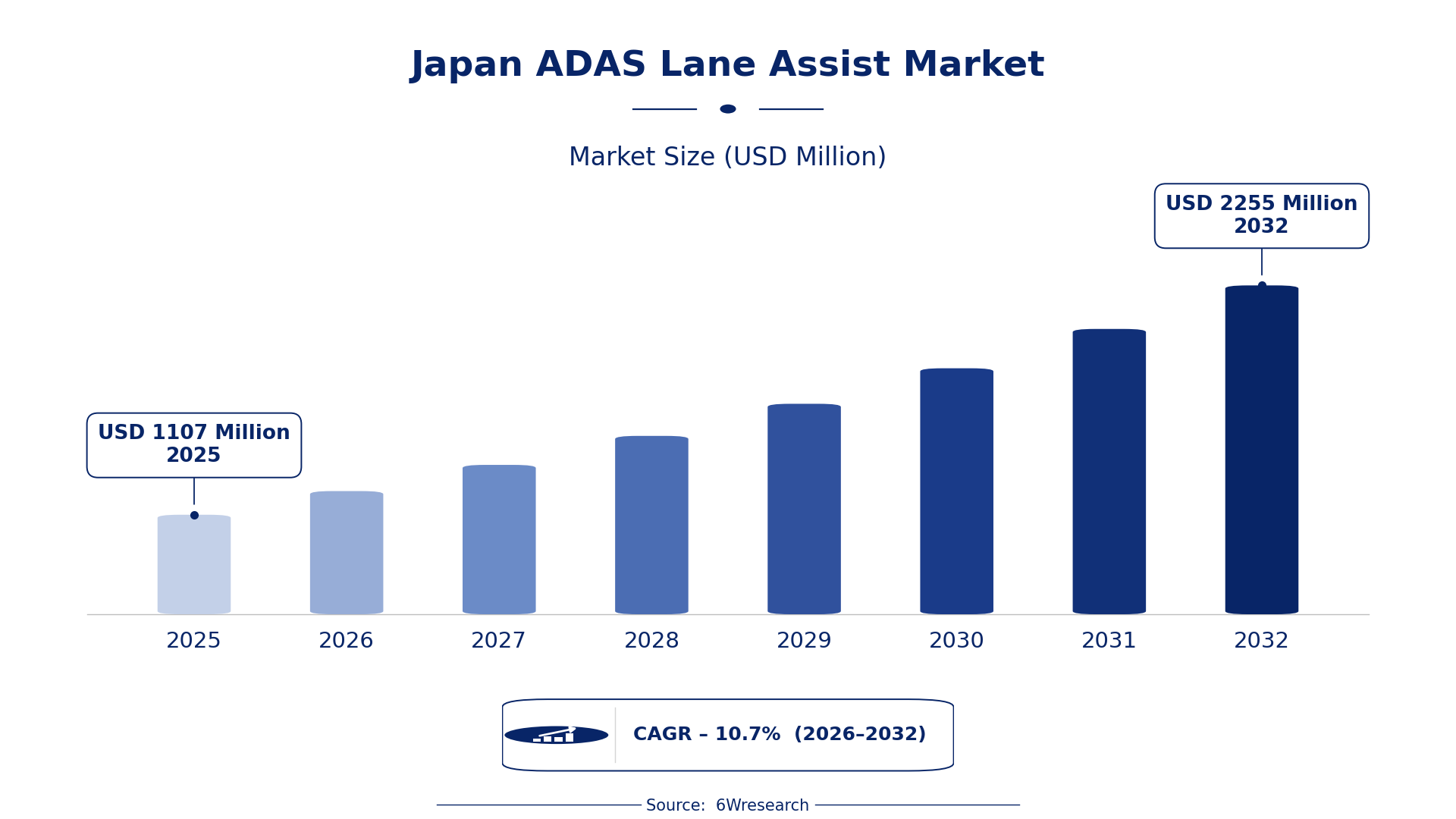
According to 6Wresearch internal database and industry insights, the Japan ADAS Lane Assist Market was valued at USD 1,107 Million in 2025 and is projected to reach USD 2,255 Million by 2032, growing at a CAGR of approximately 10.7% during 2026–2032.
Japan ADAS Lane Assist Market Highlights
| Report Metric | Details |
| Report Name | Japan ADAS Lane Assist Market (2026-2032) |
| Market Size 2025 | USD 1,107 Million |
| Market Size 2032 | USD 2,255 Million |
| Absolute Growth 2025–2032 | USD 1,148 Million |
| CAGR 2026–2032 | 10.7% |
| Peak Annual Growth | 11.8% in 2029 |
| Forecast Period | 2026–2032 |
| Historical Data | 2022–2025 |
| Base Year | 2025 |
| Leading Product Type, 2025 | Lane Departure Warning (40% share) |
| Leading Sensor Type, 2025 | Camera (37% share) |
| Leading Distribution Channel, 2025 | OEMs (49% share) |
| Leading End User, 2025 | Passenger Vehicles (40% share) |
| Fastest-Growing Product Type | Lane Keeping Assist (14.9% CAGR) |
| Fastest-Growing Sensor Type | Radar (15.6% CAGR) |
| Fastest-Growing Distribution Channel | Tier 1 Suppliers (14.0% CAGR) |
| Fastest-Growing End User | Commercial Fleets (14.5% CAGR) |
| Growing Sector | Passenger Vehicles |
| Key End Users | OEMs, Tier 1 Suppliers, Commercial Fleets, Ride-Sharing Firms |
Japan ADAS Lane Assist Market Year-wise Growth Rate and Key Drivers (2022–2032)
This graph illustrates the annual growth rates of the market from 2022 to 2032, highlighting a steady upward trajectory and projected market expansion over the forecast period.
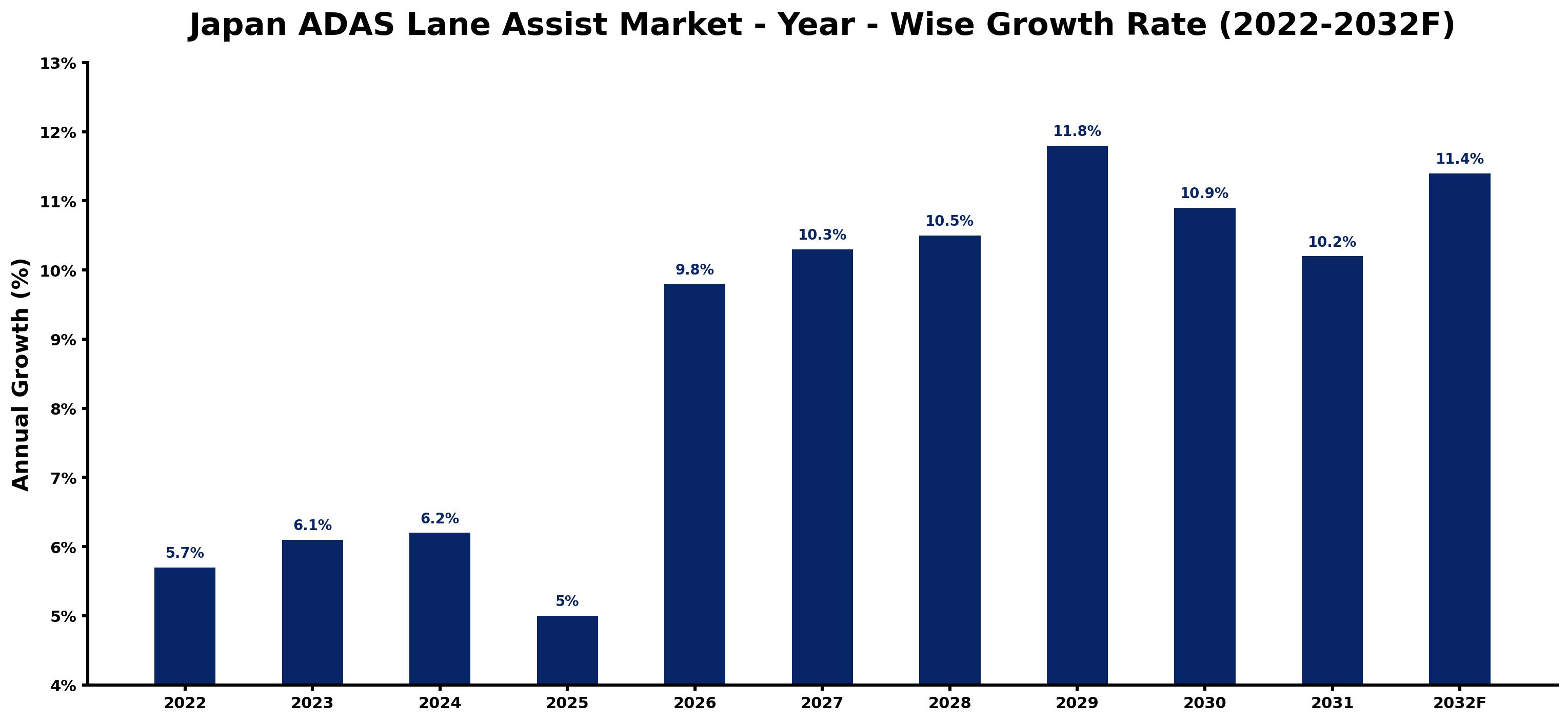
Below, each year's estimated growth is shown next to the factor that most influenced it.
| Year | Estimated Annual Growth (%) | Market Rationale |
| 2022 | 5.7 | The automotive market showed steady growth with increasing consumer interest in safety features. |
| 2023 | 6.1 | Demand for ADAS technologies grew as consumer awareness reached around 60%. |
| 2024 | 6.2 | New safety standards contributed to heightened interest in lane assist systems. |
| 2025 | 5.0 | Growth slowed as the market adjusted to new regulations for emergency systems. |
| 2026 | 9.8 | Investment in sensor fusion technologies is set to spur demand for lane assist features. |
| 2027 | 10.3 | The development of autonomous vehicles will increase the need for lane assist technologies. |
| 2028 | 10.5 | Rising consumer expectations for vehicle safety will drive demand for ADAS features. |
| 2029 | 11.8 | The market is projected to peak as safety regulations and consumer preferences align for lane assist systems. |
| 2030 | 10.9 | Growth will slow as the market matures, with established technologies becoming standard. |
| 2031 | 10.2 | Demand will remain strong but begin to normalise as the market reaches saturation. |
| 2032 | 11.4 | New models with advanced lane assist features will reignite consumer interest. |
Note: Market size estimations and growth projections presented in this report are based on 6Wresearch's proprietary forecasting methodology, utilizing the latest available industry data, government publications, and primary research inputs.
Japan ADAS Lane Assist Market Synopsis
ADAS Lane Assist improves vehicle safety by preventing unintended lane departures through sensors, cameras, and algorithms. The Japan ADAS Lane Assist Market is projected to grow, with 8.3 million vehicles produced in 2022 and a 20% increase in ADAS use in passenger vehicles by 2025. Rising consumer awareness, government mandates for safety features, and technological advancements are driving this demand.
Market Dynamics Impact Analysis (2026–2032)
| Factor | Type | Impact | Primary Segment Affected |
| Increasing consumer awareness of vehicle safety features | Driver | High | Lane Keeping Assist |
| Government mandates for emergency lane keeping systems | Driver | High | Emergency Lane Keeping |
| Growing adoption of ADAS in commercial fleets | Opportunity | High | Commercial Fleets |
| Rising demand for advanced safety technologies in passenger vehicles | Opportunity | High | Passenger Vehicles |
| High costs associated with advanced sensor technologies | Restraint | Medium | Camera |
| Limited consumer understanding of ADAS capabilities | Restraint | Medium | Lane Departure Warning |
| Competition from alternative safety technologies | Challenge | High | Lane Centering Assist |
| Supply chain disruptions affecting component availability | Challenge | Medium | Sensor Fusion |
Evaluation of Drivers in Japan ADAS Lane Assist Market (2026–2032)
These are the developments adding the most demand over the forecast period.
| Drivers | Primary Segment Affected | Why It Matters (Evidence) |
| Increased investment in R&D for safety technologies | Lane Keeping Assist | Japan's automotive industry invests heavily in R&D, focusing on advanced safety features, leading to higher demand for lane keeping systems. |
| Government regulations mandating ADAS features | Emergency Lane Keeping | Regulations requiring emergency lane keeping systems by 2025 drive manufacturers to integrate these technologies into new vehicles. |
| Growing consumer demand for advanced vehicle safety | Passenger Vehicles | The average age of vehicles in Japan is 11.5 years, prompting consumers to seek upgrades with advanced safety technologies. |
| Technological advancements in sensor fusion | Sensor Fusion | The rise of sensor fusion technologies is attracting investment and consumer interest, improving the capabilities of lane assist systems. |
| Support from industry associations for ADAS adoption | Lane Departure Warning | The Japan Automobile Manufacturers Association advocates for advanced safety features, increasing awareness and demand for lane departure warning systems. |
Spending rises because the automotive industry in Japan invests heavily in R&D for safety technologies, with over 8.3 million vehicles produced in 2022. The average vehicle age is 11.5 years, prompting consumers to seek upgrades with advanced safety features. Investments in sensor fusion technologies are attracting interest, improving lane assist capabilities and consumer demand. Advocacy from industry associations boosts awareness and demand for advanced safety features in vehicles.
Evaluation of Restraints in Japan ADAS Lane Assist Market
The main factors holding the market back are set out below.
| Market Restraint | Primary Segment Affected | Why It Matters (Evidence) |
| High costs associated with advanced sensor technologies | Camera | The integration of high-quality sensors in ADAS systems raises production costs, limiting affordability for some manufacturers. |
| Limited consumer understanding of ADAS capabilities | Lane Departure Warning | Many consumers remain unaware of the benefits of ADAS, hindering widespread adoption and market growth. |
| Competition from alternative safety technologies | Lane Centering Assist | Emerging safety technologies may divert attention and investment away from lane centering assist systems. |
| Supply chain disruptions affecting component availability | Sensor Fusion | Ongoing supply chain issues can delay the production of ADAS components, impacting market availability and growth. |
| Regulatory compliance costs for manufacturers | Emergency Lane Keeping | Meeting new safety regulations incurs additional costs for manufacturers, affecting pricing strategies. |
Japan ADAS Lane Assist Market Challenges
Buyers in Japan encounter outdated technology in ADAS Lane Assist systems, as the average vehicle age is 11.5 years, delaying necessary upgrades and increasing safety risks. Limited skills in the workforce impede the development of advanced safety features, resulting in slower adoption rates among manufacturers. Insufficient awareness of ADAS features affects buyers, with only 60% of consumers informed, restricting demand and hindering market growth. Compliance with standards like JIS D 0201 incurs rising costs for suppliers, ultimately increasing production expenses and impacting pricing for end users.
Trends in the Japan ADAS Lane Assist Market
Four trends stand out in the Japan ADAS Lane Assist Market.
- Shift towards Advanced Safety Standards: The Tokyo Motor Show 2023 showcased advancements in lane assist technologies, prompting manufacturers to adopt more sophisticated ADAS features. The government aims for 50% of new vehicles to be equipped with ADAS by 2030.
- Transition from Basic to Integrated ADAS Solutions: As of 2023, sensor fusion technologies are gaining traction in Japan's automotive sector, with a projected 20% rise in ADAS use by 2025. This trend reflects a move towards more integrated safety solutions, appealing to consumers seeking comprehensive features.
- Emergence of Autonomous Vehicle Technologies: The development of autonomous vehicles is influencing the lane assist market, with increasing investments in related technologies. By 2025, the adoption of ADAS in passenger vehicles is projected to rise by 20%, reflecting this growing trend.
- Rising Demand for Commercial Fleet Safety Solutions: With over 5 million registered commercial vehicles as of 2023, the demand for ADAS in commercial fleets is increasing. This trend underscores the need for enhanced safety features to protect drivers and reduce accidents.
Investment Opportunities in the Japan ADAS Lane Assist Market
The opportunities below stand out in the Japan ADAS Lane Assist Market for new entrants and existing suppliers.
- Focus on Commercial Fleet Safety: Tokyo is experiencing a surge in demand for ADAS in commercial fleets, with a projected 14.5% growth expected. Investing in safety technologies tailored for this sector can yield substantial returns, particularly through partnerships with fleet operators.
- Investment in Advanced Sensor Technologies: The average age of vehicles in Japan is 11.5 years, indicating a need for upgrades. Suppliers can enter the market by developing advanced sensor solutions, targeting manufacturers looking to improve their vehicle safety offerings.
- Collaboration with Industry Associations: The Japan Automobile Manufacturers Association promotes advanced safety features, creating opportunities for collaboration. Engaging with this association can facilitate access to new markets and enhance product visibility.
- Expansion of ADAS in Urban Areas: With the Tokyo metropolitan area having the highest concentration of passenger vehicles, the demand for ADAS is set to rise. Suppliers can capitalise on this by establishing local partnerships to meet urban safety needs.
Government Initiatives in the Japan ADAS Lane Assist Market
The Economic Security Promotion Act (2022) supports supply-chain resilience for critical products, including ADAS components. This measure ensures stability in supply chains for manufacturers, enabling them to meet the growing demand for advanced safety features in vehicles. The act aims to strengthen domestic production capabilities, creating a more reliable supply chain for ADAS technologies.
The Ministry of Land, Infrastructure, Transport and Tourism promotes ADAS adoption through various initiatives, funding projects that improve vehicle safety. This includes support for the integration of advanced technologies in new vehicle models, ensuring compliance with safety standards and improving overall vehicle safety.
Future Insight of the Japan ADAS Lane Assist Market
By 2032, the government will mandate that 50% of new vehicles are equipped with ADAS, prompting a policy-driven shift in the automotive market. This requirement will drive suppliers to invest in advanced sensor technologies and improve safety features. The Tokyo Motor Show will continue to showcase innovations in lane assist systems, shaping consumer expectations. With ongoing subsidies supporting ADAS adoption, buyers will likely benefit from enhanced vehicle safety and performance, boosting overall market competitiveness.
Market Segmentation Analysis
Japan ADAS Lane Assist Market report covers a detailed analysis of the following market segments:
By Product Type – Lane Departure Warning Leads, Lane Keeping Assist Expected to Grow Fastest
According to Saurav Kr Singh, Senior Research Analyst at 6Wresearch, in 2025, Lane Departure Warning led the product type split with a 40% share. Lane Departure Warning holds the largest share due to its essential function in alerting drivers to unintended lane drift, which is crucial for improving road safety. The alignment with the JIS D 0201 standard relevant to automotive safety systems further solidifies its importance in the market. Lane Keeping Assist is projected to grow fastest, at a CAGR of 14.9% during 2026–2032. Lane Keeping Assist is growing rapidly as it actively helps maintain lane position, reflecting an increasing consumer preference for advanced safety features. The government's goal of having 50% of new vehicles equipped with ADAS by 2030 will likely accelerate this segment's growth. This means suppliers should prioritise the development of lane assist technologies to align with rising market demands.
By Sensor Type – Camera Leads, Radar Expected to Grow Fastest
Camera held 37% of the Japan ADAS Lane Assist Market by sensor type in 2025. Cameras lead the market as they are vital for visual lane detection, providing precise data necessary for effective lane assist systems. Their prevalent use in vehicles, especially in urban centres like Tokyo, highlights their critical role in enhancing vehicle safety. Over 2026–2032, Radar is expected to post the fastest growth, at a CAGR of 15.6%. Radar technology is experiencing the fastest growth due to its capability to measure distances accurately, complementing lane assist functionalities. The increasing integration of radar with existing systems is becoming common as manufacturers aim to bolster overall safety features. Suppliers should focus on investing in radar technology to leverage its growing acceptance within the automotive sector.
By Distribution Channel – OEMs Lead, Tier 1 Suppliers Expected to Grow Fastest
OEMs accounted for 49% of the market by distribution channel in 2025. OEMs are the primary distribution channel, as they manufacture vehicles equipped with ADAS technologies, ensuring broad implementation across new models. The strong presence of domestic manufacturers in Japan reinforces the dominance of this channel in the market. Tier 1 Suppliers are set to record the highest CAGR in this split, 14.0% over 2026–2032. Tier 1 Suppliers are witnessing the fastest growth as they supply critical components to OEMs, facilitating the integration of advanced safety technologies. Their importance is rising as the automotive industry increasingly prioritises safety features in light of regulatory requirements. This indicates that suppliers should strengthen collaborations with Tier 1 Suppliers to enhance their market reach.
By End User – Passenger Vehicles Lead, Commercial Fleets Expected to Grow Fastest
Passenger Vehicles took 40% of end user revenue in 2025, more than any other category. Passenger Vehicles constitute the largest end-user segment, driven by the high number of registered vehicles and growing consumer awareness of ADAS features. The average vehicle age in Japan is 11.5 years, prompting many owners to upgrade to newer models with advanced safety technologies. The quickest growth will come from Commercial Fleets, forecast to expand at a CAGR of 14.5% between 2026 and 2032. Commercial Fleets are rapidly adopting lane assist technologies as companies recognise the advantages of improved safety for drivers and lower accident rates. Government subsidies are further promoting the uptake of these technologies within fleet operations. This presents an opportunity for suppliers to target commercial fleets with customised solutions that improve safety and operational efficiency.
Key Attractiveness of the Report
- 10 Years of Market Numbers
- Historical Data Starting from 2022 to 2025
- Base Year 2025
- Forecast Data until 2032
- Key Performance Indicators Impacting the Market
- Major Upcoming Developments and Projects
Key Highlights of the Report:
- Japan ADAS Lane Assist Market Outlook
- Market Size of Japan ADAS Lane Assist Market, 2025
- Forecast of Japan ADAS Lane Assist Market, 2032
- Historical Data and Forecast of Japan ADAS Lane Assist Revenues & Volume for the Period 2022-2032F
- Japan ADAS Lane Assist Market Trend Evolution
- Japan ADAS Lane Assist Market Drivers and Challenges
- Japan ADAS Lane Assist Price Trends
- Japan ADAS Lane Assist Porter's Five Forces
- Japan ADAS Lane Assist Industry Life Cycle
- Historical Data and Forecast of Japan ADAS Lane Assist Market Revenues & Volume By Product Type for the Period 2022-2032F
- Historical Data and Forecast of Japan ADAS Lane Assist Market Revenues & Volume By Lane Departure Warning for the Period 2022-2032F
- Historical Data and Forecast of Japan ADAS Lane Assist Market Revenues & Volume By Lane Keeping Assist for the Period 2022-2032F
- Historical Data and Forecast of Japan ADAS Lane Assist Market Revenues & Volume By Lane Centering Assist for the Period 2022-2032F
- Historical Data and Forecast of Japan ADAS Lane Assist Market Revenues & Volume By Emergency Lane Keeping for the Period 2022-2032F
- Historical Data and Forecast of Japan ADAS Lane Assist Market Revenues & Volume By Sensor Type for the Period 2022-2032F
- Historical Data and Forecast of Japan ADAS Lane Assist Market Revenues & Volume By Camera for the Period 2022-2032F
- Historical Data and Forecast of Japan ADAS Lane Assist Market Revenues & Volume By Radar for the Period 2022-2032F
- Historical Data and Forecast of Japan ADAS Lane Assist Market Revenues & Volume By Lidar for the Period 2022-2032F
- Historical Data and Forecast of Japan ADAS Lane Assist Market Revenues & Volume By Sensor Fusion for the Period 2022-2032F
- Historical Data and Forecast of Japan ADAS Lane Assist Market Revenues & Volume By Distribution Channel for the Period 2022-2032F
- Historical Data and Forecast of Japan ADAS Lane Assist Market Revenues & Volume By OEMs for the Period 2022-2032F
- Historical Data and Forecast of Japan ADAS Lane Assist Market Revenues & Volume By Tier 1 Suppliers for the Period 2022-2032F
- Historical Data and Forecast of Japan ADAS Lane Assist Market Revenues & Volume By Online Platforms for the Period 2022-2032F
- Historical Data and Forecast of Japan ADAS Lane Assist Market Revenues & Volume By Direct Sales for the Period 2022-2032F
- Historical Data and Forecast of Japan ADAS Lane Assist Market Revenues & Volume By End User for the Period 2022-2032F
- Historical Data and Forecast of Japan ADAS Lane Assist Market Revenues & Volume By Passenger Vehicles for the Period 2022-2032F
- Historical Data and Forecast of Japan ADAS Lane Assist Market Revenues & Volume By Commercial Fleets for the Period 2022-2032F
- Historical Data and Forecast of Japan ADAS Lane Assist Market Revenues & Volume By Ride-Sharing Firms for the Period 2022-2032F
- Historical Data and Forecast of Japan ADAS Lane Assist Market Revenues & Volume By Autonomous Vehicles for the Period 2022-2032F
- Japan ADAS Lane Assist Import Export Trade Statistics
- Market Opportunity Assessment By Product Type
- Market Opportunity Assessment By Sensor Type
- Market Opportunity Assessment By Distribution Channel
- Market Opportunity Assessment By End User
- Japan ADAS Lane Assist Top Companies Market Share
- Japan ADAS Lane Assist Competitive Benchmarking By Technical and Operational Parameters
- Japan ADAS Lane Assist Company Profiles
- Japan ADAS Lane Assist Key Strategic Recommendations
Market Covered
Segments analysed in this report are listed below.
By Product Type
- Lane Departure Warning
- Lane Keeping Assist
- Lane Centering Assist
- Emergency Lane Keeping
By Sensor Type
- Camera
- Radar
- Lidar
- Sensor Fusion
By Distribution Channel
- OEMs
- Tier 1 Suppliers
- Online Platforms
- Direct Sales
By End User
- Passenger Vehicles
- Commercial Fleets
- Ride-Sharing Firms
- Autonomous Vehicles































