Japan ADAS Sensor Integration Market Size & Growth Rate
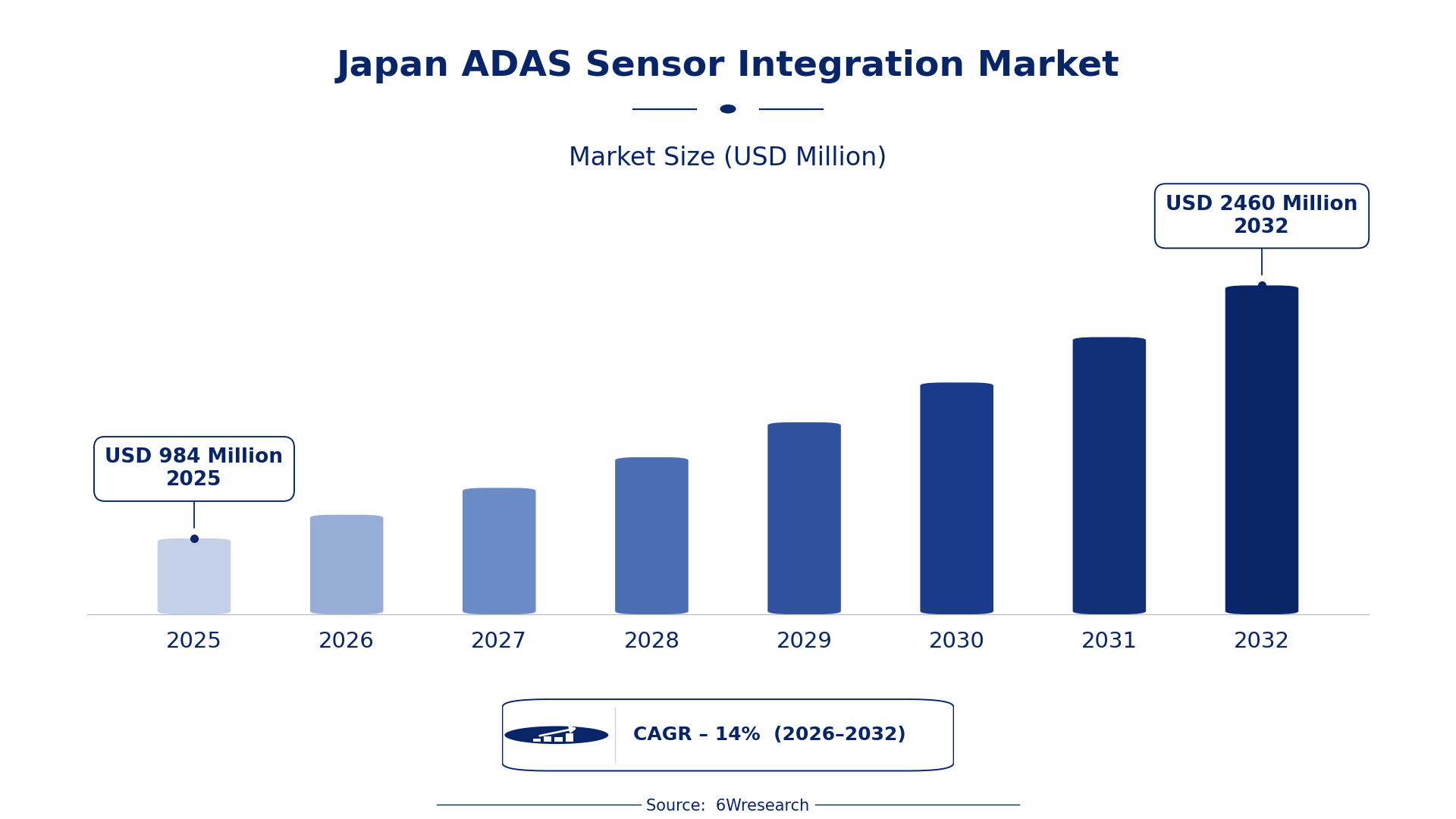
According to 6Wresearch internal database and industry insights, the Japan ADAS Sensor Integration Market was valued at USD 984 Million in 2025 and is projected to reach USD 2,460 Million by 2032, growing at a CAGR of approximately 14% during 2026–2032.
Japan ADAS Sensor Integration Market Highlights
| Report Metric | Details |
| Report Name | Japan ADAS Sensor Integration Market (2026-2032) |
| Market Size 2025 | USD 984 Million |
| Market Size 2032 | USD 2,460 Million |
| Absolute Growth 2025–2032 | USD 1,476 Million |
| CAGR 2026–2032 | 14% |
| Peak Annual Growth | 15.8% in 2027 |
| Forecast Period | 2026–2032 |
| Historical Data | 2022–2025 |
| Base Year | 2025 |
| Leading Integration Method, 2025 | Centralized Fusion (51% share) |
| Leading Sensor Type, 2025 | Radar + Lidar (43% share) |
| Leading Distribution Channel, 2025 | OEMs (48% share) |
| Leading End User, 2025 | ADAS Platform Makers (38% share) |
| Fastest-Growing Integration Method | Modular Integration (19.8% CAGR) |
| Fastest-Growing Sensor Type | Camera + Ultrasonic (20.2% CAGR) |
| Fastest-Growing Distribution Channel | Direct Sales (17.6% CAGR) |
| Fastest-Growing End User | EV Startups (18.0% CAGR) |
| Growing Sector | automotive safety |
| Key End Users | OEMs, ADAS Platform Makers, EV Startups, Commercial Fleets |
Japan ADAS Sensor Integration Market Year-wise Growth Rate and Key Drivers (2022–2032)
This graph illustrates the annual growth rates of the market from 2022 to 2032, highlighting a steady upward trajectory and projected market expansion over the forecast period.
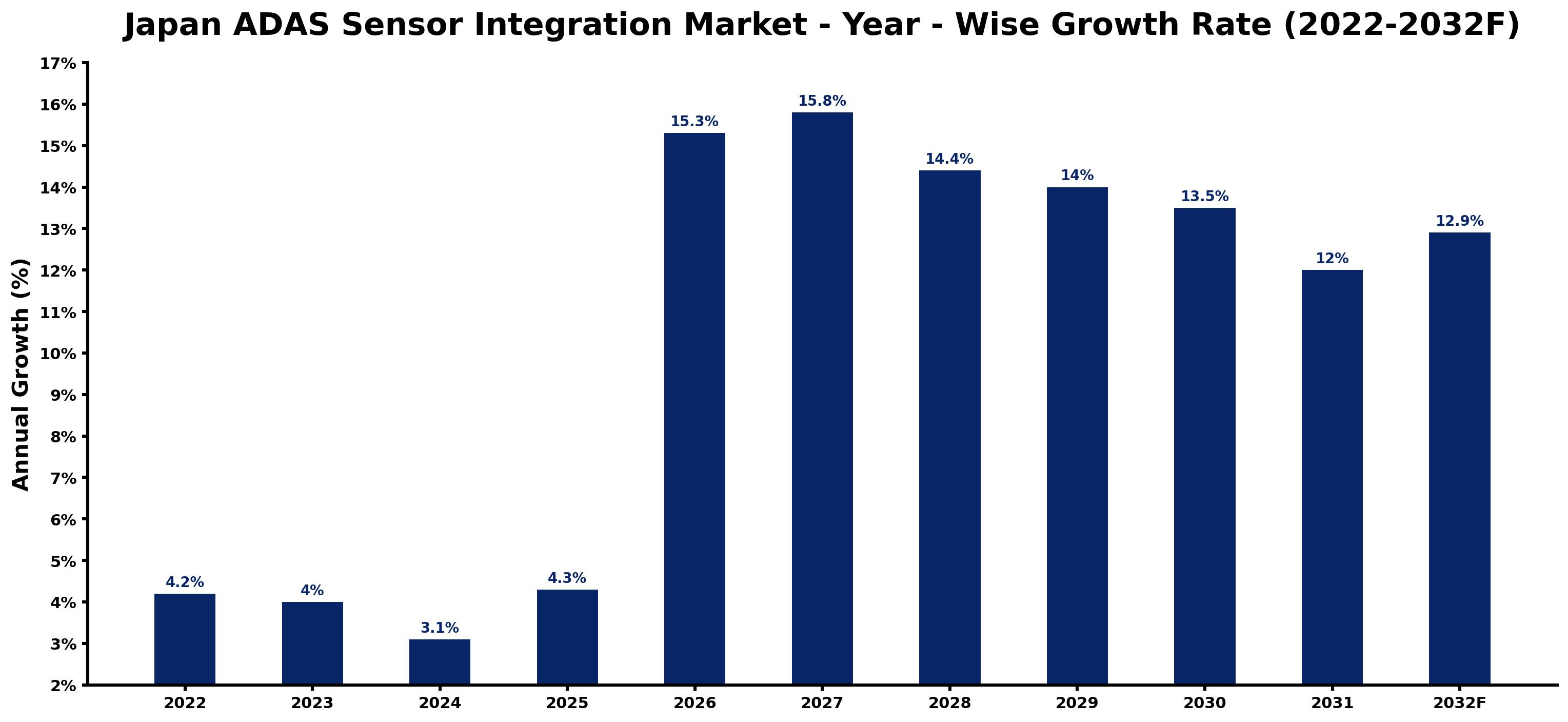
Each row of the following table gives one year's estimated growth and the event or demand shift that explains it.
| Year | Estimated Annual Growth (%) | Market Rationale |
| 2022 | 4.2 | The market experienced steady growth with strong demand from domestic manufacturers. |
| 2023 | 4.0 | Growth slowed slightly as the automotive sector faced supply chain challenges. |
| 2024 | 3.1 | Demand continued to rise, but at a slower pace due to market saturation. |
| 2025 | 4.3 | Growth accelerated as new models featuring advanced ADAS technologies were launched. |
| 2026 | 15.3 | Demand is expected to surge sharply with increased investments in safety technologies. |
| 2027 | 15.8 | The market is projected to peak due to heightened consumer interest in automated driving features. |
| 2028 | 14.4 | Growth will moderate as the market starts to stabilise after rapid expansion. |
| 2029 | 14.0 | Demand is expected to continue slowing down, reflecting a more mature market phase. |
| 2030 | 13.5 | Growth rates will decrease as competition intensifies among technology providers. |
| 2031 | 12.0 | The market is projected to experience a further slowdown, indicating a need for innovation. |
| 2032 | 12.9 | Demand is expected to rise again as new technologies are introduced. |
Note: Market size estimations and growth projections presented in this report are based on 6Wresearch's proprietary forecasting methodology, utilizing the latest available industry data, government publications, and primary research inputs.
Japan ADAS Sensor Integration Market Synopsis
ADAS Sensor Integration combines various sensor technologies to improve vehicle safety and automation, including cameras, radar, and lidar. The Japanese ADAS Sensor Integration Market is growing due to increasing consumer demand for advanced safety features, with an adoption rate of approximately 30% in new vehicles as of 2023. Investment in the automotive sector, valued at around 15 trillion JPY, is driven by government initiatives such as the Economic Security Promotion Act and the Next-Generation Vehicle Strategy, which promote innovation and integration in vehicle systems.
Market Dynamics Impact Analysis (2026–2032)
| Factor | Type | Impact | Primary Segment Affected |
| Growing demand for advanced safety features in vehicles | Driver | High | ADAS Platform Makers |
| Increase in electric vehicle production requiring advanced ADAS | Driver | High | EV Startups |
| Investment in smart mobility initiatives by the government | Opportunity | High | ADAS Platform Makers |
| Rising exports of vehicles with integrated ADAS technologies | Opportunity | High | OEMs |
| Supply chain disruptions affecting component availability | Restraint | High | Tier 1 Suppliers |
| High costs associated with advanced sensor technologies | Restraint | Medium | ADAS Platform Makers |
| Competition from international suppliers offering lower-cost solutions | Challenge | High | OEMs |
| Rapid technological advancements requiring constant adaptation | Challenge | Medium | ADAS Platform Makers |
Evaluation of Drivers in Japan ADAS Sensor Integration Market (2026–2032)
Demand rests on the following drivers, each shown with the segment it touches most.
| Drivers | Primary Segment Affected | Why It Matters (Evidence) |
| Rising consumer demand for safety features | ADAS Platform Makers | The adoption rate of ADAS in new vehicles is around 30%, prompting manufacturers to invest in integration. |
| Increased production of electric vehicles | EV Startups | Japan's automotive sector is valued at approximately 15 trillion JPY, driving demand for advanced ADAS. |
| Government initiatives promoting smart mobility | ADAS Platform Makers | The 'Smart Mobility Strategy' launched in 2023 aims to enhance ADAS integration. |
| Growing exports of vehicles with ADAS | OEMs | In 2023, Japan's automotive exports reached 4.5 trillion JPY, boosting demand for integrated systems. |
| Technological advancements in sensor integration | ADAS Platform Makers | ISO 26262 is a standard that enhances safety and drives investment in ADAS technologies. |
The strongest pull on demand comes from rising consumer interest in safety features, with the adoption rate of ADAS in new vehicles around 30%. Increased production of electric vehicles is also notable, as Japan's automotive sector is valued at approximately 15 trillion JPY. Growing exports of vehicles with integrated ADAS reached 4.5 trillion JPY in 2023, driving demand. Technological advancements, supported by ISO 26262 standards, stimulate investment in safety technologies, leading to increased purchasing from manufacturers.
Evaluation of Restraints in Japan ADAS Sensor Integration Market
These are the pressures that could keep growth below its potential.
| Market Restraint | Primary Segment Affected | Why It Matters (Evidence) |
| Supply chain disruptions affecting component availability | Tier 1 Suppliers | Challenges in sourcing critical components have delayed production schedules, impacting delivery timelines. |
| High costs associated with advanced sensor technologies | ADAS Platform Makers | The integration of multiple sensors increases production costs, limiting adoption among budget-conscious manufacturers. |
| Limited awareness among consumers about ADAS benefits | Commercial Fleets | Many fleet operators are unaware of the advantages of integrating ADAS, hindering market growth. |
| Regulatory hurdles in vehicle safety standards | OEMs | Compliance with stringent safety regulations can delay product launches and increase costs. |
| Competition from international suppliers offering lower-cost solutions | OEMs | Local manufacturers face pressure from cheaper imports, affecting their pricing strategies. |
Japan ADAS Sensor Integration Market Challenges
The adoption rate of ADAS in new vehicles is around 30% as of 2023, indicating regulatory challenges that hinder faster integration. Japan's stringent vehicle safety regulations, enforced by the Ministry of Land, Infrastructure, Transport and Tourism, create delays for manufacturers aiming to meet compliance standards. High development costs can exceed 10 billion JPY for advanced sensor technologies, which burdens smaller producers lacking sufficient capital. Intense competition among over 100 companies in ADAS development results in price wars, eroding profit margins for suppliers and restricting their capacity for long-term investments.
Trends in the Japan ADAS Sensor Integration Market
Below are the shifts with the largest effect on the Japan ADAS Sensor Integration Market.
- Shift from Traditional to Advanced Sensor Technologies: Tokyo is experiencing a shift towards advanced sensor technologies in vehicles, with the adoption of lidar and radar systems increasing. In 2023, the adoption rate of ADAS in new vehicles reached approximately 30%, indicating a growing preference for enhanced safety features.
- Transition from Manual to Automated Driving Systems: The automotive sector is transitioning towards automated driving systems, reflecting consumer demand for improved safety. The Semiconductor and Digital Industry Strategy aims to promote these technologies, with a target of significant integration by 2025.
- ADAS Features Prioritised in Luxury Vehicles: Luxury vehicle makers are prioritising advanced ADAS features, reflecting consumer expectations for safety and automation. In 2023, the market for luxury vehicles with integrated ADAS technologies expanded significantly, highlighting this trend.
- Emergence of EV Startups Focusing on ADAS: EV startups are emerging as key players in the ADAS market, focusing on integrating advanced technologies. This segment is expected to grow at a CAGR of 18.0% from 2026 to 2032, driven by innovation.
Investment Opportunities in the Japan ADAS Sensor Integration Market
Several openings in the Japan ADAS Sensor Integration Market merit attention from investors.
- ADAS Sensor Integration Solutions: The demand for ADAS sensor integration solutions is rising, with a market gap of approximately 2.5 trillion JPY by 2032. OEMs are looking for advanced integration methods to improve vehicle safety and automation.
- Investment in Smart Mobility Technologies: Now is the time to invest in smart mobility technologies, as the Japanese government aims for about JPY 150 trillion of public-private decarbonisation investment over 10 years. This creates opportunities for ADAS integration in new vehicle models.
- Growth in Commercial Fleets: The commercial fleet sector is expanding, with a significant increase in demand for ADAS technologies. This presents a chance for suppliers to partner with fleet operators to improve safety and efficiency.
- Expansion of Electric Vehicle Market: The electric vehicle market is rapidly growing, with an expected increase in production. Suppliers can enter this market by collaborating with EV startups focusing on advanced ADAS features.
Government Initiatives in the Japan ADAS Sensor Integration Market
The Economic Security Promotion Act, enacted in 2022, supports supply-chain resilience for critical products, improving the stability of ADAS component availability. This law complements existing measures by promoting local production and reducing dependency on foreign suppliers, which is vital for the automotive sector. The act aims to enhance domestic manufacturing capabilities, ensuring a steady supply of components essential for ADAS integration.
The Ministry of Land, Infrastructure, Transport and Tourism oversees vehicle safety regulations and funds projects aimed at improving automotive safety. This includes approving initiatives under the Semiconductor and Digital Industry Strategy to support the integration of ADAS technologies in vehicles, ensuring compliance with safety standards and facilitating smoother market entry for new products.
Future Insight of the Japan ADAS Sensor Integration Market
The Japanese government's 'Smart Mobility Strategy' will drive a shift towards widespread ADAS adoption by 2032, prompting suppliers to enhance their offerings. By 2032, the adoption rate of ADAS in new vehicles is expected to reach 60%, pushing manufacturers to invest in advanced sensor technologies. Increased collaboration among industry players will facilitate the development of new standards, ensuring safety and efficiency. As the automotive sector evolves, buyers will benefit from improved vehicle safety features and enhanced automation capabilities.
Market Segmentation Analysis
Japan ADAS Sensor Integration Market report covers a detailed analysis of the following market segments:
By Integration Method – Centralized Fusion Leads, Modular Integration Expected to Grow Fastest
According to Saurav Kr Singh, Senior Research Analyst at 6Wresearch, Centralized Fusion took 51% of integration method revenue in 2025, more than any other category. Centralized Fusion holds the largest share due to its essential role in processing data from multiple sensors efficiently, which is critical for vehicle safety. This method is particularly favoured by manufacturers in regions like Tokyo and Aichi, where automotive production is concentrated. Over 2026–2032, Modular Integration is expected to post the fastest growth, at a CAGR of 19.8%. Modular Integration is experiencing rapid growth as it allows for flexible sensor deployment in vehicles, catering to the diverse needs of manufacturers. The increasing adoption of modular systems aligns with Japan's 'Next-Generation Vehicle Strategy' aiming for enhanced ADAS integration by 2025. Suppliers should focus on developing modular solutions to meet the evolving demands of the automotive sector.
By Sensor Type – Radar + Lidar Leads, Camera + Ultrasonic Expected to Grow Fastest
The largest sensor type category in 2025 was Radar + Lidar, at 43% of revenue. Radar + Lidar commands the largest share as it is vital for accurate distance measurement and object detection, crucial for safety in vehicle automation. This combination is widely adopted in new vehicles, contributing to the 30% ADAS adoption rate in Japan. Camera + Ultrasonic is set to record the highest CAGR in this split, 20.2% over 2026–2032. Camera + Ultrasonic is the fastest-growing segment, primarily used for parking assistance and obstacle detection, reflecting the increasing demand for advanced driver assistance features. The popularity of these sensors is driven by the rising number of registered vehicles exceeding 78 million in Japan. Buyers should prioritise investments in Camera + Ultrasonic technologies to enhance vehicle safety features.
By Distribution Channel – OEMs Lead, Direct Sales Expected to Grow Fastest
With 48% of distribution channel revenue in 2025, OEMs was the largest category. OEMs dominate the market as they are the primary customers for ADAS integration solutions, ensuring a steady demand for advanced safety technologies. Their central role in vehicle production solidifies their position in the distribution channel. The quickest growth will come from Direct Sales, forecast to expand at a CAGR of 17.6% between 2026 and 2032. Direct Sales is growing rapidly, albeit less common compared to established channels, as manufacturers seek more direct relationships with technology providers. This trend reflects the need for tailored solutions in a competitive automotive market. Suppliers may need to explore direct sales strategies to better connect with OEMs and meet specific requirements.
By End User – ADAS Platform Makers Lead, EV Startups Expected to Grow Fastest
In 2025, ADAS Platform Makers led the end user split with a 38% share. ADAS Platform Makers lead the market as they are crucial for developing integrated systems for vehicles, driving the demand for advanced sensor technologies. Their pivotal role in the automotive ecosystem ensures a consistent market share. EV Startups are projected to grow fastest, at a CAGR of 18.0% during 2026–2032. EV Startups represent the fastest-growing segment, focusing on advanced technologies that integrate ADAS features into electric vehicles. This growth is propelled by the increasing shift towards electric mobility in Japan's automotive landscape. Investors should consider partnerships with EV Startups to capitalise on the growing demand for advanced ADAS technologies.
Key Attractiveness of the Report
- 10 Years of Market Numbers
- Historical Data Starting from 2022 to 2025
- Base Year 2025
- Forecast Data until 2032
- Key Performance Indicators Impacting the Market
- Major Upcoming Developments and Projects
Key Highlights of the Report:
- Japan ADAS Sensor Integration Market Outlook
- Market Size of Japan ADAS Sensor Integration Market, 2025
- Forecast of Japan ADAS Sensor Integration Market, 2032
- Historical Data and Forecast of Japan ADAS Sensor Integration Revenues & Volume for the Period 2022-2032F
- Japan ADAS Sensor Integration Market Trend Evolution
- Japan ADAS Sensor Integration Market Drivers and Challenges
- Japan ADAS Sensor Integration Price Trends
- Japan ADAS Sensor Integration Porter's Five Forces
- Japan ADAS Sensor Integration Industry Life Cycle
- Historical Data and Forecast of Japan ADAS Sensor Integration Market Revenues & Volume By Integration Method for the Period 2022-2032F
- Historical Data and Forecast of Japan ADAS Sensor Integration Market Revenues & Volume By Centralized Fusion for the Period 2022-2032F
- Historical Data and Forecast of Japan ADAS Sensor Integration Market Revenues & Volume By Modular Integration for the Period 2022-2032F
- Historical Data and Forecast of Japan ADAS Sensor Integration Market Revenues & Volume By Edge-Level Processing for the Period 2022-2032F
- Historical Data and Forecast of Japan ADAS Sensor Integration Market Revenues & Volume By AI-Enhanced Integration for the Period 2022-2032F
- Historical Data and Forecast of Japan ADAS Sensor Integration Market Revenues & Volume By Sensor Type for the Period 2022-2032F
- Historical Data and Forecast of Japan ADAS Sensor Integration Market Revenues & Volume By Radar + Lidar for the Period 2022-2032F
- Historical Data and Forecast of Japan ADAS Sensor Integration Market Revenues & Volume By Camera + Ultrasonic for the Period 2022-2032F
- Historical Data and Forecast of Japan ADAS Sensor Integration Market Revenues & Volume By Infrared Sensors for the Period 2022-2032F
- Historical Data and Forecast of Japan ADAS Sensor Integration Market Revenues & Volume By Sensor Arrays for the Period 2022-2032F
- Historical Data and Forecast of Japan ADAS Sensor Integration Market Revenues & Volume By Distribution Channel for the Period 2022-2032F
- Historical Data and Forecast of Japan ADAS Sensor Integration Market Revenues & Volume By OEMs for the Period 2022-2032F
- Historical Data and Forecast of Japan ADAS Sensor Integration Market Revenues & Volume By Tier 1 Suppliers for the Period 2022-2032F
- Historical Data and Forecast of Japan ADAS Sensor Integration Market Revenues & Volume By Online Distributors for the Period 2022-2032F
- Historical Data and Forecast of Japan ADAS Sensor Integration Market Revenues & Volume By Direct Sales for the Period 2022-2032F
- Historical Data and Forecast of Japan ADAS Sensor Integration Market Revenues & Volume By End User for the Period 2022-2032F
- Historical Data and Forecast of Japan ADAS Sensor Integration Market Revenues & Volume By ADAS Platform Makers for the Period 2022-2032F
- Historical Data and Forecast of Japan ADAS Sensor Integration Market Revenues & Volume By Commercial Fleets for the Period 2022-2032F
- Historical Data and Forecast of Japan ADAS Sensor Integration Market Revenues & Volume By EV Startups for the Period 2022-2032F
- Historical Data and Forecast of Japan ADAS Sensor Integration Market Revenues & Volume By Luxury Vehicle Makers for the Period 2022-2032F
- Japan ADAS Sensor Integration Import Export Trade Statistics
- Market Opportunity Assessment By Integration Method
- Market Opportunity Assessment By Sensor Type
- Market Opportunity Assessment By Distribution Channel
- Market Opportunity Assessment By End User
- Japan ADAS Sensor Integration Top Companies Market Share
- Japan ADAS Sensor Integration Competitive Benchmarking By Technical and Operational Parameters
- Japan ADAS Sensor Integration Company Profiles
- Japan ADAS Sensor Integration Key Strategic Recommendations
Market Covered
The report covers the following segments.
By Integration Method
- Centralized Fusion
- Modular Integration
- Edge-Level Processing
- AI-Enhanced Integration
By Sensor Type
- Radar + Lidar
- Camera + Ultrasonic
- Infrared Sensors
- Sensor Arrays
By Distribution Channel
- OEMs
- Tier 1 Suppliers
- Online Distributors
- Direct Sales
By End User
- ADAS Platform Makers
- Commercial Fleets
- EV Startups
- Luxury Vehicle Makers































