Japan ADAS Simulation Software Market Size & Growth Rate
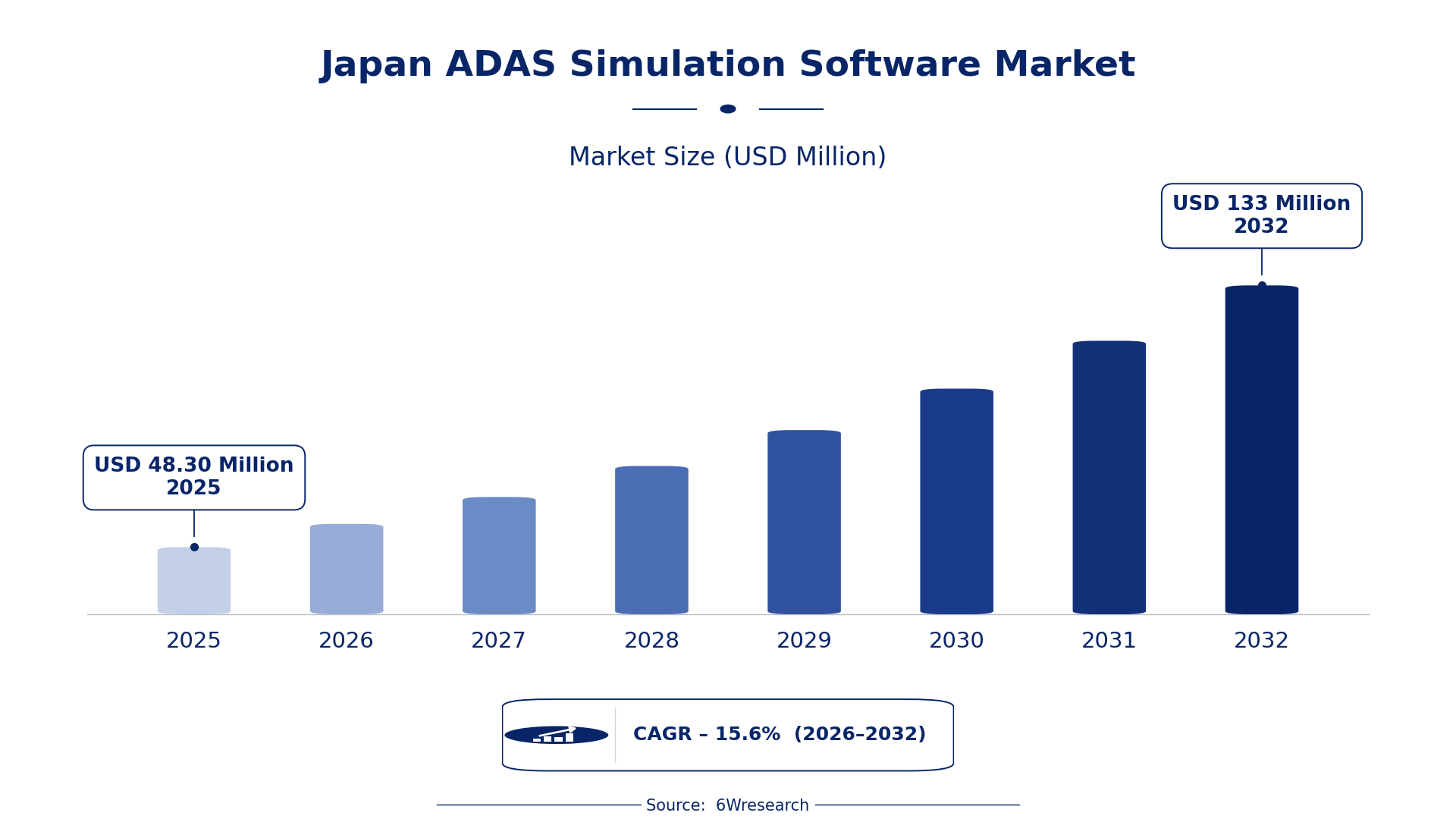
According to 6Wresearch internal database and industry insights, the Japan ADAS Simulation Software Market was valued at USD 48.30 Million in 2025 and is projected to reach USD 133 Million by 2032, growing at a CAGR of approximately 15.6% during 2026–2032.
Japan ADAS Simulation Software Market Highlights
| Report Metric | Details |
| Report Name | Japan ADAS Simulation Software Market (2026-2032) |
| Market Size 2025 | USD 48.30 Million |
| Market Size 2032 | USD 133 Million |
| Absolute Growth 2025–2032 | USD 84.70 Million |
| CAGR 2026–2032 | 15.6% |
| Peak Annual Growth | 17.2% in 2029 |
| Forecast Period | 2026–2032 |
| Historical Data | 2022–2025 |
| Base Year | 2025 |
| Leading Software Type, 2025 | Hardware-in-the-Loop (47% share) |
| Leading Simulation Method, 2025 | Real-Time Testing (41% share) |
| Leading Distribution Channel, 2025 | Direct Sales (43% share) |
| Leading End User, 2025 | Automotive OEMs (40% share) |
| Fastest-Growing Software Type | Scenario-Based Simulation (22.2% CAGR) |
| Fastest-Growing Simulation Method | Virtual Environments (16.9% CAGR) |
| Fastest-Growing Distribution Channel | Online Platforms (19.8% CAGR) |
| Fastest-Growing End User | Simulation Providers (20.3% CAGR) |
| Growing Sector | automotive |
| Key End Users | automotive OEMs, simulation providers, technology firms |
Japan ADAS Simulation Software Market Year-wise Growth Rate and Key Drivers (2022–2032)
This graph illustrates the annual growth rates of the market from 2022 to 2032, highlighting a steady upward trajectory and projected market expansion over the forecast period.
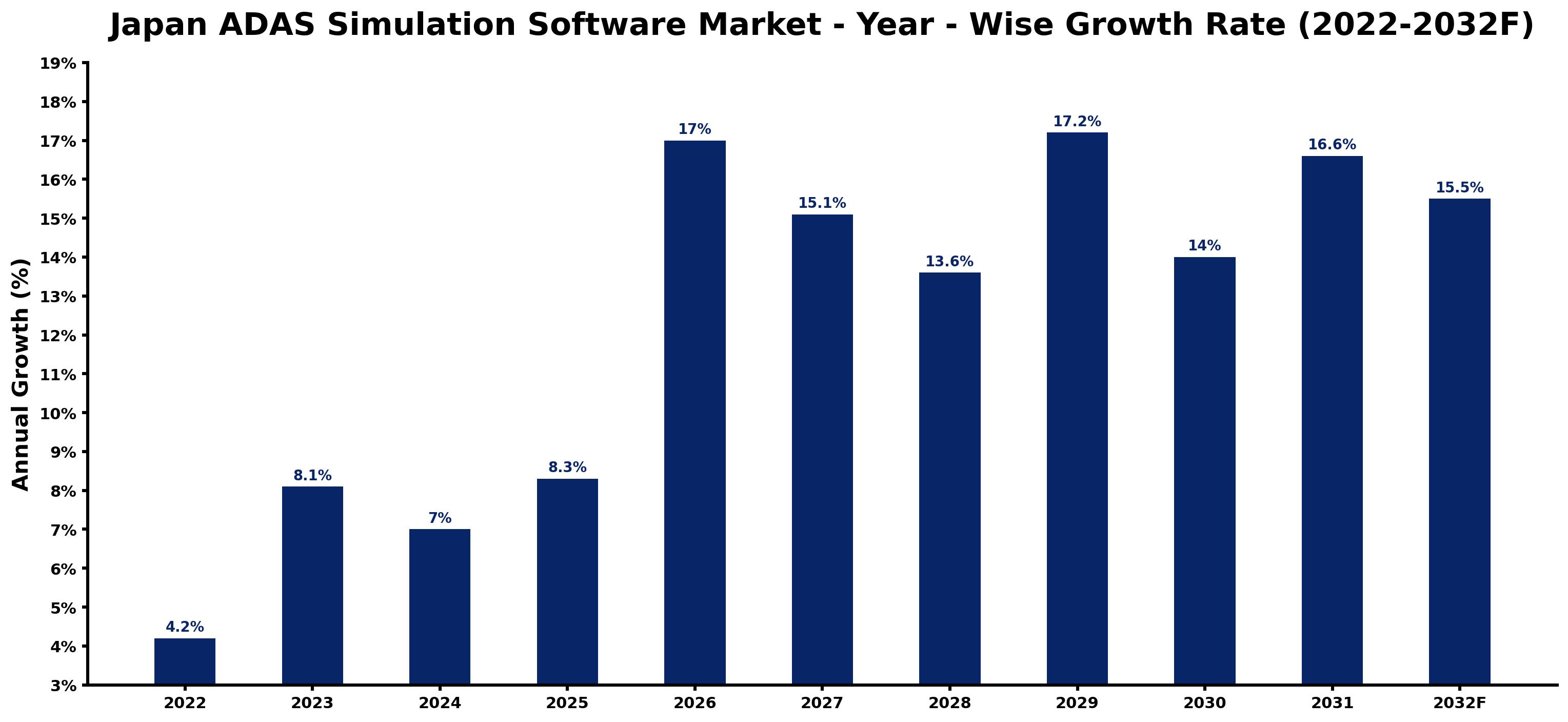
Below, each year's estimated growth is shown next to the factor that most influenced it.
| Year | Estimated Annual Growth (%) | Market Rationale |
| 2022 | 4.2 | The market experienced steady growth, reflecting ongoing demand from automotive manufacturers. |
| 2023 | 8.1 | Growth accelerated due to increased investment in advanced driver-assistance systems. |
| 2024 | 7.0 | A slight slowdown occurred as market conditions stabilised after rapid growth. |
| 2025 | 8.3 | Demand surged again as automotive OEMs focused on improving vehicle safety features. |
| 2026 | 17.0 | The market is expected to grow rapidly as AI-Driven Testing becomes more prevalent. |
| 2027 | 15.1 | Growth is projected to slow as the market adjusts to new technology implementations. |
| 2028 | 13.6 | A further slowdown is anticipated as the market matures and competition intensifies. |
| 2029 | 17.2 | The market is expected to peak, driven by innovations in simulation technologies. |
| 2030 | 14.0 | Growth will slow again as the market reaches a more stable phase. |
| 2031 | 16.6 | Demand is projected to rise as automotive companies seek to improve testing efficiency. |
| 2032 | 15.5 | A slight slowdown is anticipated as the market continues to mature. |
Note: Market size estimations and growth projections presented in this report are based on 6Wresearch's proprietary forecasting methodology, utilizing the latest available industry data, government publications, and primary research inputs.
Japan ADAS Simulation Software Market Synopsis
ADAS Simulation Software creates virtual environments for testing advanced driver-assistance systems, validating performance and accelerating autonomous vehicle development. The Japan ADAS Simulation Software Market is growing due to strong demand from automotive OEMs and technology firms, with the sector producing over 8 million vehicles in 2022. Investment in AI-Driven Testing and government support for smart mobility initiatives are propelling this growth, indicating a promising future for simulation technologies in Japan.
Market Dynamics Impact Analysis (2026–2032)
| Factor | Type | Impact | Primary Segment Affected |
| Increased investment in AI-Driven Testing technologies | Driver | High | AI-Driven Testing |
| Growing demand for enhanced vehicle safety features | Driver | High | Real-Time Testing |
| Expansion of simulation services by Simulation Providers | Opportunity | High | Simulation Providers |
| Rising collaboration through Cloud-Based Simulation tools | Opportunity | Medium | Cloud-Based Simulation |
| Challenges in integrating new technologies into existing systems | Restraint | High | AI-Driven Testing |
| Compliance with stringent safety regulations affecting development timelines | Restraint | Medium | Real-Time Testing |
| Shortage of skilled professionals in simulation technology | Challenge | High | Simulation Providers |
| High initial investment costs for advanced simulation tools | Challenge | Medium | AI-Driven Testing |
Evaluation of Drivers in Japan ADAS Simulation Software Market (2026–2032)
Key forces behind demand, with the segment each one moves most, are listed below.
| Drivers | Primary Segment Affected | Why It Matters (Evidence) |
| Investment in AI technologies | AI-Driven Testing | Investment in AI technologies is increasing, with automotive manufacturers adopting these solutions to enhance testing efficiency. |
| Focus on safety regulations | Real-Time Testing | Real-Time Testing is essential for compliance with safety regulations, as evidenced by the automotive sector producing over 8 million vehicles in 2022. |
| Demand for diverse driving scenarios | Scenario-Based Simulation | Scenario-Based Simulation is increasingly used to create diverse driving scenarios, with advancements showcased at the Tokyo Motor Show. |
| Growth of the automotive sector | Simulation Providers | The number of registered automotive companies in Japan exceeds 5,000, driving demand for simulation services. |
| Collaboration among automotive firms | Cloud-Based Simulation | Cloud-Based Simulation tools are increasingly adopted for remote collaboration, facilitating joint testing efforts among automotive manufacturers. |
In 2022, Japan's automotive sector produced over 8 million vehicles, creating a strong market for simulation technologies. Investment in AI technologies is expanding, as automotive manufacturers adopt these solutions to improve testing efficiency. The Tokyo Motor Show highlights advancements in Scenario-Based Simulation, showcasing the need for diverse driving scenarios. The growing number of registered automotive companies, exceeding 5,000, fuels demand for simulation services, increasing competition and innovation in the market.
Evaluation of Restraints in Japan ADAS Simulation Software Market
The main factors holding the market back are set out below.
| Market Restraint | Primary Segment Affected | Why It Matters (Evidence) |
| Integration challenges with existing systems | AI-Driven Testing | Integration challenges with existing systems hinder the adoption of AI-Driven Testing, delaying implementation for automotive OEMs. |
| Compliance costs associated with safety regulations | Real-Time Testing | Compliance costs for Real-Time Testing can strain budgets, particularly for smaller automotive manufacturers. |
| Limited availability of skilled professionals | Simulation Providers | The shortage of skilled professionals in simulation technology restricts growth for Simulation Providers, affecting service delivery. |
| High initial investment for advanced tools | Scenario-Based Simulation | High initial investment costs for advanced tools can deter smaller firms from entering the market. |
| Time-consuming validation processes | AI-Driven Testing | Time-consuming validation processes for AI-Driven Testing can slow down product development timelines. |
Japan ADAS Simulation Software Market Challenges
Buyers face intense competition as over 5,000 automotive companies vie for market share, driving down prices and squeezing profit margins for manufacturers. Suppliers encounter supply chain complexities for simulation tools, which can delay project timelines by three months, impacting automotive firms' development schedules. Regulatory challenges arise from compliance with standards like ISO 26262, necessitating additional testing phases that can incur costs of ¥100 million per project for software validation. Rising minimum wages, now at JPY 1,055 per hour, elevate operational costs for software developers, affecting pricing strategies for buyers.
Trends in the Japan ADAS Simulation Software Market
Four trends stand out in the Japan ADAS Simulation Software Market.
- Shift from Traditional Testing to Simulation: The automotive sector is increasingly adopting simulation over traditional testing methods, as evidenced by research from the Tokyo Institute of Technology on simulation methodologies. This shift improves efficiency and reduces costs for automotive manufacturers.
- Increase in AI-Driven Testing Adoption: AI-Driven Testing adoption has surged, with a notable rise in usage among automotive OEMs. In 2023, this segment grew, reflecting the industry's focus on improving testing efficiency.
- Growth of Cloud-Based Simulation Tools: Cloud-Based Simulation tools are becoming more prevalent, particularly for remote collaboration among automotive firms. In 2023, their adoption increased, allowing for more flexible testing environments.
- Expansion of Real-Time Testing Capabilities: Real-Time Testing capabilities are expanding as automotive companies seek immediate feedback during simulations. This trend is supported by the JASPAR standard guiding software development for automotive applications.
Investment Opportunities in the Japan ADAS Simulation Software Market
Below are the investment opportunities with the strongest case in the Japan ADAS Simulation Software Market.
- Automotive OEMs seeking advanced simulation solutions: Automotive OEMs are increasingly looking for advanced simulation solutions. Collaborating with local simulation providers can improve service offerings and meet the growing demand for testing technologies.
- Partnerships with Simulation Providers: Now is an opportune time for partnerships with Simulation Providers, as demand for testing services rises. Engaging in joint ventures can facilitate market entry and expand capabilities.
- Investment in AI-Driven Testing technologies: Investment in AI-Driven Testing technologies is essential, with the sector projected to grow. Automotive OEMs are actively seeking innovative solutions to improve testing efficiency.
- Focus on Cloud-Based Simulation for remote collaboration: Cloud-Based Simulation is increasingly important for remote collaboration, particularly in the Tokyo region. Establishing partnerships with local firms can improve access to this growing market.
Government Initiatives in the Japan ADAS Simulation Software Market
The AI Promotion Act, established in 2025, sets a national framework for AI research and development, impacting ADAS Simulation Software producers by guiding their technology advancements. This act encourages investment in AI technologies, which are essential for improving simulation capabilities and ensuring compliance with industry standards.
The Digital Agency, established in September 2021, supports automotive manufacturers in adopting digital technologies. Through funding initiatives, it helps buyers access advanced simulation tools, facilitating compliance with safety regulations and improving testing processes.
Future Insight of the Japan ADAS Simulation Software Market
Automotive manufacturers will increasingly utilise advanced simulation technologies by 2032, enhancing testing efficiency and safety features. Government initiatives will promote investments in smart transportation systems, leading to improved testing environments. The JASPAR standard will advance, setting higher safety benchmarks for software, benefiting buyers and suppliers by simplifying compliance. With the automotive sector producing over 8 million vehicles annually, the demand for sophisticated simulation capabilities will drive continuous innovation in the industry.
Market Segmentation Analysis
Japan ADAS Simulation Software Market report covers a detailed analysis of the following market segments:
By Software Type – Hardware-in-the-Loop Leads, Scenario-Based Simulation Expected to Grow Fastest
According to Saurav Kr Singh, Senior Research Analyst at 6Wresearch, Hardware-in-the-Loop held 47% of the Japan ADAS Simulation Software Market by software type in 2025. Hardware-in-the-Loop holds the largest share due to its critical role in real-time testing of vehicle systems, essential for ensuring safety and compliance. This method is particularly important for automotive manufacturers that must adhere to the JASPAR standard in their software development processes. Scenario-Based Simulation is projected to grow fastest, at a CAGR of 22.2% during 2026–2032. Scenario-Based Simulation is experiencing rapid growth as it allows for the creation of diverse driving scenarios, which are crucial for thorough testing. The Tokyo Motor Show highlights the increasing demand for such simulations to demonstrate advancements in ADAS technologies. Suppliers should prioritise the development of Scenario-Based Simulation capabilities to meet the rising needs of automotive manufacturers.
By Simulation Method – Real-Time Testing Leads, Virtual Environments Expected to Grow Fastest
In 2025, Real-Time Testing led the simulation method split with a 41% share. Real-Time Testing commands the largest share as it provides immediate feedback during simulations, which is vital for validating the functionalities of ADAS. This method is widely adopted by automotive OEMs to ensure compliance with safety regulations. The quickest growth will come from Virtual Environments, forecast to expand at a CAGR of 16.9% between 2026 and 2032. Virtual Environments are rapidly gaining traction because they offer a secure space for testing without real-world risks, appealing to firms focused on safe innovation. Government initiatives towards smart transportation systems further support this trend. Buyers can expect improved efficiency and reduced risks by investing in Virtual Environments for their testing processes.
By Distribution Channel – Direct Sales Leads, Online Platforms Expected to Grow Fastest
With 43% of distribution channel revenue in 2025, Direct Sales was the largest category. Direct Sales remains the leading distribution channel as it facilitates personalised service and direct engagement with clients, essential for complex software solutions. Many automotive OEMs prefer this method for acquiring sophisticated software. Over 2026–2032, Online Platforms are expected to post the fastest growth, at a CAGR of 19.8%. Online Platforms are quickly becoming popular as they provide convenient access to software updates and resources, catering to a tech-savvy market. The growing number of registered automotive companies in Japan supports this shift towards digital solutions. Suppliers should strengthen their online strategies to effectively meet the rising demand for accessible software solutions.
By End User – Automotive OEMs Lead, Simulation Providers Expected to Grow Fastest
Automotive OEMs took 40% of end user revenue in 2025, more than any other category. Automotive OEMs represent the largest share as they are the primary users of ADAS simulation software for vehicle development, significantly driving market demand. Their commitment to safety and compliance necessitates the use of advanced simulation tools. Simulation Providers are set to record the highest CAGR in this split, 20.3% over 2026–2032. Simulation Providers are rapidly expanding as they utilise ADAS simulation software to deliver extensive testing services, addressing the requirements of automotive OEMs. Government investments in automotive technology research are further propelling this growth. Suppliers should consider partnerships with Simulation Providers to broaden their market reach and enhance service offerings.
Key Attractiveness of the Report
- 10 Years of Market Numbers
- Historical Data Starting from 2022 to 2025
- Base Year 2025
- Forecast Data until 2032
- Key Performance Indicators Impacting the Market
- Major Upcoming Developments and Projects
Key Highlights of the Report:
- Japan ADAS Simulation Software Market Outlook
- Market Size of Japan ADAS Simulation Software Market, 2025
- Forecast of Japan ADAS Simulation Software Market, 2032
- Historical Data and Forecast of Japan ADAS Simulation Software Revenues & Volume for the Period 2022-2032F
- Japan ADAS Simulation Software Market Trend Evolution
- Japan ADAS Simulation Software Market Drivers and Challenges
- Japan ADAS Simulation Software Price Trends
- Japan ADAS Simulation Software Porter's Five Forces
- Japan ADAS Simulation Software Industry Life Cycle
- Historical Data and Forecast of Japan ADAS Simulation Software Market Revenues & Volume By Software Type for the Period 2022-2032F
- Historical Data and Forecast of Japan ADAS Simulation Software Market Revenues & Volume By Hardware-in-the-Loop for the Period 2022-2032F
- Historical Data and Forecast of Japan ADAS Simulation Software Market Revenues & Volume By Scenario-Based Simulation for the Period 2022-2032F
- Historical Data and Forecast of Japan ADAS Simulation Software Market Revenues & Volume By AI-Driven Testing for the Period 2022-2032F
- Historical Data and Forecast of Japan ADAS Simulation Software Market Revenues & Volume By Cloud-Based Simulation for the Period 2022-2032F
- Historical Data and Forecast of Japan ADAS Simulation Software Market Revenues & Volume By Simulation Method for the Period 2022-2032F
- Historical Data and Forecast of Japan ADAS Simulation Software Market Revenues & Volume By Real-Time Testing for the Period 2022-2032F
- Historical Data and Forecast of Japan ADAS Simulation Software Market Revenues & Volume By Virtual Environments for the Period 2022-2032F
- Historical Data and Forecast of Japan ADAS Simulation Software Market Revenues & Volume By Predictive Modeling for the Period 2022-2032F
- Historical Data and Forecast of Japan ADAS Simulation Software Market Revenues & Volume By Sensor Emulation for the Period 2022-2032F
- Historical Data and Forecast of Japan ADAS Simulation Software Market Revenues & Volume By Distribution Channel for the Period 2022-2032F
- Historical Data and Forecast of Japan ADAS Simulation Software Market Revenues & Volume By Direct Sales for the Period 2022-2032F
- Historical Data and Forecast of Japan ADAS Simulation Software Market Revenues & Volume By Online Platforms for the Period 2022-2032F
- Historical Data and Forecast of Japan ADAS Simulation Software Market Revenues & Volume By B2B Software Vendors for the Period 2022-2032F
- Historical Data and Forecast of Japan ADAS Simulation Software Market Revenues & Volume By Tier 1 Suppliers for the Period 2022-2032F
- Historical Data and Forecast of Japan ADAS Simulation Software Market Revenues & Volume By End User for the Period 2022-2032F
- Historical Data and Forecast of Japan ADAS Simulation Software Market Revenues & Volume By Automotive OEMs for the Period 2022-2032F
- Historical Data and Forecast of Japan ADAS Simulation Software Market Revenues & Volume By Simulation Providers for the Period 2022-2032F
- Historical Data and Forecast of Japan ADAS Simulation Software Market Revenues & Volume By Autonomous Tech Firms for the Period 2022-2032F
- Historical Data and Forecast of Japan ADAS Simulation Software Market Revenues & Volume By Mobility Solutions Co. for the Period 2022-2032F
- Japan ADAS Simulation Software Import Export Trade Statistics
- Market Opportunity Assessment By Software Type
- Market Opportunity Assessment By Simulation Method
- Market Opportunity Assessment By Distribution Channel
- Market Opportunity Assessment By End User
- Japan ADAS Simulation Software Top Companies Market Share
- Japan ADAS Simulation Software Competitive Benchmarking By Technical and Operational Parameters
- Japan ADAS Simulation Software Company Profiles
- Japan ADAS Simulation Software Key Strategic Recommendations
Market Covered
Segments analysed in this report are listed below.
By Software Type
- Hardware-in-the-Loop
- Scenario-Based Simulation
- AI-Driven Testing
- Cloud-Based Simulation
By Simulation Method
- Real-Time Testing
- Virtual Environments
- Predictive Modeling
- Sensor Emulation
By Distribution Channel
- Direct Sales
- Online Platforms
- B2B Software Vendors
- Tier 1 Suppliers
By End User
- Automotive OEMs
- Simulation Providers
- Autonomous Tech Firms
- Mobility Solutions Co.































