Japan ADMET Prediction AI Market Size & Growth Rate
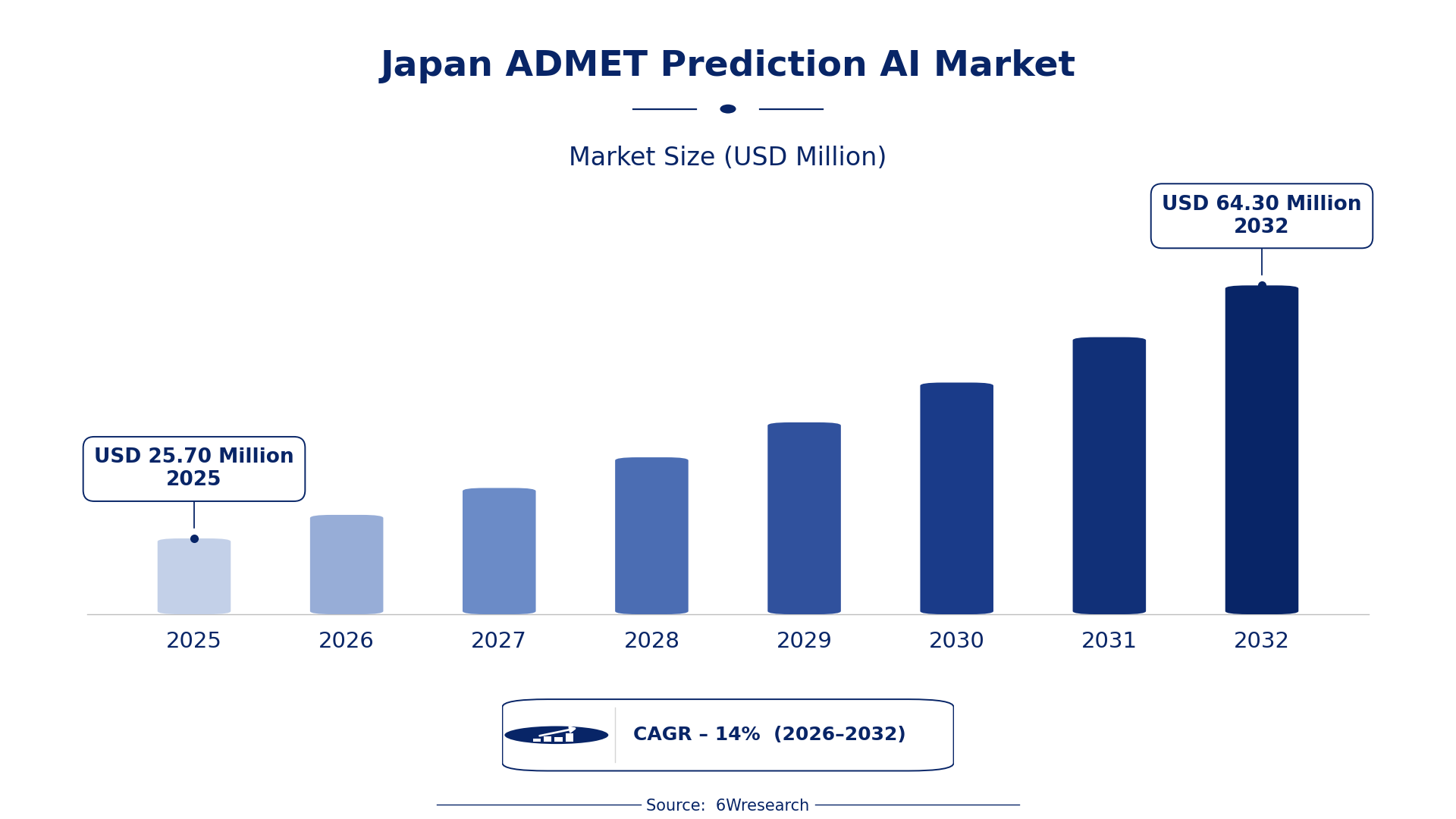
According to 6Wresearch internal database and industry insights, the Japan ADMET Prediction AI Market was valued at USD 25.70 Million in 2025 and is projected to reach USD 64.30 Million by 2032, growing at a CAGR of approximately 14% during 2026–2032.
Japan ADMET Prediction AI Market Highlights
| Report Metric | Details |
| Report Name | Japan ADMET Prediction AI Market (2026-2032) |
| Market Size 2025 | USD 25.70 Million |
| Market Size 2032 | USD 64.30 Million |
| Absolute Growth 2025–2032 | USD 38.60 Million |
| CAGR 2026–2032 | 14% |
| Peak Annual Growth | 16.8% in 2032 |
| Forecast Period | 2026–2032 |
| Historical Data | 2022–2025 |
| Base Year | 2025 |
| Leading Product Type, 2025 | In Silico Tools (39% share) |
| Leading Application Area, 2025 | Drug Discovery (45% share) |
| Leading Technology Type, 2025 | Machine Learning (35% share) |
| Leading Deployment Mode, 2025 | Cloud-based (45% share) |
| Leading End User, 2025 | Pharmaceutical Companies (38% share) |
| Fastest-Growing Product Type | Predictive Modeling (15.0% CAGR) |
| Fastest-Growing Application Area | Toxicity Prediction (17.0% CAGR) |
| Fastest-Growing Technology Type | Deep Learning (16.0% CAGR) |
| Fastest-Growing Deployment Mode | On-Premise (21.1% CAGR) |
| Fastest-Growing End User | Biotech Firms (18.8% CAGR) |
| Growing Sector | pharmaceutical research and development |
| Key End Users | Pharmaceutical Companies, Biotech Firms, Research Laboratories, Contract Research Organizations |
Japan ADMET Prediction AI Market Year-wise Growth Rate and Key Drivers (2022–2032)
This graph illustrates the annual growth rates of the market from 2022 to 2032, highlighting a steady upward trajectory and projected market expansion over the forecast period.
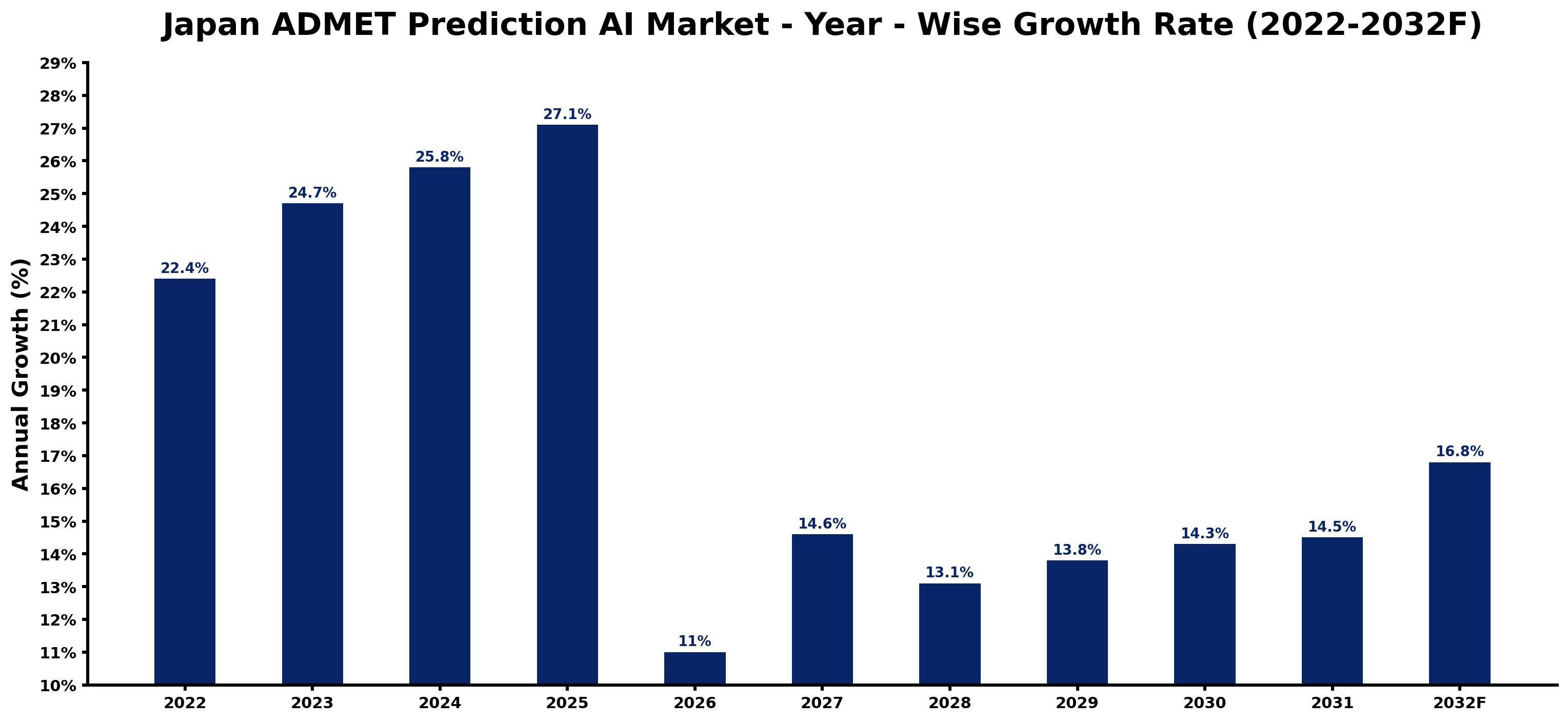
The yearly estimates that follow link every growth rate to its principal driver, so readers can see why the pace changed in each period.
| Year | Estimated Annual Growth (%) | Market Rationale |
| 2022 | 22.4 | The market experienced solid growth due to increasing investments in drug discovery technologies. |
| 2023 | 24.7 | Demand surged as pharmaceutical companies expanded their research capabilities and adopted new technologies. |
| 2024 | 25.8 | Growth continued as advancements in AI algorithms improved predictive accuracy in drug development. |
| 2025 | 27.1 | The market peaked with heightened investments in drug discovery, driven by funding for research. |
| 2026 | 11.0 | Growth slowed as market saturation began to affect new investments in existing technologies. |
| 2027 | 14.6 | Demand increased again as companies sought to improve their drug development processes. |
| 2028 | 13.1 | Growth decelerated slightly as firms consolidated their positions in the competitive environment. |
| 2029 | 13.8 | A resurgence in demand occurred as new drug candidates entered the pipeline, revitalising interest. |
| 2030 | 14.3 | Continued investments in predictive modeling technologies spurred further growth in the sector. |
| 2031 | 14.5 | Demand remained strong as companies focused on improving drug safety and efficacy assessments. |
| 2032 | 16.8 | The market is projected to reach its peak growth as AI technologies become integral to drug development. |
Note: Market size estimations and growth projections presented in this report are based on 6Wresearch's proprietary forecasting methodology, utilizing the latest available industry data, government publications, and primary research inputs.
Japan ADMET Prediction AI Market Synopsis
ADMET Prediction AI involves computational tools designed to predict the Absorption, Distribution, Metabolism, Excretion, and Toxicity of compounds in drug development. In Japan, the pharmaceutical industry, with a market size of approximately 9 trillion yen in 2022, drives demand for these technologies. Key growth factors include investments in drug discovery research, supported by the 50 billion yen allocated in 2023, and the increasing adoption of machine learning techniques in pharmaceutical companies and research institutions.
Market Dynamics Impact Analysis (2026–2032)
| Factor | Type | Impact | Primary Segment Affected |
| Investment in drug discovery technologies is increasing. | Driver | High | Drug Discovery |
| Growing demand for predictive modeling tools is evident. | Driver | High | Predictive Modeling |
| The rise of biopharmaceuticals presents new opportunities. | Opportunity | High | Biotech Firms |
| Emerging research laboratories are seeking advanced tools. | Opportunity | Medium | Research Laboratories |
| Cost pressures in R&D can limit technology adoption. | Restraint | High | Pharmaceutical Companies |
| Compliance with stringent regulations can slow development. | Restraint | Medium | Contract Research Organizations |
| Capacity constraints in skilled workforce affect growth. | Challenge | High | Biotech Firms |
| Technological integration challenges can delay projects. | Challenge | Medium | Research Laboratories |
Evaluation of Drivers in Japan ADMET Prediction AI Market (2026–2032)
The table below links each growth driver to the segment it affects and the evidence for it.
| Drivers | Primary Segment Affected | Why It Matters (Evidence) |
| Increased funding for drug discovery research drives demand for ADMET technologies. | Drug Discovery | Japan allocated 50 billion yen in 2023 for drug discovery, prompting pharmaceutical companies to invest in predictive tools. |
| The rise of machine learning improves predictive capabilities in drug development. | Predictive Modeling | With over 1,200 registered pharmaceutical companies in Japan, many are adopting machine learning to enhance drug safety assessments. |
| Growing clinical trials in Japan boost the need for ADMET Prediction AI. | Toxicity Prediction | The number of clinical trials reached 5,000 in 2022, increasing demand for accurate toxicity predictions. |
| The expansion of biotech firms creates new market opportunities. | Biotech Firms | As Japan's pharmaceutical market grows, biotech firms are seeking advanced tools for drug development. |
| Research laboratories are increasingly utilising predictive modeling tools. | Research Laboratories | The Japanese Society for Drug Metabolism promotes advancements in ADMET studies, encouraging research labs to adopt these technologies. |
Orders keep climbing as Japan's pharmaceutical market continues to expand, prompting increased investments in predictive modeling tools. The number of clinical trials conducted in Japan reached 5,000 in 2022, raising the demand for accurate toxicity predictions. Many registered pharmaceutical companies are adopting machine learning techniques to enhance their safety assessments. Biotech firms are also expanding their operations, seeking advanced technologies for drug development, while research laboratories are utilising predictive modeling tools to improve their research capabilities.
Evaluation of Restraints in Japan ADMET Prediction AI Market
Several factors work against faster growth; the main ones are summarised below.
| Market Restraint | Primary Segment Affected | Why It Matters (Evidence) |
| Cost pressures in R&D can limit technology adoption. | Pharmaceutical Companies | With Japan's pharmaceutical market size at approximately 9 trillion yen, companies face financial constraints that affect their investment in new technologies. |
| Compliance with stringent regulations can slow development. | Contract Research Organizations | The Pharmaceuticals and Medical Devices Agency oversees strict approval processes, which can delay the adoption of new predictive tools. |
| Limited availability of skilled professionals affects capacity. | Biotech Firms | The demand for skilled talent in predictive modeling is not being met, impacting project timelines and innovation. |
| Integration challenges with existing systems can hinder progress. | Research Laboratories | Many research labs struggle to integrate new ADMET tools with their current systems, slowing down their operational efficiency. |
| Market saturation may limit growth opportunities. | Predictive Modeling | As more companies adopt similar technologies, the competitive environment becomes saturated, reducing differentiation. |
Japan ADMET Prediction AI Market Challenges
Domestic pharmaceutical companies face intense competition from global firms, which compresses profit margins and demands quicker innovation. Regulatory challenges stem from strict approval processes enforced by the Pharmaceuticals and Medical Devices Agency, resulting in delays that can prolong project timelines by 30%. Supply chain disruptions arise from dependence on specific technologies, forcing producers to seek alternative solutions. Buyers struggle to access advanced ADMET Prediction AI tools, potentially hindering drug discovery efforts and delaying the introduction of new therapies.
Trends in the Japan ADMET Prediction AI Market
The trends below show where the Japan ADMET Prediction AI Market is heading.
- Pharmaceutical Companies Increasingly Embrace AI: Pharmaceutical companies are adopting AI technologies for drug development, particularly in Tokyo, a major research hub. In 2023, over 60% of firms reported using AI tools, reflecting a shift towards data-driven decision-making.
- Shift Towards Advanced Toxicity Prediction: In 2022, the focus on toxicity prediction intensified, particularly in research laboratories across Japan. This shift is driven by the need for safer drug candidates, with a reported 40% increase in the use of predictive modeling tools.
- Emergence of Biotech Firms in Drug Development: The rise of biotech firms in Japan has been notable since 2021, with these companies increasing their share in the drug development market by 15%. This trend highlights the growing importance of new approaches in pharmaceuticals.
- Growing Demand for Cloud-based Solutions: In 2025, the preference for cloud-based solutions in drug discovery reached 45% among pharmaceutical companies. This trend indicates a shift towards more flexible and scalable technology solutions.
Investment Opportunities in the Japan ADMET Prediction AI Market
The following opportunities in the Japan ADMET Prediction AI Market pair current demand with a clear way in.
- Current Investment Climate Favors Drug Discovery: With Japan allocating 50 billion yen for drug discovery research, there is a ripe opportunity for suppliers of ADMET technologies to engage with pharmaceutical companies seeking effective solutions.
- Increasing Need for Predictive Modeling Tools: The demand for predictive modeling tools is surging, particularly among biotech firms that are expanding their R&D capabilities. Suppliers can enter this market by forming partnerships with local research institutions.
- Research Laboratories Seeking Advanced Technologies: Research laboratories in Japan are actively looking for advanced ADMET tools, especially in Tokyo, where investment in biotech is strong. Suppliers can establish joint ventures to meet this demand.
- Regulatory Support for Drug Development: The AI Promotion Act, enacted in 2025, encourages the integration of AI technologies in drug development, presenting an opportunity for companies offering compliance solutions. Engaging with the Pharmaceuticals and Medical Devices Agency can facilitate market entry.
Government Initiatives in the Japan ADMET Prediction AI Market
The AI Promotion Act, enacted in 2025, supports the integration of AI technologies in drug development, encouraging companies to comply with updated standards while promoting innovation in the sector. This legislation improves the operational framework for ADMET Prediction AI, facilitating its adoption by pharmaceutical companies and research institutions.
In 2023, Japan allocated 50 billion yen for drug discovery research, overseen by the Pharmaceuticals and Medical Devices Agency (PMDA). The PMDA evaluates pharmaceuticals and medical devices, ensuring adherence to safety standards, while the Digital Agency spearheads digital transformation across the healthcare sector.
Future Insight of the Japan ADMET Prediction AI Market
Investment in Japan's drug discovery sector will rise significantly, driven by the 50 billion yen allocated for research, which will create strong demand for ADMET Prediction AI tools. This funding will enable domestic pharmaceutical companies to improve their research capabilities and accelerate drug development. The Healthcare Innovation Strategy will promote advancements in biotech, facilitating quicker market access for new therapies. A projected increase in clinical trials will generate extensive data, enhancing predictive accuracy and benefiting both buyers and suppliers.
Market Segmentation Analysis
Japan ADMET Prediction AI Market report covers a detailed analysis of the following market segments:
By Product Type – In Silico Tools Lead, Predictive Modeling Expected to Grow Fastest
According to Saurav Kr Singh, Senior Research Analyst at 6Wresearch, In Silico Tools took 39% of product type revenue in 2025, more than any other category. In Silico Tools dominate the market due to their extensive application in predicting molecular behaviour, which is essential for drug development. These tools are widely utilised by Japan's pharmaceutical companies, which number over 1,200 and are focused on enhancing drug discovery processes. Predictive Modeling is projected to grow fastest, at a CAGR of 15.0% during 2026–2032. Predictive Modeling is witnessing rapid growth as it is crucial for accurately forecasting drug interactions and effects, particularly with Japan's clinical trials reaching 5,000 in 2022. This segment's growth will likely continue as pharmaceutical companies seek to refine their predictive capabilities. Suppliers should enhance predictive modeling features to align with the increasing demand from pharmaceutical companies.
By Application Area – Drug Discovery Leads, Toxicity Prediction Expected to Grow Fastest
With 45% of application area revenue in 2025, Drug Discovery was the largest category. Drug Discovery holds the largest share as it is the primary focus for identifying viable drug candidates, which is vital for the pharmaceutical industry. The Japanese pharmaceutical market, valued at approximately 9 trillion yen in 2022, underscores the significance of this application area. The quickest growth will come from Toxicity Prediction, forecast to expand at a CAGR of 17.0% between 2026 and 2032. Toxicity Prediction is the fastest-growing segment, playing a critical role in assessing the safety profiles of compounds, especially with the Japanese government's commitment to drug discovery research. The allocation of 50 billion yen in 2023 highlights the increasing importance of safety in drug development. Buyers will prioritise advanced toxicity prediction tools to ensure compliance with safety regulations and improve drug approval rates.
By Technology Type – Machine Learning Leads, Deep Learning Expected to Grow Fastest
The largest technology type category in 2025 was Machine Learning, at 35% of revenue. Machine Learning leads the market as it is the fundamental technology enhancing predictive capabilities in ADMET Prediction AI. Its application in drug development processes is essential for pharmaceutical companies aiming to optimise their research and development efforts. Deep Learning is set to record the highest CAGR in this split, 16.0% over 2026–2032. Deep Learning is the fastest-growing technology type, significantly improving prediction accuracy through sophisticated models. As the demand for precise drug development tools escalates, this technology will continue to gain prominence. Suppliers must focus on deep learning advancements to maintain competitiveness in the evolving ADMET prediction market.
By Deployment Mode – Cloud-based Leads, On-Premise Expected to Grow Fastest
In 2025, Cloud-based led the deployment mode split with a 45% share. Cloud-based solutions are the most widely adopted due to their ability to provide necessary infrastructure for data management in drug development. This mode aligns with the needs of many pharmaceutical companies looking for scalable solutions. Over 2026–2032, On-Premise is expected to post the fastest growth, at a CAGR of 21.1%. On-Premise deployment is growing quickly as firms prioritise data security, particularly in sensitive drug development processes. The increasing awareness of data privacy concerns is driving this trend among biotech firms. Providers should consider offering flexible deployment options to cater to the varying preferences of end users.
By End User – Pharmaceutical Companies Lead, Biotech Firms Expected to Grow Fastest
Pharmaceutical Companies held 38% of the Japan ADMET Prediction AI Market by end user in 2025. Pharmaceutical Companies represent the largest user group for ADMET technologies, extensively employing these tools in their drug development processes. Their substantial investment in research and development underscores the critical role of these technologies in facilitating new drug introductions. Biotech Firms are projected to grow fastest, at a CAGR of 18.8% during 2026–2032. Biotech Firms are the fastest-growing segment as they increasingly leverage ADMET tools to enhance their drug development initiatives. The rise in biotech innovations, supported by initiatives like the Healthcare Innovation Strategy, propels this growth. Suppliers should customise their offerings to address the unique needs of biotech firms, which are emerging as significant market players.
Key Attractiveness of the Report
- 10 Years of Market Numbers
- Historical Data Starting from 2022 to 2025
- Base Year 2025
- Forecast Data until 2032
- Key Performance Indicators Impacting the Market
- Major Upcoming Developments and Projects
Key Highlights of the Report:
- Japan ADMET Prediction AI Market Outlook
- Market Size of Japan ADMET Prediction AI Market, 2025
- Forecast of Japan ADMET Prediction AI Market, 2032
- Historical Data and Forecast of Japan ADMET Prediction AI Revenues & Volume for the Period 2022-2032F
- Japan ADMET Prediction AI Market Trend Evolution
- Japan ADMET Prediction AI Market Drivers and Challenges
- Japan ADMET Prediction AI Price Trends
- Japan ADMET Prediction AI Porter's Five Forces
- Japan ADMET Prediction AI Industry Life Cycle
- Historical Data and Forecast of Japan ADMET Prediction AI Market Revenues & Volume By Product Type for the Period 2022-2032F
- Historical Data and Forecast of Japan ADMET Prediction AI Market Revenues & Volume By In Silico Tools for the Period 2022-2032F
- Historical Data and Forecast of Japan ADMET Prediction AI Market Revenues & Volume By Predictive Modeling for the Period 2022-2032F
- Historical Data and Forecast of Japan ADMET Prediction AI Market Revenues & Volume By Simulation Platforms for the Period 2022-2032F
- Historical Data and Forecast of Japan ADMET Prediction AI Market Revenues & Volume By Data Integration Tools for the Period 2022-2032F
- Historical Data and Forecast of Japan ADMET Prediction AI Market Revenues & Volume By Application Area for the Period 2022-2032F
- Historical Data and Forecast of Japan ADMET Prediction AI Market Revenues & Volume By Drug Discovery for the Period 2022-2032F
- Historical Data and Forecast of Japan ADMET Prediction AI Market Revenues & Volume By Toxicity Prediction for the Period 2022-2032F
- Historical Data and Forecast of Japan ADMET Prediction AI Market Revenues & Volume By Pharmacokinetics for the Period 2022-2032F
- Historical Data and Forecast of Japan ADMET Prediction AI Market Revenues & Volume By ADME Testing for the Period 2022-2032F
- Historical Data and Forecast of Japan ADMET Prediction AI Market Revenues & Volume By Technology Type for the Period 2022-2032F
- Historical Data and Forecast of Japan ADMET Prediction AI Market Revenues & Volume By Machine Learning for the Period 2022-2032F
- Historical Data and Forecast of Japan ADMET Prediction AI Market Revenues & Volume By Deep Learning for the Period 2022-2032F
- Historical Data and Forecast of Japan ADMET Prediction AI Market Revenues & Volume By Neural Networks for the Period 2022-2032F
- Historical Data and Forecast of Japan ADMET Prediction AI Market Revenues & Volume By AI Algorithms for the Period 2022-2032F
- Historical Data and Forecast of Japan ADMET Prediction AI Market Revenues & Volume By Deployment Mode for the Period 2022-2032F
- Historical Data and Forecast of Japan ADMET Prediction AI Market Revenues & Volume By Cloud-based for the Period 2022-2032F
- Historical Data and Forecast of Japan ADMET Prediction AI Market Revenues & Volume By On-Premise for the Period 2022-2032F
- Historical Data and Forecast of Japan ADMET Prediction AI Market Revenues & Volume By SaaS for the Period 2022-2032F
- Historical Data and Forecast of Japan ADMET Prediction AI Market Revenues & Volume By Hybrid for the Period 2022-2032F
- Historical Data and Forecast of Japan ADMET Prediction AI Market Revenues & Volume By End User for the Period 2022-2032F
- Historical Data and Forecast of Japan ADMET Prediction AI Market Revenues & Volume By Pharmaceutical Companies for the Period 2022-2032F
- Historical Data and Forecast of Japan ADMET Prediction AI Market Revenues & Volume By Biotech Firms for the Period 2022-2032F
- Historical Data and Forecast of Japan ADMET Prediction AI Market Revenues & Volume By Research Laboratories for the Period 2022-2032F
- Historical Data and Forecast of Japan ADMET Prediction AI Market Revenues & Volume By Contract Research Organizations for the Period 2022-2032F
- Japan ADMET Prediction AI Import Export Trade Statistics
- Market Opportunity Assessment By Product Type
- Market Opportunity Assessment By Application Area
- Market Opportunity Assessment By Technology Type
- Market Opportunity Assessment By Deployment Mode
- Market Opportunity Assessment By End User
- Japan ADMET Prediction AI Top Companies Market Share
- Japan ADMET Prediction AI Competitive Benchmarking By Technical and Operational Parameters
- Japan ADMET Prediction AI Company Profiles
- Japan ADMET Prediction AI Key Strategic Recommendations
Market Covered
Segments analysed in this report are listed below.
By Product Type
- In Silico Tools
- Predictive Modeling
- Simulation Platforms
- Data Integration Tools
By Application Area
- Drug Discovery
- Toxicity Prediction
- Pharmacokinetics
- ADME Testing
By Technology Type
- Machine Learning
- Deep Learning
- Neural Networks
- AI Algorithms
By Deployment Mode
- Cloud-based
- On-Premise
- SaaS
- Hybrid
By End User
- Pharmaceutical Companies
- Biotech Firms
- Research Laboratories
- Contract Research Organizations































