Japan Administrative Automation AI Market Size & Growth Rate
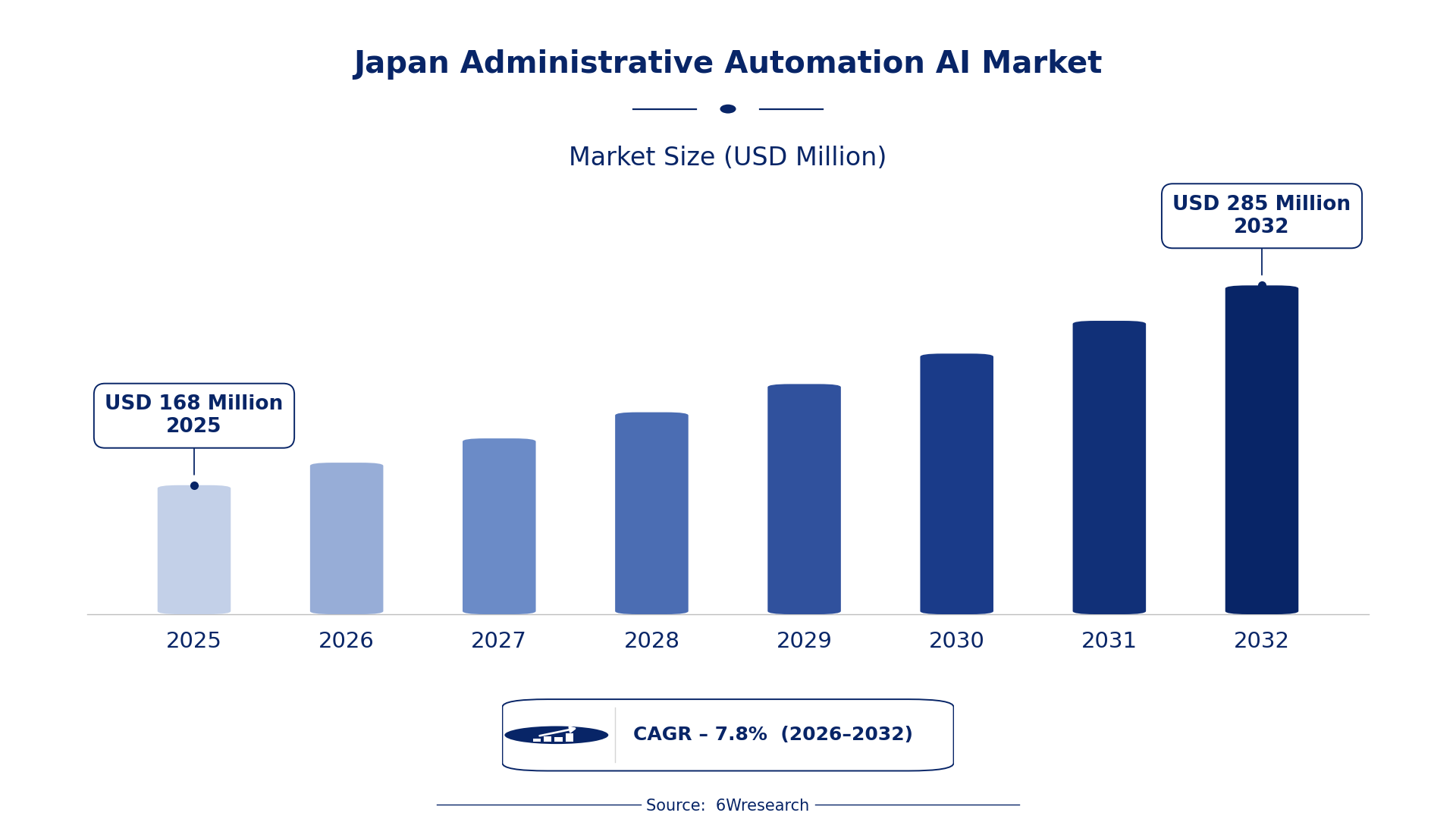
According to 6Wresearch internal database and industry insights, the Japan Administrative Automation AI Market was valued at USD 168 Million in 2025 and is projected to reach USD 285 Million by 2032, growing at a CAGR of approximately 7.8% during 2026–2032.
Japan Administrative Automation AI Market Highlights
| Report Metric | Details |
| Report Name | Japan Administrative Automation AI Market (2026-2032) |
| Market Size 2025 | USD 168 Million |
| Market Size 2032 | USD 285 Million |
| Absolute Growth 2025–2032 | USD 117 Million |
| CAGR 2026–2032 | 7.8% |
| Peak Annual Growth | 8.9% in 2030 |
| Forecast Period | 2026–2032 |
| Historical Data | 2022–2025 |
| Base Year | 2025 |
| Leading Product Type, 2025 | Workflow Automation (35% share) |
| Leading Application Area, 2025 | HR & Payroll (38% share) |
| Leading Deployment Mode, 2025 | Cloud (45% share) |
| Leading Technology Type, 2025 | NLP (46% share) |
| Leading End User, 2025 | Legal Firms (42% share) |
| Fastest-Growing Product Type | Robotic Process Automation (11.6% CAGR) |
| Fastest-Growing Application Area | Invoice Processing (9.4% CAGR) |
| Fastest-Growing Deployment Mode | On-Premise (11.3% CAGR) |
| Fastest-Growing Technology Type | Machine Learning (11.2% CAGR) |
| Fastest-Growing End User | Financial Institutions (9.9% CAGR) |
| Growing Sector | administrative automation |
| Key End Users | financial institutions, legal firms, insurance companies, banks |
Japan Administrative Automation AI Market Year-wise Growth Rate and Key Drivers (2022–2032)
This graph illustrates the annual growth rates of the market from 2022 to 2032, highlighting a steady upward trajectory and projected market expansion over the forecast period.
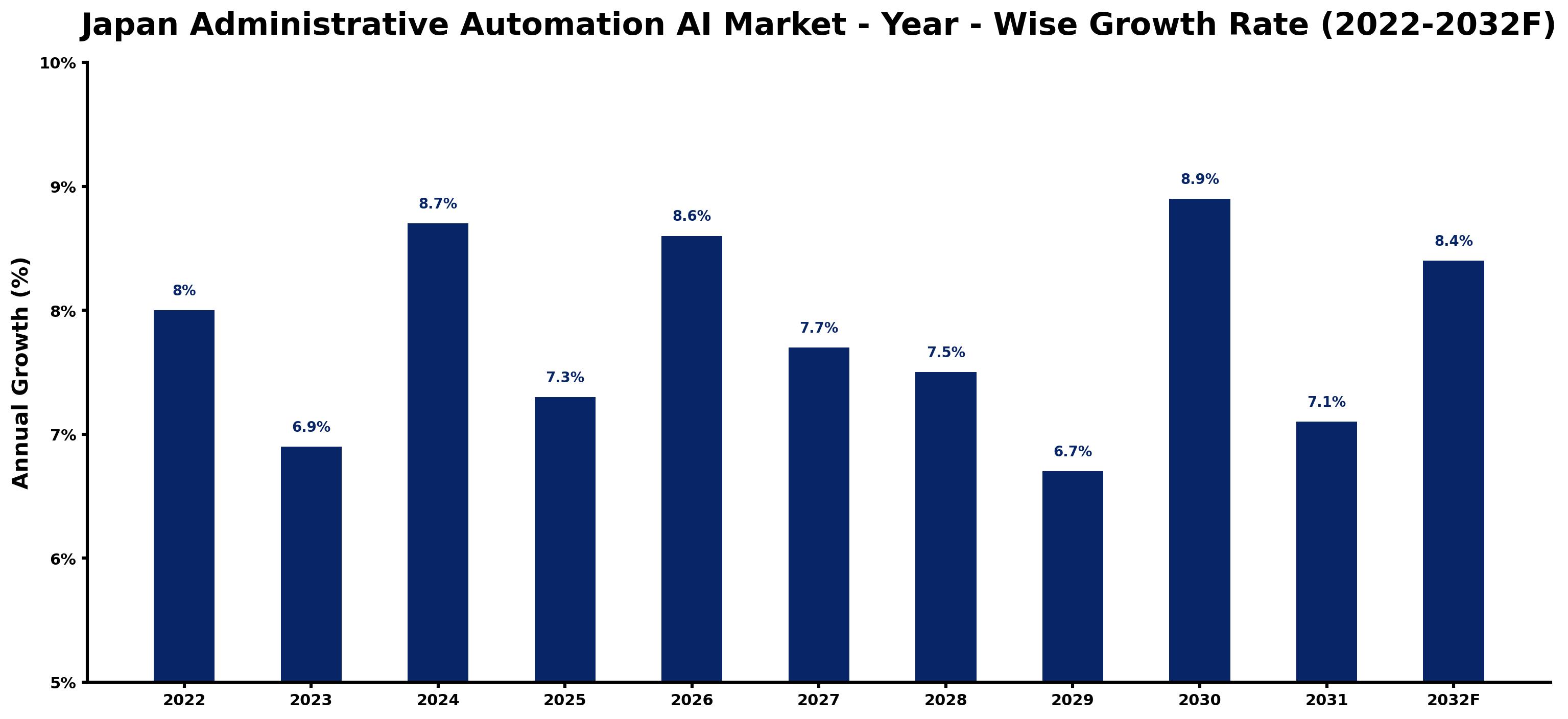
For each year, the table pairs the estimated growth rate with the leading influence on demand, showing how the drivers changed across the period.
| Year | Estimated Annual Growth (%) | Market Rationale |
| 2022 | 8.0 | The market experienced solid growth due to increasing digitalisation efforts across sectors. |
| 2023 | 6.9 | Growth slowed as firms adjusted to previous investments and market conditions. |
| 2024 | 8.7 | Demand surged as businesses adopted more advanced automation solutions. |
| 2025 | 7.3 | Growth decelerated as market maturity began to set in. |
| 2026 | 8.6 | The market is expected to rebound with renewed investments in AI technologies. |
| 2027 | 7.7 | Growth is projected to slow as companies focus on optimising existing solutions. |
| 2028 | 7.5 | Demand will continue to moderate as market saturation occurs. |
| 2029 | 6.7 | Growth is likely to slow further as firms prioritise cost management strategies. |
| 2030 | 8.9 | The market is expected to peak as firms aggressively pursue automation for efficiency. |
| 2031 | 7.1 | Growth will decelerate as the market stabilises after peak demand. |
| 2032 | 8.4 | The market is projected to grow as new technologies emerge. |
Note: Market size estimations and growth projections presented in this report are based on 6Wresearch's proprietary forecasting methodology, utilizing the latest available industry data, government publications, and primary research inputs.
Japan Administrative Automation AI Market Synopsis
Administrative Automation AI streamlines tasks through machine learning and natural language processing, improving efficiency in document management, payroll processing, and compliance reporting. The Japan Administrative Automation AI Market is expanding due to over 126 million internet users and a strong focus on digital transformation, highlighted by a ¥10 billion initiative launched in 2023. Key drivers include financial institutions and legal sectors, which are actively pursuing automation solutions to improve operational efficiency and reduce costs.
Market Dynamics Impact Analysis (2026–2032)
| Factor | Type | Impact | Primary Segment Affected |
| Increasing digitalisation in finance and legal sectors | Driver | High | HR & Payroll |
| Growing adoption of cloud solutions by financial institutions | Driver | High | Cloud |
| Expansion of AI technologies in public services | Opportunity | High | Document Management |
| Rising investment in AI by insurance companies | Opportunity | High | Invoice Processing |
| Concerns over data security in AI applications | Restraint | Medium | Robotic Process Automation |
| High initial investment costs for automation technologies | Restraint | Medium | Workflow Automation |
| Limited skilled workforce for AI implementation | Challenge | High | NLP |
| Regulatory complexities in financial services AI | Challenge | High | Compliance Reporting |
Evaluation of Drivers in Japan Administrative Automation AI Market (2026–2032)
The factors lifting demand, and the evidence behind each, are summarised below.
| Drivers | Primary Segment Affected | Why It Matters (Evidence) |
| Digital transformation initiatives in various sectors | HR & Payroll | This trend is supported by a ¥10 billion budget allocated for digital transformation in 2023. |
| Cloud deployment preference among financial institutions | Cloud | With 60% of financial institutions opting for cloud solutions, this shift improves operational flexibility and scalability. |
| Increased focus on compliance reporting tools | Document Management | Compliance reporting is essential for 70% of financial institutions, driving demand for efficient document management systems. |
| Rising automation in legal firms | Robotic Process Automation | Legal firms are adopting robotic process automation for document review, improving efficiency in case management. |
| Growing adoption of machine learning in HR | NLP | By 2025, 30% of firms are expected to implement machine learning in HR, streamlining recruitment and payroll processes. |
Compliance reporting tools are essential for 70% of financial institutions, which drives demand for effective document management systems. Legal firms are increasingly adopting robotic process automation for document review, streamlining case management. The adoption of machine learning in HR is projected to reach 30% by 2025, boosting demand for automation solutions. Financial institutions favour cloud deployment, allowing for scalable solutions that improve operational capabilities.
Evaluation of Restraints in Japan Administrative Automation AI Market
The following restraints limit how fast demand can grow.
| Market Restraint | Primary Segment Affected | Why It Matters (Evidence) |
| Data security concerns regarding AI applications | Robotic Process Automation | ISO/IEC 27001 compliance is critical, affecting adoption rates among firms concerned about data breaches. |
| High initial investment costs for automation technologies | Workflow Automation | The average salary of HR professionals at ¥5 million influences budget allocations for automation tools. |
| Limited skilled workforce for AI implementation | NLP | A shortage of qualified professionals hampers the deployment of advanced AI technologies in various sectors. |
| Regulatory complexities in financial services AI | Compliance Reporting | The Financial Services Agency oversees regulations, complicating AI integration in financial institutions. |
| Slow adoption rates for on-premise solutions | On-Premise | Only 10% of firms require on-premise solutions due to security concerns. |
Japan Administrative Automation AI Market Challenges
In 2023, 70% of financial institutions in Japan rely on compliance reporting tools, yet many struggle with outdated systems, delaying reporting by weeks and risking regulatory penalties. Many firms face challenges sourcing advanced AI technologies, leading to project delays that hinder operational efficiency. Skills shortages persist, with only 30% of firms implementing machine learning in HR by 2025, limiting innovation and efficiency for employers. Rising operational costs, driven by an average HR salary of ¥5 million, further strain budgets for automation investments, especially for small businesses.
Trends in the Japan Administrative Automation AI Market
Four trends stand out in the Japan Administrative Automation AI Market.
- Shift from On-Premise to Cloud Solutions: Since 2023, financial institutions have increasingly favoured cloud solutions, with 60% opting for this deployment mode. This shift allows for greater flexibility and scalability in operations.
- Emergence of AI in Compliance Reporting: In 2023, compliance reporting tools became essential for 70% of financial institutions, driving investment in AI technologies to ensure regulatory adherence.
- Growing Use of Robotic Process Automation in Legal Firms: Legal firms have adopted robotic process automation for document review, with a notable increase in efficiency, reflecting a broader trend towards automation in the sector.
- Expansion of Machine Learning in HR: By 2025, 30% of firms are expected to implement machine learning in HR processes, improving recruitment and payroll efficiency.
Investment Opportunities in the Japan Administrative Automation AI Market
Below are the investment opportunities with the strongest case in the Japan Administrative Automation AI Market.
- Partner with AI Startups: The Tokyo Metropolitan Government supports AI startups, presenting an opportunity for joint ventures to develop new automation solutions, with potential investments reaching ¥10 billion.
- Invest in Compliance Reporting Tools: With 70% of financial institutions prioritising compliance, investing in advanced reporting tools offers potential for growth in this sector.
- Focus on Cloud Solutions for Financial Institutions: The demand for cloud solutions is rising, particularly among financial institutions, creating opportunities for suppliers to provide scalable automation services.
- Develop AI Solutions for Legal Firms: Legal firms are increasingly adopting automation technologies, representing a prime opportunity for firms to develop tailored solutions for this sector.
Government Initiatives in the Japan Administrative Automation AI Market
The AI Promotion Act, established in 2025, sets a national framework for AI research and development, impacting producers and buyers by ensuring compliance with new standards. This act promotes innovation and integration of AI technologies across various sectors, encouraging investment and development in administrative automation. The government has allocated ¥10 billion to support these initiatives, ensuring that buyers can access the latest advancements in the field.
The Financial Services Agency oversees the implementation of various AI initiatives, including funding for projects aimed at improving automation in public services. This agency has allocated substantial resources to support the integration of AI technologies, ensuring that buyers can access the latest advancements in administrative automation.
Future Insight of the Japan Administrative Automation AI Market
Finance professionals will see increased efficiency as robotic process automation becomes commonplace, streamlining document processing. By 2032, the insurance sector plans to invest ¥2 billion in AI technologies, improving risk assessment and customer service capabilities. The Japanese government aims to boost AI usage in public services, making administrative processes more efficient for citizens. With 60% of financial institutions favouring cloud deployment, suppliers must align their offerings with the demand for scalable and secure AI solutions.
Market Segmentation Analysis
Japan Administrative Automation AI Market report covers a detailed analysis of the following market segments:
By Product Type – Workflow Automation Leads, Robotic Process Automation Expected to Grow Fastest
According to Saurav Kr Singh, Senior Research Analyst at 6Wresearch, Workflow Automation accounted for 35% of the market by product type in 2025. Workflow Automation holds the largest share due to its widespread application in sectors such as finance, where it effectively streamlines repetitive tasks. For instance, financial institutions utilise this technology to improve efficiency in processing large volumes of documents. Over 2026–2032, Robotic Process Automation is expected to post the fastest growth, at a CAGR of 11.6%. Robotic Process Automation is growing rapidly as it effectively automates rule-based tasks, particularly in legal firms for document review. The increasing reliance on automation in these firms is propelling its adoption rates, indicating a sustained growth trajectory. Suppliers should prioritise enhancing Robotic Process Automation solutions to meet the rising demand in legal and financial sectors.
By Application Area – HR & Payroll Leads, Invoice Processing Expected to Grow Fastest
With 38% of application area revenue in 2025, HR & Payroll was the largest category. HR & Payroll leads the market as it automates essential functions like payroll processing, which is critical for many businesses. The average salary of HR professionals in Japan highlights the importance of efficiency in this area. Invoice Processing is set to record the highest CAGR in this split, 9.4% over 2026–2032. Invoice Processing is the fastest-growing application area, driven by the need for streamlined handling of payments in various sectors. Companies are increasingly recognising the benefits of automating invoice management to reduce errors and save time. Buyers are encouraged to invest in Invoice Processing solutions to optimise their financial operations and improve cash flow management.
By Deployment Mode – Cloud Leads, On-Premise Expected to Grow Fastest
Cloud held 45% of the Japan Administrative Automation AI Market by deployment mode in 2025. Cloud deployment dominates the market as it offers scalable and flexible solutions that attract many organisations, especially in finance. The preference of 60% of financial institutions for cloud solutions underscores this trend and its significance in operational efficiency. On-Premise is projected to grow fastest, at a CAGR of 11.3% during 2026–2032. On-Premise deployment is experiencing notable growth due to the specific security needs of organisations handling sensitive data. As businesses increasingly prioritise data protection, this trend is likely to persist, indicating a shift in deployment preferences. Suppliers must focus on developing robust On-Premise solutions to address the growing security concerns of organisations.
By Technology Type – NLP Leads, Machine Learning Expected to Grow Fastest
The largest technology type category in 2025 was NLP, at 46% of revenue. NLP is the leading technology type as it allows systems to understand and process human language, which is essential for various administrative tasks. Its application in areas such as compliance reporting and customer interactions illustrates its critical importance. The quickest growth will come from Machine Learning, forecast to expand at a CAGR of 11.2% between 2026 and 2032. Machine Learning is the fastest-growing technology type, as it enhances task automation through data analysis, making it vital in sectors like finance and human resources. The increasing adoption of this technology signals a shift towards more sophisticated automation solutions. Buyers should consider integrating Machine Learning technologies to remain competitive and enhance operational efficiency.
By End User – Legal Firms Lead, Financial Institutions Expected to Grow Fastest
In 2025, Legal Firms led the end user split with a 42% share. Legal Firms represent the largest end user group, employing administrative automation AI for case management and documentation processes. Their reliance on efficient document handling underscores the essential role of this technology in their operations. Over 2026–2032, Financial Institutions are expected to post the fastest growth, at a CAGR of 9.9%. Financial Institutions are the fastest-growing end user segment, aiming to enhance operational efficiency in transactions through automation. The rapid digital transformation in this sector is significantly driving the demand for advanced solutions. Suppliers should tailor their offerings to meet the specific requirements of Financial Institutions, ensuring compliance and operational efficiency.
Key Attractiveness of the Report
- 10 Years of Market Numbers
- Historical Data Starting from 2022 to 2025
- Base Year 2025
- Forecast Data until 2032
- Key Performance Indicators Impacting the Market
- Major Upcoming Developments and Projects
Key Highlights of the Report:
- Japan Administrative Automation AI Market Outlook
- Market Size of Japan Administrative Automation AI Market, 2025
- Forecast of Japan Administrative Automation AI Market, 2032
- Historical Data and Forecast of Japan Administrative Automation AI Revenues & Volume for the Period 2022-2032F
- Japan Administrative Automation AI Market Trend Evolution
- Japan Administrative Automation AI Market Drivers and Challenges
- Japan Administrative Automation AI Price Trends
- Japan Administrative Automation AI Porter's Five Forces
- Japan Administrative Automation AI Industry Life Cycle
- Historical Data and Forecast of Japan Administrative Automation AI Market Revenues & Volume By Product Type for the Period 2022-2032F
- Historical Data and Forecast of Japan Administrative Automation AI Market Revenues & Volume By Workflow Automation for the Period 2022-2032F
- Historical Data and Forecast of Japan Administrative Automation AI Market Revenues & Volume By Robotic Process Automation for the Period 2022-2032F
- Historical Data and Forecast of Japan Administrative Automation AI Market Revenues & Volume By Document Management for the Period 2022-2032F
- Historical Data and Forecast of Japan Administrative Automation AI Market Revenues & Volume By Virtual Assistants for the Period 2022-2032F
- Historical Data and Forecast of Japan Administrative Automation AI Market Revenues & Volume By Application Area for the Period 2022-2032F
- Historical Data and Forecast of Japan Administrative Automation AI Market Revenues & Volume By HR & Payroll for the Period 2022-2032F
- Historical Data and Forecast of Japan Administrative Automation AI Market Revenues & Volume By Invoice Processing for the Period 2022-2032F
- Historical Data and Forecast of Japan Administrative Automation AI Market Revenues & Volume By Compliance Reporting for the Period 2022-2032F
- Historical Data and Forecast of Japan Administrative Automation AI Market Revenues & Volume By Meeting Scheduling for the Period 2022-2032F
- Historical Data and Forecast of Japan Administrative Automation AI Market Revenues & Volume By Deployment Mode for the Period 2022-2032F
- Historical Data and Forecast of Japan Administrative Automation AI Market Revenues & Volume By Cloud for the Period 2022-2032F
- Historical Data and Forecast of Japan Administrative Automation AI Market Revenues & Volume By On-Premise for the Period 2022-2032F
- Historical Data and Forecast of Japan Administrative Automation AI Market Revenues & Volume By SaaS for the Period 2022-2032F
- Historical Data and Forecast of Japan Administrative Automation AI Market Revenues & Volume By Hybrid for the Period 2022-2032F
- Historical Data and Forecast of Japan Administrative Automation AI Market Revenues & Volume By Technology Type for the Period 2022-2032F
- Historical Data and Forecast of Japan Administrative Automation AI Market Revenues & Volume By NLP for the Period 2022-2032F
- Historical Data and Forecast of Japan Administrative Automation AI Market Revenues & Volume By Machine Learning for the Period 2022-2032F
- Historical Data and Forecast of Japan Administrative Automation AI Market Revenues & Volume By AI Algorithms for the Period 2022-2032F
- Historical Data and Forecast of Japan Administrative Automation AI Market Revenues & Volume By Deep Learning for the Period 2022-2032F
- Historical Data and Forecast of Japan Administrative Automation AI Market Revenues & Volume By End User for the Period 2022-2032F
- Historical Data and Forecast of Japan Administrative Automation AI Market Revenues & Volume By Legal Firms for the Period 2022-2032F
- Historical Data and Forecast of Japan Administrative Automation AI Market Revenues & Volume By Financial Institutions for the Period 2022-2032F
- Historical Data and Forecast of Japan Administrative Automation AI Market Revenues & Volume By Banks for the Period 2022-2032F
- Historical Data and Forecast of Japan Administrative Automation AI Market Revenues & Volume By Insurance Companies for the Period 2022-2032F
- Japan Administrative Automation AI Import Export Trade Statistics
- Market Opportunity Assessment By Product Type
- Market Opportunity Assessment By Application Area
- Market Opportunity Assessment By Deployment Mode
- Market Opportunity Assessment By Technology Type
- Market Opportunity Assessment By End User
- Japan Administrative Automation AI Top Companies Market Share
- Japan Administrative Automation AI Competitive Benchmarking By Technical and Operational Parameters
- Japan Administrative Automation AI Company Profiles
- Japan Administrative Automation AI Key Strategic Recommendations
Market Covered
Coverage by segment is as follows.
By Product Type
- Workflow Automation
- Robotic Process Automation
- Document Management
- Virtual Assistants
By Application Area
- HR & Payroll
- Invoice Processing
- Compliance Reporting
- Meeting Scheduling
By Deployment Mode
- Cloud
- On-Premise
- SaaS
- Hybrid
By Technology Type
- NLP
- Machine Learning
- AI Algorithms
- Deep Learning
By End User
- Legal Firms
- Financial Institutions
- Banks
- Insurance Companies































