Japan ADS-B Avionics Market Size & Growth Rate
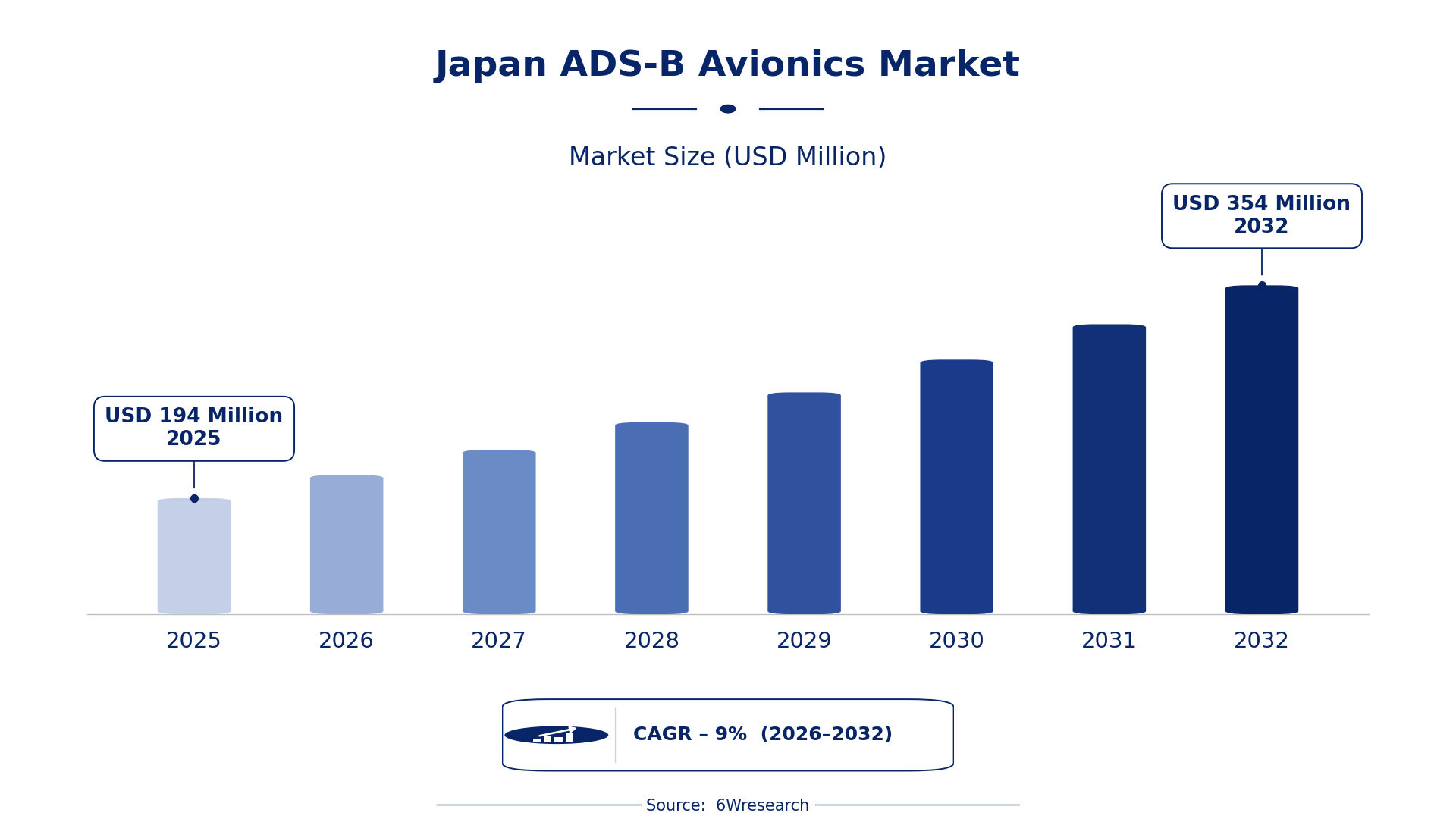
According to 6Wresearch internal database and industry insights, the Japan ADS-B Avionics Market was valued at USD 194 Million in 2025 and is projected to reach USD 354 Million by 2032, growing at a CAGR of approximately 9% during 2026–2032.
Japan ADS-B Avionics Market Highlights
| Report Metric | Details |
| Report Name | Japan ADS-B Avionics Market (2026-2032) |
| Market Size 2025 | USD 194 Million |
| Market Size 2032 | USD 354 Million |
| Absolute Growth 2025–2032 | USD 160 Million |
| CAGR 2026–2032 | 9% |
| Peak Annual Growth | 9.9% in 2032 |
| Forecast Period | 2026–2032 |
| Historical Data | 2022–2025 |
| Base Year | 2025 |
| Leading Product Type, 2025 | Integrated Systems (43% share) |
| Leading Component Type, 2025 | GPS Receiver (42% share) |
| Leading Application Type, 2025 | Air Traffic Control (45% share) |
| Leading Aircraft Type, 2025 | Commercial Aircraft (42% share) |
| Leading End User, 2025 | Civil Aviation Authorities (45% share) |
| Fastest-Growing Product Type | Transmitters (12.7% CAGR) |
| Fastest-Growing Component Type | Antenna Systems (12.9% CAGR) |
| Fastest-Growing Application Type | Traffic Monitoring (12.1% CAGR) |
| Fastest-Growing Aircraft Type | UAVs (13.1% CAGR) |
| Fastest-Growing End User | Avionics Manufacturers (11.7% CAGR) |
| Growing Sector | Civil Aviation |
| Key End Users | Civil Aviation Authorities, Avionics Manufacturers, Aircraft OEMs |
Japan ADS-B Avionics Market Year-wise Growth Rate and Key Drivers (2022–2032)
This graph illustrates the annual growth rates of the market from 2022 to 2032, highlighting a steady upward trajectory and projected market expansion over the forecast period.
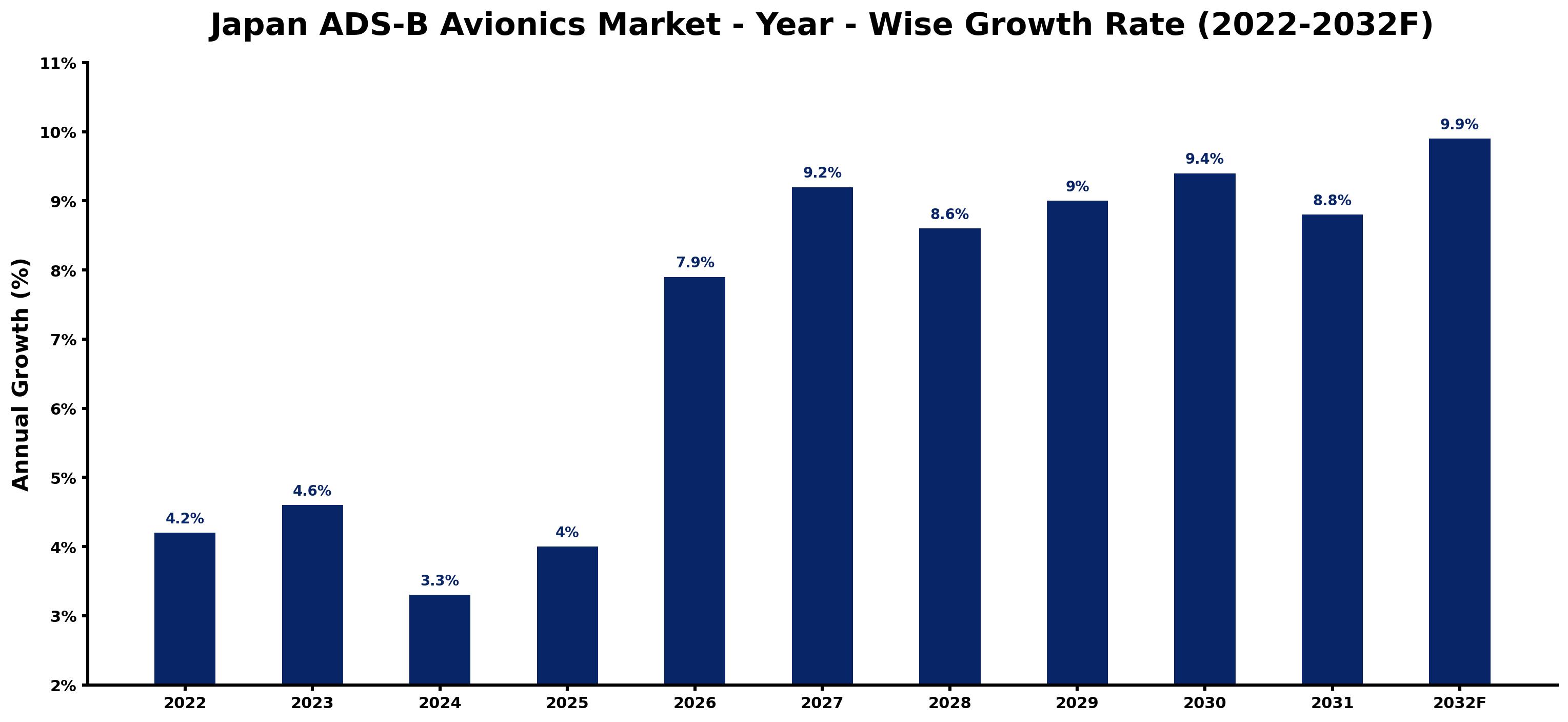
For each year, the table pairs the estimated growth rate with the leading influence on demand, showing how the drivers changed across the period.
| Year | Estimated Annual Growth (%) | Market Rationale |
| 2022 | 4.2 | The market exhibited steady growth due to ongoing investments in aviation infrastructure. |
| 2023 | 4.6 | Demand increased as the civil aviation authority mandated ADS-B implementation by 2025. |
| 2024 | 3.3 | Growth slowed as some buyers delayed upgrades in response to budget constraints. |
| 2025 | 4.0 | A rise in registered commercial aircraft spurred renewed investment in avionics. |
| 2026 | 7.9 | Increased safety concerns are expected to drive demand for advanced air traffic management systems. |
| 2027 | 9.2 | The introduction of new regulations will further boost the need for ADS-B technology. |
| 2028 | 8.6 | A slowdown is projected as the market adjusts to prior high growth rates. |
| 2029 | 9.0 | Renewed interest in UAVs will contribute to a rise in demand for ADS-B systems. |
| 2030 | 9.4 | The ongoing modernization of air traffic control systems is expected to stimulate further purchases. |
| 2031 | 8.8 | Growth is projected to slow as the market approaches saturation in certain segments. |
| 2032 | 9.9 | The peak growth rate reflects heightened investments in aviation safety and technology. |
Note: Market size estimations and growth projections presented in this report are based on 6Wresearch's proprietary forecasting methodology, utilizing the latest available industry data, government publications, and primary research inputs.
Japan ADS-B Avionics Market Synopsis
ADS-B avionics improves aircraft surveillance capabilities by broadcasting precise location data, integrating GPS with onboard systems. The Japan ADS-B Avionics Market is growing due to a regulatory mandate for ADS-B implementation by 2025, an increase in registered commercial aircraft exceeding 300, and investments in upgrading air traffic control systems. The Tokyo region, characterised by high air traffic density, is a key driver, aiming to boost air traffic management efficiency by 20% by 2025.
Market Dynamics Impact Analysis (2026–2032)
| Factor | Type | Impact | Primary Segment Affected |
| Regulatory mandate for ADS-B implementation by 2025 | Driver | High | Transmitters |
| Significant investments in air traffic control upgrades | Driver | High | Integrated Systems |
| Growing demand for UAV applications in airspace management | Opportunity | Medium | Receivers |
| Expansion of commercial aviation in the Tokyo region | Opportunity | High | Surveillance Units |
| High costs associated with avionics upgrades | Restraint | High | GPS Receiver |
| Limited awareness among smaller operators about ADS-B benefits | Restraint | Medium | Display Units |
| Compliance with international aviation standards | Challenge | High | Air Traffic Control |
| Capacity constraints in existing air traffic management systems | Challenge | Medium | Commercial Aircraft |
Evaluation of Drivers in Japan ADS-B Avionics Market (2026–2032)
The factors lifting demand, and the evidence behind each, are summarised below.
| Drivers | Primary Segment Affected | Why It Matters (Evidence) |
| Regulatory compliance driving demand for ADS-B systems | Transmitters | Japan's civil aviation authority mandates ADS-B implementation by 2025, increasing transmitter purchases to meet regulations. |
| Investments in air traffic control modernization | Integrated Systems | The government has allocated funds for upgrading air traffic control systems, boosting demand for integrated systems to enhance safety. |
| Rising number of registered commercial aircraft | Receivers | The number of registered commercial aircraft in Japan exceeds 300, driving demand for receivers to support enhanced surveillance. |
| Increased focus on flight safety | Surveillance Units | Japan's air traffic control system is adopting ADS-B for improved safety, increasing surveillance unit sales across the sector. |
| Growing UAV market in Japan | GPS Receiver | The number of UAVs registered in Japan is increasing rapidly, enhancing demand for GPS receivers to support navigation. |
Volumes increase due to mandates requiring ADS-B implementation by 2025, prompting buyers to invest in compliant systems. The civil aviation authority fuels this demand, resulting in a rise in transmitter sales. With over 300 registered commercial aircraft, further purchases of receivers are expected. Significant investments in air traffic control modernisation are apparent, with allocated funds for upgrades driving demand for integrated systems. As flight safety becomes a priority, the need for surveillance units grows, ensuring real-time monitoring of air traffic.
Evaluation of Restraints in Japan ADS-B Avionics Market
Below are the constraints most often cited by buyers and suppliers, with the segment each affects.
| Market Restraint | Primary Segment Affected | Why It Matters (Evidence) |
| High costs associated with avionics upgrades | GPS Receiver | Upgrading to ADS-B systems incurs costs that may deter smaller operators, impacting their ability to comply. |
| Limited awareness of ADS-B benefits among smaller operators | Display Units | Many smaller aviation operators lack knowledge about the advantages of ADS-B, affecting adoption rates. |
| Complexity of compliance with international standards | Air Traffic Control | Navigating compliance with international aviation standards can be challenging, hindering timely upgrades and investments. |
| Capacity constraints in existing air traffic management systems | Commercial Aircraft | Current air traffic management systems may not support the rapid growth in air traffic, limiting operational efficiency. |
| Dependence on advanced technology for integration | Integrated Systems | The reliance on sophisticated technology for ADS-B integration can pose challenges for some operators, delaying implementation. |
Japan ADS-B Avionics Market Challenges
Producers face a skills shortage in the ADS-B avionics field, which delays project completions and hinders upgrades for over 300 registered commercial aircraft. Buyers encounter supply chain disruptions as the Tokyo region experiences high demand, leading to delivery delays of up to three months for essential components. Compliance with stringent regulations from the Japan Civil Aviation Bureau raises production costs for manufacturers by approximately 15%, affecting pricing for buyers. Importers experience increased financial pressure due to the government's ADS-B implementation mandate by 2025, requiring substantial investments in avionics upgrades for their fleets.
Trends in the Japan ADS-B Avionics Market
Several trends are reshaping the Japan ADS-B Avionics Market; the most important are set out below.
- Shift towards Advanced Air Traffic Management Systems: Japan's air traffic control system is increasingly adopting ADS-B technology to improve safety and efficiency. In 2023, the Tokyo region saw a 20% increase in air traffic, necessitating improved management solutions.
- Transition from Traditional to Modern Avionics Solutions: The aviation sector is moving from conventional systems to modern avionics solutions, driven by safety mandates. By 2025, over 100 airports in Japan will be equipped with ADS-B ground stations.
- Emergence of UAVs in Air Traffic Management: The rapid increase in UAV registrations, exceeding 10,000 in Japan, is prompting the integration of ADS-B systems for effective airspace management. This trend is reshaping how air traffic is monitored.
- Adoption of ISO 9001 Standards in Avionics Manufacturing: The application of ISO 9001 standards in avionics manufacturing is becoming more prevalent, ensuring quality and safety. As of 2023, over 70% of avionics manufacturers in Japan comply with these standards.
Investment Opportunities in the Japan ADS-B Avionics Market
Investors looking at the Japan ADS-B Avionics Market should consider the following areas.
- Partnerships for Technology Integration: Local partnerships for integrating ADS-B technology are crucial, particularly in the Tokyo region, where air traffic density is high. With over 300 registered commercial aircraft, demand for advanced systems is on the rise.
- Supply of Integrated Systems for Air Traffic Control: The need for integrated systems to improve air traffic control is considerable, especially with the upcoming mandate. The government has allocated funds for modernisation, creating opportunities for suppliers.
- Investment in UAV Surveillance Solutions: With the UAV market expanding rapidly, there is a gap for surveillance solutions tailored for these aircraft. Avionics manufacturers can target this segment, particularly in urban areas.
- Development of Training Programs for ADS-B Implementation: Training programs for operators on ADS-B technology are in demand, especially as regulations tighten. Civil Aviation Authorities are seeking certified training providers to ensure compliance.
Government Initiatives in the Japan ADS-B Avionics Market
The Electrical Appliance and Material Safety Act regulates the safety of avionics systems, ensuring that all ADS-B components meet strict safety standards. Compliance with this act is necessary for manufacturers and suppliers to operate in the Japanese market. The Industrial Safety and Health Act mandates that employers ensure the safety of machinery and hazardous substances, impacting the production processes of avionics manufacturers. The government has allocated funds to support the modernisation of air traffic management systems, improving overall efficiency.
The Japan Civil Aviation Bureau oversees the implementation of aviation standards, approving ADS-B systems and components. This agency ensures that manufacturers meet compliance requirements, facilitating smoother market entry for new products. The Ministry of Land, Infrastructure, Transport and Tourism supports avionics upgrades, providing funding for projects that enhance air traffic management systems. These efforts aim to improve safety and operational efficiency across the aviation sector.
Future Insight of the Japan ADS-B Avionics Market
A shift towards enhanced air traffic management will emerge by 2032, driven by government initiatives and funding for system upgrades. Suppliers will leverage advanced technologies to meet rising demand effectively. With over 100 airports equipped with ADS-B ground stations, buyers will benefit from improved surveillance capabilities and enhanced flight safety. Ongoing research from the Japan Aerospace Exploration Agency will stimulate innovation in avionics, ensuring the industry remains competitive and responsive to evolving needs.
Market Segmentation Analysis
Japan ADS-B Avionics Market report covers a detailed analysis of the following market segments:
By Product Type – Integrated Systems Lead, Transmitters Expected to Grow Fastest
According to Saurav Kr Singh, Senior Research Analyst at 6Wresearch, Integrated Systems took 43% of product type revenue in 2025, more than any other category. Integrated Systems hold the largest market share because they consolidate multiple surveillance functions, which are essential for managing air traffic in high-density areas like Tokyo. This integration is vital for maintaining safety and efficiency amid significant air traffic volumes. Transmitters are set to record the highest CAGR in this split, 12.7% over 2026–2032. Transmitters are rapidly growing due to the impending 2025 mandate for ADS-B implementation, which requires reliable broadcasting of location data. The increasing fleet of registered commercial aircraft further drives the demand for these crucial components. Suppliers must enhance transmitter capabilities to meet regulatory requirements and growing market demands.
By Component Type – GPS Receiver Leads, Antenna Systems Expected to Grow Fastest
With 42% of component type revenue in 2025, GPS Receiver was the largest category. GPS Receivers lead the market as they are essential for providing accurate positioning and navigation data necessary for effective ADS-B system operations. The focus from the Japan Civil Aviation Bureau on reliable surveillance systems highlights their critical role in aviation safety. Antenna Systems are projected to grow fastest, at a CAGR of 12.9% during 2026–2032. Antenna Systems are experiencing swift growth due to their importance in effective signal transmission and reception, especially with the expansion of ADS-B ground stations in Japan. Government investments in modernising air traffic management systems further fuel this trend. Manufacturers should prioritise advancements in antenna systems to capitalise on emerging market opportunities.
By Application Type – Air Traffic Control Leads, Traffic Monitoring Expected to Grow Fastest
Air Traffic Control accounted for 45% of the market by application type in 2025. Air Traffic Control commands the largest share as it is vital for the safe and efficient management of air traffic, particularly in densely populated regions like Tokyo. Continuous investments in aviation infrastructure reinforce the need for robust air traffic control systems. The quickest growth will come from Traffic Monitoring, forecast to expand at a CAGR of 12.1% between 2026 and 2032. Traffic Monitoring is witnessing rapid growth due to its critical role in tracking air traffic flow, especially with Japan's population of approximately 126 million driving increased demand. This emphasis on traffic management necessitates improved monitoring solutions. Buyers should invest in advanced traffic monitoring solutions to enhance operational efficiency and safety.
By Aircraft Type – Commercial Aircraft Leads, UAVs Expected to Grow Fastest
In 2025, Commercial Aircraft led the aircraft type split with a 42% share. Commercial Aircraft represent the largest segment as they are the primary users of ADS-B technology for passenger flights, with over 300 registered commercial aircraft in Japan. This substantial installed base necessitates comprehensive surveillance capabilities to ensure safety and operational efficiency. Over 2026–2032, UAVs are expected to post the fastest growth, at a CAGR of 13.1%. UAVs are the fastest-growing segment, with their registration rapidly increasing and exceeding 10,000, indicating a shift towards integrating ADS-B technology in emerging aviation sectors. This growth reflects a developing market for advanced aviation solutions. Suppliers should explore opportunities in the UAV market to align with future aviation trends.
By End User – Civil Aviation Authorities Lead, Avionics Manufacturers Expected to Grow Fastest
Civil Aviation Authorities held 45% of the Japan ADS-B Avionics Market by end user in 2025. Civil Aviation Authorities dominate the market as they are the regulatory bodies mandating the implementation of ADS-B systems, ensuring compliance across the aviation sector. Their active role in overseeing aviation standards drives the demand for these technologies. Avionics Manufacturers are set to record the highest CAGR in this split, 11.7% over 2026–2032. Avionics Manufacturers are experiencing the fastest growth as they are essential in producing ADS-B systems and components, particularly in response to the government's funding for modernising air traffic management. This trend highlights the increasing need for advanced avionics solutions. Suppliers must engage with avionics manufacturers to develop tailored solutions that meet regulatory requirements.
Key Attractiveness of the Report
- 10 Years of Market Numbers
- Historical Data Starting from 2022 to 2025
- Base Year 2025
- Forecast Data until 2032
- Key Performance Indicators Impacting the Market
- Major Upcoming Developments and Projects
Key Highlights of the Report:
- Japan ADS-B Avionics Market Outlook
- Market Size of Japan ADS-B Avionics Market, 2025
- Forecast of Japan ADS-B Avionics Market, 2032
- Historical Data and Forecast of Japan ADS-B Avionics Revenues & Volume for the Period 2022-2032F
- Japan ADS-B Avionics Market Trend Evolution
- Japan ADS-B Avionics Market Drivers and Challenges
- Japan ADS-B Avionics Price Trends
- Japan ADS-B Avionics Porter's Five Forces
- Japan ADS-B Avionics Industry Life Cycle
- Historical Data and Forecast of Japan ADS-B Avionics Market Revenues & Volume By Product Type for the Period 2022-2032F
- Historical Data and Forecast of Japan ADS-B Avionics Market Revenues & Volume By Transmitters for the Period 2022-2032F
- Historical Data and Forecast of Japan ADS-B Avionics Market Revenues & Volume By Receivers for the Period 2022-2032F
- Historical Data and Forecast of Japan ADS-B Avionics Market Revenues & Volume By Integrated Systems for the Period 2022-2032F
- Historical Data and Forecast of Japan ADS-B Avionics Market Revenues & Volume By Surveillance Units for the Period 2022-2032F
- Historical Data and Forecast of Japan ADS-B Avionics Market Revenues & Volume By Component Type for the Period 2022-2032F
- Historical Data and Forecast of Japan ADS-B Avionics Market Revenues & Volume By GPS Receiver for the Period 2022-2032F
- Historical Data and Forecast of Japan ADS-B Avionics Market Revenues & Volume By Antenna Systems for the Period 2022-2032F
- Historical Data and Forecast of Japan ADS-B Avionics Market Revenues & Volume By Display Units for the Period 2022-2032F
- Historical Data and Forecast of Japan ADS-B Avionics Market Revenues & Volume By Processing Units for the Period 2022-2032F
- Historical Data and Forecast of Japan ADS-B Avionics Market Revenues & Volume By Application Type for the Period 2022-2032F
- Historical Data and Forecast of Japan ADS-B Avionics Market Revenues & Volume By Airborne Surveillance for the Period 2022-2032F
- Historical Data and Forecast of Japan ADS-B Avionics Market Revenues & Volume By Traffic Monitoring for the Period 2022-2032F
- Historical Data and Forecast of Japan ADS-B Avionics Market Revenues & Volume By Air Traffic Control for the Period 2022-2032F
- Historical Data and Forecast of Japan ADS-B Avionics Market Revenues & Volume By Flight Safety for the Period 2022-2032F
- Historical Data and Forecast of Japan ADS-B Avionics Market Revenues & Volume By Aircraft Type for the Period 2022-2032F
- Historical Data and Forecast of Japan ADS-B Avionics Market Revenues & Volume By Commercial Aircraft for the Period 2022-2032F
- Historical Data and Forecast of Japan ADS-B Avionics Market Revenues & Volume By Military Aircraft for the Period 2022-2032F
- Historical Data and Forecast of Japan ADS-B Avionics Market Revenues & Volume By UAVs for the Period 2022-2032F
- Historical Data and Forecast of Japan ADS-B Avionics Market Revenues & Volume By Helicopters for the Period 2022-2032F
- Historical Data and Forecast of Japan ADS-B Avionics Market Revenues & Volume By End User for the Period 2022-2032F
- Historical Data and Forecast of Japan ADS-B Avionics Market Revenues & Volume By Civil Aviation Authorities for the Period 2022-2032F
- Historical Data and Forecast of Japan ADS-B Avionics Market Revenues & Volume By Defense Organizations for the Period 2022-2032F
- Historical Data and Forecast of Japan ADS-B Avionics Market Revenues & Volume By Avionics Manufacturers for the Period 2022-2032F
- Historical Data and Forecast of Japan ADS-B Avionics Market Revenues & Volume By Aircraft OEMs for the Period 2022-2032F
- Japan ADS-B Avionics Import Export Trade Statistics
- Market Opportunity Assessment By Product Type
- Market Opportunity Assessment By Component Type
- Market Opportunity Assessment By Application Type
- Market Opportunity Assessment By Aircraft Type
- Market Opportunity Assessment By End User
- Japan ADS-B Avionics Top Companies Market Share
- Japan ADS-B Avionics Competitive Benchmarking By Technical and Operational Parameters
- Japan ADS-B Avionics Company Profiles
- Japan ADS-B Avionics Key Strategic Recommendations
Market Covered
This report examines the market across the segments below.
By Product Type
- Transmitters
- Receivers
- Integrated Systems
- Surveillance Units
By Component Type
- GPS Receiver
- Antenna Systems
- Display Units
- Processing Units
By Application Type
- Airborne Surveillance
- Traffic Monitoring
- Air Traffic Control
- Flight Safety
By Aircraft Type
- Commercial Aircraft
- Military Aircraft
- UAVs
- Helicopters
By End User
- Civil Aviation Authorities
- Defense Organizations
- Avionics Manufacturers
- Aircraft OEMs































