Japan ADS-B Transponder Market Size & Growth Rate
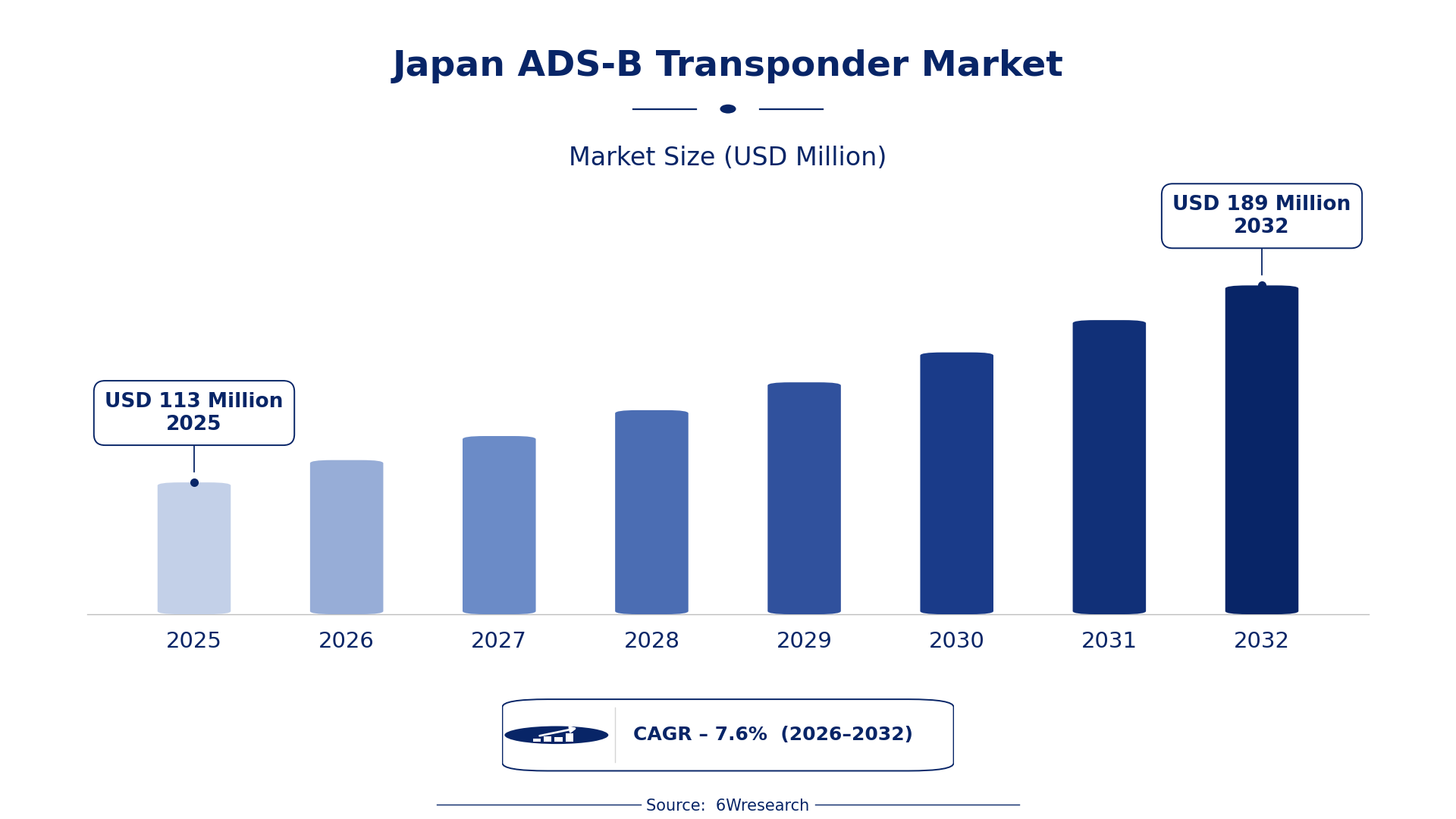
According to 6Wresearch internal database and industry insights, the Japan ADS-B Transponder Market was valued at USD 113 Million in 2025 and is projected to reach USD 189 Million by 2032, growing at a CAGR of approximately 7.6% during 2026–2032.
Japan ADS-B Transponder Market Highlights
| Report Metric | Details |
| Report Name | Japan ADS-B Transponder Market (2026-2032) |
| Market Size 2025 | USD 113 Million |
| Market Size 2032 | USD 189 Million |
| Absolute Growth 2025–2032 | USD 76 Million |
| CAGR 2026–2032 | 7.6% |
| Peak Annual Growth | 8.5% in 2028 |
| Forecast Period | 2026–2032 |
| Historical Data | 2022–2025 |
| Base Year | 2025 |
| Leading Product Type, 2025 | Mode S Transponders (47% share) |
| Leading Component Type, 2025 | Signal Processors (44% share) |
| Leading Platform Type, 2025 | Commercial Aircraft (45% share) |
| Leading Technology Type, 2025 | ADS-B Out (42% share) |
| Leading End User, 2025 | Airline Operators (38% share) |
| Fastest-Growing Product Type | Mode A/C Transponders (10.5% CAGR) |
| Fastest-Growing Component Type | RF Modules (10.3% CAGR) |
| Fastest-Growing Platform Type | Private Aircraft (10.7% CAGR) |
| Fastest-Growing Technology Type | ADS-B In/Out (10.9% CAGR) |
| Fastest-Growing End User | Aircraft Manufacturers (9.5% CAGR) |
| Growing Sector | aviation safety |
| Key End Users | airline operators, government aviation agencies, aircraft manufacturers |
Japan ADS-B Transponder Market Year-wise Growth Rate and Key Drivers (2022–2032)
This graph illustrates the annual growth rates of the market from 2022 to 2032, highlighting a steady upward trajectory and projected market expansion over the forecast period.
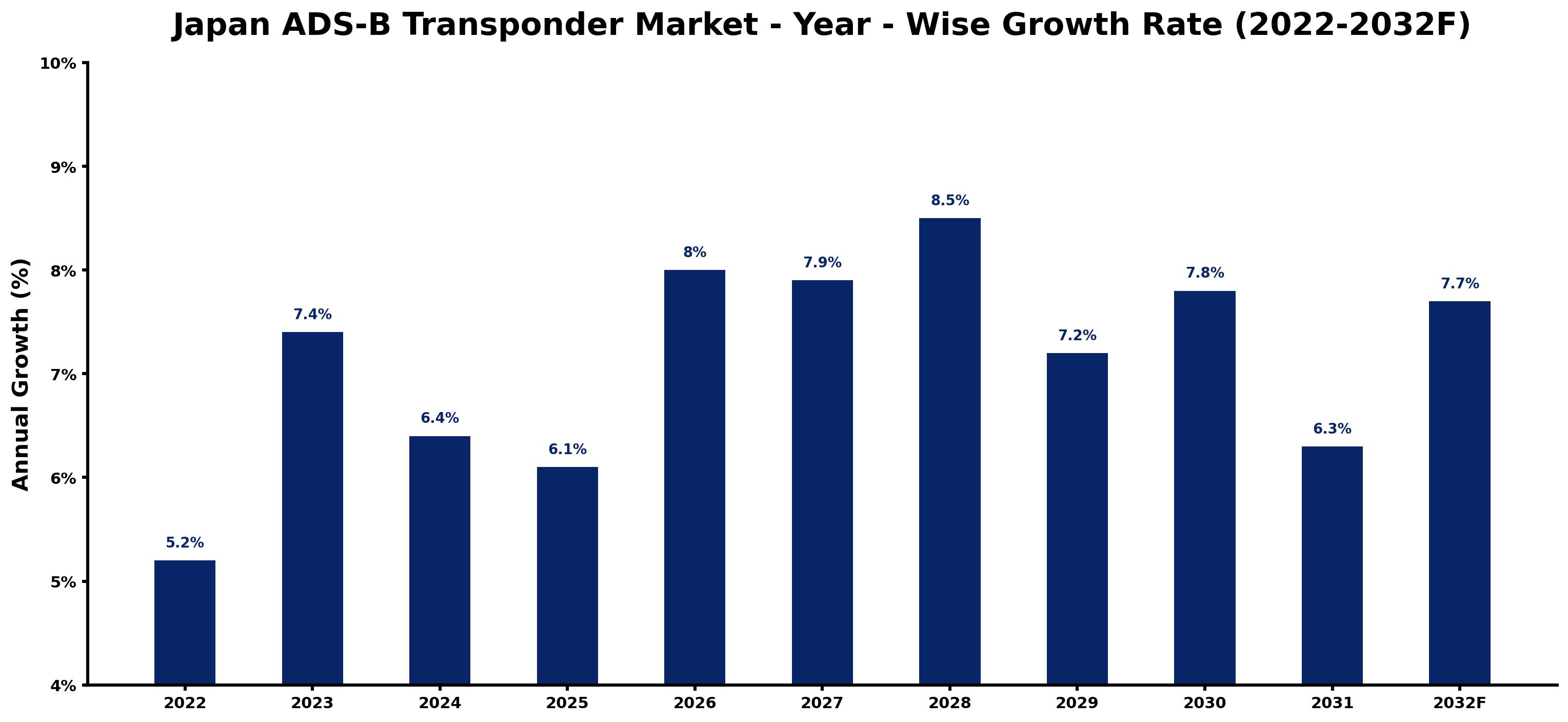
Year by year, the estimates below pair each growth rate with the development that shaped it.
| Year | Estimated Annual Growth (%) | Market Rationale |
| 2022 | 5.2 | Demand from domestic airline operators remained steady, reflecting ongoing aviation activity. |
| 2023 | 7.4 | Growth accelerated due to increased air traffic volume and safety regulations. |
| 2024 | 6.4 | Market growth slowed as demand stabilised following a peak in 2023. |
| 2025 | 6.1 | A slight slowdown continued as the market adjusted to previous growth rates. |
| 2026 | 8.0 | Demand is expected to rise as new safety initiatives are implemented. |
| 2027 | 7.9 | Growth will continue, supported by rising air traffic and safety compliance. |
| 2028 | 8.5 | The peak growth rate will be driven by investments in aviation technology. |
| 2029 | 7.2 | Growth will moderate as the market begins to stabilise post-peak. |
| 2030 | 7.8 | Demand is projected to rise again as air travel continues to increase. |
| 2031 | 6.3 | A slowdown is anticipated as the market reaches a more mature phase. |
| 2032 | 7.7 | Growth will pick up again due to ongoing investments in air traffic management. |
Note: Market size estimations and growth projections presented in this report are based on 6Wresearch's proprietary forecasting methodology, utilizing the latest available industry data, government publications, and primary research inputs.
Japan ADS-B Transponder Market Synopsis
An ADS-B transponder is a surveillance technology that broadcasts an aircraft's GPS position to air traffic control and other aircraft, improving safety and air traffic management. The Japan ADS-B Transponder Market is expanding, supported by a government investment of ¥2 billion in aviation safety systems and the mandatory implementation of ADS-B Out in controlled airspace, which drives demand from domestic airline operators and government aviation agencies.
Market Dynamics Impact Analysis (2026–2032)
| Factor | Type | Impact | Primary Segment Affected |
| Increasing air traffic volume necessitates the adoption of ADS-B transponders for improved safety and management, particularly in the Tokyo region where air traffic is concentrated. | Driver | High | Commercial Aircraft |
| Government investment of ¥2 billion in aviation safety systems is driving demand for advanced ADS-B technologies among domestic airline operators. | Driver | High | Airline Operators |
| The growing need for compliance with ADS-B Out regulations presents opportunities for manufacturers to expand their product offerings. | Opportunity | High | ADS-B Out |
| The rise in domestic travel creates a demand for more efficient air traffic management solutions, opening avenues for new entrants in the market. | Opportunity | High | Government Aviation Agencies |
| High implementation costs of ADS-B Out can deter smaller operators from upgrading their systems, limiting the overall market growth. | Restraint | High | Airline Operators |
| Supply chain constraints due to reliance on a limited number of suppliers can delay the availability of ADS-B transponders, impacting production timelines. | Restraint | Medium | Aircraft Manufacturers |
| Technological advancements require continuous investment, which can be challenging for smaller operators who may struggle to keep up with larger competitors. | Challenge | High | Avionics Service Providers |
| Increasing operational costs associated with rising air traffic volumes compel buyers to adopt more efficient systems, which can be a barrier for some operators. | Challenge | Medium | Airline Operators |
Evaluation of Drivers in Japan ADS-B Transponder Market (2026–2032)
These are the developments adding the most demand over the forecast period.
| Drivers | Primary Segment Affected | Why It Matters (Evidence) |
| Rising air traffic volume increases the need for ADS-B transponders. | Commercial Aircraft | Japan's air traffic volume is approximately 1.2 million flights annually, leading to higher demand for safety equipment. |
| Government investment in aviation safety systems boosts market growth. | ADS-B Out | The government has invested ¥2 billion in upgrading aviation safety systems, prompting more purchases. |
| Mandatory ADS-B Out compliance drives transponder adoption. | ADS-B Out | ADS-B Out is mandatory for aircraft operating in controlled airspace, ensuring consistent demand. |
| Technological advancements improve situational awareness for operators. | ADS-B In/Out | The adoption of ADS-B In/Out improves safety in crowded airspaces, increasing demand among airline operators. |
| Growing domestic travel boosts demand for commercial aircraft. | Commercial Aircraft | Japan's population growth is driving increased air travel demand, necessitating more transponders. |
Purchasing is picking up as air traffic volume increases, creating a heightened need for ADS-B transponders. The growing domestic travel market fuels the need for improved safety measures in aviation, further driving purchases.
Evaluation of Restraints in Japan ADS-B Transponder Market
Several factors work against faster growth; the main ones are summarised below.
| Market Restraint | Primary Segment Affected | Why It Matters (Evidence) |
| Regulatory compliance for older transponder types limits their adoption. | Mode A/C Transponders | As ADS-B Out becomes mandatory, older transponder types face reduced demand, impacting sales. |
| High initial costs of advanced transponder systems deter some buyers. | ADS-B In/Out | Budget constraints for smaller operators may prevent them from investing in necessary upgrades. |
| Supply chain disruptions can affect timely delivery of components. | Signal Processors | Delays in component supply can lead to longer lead times for manufacturers, affecting overall sales. |
| Limited awareness of advanced transponder benefits may hinder market growth. | Mode S Transponders | Many operators are unaware of the advantages of upgrading to newer technologies, slowing adoption. |
| Technological advancements may outpace current production capabilities. | RF Modules | Manufacturers may struggle to keep up with rapid technological changes, limiting their ability to meet demand. |
Japan ADS-B Transponder Market Challenges
Japan's aviation sector faces high costs due to mandatory ADS-B Out implementation, which can exceed ¥1 million per aircraft, placing financial strain on operators. Supply chain issues arise from reliance on a limited number of technology suppliers, causing delays in necessary upgrades for producers and hindering compliance with aviation regulations. Technological advancements require ongoing investments, which burden smaller operators that struggle to keep pace with larger competitors. Buyers encounter rising operational costs as air traffic volume reaches approximately 1.2 million flights annually, pushing them to adopt more efficient systems to manage congestion and improve safety.
Trends in the Japan ADS-B Transponder Market
The trends below show where the Japan ADS-B Transponder Market is heading.
- Shift towards Enhanced Air Traffic Management: In 2023, Japan initiated a program to improve air traffic management systems, reflecting a shift towards better operational safety. This change is expected to increase ADS-B transponder adoption, with approximately 300 commercial airports equipped with ADS-B systems.
- Transition from Older to Newer Transponder Technologies: The aviation sector is moving from Mode A/C transponders to ADS-B Out systems, driven by regulatory changes. This transition is evident as the government mandates ADS-B Out for controlled airspace, impacting nearly 1.2 million flights annually.
- Airline Operators Prioritising Safety Compliance: Airline operators are increasingly prioritising compliance with ADS-B Out regulations, resulting in higher demand for modern transponder systems. This trend is supported by the government's investment of ¥2 billion in aviation safety upgrades.
- Emergence of Advanced Signal Processing Technologies: The adoption of advanced signal processing technologies is becoming prevalent in Japan's aviation sector. With a focus on improving situational awareness, the market for signal processors is expected to grow significantly.
Investment Opportunities in the Japan ADS-B Transponder Market
The following areas offer the clearest openings for investors and suppliers in the Japan ADS-B Transponder Market.
- Investment in Upgrading Aviation Safety Systems: With the government investing ¥2 billion in aviation safety systems, suppliers can take advantage of this opportunity. Airline operators are the primary buyer group, and partnerships with local manufacturers can facilitate market entry.
- Growing Demand for ADS-B Out Compliance: As ADS-B Out becomes mandatory, there is a gap in the market for compliant transponders. Government aviation agencies are actively seeking suppliers to meet this need, creating an entry point for new players.
- Expansion of Aviation Manufacturing Facilities in Kansai: The Kansai region is known for its aviation manufacturing facilities, presenting opportunities for investment. Suppliers can enter by forming joint ventures with local manufacturers to improve production capabilities.
- Rising Air Travel Demand: Japan's growing population is driving increased air travel demand, creating a substantial opportunity for ADS-B transponder suppliers. Engaging with airline operators can facilitate market penetration.
Government Initiatives in the Japan ADS-B Transponder Market
The Industrial Standardization Act governs the standards for aviation equipment in Japan, ensuring that ADS-B transponders meet safety and performance criteria. Compliance with JIS Q 10001 is essential for manufacturers, as it dictates testing and certification processes, influencing production practices.
The Japan Civil Aviation Bureau oversees aviation safety regulations and has funded initiatives to improve air traffic management systems. In 2023, the bureau initiated a program with a budget of ¥2 billion to improve safety protocols, directly impacting ADS-B transponder requirements.
Future Insight of the Japan ADS-B Transponder Market
Investment in aviation safety systems will improve air traffic management capabilities and stimulate demand for ADS-B transponders. By 2032, the adoption of advanced technologies will streamline operations for both buyers and suppliers. The implementation of JIS Q 10001 standards will establish higher safety and performance benchmarks for aviation equipment. As domestic travel continues to grow, the demand for efficient surveillance technology will drive innovation and expansion in the ADS-B market.
Market Segmentation Analysis
Japan ADS-B Transponder Market report covers a detailed analysis of the following market segments:
By Product Type – Mode S Transponders Lead, Mode A/C Transponders Expected to Grow Fastest
According to Saurav Kr Singh, Senior Research Analyst at 6Wresearch, with 47% of product type revenue in 2025, Mode S Transponders was the largest category. Mode S Transponders dominate the market due to their critical role in ensuring air traffic control and safety in Japan's busy airspace. Their necessity is highlighted by the compliance requirements across over 300 commercial airports equipped with ADS-B systems. Mode A/C Transponders are projected to grow fastest, at a CAGR of 10.5% during 2026–2032. Mode A/C Transponders are rapidly gaining traction as older aircraft types are increasingly upgraded to meet modern regulations. This shift is propelled by the rise in air traffic volume, which reached approximately 1.2 million flights annually. Suppliers should prioritise advancements in both Mode S and Mode A/C Transponders to effectively capture the expanding market.
By Component Type – Signal Processors Lead, RF Modules Expected to Grow Fastest
The largest component type category in 2025 was Signal Processors, at 44% of revenue. Signal Processors hold the largest share as they are critical for processing signals in transponders, ensuring accurate communication in aviation. Their importance is underscored by the government's investment of ¥2 billion in upgrading aviation safety systems. The quickest growth will come from RF Modules, forecast to expand at a CAGR of 10.3% between 2026 and 2032. RF Modules are growing quickly due to their necessity for radio frequency communication, particularly as the aviation sector expands with increased domestic travel. This growth is supported by the ongoing upgrades in aviation technology. Buyers will benefit from suppliers prioritising advancements in Signal Processors and RF Modules to improve operational efficiency.
By Platform Type – Commercial Aircraft Leads, Private Aircraft Expected to Grow Fastest
Commercial Aircraft accounted for 45% of the market by platform type in 2025. Commercial Aircraft lead the market as they are the primary users of ADS-B technology, essential for maintaining safety in Japan's crowded airspace. The significance of this segment is reinforced by the high volume of operations in the Tokyo region, a major aviation hub. Over 2026–2032, Private Aircraft is expected to post the fastest growth, at a CAGR of 10.7%. Private Aircraft are experiencing the fastest growth as more individuals pursue personal travel options, resulting in increased installations of ADS-B systems. This trend is indicative of the broader growth trajectory of Japan's aviation market. Suppliers should adapt their strategies to meet the distinct requirements of both Commercial and Private Aircraft segments.
By Technology Type – ADS-B Out Leads, ADS-B In/Out Expected to Grow Fastest
ADS-B Out held 42% of the Japan ADS-B Transponder Market by technology type in 2025. ADS-B Out holds the largest share as it is mandatory for compliance with aviation regulations, ensuring safety in controlled airspace. The enforcement of these regulations by the Japan Civil Aviation Bureau highlights its critical importance. ADS-B In/Out is set to record the highest CAGR in this split, 10.9% over 2026–2032. ADS-B In/Out is rapidly advancing as it significantly enhances situational awareness for pilots, a feature increasingly valued in the aviation sector. Government initiatives aimed at improving air traffic management systems further stimulate this growth. Suppliers must focus on developing ADS-B In/Out technologies to satisfy the rising demand for improved safety features.
By End User – Airline Operators Lead, Aircraft Manufacturers Expected to Grow Fastest
In 2025, Airline Operators led the end user split with a 38% share. Airline Operators constitute the largest consumer group for ADS-B transponders, as they require dependable systems for their fleets to ensure safety and regulatory compliance. Their substantial presence is underscored by the high volume of flights they operate annually. Aircraft Manufacturers are projected to grow fastest, at a CAGR of 9.5% during 2026–2032. Aircraft Manufacturers are witnessing rapid growth as they incorporate ADS-B systems into new aircraft designs, aligning with regulatory requirements and market demands. This trend is crucial as the aviation industry in Japan continues to expand. Suppliers should enhance collaborations with both Airline Operators and Aircraft Manufacturers to optimise market opportunities.
Key Attractiveness of the Report
- 10 Years of Market Numbers
- Historical Data Starting from 2022 to 2025
- Base Year 2025
- Forecast Data until 2032
- Key Performance Indicators Impacting the Market
- Major Upcoming Developments and Projects
Key Highlights of the Report:
- Japan ADS-B Transponder Market Outlook
- Market Size of Japan ADS-B Transponder Market, 2025
- Forecast of Japan ADS-B Transponder Market, 2032
- Historical Data and Forecast of Japan ADS-B Transponder Revenues & Volume for the Period 2022-2032F
- Japan ADS-B Transponder Market Trend Evolution
- Japan ADS-B Transponder Market Drivers and Challenges
- Japan ADS-B Transponder Price Trends
- Japan ADS-B Transponder Porter's Five Forces
- Japan ADS-B Transponder Industry Life Cycle
- Historical Data and Forecast of Japan ADS-B Transponder Market Revenues & Volume By Product Type for the Period 2022-2032F
- Historical Data and Forecast of Japan ADS-B Transponder Market Revenues & Volume By Mode S Transponders for the Period 2022-2032F
- Historical Data and Forecast of Japan ADS-B Transponder Market Revenues & Volume By Mode A/C Transponders for the Period 2022-2032F
- Historical Data and Forecast of Japan ADS-B Transponder Market Revenues & Volume By 1090ES Transponders for the Period 2022-2032F
- Historical Data and Forecast of Japan ADS-B Transponder Market Revenues & Volume By UAT Transponders for the Period 2022-2032F
- Historical Data and Forecast of Japan ADS-B Transponder Market Revenues & Volume By Component Type for the Period 2022-2032F
- Historical Data and Forecast of Japan ADS-B Transponder Market Revenues & Volume By Signal Processors for the Period 2022-2032F
- Historical Data and Forecast of Japan ADS-B Transponder Market Revenues & Volume By RF Modules for the Period 2022-2032F
- Historical Data and Forecast of Japan ADS-B Transponder Market Revenues & Volume By Antennas for the Period 2022-2032F
- Historical Data and Forecast of Japan ADS-B Transponder Market Revenues & Volume By GPS Interface for the Period 2022-2032F
- Historical Data and Forecast of Japan ADS-B Transponder Market Revenues & Volume By Platform Type for the Period 2022-2032F
- Historical Data and Forecast of Japan ADS-B Transponder Market Revenues & Volume By Commercial Aircraft for the Period 2022-2032F
- Historical Data and Forecast of Japan ADS-B Transponder Market Revenues & Volume By Private Aircraft for the Period 2022-2032F
- Historical Data and Forecast of Japan ADS-B Transponder Market Revenues & Volume By Helicopters for the Period 2022-2032F
- Historical Data and Forecast of Japan ADS-B Transponder Market Revenues & Volume By Drones/UAVs for the Period 2022-2032F
- Historical Data and Forecast of Japan ADS-B Transponder Market Revenues & Volume By Technology Type for the Period 2022-2032F
- Historical Data and Forecast of Japan ADS-B Transponder Market Revenues & Volume By ADS-B Out for the Period 2022-2032F
- Historical Data and Forecast of Japan ADS-B Transponder Market Revenues & Volume By ADS-B In/Out for the Period 2022-2032F
- Historical Data and Forecast of Japan ADS-B Transponder Market Revenues & Volume By Extended Squitter for the Period 2022-2032F
- Historical Data and Forecast of Japan ADS-B Transponder Market Revenues & Volume By Universal Access for the Period 2022-2032F
- Historical Data and Forecast of Japan ADS-B Transponder Market Revenues & Volume By End User for the Period 2022-2032F
- Historical Data and Forecast of Japan ADS-B Transponder Market Revenues & Volume By Airline Operators for the Period 2022-2032F
- Historical Data and Forecast of Japan ADS-B Transponder Market Revenues & Volume By Aircraft Manufacturers for the Period 2022-2032F
- Historical Data and Forecast of Japan ADS-B Transponder Market Revenues & Volume By Government Aviation Agencies for the Period 2022-2032F
- Historical Data and Forecast of Japan ADS-B Transponder Market Revenues & Volume By Avionics Service Providers for the Period 2022-2032F
- Japan ADS-B Transponder Import Export Trade Statistics
- Market Opportunity Assessment By Product Type
- Market Opportunity Assessment By Component Type
- Market Opportunity Assessment By Platform Type
- Market Opportunity Assessment By Technology Type
- Market Opportunity Assessment By End User
- Japan ADS-B Transponder Top Companies Market Share
- Japan ADS-B Transponder Competitive Benchmarking By Technical and Operational Parameters
- Japan ADS-B Transponder Company Profiles
- Japan ADS-B Transponder Key Strategic Recommendations
Market Covered
The study includes the following segmentation.
By Product Type
- Mode S Transponders
- Mode A/C Transponders
- 1090ES Transponders
- UAT Transponders
By Component Type
- Signal Processors
- RF Modules
- Antennas
- GPS Interface
By Platform Type
- Commercial Aircraft
- Private Aircraft
- Helicopters
- Drones/UAVs
By Technology Type
- ADS-B Out
- ADS-B In/Out
- Extended Squitter
- Universal Access
By End User
- Airline Operators
- Aircraft Manufacturers
- Government Aviation Agencies
- Avionics Service Providers































