Japan Adsorbent Clays Market Size & Growth Rate
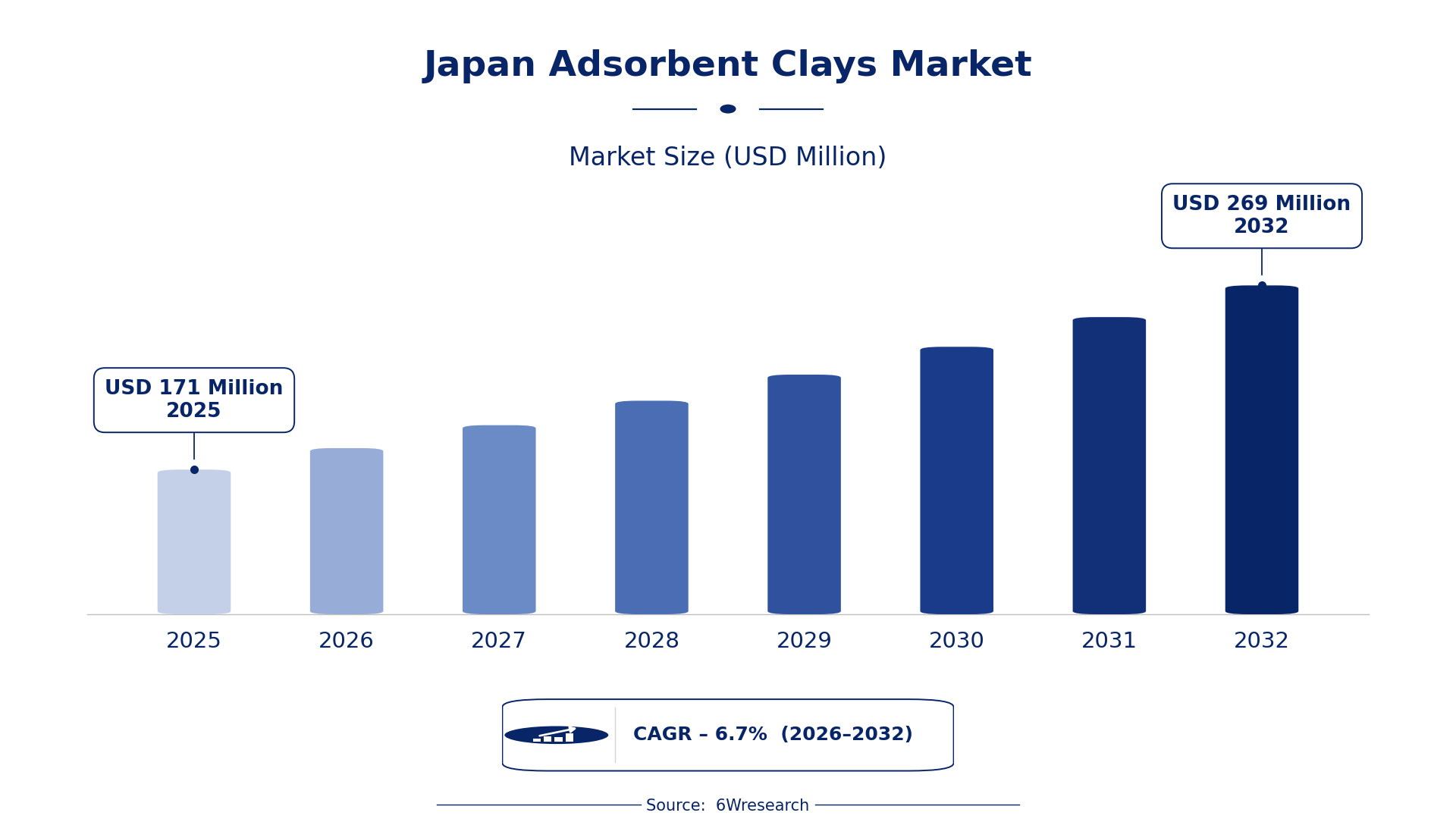
According to 6Wresearch internal database and industry insights, the Japan Adsorbent Clays Market was valued at USD 171 Million in 2025 and is projected to reach USD 269 Million by 2032, growing at a CAGR of approximately 6.7% during 2026–2032.
Japan Adsorbent Clays Market Highlights
| Report Metric | Details |
| Report Name | Japan Adsorbent Clays Market (2026-2032) |
| Market Size 2025 | USD 171 Million |
| Market Size 2032 | USD 269 Million |
| Absolute Growth 2025–2032 | USD 98 Million |
| CAGR 2026–2032 | 6.7% |
| Peak Annual Growth | 8.2% in 2026 |
| Forecast Period | 2026–2032 |
| Historical Data | 2022–2025 |
| Base Year | 2025 |
| Leading Product Type, 2025 | Bentonite Clay (41% share) |
| Leading Material Type, 2025 | Natural Clay (40% share) |
| Leading Application Area, 2025 | Oil & Grease Removal (41% share) |
| Leading Distribution Channel, 2025 | Industrial Distributors (35% share) |
| Leading End User, 2025 | Petrochemical Industry (37% share) |
| Fastest-Growing Product Type | Fuller's Earth (9.1% CAGR) |
| Fastest-Growing Material Type | Modified Clay (9.6% CAGR) |
| Fastest-Growing Application Area | Chemical Purification (7.9% CAGR) |
| Fastest-Growing Distribution Channel | Direct Sales (8.6% CAGR) |
| Fastest-Growing End User | Water Treatment Plants (8.4% CAGR) |
| Growing Sector | Chemical Purification |
| Key End Users | Oil & Grease Removal, Chemical Purification, Personal Care Products, Food Processing |
Japan Adsorbent Clays Market Year-wise Growth Rate and Key Drivers (2022–2032)
This graph illustrates the annual growth rates of the market from 2022 to 2032, highlighting a steady upward trajectory and projected market expansion over the forecast period.
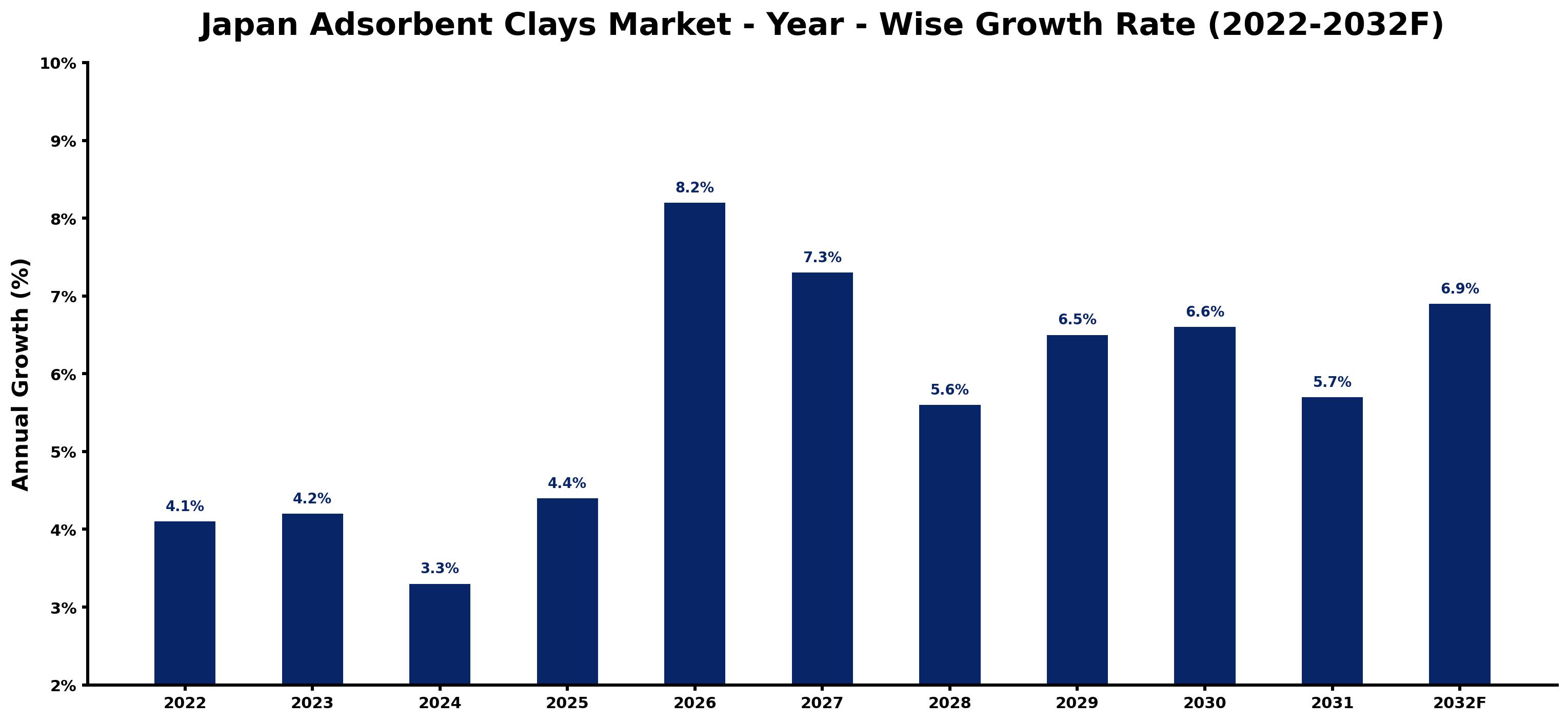
Annual growth estimates for each year appear below with the principal reason behind them, explaining the shifts that set the pace of the market.
| Year | Estimated Annual Growth (%) | Market Rationale |
| 2022 | 4.1 | The market experienced steady growth due to consistent demand from the petrochemical industry. |
| 2023 | 4.2 | Growth continued as personal care product demand increased, driving adsorbent clay purchases. |
| 2024 | 3.3 | A slowdown in growth occurred as the market adjusted to previous high demand levels. |
| 2025 | 4.4 | The market rebounded with faster growth, supported by rising needs for oil and grease removal. |
| 2026 | 8.2 | Peak growth is expected as investments in water treatment processes surge. |
| 2027 | 7.3 | Growth will slow as the market stabilises after the peak demand year. |
| 2028 | 5.6 | A further slowdown is projected, reflecting a normalisation in purchasing patterns. |
| 2029 | 6.5 | Growth is expected to pick up again, driven by increased demand from water treatment facilities. |
| 2030 | 6.6 | The upward trend will continue as the cosmetic industry expands its use of adsorbent clays. |
| 2031 | 5.7 | Growth will slow again, as the market adjusts to previous peaks and demand levels. |
| 2032 | 6.9 | The market is expected to grow faster as the food processing sector increases its clay usage. |
Note: Market size estimations and growth projections presented in this report are based on 6Wresearch's proprietary forecasting methodology, utilizing the latest available industry data, government publications, and primary research inputs.
Japan Adsorbent Clays Market Synopsis
Adsorbent clays are naturally occurring minerals that can adsorb liquids and gases, primarily applied in oil and grease removal, chemical purification, and food processing. The Japan Adsorbent Clays Market is growing due to heightened demand from the petrochemical and water treatment sectors, alongside a burgeoning cosmetic industry valued at over 3 trillion yen. The Kanto region plays a crucial role in clay mining and processing, ensuring a reliable supply to satisfy this demand.
Market Dynamics Impact Analysis (2026–2032)
| Factor | Type | Impact | Primary Segment Affected |
| Increasing demand for oil and grease removal in various industries | Driver | High | Oil & Grease Removal |
| Growth in the cosmetic industry driving demand for adsorbent clays | Driver | High | Personal Care Products |
| Rising need for chemical purification processes in manufacturing | Opportunity | High | Chemical Purification |
| Expansion of water treatment facilities increasing clay usage | Opportunity | High | Water Treatment Plants |
| Regulatory challenges in clay mining and processing | Restraint | Medium | Natural Clay |
| Environmental concerns regarding the extraction of natural resources | Restraint | Medium | Activated Clay |
| Fluctuations in raw material availability affecting supply chains | Challenge | High | Bentonite Clay |
| Competition from synthetic alternatives impacting market share | Challenge | Medium | Modified Clay |
Evaluation of Drivers in Japan Adsorbent Clays Market (2026–2032)
Demand rests on the following drivers, each shown with the segment it touches most.
| Drivers | Primary Segment Affected | Why It Matters (Evidence) |
| Expansion of the petrochemical industry | Bentonite Clay | The petrochemical industry is increasing its production capacity, leading to a 4% rise in demand for bentonite clay used in oil drilling and construction. |
| Growth in the cosmetic sector | Attapulgite Clay | The cosmetic industry, valued at over 3 trillion yen, drives demand for attapulgite clay, essential for product formulations and stability. |
| Regulatory compliance in food processing | Kaolin Clay | Stricter food safety regulations have increased the demand for kaolin clay in edible oil refining, ensuring product quality and safety. |
| Investment in wastewater treatment | Activated Clay | Water treatment plants are investing in activated clay for effective wastewater treatment, enhancing compliance with environmental standards. |
| Rising need for chemical purification | Fuller's Earth | The need for chemical purification processes has increased the usage of Fuller's Earth across various manufacturing sectors, ensuring product quality. |
Buyers are expanding capacity as the petrochemical industry grows, resulting in increased use of adsorbent clays for oil and grease removal. The cosmetic sector, valued at over 3 trillion yen, is propelling demand for attapulgite clay in personal care products. Water treatment facilities are increasingly employing activated clay for effective wastewater treatment. The need for chemical purification processes has led to greater use of Fuller's Earth across various manufacturing sectors.
Evaluation of Restraints in Japan Adsorbent Clays Market
The main factors holding the market back are set out below.
| Market Restraint | Primary Segment Affected | Why It Matters (Evidence) |
| Regulatory challenges in clay mining and processing | Natural Clay | Compliance with stringent regulations can delay production timelines, impacting supply availability. |
| Environmental concerns regarding the extraction of natural resources | Activated Clay | Growing scrutiny of mining practices increases operational costs and complicates extraction processes. |
| Supply chain disruptions affecting raw material availability | Bentonite Clay | Supply chain disruptions can lead to inconsistent availability of essential raw materials. |
| Competition from synthetic alternatives impacting market share | Modified Clay | The rise of synthetic substitutes may divert demand away from natural adsorbent clays. |
| Market saturation in certain applications limiting growth potential | Kaolin Clay | High competition in established markets can hinder new entrants and innovation. |
Japan Adsorbent Clays Market Challenges
Water treatment plants in Japan encounter project delays due to outdated technology, extending timelines by up to six months for municipal buyers. Competition among suppliers has intensified, prompting price wars that can shrink margins by 15%, affecting producer profitability. Buyers in the cosmetic industry are facing a 10% rise in adsorbent clay costs this year, straining their budgets. Compliance with ISO 14001 certification incurs costs of around 5 million yen per facility, which may deter new entrants and restrict market growth.
Trends in the Japan Adsorbent Clays Market
These developments are changing demand patterns in the Japan Adsorbent Clays Market.
- Shift from Traditional to Sustainable Mining Practices: In 2023, the Kanto region is embracing sustainable mining practices to minimise environmental impact. This transition is driven by the Ministry of the Environment's initiatives, targeting a 20% reduction in resource extraction waste.
- Transition from Conventional to Modified Adsorbent Clays: The cosmetic industry is increasingly opting for modified clays to enhance product formulations. This trend is reflected in the rising demand for modified clay, projected to grow by 9.6% over the next several years.
- Emergence of Direct Sales Channels in Adsorbent Clay Distribution: Direct sales channels are becoming more popular among industrial users, with an anticipated growth rate of 8.6% as manufacturers seek closer relationships with buyers for tailored solutions.
- Prioritisation of Wastewater Treatment Solutions: Water treatment plants are prioritising advanced adsorbent technologies, with activated clay usage rising by 6% to comply with stricter environmental standards.
Investment Opportunities in the Japan Adsorbent Clays Market
The following opportunities in the Japan Adsorbent Clays Market pair current demand with a clear way in.
- Kanto Region's Mining Facilities: With a projected increase in demand for adsorbent clays, investment in mining facilities in the Kanto region is essential. Local suppliers can partner with industrial distributors to meet this growing need.
- Petrochemical Industry Expansion: The petrochemical sector is currently expanding, presenting an opportunity for suppliers to provide adsorbent clays for oil and grease removal. This is a timely investment as the sector anticipates a 4% growth in production.
- Growth in Food Processing: The food processing industry is expected to increase its use of kaolin clay, driven by stricter food safety regulations. Suppliers can enter this market through certification processes.
- Water Treatment Facilities Upgrade: As water treatment facilities upgrade their technologies, there is an opportunity to supply activated clay. This need is urgent, given the rising regulatory requirements for wastewater treatment.
Government Initiatives in the Japan Adsorbent Clays Market
The Chemical Substances Control Law (1973; METI, MHLW and MoE) mandates evaluation and control of chemical substances used in the manufacture and import of adsorbent clays, ensuring adherence to safety standards. This law requires rigorous testing and reporting, which can elevate operational costs for manufacturers.
The Ministry of the Environment supervises compliance with environmental regulations, endorsing initiatives that promote sustainable practices in clay extraction. Agencies like the Japan Clay Association ensure that producers comply with these standards, facilitating market access for compliant manufacturers.
Future Insight of the Japan Adsorbent Clays Market
By 2032, new recycling initiatives will enhance the reuse of adsorbent clays, reducing reliance on virgin materials for producers. Improved environmental standards will compel suppliers to adopt better mining practices, aligning with government sustainability goals. Demand for advanced clay formulations will rise, enabling buyers to access higher-quality products. The cosmetic industry is projected to grow, offering suppliers opportunities to diversify their offerings.
Market Segmentation Analysis
Japan Adsorbent Clays Market report covers a detailed analysis of the following market segments:
By Product Type – Bentonite Clay Leads, Fuller's Earth Expected to Grow Fastest
According to Saurav Kr Singh, Senior Research Analyst at 6Wresearch, Bentonite Clay held 41% of the Japan Adsorbent Clays Market by product type in 2025. The leading sub-segment is widely used for oil and grease removal in various industries, particularly in the petrochemical sector. This extensive application drives demand from numerous facilities, particularly in the Kanto region, which is known for its clay mining activities. Fuller's Earth is projected to grow fastest, at a CAGR of 9.1% during 2026–2032. Fuller's Earth is rapidly gaining traction for its unique properties in chemical purification processes, particularly in industrial applications. The increasing focus on product quality in manufacturing is propelling its adoption, ensuring that demand continues to rise. Suppliers should prioritise the production of Fuller's Earth to meet the growing demand in chemical purification.
By Material Type – Natural Clay Leads, Modified Clay Expected to Grow Fastest
The largest material type category in 2025 was Natural Clay, at 40% of revenue. Natural clay holds the largest share due to its inherent adsorptive qualities, making it suitable for a variety of applications. Its extensive use in sectors such as oil drilling and construction underscores its reliability and effectiveness in critical processes. The quickest growth will come from Modified Clay, forecast to expand at a CAGR of 9.6% between 2026 and 2032. Modified clay is experiencing the fastest growth as industries increasingly demand enhanced properties tailored for specific applications. This trend is particularly prominent in sectors that require superior adsorptive capabilities, leading to heightened investments in modified formulations. Buyers may find value in exploring modified clay options to optimise their operational efficiency.
By Application Area – Oil & Grease Removal Leads, Chemical Purification Expected to Grow Fastest
Oil & Grease Removal accounted for 41% of the market by application area in 2025. Oil and grease removal is the leading application area, crucial for industrial cleaning across various sectors. Its importance in maintaining operational efficiency drives consistent demand from industries that rely on effective cleaning solutions. Over 2026–2032, Chemical Purification is expected to post the fastest growth, at a CAGR of 7.9%. Chemical purification is the fastest-growing application area, essential for ensuring product quality in manufacturing. The rising regulatory standards for product safety are accelerating this growth, prompting industries to invest more in purification solutions. Suppliers should enhance their offerings for chemical purification to meet the increasing market demand.
By Distribution Channel – Industrial Distributors Lead, Direct Sales Expected to Grow Fastest
Industrial Distributors took 35% of distribution channel revenue in 2025, more than any other category. Industrial distributors lead the distribution channel, as they effectively facilitate the supply of clays to various industries requiring bulk quantities. Their established networks ensure reliable access to essential materials for users. Direct Sales is set to record the highest CAGR in this split, 8.6% over 2026–2032. Direct sales are growing rapidly, primarily due to the increasing preference of large industrial users for direct procurement. This method allows for better negotiation and tailored solutions to meet specific needs. Suppliers should consider strengthening their direct sales strategies to capture this growing segment.
By End User – Petrochemical Industry Leads, Water Treatment Plants Expected to Grow Fastest
In 2025, Petrochemical Industry led the end user split with a 37% share. The petrochemical industry is the largest end user, heavily relying on adsorbent clays for diverse processes. Its extensive operational scale and ongoing projects ensure a steady demand for these materials throughout the sector. Water Treatment Plants are projected to grow fastest, at a CAGR of 8.4% during 2026–2032. Water treatment plants represent the fastest-growing end user, playing a vital role in wastewater treatment and compliance with environmental regulations. The heightened emphasis on sustainable practices and effective waste management is propelling this growth. Suppliers should focus on water treatment facilities to leverage the expanding market opportunities.
Key Attractiveness of the Report
- 10 Years of Market Numbers
- Historical Data Starting from 2022 to 2025
- Base Year 2025
- Forecast Data until 2032
- Key Performance Indicators Impacting the Market
- Major Upcoming Developments and Projects
Key Highlights of the Report:
- Japan Adsorbent Clays Market Outlook
- Market Size of Japan Adsorbent Clays Market, 2025
- Forecast of Japan Adsorbent Clays Market, 2032
- Historical Data and Forecast of Japan Adsorbent Clays Revenues & Volume for the Period 2022-2032F
- Japan Adsorbent Clays Market Trend Evolution
- Japan Adsorbent Clays Market Drivers and Challenges
- Japan Adsorbent Clays Price Trends
- Japan Adsorbent Clays Porter's Five Forces
- Japan Adsorbent Clays Industry Life Cycle
- Historical Data and Forecast of Japan Adsorbent Clays Market Revenues & Volume By Product Type for the Period 2022-2032F
- Historical Data and Forecast of Japan Adsorbent Clays Market Revenues & Volume By Bentonite Clay for the Period 2022-2032F
- Historical Data and Forecast of Japan Adsorbent Clays Market Revenues & Volume By Attapulgite Clay for the Period 2022-2032F
- Historical Data and Forecast of Japan Adsorbent Clays Market Revenues & Volume By Fuller's Earth for the Period 2022-2032F
- Historical Data and Forecast of Japan Adsorbent Clays Market Revenues & Volume By Kaolin Clay for the Period 2022-2032F
- Historical Data and Forecast of Japan Adsorbent Clays Market Revenues & Volume By Material Type for the Period 2022-2032F
- Historical Data and Forecast of Japan Adsorbent Clays Market Revenues & Volume By Natural Clay for the Period 2022-2032F
- Historical Data and Forecast of Japan Adsorbent Clays Market Revenues & Volume By Modified Clay for the Period 2022-2032F
- Historical Data and Forecast of Japan Adsorbent Clays Market Revenues & Volume By Activated Clay for the Period 2022-2032F
- Historical Data and Forecast of Japan Adsorbent Clays Market Revenues & Volume By Bleaching Clay for the Period 2022-2032F
- Historical Data and Forecast of Japan Adsorbent Clays Market Revenues & Volume By Application Area for the Period 2022-2032F
- Historical Data and Forecast of Japan Adsorbent Clays Market Revenues & Volume By Oil & Grease Removal for the Period 2022-2032F
- Historical Data and Forecast of Japan Adsorbent Clays Market Revenues & Volume By Chemical Purification for the Period 2022-2032F
- Historical Data and Forecast of Japan Adsorbent Clays Market Revenues & Volume By Personal Care Products for the Period 2022-2032F
- Historical Data and Forecast of Japan Adsorbent Clays Market Revenues & Volume By Food Processing for the Period 2022-2032F
- Historical Data and Forecast of Japan Adsorbent Clays Market Revenues & Volume By Distribution Channel for the Period 2022-2032F
- Historical Data and Forecast of Japan Adsorbent Clays Market Revenues & Volume By Industrial Distributors for the Period 2022-2032F
- Historical Data and Forecast of Japan Adsorbent Clays Market Revenues & Volume By Direct Sales for the Period 2022-2032F
- Historical Data and Forecast of Japan Adsorbent Clays Market Revenues & Volume By Online Retailers for the Period 2022-2032F
- Historical Data and Forecast of Japan Adsorbent Clays Market Revenues & Volume By Specialty Stores for the Period 2022-2032F
- Historical Data and Forecast of Japan Adsorbent Clays Market Revenues & Volume By End User for the Period 2022-2032F
- Historical Data and Forecast of Japan Adsorbent Clays Market Revenues & Volume By Petrochemical Industry for the Period 2022-2032F
- Historical Data and Forecast of Japan Adsorbent Clays Market Revenues & Volume By Water Treatment Plants for the Period 2022-2032F
- Historical Data and Forecast of Japan Adsorbent Clays Market Revenues & Volume By Cosmetic Manufacturers for the Period 2022-2032F
- Historical Data and Forecast of Japan Adsorbent Clays Market Revenues & Volume By Edible Oil Refiners for the Period 2022-2032F
- Japan Adsorbent Clays Import Export Trade Statistics
- Market Opportunity Assessment By Product Type
- Market Opportunity Assessment By Material Type
- Market Opportunity Assessment By Application Area
- Market Opportunity Assessment By Distribution Channel
- Market Opportunity Assessment By End User
- Japan Adsorbent Clays Top Companies Market Share
- Japan Adsorbent Clays Competitive Benchmarking By Technical and Operational Parameters
- Japan Adsorbent Clays Company Profiles
- Japan Adsorbent Clays Key Strategic Recommendations
Market Covered
Coverage by segment is as follows.
By Product Type
- Bentonite Clay
- Attapulgite Clay
- Fuller's Earth
- Kaolin Clay
By Material Type
- Natural Clay
- Modified Clay
- Activated Clay
- Bleaching Clay
By Application Area
- Oil & Grease Removal
- Chemical Purification
- Personal Care Products
- Food Processing
By Distribution Channel
- Industrial Distributors
- Direct Sales
- Online Retailers
- Specialty Stores
By End User
- Petrochemical Industry
- Water Treatment Plants
- Cosmetic Manufacturers
- Edible Oil Refiners































