Japan Adsorbent Materials Market Size & Growth Rate
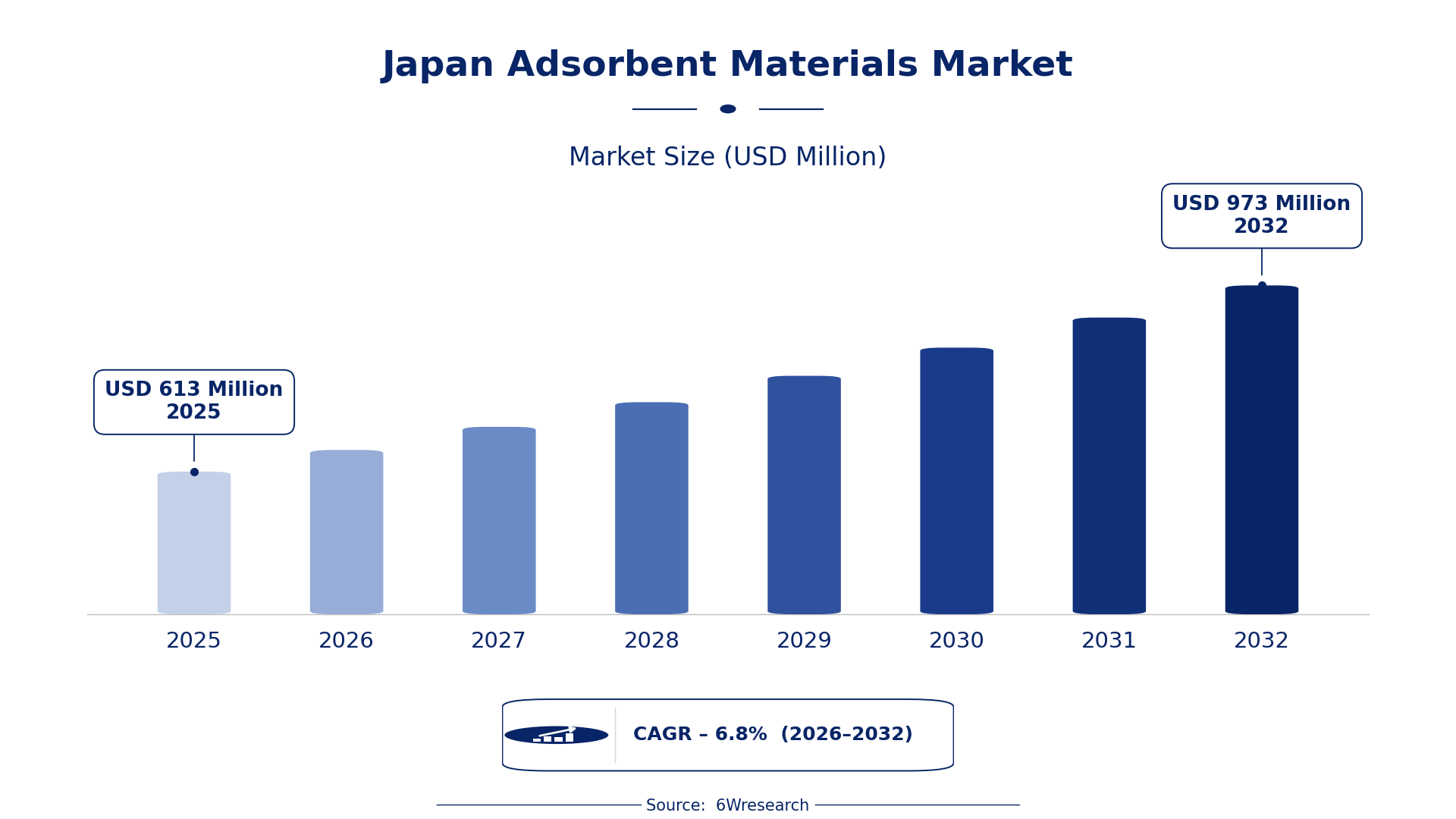
According to 6Wresearch internal database and industry insights, the Japan Adsorbent Materials Market was valued at USD 613 Million in 2025 and is projected to reach USD 973 Million by 2032, growing at a CAGR of approximately 6.8% during 2026–2032.
Japan Adsorbent Materials Market Highlights
| Report Metric | Details |
| Report Name | Japan Adsorbent Materials Market (2026-2032) |
| Market Size 2025 | USD 613 Million |
| Market Size 2032 | USD 973 Million |
| Absolute Growth 2025–2032 | USD 360 Million |
| CAGR 2026–2032 | 6.8% |
| Peak Annual Growth | 7.7% in 2032 |
| Forecast Period | 2026–2032 |
| Historical Data | 2022–2025 |
| Base Year | 2025 |
| Leading Product Type, 2025 | Activated Carbon (53% share) |
| Leading Material Type, 2025 | Organic Adsorbents (40% share) |
| Leading Application Area, 2025 | Air & Water Filtration (47% share) |
| Leading Distribution Channel, 2025 | Direct Sales (39% share) |
| Leading End User, 2025 | Environmental Agencies (42% share) |
| Fastest-Growing Product Type | Zeolites (9.6% CAGR) |
| Fastest-Growing Material Type | Inorganic Adsorbents (10.1% CAGR) |
| Fastest-Growing Application Area | Gas Separation (8.4% CAGR) |
| Fastest-Growing Distribution Channel | Industrial Suppliers (9.0% CAGR) |
| Fastest-Growing End User | Oil & Gas Sector (9.1% CAGR) |
| Growing Sector | Environmental Agencies |
| Key End Users | Environmental Agencies, Oil & Gas Sector, Chemical Manufacturers, Pharmaceutical Industry |
Japan Adsorbent Materials Market Year-wise Growth Rate and Key Drivers (2022–2032)
This graph illustrates the annual growth rates of the market from 2022 to 2032, highlighting a steady upward trajectory and projected market expansion over the forecast period.
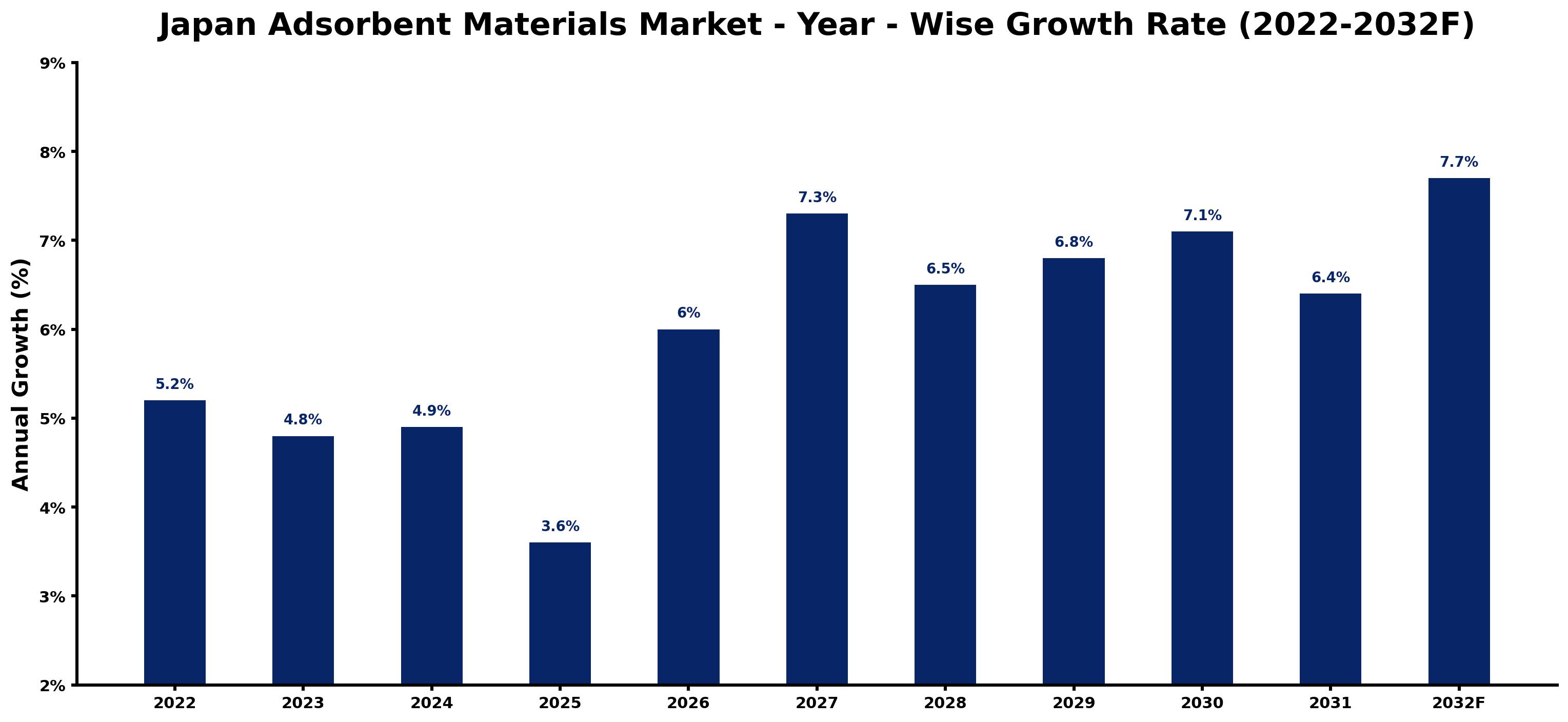
The table below sets out the estimated growth rate for each year and the main factor behind it.
| Year | Estimated Annual Growth (%) | Market Rationale |
| 2022 | 5.2 | The demand for adsorbent materials was strong due to environmental regulations. |
| 2023 | 4.8 | Growth slowed as some sectors adjusted to previous investments in adsorbents. |
| 2024 | 4.9 | Increased focus on air quality led to higher demand for filtration solutions. |
| 2025 | 3.6 | The market experienced slower growth as competition intensified among suppliers. |
| 2026 | 6.0 | Demand increased as industries adopted new technologies for pollution control. |
| 2027 | 7.3 | Investments in environmental projects are expected to drive demand for adsorbents. |
| 2028 | 6.5 | The growth rate is projected to slow as market saturation begins in certain segments. |
| 2029 | 6.8 | Demand is expected to accelerate with new applications for zeolites in carbon capture. |
| 2030 | 7.1 | The market will benefit from rising investments in gas separation technologies. |
| 2031 | 6.4 | Growth is projected to slow as regulatory pressures prompt consolidation among suppliers. |
| 2032 | 7.7 | Demand will surge as environmental policies mandate stricter emission controls. |
Note: Market size estimations and growth projections presented in this report are based on 6Wresearch's proprietary forecasting methodology, utilizing the latest available industry data, government publications, and primary research inputs.
Japan Adsorbent Materials Market Synopsis
Adsorbent materials capture and hold molecules on their surfaces, primarily produced through thermal activation or chemical treatment. They play a crucial role in air and water purification, gas separation, and moisture control. The Japan Adsorbent Materials Market is expanding due to increasing environmental regulations, heightened investments in pollution control technologies, and a growing focus on sustainability. Japan's commitment to a 46% reduction in greenhouse gas emissions by 2030 is driving demand for effective adsorbent solutions, particularly in air and water filtration applications. In 2022, over 200,000 tons of activated carbon were produced, primarily for water treatment.
Market Dynamics Impact Analysis (2026–2032)
| Factor | Type | Impact | Primary Segment Affected |
| Growing environmental regulations drive demand for air and water purification solutions. | Driver | High | Air & Water Filtration |
| Rising investments in advanced gas separation technologies create opportunities for adsorbent suppliers. | Driver | High | Gas Separation |
| The push for sustainable solutions in manufacturing presents opportunities for innovative adsorbent applications. | Opportunity | High | Organic Adsorbents |
| The increasing need for moisture control in packaging offers a growing market for silica gel. | Opportunity | High | Silica Gel |
| Competition among suppliers may lead to price wars, affecting profit margins. | Restraint | Medium | Activated Carbon |
| Market saturation in certain segments could limit growth potential for new entrants. | Restraint | Medium | Zeolites |
| Supply chain disruptions can delay product availability for buyers, impacting project timelines. | Challenge | High | Inorganic Adsorbents |
| Technological advancements require continuous investment, posing a challenge for smaller suppliers. | Challenge | High | Synthetic Adsorbents |
Evaluation of Drivers in Japan Adsorbent Materials Market (2026–2032)
Below are the drivers that matter most for revenue growth, with supporting evidence.
| Drivers | Primary Segment Affected | Why It Matters (Evidence) |
| Increased focus on air quality improvements boosts demand for filtration materials. | Air & Water Filtration | Japan's population of approximately 125 million drives the need for effective air filtration solutions. |
| Rising investments in gas separation technologies boost demand for zeolites. | Gas Separation | The Oil & Gas sector in Japan is investing in advanced separation technologies using adsorbents. |
| Environmental agencies are increasing their use of adsorbents for pollution control. | Activated Carbon | Environmental agencies in Japan are focusing on compliance with stricter pollution regulations. |
| Growing online sales reflect changing purchasing habits in the adsorbent market. | Silica Gel | Online sales of adsorbent materials increased by 15% in 2023 due to the rise of e-commerce. |
| The pharmaceutical industry is expanding its use of silica gel for drug packaging. | Silica Gel | The pharmaceutical sector is expected to utilize more silica gel to control humidity levels in packaging. |
In 2022, Japan produced over 200,000 tons of activated carbon, primarily for water treatment plants. The Oil & Gas sector is investing in advanced gas separation technologies, increasing demand for zeolites. The pharmaceutical industry is also expected to utilise more silica gel for humidity control in drug packaging, further driving demand.
Evaluation of Restraints in Japan Adsorbent Materials Market
These restraints slow adoption and weigh on supplier margins.
| Market Restraint | Primary Segment Affected | Why It Matters (Evidence) |
| Intense competition may lead to price wars, squeezing margins for suppliers. | Activated Carbon | Suppliers face pressure to reduce prices, impacting profitability as competition increases. |
| Market saturation in certain segments limits growth opportunities for new entrants. | Zeolites | Established players dominate the zeolite market, making it difficult for newcomers to gain traction. |
| Supply chain disruptions can delay product availability, affecting project timelines. | Inorganic Adsorbents | Global supply chain issues hinder timely access to raw materials for adsorbent production. |
| Technological advancements require continuous investment, posing a challenge for smaller suppliers. | Synthetic Adsorbents | Smaller suppliers may struggle to keep pace with rapid technological changes in adsorbent production. |
| Regulatory compliance costs can burden smaller manufacturers, limiting their competitiveness. | Organic Adsorbents | Smaller firms may find it challenging to meet stringent regulatory requirements, impacting their market position. |
Japan Adsorbent Materials Market Challenges
Japan's adsorbent materials market faces a major obstacle with buyers struggling to meet new regulations that enhance quality standards, resulting in increased compliance costs for environmental agencies. Slow technology adoption hinders producers, as high investment in advanced manufacturing processes delays the introduction of new adsorbents, costing them market share. Local suppliers encounter fierce competition from cheaper alternatives, forcing them to reduce prices and eroding profit margins. Rising production costs, particularly for alumina-based adsorbents, are straining chemical manufacturers, who must allocate more resources to maintain quality and meet growing market demands, impacting their operational efficiency.
Trends in the Japan Adsorbent Materials Market
The following changes are redrawing the Japan Adsorbent Materials Market.
- Shift from Traditional to Advanced Filtration Technologies: The Tokyo Metropolitan Government has initiated projects focusing on air quality improvement using advanced adsorbents, targeting a 46% reduction in emissions by 2030. This shift drives suppliers to innovate in filtration technologies.
- Transition from Conventional to Eco-Friendly Adsorbents: In 2023, the Japanese government launched a program promoting the use of zeolites in environmental applications. This initiative is expected to increase the adoption of eco-friendly adsorbents across various sectors.
- Emergence of Online Sales Channels for Adsorbents: Online platforms for adsorbent materials saw a 15% increase in sales in 2023, reflecting changing purchasing habits. This trend indicates a growing market for suppliers who adapt to e-commerce strategies.
- Prioritisation of Humidity Control in Packaging: Silica gel is increasingly used in food packaging to control humidity levels, with the pharmaceutical industry projected to expand its use. This trend highlights the importance of adsorbents in maintaining product quality.
Investment Opportunities in the Japan Adsorbent Materials Market
Below are the investment opportunities with the strongest case in the Japan Adsorbent Materials Market.
- Current Demand for Sustainable Solutions: With Japan targeting a 46% cut in greenhouse-gas emissions by 2030, there is strong demand for eco-friendly adsorbents. Environmental agencies are major buyers looking for effective solutions.
- Investment in Advanced Gas Separation Technologies: The Oil & Gas sector is investing heavily in gas separation technologies, creating opportunities for suppliers of zeolites. This sector is expected to grow substantially in the coming years.
- Growing Need for Humidity Control in Packaging: The pharmaceutical industry is increasingly focusing on humidity control, with a projected rise in silica gel usage. Suppliers can enter this market by collaborating with packaging manufacturers.
- Expansion of Online Sales Channels: The rise in online sales of adsorbent materials presents a significant opportunity for suppliers. Companies can use digital platforms to reach a wider audience and increase sales.
Government Initiatives in the Japan Adsorbent Materials Market
The PRTR Law, enacted in 1999, mandates businesses to report the release of designated chemical substances, ensuring transparency in chemical management. Following this, the Chemical Substances Control Law of 1973 requires rigorous evaluation of new and existing substances, impacting the production of adsorbent materials.
In 2023, the GX Promotion Act was introduced, establishing a legal framework for decarbonisation efforts. The Ministry of the Environment oversees initiatives promoting the use of adsorbents in compliance with these regulations, supporting industries in meeting environmental targets.
Future Insight of the Japan Adsorbent Materials Market
The launch of new environmental projects will reshape the demand for adsorbent materials by 2032, particularly in air quality improvement initiatives. Japan's greenhouse gas reduction targets will drive advancements in carbon capture technologies, with a projected JPY 150 trillion investment over the next decade facilitating innovations in adsorbent production processes. Stricter regulations will compel suppliers to adopt sustainable practices, ensuring buyers access higher quality and environmentally friendly products. Increased use of zeolites in environmental applications will further enhance the market's growth potential.
Market Segmentation Analysis
Japan Adsorbent Materials Market report covers a detailed analysis of the following market segments:
By Product Type – Activated Carbon Leads, Zeolites Expected to Grow Fastest
According to Saurav Kr Singh, Senior Research Analyst at 6Wresearch, Activated Carbon accounted for 53% of the market by product type in 2025. Activated carbon holds the largest share due to its extensive use in air and water filtration systems across Japan, with over 200,000 tons produced in 2022. This widespread application is supported by environmental agencies focusing on pollution control, making it a staple in various industries. The quickest growth will come from Zeolites, forecast to expand at a CAGR of 9.6% between 2026 and 2032. Zeolites are experiencing rapid growth as they are increasingly utilised in gas separation processes, aligning with Japan's investments in advanced technologies. The government's 2023 programme promoting zeolites for environmental applications further fuels this demand. Suppliers should prioritise investments in zeolite production to capitalise on emerging opportunities.
By Material Type – Organic Adsorbents Lead, Inorganic Adsorbents Expected to Grow Fastest
Organic Adsorbents took 40% of material type revenue in 2025, more than any other category. Organic adsorbents dominate the market primarily due to their eco-friendly characteristics, appealing to industries looking to comply with Japan's stringent environmental regulations. Their use is encouraged by government policies promoting sustainable solutions. Inorganic Adsorbents are set to record the highest CAGR in this split, 10.1% over 2026–2032. Inorganic adsorbents are growing quickly as they are widely used in filtration applications, driven by the increasing need for effective air and water purification. Their broad applicability in industrial processes ensures sustained demand. Buyers should consider inorganic adsorbents for their efficiency in meeting regulatory requirements.
By Application Area – Air & Water Filtration Leads, Gas Separation Expected to Grow Fastest
With 47% of application area revenue in 2025, Air & Water Filtration was the largest category. Air and water filtration holds the largest share due to its essential role in environmental protection, particularly in light of Japan's stringent greenhouse gas emissions reduction goals. The extensive deployment of activated carbon in water treatment facilities illustrates its importance in ensuring water quality standards are met. Gas Separation is projected to grow fastest, at a CAGR of 8.4% during 2026–2032. Gas separation is experiencing the highest growth rate, propelled by substantial investments in advanced technologies from the Oil & Gas sector. This trend is expected to continue as industries seek to enhance operational efficiency and sustainability through innovative separation methods. Suppliers should focus on developing advanced solutions for gas separation to meet the rising industrial demand.
By Distribution Channel – Direct Sales Leads, Industrial Suppliers Expected to Grow Fastest
In 2025, Direct Sales led the distribution channel split with a 39% share. Direct sales dominate the distribution channel, providing manufacturers with direct access to key users such as environmental agencies. This approach facilitates tailored solutions and immediate support for compliance-related needs, reinforcing its leading position in the market. Over 2026–2032, Industrial Suppliers are expected to post the fastest growth, at a CAGR of 9.0%. Industrial suppliers are the fastest-growing distribution channel, crucial for bulk purchasing in sectors like Oil & Gas that require large quantities of adsorbents. Their role in streamlining supply chains is set to expand further as demand increases. Suppliers need to strengthen partnerships with industrial suppliers to enhance distribution effectiveness and reach.
By End User – Environmental Agencies Lead, Oil & Gas Sector Expected to Grow Fastest
Environmental Agencies held 42% of the Japan Adsorbent Materials Market by end user in 2025. Environmental agencies are the leading end users, utilising adsorbents to meet regulatory requirements for pollution control. Their significant influence in enforcing environmental standards guarantees a consistent demand for adsorbent materials across multiple applications. The quickest growth will come from Oil & Gas Sector, forecast to expand at a CAGR of 9.1% between 2026 and 2032. The Oil & Gas sector is the fastest-growing end user, employing adsorbents for separation processes as they invest in state-of-the-art technologies. This sector's growth is vital for the overall expansion of the adsorbent materials market. Suppliers should tailor their products to meet the specific needs of the Oil & Gas sector.
Key Attractiveness of the Report
- 10 Years of Market Numbers
- Historical Data Starting from 2022 to 2025
- Base Year 2025
- Forecast Data until 2032
- Key Performance Indicators Impacting the Market
- Major Upcoming Developments and Projects
Key Highlights of the Report:
- Japan Adsorbent Materials Market Outlook
- Market Size of Japan Adsorbent Materials Market, 2025
- Forecast of Japan Adsorbent Materials Market, 2032
- Historical Data and Forecast of Japan Adsorbent Materials Revenues & Volume for the Period 2022-2032F
- Japan Adsorbent Materials Market Trend Evolution
- Japan Adsorbent Materials Market Drivers and Challenges
- Japan Adsorbent Materials Price Trends
- Japan Adsorbent Materials Porter's Five Forces
- Japan Adsorbent Materials Industry Life Cycle
- Historical Data and Forecast of Japan Adsorbent Materials Market Revenues & Volume By Product Type for the Period 2022-2032F
- Historical Data and Forecast of Japan Adsorbent Materials Market Revenues & Volume By Activated Carbon for the Period 2022-2032F
- Historical Data and Forecast of Japan Adsorbent Materials Market Revenues & Volume By Zeolites for the Period 2022-2032F
- Historical Data and Forecast of Japan Adsorbent Materials Market Revenues & Volume By Silica Gel for the Period 2022-2032F
- Historical Data and Forecast of Japan Adsorbent Materials Market Revenues & Volume By Alumina for the Period 2022-2032F
- Historical Data and Forecast of Japan Adsorbent Materials Market Revenues & Volume By Material Type for the Period 2022-2032F
- Historical Data and Forecast of Japan Adsorbent Materials Market Revenues & Volume By Organic Adsorbents for the Period 2022-2032F
- Historical Data and Forecast of Japan Adsorbent Materials Market Revenues & Volume By Inorganic Adsorbents for the Period 2022-2032F
- Historical Data and Forecast of Japan Adsorbent Materials Market Revenues & Volume By Synthetic Adsorbents for the Period 2022-2032F
- Historical Data and Forecast of Japan Adsorbent Materials Market Revenues & Volume By Regenerative Adsorbents for the Period 2022-2032F
- Historical Data and Forecast of Japan Adsorbent Materials Market Revenues & Volume By Application Area for the Period 2022-2032F
- Historical Data and Forecast of Japan Adsorbent Materials Market Revenues & Volume By Air & Water Filtration for the Period 2022-2032F
- Historical Data and Forecast of Japan Adsorbent Materials Market Revenues & Volume By Gas Separation for the Period 2022-2032F
- Historical Data and Forecast of Japan Adsorbent Materials Market Revenues & Volume By Desiccants for the Period 2022-2032F
- Historical Data and Forecast of Japan Adsorbent Materials Market Revenues & Volume By Catalyst Carrier for the Period 2022-2032F
- Historical Data and Forecast of Japan Adsorbent Materials Market Revenues & Volume By Distribution Channel for the Period 2022-2032F
- Historical Data and Forecast of Japan Adsorbent Materials Market Revenues & Volume By Direct Sales for the Period 2022-2032F
- Historical Data and Forecast of Japan Adsorbent Materials Market Revenues & Volume By Industrial Suppliers for the Period 2022-2032F
- Historical Data and Forecast of Japan Adsorbent Materials Market Revenues & Volume By Online Platforms for the Period 2022-2032F
- Historical Data and Forecast of Japan Adsorbent Materials Market Revenues & Volume By B2B Distributors for the Period 2022-2032F
- Historical Data and Forecast of Japan Adsorbent Materials Market Revenues & Volume By End User for the Period 2022-2032F
- Historical Data and Forecast of Japan Adsorbent Materials Market Revenues & Volume By Environmental Agencies for the Period 2022-2032F
- Historical Data and Forecast of Japan Adsorbent Materials Market Revenues & Volume By Oil & Gas Sector for the Period 2022-2032F
- Historical Data and Forecast of Japan Adsorbent Materials Market Revenues & Volume By Pharmaceutical Industry for the Period 2022-2032F
- Historical Data and Forecast of Japan Adsorbent Materials Market Revenues & Volume By Chemical Manufacturers for the Period 2022-2032F
- Japan Adsorbent Materials Import Export Trade Statistics
- Market Opportunity Assessment By Product Type
- Market Opportunity Assessment By Material Type
- Market Opportunity Assessment By Application Area
- Market Opportunity Assessment By Distribution Channel
- Market Opportunity Assessment By End User
- Japan Adsorbent Materials Top Companies Market Share
- Japan Adsorbent Materials Competitive Benchmarking By Technical and Operational Parameters
- Japan Adsorbent Materials Company Profiles
- Japan Adsorbent Materials Key Strategic Recommendations
Market Covered
This report examines the market across the segments below.
By Product Type
- Activated Carbon
- Zeolites
- Silica Gel
- Alumina
By Material Type
- Organic Adsorbents
- Inorganic Adsorbents
- Synthetic Adsorbents
- Regenerative Adsorbents
By Application Area
- Air & Water Filtration
- Gas Separation
- Desiccants
- Catalyst Carrier
By Distribution Channel
- Direct Sales
- Industrial Suppliers
- Online Platforms
- B2B Distributors
By End User
- Environmental Agencies
- Oil & Gas Sector
- Pharmaceutical Industry
- Chemical Manufacturers































