Japan Advanced Aerospace Materials Market Size & Growth Rate
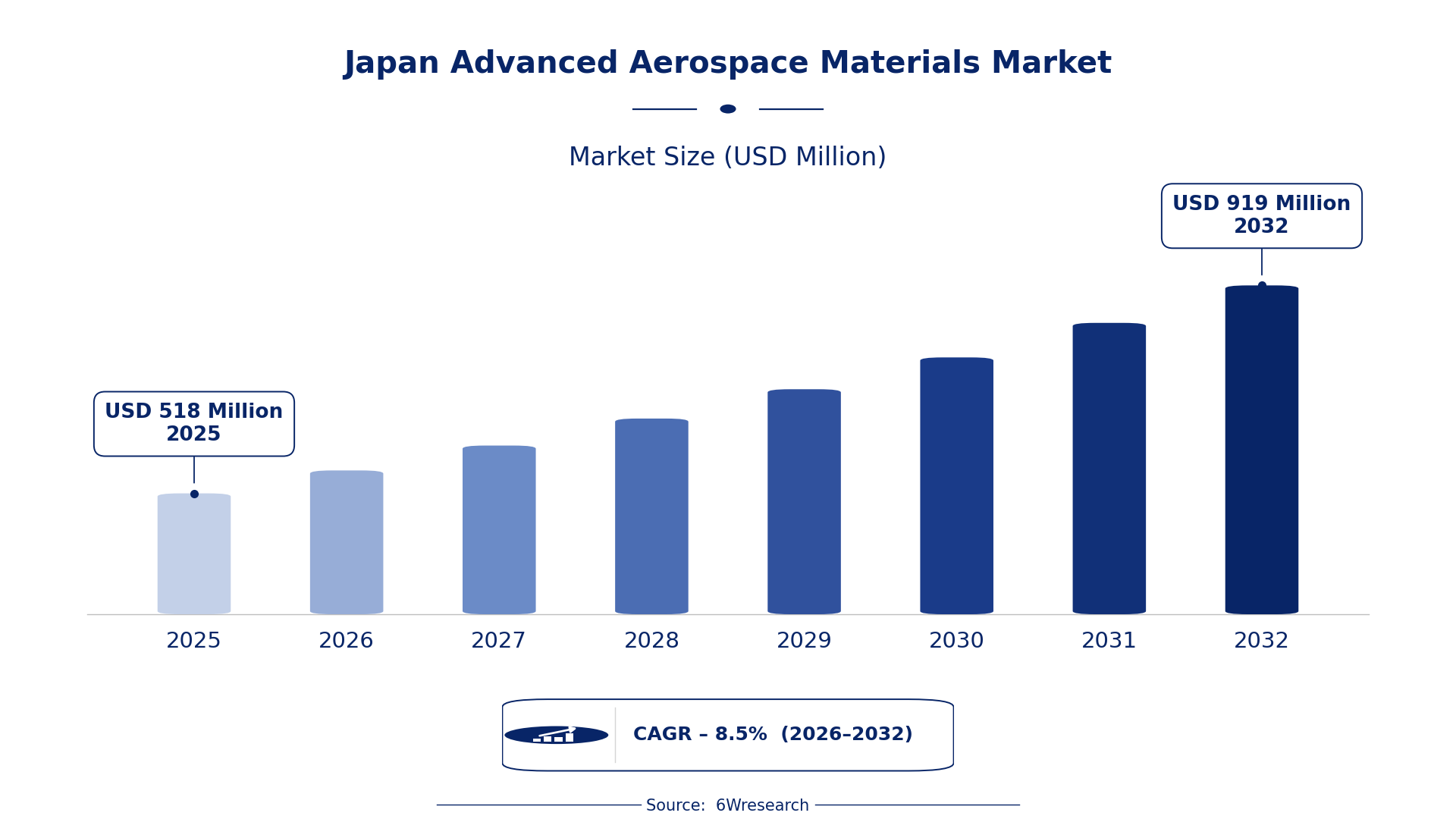
According to 6Wresearch internal database and industry insights, the Japan Advanced Aerospace Materials Market was valued at USD 518 Million in 2025 and is projected to reach USD 919 Million by 2032, growing at a CAGR of approximately 8.5% during 2026–2032.
Japan Advanced Aerospace Materials Market Highlights
| Report Metric | Details |
| Report Name | Japan Advanced Aerospace Materials Market (2026-2032) |
| Market Size 2025 | USD 518 Million |
| Market Size 2032 | USD 919 Million |
| Absolute Growth 2025–2032 | USD 401 Million |
| CAGR 2026–2032 | 8.5% |
| Peak Annual Growth | 9.7% in 2029 |
| Forecast Period | 2026–2032 |
| Historical Data | 2022–2025 |
| Base Year | 2025 |
| Leading Material Type, 2025 | Titanium Alloys (51% share) |
| Leading Application, 2025 | Aircraft Structures (45% share) |
| Leading Form Type, 2025 | Sheets & Plates (39% share) |
| Leading Distribution Channel, 2025 | Direct Sales (43% share) |
| Leading End User Industry, 2025 | Aerospace Manufacturers (40% share) |
| Fastest-Growing Material Type | Carbon Composites (11.9% CAGR) |
| Fastest-Growing Application | Engine Components (11.6% CAGR) |
| Fastest-Growing Form Type | Prepregs (12.3% CAGR) |
| Fastest-Growing Distribution Channel | Online Platforms (11.3% CAGR) |
| Fastest-Growing End User Industry | Defense Contractors (11.0% CAGR) |
| Growing Sector | Engine Components |
| Key End Users | Aircraft Structures, Engine Components, Thermal Insulation, Fuselage & Wings |
Japan Advanced Aerospace Materials Market Year-wise Growth Rate and Key Drivers (2022–2032)
This graph illustrates the annual growth rates of the market from 2022 to 2032, highlighting a steady upward trajectory and projected market expansion over the forecast period.
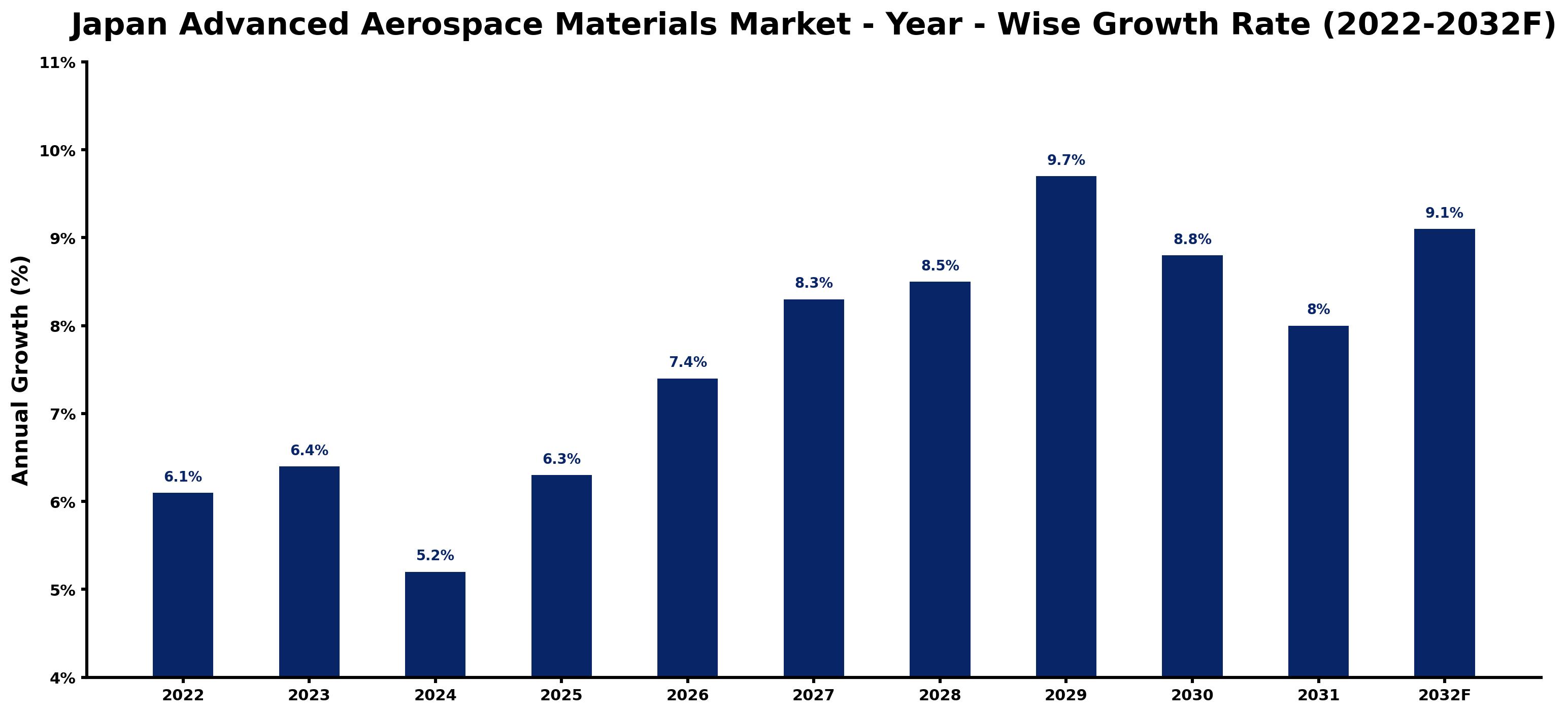
Below, each year's estimated growth is shown next to the factor that most influenced it.
| Year | Estimated Annual Growth (%) | Market Rationale |
| 2022 | 6.1 | The market showed solid demand from domestic manufacturers and defense contractors. |
| 2023 | 6.4 | Demand increased due to the adoption of the JIS Q 9100 standard in aerospace quality management. |
| 2024 | 5.2 | Growth slowed as supply chain challenges affected material availability. |
| 2025 | 6.3 | Demand accelerated with the government's 50 billion JPY aerospace innovation program. |
| 2026 | 7.4 | Investment in decarbonisation initiatives spurred growth in advanced materials. |
| 2027 | 8.3 | Rising production of commercial aircraft boosted demand for aerospace materials. |
| 2028 | 8.5 | Technological advancements in material science enhanced product offerings. |
| 2029 | 9.7 | Peak growth was driven by increased military spending and aerospace projects. |
| 2030 | 8.8 | Growth slowed as the market adjusted to previous rapid expansions. |
| 2031 | 8.0 | Demand stabilised as manufacturers focused on efficiency and sustainability. |
| 2032 | 9.1 | The market is expected to grow as new aerospace projects come online. |
Note: Market size estimations and growth projections presented in this report are based on 6Wresearch's proprietary forecasting methodology, utilizing the latest available industry data, government publications, and primary research inputs.
Japan Advanced Aerospace Materials Market Synopsis
Advanced aerospace materials are high-performance materials crucial for the aerospace industry, primarily composed of titanium alloys, carbon composites, and aluminum alloys. The Japan Advanced Aerospace Materials Market is expanding due to substantial investment in aerospace innovation, propelled by domestic manufacturers and defense contractors. The government aims for a 46% reduction in greenhouse gas emissions by 2030, which is driving demand for lightweight and efficient materials. Furthermore, the aerospace sector in Japan is valued at approximately 1.2 trillion JPY, highlighting strong market potential.
Market Dynamics Impact Analysis (2026–2032)
| Factor | Type | Impact | Primary Segment Affected |
| Increased investment in aerospace innovation | Driver | High | Aircraft Structures |
| Rising demand for lightweight materials | Driver | High | Carbon Composites |
| Growing need for sustainable materials | Opportunity | High | Titanium Alloys |
| Expansion of the defense sector | Opportunity | High | Engine Components |
| Supply chain disruptions affecting material availability | Restraint | High | Aluminum Alloys |
| High production costs for advanced materials | Restraint | Medium | Carbon Composites |
| Limited local production capacity for advanced materials | Challenge | High | Aircraft Structures |
| Technological challenges in material development | Challenge | Medium | Prepregs |
Evaluation of Drivers in Japan Advanced Aerospace Materials Market (2026–2032)
Key forces behind demand, with the segment each one moves most, are listed below.
| Drivers | Primary Segment Affected | Why It Matters (Evidence) |
| Investment in aerospace innovation programs | Aircraft Structures | In 2023, Japan launched a program with a budget of 50 billion JPY to enhance aerospace capabilities. |
| Rising production of commercial aircraft | Carbon Composites | Over 400 commercial aircraft are installed in Japan, driving demand for lightweight materials. |
| Government targets for emissions reduction | Titanium Alloys | Japan aims for a 46% cut in greenhouse gas emissions by 2030, increasing demand for sustainable materials. |
| Expansion of defense contracts | Engine Components | Defense contractors are increasingly using advanced materials for military applications, driving demand. |
| Adoption of quality management standards | Aluminum Alloys | The JIS Q 9100 standard is widely adopted, ensuring high-quality aerospace material production. |
The installed base of over 400 commercial aircraft significantly drives demand for lightweight materials, particularly carbon composites, which account for about 30% of modern aircraft materials. The focus on reducing greenhouse gas emissions is prompting manufacturers to seek sustainable titanium alloys. The expansion of defense contracts also fuels demand for engine components, while adherence to quality management standards ensures high production quality of aluminum alloys.
Evaluation of Restraints in Japan Advanced Aerospace Materials Market
The following restraints limit how fast demand can grow.
| Market Restraint | Primary Segment Affected | Why It Matters (Evidence) |
| Supply chain disruptions due to reliance on imported titanium alloys increase production costs for Aircraft Structures. | Aircraft Structures | Producers face higher costs, affecting pricing and competitiveness in the market. |
| Regulatory compliance with the JIS Q 9100 standard extends certification processes for Engine Components. | Engine Components | New suppliers may experience delays of up to six months, hindering timely market entry. |
| Rising costs of carbon composites inflate project expenses for Aerospace Manufacturers. | Aerospace Manufacturers | Carbon composites represent about 30% of materials, leading to increased overall project budgets. |
| Intense competition from international markets pressures local producers to lower prices for Aluminum Alloys. | Aluminum Alloys | This pricing pressure risks profit margins and limits innovation investment. |
| Limited availability of specialized Ceramic Matrix materials restricts applications in advanced aerospace projects. | Ceramic Matrix | The niche nature of these materials results in supply constraints, impacting project timelines. |
Japan Advanced Aerospace Materials Market Challenges
Producers face supply chain disruptions due to reliance on imported raw materials, resulting in increased production costs that can exceed 15% for domestic manufacturers. Compliance with the JIS Q 9100 standard creates regulatory hurdles, extending certification processes by up to six months for new suppliers, which delays their market entry. Intense competition from international markets forces local producers to lower prices, risking profit margins and limiting their capacity for innovation. Rising costs of carbon composites, which constitute about 30% of materials used in aircraft, can inflate overall project expenses by around 10% for buyers, straining their budgets.
Trends in the Japan Advanced Aerospace Materials Market
Below are the shifts with the largest effect on the Japan Advanced Aerospace Materials Market.
- Shift towards Sustainable Materials in Aerospace: Japan's aerospace sector is increasingly adopting sustainable materials, driven by the GX Promotion Act launched in 2023, which aims for a 46% reduction in greenhouse gas emissions by 2030. This shift is expected to boost demand for lightweight materials, with carbon composites comprising 30% of modern aircraft.
- Growth of Online Distribution Channels: The rise of online platforms for aerospace materials is evident in Tokyo, where the market is expanding rapidly. The growth rate for online sales channels is projected at 11.3% by 2032, reflecting changing purchasing behaviours among manufacturers.
- Increased Focus on Aerospace Innovation: Aerospace innovation initiatives commenced in 2023, with a government budget of 50 billion JPY allocated to support research and development. This funding is anticipated to improve material performance and production capabilities in the coming years.
- Emergence of Advanced Composite Manufacturing: The shift towards advanced composite manufacturing techniques began in 2026, with a growing emphasis on Prepregs, projected to grow at a CAGR of 12.3%. This trend highlights the industry's move towards more efficient production methods.
Investment Opportunities in the Japan Advanced Aerospace Materials Market
The following areas offer the clearest openings for investors and suppliers in the Japan Advanced Aerospace Materials Market.
- Tokyo's Aerospace Manufacturing Hub: Tokyo's aerospace manufacturers are seeking advanced titanium alloys to meet increasing performance standards. With a projected market size of 518 million USD by 2025, suppliers can enter through partnerships with local firms to improve distribution.
- Defense Contractors' Demand for Engine Components: Defense contractors in Japan are expanding their procurement of engine components, driven by increased military spending. With a projected growth rate of 11.0% for this sector, suppliers should consider joint ventures to tap into this demand.
- Investment in Carbon Composite Technologies: The need for lightweight materials in aircraft structures is prompting investment in carbon composite technologies. Suppliers can capitalise on this trend by establishing collaborations with aerospace manufacturers in Nagoya, where innovation is a priority.
- Approval Pathways for New Materials: The introduction of new aerospace materials requires compliance with the JIS Q 9100 standard. Suppliers should focus on obtaining necessary certifications to access the growing market for advanced materials, projected to reach 919 million USD by 2032.
Government Initiatives in the Japan Advanced Aerospace Materials Market
The GX Promotion Act, enacted in 2023, strengthens the legal framework for reducing greenhouse gas emissions in aerospace production. This act complements existing regulations such as the Chemical Substances Control Law, which mandates strict evaluation of materials used in manufacturing, ensuring compliance with environmental standards.
The Japan Aerospace Exploration Agency (JAXA) plays a crucial role in funding aerospace material research and development projects. With a budget allocation of 50 billion JPY in 2023, JAXA supports initiatives that promote innovation and sustainability in the aerospace sector.
Future Insight of the Japan Advanced Aerospace Materials Market
The introduction of a government programme promoting aerospace innovation will improve material technology and production processes. By 2032, Japan's goal of a 46% reduction in greenhouse gas emissions will drive investment in sustainable materials, benefiting domestic suppliers. The Japan Aerospace Exploration Agency will likely encourage new research partnerships, aligning academic advancements with industry requirements. As the installed base of commercial aircraft exceeds 400 units, demand for advanced aerospace materials will continue to rise, creating opportunities for suppliers.
Market Segmentation Analysis
Japan Advanced Aerospace Materials Market report covers a detailed analysis of the following market segments:
By Material Type – Titanium Alloys Lead, Carbon Composites Expected to Grow Fastest
According to Saurav Kr Singh, Senior Research Analyst at 6Wresearch, with 51% of material type revenue in 2025, Titanium Alloys was the largest category. Titanium alloys are crucial for critical structural components in aircraft, making them indispensable for aerospace manufacturers. Their widespread use in Japan's aerospace sector, which is valued at approximately 1.2 trillion JPY, solidifies their dominant position. Carbon Composites are set to record the highest CAGR in this split, 11.9% over 2026–2032. The growing demand for carbon composites is attributed to their lightweight and strong characteristics, essential for modern aircraft designs. With carbon composites accounting for about 30% of materials used in contemporary aircraft, their market growth is expected to accelerate. Suppliers should focus on enhancing their carbon composite offerings to meet the surging demand in the aerospace sector.
By Application – Aircraft Structures Lead, Engine Components Expected to Grow Fastest
Aircraft Structures held 45% of the Japan Advanced Aerospace Materials Market by application in 2025. Aircraft structures are fundamental for ensuring the integrity and performance of aircraft, establishing them as the leading application for advanced aerospace materials. The presence of over 400 commercial aircraft in Japan underscores the critical requirement for these materials. Over 2026–2032, Engine Components are expected to post the fastest growth, at a CAGR of 11.6%. Engine components are seeing rapid growth due to their vital role in enhancing engine efficiency and safety. As advancements in Japan's aerospace sector continue, the demand for materials in engine components is projected to rise significantly. Buyers in the aerospace industry must prioritise sourcing high-quality materials for engine components to meet stringent safety regulations.
By Form Type – Sheets & Plates Lead, Prepregs Expected to Grow Fastest
The largest form type category in 2025 was Sheets & Plates, at 39% of revenue. Sheets and plates are the most common forms for manufacturing components, providing versatility in production processes. Their widespread application in various aerospace structures solidifies their leading position in the market. The quickest growth will come from Prepregs, forecast to expand at a CAGR of 12.3% between 2026 and 2032. Prepregs are gaining traction due to their effectiveness in composite manufacturing processes, which are increasingly favoured in aerospace applications. As the industry pushes for lighter and stronger materials, the demand for prepregs is set to rise. Suppliers should consider expanding their production capabilities for prepregs to meet the anticipated increase in demand.
By Distribution Channel – Direct Sales Leads, Online Platforms Expected to Grow Fastest
In 2025, Direct Sales led the distribution channel split with a 43% share. Direct sales are the primary channel for industrial transactions in the aerospace sector, where trust and established relationships are essential. This channel effectively meets the requirements of aerospace manufacturers and contractors. Online Platforms are projected to grow fastest, at a CAGR of 11.3% during 2026–2032. Online platforms are emerging as a significant channel for niche products, driven by the increasing digitalisation of procurement processes. As buyers seek convenience, the growth of this distribution channel is anticipated to continue. Suppliers should enhance their online presence to cater to the growing number of buyers who prefer digital purchasing options.
By End User Industry – Aerospace Manufacturers Lead, Defense Contractors Expected to Grow Fastest
Aerospace Manufacturers accounted for 40% of the market by end user industry in 2025. Aerospace manufacturers are the largest consumers of advanced aerospace materials, relying on them for various applications in aircraft production. Their substantial investments in innovation and production capacity ensure a steady demand for these materials. Defense Contractors are set to record the highest CAGR in this split, 11.0% over 2026–2032. Defense contractors are experiencing increased demand for advanced materials due to their critical applications in military projects. As Japan strengthens its defense capabilities, the need for high-performance materials in this sector is expected to grow further. Buyers in the defense sector should align their procurement strategies to secure advanced materials that meet rigorous performance standards.
Key Attractiveness of the Report
- 10 Years of Market Numbers
- Historical Data Starting from 2022 to 2025
- Base Year 2025
- Forecast Data until 2032
- Key Performance Indicators Impacting the Market
- Major Upcoming Developments and Projects
Key Highlights of the Report:
- Japan Advanced Aerospace Materials Market Outlook
- Market Size of Japan Advanced Aerospace Materials Market, 2025
- Forecast of Japan Advanced Aerospace Materials Market, 2032
- Historical Data and Forecast of Japan Advanced Aerospace Materials Revenues & Volume for the Period 2022-2032F
- Japan Advanced Aerospace Materials Market Trend Evolution
- Japan Advanced Aerospace Materials Market Drivers and Challenges
- Japan Advanced Aerospace Materials Price Trends
- Japan Advanced Aerospace Materials Porter's Five Forces
- Japan Advanced Aerospace Materials Industry Life Cycle
- Historical Data and Forecast of Japan Advanced Aerospace Materials Market Revenues & Volume By Material Type for the Period 2022-2032F
- Historical Data and Forecast of Japan Advanced Aerospace Materials Market Revenues & Volume By Titanium Alloys for the Period 2022-2032F
- Historical Data and Forecast of Japan Advanced Aerospace Materials Market Revenues & Volume By Carbon Composites for the Period 2022-2032F
- Historical Data and Forecast of Japan Advanced Aerospace Materials Market Revenues & Volume By Ceramic Matrix for the Period 2022-2032F
- Historical Data and Forecast of Japan Advanced Aerospace Materials Market Revenues & Volume By Aluminum Alloys for the Period 2022-2032F
- Historical Data and Forecast of Japan Advanced Aerospace Materials Market Revenues & Volume By Application for the Period 2022-2032F
- Historical Data and Forecast of Japan Advanced Aerospace Materials Market Revenues & Volume By Aircraft Structures for the Period 2022-2032F
- Historical Data and Forecast of Japan Advanced Aerospace Materials Market Revenues & Volume By Engine Components for the Period 2022-2032F
- Historical Data and Forecast of Japan Advanced Aerospace Materials Market Revenues & Volume By Thermal Insulation for the Period 2022-2032F
- Historical Data and Forecast of Japan Advanced Aerospace Materials Market Revenues & Volume By Fuselage & Wings for the Period 2022-2032F
- Historical Data and Forecast of Japan Advanced Aerospace Materials Market Revenues & Volume By Form Type for the Period 2022-2032F
- Historical Data and Forecast of Japan Advanced Aerospace Materials Market Revenues & Volume By Sheets & Plates for the Period 2022-2032F
- Historical Data and Forecast of Japan Advanced Aerospace Materials Market Revenues & Volume By Prepregs for the Period 2022-2032F
- Historical Data and Forecast of Japan Advanced Aerospace Materials Market Revenues & Volume By Powders for the Period 2022-2032F
- Historical Data and Forecast of Japan Advanced Aerospace Materials Market Revenues & Volume By Rods & Bars for the Period 2022-2032F
- Historical Data and Forecast of Japan Advanced Aerospace Materials Market Revenues & Volume By Distribution Channel for the Period 2022-2032F
- Historical Data and Forecast of Japan Advanced Aerospace Materials Market Revenues & Volume By Direct Sales for the Period 2022-2032F
- Historical Data and Forecast of Japan Advanced Aerospace Materials Market Revenues & Volume By Online Platforms for the Period 2022-2032F
- Historical Data and Forecast of Japan Advanced Aerospace Materials Market Revenues & Volume By Industrial Suppliers for the Period 2022-2032F
- Historical Data and Forecast of Japan Advanced Aerospace Materials Market Revenues & Volume By Specialty Stores for the Period 2022-2032F
- Historical Data and Forecast of Japan Advanced Aerospace Materials Market Revenues & Volume By End User Industry for the Period 2022-2032F
- Historical Data and Forecast of Japan Advanced Aerospace Materials Market Revenues & Volume By Aerospace Manufacturers for the Period 2022-2032F
- Historical Data and Forecast of Japan Advanced Aerospace Materials Market Revenues & Volume By Defense Contractors for the Period 2022-2032F
- Historical Data and Forecast of Japan Advanced Aerospace Materials Market Revenues & Volume By Satellite Industry for the Period 2022-2032F
- Historical Data and Forecast of Japan Advanced Aerospace Materials Market Revenues & Volume By Commercial Aviation for the Period 2022-2032F
- Japan Advanced Aerospace Materials Import Export Trade Statistics
- Market Opportunity Assessment By Material Type
- Market Opportunity Assessment By Application
- Market Opportunity Assessment By Form Type
- Market Opportunity Assessment By Distribution Channel
- Market Opportunity Assessment By End User Industry
- Japan Advanced Aerospace Materials Top Companies Market Share
- Japan Advanced Aerospace Materials Competitive Benchmarking By Technical and Operational Parameters
- Japan Advanced Aerospace Materials Company Profiles
- Japan Advanced Aerospace Materials Key Strategic Recommendations
Market Covered
This report examines the market across the segments below.
By Material Type
- Titanium Alloys
- Carbon Composites
- Ceramic Matrix
- Aluminum Alloys
By Application
- Aircraft Structures
- Engine Components
- Thermal Insulation
- Fuselage & Wings
By Form Type
- Sheets & Plates
- Prepregs
- Powders
- Rods & Bars
By Distribution Channel
- Direct Sales
- Online Platforms
- Industrial Suppliers
- Specialty Stores
By End User Industry
- Aerospace Manufacturers
- Defense Contractors
- Satellite Industry
- Commercial Aviation































