Japan Advanced Battery Components Market Size & Growth Rate
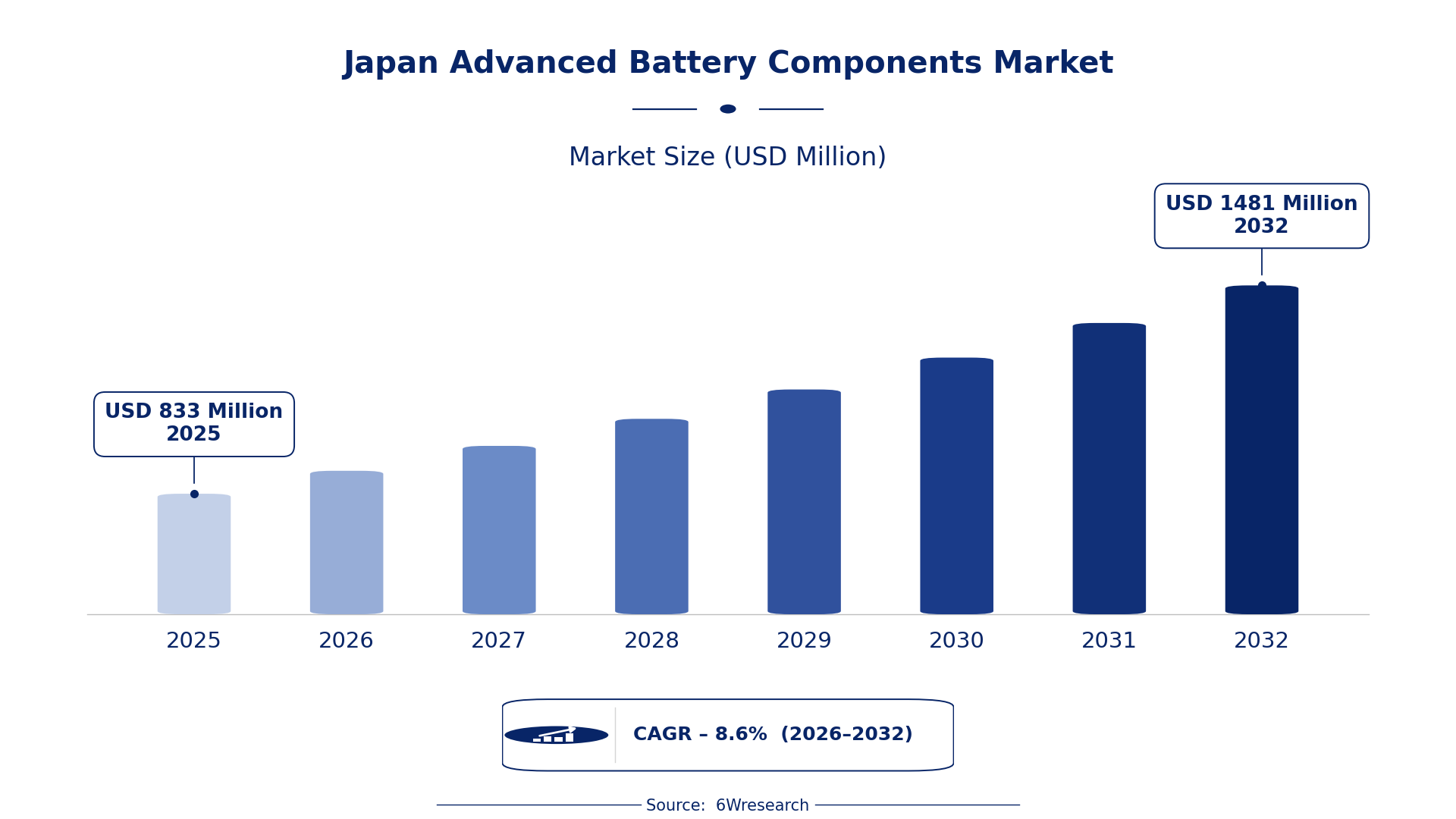
According to 6Wresearch internal database and industry insights, the Japan Advanced Battery Components Market was valued at USD 833 Million in 2025 and is projected to reach USD 1,481 Million by 2032, growing at a CAGR of approximately 8.6% during 2026–2032.
Japan Advanced Battery Components Market Highlights
| Report Metric | Details |
| Report Name | Japan Advanced Battery Components Market (2026-2032) |
| Market Size 2025 | USD 833 Million |
| Market Size 2032 | USD 1,481 Million |
| Absolute Growth 2025–2032 | USD 648 Million |
| CAGR 2026–2032 | 8.6% |
| Peak Annual Growth | 9.6% in 2029 |
| Forecast Period | 2026–2032 |
| Historical Data | 2022–2025 |
| Base Year | 2025 |
| Leading Component Type, 2025 | Anode Materials (40% share) |
| Leading Battery Chemistry, 2025 | Lithium-Ion (44% share) |
| Leading Application, 2025 | Electric Vehicles (41% share) |
| Leading Distribution Channel, 2025 | OEMs (47% share) |
| Leading End Use Sector, 2025 | Automotive (50% share) |
| Fastest-Growing Component Type | Electrolytes (12.1% CAGR) |
| Fastest-Growing Battery Chemistry | Solid-State (11.7% CAGR) |
| Fastest-Growing Application | Energy Storage (11.8% CAGR) |
| Fastest-Growing Distribution Channel | Industrial Suppliers (11.3% CAGR) |
| Fastest-Growing End Use Sector | Utility Providers (11.1% CAGR) |
| Growing Sector | Energy Storage |
| Key End Users | Electric Vehicles, Energy Storage, Consumer Devices, Medical Devices |
Japan Advanced Battery Components Market Year-wise Growth Rate and Key Drivers (2022–2032)
This graph illustrates the annual growth rates of the market from 2022 to 2032, highlighting a steady upward trajectory and projected market expansion over the forecast period.
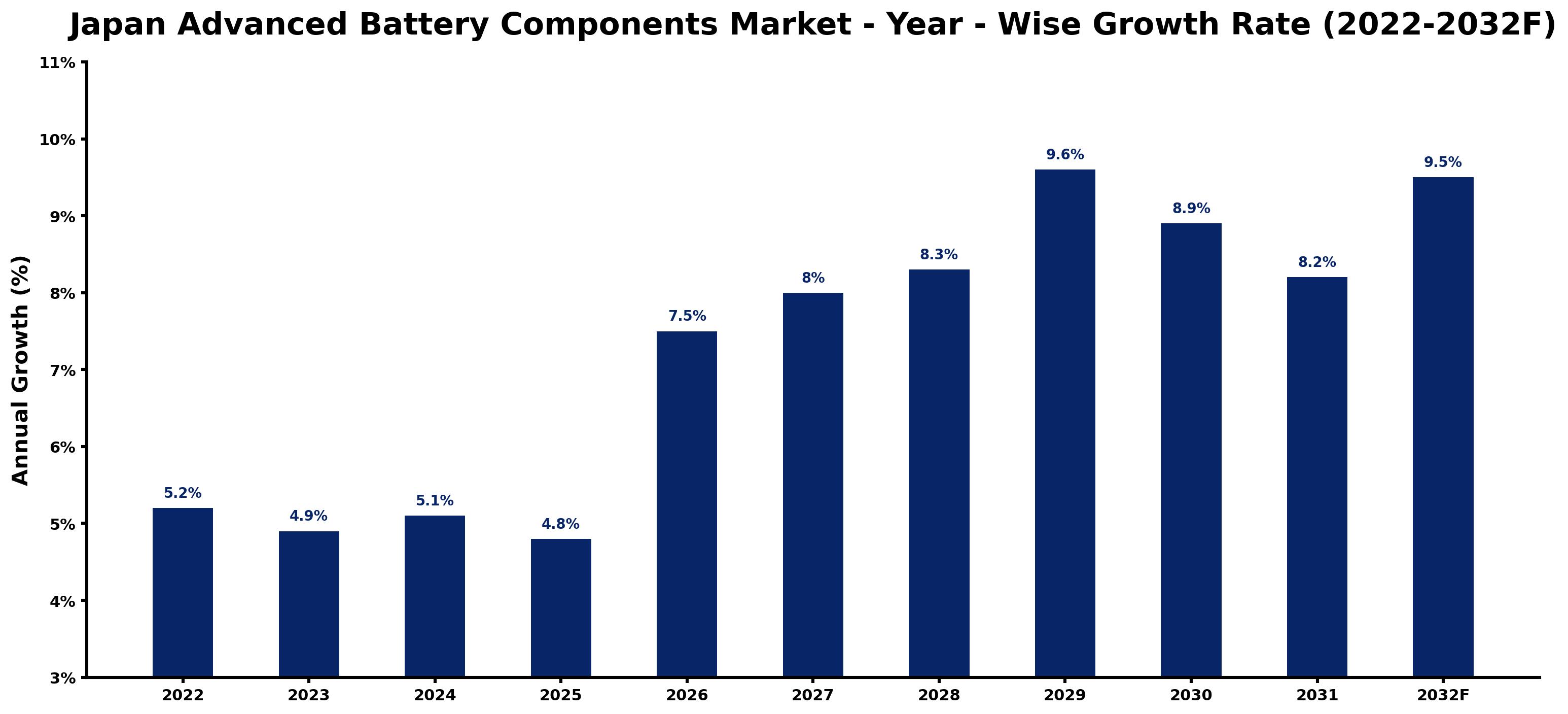
Below, each year's estimated growth is shown next to the factor that most influenced it.
| Year | Estimated Annual Growth (%) | Market Rationale |
| 2022 | 5.2 | Growth was driven by strong demand from the automotive sector, particularly for electric vehicles. |
| 2023 | 4.9 | Demand slowed slightly due to production challenges and skills shortages in advanced manufacturing. |
| 2024 | 5.1 | Increased investments in battery manufacturing capacity spurred faster growth compared to the previous year. |
| 2025 | 4.8 | Growth slowed again as producers faced rising raw material costs impacting overall production. |
| 2026 | 7.5 | Investment in domestic battery capacity began to yield results, driving demand for essential components. |
| 2027 | 8.0 | The market saw a boost as demand for electric vehicles continued to rise significantly. |
| 2028 | 8.3 | Growing interest in energy storage systems contributed to an acceleration in component purchases. |
| 2029 | 9.6 | The peak growth year was marked by heightened investments in solid-state battery technologies. |
| 2030 | 8.9 | A slight slowdown occurred as the market began to stabilise after rapid growth phases. |
| 2031 | 8.2 | Market growth continued but at a reduced pace due to maturing production capabilities. |
| 2032 | 9.5 | Demand is expected to rise again as new technologies improve efficiency and sustainability. |
Note: Market size estimations and growth projections presented in this report are based on 6Wresearch's proprietary forecasting methodology, utilizing the latest available industry data, government publications, and primary research inputs.
Japan Advanced Battery Components Market Synopsis
Advanced battery components are critical materials for batteries, particularly in electric vehicles and energy storage systems. These components, including anode materials and electrolytes, are produced through chemical processes involving lithium and nickel. The Japan Advanced Battery Components Market is growing due to strong demand from the automotive and electronics sectors, driven by public and private investments targeting JPY 150 trillion over the next decade for decarbonisation and battery manufacturing capacity.
Market Dynamics Impact Analysis (2026–2032)
| Factor | Type | Impact | Primary Segment Affected |
| Growing investment in domestic battery manufacturing capacity | Driver | High | Anode Materials |
| Increased adoption of electric vehicles | Driver | High | Electric Vehicles |
| Rising demand for energy storage solutions | Opportunity | High | Energy Storage |
| Emerging technologies in battery chemistry | Opportunity | Medium | Solid-State |
| Supply chain disruptions affecting material availability | Restraint | High | Electrolytes |
| High production costs for advanced components | Restraint | Medium | Cathode Materials |
| Limited local production capacity for certain materials | Challenge | High | Separators |
| Competition from alternative battery technologies | Challenge | Medium | Lithium-Ion |
Evaluation of Drivers in Japan Advanced Battery Components Market (2026–2032)
The main growth drivers and the segments they affect most are set out below.
| Drivers | Primary Segment Affected | Why It Matters (Evidence) |
| Investment in battery manufacturing capacity | Anode Materials | Japan targets 150 GWh of domestic battery capacity by 2030, increasing demand for anode materials. |
| Growing electric vehicle market | Electric Vehicles | The automotive sector is projected to hold a 50% share in advanced battery components by 2025. |
| Rising energy storage needs | Energy Storage | The demand for energy storage systems is set to increase as renewable energy integration grows. |
| Technological advancements in battery chemistry | Solid-State | Emerging solid-state technologies are expected to grow at 11.7% CAGR, boosting component demand. |
| Government decarbonisation initiatives | Electrolytes | Japan's GX Basic Policy aims for JPY 150 trillion in decarbonisation investments over 10 years. |
Purchasing is picking up as investment in battery manufacturing capacity increases. Japan's target of 150 GWh of domestic battery capacity by 2030 drives demand for anode materials, essential for performance. The electric vehicle market is projected to hold a 50% share in advanced battery components by 2025, leading to higher purchases from automotive manufacturers. The growing need for energy storage systems is likely to boost demand for electrolytes, necessary for ion conduction. Advancements in solid-state batteries are further unlocking demand for new components, with a projected CAGR of 11.7%.
Evaluation of Restraints in Japan Advanced Battery Components Market
These restraints slow adoption and weigh on supplier margins.
| Market Restraint | Primary Segment Affected | Why It Matters (Evidence) |
| Supply chain disruptions affecting material availability | Electrolytes | Recent global supply chain issues have led to shortages of critical materials, impacting production timelines. |
| High production costs for advanced components | Cathode Materials | Rising costs of raw materials such as nickel and cobalt are squeezing profit margins for manufacturers. |
| Limited local production capacity for certain materials | Separators | The inability to scale local production of separators is constraining supply for battery manufacturers. |
| Competition from alternative battery technologies | Lithium-Ion | Emerging battery technologies are drawing investment away from traditional lithium-ion components. |
| Regulatory hurdles in material sourcing | Anode Materials | Strict regulations on sourcing materials can delay production and increase costs for manufacturers. |
Japan Advanced Battery Components Market Challenges
Increased demand for advanced battery components strains production capabilities for producers, resulting in delayed deliveries for buyers in the automotive and electronics sectors. Skills shortages in specialised manufacturing processes restrict production scalability, potentially extending lead times by 20%. Rising costs of raw materials, such as lithium and nickel, inflate prices for producers, which in turn raises costs for buyers, possibly increasing the price of electric vehicles by 15%. Technology gaps in manufacturing processes hinder efficiency, causing further delays and impacting producers' ability to meet market needs.
Trends in the Japan Advanced Battery Components Market
The following changes are redrawing the Japan Advanced Battery Components Market.
- Shift towards Solid-State Battery Technology: Japan is experiencing a shift towards solid-state battery technology, promising higher energy density and safety. The projected CAGR for solid-state batteries is 11.7%, indicating a growing interest in this innovation.
- Increased Focus on Energy Storage Solutions: The demand for energy storage solutions is rising as Japan integrates more renewable energy sources. By 2030, energy storage systems are expected to play a key role in stabilising the grid.
- Growth of Domestic Battery Manufacturing: Japan's domestic battery manufacturing is expanding, with a target of 150 GWh capacity by 2030. This growth is driven by substantial investments in local production facilities.
- Emergence of New Distribution Channels: The distribution of advanced battery components is evolving, with industrial suppliers growing at a CAGR of 11.3%. This shift reflects changing buyer preferences and market trends.
Investment Opportunities in the Japan Advanced Battery Components Market
The opportunities below stand out in the Japan Advanced Battery Components Market for new entrants and existing suppliers.
- Investment in Energy Storage Systems: With Japan's energy storage market projected to grow, suppliers can invest in advanced components for energy storage systems, targeting utility providers to meet rising demand for renewable energy integration.
- Partnerships for Battery Recycling: As the need for sustainable practices increases, forming partnerships with recycling facilities can help suppliers tap into the growing market for recycled battery components, addressing environmental concerns.
- Expansion into Emerging Markets: With the global push for electric vehicles, now is the time for manufacturers to expand into emerging markets, utilising Japan's advanced technology to meet international demand.
- New Opportunities in Distribution Channels: The rise of online platforms for component sales presents an opportunity for suppliers to reach a broader customer base, particularly among smaller manufacturers.
Government Initiatives in the Japan Advanced Battery Components Market
The Economic Security Promotion Act (2022) supports supply-chain resilience for critical products and materials, ensuring that producers can maintain stable operations. This law aims to improve local production capabilities and reduce reliance on imports, which is crucial for the advanced battery components sector. Additionally, this act facilitates better access to necessary materials, improving overall supply chain efficiency.
The GX Promotion Act (2023) serves as the legal foundation for Japan's Green Transformation strategy, which includes substantial funding for battery manufacturing initiatives. The Ministry of Economy, Trade and Industry (METI) oversees this funding, which targets the development of domestic battery production capabilities and supports the transition to a low-carbon economy.
Future Insight of the Japan Advanced Battery Components Market
Japan's policy-driven shift towards decarbonisation will spur substantial investment in advanced battery component production by 2032, with JPY 150 trillion earmarked for decarbonisation initiatives. This transition will encourage suppliers to adopt new manufacturing technologies, improving operational efficiency. As demand for advanced components escalates, innovations in recycling technologies will emerge, enhancing sustainability. Buyers will benefit from more reliable supply chains, ensuring timely access to essential materials for energy storage and electric vehicle production.
Market Segmentation Analysis
Japan Advanced Battery Components Market report covers a detailed analysis of the following market segments:
By Component Type – Anode Materials Lead, Electrolytes Expected to Grow Fastest
According to Saurav Kr Singh, Senior Research Analyst at 6Wresearch, with 40% of component type revenue in 2025, Anode Materials was the largest category. Anode materials hold the largest share as they are essential for battery performance, particularly in electric vehicles. The strong demand from Japan's automotive sector, which is increasingly focused on electrification, drives the reliance on these materials. Over 2026–2032, Electrolytes are expected to post the fastest growth, at a CAGR of 12.1%. Electrolytes are experiencing the fastest growth due to their crucial role in ion conduction, which is vital for battery efficiency. The rising adoption of advanced battery technologies, especially in electric vehicles, is significantly boosting this segment's expansion. Suppliers should enhance production capabilities for electrolytes to meet the surging demand.
By Battery Chemistry – Lithium-Ion Leads, Solid-State Expected to Grow Fastest
Lithium-Ion took 44% of battery chemistry revenue in 2025, more than any other category. Lithium-ion batteries dominate the market as they are the predominant type used in electric vehicles and energy storage systems. Their established manufacturing processes and widespread application across various sectors ensure their leading position. Solid-State is projected to grow fastest, at a CAGR of 11.7% during 2026–2032. Solid-state batteries are rapidly gaining traction due to their potential for improved energy density and safety, attracting significant investment for development. This emerging technology is poised to transform the battery market in the near future. Buyers should monitor advancements in solid-state technology for potential performance benefits.
By Application – Electric Vehicles Lead, Energy Storage Expected to Grow Fastest
In 2025, Electric Vehicles led the application split with a 41% share. Electric vehicles represent the largest application for advanced battery components, driven by Japan's commitment to reducing greenhouse gas emissions and promoting electric vehicle adoption. Government policies that support sustainable transportation further enhance this sector's growth. Energy Storage is set to record the highest CAGR in this split, 11.8% over 2026–2032. Energy storage is expanding rapidly as it is crucial for integrating renewable energy sources into the grid. The increasing demand for reliable energy storage solutions is propelling this segment's growth. Suppliers must align their strategies with the expanding energy storage market to seize new opportunities.
By Distribution Channel – OEMs Lead, Industrial Suppliers Expected to Grow Fastest
OEMs accounted for 47% of the market by distribution channel in 2025. OEMs serve as the primary distribution channel for advanced battery components, directly manufacturing electric vehicles and energy storage systems. Their established connections with component suppliers ensure consistent demand for these materials. The quickest growth will come from Industrial Suppliers, forecast to expand at a CAGR of 11.3% between 2026 and 2032. Industrial suppliers are experiencing the fastest growth as they address the needs of various sectors requiring advanced battery components. Their ability to serve multiple industries is driving their rapid expansion. Suppliers should consider partnerships with industrial suppliers to broaden their market reach.
By End Use Sector – Automotive Leads, Utility Providers Expected to Grow Fastest
The largest end use sector category in 2025 was Automotive, at 50% of revenue. The automotive sector is the largest end-use market for advanced battery components, as electric vehicles require substantial quantities of these materials. Japan's automotive industry plays a pivotal role in the global electric vehicle market, reinforcing this sector's leadership. Over 2026–2032, Utility Providers are expected to post the fastest growth, at a CAGR of 11.1%. Utility providers are experiencing rapid growth due to their involvement in energy storage solutions, which are essential for integrating renewable energy. This sector's heightened focus on sustainability is driving demand for advanced battery components. Suppliers should explore opportunities within the utility sector to capitalise on the growing demand for energy storage solutions.
Key Attractiveness of the Report
- 10 Years of Market Numbers
- Historical Data Starting from 2022 to 2025
- Base Year 2025
- Forecast Data until 2032
- Key Performance Indicators Impacting the Market
- Major Upcoming Developments and Projects
Key Highlights of the Report:
- Japan Advanced Battery Components Market Outlook
- Market Size of Japan Advanced Battery Components Market, 2025
- Forecast of Japan Advanced Battery Components Market, 2032
- Historical Data and Forecast of Japan Advanced Battery Components Revenues & Volume for the Period 2022-2032F
- Japan Advanced Battery Components Market Trend Evolution
- Japan Advanced Battery Components Market Drivers and Challenges
- Japan Advanced Battery Components Price Trends
- Japan Advanced Battery Components Porter's Five Forces
- Japan Advanced Battery Components Industry Life Cycle
- Historical Data and Forecast of Japan Advanced Battery Components Market Revenues & Volume By Component Type for the Period 2022-2032F
- Historical Data and Forecast of Japan Advanced Battery Components Market Revenues & Volume By Anode Materials for the Period 2022-2032F
- Historical Data and Forecast of Japan Advanced Battery Components Market Revenues & Volume By Electrolytes for the Period 2022-2032F
- Historical Data and Forecast of Japan Advanced Battery Components Market Revenues & Volume By Cathode Materials for the Period 2022-2032F
- Historical Data and Forecast of Japan Advanced Battery Components Market Revenues & Volume By Separators for the Period 2022-2032F
- Historical Data and Forecast of Japan Advanced Battery Components Market Revenues & Volume By Battery Chemistry for the Period 2022-2032F
- Historical Data and Forecast of Japan Advanced Battery Components Market Revenues & Volume By Lithium-Ion for the Period 2022-2032F
- Historical Data and Forecast of Japan Advanced Battery Components Market Revenues & Volume By Solid-State for the Period 2022-2032F
- Historical Data and Forecast of Japan Advanced Battery Components Market Revenues & Volume By Lithium-Ion for the Period 2022-2032F
- Historical Data and Forecast of Japan Advanced Battery Components Market Revenues & Volume By Nickel-Metal Hydride for the Period 2022-2032F
- Historical Data and Forecast of Japan Advanced Battery Components Market Revenues & Volume By Application for the Period 2022-2032F
- Historical Data and Forecast of Japan Advanced Battery Components Market Revenues & Volume By Electric Vehicles for the Period 2022-2032F
- Historical Data and Forecast of Japan Advanced Battery Components Market Revenues & Volume By Energy Storage for the Period 2022-2032F
- Historical Data and Forecast of Japan Advanced Battery Components Market Revenues & Volume By Consumer Devices for the Period 2022-2032F
- Historical Data and Forecast of Japan Advanced Battery Components Market Revenues & Volume By Medical Devices for the Period 2022-2032F
- Historical Data and Forecast of Japan Advanced Battery Components Market Revenues & Volume By Distribution Channel for the Period 2022-2032F
- Historical Data and Forecast of Japan Advanced Battery Components Market Revenues & Volume By OEMs for the Period 2022-2032F
- Historical Data and Forecast of Japan Advanced Battery Components Market Revenues & Volume By Industrial Suppliers for the Period 2022-2032F
- Historical Data and Forecast of Japan Advanced Battery Components Market Revenues & Volume By Online Platforms for the Period 2022-2032F
- Historical Data and Forecast of Japan Advanced Battery Components Market Revenues & Volume By Direct Sales for the Period 2022-2032F
- Historical Data and Forecast of Japan Advanced Battery Components Market Revenues & Volume By End Use Sector for the Period 2022-2032F
- Historical Data and Forecast of Japan Advanced Battery Components Market Revenues & Volume By Automotive for the Period 2022-2032F
- Historical Data and Forecast of Japan Advanced Battery Components Market Revenues & Volume By Utility Providers for the Period 2022-2032F
- Historical Data and Forecast of Japan Advanced Battery Components Market Revenues & Volume By Electronics for the Period 2022-2032F
- Historical Data and Forecast of Japan Advanced Battery Components Market Revenues & Volume By Healthcare Sector for the Period 2022-2032F
- Japan Advanced Battery Components Import Export Trade Statistics
- Market Opportunity Assessment By Component Type
- Market Opportunity Assessment By Battery Chemistry
- Market Opportunity Assessment By Application
- Market Opportunity Assessment By Distribution Channel
- Market Opportunity Assessment By End Use Sector
- Japan Advanced Battery Components Top Companies Market Share
- Japan Advanced Battery Components Competitive Benchmarking By Technical and Operational Parameters
- Japan Advanced Battery Components Company Profiles
- Japan Advanced Battery Components Key Strategic Recommendations
Market Covered
This report examines the market across the segments below.
By Component Type
- Anode Materials
- Electrolytes
- Cathode Materials
- Separators
By Battery Chemistry
- Lithium-Ion
- Solid-State
- Nickel-Metal Hydride
By Application
- Electric Vehicles
- Energy Storage
- Consumer Devices
- Medical Devices
By Distribution Channel
- OEMs
- Industrial Suppliers
- Online Platforms
- Direct Sales
By End Use Sector
- Automotive
- Utility Providers
- Electronics
- Healthcare Sector































