Japan Advanced Battery Technologies Market Size & Growth Rate
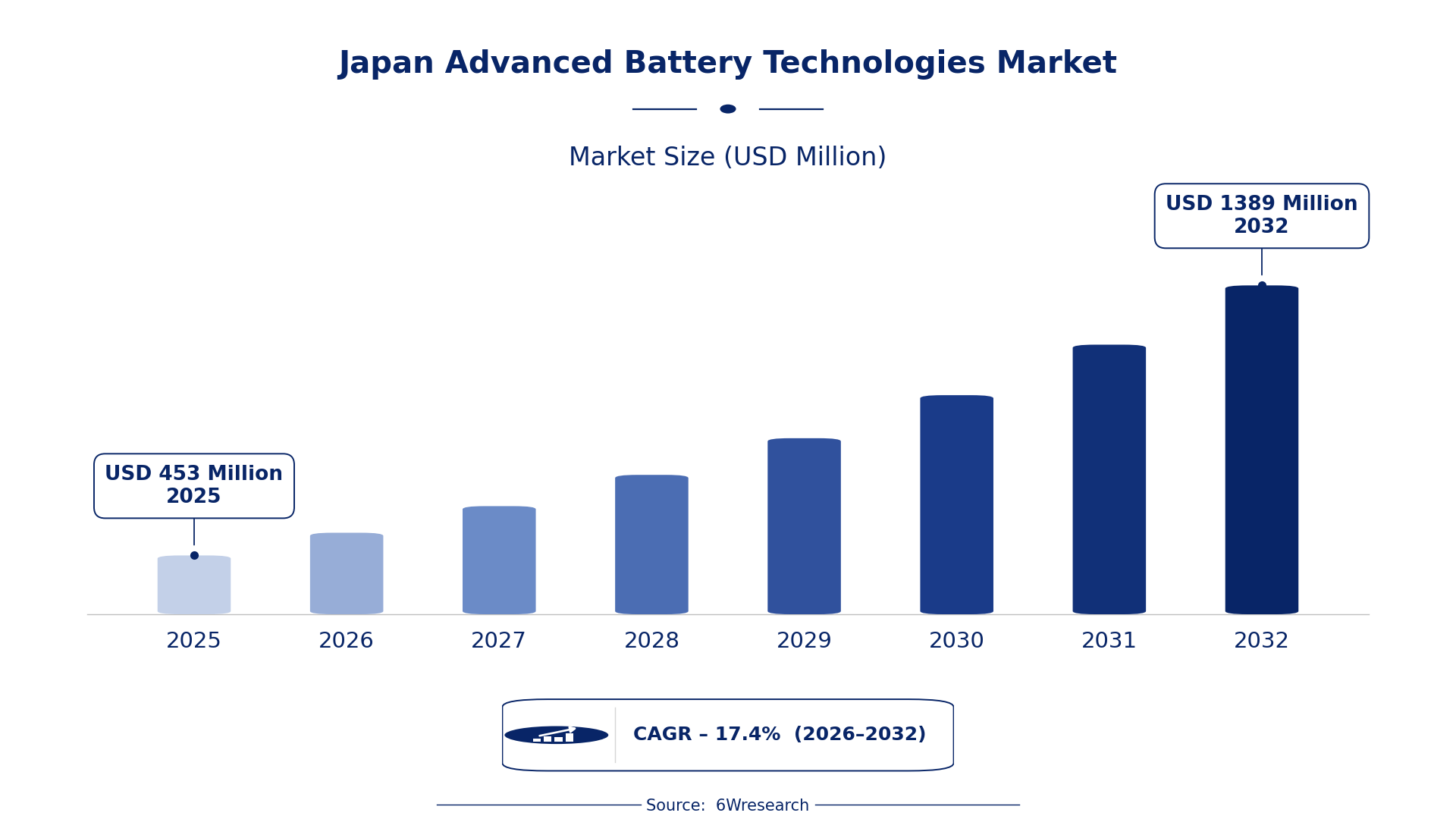
According to 6Wresearch internal database and industry insights, the Japan Advanced Battery Technologies Market was valued at USD 453 Million in 2025 and is projected to reach USD 1,389 Million by 2032, growing at a CAGR of approximately 17.4% during 2026–2032.
Japan Advanced Battery Technologies Market Highlights
| Report Metric | Details |
| Report Name | Japan Advanced Battery Technologies Market (2026-2032) |
| Market Size 2025 | USD 453 Million |
| Market Size 2032 | USD 1,389 Million |
| Absolute Growth 2025–2032 | USD 936 Million |
| CAGR 2026–2032 | 17.4% |
| Peak Annual Growth | 23.7% in 2026 |
| Forecast Period | 2026–2032 |
| Historical Data | 2022–2025 |
| Base Year | 2025 |
| Leading Technology Type, 2025 | Solid-State Batteries (46% share) |
| Leading Battery Chemistry, 2025 | Lithium (53% share) |
| Leading Application, 2025 | Electric Vehicles (40% share) |
| Leading Distribution Channel, 2025 | OEMs (35% share) |
| Leading End User, 2025 | Automotive Sector (48% share) |
| Fastest-Growing Battery Chemistry | Lithium Polymer (22.8% CAGR) |
| Fastest-Growing Application | Grid Storage (23.5% CAGR) |
| Fastest-Growing Distribution Channel | Direct Sales (21.2% CAGR) |
| Fastest-Growing End User | Energy Providers (21.4% CAGR) |
| Growing Sector | Electric Vehicles |
| Key End Users | Automotive Sector, Energy Providers, Tech Manufacturers, Consumers |
Japan Advanced Battery Technologies Market Year-wise Growth Rate and Key Drivers (2022–2032)
This graph illustrates the annual growth rates of the market from 2022 to 2032, highlighting a steady upward trajectory and projected market expansion over the forecast period.
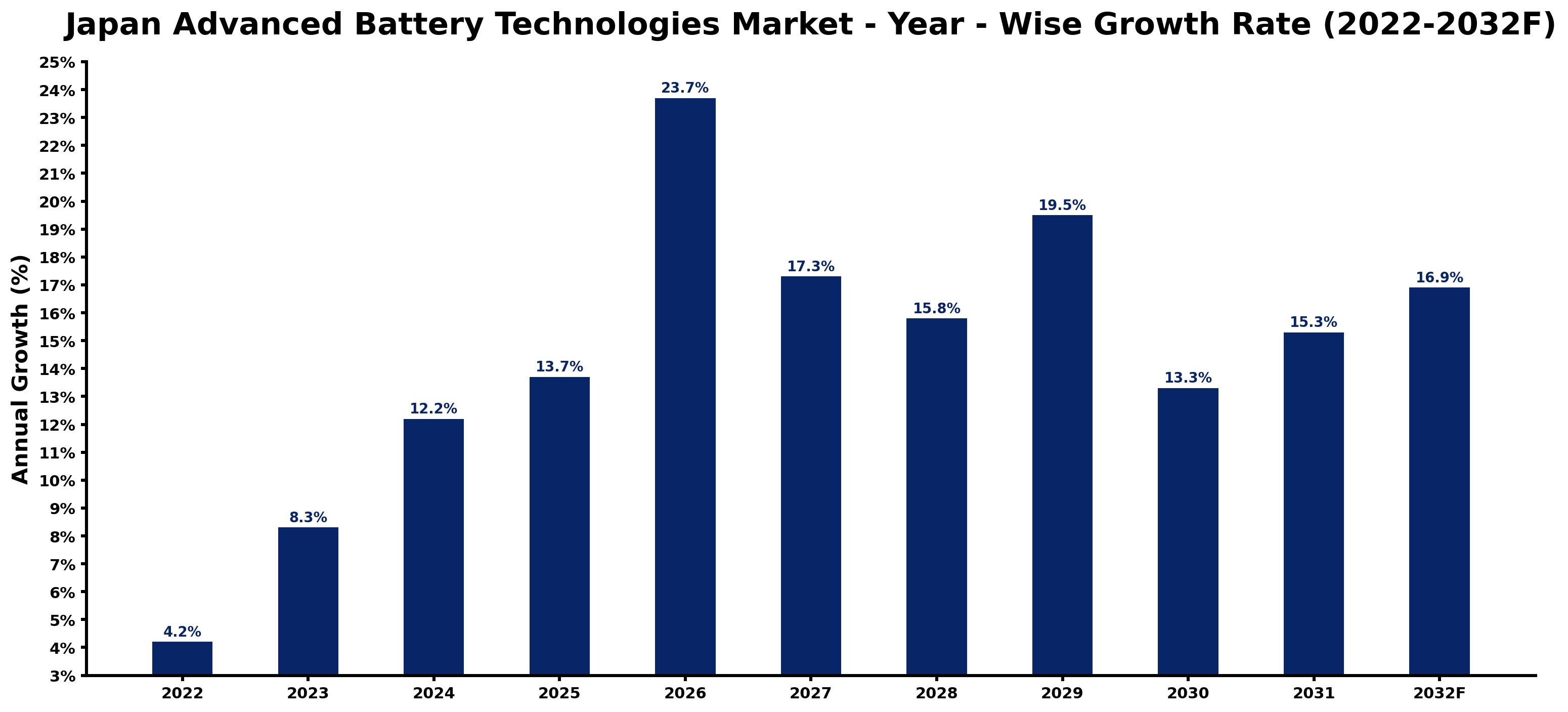
For each year, the table pairs the estimated growth rate with the leading influence on demand, showing how the drivers changed across the period.
| Year | Estimated Annual Growth (%) | Market Rationale |
| 2022 | 4.2 | The market experienced steady growth due to increased consumer interest in advanced battery technologies. |
| 2023 | 8.3 | Demand surged as more electric vehicles entered the market, driving battery orders higher. |
| 2024 | 12.2 | The introduction of new battery technologies contributed to faster growth compared to the previous year. |
| 2025 | 13.7 | Investments in battery manufacturing capacity led to heightened market activity. |
| 2026 | 23.7 | The peak growth was driven by a surge in electric vehicle adoption and charging infrastructure expansion. |
| 2027 | 17.3 | Growth slowed as the market adjusted to increased supply and demand. |
| 2028 | 15.8 | Demand continued to grow but at a slower pace due to market saturation in certain segments. |
| 2029 | 19.5 | A renewed interest in grid storage solutions spurred faster growth in the market. |
| 2030 | 13.3 | Growth slowed as the market stabilised following rapid expansions in previous years. |
| 2031 | 15.3 | Increased investments in battery recycling initiatives contributed to a rise in demand. |
| 2032 | 16.9 | The market is expected to grow steadily as new technologies gain traction and adoption. |
Note: Market size estimations and growth projections presented in this report are based on 6Wresearch's proprietary forecasting methodology, utilizing the latest available industry data, government publications, and primary research inputs.
Japan Advanced Battery Technologies Market Synopsis
Advanced Battery Technologies focus on innovations that improve energy storage efficiency and safety through advanced chemical processes. The automotive sector in Japan is a major user, particularly with the rise of electric vehicles. The Japan Advanced Battery Technologies Market is expanding due to strong domestic demand, driven by local manufacturers and substantial investments in battery technology, including JPY 150 trillion in decarbonisation efforts over the next decade. This investment is set to create new applications and stimulate further growth in the sector.
Market Dynamics Impact Analysis (2026–2032)
| Factor | Type | Impact | Primary Segment Affected |
| Growing adoption of electric vehicles is driving demand for advanced battery technologies. | Driver | High | Electric Vehicles |
| Significant investments in battery manufacturing capacity are creating opportunities for suppliers. | Driver | High | Solid-State Batteries |
| The increasing need for grid storage solutions presents a lucrative opportunity for battery suppliers. | Opportunity | High | Grid Storage |
| The push for battery recycling initiatives opens new markets for advanced battery technologies. | Opportunity | High | Lithium Polymer |
| High production costs can limit the competitiveness of advanced battery technologies in the market. | Restraint | High | Solid-State Batteries |
| Supply chain disruptions can affect the availability of critical materials for battery production. | Restraint | Medium | Lithium |
| Compliance with stringent safety standards can increase the time and cost of product development. | Challenge | High | Electric Vehicles |
| Capacity constraints in manufacturing can limit the ability to meet growing demand. | Challenge | Medium | Lithium Polymer |
Evaluation of Drivers in Japan Advanced Battery Technologies Market (2026–2032)
Key forces behind demand, with the segment each one moves most, are listed below.
| Drivers | Primary Segment Affected | Why It Matters (Evidence) |
| Increased electric vehicle sales boost demand for advanced batteries. | Electric Vehicles | In 2022, over 1 million electric vehicles were sold in Japan, boosting battery orders. |
| Investments are expanding manufacturing capabilities in advanced battery technologies. | Solid-State Batteries | Japan's GX Basic Policy targets JPY 150 trillion in decarbonisation investment over 10 years. |
| Growing interest in renewable energy storage solutions is increasing demand for batteries. | Grid Storage | The energy storage market is projected to reach 10 GWh by 2025, driven by grid needs. |
| Technological advancements are improving battery efficiency and safety features. | Lithium Polymer | Solid-state batteries are gaining attention for their high energy density and safety benefits. |
| The expanding consumer electronics market drives demand for lightweight batteries. | Smartphones | Lithium-ion batteries account for over 70% of the battery market share in consumer electronics. |
Behind the steady rise in orders sits the increasing adoption of electric vehicles, with over 1 million units sold in 2022, boosting battery demand. Investments targeting JPY 150 trillion for decarbonisation are expanding manufacturing capabilities, particularly in solid-state technologies. The energy storage market is expected to reach 10 GWh by 2025, driven by the need for grid solutions. Advancements in battery technology are improving efficiency, with solid-state batteries emerging for their high energy density and safety features. The consumer electronics sector continues to expand, with lithium-ion batteries dominating the market.
Evaluation of Restraints in Japan Advanced Battery Technologies Market
Several factors work against faster growth; the main ones are summarised below.
| Market Restraint | Primary Segment Affected | Why It Matters (Evidence) |
| High production costs limit the competitiveness of advanced battery technologies. | Solid-State Batteries | Production costs for solid-state batteries remain high, affecting market pricing strategies. |
| Supply chain disruptions affect the availability of critical materials for battery production. | Lithium | Material shortages can delay production timelines and increase costs for manufacturers. |
| Compliance with safety standards increases development time and costs. | Electric Vehicles | Adhering to ISO 26262 standards for battery management systems can extend product launch timelines. |
| Limited recycling infrastructure can hinder the adoption of sustainable practices. | Lithium Polymer | Insufficient recycling options for lithium polymer batteries can deter environmentally conscious consumers. |
| Market saturation in certain segments can slow growth rates. | Grid Storage | As more solutions enter the market, competition intensifies, affecting pricing and profitability. |
Japan Advanced Battery Technologies Market Challenges
Producers in Japan face a skills gap in advanced battery technologies, leading to delays in production processes that can extend timelines by six months, costing them approximately ¥5 billion in potential revenue annually. Material costs have risen sharply, with lithium prices increasing by 30% in the last year, which pressures suppliers' profit margins and limits their pricing strategies. Regulatory requirements, such as ISO 26262, complicate compliance efforts and can push product launch schedules back by several months, impacting manufacturers' competitiveness. Competition from international markets intensifies, as foreign firms leverage lower production costs, making it harder for local producers to maintain market share.
Trends in the Japan Advanced Battery Technologies Market
Buyers and suppliers in the Japan Advanced Battery Technologies Market are adjusting to the following trends.
- Shift Towards Sustainable Energy Solutions: Energy providers are increasingly adopting advanced battery technologies for grid storage applications, with the market expected to reach 10 GWh by 2025. This shift reflects a growing commitment to renewable energy integration.
- Growing Demand for Solid-State Batteries: Solid-state batteries are gaining traction in the automotive sector, supported by their high energy density and safety features. Japan allocated ¥10 billion for solid-state battery research in 2023, indicating strong government support.
- Increased Focus on Battery Recycling: A new programme launched in 2023 aims to promote battery recycling initiatives, aiming to create a circular economy. This initiative is set to improve sustainability in battery production.
- Expansion of Electric Vehicle Charging Infrastructure: The automotive sector is projected to install over 1 million electric vehicle charging stations by 2025, significantly boosting the infrastructure needed for electric vehicles and increasing battery demand.
Investment Opportunities in the Japan Advanced Battery Technologies Market
Investors looking at the Japan Advanced Battery Technologies Market should consider the following areas.
- Investment in Battery Recycling Initiatives: Energy providers are looking to invest in battery recycling technologies, with Japan's government allocating funds to support these initiatives. This presents an opportunity for suppliers to enter the recycling market.
- Growth in Electric Vehicle Market: With over 1 million electric vehicles sold in 2022, there is a pressing need for advanced batteries. Suppliers can capitalise on this demand by partnering with automotive manufacturers.
- Expansion of Grid Storage Solutions: The energy storage market is set to reach 10 GWh by 2025, creating opportunities for suppliers of advanced battery technologies. Collaborating with energy providers can facilitate market entry.
- Development of Solid-State Battery Technologies: The Japanese government has committed ¥10 billion to solid-state battery research, indicating a ripe opportunity for investment in this emerging technology.
Government Initiatives in the Japan Advanced Battery Technologies Market
The Economic Security Promotion Act of 2022 supports supply-chain resilience for critical products, including advanced batteries. This measure ensures that producers can maintain a steady supply of essential materials, which is vital for meeting demand in the market. Additionally, the GX Promotion Act of 2023 establishes a legal framework for the GX strategy, promoting investments in sustainable technologies, including advanced batteries, to achieve carbon neutrality by 2050.
In 2023, the Japanese government allocated ¥10 billion to support research in solid-state battery technology, administered by the Ministry of Economy, Trade and Industry (METI). This funding aims to improve domestic manufacturing capabilities and drive innovation in battery technologies, ensuring that Japan remains competitive in the global market.
Future Insight of the Japan Advanced Battery Technologies Market
A policy-driven shift will catalyse advancements in battery technologies by 2032, prompting suppliers to innovate and adapt. The government aims to allocate ¥10 billion for solid-state battery research, enhancing safety and efficiency in energy storage. The establishment of over 1 million electric vehicle charging stations will create a robust infrastructure, supporting the growth of advanced battery applications. As the energy storage market approaches 10 GWh, buyers will gain access to more reliable energy solutions, while suppliers will need to meet evolving industry standards.
Market Segmentation Analysis
Japan Advanced Battery Technologies Market report covers a detailed analysis of the following market segments:
By Technology Type – Solid-State Batteries Lead and Record the Fastest Growth
According to Saurav Kr Singh, Senior Research Analyst at 6Wresearch, the largest technology type category in 2025 was Solid-State Batteries, at 46% of revenue. Solid-state batteries dominate the market due to their exceptional energy density and safety features, essential for electric vehicles. Their increasing adoption is driven by automotive manufacturers prioritising performance and safety in their electric vehicle designs. The same category are also set to grow fastest, at a CAGR of 19.0% during 2026–2032. The rapid growth of solid-state batteries is bolstered by significant government investment, illustrated by the ¥10 billion allocated for research in this technology in 2023. This ongoing support will likely allow solid-state batteries to maintain their competitive edge over other technologies. Suppliers should focus on solid-state technology to align with market trends and government backing.
By Battery Chemistry – Lithium Leads, Lithium Polymer Expected to Grow Fastest
With 53% of battery chemistry revenue in 2025, Lithium was the largest category. Lithium batteries capture the largest market share, as they are extensively utilised in consumer electronics and electric vehicles due to their high energy capacity. Their dominance is evident in their over 70% share in the battery market for consumer electronics in Japan. Over 2026–2032, Lithium Polymer is expected to post the fastest growth, at a CAGR of 22.8%. Lithium polymer batteries are witnessing rapid growth owing to their lightweight characteristics, making them ideal for portable devices like smartphones. The rising demand for lightweight energy solutions is anticipated to drive substantial growth in this segment. Buyers should consider lithium polymer options for applications requiring lightweight and efficient energy storage.
By Application – Electric Vehicles Lead, Grid Storage Expected to Grow Fastest
In 2025, Electric Vehicles led the application split with a 40% share. Electric vehicles represent the largest application for advanced batteries, driving substantial demand and innovation in battery technology. The automotive sector's commitment to electrification is underscored by projections of over 1 million electric vehicle charging stations by 2025. Grid Storage is set to record the highest CAGR in this split, 23.5% over 2026–2032. Grid storage is the fastest-growing application, driven by the need for balancing renewable energy supply and demand as Japan increases its renewable energy capacity. This focus on grid solutions will likely accelerate the adoption of advanced battery technologies. Suppliers should explore partnerships with grid operators to tap into the growing demand for energy storage solutions.
By Distribution Channel – OEMs Lead, Direct Sales Expected to Grow Fastest
OEMs took 35% of distribution channel revenue in 2025, more than any other category. OEMs lead the distribution channel by integrating advanced batteries into their products, creating a substantial demand source. This integration is crucial for manufacturers focused on developing electric vehicles and other battery-powered technologies. The quickest growth will come from Direct Sales, forecast to expand at a CAGR of 21.2% between 2026 and 2032. Direct sales are experiencing rapid growth as manufacturers seek to establish closer relationships with end-users, enhancing service and support. This trend indicates a shift towards more personalised distribution strategies in the battery market. Suppliers should enhance direct sales strategies to improve customer engagement and service delivery.
By End User – Automotive Sector Leads, Energy Providers Expected to Grow Fastest
Automotive Sector held 48% of the Japan Advanced Battery Technologies Market by end user in 2025. The automotive sector is the largest end user of advanced batteries, primarily driven by the increasing sales of electric vehicles. This sector's demand for advanced battery solutions significantly shapes market trends and technological advancements. Energy Providers are projected to grow fastest, at a CAGR of 21.4% during 2026–2032. Energy providers represent the fastest-growing end user segment, utilising advanced batteries for energy storage solutions to support renewable energy integration. As the energy sector progresses, this segment is poised for rapid expansion. Suppliers should target energy providers to capitalise on the growing demand for energy storage solutions.
Key Attractiveness of the Report
- 10 Years of Market Numbers
- Historical Data Starting from 2022 to 2025
- Base Year 2025
- Forecast Data until 2032
- Key Performance Indicators Impacting the Market
- Major Upcoming Developments and Projects
Key Highlights of the Report:
- Japan Advanced Battery Technologies Market Outlook
- Market Size of Japan Advanced Battery Technologies Market, 2025
- Forecast of Japan Advanced Battery Technologies Market, 2032
- Historical Data and Forecast of Japan Advanced Battery Technologies Revenues & Volume for the Period 2022-2032F
- Japan Advanced Battery Technologies Market Trend Evolution
- Japan Advanced Battery Technologies Market Drivers and Challenges
- Japan Advanced Battery Technologies Price Trends
- Japan Advanced Battery Technologies Porter's Five Forces
- Japan Advanced Battery Technologies Industry Life Cycle
- Historical Data and Forecast of Japan Advanced Battery Technologies Market Revenues & Volume By Technology Type for the Period 2022-2032F
- Historical Data and Forecast of Japan Advanced Battery Technologies Market Revenues & Volume By Solid-State Batteries for the Period 2022-2032F
- Historical Data and Forecast of Japan Advanced Battery Technologies Market Revenues & Volume By Flow Batteries for the Period 2022-2032F
- Historical Data and Forecast of Japan Advanced Battery Technologies Market Revenues & Volume By Lithium-Sulfur for the Period 2022-2032F
- Historical Data and Forecast of Japan Advanced Battery Technologies Market Revenues & Volume By Thin-Film Batteries for the Period 2022-2032F
- Historical Data and Forecast of Japan Advanced Battery Technologies Market Revenues & Volume By Battery Chemistry for the Period 2022-2032F
- Historical Data and Forecast of Japan Advanced Battery Technologies Market Revenues & Volume By Lithium for the Period 2022-2032F
- Historical Data and Forecast of Japan Advanced Battery Technologies Market Revenues & Volume By Zinc-Bromine for the Period 2022-2032F
- Historical Data and Forecast of Japan Advanced Battery Technologies Market Revenues & Volume By Lithium for the Period 2022-2032F
- Historical Data and Forecast of Japan Advanced Battery Technologies Market Revenues & Volume By Lithium Polymer for the Period 2022-2032F
- Historical Data and Forecast of Japan Advanced Battery Technologies Market Revenues & Volume By Application for the Period 2022-2032F
- Historical Data and Forecast of Japan Advanced Battery Technologies Market Revenues & Volume By Smartphones for the Period 2022-2032F
- Historical Data and Forecast of Japan Advanced Battery Technologies Market Revenues & Volume By Grid Storage for the Period 2022-2032F
- Historical Data and Forecast of Japan Advanced Battery Technologies Market Revenues & Volume By Electric Vehicles for the Period 2022-2032F
- Historical Data and Forecast of Japan Advanced Battery Technologies Market Revenues & Volume By Wearables for the Period 2022-2032F
- Historical Data and Forecast of Japan Advanced Battery Technologies Market Revenues & Volume By Distribution Channel for the Period 2022-2032F
- Historical Data and Forecast of Japan Advanced Battery Technologies Market Revenues & Volume By Online Platforms for the Period 2022-2032F
- Historical Data and Forecast of Japan Advanced Battery Technologies Market Revenues & Volume By Industrial Suppliers for the Period 2022-2032F
- Historical Data and Forecast of Japan Advanced Battery Technologies Market Revenues & Volume By OEMs for the Period 2022-2032F
- Historical Data and Forecast of Japan Advanced Battery Technologies Market Revenues & Volume By Direct Sales for the Period 2022-2032F
- Historical Data and Forecast of Japan Advanced Battery Technologies Market Revenues & Volume By End User for the Period 2022-2032F
- Historical Data and Forecast of Japan Advanced Battery Technologies Market Revenues & Volume By Consumers for the Period 2022-2032F
- Historical Data and Forecast of Japan Advanced Battery Technologies Market Revenues & Volume By Energy Providers for the Period 2022-2032F
- Historical Data and Forecast of Japan Advanced Battery Technologies Market Revenues & Volume By Automotive Sector for the Period 2022-2032F
- Historical Data and Forecast of Japan Advanced Battery Technologies Market Revenues & Volume By Tech Manufacturers for the Period 2022-2032F
- Japan Advanced Battery Technologies Import Export Trade Statistics
- Market Opportunity Assessment By Technology Type
- Market Opportunity Assessment By Battery Chemistry
- Market Opportunity Assessment By Application
- Market Opportunity Assessment By Distribution Channel
- Market Opportunity Assessment By End User
- Japan Advanced Battery Technologies Top Companies Market Share
- Japan Advanced Battery Technologies Competitive Benchmarking By Technical and Operational Parameters
- Japan Advanced Battery Technologies Company Profiles
- Japan Advanced Battery Technologies Key Strategic Recommendations
Market Covered
The report covers the following segments.
By Technology Type
- Solid-State Batteries
- Flow Batteries
- Lithium-Sulfur
- Thin-Film Batteries
By Battery Chemistry
- Lithium
- Zinc-Bromine
- Lithium Polymer
By Application
- Smartphones
- Grid Storage
- Electric Vehicles
- Wearables
By Distribution Channel
- Online Platforms
- Industrial Suppliers
- OEMs
- Direct Sales
By End User
- Consumers
- Energy Providers
- Automotive Sector
- Tech Manufacturers































