Japan Advanced Biomaterials Market Size & Growth Rate
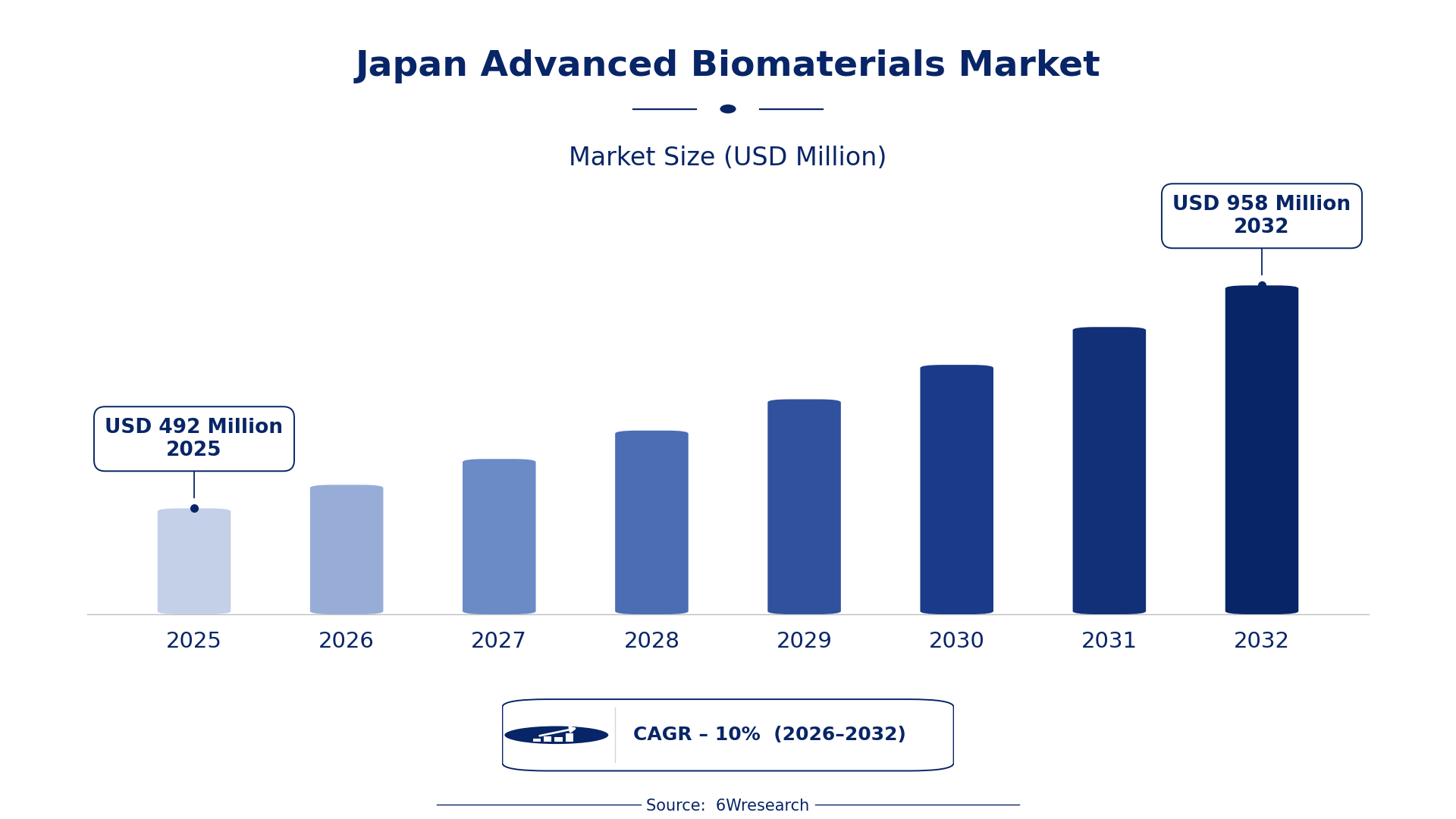
According to 6Wresearch internal database and industry insights, the Japan Advanced Biomaterials Market was valued at USD 492 Million in 2025 and is projected to reach USD 958 Million by 2032, growing at a CAGR of approximately 10% during 2026–2032.
Japan Advanced Biomaterials Market Highlights
| Report Metric | Details |
| Report Name | Japan Advanced Biomaterials Market (2026-2032) |
| Market Size 2025 | USD 492 Million |
| Market Size 2032 | USD 958 Million |
| Absolute Growth 2025–2032 | USD 466 Million |
| CAGR 2026–2032 | 10% |
| Peak Annual Growth | 11.2% in 2032 |
| Forecast Period | 2026–2032 |
| Historical Data | 2022–2025 |
| Base Year | 2025 |
| Leading Material Type, 2025 | Natural Polymers (35% share) |
| Leading Application Area, 2025 | Orthopedic Implants (36% share) |
| Leading Product Form, 2025 | Hydrogels (40% share) |
| Leading Distribution Channel, 2025 | Hospitals (37% share) |
| Leading End User, 2025 | Surgeons (40% share) |
| Fastest-Growing Material Type | Metallic Biomaterials (14.8% CAGR) |
| Fastest-Growing Application Area | Dental Applications (12.1% CAGR) |
| Fastest-Growing Product Form | Foils & Sheets (14.4% CAGR) |
| Fastest-Growing Distribution Channel | Clinics (13.4% CAGR) |
| Fastest-Growing End User | Dentists (13.0% CAGR) |
| Growing Sector | Dental Applications |
| Key End Users | Orthopedic Implants, Dental Applications, Bone Grafting, Cardiovascular Devices |
Japan Advanced Biomaterials Market Year-wise Growth Rate and Key Drivers (2022–2032)
This graph illustrates the annual growth rates of the market from 2022 to 2032, highlighting a steady upward trajectory and projected market expansion over the forecast period.
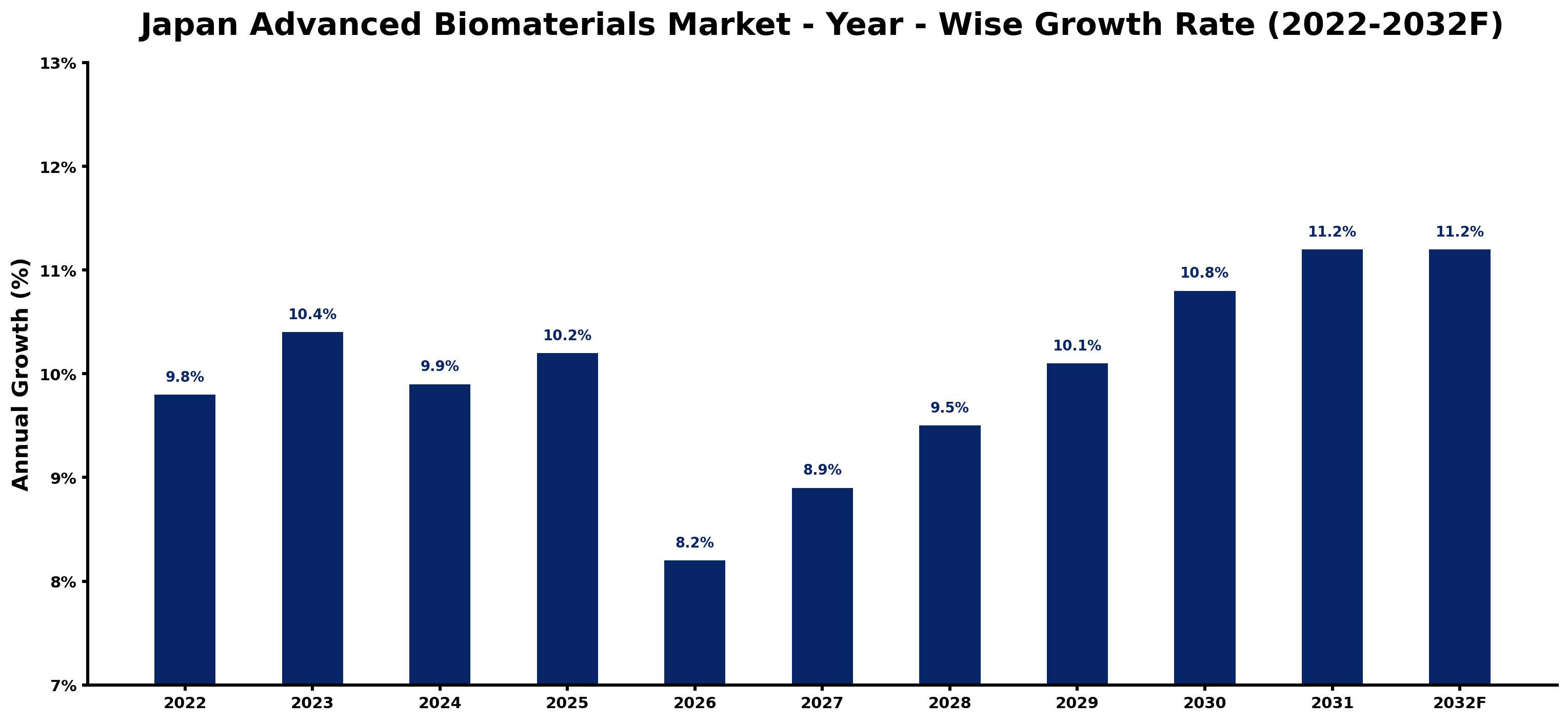
Each row of the following table gives one year's estimated growth and the event or demand shift that explains it.
| Year | Estimated Annual Growth (%) | Market Rationale |
| 2022 | 9.8 | The market exhibited stable growth due to rising healthcare expenditure and an aging population. |
| 2023 | 10.4 | Demand increased as healthcare providers expanded their use of advanced biomaterials in surgical procedures. |
| 2024 | 9.9 | Growth slowed slightly as market saturation began to affect some segments, particularly orthopedic implants. |
| 2025 | 10.2 | The market rebounded with renewed interest in advanced biomaterials and increased funding for research. |
| 2026 | 8.2 | Growth is expected to decelerate as manufacturers face challenges in scaling up production capacities to meet demand. |
| 2027 | 8.9 | Demand is projected to rise as advancements in biomaterials technology attract new investments and applications. |
| 2028 | 9.5 | The market is expected to experience a resurgence as hospitals adopt new surgical techniques requiring advanced materials. |
| 2029 | 10.1 | Growth is projected to accelerate due to increased public and private investment in healthcare technologies. |
| 2030 | 10.8 | Demand is expected to strengthen as the population ages and the need for medical interventions rises. |
| 2031 | 11.2 | The market is projected to peak as advanced biomaterials gain widespread acceptance in various medical applications. |
| 2032 | 11.2 | Demand is expected to stabilise at a high level, driven by ongoing advancements and regulatory support. |
Note: Market size estimations and growth projections presented in this report are based on 6Wresearch's proprietary forecasting methodology, utilizing the latest available industry data, government publications, and primary research inputs.
Japan Advanced Biomaterials Market Synopsis
Advanced biomaterials are engineered materials for medical applications, primarily made from natural or synthetic polymers, metals, and ceramics. They are produced through processes like polymerization, sintering, and surface modification. Their main uses include orthopedic implants, dental applications, and cardiovascular devices. The Japan Advanced Biomaterials Market is expanding due to rising healthcare expenditure, which reached approximately JPY 42 trillion in 2022, alongside a growing elderly population, with 29.3% aged 65 or older in 2024. The Tokyo region serves as a hub for research and development, driving innovation and demand for new products.
Market Dynamics Impact Analysis (2026–2032)
| Factor | Type | Impact | Primary Segment Affected |
| Increasing healthcare expenditure | Driver | High | Orthopedic Implants |
| Growing elderly population | Driver | High | Dental Applications |
| Rising demand for innovative medical technologies | Opportunity | High | Cardiovascular Devices |
| Expansion of research funding in biomaterials | Opportunity | High | Bone Grafting |
| Production capacity constraints | Restraint | Medium | Metallic Biomaterials |
| Regulatory compliance costs | Restraint | Medium | Polymeric Biomaterials |
| High costs of advanced materials | Challenge | High | Natural Polymers |
| Limited skilled workforce for production | Challenge | Medium | Ceramics |
Evaluation of Drivers in Japan Advanced Biomaterials Market (2026–2032)
Demand rests on the following drivers, each shown with the segment it touches most.
| Drivers | Primary Segment Affected | Why It Matters (Evidence) |
| Healthcare expenditure growth | Orthopedic Implants | Japan's healthcare expenditure was approximately JPY 42 trillion in 2022, prompting hospitals to invest in advanced biomaterials for surgical procedures. |
| Aging population | Dental Applications | With 29.3% of the population aged 65 or older, demand for dental procedures and materials rises. |
| Technological advancements in biomaterials | Cardiovascular Devices | Innovations in biomaterials improve performance, driving hospitals to invest more in advanced devices. |
| Increased research funding | Bone Grafting | The government allocated 5 billion yen in 2023 to enhance biomaterials research, boosting demand. |
| Rising patient awareness | Polymeric Biomaterials | Patients are increasingly informed about treatment options, resulting in higher demand for advanced materials. |
What keeps demand rising is Japan's healthcare expenditure, which reached approximately JPY 42 trillion in 2022, prompting hospitals to invest in advanced biomaterials for surgical procedures. The aging population drives demand for orthopedic implants and dental applications, with 29.3% of the population aged 65 or older. Increased patient awareness about treatment options fuels demand for advanced materials across various medical applications. Research at Tokyo Medical University is focusing on new polymeric materials, which are gaining traction in the market.
Evaluation of Restraints in Japan Advanced Biomaterials Market
The key brakes on demand, and where they bite hardest, are shown below.
| Market Restraint | Primary Segment Affected | Why It Matters (Evidence) |
| Production capacity constraints | Metallic Biomaterials | Manufacturers struggle to scale production, limiting supply and increasing lead times for hospitals. |
| Regulatory compliance costs | Polymeric Biomaterials | The need to meet stringent regulations raises costs for producers, impacting pricing strategies. |
| High costs of advanced materials | Natural Polymers | The expense of sourcing and processing advanced materials limits accessibility for smaller clinics. |
| Limited skilled workforce for production | Ceramics | A shortage of trained personnel affects production efficiency and quality control in manufacturing. |
| Market saturation in certain segments | Orthopedic Implants | Increased competition has led to price pressures, affecting profitability for manufacturers. |
Japan Advanced Biomaterials Market Challenges
High costs of advanced biomaterials hinder hospitals from adopting new technologies, as Japan's healthcare expenditure was approximately 42 trillion yen in 2022. Supply chain issues create delays for suppliers, resulting in extended patient wait times for surgeries by up to two weeks. Regulatory requirements from the Ministry of Health, Labour and Welfare complicate processes for producers, increasing production costs by as much as 20%. Buyers, particularly healthcare providers, face challenges in sourcing sufficient materials due to limited research funding, which increased by only 5 billion yen in 2023, insufficient to meet rising demand.
Trends in the Japan Advanced Biomaterials Market
The following changes are redrawing the Japan Advanced Biomaterials Market.
- Shift from Conventional to Advanced Biomaterials: Japan is experiencing a shift towards advanced biomaterials in medical applications, particularly in orthopedic implants. Research at Tokyo Medical University focuses on new polymeric materials, which accounted for a substantial portion of advanced biomaterials used in 2023.
- Transition from Hospitals to Clinics for Procedures: There is a notable transition from hospitals to clinics for outpatient procedures utilising advanced biomaterials. Clinics are projected to grow at a CAGR of 13.4% from 2026 to 2032, increasingly adopting these materials for minor surgeries.
- Dentists Prioritising Advanced Biomaterials: Dentists are increasingly prioritising advanced biomaterials for dental applications, with a projected CAGR of 13.0% from 2026 to 2032. This trend is evidenced by the growing number of dental clinics, approximately 70,000 in Japan, adopting these materials.
- Emergence of Hydrogels in Wound Care: Hydrogels are emerging as a preferred choice in wound care applications, capturing a market share of 15% in 2023. Their versatility and effectiveness are driving demand among healthcare providers across Japan.
Investment Opportunities in the Japan Advanced Biomaterials Market
Investors looking at the Japan Advanced Biomaterials Market should consider the following areas.
- Partnering with Research Institutions: By 2026, Japan's healthcare market is expected to grow, creating a gap for advanced biomaterials. Collaborating with research institutions in the Tokyo region can facilitate entry into this expanding market.
- Investing in Production Facilities: With the anticipated growth of the advanced biomaterials market, estimated to reach USD 958 million by 2032, investing in local production facilities can meet increasing demand from hospitals and clinics.
- Focusing on Dental Applications: The demand for dental applications is expected to rise, driven by the increasing number of dental clinics, approximately 70,000 in Japan. Suppliers can enter this segment by providing tailored solutions.
- Expanding into Bone Grafting: The recent 10% increase in bone grafting procedures indicates a growing need for materials in this area. Suppliers can explore opportunities by developing advanced solutions for reconstructive surgeries.
Government Initiatives in the Japan Advanced Biomaterials Market
The PRTR Law, established in 1999, requires businesses to report the release of designated chemical substances, impacting producers of advanced biomaterials by ensuring compliance with environmental standards. The Chemical Substances Control Law mandates evaluation and control of new chemical substances, affecting how manufacturers approach material sourcing and production.
The Pharmaceuticals and Medical Devices Agency (PMDA) oversees the approval of advanced biomaterials, ensuring they meet safety and efficacy standards. The Japan Agency for Medical Research and Development (AMED) funds research initiatives, including a recent allocation of 5 billion yen to boost biomaterials research, supporting innovation in the sector.
Future Insight of the Japan Advanced Biomaterials Market
By 2032, Japan's decarbonisation strategy will drive the development of advanced biomaterials, focusing on sustainable alternatives. The government's push to improve medical technology adoption will facilitate collaborations between research institutions and healthcare providers. Increased research funding is projected to lead to breakthroughs in applications, particularly in wound care, where hydrogels hold a 15% market share. Stricter quality management standards, such as ISO 13485, will enhance product reliability, benefiting both buyers and suppliers.
Market Segmentation Analysis
Japan Advanced Biomaterials Market report covers a detailed analysis of the following market segments:
By Material Type – Natural Polymers Lead, Metallic Biomaterials Expected to Grow Fastest
According to Saurav Kr Singh, Senior Research Analyst at 6Wresearch, Natural Polymers took 35% of material type revenue in 2025, more than any other category. Natural Polymers dominate the market because of their biocompatibility, making them ideal for applications like wound care and drug delivery. Their prevalent use in critical healthcare environments, such as hospitals and clinics, solidifies their leading status. Over 2026–2032, Metallic Biomaterials are expected to post the fastest growth, at a CAGR of 14.8%. Metallic Biomaterials are experiencing rapid growth due to their essential role in load-bearing implants, especially for orthopedic surgeries. The increase in orthopedic procedures, particularly among the elderly, significantly contributes to this segment's expansion. Suppliers must concentrate on enhancing metallic biomaterials to meet the rising demand from healthcare providers.
By Application Area – Orthopedic Implants Lead, Dental Applications Expected to Grow Fastest
Orthopedic Implants held 36% of the Japan Advanced Biomaterials Market by application area in 2025. Orthopedic Implants hold the largest share as they are critical for bone repair and joint replacement surgeries, which are prevalent due to Japan's aging population. Approximately 80% of orthopedic surgeries utilise advanced biomaterials, highlighting their importance. The quickest growth will come from Dental Applications, forecast to expand at a CAGR of 12.1% between 2026 and 2032. Dental Applications are growing quickly, driven by the increasing number of dental clinics, which total around 70,000 in Japan. The rising demand for restorative and cosmetic procedures further accelerates this segment's growth. Suppliers should consider expanding their product lines to cater to the growing dental applications market.
By Product Form – Hydrogels Lead, Foils & Sheets Expected to Grow Fastest
In 2025, Hydrogels led the product form split with a 40% share. Hydrogels lead the market due to their versatility in wound care and drug delivery, making them a preferred choice for various medical applications. Their usage in over 15% of wound care products underscores their significance in healthcare. Foils & Sheets are projected to grow fastest, at a CAGR of 14.4% during 2026–2032. Foils & Sheets are the fastest-growing segment, primarily due to their use in packaging for medical products. As the demand for efficient packaging solutions increases, this segment is expected to expand rapidly. Suppliers may need to innovate in packaging solutions to capitalise on the growth of foils and sheets.
By Distribution Channel – Hospitals Lead, Clinics Expected to Grow Fastest
The largest distribution channel category in 2025 was Hospitals, at 37% of revenue. Hospitals are the dominant distribution channel for advanced biomaterials, as they are the primary users in surgical procedures. With approximately 8,100 hospitals in Japan, they create a substantial demand for these materials in various medical applications. Clinics are set to record the highest CAGR in this split, 13.4% over 2026–2032. Clinics are experiencing the fastest growth due to their increasing adoption of advanced biomaterials for outpatient procedures and minor surgeries. This trend is driven by the convenience and accessibility clinics offer to patients seeking medical care. Suppliers need to adjust their distribution strategies to effectively reach and serve the expanding clinic market.
By End User – Surgeons Lead, Dentists Expected to Grow Fastest
Surgeons accounted for 40% of the market by end user in 2025. Surgeons are the primary end user group, as they are the key practitioners employing advanced biomaterials in surgical settings. Their direct engagement ensures a consistent demand for these materials in various surgical applications. Over 2026–2032, Dentists are expected to post the fastest growth, at a CAGR of 13.0%. Dentists represent the fastest-growing end users, driven by the rising number of dental procedures being conducted. The growing accessibility of dental care is leading to a notable increase in the demand for advanced biomaterials in this field. Suppliers should direct their marketing strategies towards dental professionals to leverage this expanding segment.
Key Attractiveness of the Report
- 10 Years of Market Numbers
- Historical Data Starting from 2022 to 2025
- Base Year 2025
- Forecast Data until 2032
- Key Performance Indicators Impacting the Market
- Major Upcoming Developments and Projects
Key Highlights of the Report:
- Japan Advanced Biomaterials Market Outlook
- Market Size of Japan Advanced Biomaterials Market, 2025
- Forecast of Japan Advanced Biomaterials Market, 2032
- Historical Data and Forecast of Japan Advanced Biomaterials Revenues & Volume for the Period 2022-2032F
- Japan Advanced Biomaterials Market Trend Evolution
- Japan Advanced Biomaterials Market Drivers and Challenges
- Japan Advanced Biomaterials Price Trends
- Japan Advanced Biomaterials Porter's Five Forces
- Japan Advanced Biomaterials Industry Life Cycle
- Historical Data and Forecast of Japan Advanced Biomaterials Market Revenues & Volume By Material Type for the Period 2022-2032F
- Historical Data and Forecast of Japan Advanced Biomaterials Market Revenues & Volume By Natural Polymers for the Period 2022-2032F
- Historical Data and Forecast of Japan Advanced Biomaterials Market Revenues & Volume By Metallic Biomaterials for the Period 2022-2032F
- Historical Data and Forecast of Japan Advanced Biomaterials Market Revenues & Volume By Ceramics for the Period 2022-2032F
- Historical Data and Forecast of Japan Advanced Biomaterials Market Revenues & Volume By Polymeric Biomaterials for the Period 2022-2032F
- Historical Data and Forecast of Japan Advanced Biomaterials Market Revenues & Volume By Application Area for the Period 2022-2032F
- Historical Data and Forecast of Japan Advanced Biomaterials Market Revenues & Volume By Orthopedic Implants for the Period 2022-2032F
- Historical Data and Forecast of Japan Advanced Biomaterials Market Revenues & Volume By Dental Applications for the Period 2022-2032F
- Historical Data and Forecast of Japan Advanced Biomaterials Market Revenues & Volume By Bone Grafting for the Period 2022-2032F
- Historical Data and Forecast of Japan Advanced Biomaterials Market Revenues & Volume By Cardiovascular Devices for the Period 2022-2032F
- Historical Data and Forecast of Japan Advanced Biomaterials Market Revenues & Volume By Product Form for the Period 2022-2032F
- Historical Data and Forecast of Japan Advanced Biomaterials Market Revenues & Volume By Hydrogels for the Period 2022-2032F
- Historical Data and Forecast of Japan Advanced Biomaterials Market Revenues & Volume By Foils & Sheets for the Period 2022-2032F
- Historical Data and Forecast of Japan Advanced Biomaterials Market Revenues & Volume By Powders for the Period 2022-2032F
- Historical Data and Forecast of Japan Advanced Biomaterials Market Revenues & Volume By Films for the Period 2022-2032F
- Historical Data and Forecast of Japan Advanced Biomaterials Market Revenues & Volume By Distribution Channel for the Period 2022-2032F
- Historical Data and Forecast of Japan Advanced Biomaterials Market Revenues & Volume By Hospitals for the Period 2022-2032F
- Historical Data and Forecast of Japan Advanced Biomaterials Market Revenues & Volume By Clinics for the Period 2022-2032F
- Historical Data and Forecast of Japan Advanced Biomaterials Market Revenues & Volume By Specialty Stores for the Period 2022-2032F
- Historical Data and Forecast of Japan Advanced Biomaterials Market Revenues & Volume By Online Platforms for the Period 2022-2032F
- Historical Data and Forecast of Japan Advanced Biomaterials Market Revenues & Volume By End User for the Period 2022-2032F
- Historical Data and Forecast of Japan Advanced Biomaterials Market Revenues & Volume By Surgeons for the Period 2022-2032F
- Historical Data and Forecast of Japan Advanced Biomaterials Market Revenues & Volume By Dentists for the Period 2022-2032F
- Historical Data and Forecast of Japan Advanced Biomaterials Market Revenues & Volume By Hospitals for the Period 2022-2032F
- Historical Data and Forecast of Japan Advanced Biomaterials Market Revenues & Volume By Medical Facilities for the Period 2022-2032F
- Japan Advanced Biomaterials Import Export Trade Statistics
- Market Opportunity Assessment By Material Type
- Market Opportunity Assessment By Application Area
- Market Opportunity Assessment By Product Form
- Market Opportunity Assessment By Distribution Channel
- Market Opportunity Assessment By End User
- Japan Advanced Biomaterials Top Companies Market Share
- Japan Advanced Biomaterials Competitive Benchmarking By Technical and Operational Parameters
- Japan Advanced Biomaterials Company Profiles
- Japan Advanced Biomaterials Key Strategic Recommendations
Market Covered
The following segment groups are covered in the report.
By Material Type
- Natural Polymers
- Metallic Biomaterials
- Ceramics
- Polymeric Biomaterials
By Application Area
- Orthopedic Implants
- Dental Applications
- Bone Grafting
- Cardiovascular Devices
By Product Form
- Hydrogels
- Foils & Sheets
- Powders
- Films
By Distribution Channel
- Hospitals
- Clinics
- Specialty Stores
- Online Platforms
By End User
- Surgeons
- Dentists
- Hospitals
- Medical Facilities































