Japan Advanced Braking Systems Market Size & Growth Rate
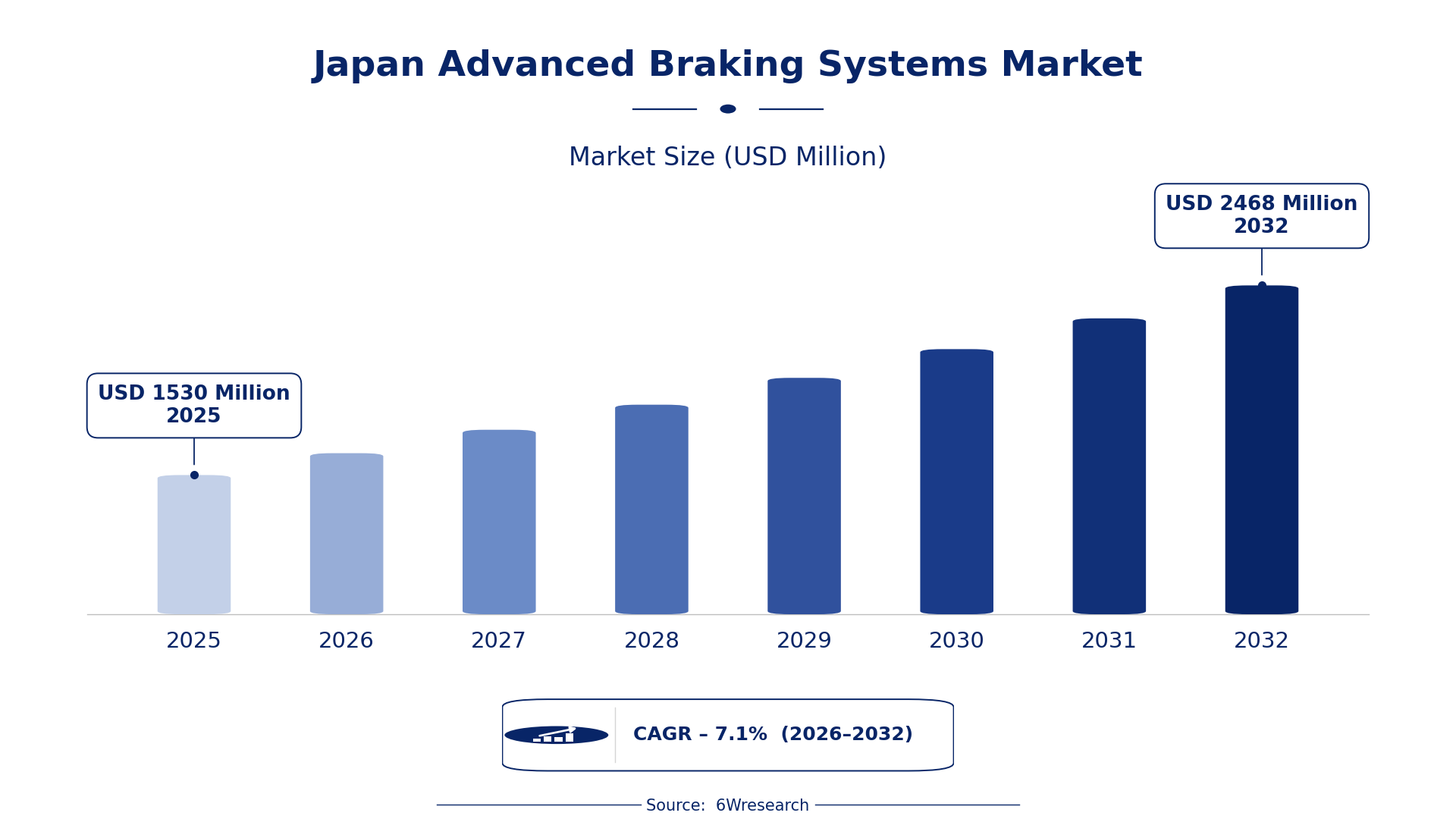
According to 6Wresearch internal database and industry insights, the Japan Advanced Braking Systems Market was valued at USD 1,530 Million in 2025 and is projected to reach USD 2,468 Million by 2032, growing at a CAGR of approximately 7.1% during 2026–2032.
Japan Advanced Braking Systems Market Highlights
| Report Metric | Details |
| Report Name | Japan Advanced Braking Systems Market (2026-2032) |
| Market Size 2025 | USD 1,530 Million |
| Market Size 2032 | USD 2,468 Million |
| Absolute Growth 2025–2032 | USD 938 Million |
| CAGR 2026–2032 | 7.1% |
| Peak Annual Growth | 7.9% in 2032 |
| Forecast Period | 2026–2032 |
| Historical Data | 2022–2025 |
| Base Year | 2025 |
| Leading System Type, 2025 | ABS (48% share) |
| Leading Technology Type, 2025 | Electronic (52% share) |
| Leading Vehicle Type, 2025 | Passenger Cars (41% share) |
| Leading Distribution Channel, 2025 | OEMs (39% share) |
| Leading End User, 2025 | Car Manufacturers (46% share) |
| Fastest-Growing System Type | EBD (10.4% CAGR) |
| Fastest-Growing Technology Type | Hydraulic (10.6% CAGR) |
| Fastest-Growing Vehicle Type | SUVs (10.8% CAGR) |
| Fastest-Growing Distribution Channel | Industrial Suppliers (9.4% CAGR) |
| Fastest-Growing End User | Fleet Operators (9.5% CAGR) |
| Growing Sector | automotive |
| Key End Users | car manufacturers, EV companies, fleet operators |
Japan Advanced Braking Systems Market Year-wise Growth Rate and Key Drivers (2022–2032)
This graph illustrates the annual growth rates of the market from 2022 to 2032, highlighting a steady upward trajectory and projected market expansion over the forecast period.
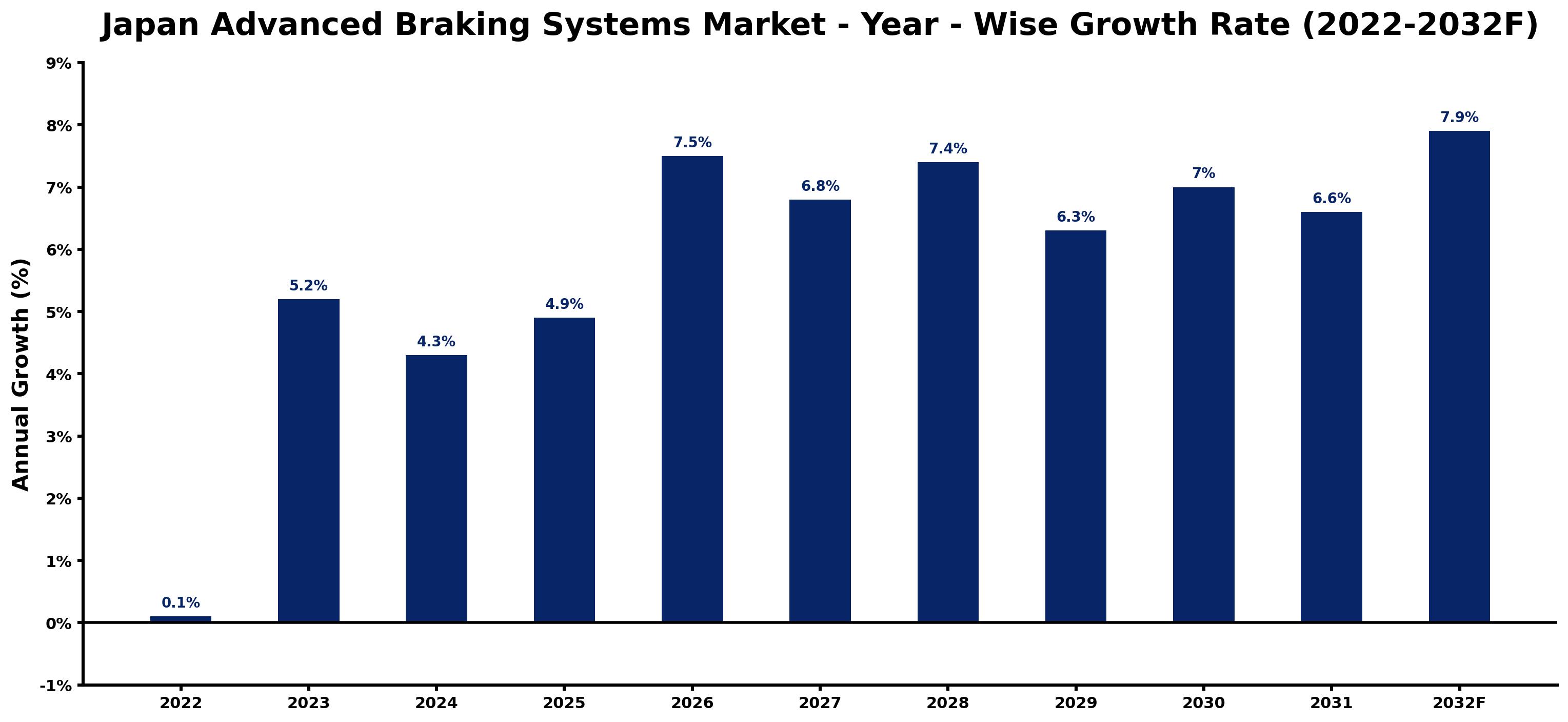
Below, each year's estimated growth is shown next to the factor that most influenced it.
| Year | Estimated Annual Growth (%) | Market Rationale |
| 2022 | 0.1 | The market showed minimal growth due to stabilised demand from existing vehicle technologies. |
| 2023 | 5.2 | Increased production of over 8 million vehicles boosted market performance. |
| 2024 | 4.3 | A slowdown occurred as the market adjusted to production fluctuations and supply chain issues. |
| 2025 | 4.9 | Growth accelerated again, driven by rising investments in advanced vehicle technologies. |
| 2026 | 7.5 | The market is expected to grow faster as electric vehicle adoption increases. |
| 2027 | 6.8 | A slight slowdown is anticipated as the market stabilises after rapid growth. |
| 2028 | 7.4 | Growth is projected to rise again, supported by advancements in braking systems. |
| 2029 | 6.3 | A slowdown is expected as the market approaches saturation in key segments. |
| 2030 | 7.0 | Growth will pick up due to government initiatives promoting electric vehicle adoption. |
| 2031 | 6.6 | The market is expected to slow down as it reaches a more mature phase. |
| 2032 | 7.9 | A peak in growth is anticipated, driven by innovations in braking technologies. |
Note: Market size estimations and growth projections presented in this report are based on 6Wresearch's proprietary forecasting methodology, utilizing the latest available industry data, government publications, and primary research inputs.
Japan Advanced Braking Systems Market Synopsis
Advanced Braking Systems are critical safety components in vehicles, incorporating technologies like ABS and EBD to ensure effective braking performance. The Japan Advanced Braking Systems Market is propelled by domestic car manufacturers, with the automotive industry producing over 8 million vehicles in 2022. Growth factors include the rise in electric vehicle sales, which reached 15% of total vehicle sales in 2023, and ongoing investments in automotive R&D exceeding ¥1 trillion annually. The push for improved vehicle safety and energy efficiency further drives market expansion.
Market Dynamics Impact Analysis (2026–2032)
| Factor | Type | Impact | Primary Segment Affected |
| Rising electric vehicle adoption | Driver | High | Electric Vehicles |
| Increased focus on vehicle safety regulations | Driver | High | Passenger Cars |
| Expansion of electric vehicle infrastructure | Opportunity | High | Electric Vehicles |
| Growing demand for energy-efficient braking systems | Opportunity | Medium | Hybrid Systems |
| High production costs for advanced technologies | Restraint | High | Electronic |
| Supply chain disruptions affecting component availability | Restraint | Medium | Hydraulic |
| Challenges in meeting stringent safety standards | Challenge | High | ABS |
| Competition from alternative braking technologies | Challenge | Medium | Brake-By-Wire |
Evaluation of Drivers in Japan Advanced Braking Systems Market (2026–2032)
Key forces behind demand, with the segment each one moves most, are listed below.
| Drivers | Primary Segment Affected | Why It Matters (Evidence) |
| Increased investment in electric vehicle technology | Electric Vehicles | The electric vehicle market reached 15% of total vehicle sales in 2023, driving demand for advanced braking systems. |
| Growing regulatory focus on vehicle safety | Passenger Cars | The JIS D 5001 standard governs braking system performance, compelling manufacturers to adopt advanced technologies. |
| Rising production of vehicles incorporating advanced braking systems | Car Manufacturers | Japan's automotive industry produced over 8 million vehicles in 2022, increasing demand for braking systems. |
| Investment in R&D for braking technologies | Electronic | Annual investment in automotive R&D in Japan exceeds ¥1 trillion, driving innovation in braking systems. |
| Adoption of energy-efficient braking systems in hybrids | Hybrid Systems | The focus on energy efficiency in vehicles drives demand for regenerative braking technologies. |
The strongest pull on demand comes from increased investment in electric vehicle technology, with the market reaching 15% of total vehicle sales in 2023. The production of over 8 million vehicles in 2022 has led to heightened demand from car manufacturers. Investment in R&D exceeding ¥1 trillion annually supports advancements in braking technologies, while the emphasis on energy efficiency in hybrids boosts demand for advanced braking technologies.
Evaluation of Restraints in Japan Advanced Braking Systems Market
The following restraints limit how fast demand can grow.
| Market Restraint | Primary Segment Affected | Why It Matters (Evidence) |
| High production costs for advanced braking technologies | Electronic | The average lifespan of a braking system in Japan is around 10 years, making upgrades costly for manufacturers. |
| Supply chain disruptions affecting component availability | Hydraulic | The automotive sector employs approximately 5 million people, leading to potential labour shortages in production. |
| Challenges in meeting stringent safety standards | ABS | Strict regulations from the Ministry of Land, Infrastructure, Transport and Tourism complicate compliance for manufacturers. |
| Competition from alternative braking technologies | Brake-By-Wire | Emerging technologies are gaining traction, potentially impacting the market share of traditional systems. |
| Limited consumer awareness of advanced braking benefits | EBD | Many consumers remain unaware of the advantages of advanced braking systems, affecting market penetration. |
Japan Advanced Braking Systems Market Challenges
A shortage of skilled workers in Japan's automotive sector hampers production capabilities, delaying vehicle launches for manufacturers. Increased competition among producers arises from the need to meet the JIS D 5001 standard, which elevates operational costs and reduces profit margins for many. Supply chain disruptions occur due to reliance on specific components, causing delays for buyers waiting for advanced braking systems. Rapid technological changes necessitate ongoing investment in research and development, straining budgets for smaller producers and limiting their competitive edge in the market.
Trends in the Japan Advanced Braking Systems Market
The trends below show where the Japan Advanced Braking Systems Market is heading.
- Shift towards Electric Vehicles: In 2023, Japan's electric vehicle market reached 15% of total vehicle sales, reflecting a shift. This trend encourages manufacturers to invest in advanced braking technologies, improving safety and efficiency.
- Transition from Traditional to Advanced Braking Systems: The adoption rate of ABS in new vehicles is over 90% in Japan, indicating a transition to advanced braking technologies. This shift is driven by consumer demand for improved safety and performance.
- Emergence of Regenerative Braking: The increasing focus on energy efficiency has led to the rise of regenerative braking systems in electric vehicles. With over 5 million registered electric vehicles as of 2023, this trend is reshaping braking technology.
- Prioritisation of Safety Standards: The JIS D 5001 standard governs braking system performance, highlighting the industry's focus on safety. This regulation ensures that manufacturers meet high safety benchmarks, influencing product development.
Investment Opportunities in the Japan Advanced Braking Systems Market
The following areas offer the clearest openings for investors and suppliers in the Japan Advanced Braking Systems Market.
- Investment in Electric Vehicle Infrastructure: With the electric vehicle market reaching 15% of total sales, there is a gap in infrastructure. Investing in charging stations and related technologies will support the growing demand from EV companies.
- Collaborations for Advanced Braking Technologies: Now is the time for partnerships with car manufacturers, as they seek to improve vehicle safety. Forming joint ventures can facilitate access to advanced braking technologies and expertise.
- Supply of Energy-Efficient Braking Systems: The push for energy efficiency creates opportunities for suppliers of regenerative braking technologies. Car manufacturers are increasingly looking for solutions that improve energy use in hybrid and electric vehicles.
- Expansion into Emerging Markets: The automotive sector accounts for about 20% of Japan's manufacturing output, indicating a stable market. Expanding into emerging markets with advanced braking systems can yield substantial returns.
Government Initiatives in the Japan Advanced Braking Systems Market
The Industrial Safety and Health Act (1972) mandates employer duties for hazardous substances and machinery, ensuring safety in manufacturing processes. The Act on the Rational Use of Energy (1979) requires large energy users to enhance energy efficiency, impacting how automotive manufacturers operate. Recent measures under the Green Growth Strategy aim to promote advanced technologies in the automotive sector, including braking systems, to reduce emissions.
The Japan Electric Vehicle Association utilises government subsidies to support the development of electric vehicle infrastructure. The Ministry of Land, Infrastructure, Transport and Tourism oversees vehicle safety regulations, ensuring compliance with standards like JIS D 5001. These agencies play a vital role in funding projects that improve vehicle safety and promote the adoption of advanced braking technologies.
Future Insight of the Japan Advanced Braking Systems Market
New electric vehicle infrastructure projects will emerge by 2032, driven by government subsidies for advanced technologies. The adoption of the ISO 26262 standard will enhance safety protocols, ensuring more reliable braking systems for consumers. With Japan's automotive industry producing over 8 million vehicles in 2022, demand for advanced braking systems will escalate as the government aims for a 50% electric vehicle adoption rate by 2030. Innovations highlighted at events like the Tokyo Motor Show will motivate suppliers to advance braking technologies.
Market Segmentation Analysis
Japan Advanced Braking Systems Market report covers a detailed analysis of the following market segments:
By System Type – ABS Leads, EBD Expected to Grow Fastest
According to Saurav Kr Singh, Senior Research Analyst at 6Wresearch, the largest system type category in 2025 was ABS, at 48% of revenue. The ABS segment holds the largest share due to its essential role in vehicle safety, with an adoption rate exceeding 90% in new vehicles. This high uptake is driven by stringent safety regulations set by the Ministry of Land, Infrastructure, Transport and Tourism. EBD is set to record the highest CAGR in this split, 10.4% over 2026–2032. EBD is experiencing rapid growth as it enhances braking efficiency, a feature increasingly valued by car manufacturers focused on performance. Innovations showcased at the Tokyo Motor Show in 2023 highlight its rising significance in modern vehicle engineering. Suppliers should prioritise the development of advanced EBD technologies to align with the increasing demand from manufacturers.
By Technology Type – Electronic Leads, Hydraulic Expected to Grow Fastest
With 52% of technology type revenue in 2025, Electronic was the largest category. The Electronic technology segment leads the market, being extensively used in modern braking systems to ensure optimal performance and safety. Its dominance is evident in the high adoption rates of ABS, which relies heavily on electronic components for functionality. The quickest growth will come from Hydraulic, forecast to expand at a CAGR of 10.6% between 2026 and 2032. Hydraulic technology is witnessing growth due to its established reliability, remaining prevalent in numerous vehicles, particularly older models. The average lifespan of a braking system in Japan, around 10 years, indicates a continuous need for hydraulic system replacements. Buyers may find value in investing in both electronic and hydraulic systems to achieve comprehensive safety solutions.
By Vehicle Type – Passenger Cars Lead, SUVs Expected to Grow Fastest
In 2025, Passenger Cars led the vehicle type split with a 41% share. Passenger Cars dominate the market as they represent the largest segment utilising advanced braking systems, supported by the production of over 8 million vehicles in 2022. The reliance on safety features like ABS is crucial for maintaining consumer confidence in this segment. Over 2026–2032, SUVs are expected to post the fastest growth, at a CAGR of 10.8%. SUVs are rapidly gaining market share, reflecting a shift in consumer preferences towards larger vehicles that offer enhanced space and comfort. The concentration of automotive companies in the Tokyo metropolitan area further supports this growing trend. Suppliers should adapt their strategies to meet the specific demands of the SUV market.
By Distribution Channel – OEMs Lead, Industrial Suppliers Expected to Grow Fastest
OEMs took 39% of distribution channel revenue in 2025, more than any other category. OEMs are the primary purchasers of braking systems, holding the largest share of the distribution channel due to their direct relationships with car manufacturers. This connection ensures a consistent demand for advanced braking technologies across the automotive sector. Industrial Suppliers are projected to grow fastest, at a CAGR of 9.4% during 2026–2032. Industrial Suppliers are experiencing growth as they provide essential components to OEMs, which is vital for the production of advanced braking systems. The substantial annual investment in automotive R&D in Japan, exceeding ¥1 trillion, is driving innovation in this segment. Suppliers should enhance partnerships with industrial suppliers to broaden their market reach effectively.
By End User – Car Manufacturers Lead, Fleet Operators Expected to Grow Fastest
Car Manufacturers accounted for 46% of the market by end user in 2025. Car Manufacturers lead the market as they are the primary users of advanced braking systems, directly influencing the demand for these technologies. Their focus on safety and performance drives the widespread adoption of systems such as ABS and EBD. Fleet Operators are set to record the highest CAGR in this split, 9.5% over 2026–2032. Fleet Operators are increasingly adopting advanced braking systems to improve safety across their vehicle fleets, reflecting a growing emphasis on operational efficiency. The government's initiatives to enhance vehicle safety standards further support this trend. Suppliers should develop strategies that specifically address the requirements of fleet operators.
Key Attractiveness of the Report
- 10 Years of Market Numbers
- Historical Data Starting from 2022 to 2025
- Base Year 2025
- Forecast Data until 2032
- Key Performance Indicators Impacting the Market
- Major Upcoming Developments and Projects
Key Highlights of the Report:
- Japan Advanced Braking Systems Market Outlook
- Market Size of Japan Advanced Braking Systems Market, 2025
- Forecast of Japan Advanced Braking Systems Market, 2032
- Historical Data and Forecast of Japan Advanced Braking Systems Revenues & Volume for the Period 2022-2032F
- Japan Advanced Braking Systems Market Trend Evolution
- Japan Advanced Braking Systems Market Drivers and Challenges
- Japan Advanced Braking Systems Price Trends
- Japan Advanced Braking Systems Porter's Five Forces
- Japan Advanced Braking Systems Industry Life Cycle
- Historical Data and Forecast of Japan Advanced Braking Systems Market Revenues & Volume By System Type for the Period 2022-2032F
- Historical Data and Forecast of Japan Advanced Braking Systems Market Revenues & Volume By ABS for the Period 2022-2032F
- Historical Data and Forecast of Japan Advanced Braking Systems Market Revenues & Volume By EBD for the Period 2022-2032F
- Historical Data and Forecast of Japan Advanced Braking Systems Market Revenues & Volume By Brake-By-Wire for the Period 2022-2032F
- Historical Data and Forecast of Japan Advanced Braking Systems Market Revenues & Volume By Regenerative Braking for the Period 2022-2032F
- Historical Data and Forecast of Japan Advanced Braking Systems Market Revenues & Volume By Technology Type for the Period 2022-2032F
- Historical Data and Forecast of Japan Advanced Braking Systems Market Revenues & Volume By Electronic for the Period 2022-2032F
- Historical Data and Forecast of Japan Advanced Braking Systems Market Revenues & Volume By Hydraulic for the Period 2022-2032F
- Historical Data and Forecast of Japan Advanced Braking Systems Market Revenues & Volume By Electric for the Period 2022-2032F
- Historical Data and Forecast of Japan Advanced Braking Systems Market Revenues & Volume By Hybrid Systems for the Period 2022-2032F
- Historical Data and Forecast of Japan Advanced Braking Systems Market Revenues & Volume By Vehicle Type for the Period 2022-2032F
- Historical Data and Forecast of Japan Advanced Braking Systems Market Revenues & Volume By Passenger Cars for the Period 2022-2032F
- Historical Data and Forecast of Japan Advanced Braking Systems Market Revenues & Volume By SUVs for the Period 2022-2032F
- Historical Data and Forecast of Japan Advanced Braking Systems Market Revenues & Volume By Electric Vehicles for the Period 2022-2032F
- Historical Data and Forecast of Japan Advanced Braking Systems Market Revenues & Volume By Hybrid Vehicles for the Period 2022-2032F
- Historical Data and Forecast of Japan Advanced Braking Systems Market Revenues & Volume By Distribution Channel for the Period 2022-2032F
- Historical Data and Forecast of Japan Advanced Braking Systems Market Revenues & Volume By OEMs for the Period 2022-2032F
- Historical Data and Forecast of Japan Advanced Braking Systems Market Revenues & Volume By Industrial Suppliers for the Period 2022-2032F
- Historical Data and Forecast of Japan Advanced Braking Systems Market Revenues & Volume By Direct Sales for the Period 2022-2032F
- Historical Data and Forecast of Japan Advanced Braking Systems Market Revenues & Volume By Online Platforms for the Period 2022-2032F
- Historical Data and Forecast of Japan Advanced Braking Systems Market Revenues & Volume By End User for the Period 2022-2032F
- Historical Data and Forecast of Japan Advanced Braking Systems Market Revenues & Volume By Car Manufacturers for the Period 2022-2032F
- Historical Data and Forecast of Japan Advanced Braking Systems Market Revenues & Volume By Fleet Operators for the Period 2022-2032F
- Historical Data and Forecast of Japan Advanced Braking Systems Market Revenues & Volume By EV Companies for the Period 2022-2032F
- Historical Data and Forecast of Japan Advanced Braking Systems Market Revenues & Volume By Auto Dealers for the Period 2022-2032F
- Japan Advanced Braking Systems Import Export Trade Statistics
- Market Opportunity Assessment By System Type
- Market Opportunity Assessment By Technology Type
- Market Opportunity Assessment By Vehicle Type
- Market Opportunity Assessment By Distribution Channel
- Market Opportunity Assessment By End User
- Japan Advanced Braking Systems Top Companies Market Share
- Japan Advanced Braking Systems Competitive Benchmarking By Technical and Operational Parameters
- Japan Advanced Braking Systems Company Profiles
- Japan Advanced Braking Systems Key Strategic Recommendations
Market Covered
The study includes the following segmentation.
By System Type
- ABS
- EBD
- Brake-By-Wire
- Regenerative Braking
By Technology Type
- Electronic
- Hydraulic
- Electric
- Hybrid Systems
By Vehicle Type
- Passenger Cars
- SUVs
- Electric Vehicles
- Hybrid Vehicles
By Distribution Channel
- OEMs
- Industrial Suppliers
- Direct Sales
- Online Platforms
By End User
- Car Manufacturers
- Fleet Operators
- EV Companies
- Auto Dealers































