Japan Advanced Cell Chemistry Market Size & Growth Rate
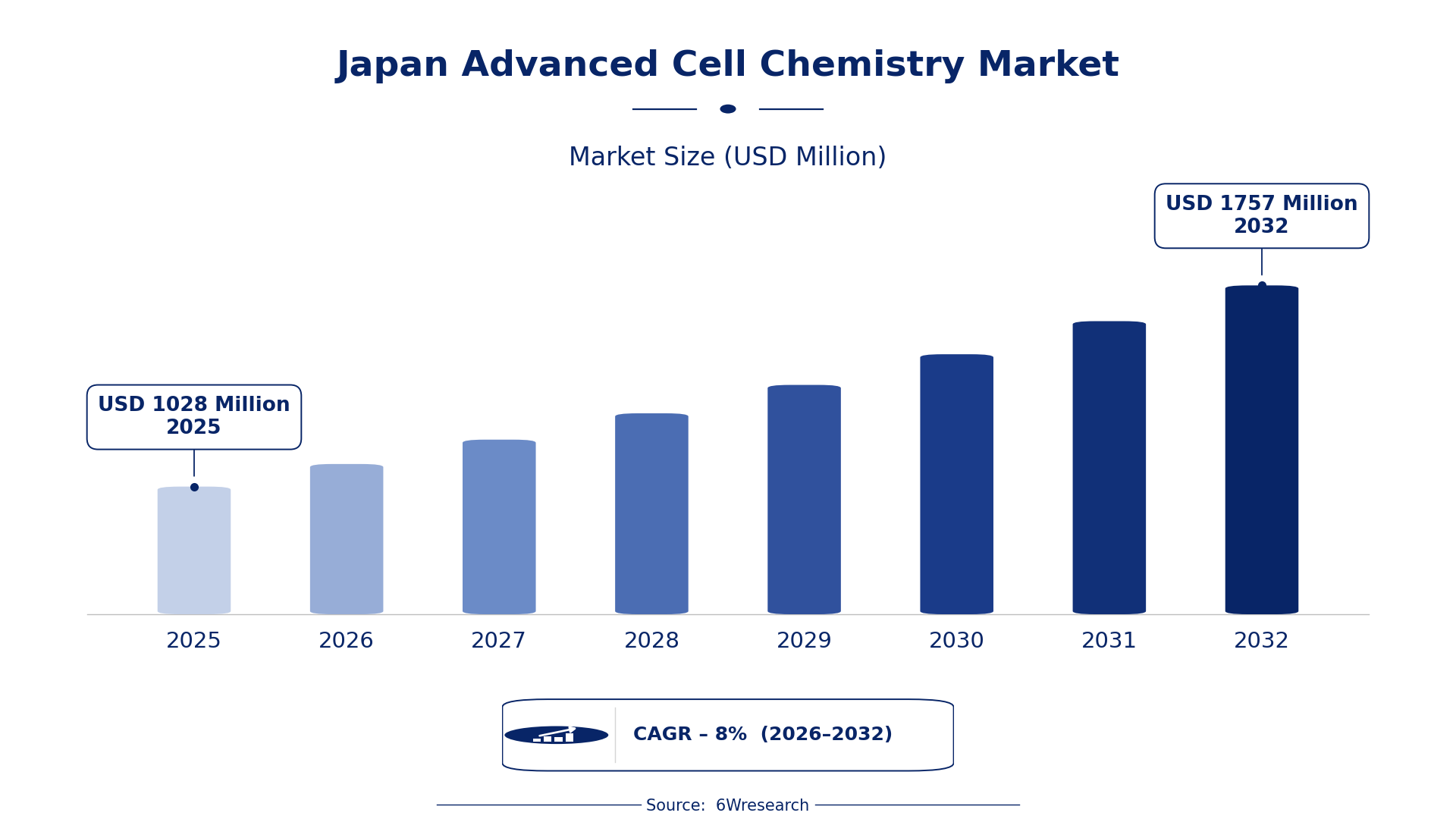
According to 6Wresearch internal database and industry insights, the Japan Advanced Cell Chemistry Market was valued at USD 1,028 Million in 2025 and is projected to reach USD 1,757 Million by 2032, growing at a CAGR of approximately 8% during 2026–2032.
Japan Advanced Cell Chemistry Market Highlights
| Report Metric | Details |
| Report Name | Japan Advanced Cell Chemistry Market (2026-2032) |
| Market Size 2025 | USD 1,028 Million |
| Market Size 2032 | USD 1,757 Million |
| Absolute Growth 2025–2032 | USD 729 Million |
| CAGR 2026–2032 | 8% |
| Peak Annual Growth | 9.2% in 2026 |
| Forecast Period | 2026–2032 |
| Historical Data | 2022–2025 |
| Base Year | 2025 |
| Leading Chemistry Type, 2025 | Lithium-Iron-Phosphate (43% share) |
| Leading Battery Type, 2025 | Lithium-Ion (40% share) |
| Leading Application, 2025 | Energy Storage (40% share) |
| Leading Distribution Channel, 2025 | Direct Sales (54% share) |
| Leading End User Sector, 2025 | Renewable Energy (44% share) |
| Fastest-Growing Chemistry Type | Sodium-Ion (10.9% CAGR) |
| Fastest-Growing Battery Type | Grid-Scale Storage (11.0% CAGR) |
| Fastest-Growing Application | Utility Sector (10.2% CAGR) |
| Fastest-Growing Distribution Channel | Online Platforms (10.1% CAGR) |
| Fastest-Growing End User Sector | Healthcare (10.0% CAGR) |
| Growing Sector | Utility Sector |
| Key End Users | Energy Storage, Industrial Equipment, Medical Devices, Utility Sector |
Japan Advanced Cell Chemistry Market Year-wise Growth Rate and Key Drivers (2022–2032)
This graph illustrates the annual growth rates of the market from 2022 to 2032, highlighting a steady upward trajectory and projected market expansion over the forecast period.
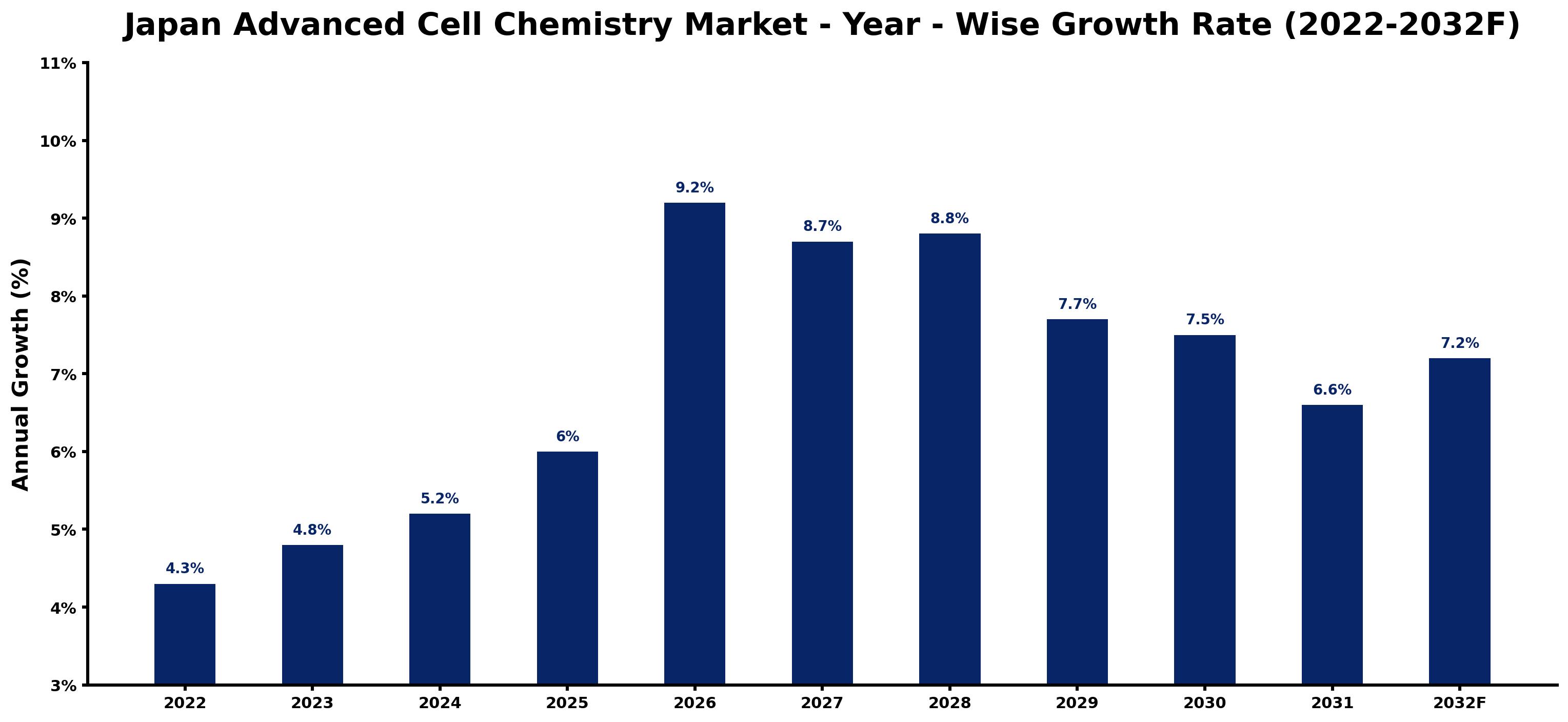
The table below sets out the estimated growth rate for each year and the main factor behind it.
| Year | Estimated Annual Growth (%) | Market Rationale |
| 2022 | 4.3 | The market maintained steady growth due to ongoing demand from the renewable energy sector. |
| 2023 | 4.8 | Growth accelerated as the healthcare sector expanded its reliance on battery-powered devices. |
| 2024 | 5.2 | Increased investments in energy storage systems contributed to faster growth rates. |
| 2025 | 6.0 | The market reached a peak as energy storage solutions gained traction. |
| 2026 | 9.2 | A surge in demand for lithium-ion batteries drove substantial growth in this year. |
| 2027 | 8.7 | Growth slowed slightly as market conditions began to normalise after rapid expansion. |
| 2028 | 8.8 | Demand increased again as new technologies emerged in battery chemistry. |
| 2029 | 7.7 | The market experienced a slowdown as competition intensified among battery producers. |
| 2030 | 7.5 | Growth slowed further as the market adjusted to maturing technologies and saturation. |
| 2031 | 6.6 | A slight recovery occurred as innovations in battery recycling began to take effect. |
| 2032 | 7.2 | Demand grew again as the focus on renewable energy sources intensified. |
Note: Market size estimations and growth projections presented in this report are based on 6Wresearch's proprietary forecasting methodology, utilizing the latest available industry data, government publications, and primary research inputs.
Japan Advanced Cell Chemistry Market Synopsis
Advanced Cell Chemistry encompasses various battery compositions, including Lithium-Iron-Phosphate and Sodium-Ion, produced through the synthesis of active materials and assembly of components. The Japan Advanced Cell Chemistry Market is growing due to rising demand from sectors like renewable energy and healthcare, driven by substantial investments in energy storage solutions. The renewable energy sector is projected to reach 50% of total energy by 2030, promoting innovation and sustainability in battery technology.
Market Dynamics Impact Analysis (2026–2032)
| Factor | Type | Impact | Primary Segment Affected |
| Growing demand for energy storage solutions in renewable energy applications | Driver | High | Energy Storage |
| Increased investments in battery research and development | Driver | High | Lithium-Ion |
| Emerging technologies in battery chemistry present new market opportunities | Opportunity | High | Sodium-Ion |
| Rising healthcare needs for reliable power sources create demand | Opportunity | Medium | Medical Devices |
| Environmental regulations limiting certain battery materials | Restraint | High | Nickel-Cadmium |
| Competition among battery manufacturers leading to price pressures | Restraint | Medium | Lithium-Ion |
| High R&D costs for developing new battery technologies | Challenge | High | Sodium-Ion |
| Supply chain disruptions affecting battery component availability | Challenge | Medium | Energy Storage |
Evaluation of Drivers in Japan Advanced Cell Chemistry Market (2026–2032)
The table below links each growth driver to the segment it affects and the evidence for it.
| Drivers | Primary Segment Affected | Why It Matters (Evidence) |
| Increased adoption of renewable energy sources | Energy Storage | The installed base of energy storage systems reached 2.5 GW in 2022, prompting utilities to invest in storage solutions. |
| Rising demand for electric vehicles | Lithium-Ion | Japan produced 1.5 million lithium-ion batteries in 2022, driven by the automotive sector's shift to electric mobility. |
| Growing healthcare sector requiring reliable power sources | Medical Devices | Over 10 million patients in Japan rely on battery-powered medical devices, increasing demand for dependable batteries. |
| Technological advancements in battery chemistry | Sodium-Ion | In 2023, Japan's Ministry of the Environment launched a program to promote sodium-ion battery research, enhancing market potential. |
| Government initiatives supporting battery recycling | Lithium-Ion | The government aims for a 90% battery recycling rate by 2030, driving demand for sustainable battery solutions. |
A wider customer base explains much of the growth, as increased adoption of renewable energy sources has led to an installed base of 2.5 GW of energy storage systems in Japan. Demand for electric vehicles has resulted in the production of 1.5 million lithium-ion batteries in 2022, boosting the market. The healthcare sector, with over 10 million patients using battery-powered medical devices, has also contributed to this trend.
Evaluation of Restraints in Japan Advanced Cell Chemistry Market
Several factors work against faster growth; the main ones are summarised below.
| Market Restraint | Primary Segment Affected | Why It Matters (Evidence) |
| Environmental regulations limiting the use of certain battery materials | Nickel-Cadmium | Strict regulations have reduced the market for Nickel-Cadmium batteries, impacting production levels. |
| Intense competition among manufacturers leading to price pressures | Lithium-Ion | The competitive environment has resulted in lower profit margins for producers, affecting investment in innovation. |
| High research and development costs for new battery technologies | Sodium-Ion | The financial burden of developing sodium-ion technology can deter investment and slow market entry. |
| Supply chain disruptions affecting battery component availability | Energy Storage | Recent global supply chain issues have led to delays in acquiring essential materials for energy storage systems. |
| Limited adoption of emerging battery technologies in mainstream applications | Sodium-Ion | Sodium-Ion technology remains largely untested in large-scale applications, hindering its market penetration. |
Japan Advanced Cell Chemistry Market Challenges
High production costs arise from expensive raw materials and complex manufacturing, which inflate prices for buyers in Japan's battery market. Local producers encounter fierce competition from international players, reducing profit margins and stifling innovation for suppliers. Delays due to adherence to standards like JIS C 8714 disrupt battery supply, affecting over 10 million patients in the healthcare sector reliant on medical devices. A lack of skilled technicians in battery manufacturing limits production capacity, causing delays that prevent producers from meeting rising demand from the industrial sector.
Trends in the Japan Advanced Cell Chemistry Market
Below are the shifts with the largest effect on the Japan Advanced Cell Chemistry Market.
- Shift towards Sustainable Battery Solutions: Japan is prioritising sustainable battery solutions, with the government targeting a 90% recycling rate by 2030. This shift is reflected in the growing adoption of lithium-ion batteries that meet environmental standards, improving market competitiveness.
- Emergence of Sodium-Ion Batteries: In 2023, Japan's Ministry of the Environment initiated a program to promote sodium-ion battery research, reflecting a shift in battery technology. This development could reshape energy storage solutions, attracting new investments.
- Increased Demand for Energy Storage in Renewable Energy: With the renewable energy sector projected to reach 50% of total energy by 2030, energy storage solutions are becoming essential. This trend is driving investments in grid-scale storage systems across Japan.
- Growth of Online Sales Channels for Batteries: Online platforms are gaining traction as a distribution channel for batteries, with a projected growth rate of 10.1% from 2026 to 2032. This trend reflects changing consumer behaviours and preferences in purchasing batteries.
Investment Opportunities in the Japan Advanced Cell Chemistry Market
The opportunities below stand out in the Japan Advanced Cell Chemistry Market for new entrants and existing suppliers.
- Investment in Energy Storage Facilities: The Kansai region is an ideal location for energy storage facilities, with a growing installed base of 2.5 GW. This presents an opportunity for investment in advanced storage technologies to meet increasing demand.
- Focus on Healthcare Applications: With over 10 million patients relying on battery-powered medical devices, there is a pressing need for reliable battery solutions. Investing in this sector can cater to the expanding healthcare market.
- Expansion of Recycling Initiatives: The government aims for a 90% battery recycling rate by 2030, creating opportunities for companies involved in recycling technologies and processes. This aligns with sustainability goals and market demands.
- Development of Sodium-Ion Technology: The recent government program promoting sodium-ion battery research opens avenues for investment in this emerging technology. This could lead to new applications and market growth.
Government Initiatives in the Japan Advanced Cell Chemistry Market
The Act on the Rational Use of Energy obliges large energy users to enhance energy efficiency and monitor energy consumption. This measure impacts battery producers by ensuring compliance with energy standards, driving innovation in energy-efficient battery technologies. The Battery Industry Strategy targets 150 GWh of domestic battery manufacturing capacity by 2030, supporting local production and reducing dependency on imports.
The Ministry of Economy, Trade and Industry oversees the approval of battery recycling initiatives and funds research projects aimed at advancing battery technology. This support is essential for improving the sustainability and efficiency of battery production in Japan.
Future Insight of the Japan Advanced Cell Chemistry Market
Sodium-ion battery technology will transform demand by 2032, driven by the government's 1 billion JPY investment in research and development. The installed base of energy storage systems is expected to reach 5 GW, coinciding with the renewable energy sector's goal of 36-38% of total energy by 2030. Recycling initiatives will enhance sustainability and efficiency in the industry, benefiting both buyers and suppliers. Adoption of ISO 9001 standards will promote higher quality and reliability in battery products, fostering consumer trust.
Market Segmentation Analysis
Japan Advanced Cell Chemistry Market report covers a detailed analysis of the following market segments:
By Chemistry Type – Lithium-Iron-Phosphate Leads, Sodium-Ion Expected to Grow Fastest
According to Saurav Kr Singh, Senior Research Analyst at 6Wresearch, Lithium-Iron-Phosphate held 43% of the Japan Advanced Cell Chemistry Market by chemistry type in 2025. Lithium-Iron-Phosphate is preferred for energy storage systems owing to its safety and thermal stability, making it a reliable choice for various applications. Its extensive use in energy storage supports Japan's goal of enhancing renewable energy integration, particularly in the Tokyo region. Over 2026–2032, Sodium-Ion is expected to post the fastest growth, at a CAGR of 10.9%. Sodium-Ion is gaining traction as a promising technology, especially with government support for research initiatives aimed at advancing its applications. The programme launched in 2023 highlights the potential for this chemistry type to achieve rapid growth in the coming years. Suppliers should focus on developing Sodium-Ion technologies to meet the anticipated market demand.
By Battery Type – Lithium-Ion Leads, Grid-Scale Storage Expected to Grow Fastest
In 2025, Lithium-Ion led the battery type split with a 40% share. Lithium-Ion batteries dominate the market, particularly in consumer electronics and electric vehicles, due to their high energy density and efficiency. This widespread adoption is evidenced by Japan producing 1.5 million lithium-ion batteries in 2022. Grid-Scale Storage is projected to grow fastest, at a CAGR of 11.0% during 2026–2032. Grid-Scale Storage is experiencing rapid growth as it plays a critical role in balancing supply and demand in renewable energy systems. The increasing need for energy management solutions is propelling this segment forward. Buyers should consider investing in Grid-Scale Storage solutions to optimise energy use and support renewable initiatives.
By Application – Energy Storage Leads, Utility Sector Expected to Grow Fastest
Energy Storage took 40% of application revenue in 2025, more than any other category. Energy Storage is crucial for integrating renewable energy sources into the grid, establishing it as the leading application in the market. The installed base of energy storage systems reached 2.5 GW in 2022, underscoring its importance in Japan's energy strategy. The quickest growth will come from Utility Sector, forecast to expand at a CAGR of 10.2% between 2026 and 2032. The Utility Sector is expanding rapidly as it becomes increasingly vital for energy management and distribution. This growth is driven by the need for efficient energy solutions in a transitioning energy landscape, particularly in urban areas. Suppliers must adapt their offerings to meet the increasing demands of the Utility Sector.
By Distribution Channel – Direct Sales Leads, Online Platforms Expected to Grow Fastest
Direct Sales accounted for 54% of the market by distribution channel in 2025. Direct Sales serves as the primary method for reaching industrial customers, enabling suppliers to effectively cater to their requirements. This channel is essential for maintaining strong relationships with key buyers in the market, especially in the Kansai region. Online Platforms are set to record the highest CAGR in this split, 10.1% over 2026–2032. Online Platforms are emerging as a significant channel, particularly for consumer and small business sales. The shift towards digital purchasing is reshaping how products are marketed and sold, indicating a trend towards more accessible buying options. Suppliers should invest in online sales strategies to capture the expanding consumer market.
By End User Sector – Renewable Energy Leads, Healthcare Expected to Grow Fastest
The largest end user sector category in 2025 was Renewable Energy, at 44% of revenue. Renewable Energy is the leading end user sector, driven by substantial demand for storage solutions in solar and wind applications. The government's commitment to increasing the renewable energy share by 36-38% by 2030 reinforces this trend, particularly in rural areas. Over 2026–2032, Healthcare is expected to post the fastest growth, at a CAGR of 10.0%. Healthcare is witnessing rapid growth due to the rising demand for reliable power sources in medical technology. With over 10 million patients using battery-powered devices, this sector is poised for significant expansion in the coming years. Buyers in the healthcare sector should prioritise reliable battery solutions to ensure uninterrupted power for medical devices.
Key Attractiveness of the Report
- 10 Years of Market Numbers
- Historical Data Starting from 2022 to 2025
- Base Year 2025
- Forecast Data until 2032
- Key Performance Indicators Impacting the Market
- Major Upcoming Developments and Projects
Key Highlights of the Report:
- Japan Advanced Cell Chemistry Market Outlook
- Market Size of Japan Advanced Cell Chemistry Market, 2025
- Forecast of Japan Advanced Cell Chemistry Market, 2032
- Historical Data and Forecast of Japan Advanced Cell Chemistry Revenues & Volume for the Period 2022-2032F
- Japan Advanced Cell Chemistry Market Trend Evolution
- Japan Advanced Cell Chemistry Market Drivers and Challenges
- Japan Advanced Cell Chemistry Price Trends
- Japan Advanced Cell Chemistry Porter's Five Forces
- Japan Advanced Cell Chemistry Industry Life Cycle
- Historical Data and Forecast of Japan Advanced Cell Chemistry Market Revenues & Volume By Chemistry Type for the Period 2022-2032F
- Historical Data and Forecast of Japan Advanced Cell Chemistry Market Revenues & Volume By Lithium-Iron-Phosphate for the Period 2022-2032F
- Historical Data and Forecast of Japan Advanced Cell Chemistry Market Revenues & Volume By Nickel-Cadmium for the Period 2022-2032F
- Historical Data and Forecast of Japan Advanced Cell Chemistry Market Revenues & Volume By Zinc-Air for the Period 2022-2032F
- Historical Data and Forecast of Japan Advanced Cell Chemistry Market Revenues & Volume By Sodium-Ion for the Period 2022-2032F
- Historical Data and Forecast of Japan Advanced Cell Chemistry Market Revenues & Volume By Battery Type for the Period 2022-2032F
- Historical Data and Forecast of Japan Advanced Cell Chemistry Market Revenues & Volume By Lithium-Ion for the Period 2022-2032F
- Historical Data and Forecast of Japan Advanced Cell Chemistry Market Revenues & Volume By Rechargeable Batteries for the Period 2022-2032F
- Historical Data and Forecast of Japan Advanced Cell Chemistry Market Revenues & Volume By Primary Batteries for the Period 2022-2032F
- Historical Data and Forecast of Japan Advanced Cell Chemistry Market Revenues & Volume By Grid-Scale Storage for the Period 2022-2032F
- Historical Data and Forecast of Japan Advanced Cell Chemistry Market Revenues & Volume By Application for the Period 2022-2032F
- Historical Data and Forecast of Japan Advanced Cell Chemistry Market Revenues & Volume By Energy Storage for the Period 2022-2032F
- Historical Data and Forecast of Japan Advanced Cell Chemistry Market Revenues & Volume By Industrial Equipment for the Period 2022-2032F
- Historical Data and Forecast of Japan Advanced Cell Chemistry Market Revenues & Volume By Medical Devices for the Period 2022-2032F
- Historical Data and Forecast of Japan Advanced Cell Chemistry Market Revenues & Volume By Utility Sector for the Period 2022-2032F
- Historical Data and Forecast of Japan Advanced Cell Chemistry Market Revenues & Volume By Distribution Channel for the Period 2022-2032F
- Historical Data and Forecast of Japan Advanced Cell Chemistry Market Revenues & Volume By Direct Sales for the Period 2022-2032F
- Historical Data and Forecast of Japan Advanced Cell Chemistry Market Revenues & Volume By Industrial Suppliers for the Period 2022-2032F
- Historical Data and Forecast of Japan Advanced Cell Chemistry Market Revenues & Volume By Online Platforms for the Period 2022-2032F
- Historical Data and Forecast of Japan Advanced Cell Chemistry Market Revenues & Volume By Specialty Stores for the Period 2022-2032F
- Historical Data and Forecast of Japan Advanced Cell Chemistry Market Revenues & Volume By End User Sector for the Period 2022-2032F
- Historical Data and Forecast of Japan Advanced Cell Chemistry Market Revenues & Volume By Renewable Energy for the Period 2022-2032F
- Historical Data and Forecast of Japan Advanced Cell Chemistry Market Revenues & Volume By Manufacturing Plants for the Period 2022-2032F
- Historical Data and Forecast of Japan Advanced Cell Chemistry Market Revenues & Volume By Healthcare for the Period 2022-2032F
- Historical Data and Forecast of Japan Advanced Cell Chemistry Market Revenues & Volume By Power Providers for the Period 2022-2032F
- Japan Advanced Cell Chemistry Import Export Trade Statistics
- Market Opportunity Assessment By Chemistry Type
- Market Opportunity Assessment By Battery Type
- Market Opportunity Assessment By Application
- Market Opportunity Assessment By Distribution Channel
- Market Opportunity Assessment By End User Sector
- Japan Advanced Cell Chemistry Top Companies Market Share
- Japan Advanced Cell Chemistry Competitive Benchmarking By Technical and Operational Parameters
- Japan Advanced Cell Chemistry Company Profiles
- Japan Advanced Cell Chemistry Key Strategic Recommendations
Market Covered
The report covers the following segments.
By Chemistry Type
- Lithium-Iron-Phosphate
- Nickel-Cadmium
- Zinc-Air
- Sodium-Ion
By Battery Type
- Lithium-Ion
- Rechargeable Batteries
- Primary Batteries
- Grid-Scale Storage
By Application
- Energy Storage
- Industrial Equipment
- Medical Devices
- Utility Sector
By Distribution Channel
- Direct Sales
- Industrial Suppliers
- Online Platforms
- Specialty Stores
By End User Sector
- Renewable Energy
- Manufacturing Plants
- Healthcare
- Power Providers































