Japan Advanced Driver Assistance Chips Market Size & Growth Rate
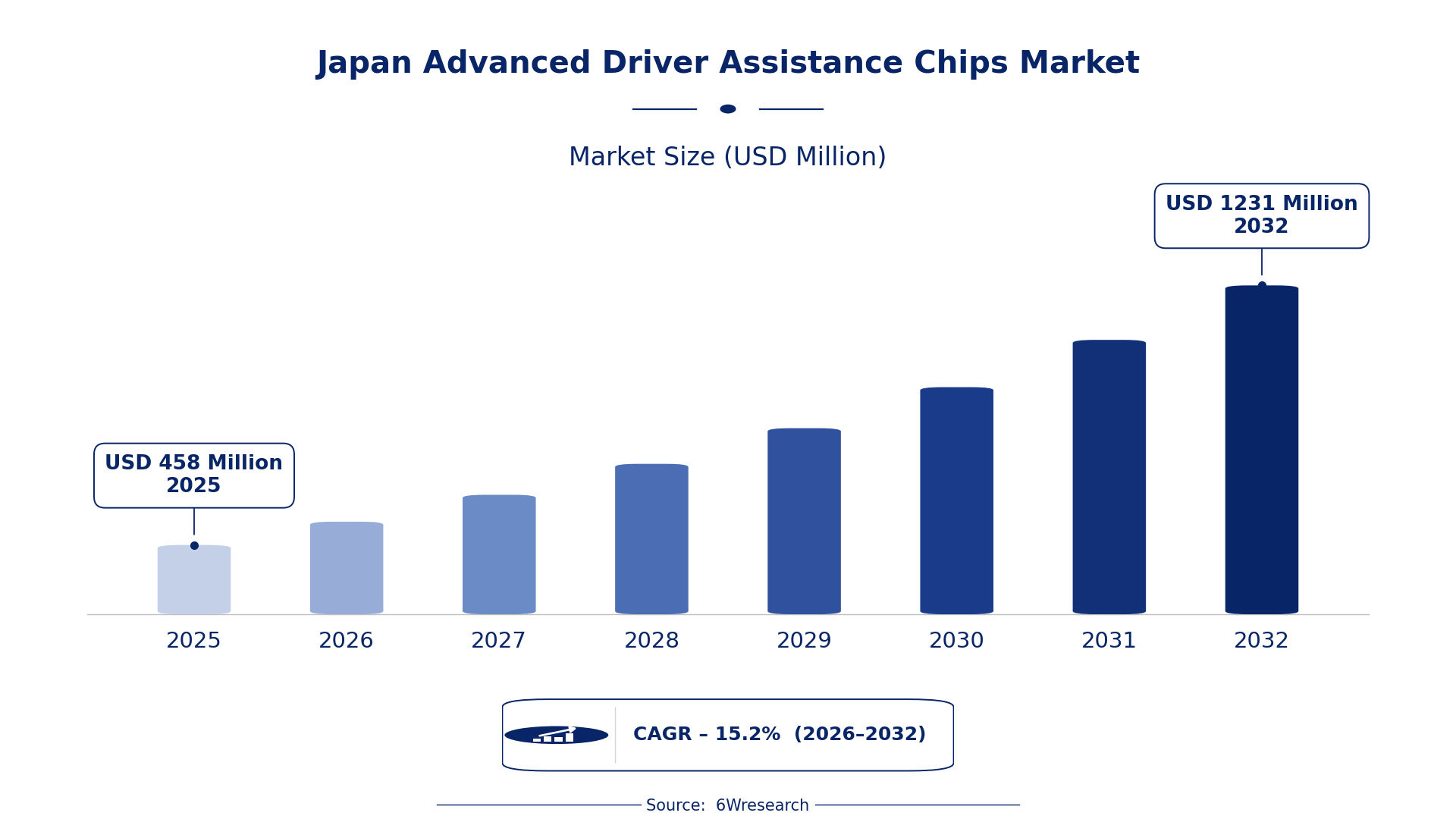
According to 6Wresearch internal database and industry insights, the Japan Advanced Driver Assistance Chips Market was valued at USD 458 Million in 2025 and is projected to reach USD 1,231 Million by 2032, growing at a CAGR of approximately 15.2% during 2026–2032.
Japan Advanced Driver Assistance Chips Market Highlights
| Report Metric | Details |
| Report Name | Japan Advanced Driver Assistance Chips Market (2026-2032) |
| Market Size 2025 | USD 458 Million |
| Market Size 2032 | USD 1,231 Million |
| Absolute Growth 2025–2032 | USD 773 Million |
| CAGR 2026–2032 | 15.2% |
| Peak Annual Growth | 17.1% in 2030 |
| Forecast Period | 2026–2032 |
| Historical Data | 2022–2025 |
| Base Year | 2025 |
| Leading Advanced Driver Assistance Chips Market, 2025 | Vision Processor Chips (37% share) |
| Leading Chip Type, 2025 | SoC (46% share) |
| Leading Architecture, 2025 | ARM Cortex (38% share) |
| Leading Feature Integration, 2025 | Obstacle Detection (51% share) |
| Leading End User Sector, 2025 | Automotive (46% share) |
| Fastest-Growing Advanced Driver Assistance Chips Market | Sensor Fusion Chips (20.3% CAGR) |
| Fastest-Growing Chip Type | AI Accelerators (22.3% CAGR) |
| Fastest-Growing Architecture | RISC-V (19.7% CAGR) |
| Fastest-Growing Feature Integration | ADAS Subsystems Support (21.4% CAGR) |
| Fastest-Growing End User Sector | Autonomous Vehicles (20.4% CAGR) |
| Growing Sector | Autonomous Vehicles |
| Key End Users | Automotive, Electric Vehicles, Autonomous Vehicles, Robotics |
Japan Advanced Driver Assistance Chips Market Year-wise Growth Rate and Key Drivers (2022–2032)
This graph illustrates the annual growth rates of the market from 2022 to 2032, highlighting a steady upward trajectory and projected market expansion over the forecast period.
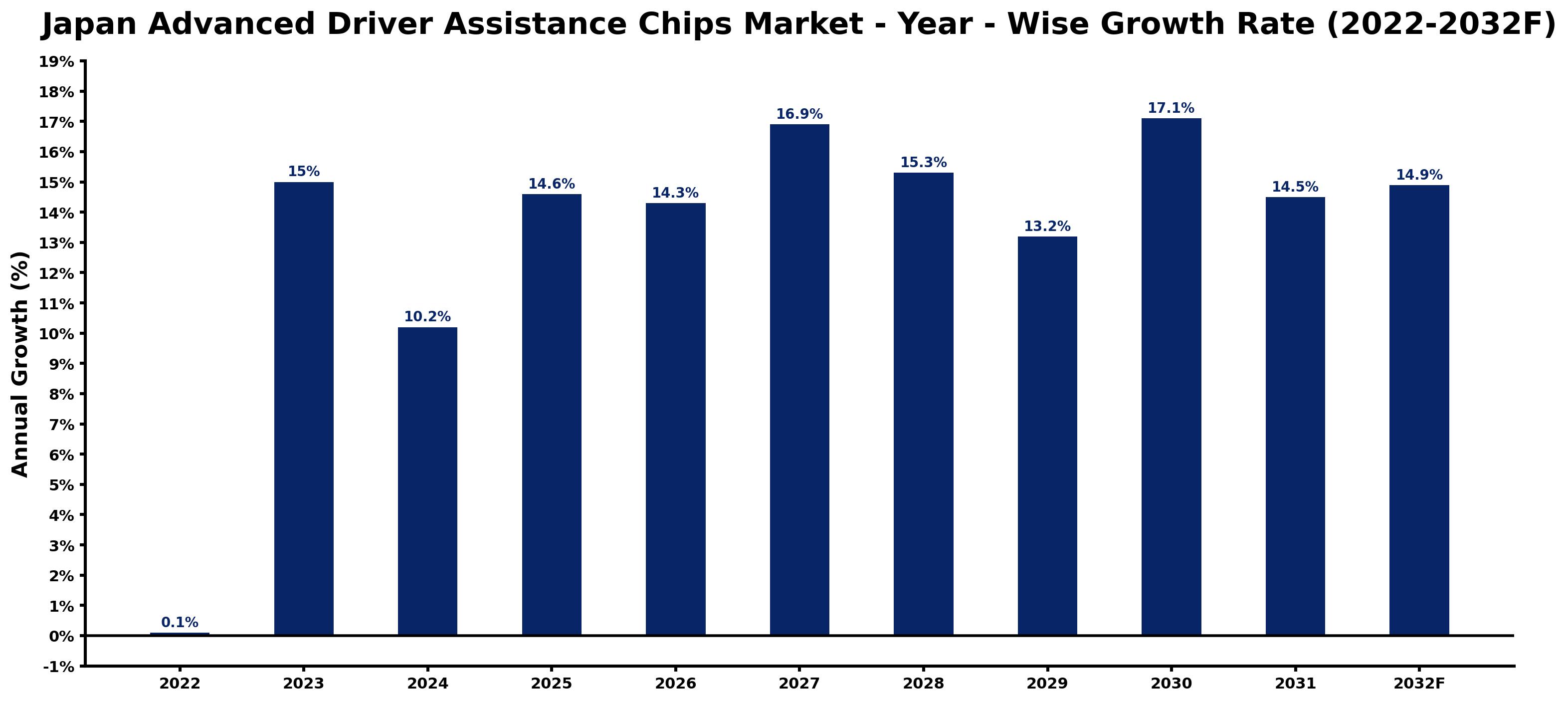
Below, each year's estimated growth is shown next to the factor that most influenced it.
| Year | Estimated Annual Growth (%) | Market Rationale |
| 2022 | 0.1 | The automotive sector produced over 8 million vehicles, indicating steady market activity. |
| 2023 | 15.0 | The adoption rate of ADAS features exceeded 60%, reflecting growing consumer interest in safety technologies. |
| 2024 | 10.2 | Safety regulations continued to drive demand, though growth slowed compared to the previous year. |
| 2025 | 14.6 | Investments in electric vehicles surged, boosting demand for advanced driver assistance technologies. |
| 2026 | 14.3 | Market growth slowed as manufacturers adjusted to evolving technological standards and consumer expectations. |
| 2027 | 16.9 | Increased production of autonomous vehicles spurred demand for advanced chips, accelerating growth. |
| 2028 | 15.3 | The market experienced a slowdown as manufacturers faced challenges in meeting regulatory compliance. |
| 2029 | 13.2 | Demand stabilised as the market adjusted to technological advancements and consumer preferences. |
| 2030 | 17.1 | The push for 100% autonomous vehicle deployment by 2040 ignited renewed interest in advanced chips. |
| 2031 | 14.5 | Technological advancements in smart mobility solutions began to reshape market dynamics, sustaining growth. |
| 2032 | 14.9 | The growing number of electric vehicles continued to drive demand for advanced driver assistance technologies. |
Note: Market size estimations and growth projections presented in this report are based on 6Wresearch's proprietary forecasting methodology, utilizing the latest available industry data, government publications, and primary research inputs.
Japan Advanced Driver Assistance Chips Market Synopsis
Advanced Driver Assistance Chips are semiconductor devices designed to improve vehicle safety and automation, enabling features like adaptive cruise control and automated parking. The Japan Advanced Driver Assistance Chips Market is growing due to investments in electric and autonomous vehicles, with over 8 million vehicles produced in 2022. The adoption rate of ADAS features in new vehicles exceeds 60%, driven by domestic automotive manufacturers and safety regulations mandating these technologies since 2021. This growth is supported by ongoing advancements in automotive technology and a commitment to improving road safety.
Market Dynamics Impact Analysis (2026–2032)
| Factor | Type | Impact | Primary Segment Affected |
| Increasing vehicle production and safety regulations drive demand for ADAS features. | Driver | High | Radar Processor Chips |
| Growing investments in electric and autonomous vehicles create a need for advanced chips. | Driver | High | Vision Processor Chips |
| The shift towards autonomous vehicles opens new markets for chip manufacturers. | Opportunity | High | Sensor Fusion Chips |
| Investment in smart mobility initiatives provides funding for ADAS technology development. | Opportunity | Medium | Neural Processing Chips |
| Supply chain disruptions have impacted chip availability, limiting production capabilities. | Restraint | High | Power Management Chips |
| The high cost of ADAS features can deter some consumers from purchasing new vehicles. | Restraint | Medium | ASIC |
| High competition among manufacturers can lead to price wars, affecting profitability. | Challenge | High | SoC |
| Rapid technological changes require continuous investment in R&D to stay competitive. | Challenge | Medium | AI Accelerators |
Evaluation of Drivers in Japan Advanced Driver Assistance Chips Market (2026–2032)
Demand rests on the following drivers, each shown with the segment it touches most.
| Drivers | Primary Segment Affected | Why It Matters (Evidence) |
| Increased vehicle production | Radar Processor Chips | Japan's automotive sector produced over 8 million vehicles in 2022, driving demand for ADAS features. |
| Rising electric vehicle adoption | Vision Processor Chips | The number of electric vehicles in Japan reached 1.5 million in 2023, boosting demand for advanced chips. |
| Safety regulations mandating ADAS | Sensor Fusion Chips | ADAS features have been mandated by safety regulations in Japan since 2021, increasing chip requirements. |
| Technological advancements in automation | Neural Processing Chips | The Japanese government aims for 100% autonomous vehicle deployment by 2040, enhancing demand for advanced chips. |
| Investment in smart mobility initiatives | Power Management Chips | The government allocated ¥100 billion for smart mobility initiatives in 2023, promoting ADAS technology. |
Spending rises because the Tokyo region is a hub for automotive technology development, with over 8 million vehicles produced in 2022. The number of electric vehicles in Japan reached 1.5 million in 2023, increasing demand for advanced chips.
Evaluation of Restraints in Japan Advanced Driver Assistance Chips Market
Below are the constraints most often cited by buyers and suppliers, with the segment each affects.
| Market Restraint | Primary Segment Affected | Why It Matters (Evidence) |
| Supply chain disruptions affecting chip availability limit production capabilities. | Power Management Chips | The automotive sector faced challenges in sourcing components, impacting the timely production of ADAS. |
| High costs of ADAS features can deter consumer purchases. | ASIC | The average cost of ADAS features in new vehicles is approximately ¥300,000, which may discourage buyers. |
| Intense competition among manufacturers leads to price wars. | SoC | As many players enter the market, pricing pressures can reduce profit margins for chip manufacturers. |
| Rapid technological changes require continuous R&D investment. | AI Accelerators | Staying competitive necessitates ongoing investment in research and development, straining resources. |
| Regulatory compliance can increase production costs. | Neural Processing Chips | Compliance with ISO 26262 for functional safety adds complexity and cost to chip production. |
Japan Advanced Driver Assistance Chips Market Challenges
Japan's automotive manufacturers face a skills gap in semiconductor engineering, which can delay Advanced Driver Assistance Chips production by up to six months, impacting timelines for suppliers. Stringent safety regulations enforced by the Ministry of Land, Infrastructure, Transport and Tourism since 2021 increase compliance costs, raising prices for buyers. The average cost of ADAS features in new vehicles is approximately ¥300,000, which can deter consumer adoption and hinder market growth. Rapid technological advancements require producers to invest heavily in updates, straining budgets and potentially leading to higher prices for end users.
Trends in the Japan Advanced Driver Assistance Chips Market
The trends below show where the Japan Advanced Driver Assistance Chips Market is heading.
- Shift from Traditional to Advanced Safety Features: The Tokyo Motor Show has highlighted advancements in ADAS technologies, with over 60% adoption in new vehicles. This shift reflects a growing emphasis on vehicle safety and automation.
- Transition from Manual to Automated Driving: Since 2023, the number of registered autonomous vehicles in Japan reached 10,000, indicating a move towards automation in the automotive sector. This trend is reshaping demand for advanced chips.
- Emergence of AI-Driven ADAS Solutions: The adoption of AI accelerators is increasing, with a projected CAGR of 22.3% for 2026-2032. This trend is driven by the need for improved machine learning capabilities in ADAS applications.
- Prioritisation of Smart Mobility Initiatives: In 2023, the government allocated ¥100 billion for smart mobility initiatives, reflecting a commitment to advancing automotive technology. This funding is expected to boost the ADAS market.
Investment Opportunities in the Japan Advanced Driver Assistance Chips Market
Below are the investment opportunities with the strongest case in the Japan Advanced Driver Assistance Chips Market.
- Investment in Smart Mobility Technology: The Tokyo region is focusing on smart traffic management systems, with ¥100 billion allocated for initiatives in 2023. Suppliers can enter this market by partnering with local governments.
- Supply of Advanced Sensor Chips: The demand for sensor fusion chips is rising, driven by the need for accurate decision-making in vehicles. The automotive sector is a key buyer group, presenting opportunities for suppliers.
- Development of AI-Driven ADAS Solutions: The growing interest in AI accelerators creates opportunities for innovation in ADAS. Collaborating with automotive manufacturers can facilitate entry into this expanding market.
- Expansion of Autonomous Vehicle Technology: The autonomous vehicles segment is growing rapidly, with a projected CAGR of 20.4% for 2026-2032. Suppliers should consider partnerships with automotive manufacturers to meet this demand.
Government Initiatives in the Japan Advanced Driver Assistance Chips Market
The Semiconductor and Digital Industry Strategy, introduced in June 2021, aims to strengthen domestic semiconductor manufacturing. This initiative builds on existing frameworks by ensuring a stable supply chain for advanced driver assistance chips, which are critical for vehicle safety and automation. The strategy includes funding for R&D and infrastructure improvements, facilitating innovation in the sector.
The Ministry of Land, Infrastructure, Transport and Tourism oversees the implementation of ADAS regulations. By promoting compliance with safety standards, the ministry ensures that manufacturers meet the necessary requirements for ADAS technologies, thereby supporting the industry's growth. The ministry's efforts include regular inspections and certification processes to maintain high safety standards in the automotive sector.
Future Insight of the Japan Advanced Driver Assistance Chips Market
Advancements in smart traffic management systems will reshape demand for Advanced Driver Assistance Chips by 2032, enhancing urban mobility. The government's initiative for 100% autonomous vehicle deployment by 2040 will drive innovation in chip technology. Annual investments in automotive R&D exceeding ¥1 trillion will support breakthroughs in safety and automation. As the number of electric vehicles in Japan reaches 1.5 million, suppliers will need to adapt to the evolving expectations of buyers.
Market Segmentation Analysis
Japan Advanced Driver Assistance Chips Market report covers a detailed analysis of the following market segments:
By Advanced Driver Assistance Chips Market – Vision Processor Chips Lead, Sensor Fusion Chips Expected to Grow Fastest
According to Saurav Kr Singh, Senior Research Analyst at 6Wresearch, Vision Processor Chips accounted for 37% of the market by advanced driver assistance chips market in 2025. Vision Processor Chips dominate the market due to their essential function in processing camera data for ADAS applications. With over 60% of new vehicles featuring ADAS, these chips are vital for enhancing vehicle safety in Japan. The quickest growth will come from Sensor Fusion Chips, forecast to expand at a CAGR of 20.3% between 2026 and 2032. Sensor Fusion Chips are growing rapidly as they combine data from various sensors, ensuring precise decision-making in complex driving conditions. The increasing complexity of ADAS features drives the need for these chips, leading to their swift market expansion. Suppliers should focus on advancing sensor fusion technology to meet the growing demands of the automotive industry.
By Chip Type – SoC Leads, AI Accelerators Expected to Grow Fastest
SoC took 46% of chip type revenue in 2025, more than any other category. SoC leads the market as it consolidates multiple functions into a single chip, which is crucial for efficiency in automotive systems. This integration is vital for manufacturers looking to optimise space and performance in their vehicle designs. AI Accelerators are projected to grow fastest, at a CAGR of 22.3% during 2026–2032. AI Accelerators are experiencing the highest growth due to their ability to improve machine learning applications for ADAS. As the automotive sector increasingly adopts AI-driven features, the demand for these accelerators is anticipated to rise significantly. Buyers should invest in AI Accelerator technology to stay competitive in the rapidly evolving automotive market.
By Architecture – ARM Cortex Leads, RISC-V Expected to Grow Fastest
The largest architecture category in 2025 was ARM Cortex, at 38% of revenue. ARM Cortex is the predominant architecture in this market due to its widespread adoption for processing tasks in ADAS systems. Its extensive use among manufacturers ensures compatibility and reliability across various vehicle models, reinforcing its leading position. RISC-V is set to record the highest CAGR in this split, 19.7% over 2026–2032. RISC-V architecture is emerging quickly, offering substantial potential for future ADAS applications with its flexibility and customisation capabilities. As manufacturers seek innovative solutions, RISC-V's growth is expected to accelerate, increasing its market relevance. Suppliers should consider RISC-V solutions to align with the future needs of the automotive industry.
By Feature Integration – Obstacle Detection Leads, ADAS Subsystems Support Expected to Grow Fastest
Obstacle Detection held 51% of the Japan Advanced Driver Assistance Chips Market by feature integration in 2025. Obstacle Detection is the leading feature in ADAS, playing a crucial role in ensuring vehicle safety. Its significance in preventing accidents makes it a priority for automotive manufacturers, driving its widespread adoption. Over 2026–2032, ADAS Subsystems Support is expected to post the fastest growth, at a CAGR of 21.4%. ADAS Subsystems Support is rapidly growing as it enables the integration of various ADAS features, enhancing overall vehicle functionality. The increasing complexity of vehicle systems necessitates robust support for these subsystems, contributing to their swift growth. Suppliers must concentrate on developing comprehensive ADAS subsystems to effectively meet market demands.
By End User Sector – Automotive Leads, Autonomous Vehicles Expected to Grow Fastest
In 2025, Automotive led the end user sector split with a 46% share. The Automotive sector is the largest consumer of ADAS technology, being the primary industry that utilises these advancements for improved safety and automation. With over 8 million vehicles produced in Japan, the demand for ADAS technology remains strong and continues to increase. The quickest growth will come from Autonomous Vehicles, forecast to expand at a CAGR of 20.4% between 2026 and 2032. Autonomous Vehicles represent the fastest-growing segment, essential for enabling self-driving capabilities. The Japanese government's goal for 100% autonomous vehicle deployment by 2040 significantly accelerates this growth, indicating a shift in industry focus. Buyers should align their strategies with the transition towards autonomous vehicle technology to remain relevant in the market.
Key Attractiveness of the Report
- 10 Years of Market Numbers
- Historical Data Starting from 2022 to 2025
- Base Year 2025
- Forecast Data until 2032
- Key Performance Indicators Impacting the Market
- Major Upcoming Developments and Projects
Key Highlights of the Report:
- Japan Advanced Driver Assistance Chips Market Outlook
- Market Size of Japan Advanced Driver Assistance Chips Market, 2025
- Forecast of Japan Advanced Driver Assistance Chips Market, 2032
- Historical Data and Forecast of Japan Advanced Driver Assistance Chips Revenues & Volume for the Period 2022-2032F
- Japan Advanced Driver Assistance Chips Market Trend Evolution
- Japan Advanced Driver Assistance Chips Market Drivers and Challenges
- Japan Advanced Driver Assistance Chips Price Trends
- Japan Advanced Driver Assistance Chips Porter's Five Forces
- Japan Advanced Driver Assistance Chips Industry Life Cycle
- Historical Data and Forecast of Japan Advanced Driver Assistance Chips Market Revenues & Volume By Advanced Driver Assistance Chips Market for the Period 2022-2032F
- Historical Data and Forecast of Japan Advanced Driver Assistance Chips Market Revenues & Volume By Radar Processor Chips for the Period 2022-2032F
- Historical Data and Forecast of Japan Advanced Driver Assistance Chips Market Revenues & Volume By Vision Processor Chips for the Period 2022-2032F
- Historical Data and Forecast of Japan Advanced Driver Assistance Chips Market Revenues & Volume By Sensor Fusion Chips for the Period 2022-2032F
- Historical Data and Forecast of Japan Advanced Driver Assistance Chips Market Revenues & Volume By Power Management Chips for the Period 2022-2032F
- Historical Data and Forecast of Japan Advanced Driver Assistance Chips Market Revenues & Volume By Neural Processing Chips for the Period 2022-2032F
- Historical Data and Forecast of Japan Advanced Driver Assistance Chips Market Revenues & Volume By Chip Type for the Period 2022-2032F
- Historical Data and Forecast of Japan Advanced Driver Assistance Chips Market Revenues & Volume By ASIC for the Period 2022-2032F
- Historical Data and Forecast of Japan Advanced Driver Assistance Chips Market Revenues & Volume By SoC for the Period 2022-2032F
- Historical Data and Forecast of Japan Advanced Driver Assistance Chips Market Revenues & Volume By FPGA for the Period 2022-2032F
- Historical Data and Forecast of Japan Advanced Driver Assistance Chips Market Revenues & Volume By PMIC for the Period 2022-2032F
- Historical Data and Forecast of Japan Advanced Driver Assistance Chips Market Revenues & Volume By AI Accelerators for the Period 2022-2032F
- Historical Data and Forecast of Japan Advanced Driver Assistance Chips Market Revenues & Volume By Architecture for the Period 2022-2032F
- Historical Data and Forecast of Japan Advanced Driver Assistance Chips Market Revenues & Volume By ARM Cortex for the Period 2022-2032F
- Historical Data and Forecast of Japan Advanced Driver Assistance Chips Market Revenues & Volume By RISC-V for the Period 2022-2032F
- Historical Data and Forecast of Japan Advanced Driver Assistance Chips Market Revenues & Volume By Embedded for the Period 2022-2032F
- Historical Data and Forecast of Japan Advanced Driver Assistance Chips Market Revenues & Volume By Mixed-Signal for the Period 2022-2032F
- Historical Data and Forecast of Japan Advanced Driver Assistance Chips Market Revenues & Volume By Neural Net Engines for the Period 2022-2032F
- Historical Data and Forecast of Japan Advanced Driver Assistance Chips Market Revenues & Volume By Feature Integration for the Period 2022-2032F
- Historical Data and Forecast of Japan Advanced Driver Assistance Chips Market Revenues & Volume By Obstacle Detection for the Period 2022-2032F
- Historical Data and Forecast of Japan Advanced Driver Assistance Chips Market Revenues & Volume By Lane Departure Warning for the Period 2022-2032F
- Historical Data and Forecast of Japan Advanced Driver Assistance Chips Market Revenues & Volume By Sensor Data Processing for the Period 2022-2032F
- Historical Data and Forecast of Japan Advanced Driver Assistance Chips Market Revenues & Volume By ADAS Subsystems Support for the Period 2022-2032F
- Historical Data and Forecast of Japan Advanced Driver Assistance Chips Market Revenues & Volume By Driver Behavior Analysis for the Period 2022-2032F
- Historical Data and Forecast of Japan Advanced Driver Assistance Chips Market Revenues & Volume By End User Sector for the Period 2022-2032F
- Historical Data and Forecast of Japan Advanced Driver Assistance Chips Market Revenues & Volume By Automotive for the Period 2022-2032F
- Historical Data and Forecast of Japan Advanced Driver Assistance Chips Market Revenues & Volume By Autonomous Vehicles for the Period 2022-2032F
- Historical Data and Forecast of Japan Advanced Driver Assistance Chips Market Revenues & Volume By Robotics for the Period 2022-2032F
- Historical Data and Forecast of Japan Advanced Driver Assistance Chips Market Revenues & Volume By Electric Vehicles for the Period 2022-2032F
- Historical Data and Forecast of Japan Advanced Driver Assistance Chips Market Revenues & Volume By Automotive for the Period 2022-2032F
- Japan Advanced Driver Assistance Chips Import Export Trade Statistics
- Market Opportunity Assessment By Advanced Driver Assistance Chips Market
- Market Opportunity Assessment By Chip Type
- Market Opportunity Assessment By Architecture
- Market Opportunity Assessment By Feature Integration
- Market Opportunity Assessment By End User Sector
- Japan Advanced Driver Assistance Chips Top Companies Market Share
- Japan Advanced Driver Assistance Chips Competitive Benchmarking By Technical and Operational Parameters
- Japan Advanced Driver Assistance Chips Company Profiles
- Japan Advanced Driver Assistance Chips Key Strategic Recommendations
Market Covered
Segments analysed in this report are listed below.
By Advanced Driver Assistance Chips Market
- Radar Processor Chips
- Vision Processor Chips
- Sensor Fusion Chips
- Power Management Chips
- Neural Processing Chips
By Chip Type
- ASIC
- SoC
- FPGA
- PMIC
- AI Accelerators
By Architecture
- ARM Cortex
- RISC-V
- Embedded
- Mixed-Signal
- Neural Net Engines
By Feature Integration
- Obstacle Detection
- Lane Departure Warning
- Sensor Data Processing
- ADAS Subsystems Support
- Driver Behavior Analysis
By End User Sector
- Automotive
- Autonomous Vehicles
- Robotics
- Electric Vehicles































