Japan Advanced EV Energy Storage Market Size & Growth Rate
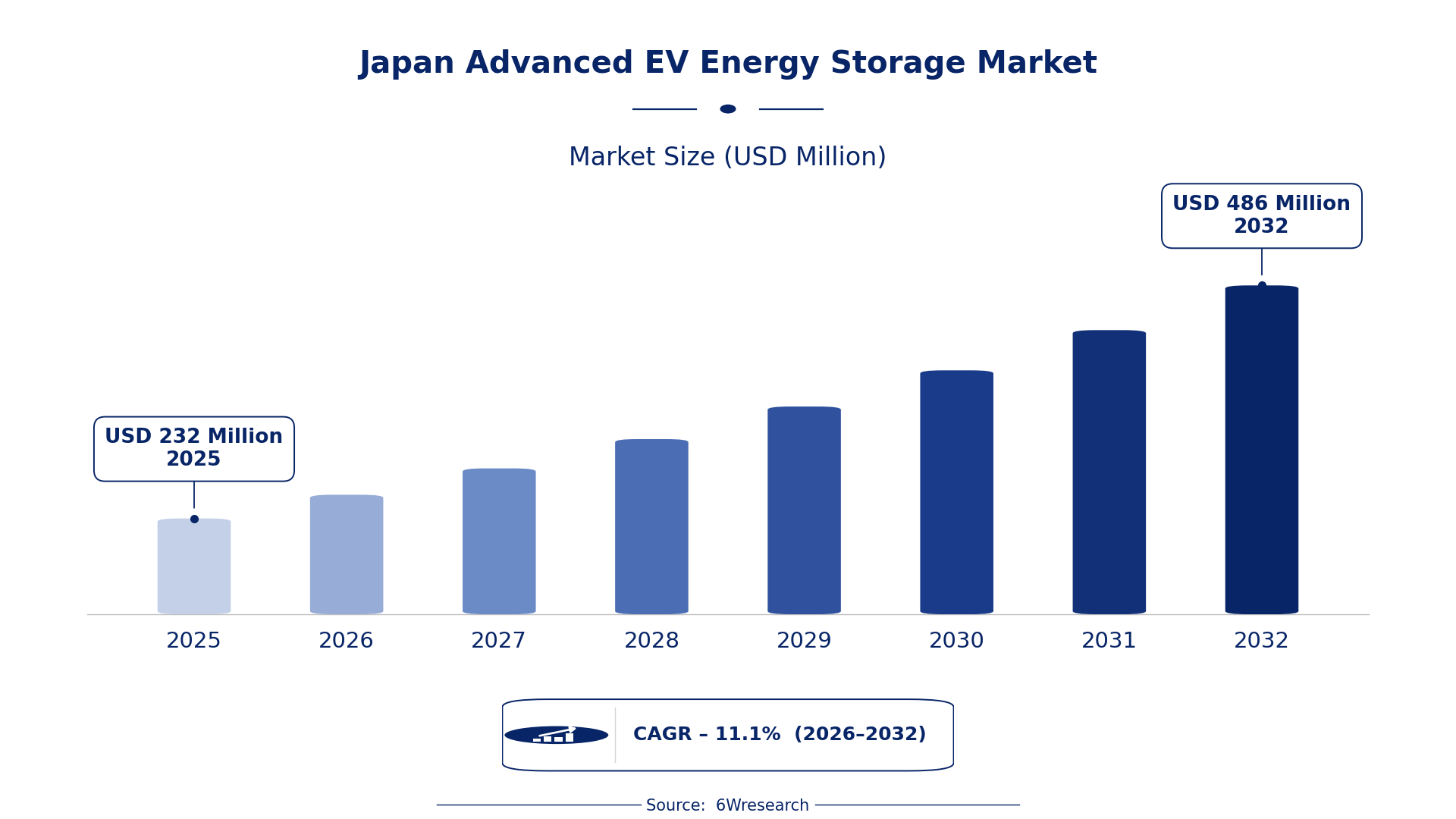
According to 6Wresearch internal database and industry insights, the Japan Advanced EV Energy Storage Market was valued at USD 232 Million in 2025 and is projected to reach USD 486 Million by 2032, growing at a CAGR of approximately 11.1% during 2026–2032.
Japan Advanced EV Energy Storage Market Highlights
| Report Metric | Details |
| Report Name | Japan Advanced EV Energy Storage Market (2026-2032) |
| Market Size 2025 | USD 232 Million |
| Market Size 2032 | USD 486 Million |
| Absolute Growth 2025–2032 | USD 254 Million |
| CAGR 2026–2032 | 11.1% |
| Peak Annual Growth | 12.7% in 2028 |
| Forecast Period | 2026–2032 |
| Historical Data | 2022–2025 |
| Base Year | 2025 |
| Leading Advanced EV Energy Storage Market, 2025 | Lithium-ion Battery Systems (49% share) |
| Leading Storage Type, 2025 | Rechargeable Batteries (38% share) |
| Leading Battery Chemistry, 2025 | NMC (Nickel Manganese Cobalt) (53% share) |
| Leading Charging Type, 2025 | Fast Charging (45% share) |
| Leading End User Sector, 2025 | Electric Passenger Cars (54% share) |
| Fastest-Growing Advanced EV Energy Storage Market | Solid-State Battery (14.3% CAGR) |
| Fastest-Growing Storage Type | Solid Electrolytes (15.1% CAGR) |
| Fastest-Growing Battery Chemistry | Lithium Metal (14.8% CAGR) |
| Fastest-Growing Charging Type | Wireless Charging (15.7% CAGR) |
| Fastest-Growing End User Sector | Premium EVs (14.6% CAGR) |
| Growing Sector | Electric Passenger Cars |
| Key End Users | Electric vehicle manufacturers, battery producers, logistics companies, renewable energy providers |
Japan Advanced EV Energy Storage Market Year-wise Growth Rate and Key Drivers (2022–2032)
This graph illustrates the annual growth rates of the market from 2022 to 2032, highlighting a steady upward trajectory and projected market expansion over the forecast period.
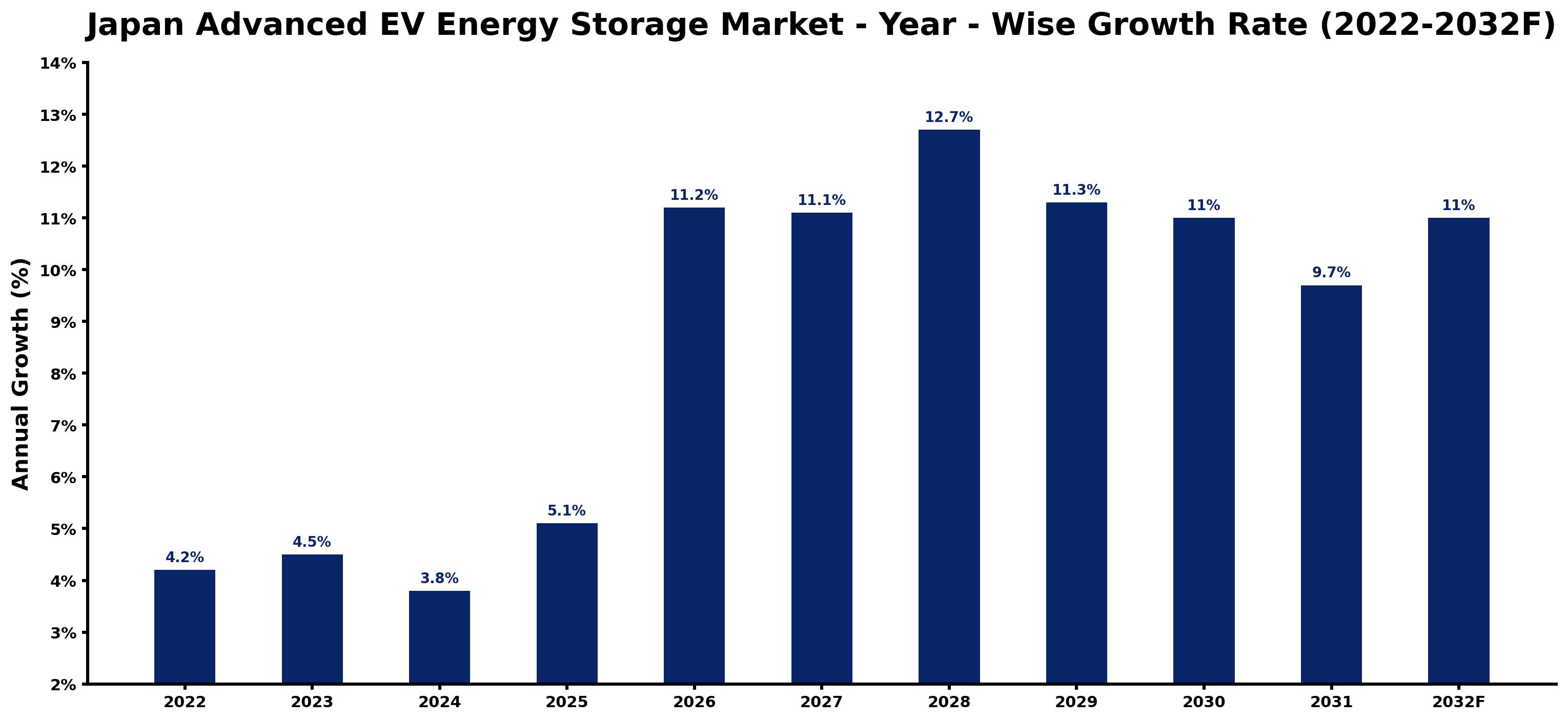
Below, each year's estimated growth is shown next to the factor that most influenced it.
| Year | Estimated Annual Growth (%) | Market Rationale |
| 2022 | 4.2 | The market experienced steady growth as electric vehicle adoption increased. |
| 2023 | 4.5 | Demand for advanced energy storage rose due to government initiatives and consumer interest. |
| 2024 | 3.8 | Growth slowed slightly as supply chain challenges affected production rates. |
| 2025 | 5.1 | The market saw a resurgence with new investments in battery technology and infrastructure. |
| 2026 | 11.2 | Demand is expected to surge as manufacturers ramp up production of electric vehicles and batteries. |
| 2027 | 11.1 | Growth is projected to moderate as the market adjusts to increased supply and demand balance. |
| 2028 | 12.7 | A peak in growth is expected driven by technological advancements in battery efficiency. |
| 2029 | 11.3 | The market will continue to grow but at a slower pace as saturation begins in urban areas. |
| 2030 | 11.0 | Growth is anticipated to slow as the market stabilises with established players dominating. |
| 2031 | 9.7 | The market will maintain steady growth as consumer preferences shift towards premium EVs. |
| 2032 | 11.0 | Demand is expected to rise again with new innovations in battery technology. |
Note: Market size estimations and growth projections presented in this report are based on 6Wresearch's proprietary forecasting methodology, utilizing the latest available industry data, government publications, and primary research inputs.
Japan Advanced EV Energy Storage Market Synopsis
Advanced EV Energy Storage encompasses technologies like lithium-ion and solid-state batteries, essential for powering electric vehicles and enabling renewable energy storage. The Japan Advanced EV Energy Storage Market is growing rapidly, driven by domestic demand for electric vehicles, government policies targeting decarbonisation, and investments in battery technology. The sector is set for continued expansion as Japan aims for 100% electric vehicle sales by 2035, with a target of reducing greenhouse gas emissions by 46% from fiscal 2013 levels by 2030.
Market Dynamics Impact Analysis (2026–2032)
| Factor | Type | Impact | Primary Segment Affected |
| Increasing electric vehicle production | Driver | High | Lithium-ion Battery Systems |
| Emerging solid-state battery technology | Driver | High | Solid-State Battery |
| Growing demand for battery swapping stations | Opportunity | Medium | Battery Swapping Modules |
| Investment in fast charging infrastructure | Opportunity | High | Fast Charging |
| High initial investment costs for advanced technologies | Restraint | High | Solid-State Battery |
| Supply chain disruptions affecting battery components | Restraint | Medium | Lithium-ion Battery Systems |
| Competition from alternative energy storage solutions | Challenge | High | Supercapacitors |
| Regulatory hurdles for new battery technologies | Challenge | Medium | Solid-State Battery |
Evaluation of Drivers in Japan Advanced EV Energy Storage Market (2026–2032)
The main growth drivers and the segments they affect most are set out below.
| Drivers | Primary Segment Affected | Why It Matters (Evidence) |
| Rising electric vehicle production | Lithium-ion Battery Systems | Japan produced 1.5 million electric vehicles in 2022, increasing demand for energy storage solutions. |
| Technological advancements in battery chemistry | Solid-State Battery | Solid-state batteries are funded by a government budget of ¥10 billion in 2023, improving energy density. |
| Expansion of charging infrastructure | Fast Charging | The number of EV charging stations in Japan exceeded 30,000 in 2023, facilitating quicker vehicle charging. |
| Government decarbonisation initiatives | Battery Swapping Modules | Japan's GX Basic Policy targets about JPY 150 trillion of investment over 10 years, boosting infrastructure. |
| Consumer preference for sustainable solutions | Rechargeable Batteries | The country aims for 100% electric vehicle sales by 2035, driving demand for reliable battery systems. |
Buyers are increasing capacity in response to the rising production of electric vehicles, with Japan manufacturing 1.5 million units in 2022. The growth of charging infrastructure, which includes over 30,000 stations, supports this trend. Technological progress in solid-state batteries, backed by a ¥10 billion budget, enhances energy density and performance. Consumer preferences are shifting towards sustainable options, driving the demand for dependable rechargeable batteries in electric vehicles.
Evaluation of Restraints in Japan Advanced EV Energy Storage Market
The key brakes on demand, and where they bite hardest, are shown below.
| Market Restraint | Primary Segment Affected | Why It Matters (Evidence) |
| High initial investment costs for solid-state technology | Solid-State Battery | The emerging technology requires substantial funding, which can deter smaller manufacturers from entering the market. |
| Supply chain disruptions affecting lithium-ion batteries | Lithium-ion Battery Systems | Global supply chain issues have led to delays in sourcing critical components, impacting production timelines. |
| Competition from alternative energy storage technologies | Supercapacitors | As supercapacitors gain traction for quick energy bursts, they may divert investment from traditional battery technologies. |
| Regulatory hurdles for new battery technologies | Solid-State Battery | Strict regulations can slow the introduction of new battery solutions, affecting market growth. |
| Market saturation in urban areas | Battery Swapping Modules | As battery swapping stations proliferate, the market may face diminishing returns in densely populated regions. |
Japan Advanced EV Energy Storage Market Challenges
High demand for advanced EV energy storage is outpacing local supply, leading to delays in production for manufacturers. This gap exists due to limited domestic sourcing of battery components, which can extend lead times by up to six months for producers. Insufficient advancements in battery technology restrict suppliers from meeting buyer expectations, resulting in potential revenue losses of around JPY 10 billion annually for the industry. Regulatory compliance with the JIS C 8715 standard incurs additional costs for manufacturers, with some facing up to 20% in increased operational expenses, ultimately affecting pricing for buyers.
Trends in the Japan Advanced EV Energy Storage Market
Four trends stand out in the Japan Advanced EV Energy Storage Market.
- Shift in Consumer Preferences towards Premium EVs: Electric vehicle buyers are increasingly opting for premium models, with a projected CAGR of 14.6% for Premium EVs. This trend reflects a growing demand for advanced battery technologies that improve performance and range.
- Transition to Fast Charging Infrastructure: Japan is rapidly expanding its fast charging infrastructure, with over 30,000 stations established by 2023. This shift is vital for supporting the growing electric vehicle market and reducing downtime.
- Emergence of Solid-State Batteries: Research into solid-state batteries is gaining momentum, supported by a ¥10 billion government budget in 2023. This technology promises higher energy density and safety, positioning it as a future market leader.
- Increase in Battery Swapping Stations: The Tokyo metropolitan area has over 200 battery swapping stations, facilitating quick battery replacements. This trend is important for improving convenience for electric vehicle users.
Investment Opportunities in the Japan Advanced EV Energy Storage Market
Where to invest in the Japan Advanced EV Energy Storage Market: the main openings are set out below.
- Investment in Fast Charging Solutions: With over 30,000 charging stations in Japan, there is a strong opportunity to invest in fast charging solutions. This infrastructure is essential for supporting the growing electric vehicle market.
- Expansion of Battery Swapping Infrastructure: The current trend towards battery swapping stations offers a chance to supply modular battery packs. Collaborating with local authorities in urban areas can facilitate market entry.
- Development of Solid-State Battery Technologies: The government’s ¥10 billion funding for solid-state battery research presents an opportunity for investment in advanced energy storage technologies. Partnering with research institutions can advance product development.
- Focus on Commercial EV Fleets: As commercial EV fleets grow, there is a demand for reliable rechargeable batteries. Targeting logistics companies in urban hubs can provide substantial market entry opportunities.
Government Initiatives in the Japan Advanced EV Energy Storage Market
The Act on the Rational Use of Energy, established in 1979, requires large energy consumers to improve energy efficiency and report their energy usage. This legislation has driven manufacturers of advanced EV energy storage to invest in energy-efficient technologies, ensuring compliance with standards and reducing operational costs. The GX Promotion Act, introduced in 2023, outlines a framework for decarbonisation strategies, supporting the transition to electric vehicles and advanced battery technologies, while aiming for a 46% reduction in greenhouse gas emissions by 2030.
The Ministry of Economy, Trade and Industry (METI) oversees the implementation of various initiatives, including the Battery Industry Strategy, which aims for 150 GWh of domestic battery manufacturing capacity by 2030. METI also funds projects focused on enhancing battery recycling initiatives, allocating ¥5 billion for EV infrastructure development in 2023. These efforts are crucial for supporting the growth of advanced EV energy storage and ensuring sustainable practices in the industry.
Future Insight of the Japan Advanced EV Energy Storage Market
Lithium-ion battery technology will transform demand by 2032, promising higher energy densities and faster charging times. Government funding of ¥10 billion for solid-state battery research will drive innovation, benefiting suppliers and improving product offerings. An increase in EV charging stations to 1 million by 2030 will enhance accessibility for buyers, driving higher adoption rates. The green vehicle promotion program will incentivise consumers, contributing to a projected 46% reduction in greenhouse gas emissions by 2030.
Market Segmentation Analysis
Japan Advanced EV Energy Storage Market report covers a detailed analysis of the following market segments:
By Advanced EV Energy Storage Market – Lithium-ion Battery Systems Lead, Solid-State Battery Expected to Grow Fastest
According to Saurav Kr Singh, Senior Research Analyst at 6Wresearch, the largest advanced ev energy storage market category in 2025 was Lithium-ion Battery Systems, at 49% of revenue. Lithium-ion battery systems dominate the market due to their extensive use in electric vehicles, which are highly sought after in Japan. The production of 1.5 million electric vehicles in 2022 underscores their critical importance in the energy storage landscape. Over 2026–2032, Solid-State Battery is expected to post the fastest growth, at a CAGR of 14.3%. Solid-state batteries are set for rapid growth as they promise improved energy density and safety, bolstered by a government investment of ¥10 billion in 2023 for research. This financial backing will likely accelerate their development, allowing lithium-ion systems to maintain their lead. Suppliers should focus on enhancing lithium-ion technologies while preparing for the eventual shift towards solid-state batteries.
By Storage Type – Rechargeable Batteries Lead, Solid Electrolytes Expected to Grow Fastest
Rechargeable Batteries took 38% of storage type revenue in 2025, more than any other category. Rechargeable batteries are essential for electric vehicle operation, making them the leading storage type in the market. Their widespread adoption in Japan's growing EV sector underscores their critical role in energy storage solutions. The quickest growth will come from Solid Electrolytes, forecast to expand at a CAGR of 15.1% between 2026 and 2032. Solid electrolytes, while still in the research phase, show promise for future applications in batteries, potentially revolutionising energy storage with their unique properties. This indicates a shift towards more advanced storage solutions in the coming years. Buyers should consider the long-term benefits of investing in rechargeable battery technologies while keeping an eye on solid electrolyte advancements.
By Battery Chemistry – NMC (Nickel Manganese Cobalt) Leads, Lithium Metal Expected to Grow Fastest
NMC (Nickel Manganese Cobalt) held 53% of the Japan Advanced EV Energy Storage Market by battery chemistry in 2025. NMC (Nickel Manganese Cobalt) chemistry leads the market due to its prevalent use in high-performance batteries, especially in electric vehicles. Its optimal balance of energy density and stability makes it the preferred choice for manufacturers, securing its dominant position. Lithium Metal is set to record the highest CAGR in this split, 14.8% over 2026–2032. Lithium metal is emerging as a promising option for next-generation batteries, with research indicating it could significantly improve battery performance. As advancements continue, this chemistry may gain traction, potentially altering market dynamics. Suppliers must stay informed about developments in battery chemistries to align with evolving market trends.
By Charging Type – Fast Charging Leads, Wireless Charging Expected to Grow Fastest
Fast Charging accounted for 45% of the market by charging type in 2025. Fast charging is essential for minimising electric vehicle downtime, making it the preferred choice among consumers and businesses alike. The existence of over 30,000 EV charging stations in Japan underscores the critical importance of this technology for facilitating widespread EV adoption. Wireless Charging is projected to grow fastest, at a CAGR of 15.7% during 2026–2032. Wireless charging is emerging as a promising technology, offering potential benefits in user convenience and efficiency, although it has not yet achieved widespread implementation. Continued research and development may lead to its broader acceptance in the market. Suppliers should focus on expanding fast charging infrastructure while exploring the opportunities presented by wireless charging technologies.
By End User Sector – Electric Passenger Cars Lead, Premium EVs Expected to Grow Fastest
With 54% of end user sector revenue in 2025, Electric Passenger Cars was the largest category. Electric passenger cars represent the largest segment utilising advanced energy storage, driven by a rising consumer shift towards electric vehicles. With an adoption rate of around 15% as of 2023, this sector plays a pivotal role in market expansion. Over 2026–2032, Premium EVs are expected to post the fastest growth, at a CAGR of 14.6%. Premium EVs are gaining traction as luxury vehicles increasingly incorporate advanced battery technologies for enhanced performance. This trend indicates a movement towards more sophisticated energy storage solutions in the high-end vehicle market. Suppliers should customise their offerings to meet the specific needs of electric passenger cars while capitalising on the growth of the premium EV segment.
Key Attractiveness of the Report
- 10 Years of Market Numbers
- Historical Data Starting from 2022 to 2025
- Base Year 2025
- Forecast Data until 2032
- Key Performance Indicators Impacting the Market
- Major Upcoming Developments and Projects
Key Highlights of the Report:
- Japan Advanced EV Energy Storage Market Outlook
- Market Size of Japan Advanced EV Energy Storage Market, 2025
- Forecast of Japan Advanced EV Energy Storage Market, 2032
- Historical Data and Forecast of Japan Advanced EV Energy Storage Revenues & Volume for the Period 2022-2032F
- Japan Advanced EV Energy Storage Market Trend Evolution
- Japan Advanced EV Energy Storage Market Drivers and Challenges
- Japan Advanced EV Energy Storage Price Trends
- Japan Advanced EV Energy Storage Porter's Five Forces
- Japan Advanced EV Energy Storage Industry Life Cycle
- Historical Data and Forecast of Japan Advanced EV Energy Storage Market Revenues & Volume By Advanced EV Energy Storage Market for the Period 2022-2032F
- Historical Data and Forecast of Japan Advanced EV Energy Storage Market Revenues & Volume By Lithium-ion Battery Systems for the Period 2022-2032F
- Historical Data and Forecast of Japan Advanced EV Energy Storage Market Revenues & Volume By Solid-State Battery for the Period 2022-2032F
- Historical Data and Forecast of Japan Advanced EV Energy Storage Market Revenues & Volume By Supercapacitors for the Period 2022-2032F
- Historical Data and Forecast of Japan Advanced EV Energy Storage Market Revenues & Volume By Battery Swapping Modules for the Period 2022-2032F
- Historical Data and Forecast of Japan Advanced EV Energy Storage Market Revenues & Volume By Storage Type for the Period 2022-2032F
- Historical Data and Forecast of Japan Advanced EV Energy Storage Market Revenues & Volume By Rechargeable Batteries for the Period 2022-2032F
- Historical Data and Forecast of Japan Advanced EV Energy Storage Market Revenues & Volume By Solid Electrolytes for the Period 2022-2032F
- Historical Data and Forecast of Japan Advanced EV Energy Storage Market Revenues & Volume By High-Cycle Storage for the Period 2022-2032F
- Historical Data and Forecast of Japan Advanced EV Energy Storage Market Revenues & Volume By Modular Packs for the Period 2022-2032F
- Historical Data and Forecast of Japan Advanced EV Energy Storage Market Revenues & Volume By Battery Chemistry for the Period 2022-2032F
- Historical Data and Forecast of Japan Advanced EV Energy Storage Market Revenues & Volume By NMC (Nickel Manganese Cobalt) for the Period 2022-2032F
- Historical Data and Forecast of Japan Advanced EV Energy Storage Market Revenues & Volume By Lithium Metal for the Period 2022-2032F
- Historical Data and Forecast of Japan Advanced EV Energy Storage Market Revenues & Volume By Carbon-based for the Period 2022-2032F
- Historical Data and Forecast of Japan Advanced EV Energy Storage Market Revenues & Volume By LFP (Lithium Iron Phosphate) for the Period 2022-2032F
- Historical Data and Forecast of Japan Advanced EV Energy Storage Market Revenues & Volume By Charging Type for the Period 2022-2032F
- Historical Data and Forecast of Japan Advanced EV Energy Storage Market Revenues & Volume By Fast Charging for the Period 2022-2032F
- Historical Data and Forecast of Japan Advanced EV Energy Storage Market Revenues & Volume By Wireless Charging for the Period 2022-2032F
- Historical Data and Forecast of Japan Advanced EV Energy Storage Market Revenues & Volume By Rapid Discharge for the Period 2022-2032F
- Historical Data and Forecast of Japan Advanced EV Energy Storage Market Revenues & Volume By Swap Stations for the Period 2022-2032F
- Historical Data and Forecast of Japan Advanced EV Energy Storage Market Revenues & Volume By End User Sector for the Period 2022-2032F
- Historical Data and Forecast of Japan Advanced EV Energy Storage Market Revenues & Volume By Electric Passenger Cars for the Period 2022-2032F
- Historical Data and Forecast of Japan Advanced EV Energy Storage Market Revenues & Volume By Premium EVs for the Period 2022-2032F
- Historical Data and Forecast of Japan Advanced EV Energy Storage Market Revenues & Volume By Commercial EV Fleets for the Period 2022-2032F
- Historical Data and Forecast of Japan Advanced EV Energy Storage Market Revenues & Volume By Two-Wheelers & E-Rickshaws for the Period 2022-2032F
- Japan Advanced EV Energy Storage Import Export Trade Statistics
- Market Opportunity Assessment By Advanced EV Energy Storage Market
- Market Opportunity Assessment By Storage Type
- Market Opportunity Assessment By Battery Chemistry
- Market Opportunity Assessment By Charging Type
- Market Opportunity Assessment By End User Sector
- Japan Advanced EV Energy Storage Top Companies Market Share
- Japan Advanced EV Energy Storage Competitive Benchmarking By Technical and Operational Parameters
- Japan Advanced EV Energy Storage Company Profiles
- Japan Advanced EV Energy Storage Key Strategic Recommendations
Market Covered
This report examines the market across the segments below.
By Advanced EV Energy Storage Market
- Lithium-ion Battery Systems
- Solid-State Battery
- Supercapacitors
- Battery Swapping Modules
By Storage Type
- Rechargeable Batteries
- Solid Electrolytes
- High-Cycle Storage
- Modular Packs
By Battery Chemistry
- NMC (Nickel Manganese Cobalt)
- Lithium Metal
- Carbon-based
- LFP (Lithium Iron Phosphate)
By Charging Type
- Fast Charging
- Wireless Charging
- Rapid Discharge
- Swap Stations
By End User Sector
- Electric Passenger Cars
- Premium EVs
- Commercial EV Fleets
- Two-Wheelers & E-Rickshaws































