Japan Advanced Farming Automation Market Size & Growth Rate
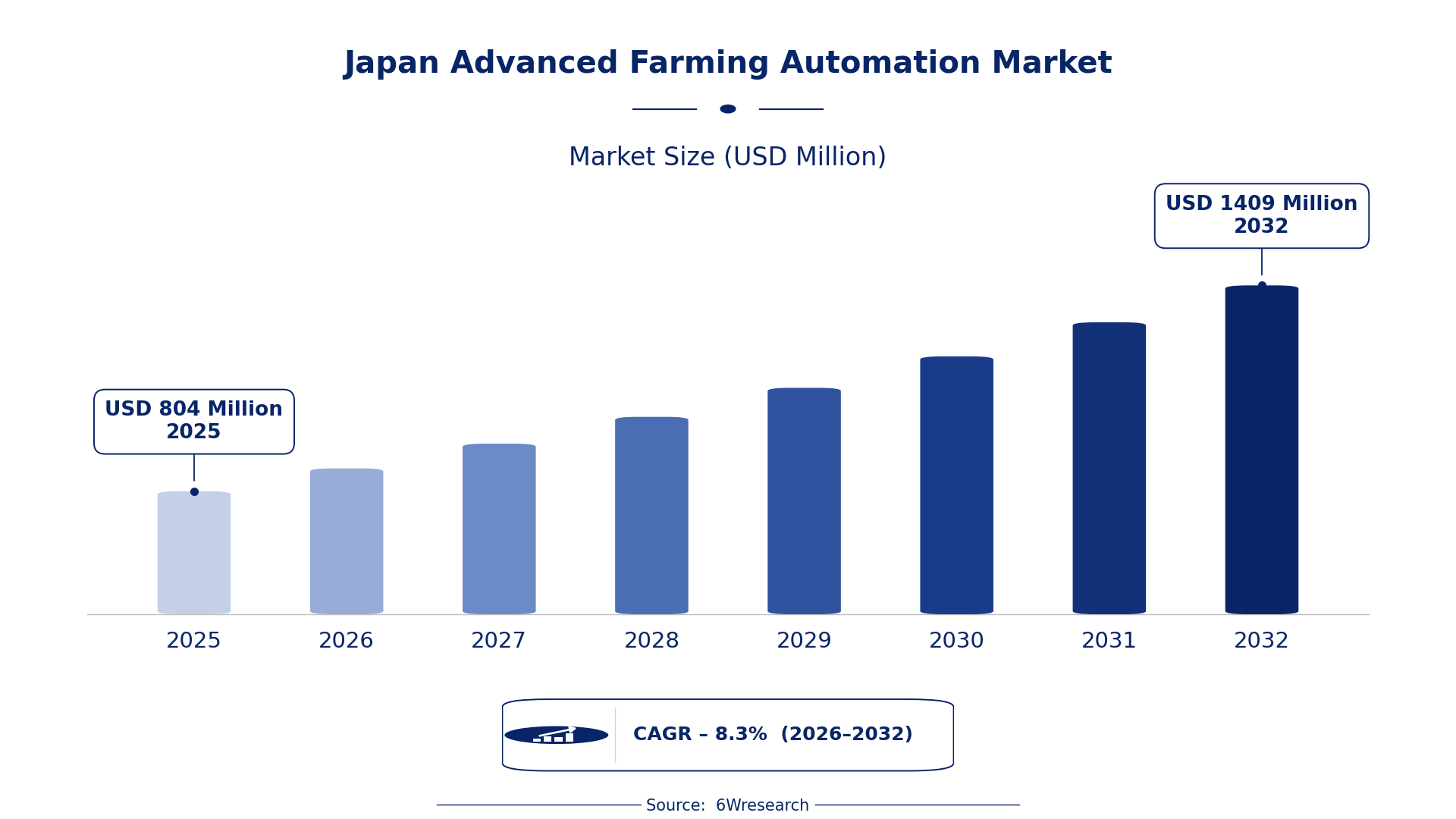
According to 6Wresearch internal database and industry insights, the Japan Advanced Farming Automation Market was valued at USD 804 Million in 2025 and is projected to reach USD 1,409 Million by 2032, growing at a CAGR of approximately 8.3% during 2026–2032.
Japan Advanced Farming Automation Market Highlights
| Report Metric | Details |
| Report Name | Japan Advanced Farming Automation Market (2026-2032) |
| Market Size 2025 | USD 804 Million |
| Market Size 2032 | USD 1,409 Million |
| Absolute Growth 2025–2032 | USD 605 Million |
| CAGR 2026–2032 | 8.3% |
| Peak Annual Growth | 9.7% in 2027 |
| Forecast Period | 2026–2032 |
| Historical Data | 2022–2025 |
| Base Year | 2025 |
| Leading Advanced Farming Automation Market, 2025 | Precision Planters (53% share) |
| Leading Automation Type, 2025 | Smart Machinery (40% share) |
| Leading Technology Used, 2025 | GPS and IoT (46% share) |
| Leading Distribution Channel, 2025 | Agricultural Suppliers (48% share) |
| Leading End User Sector, 2025 | Large-Scale Farmers (52% share) |
| Fastest-Growing Advanced Farming Automation Market | Drone Sprayers (10.9% CAGR) |
| Fastest-Growing Automation Type | Driverless Systems (11.7% CAGR) |
| Fastest-Growing Technology Used | AI and Machine Vision (12.1% CAGR) |
| Fastest-Growing Distribution Channel | Direct Sales (10.4% CAGR) |
| Fastest-Growing End User Sector | Agri-Tech Companies (10.8% CAGR) |
| Growing Sector | Large-Scale Farmers |
| Key End Users | Large-Scale Farmers, Agri-Tech Companies, Crop Growers |
Japan Advanced Farming Automation Market Year-wise Growth Rate and Key Drivers (2022–2032)
This graph illustrates the annual growth rates of the market from 2022 to 2032, highlighting a steady upward trajectory and projected market expansion over the forecast period.
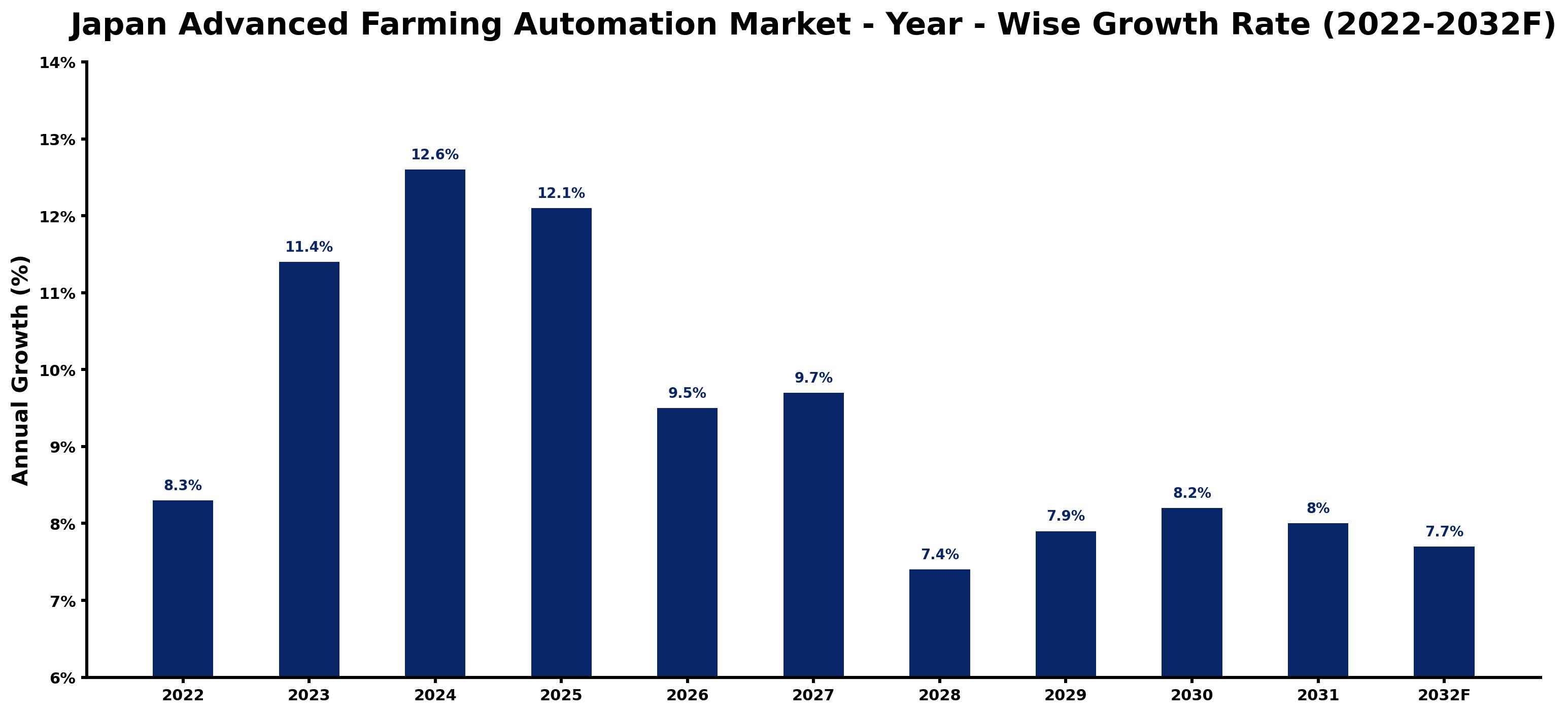
For each year, the table pairs the estimated growth rate with the leading influence on demand, showing how the drivers changed across the period.
| Year | Estimated Annual Growth (%) | Market Rationale |
| 2022 | 8.3 | The market showed steady growth due to increasing adoption of automation technologies. |
| 2023 | 11.4 | Demand surged as large-scale farmers invested more in advanced farming solutions. |
| 2024 | 12.6 | The introduction of new smart farming programmes accelerated growth. |
| 2025 | 12.1 | Growth slowed slightly as market maturity began to set in. |
| 2026 | 9.5 | A continued focus on efficiency is expected to keep demand rising, though at a slower pace. |
| 2027 | 9.7 | The peak growth year will see renewed investments in automation technologies. |
| 2028 | 7.4 | Growth is projected to slow as market saturation begins to impact new purchases. |
| 2029 | 7.9 | Demand will increase again as farmers seek to upgrade older equipment. |
| 2030 | 8.2 | Continued advancements in technology will support a rise in market activity. |
| 2031 | 8.0 | A slight slowdown is expected as competition intensifies among suppliers. |
| 2032 | 7.7 | Growth is projected to slow as the market stabilises at a mature level. |
Note: Market size estimations and growth projections presented in this report are based on 6Wresearch's proprietary forecasting methodology, utilizing the latest available industry data, government publications, and primary research inputs.
Japan Advanced Farming Automation Market Synopsis
Advanced Farming Automation includes technologies such as precision planters, autonomous tractors, and drone sprayers, all designed to improve agricultural efficiency. Demand stems from large-scale farmers and agri-tech companies focused on optimising crop yields and lowering labour costs. The Japan Advanced Farming Automation Market is expanding due to increased investments in smart farming technologies, underscored by a programme initiated in 2023 aimed at achieving a 30% rise in agricultural productivity by 2030.
Market Dynamics Impact Analysis (2026–2032)
| Factor | Type | Impact | Primary Segment Affected |
| Growing adoption of precision agriculture technologies | Driver | High | Precision Planters |
| Rising demand for labour-saving solutions | Driver | High | Autonomous Tractors |
| Increasing investment in smart farming technologies | Opportunity | High | Drone Sprayers |
| Expansion of agricultural technology subsidies | Opportunity | Medium | Robotic Harvesters |
| High initial investment costs for advanced equipment | Restraint | High | Precision Planters |
| Limited awareness among small-scale farmers | Restraint | Medium | Autonomous Tractors |
| Aging farmer population affecting adoption rates | Challenge | High | Drone Sprayers |
| Supply chain disruptions impacting equipment availability | Challenge | Medium | Robotic Harvesters |
Evaluation of Drivers in Japan Advanced Farming Automation Market (2026–2032)
The table below links each growth driver to the segment it affects and the evidence for it.
| Drivers | Primary Segment Affected | Why It Matters (Evidence) |
| Increased crop yield through precision planting | Precision Planters | Precision planters improve planting accuracy, leading to higher yields; adoption rates are rising across major agricultural regions. |
| Efficiency in land management | Autonomous Tractors | Autonomous tractors reduce labour costs and improve operational efficiency; the average age of farmers necessitates such solutions. |
| Popularity in rice cultivation | Drone Sprayers | Drone sprayers are increasingly used in rice farming, particularly in regions where their adoption is rising. |
| Integration of AI in farming equipment | AI and Machine Vision | AI and machine vision technologies are now integrated into 60% of new farming equipment, improving decision-making capabilities. |
| Support from government subsidies | Robotic Harvesters | The government has allocated ¥10 billion for agricultural technology innovation, boosting the adoption of robotic harvesters. |
Spending rises because large-scale farmers are increasingly adopting advanced farming technologies to improve productivity. The average age of farmers drives demand for autonomous tractors that reduce labour costs. Drone sprayers are gaining traction in rice cultivation, improving efficiency in pesticide application. AI and machine vision technologies are integrated into 60% of new farming equipment, streamlining operations and decision-making.
Evaluation of Restraints in Japan Advanced Farming Automation Market
Several factors work against faster growth; the main ones are summarised below.
| Market Restraint | Primary Segment Affected | Why It Matters (Evidence) |
| High initial costs of advanced farming technologies | Precision Planters | The investment required for precision planters limits their adoption among smaller farms, hindering overall market growth. |
| Limited knowledge of automation benefits among farmers | Autonomous Tractors | Many small-scale farmers lack awareness of the efficiency gains from autonomous tractors, slowing their uptake. |
| Aging workforce in agriculture | Drone Sprayers | The average age of farmers at 67 years creates challenges in adopting new technologies like drone sprayers. |
| Supply chain issues affecting equipment availability | Robotic Harvesters | Delays in the supply chain can impact the delivery of robotic harvesters, affecting farmers' operational efficiency. |
| Regulatory hurdles for new technologies | AI and Machine Vision | Complex regulations surrounding AI integration can slow down the adoption of machine vision technologies in farming. |
Japan Advanced Farming Automation Market Challenges
In Hokkaido, many farms face challenges in finding skilled workers, as the average age of farmers hovers around 67 years. This shortage hampers the adoption of advanced farming technologies, costing large-scale farmers potential productivity gains. Technological integration remains sluggish; for example, only 60% of new farming equipment featured AI and machine vision in 2023. This delay obstructs efficiency improvements, affecting the competitiveness of agri-tech companies. Regulatory frameworks present hurdles; the JIS Z 8801 standard complicates the introduction of new machinery, raising compliance costs for suppliers. Competition from international markets pressures local producers to innovate swiftly or risk losing market share.
Trends in the Japan Advanced Farming Automation Market
The shifts below are changing how Japan Advanced Farming Automation Market products are bought and supplied.
- Shift towards Smart Machinery: In 2023, the Ministry of Agriculture launched a programme promoting smart farming technologies, resulting in a 30% increase in productivity targets by 2030.
- Transition from Manual to Automated Farming: More farmers are adopting autonomous tractors, with a 15% increase in usage reported in major agricultural regions, which is reducing labour costs.
- Emergence of AI in Agriculture: AI and machine vision technologies are becoming standard in new farming equipment, with 60% of new devices incorporating these technologies in 2023.
- Growing Popularity of Drone Sprayers: Drone sprayers are increasingly used in rice cultivation, particularly in Kumamoto Prefecture, where adoption has risen by 20%.
Investment Opportunities in the Japan Advanced Farming Automation Market
The following opportunities in the Japan Advanced Farming Automation Market pair current demand with a clear way in.
- Timing for Investment in Automation: With Japan targeting a 30% increase in agricultural productivity by 2030, now is an opportune moment to invest in advanced farming technologies, especially for large-scale farmers.
- Gap in Technology Adoption: The average farm size of 1.5 hectares indicates a need for efficient solutions; investing in robotic harvesters can effectively meet this demand.
- Entry through Local Partnerships: Establishing partnerships with agricultural suppliers can facilitate entry into the market, utilising their existing distribution channels.
- Focus on Agricultural Technology Innovation: The substantial funding allocated for agricultural technology innovation in 2023 presents an opportunity for suppliers to develop and introduce new solutions.
Government Initiatives in the Japan Advanced Farming Automation Market
Policy measures influence producers and buyers of advanced farming automation. The New Robot Strategy (2015) seeks to expand robot use in agriculture, while the GX Promotion Act (2023) sets a framework for decarbonisation, promoting the adoption of sustainable farming technologies.
The Ministry of Agriculture's subsidy programme for smart farming equipment aids the integration of advanced technologies. This programme aims to boost productivity by 30% by 2030, with funding directed towards farmers who embrace these innovations.
Future Insight of the Japan Advanced Farming Automation Market
By 2032, smart farming initiatives will revolutionise agricultural practices, with the government's subsidy program for smart farming equipment facilitating widespread adoption. Automation is projected to cover 20% of farmland by 2025, improving productivity for large-scale farmers. The Tokyo Agricultural Technology Center will offer research and support for automation, benefiting both buyers and suppliers. As Japan strives for a 30% productivity increase by 2030, collaboration between farmers and technology providers will be crucial for achieving sustainability goals.
Market Segmentation Analysis
Japan Advanced Farming Automation Market report covers a detailed analysis of the following market segments:
By Advanced Farming Automation Market – Precision Planters Lead, Drone Sprayers Expected to Grow Fastest
According to Saurav Kr Singh, Senior Research Analyst at 6Wresearch, with 53% of advanced farming automation market revenue in 2025, Precision Planters was the largest category. Precision planters dominate the market as they are crucial for accurate planting and maximising yield, particularly among large-scale farmers. Their adoption in Hokkaido has led to notable productivity improvements in this key agricultural region. Drone Sprayers are projected to grow fastest, at a CAGR of 10.9% during 2026–2032. Drone sprayers are rapidly gaining traction due to their ability to facilitate precise pesticide and fertiliser application, particularly in rice cultivation in Kumamoto Prefecture. This growth aligns with the government's target to increase agricultural productivity by 30% by 2030 through enhanced automation. Suppliers should focus on developing drone sprayers to meet the rising demand in the market.
By Automation Type – Smart Machinery Leads, Driverless Systems Expected to Grow Fastest
Smart Machinery took 40% of automation type revenue in 2025, more than any other category. Smart machinery leads the segment as it integrates advanced technologies that significantly improve farming operations for large-scale farmers. This equipment is essential for optimising efficiency and productivity in Japan's agricultural practices. Driverless Systems are set to record the highest CAGR in this split, 11.7% over 2026–2032. Driverless systems are experiencing swift growth, enhancing operational efficiency in expansive fields, which is vital given the challenges of an ageing farmer demographic. Government initiatives promoting smart farming technologies further encourage this transition. Buyers will increasingly seek smart machinery and driverless systems to remain competitive in agriculture.
By Technology Used – GPS and IoT Leads, AI and Machine Vision Expected to Grow Fastest
GPS and IoT held 46% of the Japan Advanced Farming Automation Market by technology used in 2025. GPS and IoT technologies are essential for precision agriculture, allowing farmers to track and manage their operations effectively. Their critical role in optimising crop yields makes them a staple in advanced farming automation. Over 2026–2032, AI and Machine Vision is expected to post the fastest growth, at a CAGR of 12.1%. AI and machine vision technologies are growing rapidly as they improve decision-making and operational efficiency, with 60% of new farming equipment integrating these advancements in 2023. This trend is vital for addressing the demands of modern agriculture. Suppliers must invest in AI and machine vision capabilities to meet the increasing expectations of farmers for smarter solutions.
By Distribution Channel – Agricultural Suppliers Lead, Direct Sales Expected to Grow Fastest
In 2025, Agricultural Suppliers led the distribution channel split with a 48% share. Agricultural suppliers dominate the market as they provide essential equipment and support to farmers, ensuring access to advanced farming technologies. Their established networks are instrumental in effectively reaching the farming community. The quickest growth will come from Direct Sales, forecast to expand at a CAGR of 10.4% between 2026 and 2032. Direct sales are the fastest-growing channel, enabling suppliers to connect directly with end-users and streamline the purchasing process. This method is particularly advantageous for new technologies that require close customer interaction. Suppliers should refine their direct sales strategies to better engage with end-users and adapt to evolving purchasing behaviours.
By End User Sector – Large-Scale Farmers Lead, Agri-Tech Companies Expected to Grow Fastest
Large-Scale Farmers accounted for 52% of the market by end user sector in 2025. Large-scale farmers are the primary users of advanced farming technologies, employing these solutions to optimise their operations and enhance productivity. Their substantial investments in automation are a key driver of market growth. Agri-Tech Companies are projected to grow fastest, at a CAGR of 10.8% during 2026–2032. Agri-tech companies are rapidly expanding as they develop and implement innovative farming solutions, addressing the growing demand for efficiency and sustainability in agriculture. This sector's growth is critical for advancing agricultural practices. Suppliers should explore partnerships with agri-tech companies to co-develop solutions that meet the evolving needs of the agricultural sector.
Key Attractiveness of the Report
- 10 Years of Market Numbers
- Historical Data Starting from 2022 to 2025
- Base Year 2025
- Forecast Data until 2032
- Key Performance Indicators Impacting the Market
- Major Upcoming Developments and Projects
Key Highlights of the Report:
- Japan Advanced Farming Automation Market Outlook
- Market Size of Japan Advanced Farming Automation Market, 2025
- Forecast of Japan Advanced Farming Automation Market, 2032
- Historical Data and Forecast of Japan Advanced Farming Automation Revenues & Volume for the Period 2022-2032F
- Japan Advanced Farming Automation Market Trend Evolution
- Japan Advanced Farming Automation Market Drivers and Challenges
- Japan Advanced Farming Automation Price Trends
- Japan Advanced Farming Automation Porter's Five Forces
- Japan Advanced Farming Automation Industry Life Cycle
- Historical Data and Forecast of Japan Advanced Farming Automation Market Revenues & Volume By Advanced Farming Automation Market for the Period 2022-2032F
- Historical Data and Forecast of Japan Advanced Farming Automation Market Revenues & Volume By Precision Planters for the Period 2022-2032F
- Historical Data and Forecast of Japan Advanced Farming Automation Market Revenues & Volume By Autonomous Tractors for the Period 2022-2032F
- Historical Data and Forecast of Japan Advanced Farming Automation Market Revenues & Volume By Drone Sprayers for the Period 2022-2032F
- Historical Data and Forecast of Japan Advanced Farming Automation Market Revenues & Volume By Robotic Harvesters for the Period 2022-2032F
- Historical Data and Forecast of Japan Advanced Farming Automation Market Revenues & Volume By Automation Type for the Period 2022-2032F
- Historical Data and Forecast of Japan Advanced Farming Automation Market Revenues & Volume By Smart Machinery for the Period 2022-2032F
- Historical Data and Forecast of Japan Advanced Farming Automation Market Revenues & Volume By Driverless Systems for the Period 2022-2032F
- Historical Data and Forecast of Japan Advanced Farming Automation Market Revenues & Volume By UAV-Based Equipment for the Period 2022-2032F
- Historical Data and Forecast of Japan Advanced Farming Automation Market Revenues & Volume By Automated Arms for the Period 2022-2032F
- Historical Data and Forecast of Japan Advanced Farming Automation Market Revenues & Volume By Technology Used for the Period 2022-2032F
- Historical Data and Forecast of Japan Advanced Farming Automation Market Revenues & Volume By GPS and IoT for the Period 2022-2032F
- Historical Data and Forecast of Japan Advanced Farming Automation Market Revenues & Volume By AI and Machine Vision for the Period 2022-2032F
- Historical Data and Forecast of Japan Advanced Farming Automation Market Revenues & Volume By Aerial Imaging for the Period 2022-2032F
- Historical Data and Forecast of Japan Advanced Farming Automation Market Revenues & Volume By AI-Based Harvest Logic for the Period 2022-2032F
- Historical Data and Forecast of Japan Advanced Farming Automation Market Revenues & Volume By Distribution Channel for the Period 2022-2032F
- Historical Data and Forecast of Japan Advanced Farming Automation Market Revenues & Volume By Agricultural Suppliers for the Period 2022-2032F
- Historical Data and Forecast of Japan Advanced Farming Automation Market Revenues & Volume By Direct Sales for the Period 2022-2032F
- Historical Data and Forecast of Japan Advanced Farming Automation Market Revenues & Volume By Online Platforms for the Period 2022-2032F
- Historical Data and Forecast of Japan Advanced Farming Automation Market Revenues & Volume By Equipment Dealers for the Period 2022-2032F
- Historical Data and Forecast of Japan Advanced Farming Automation Market Revenues & Volume By End User Sector for the Period 2022-2032F
- Historical Data and Forecast of Japan Advanced Farming Automation Market Revenues & Volume By Large-Scale Farmers for the Period 2022-2032F
- Historical Data and Forecast of Japan Advanced Farming Automation Market Revenues & Volume By Agri-Tech Companies for the Period 2022-2032F
- Historical Data and Forecast of Japan Advanced Farming Automation Market Revenues & Volume By Crop Growers for the Period 2022-2032F
- Historical Data and Forecast of Japan Advanced Farming Automation Market Revenues & Volume By Organic & Vertical Farms for the Period 2022-2032F
- Japan Advanced Farming Automation Import Export Trade Statistics
- Market Opportunity Assessment By Advanced Farming Automation Market
- Market Opportunity Assessment By Automation Type
- Market Opportunity Assessment By Technology Used
- Market Opportunity Assessment By Distribution Channel
- Market Opportunity Assessment By End User Sector
- Japan Advanced Farming Automation Top Companies Market Share
- Japan Advanced Farming Automation Competitive Benchmarking By Technical and Operational Parameters
- Japan Advanced Farming Automation Company Profiles
- Japan Advanced Farming Automation Key Strategic Recommendations
Market Covered
The study includes the following segmentation.
By Advanced Farming Automation Market
- Precision Planters
- Autonomous Tractors
- Drone Sprayers
- Robotic Harvesters
By Automation Type
- Smart Machinery
- Driverless Systems
- UAV-Based Equipment
- Automated Arms
By Technology Used
- GPS and IoT
- AI and Machine Vision
- Aerial Imaging
- AI-Based Harvest Logic
By Distribution Channel
- Agricultural Suppliers
- Direct Sales
- Online Platforms
- Equipment Dealers
By End User Sector
- Large-Scale Farmers
- Agri-Tech Companies
- Crop Growers
- Organic & Vertical Farms































