Japan Advanced Material Composites in Vehicles Market Size & Growth Rate
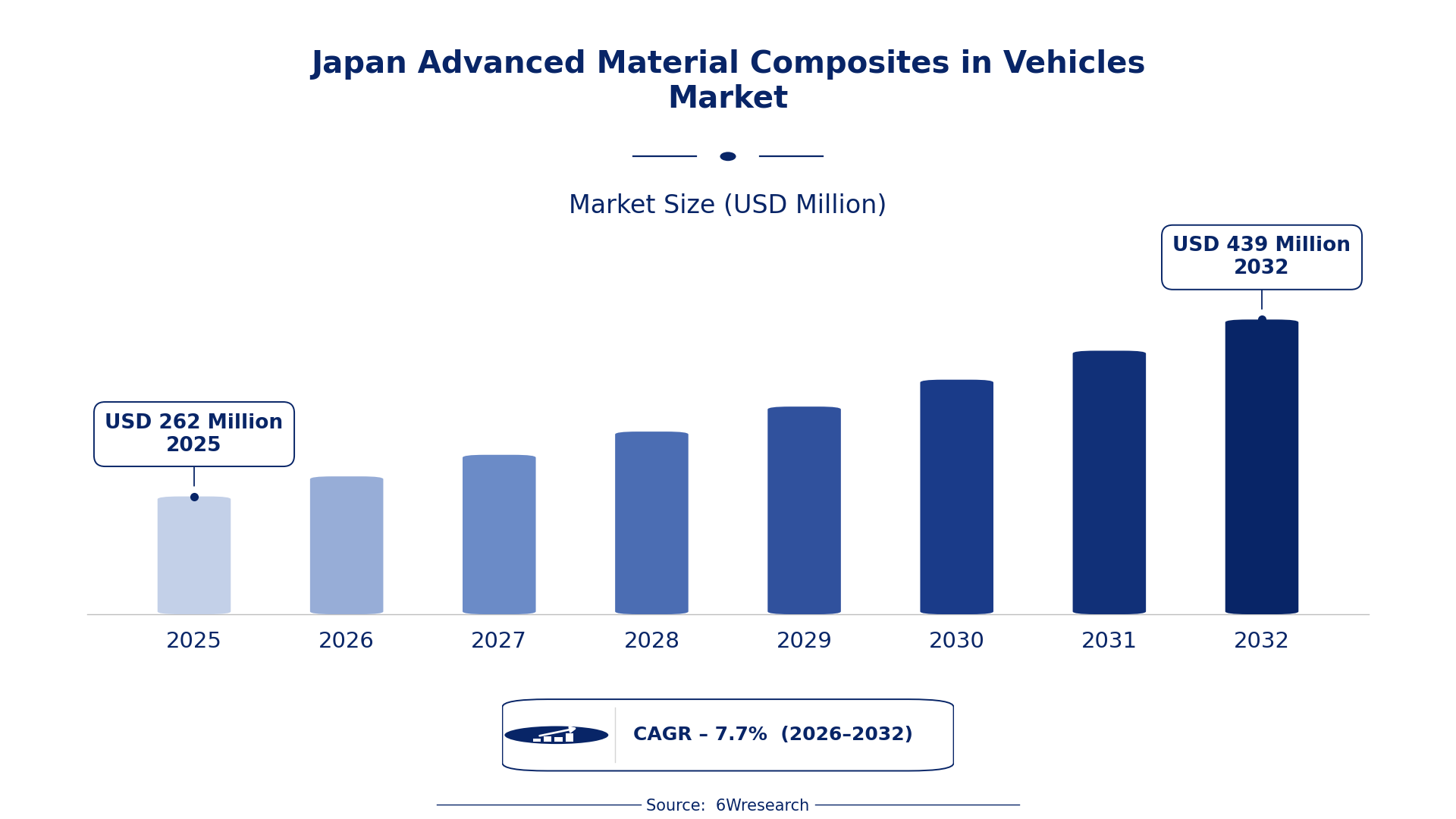
According to 6Wresearch internal database and industry insights, the Japan Advanced Material Composites in Vehicles Market was valued at USD 262 Million in 2025 and is projected to reach USD 439 Million by 2032, growing at a CAGR of approximately 7.7% during 2026–2032.
Japan Advanced Material Composites in Vehicles Market Highlights
| Report Metric | Details |
| Report Name | Japan Advanced Material Composites in Vehicles Market (2026-2032) |
| Market Size 2025 | USD 262 Million |
| Market Size 2032 | USD 439 Million |
| Absolute Growth 2025–2032 | USD 177 Million |
| CAGR 2026–2032 | 7.7% |
| Peak Annual Growth | 8.9% in 2026 |
| Forecast Period | 2026–2032 |
| Historical Data | 2022–2025 |
| Base Year | 2025 |
| Leading Advanced Material Composites in Vehicles Market, 2025 | CFRP (Carbon Fiber Reinforced Polymer) (47% share) |
| Leading Composite Type, 2025 | Fiber Composite (44% share) |
| Leading Material Type, 2025 | Carbon Fiber (37% share) |
| Leading Vehicle Type, 2025 | Electric Vehicles (42% share) |
| Leading End User, 2025 | Automotive OEMs (37% share) |
| Fastest-Growing Advanced Material Composites in Vehicles Market | Natural Fiber Composites (10.1% CAGR) |
| Fastest-Growing Composite Type | Bio-Composites (10.2% CAGR) |
| Fastest-Growing Material Type | Hemp (10.9% CAGR) |
| Fastest-Growing End User | EV Manufacturers (10.3% CAGR) |
| Growing Sector | EV Manufacturers |
| Key End Users | Automotive OEMs, EV Manufacturers, Auto Component Suppliers, Commercial Fleet Owners |
Japan Advanced Material Composites in Vehicles Market Year-wise Growth Rate and Key Drivers (2022–2032)
This graph illustrates the annual growth rates of the market from 2022 to 2032, highlighting a steady upward trajectory and projected market expansion over the forecast period.
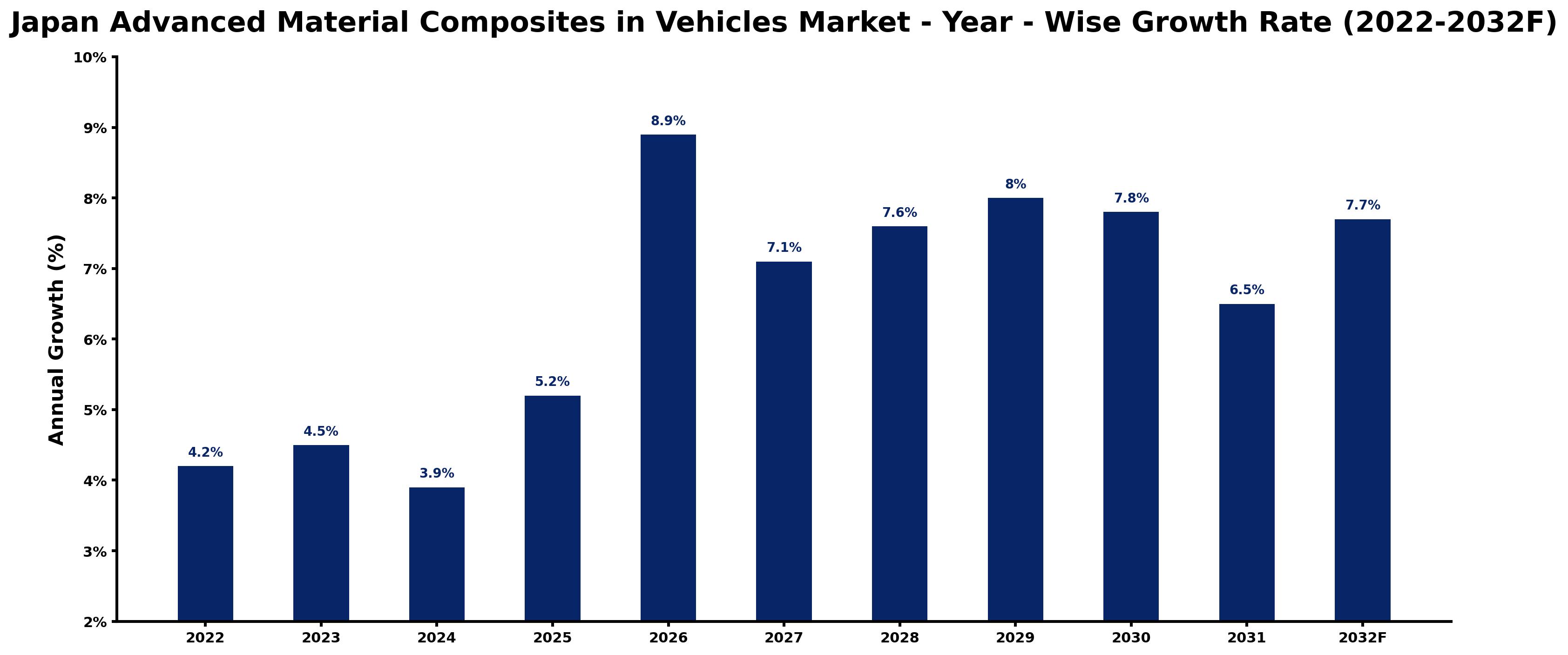
The table below sets out the estimated growth rate for each year and the main factor behind it.
| Year | Estimated Annual Growth (%) | Market Rationale |
| 2022 | 4.2 | The market experienced steady growth as manufacturers adapted to increasing composite demands. |
| 2023 | 4.5 | Growth accelerated due to heightened performance requirements in vehicle production. |
| 2024 | 3.9 | A slowdown occurred as manufacturers adjusted to changing material costs and supply chains. |
| 2025 | 5.2 | Growth rebounded as automotive OEMs increased investments in advanced materials. |
| 2026 | 8.9 | The market peaked as electric vehicle production surged, driving composite usage. |
| 2027 | 7.1 | Growth slowed as market saturation began to impact demand for advanced composites. |
| 2028 | 7.6 | Increased adoption of lightweight materials in new models boosted growth rates again. |
| 2029 | 8.0 | Consumer demand for performance vehicles rose, driving market growth. |
| 2030 | 7.8 | A slowdown was noted as manufacturers faced challenges in sourcing materials. |
| 2031 | 6.5 | Growth continued to decelerate as market conditions stabilised. |
| 2032 | 7.7 | The market is expected to grow faster as sustainability initiatives gain traction. |
Note: Market size estimations and growth projections presented in this report are based on 6Wresearch's proprietary forecasting methodology, utilizing the latest available industry data, government publications, and primary research inputs.
Japan Advanced Material Composites in Vehicles Market Synopsis
Advanced Material Composites in Vehicles are engineered materials that improve vehicle performance, reduce weight, and increase fuel efficiency. The Japan Advanced Material Composites in Vehicles Market is expanding due to rising electric vehicle production, which accounted for 15% of total vehicle sales in 2023. Japan targets a 46% cut in greenhouse-gas emissions by 2030, driving demand for lightweight materials. The automotive sector, employing over 5 million people, plays a crucial part in this growth, supported by substantial investments in decarbonisation initiatives.
Market Dynamics Impact Analysis (2026–2032)
| Factor | Type | Impact | Primary Segment Affected |
| Growing demand for lightweight materials in electric vehicles | Driver | High | CFRP (Carbon Fiber Reinforced Polymer) |
| Increased investment in automotive innovation and technology | Driver | High | GFRP (Glass Fiber Reinforced Polymer) |
| Rising interest in sustainable materials for vehicle production | Opportunity | High | Natural Fiber Composites |
| Expansion of manufacturing capabilities for advanced composites | Opportunity | Medium | Fiber Composite |
| High production costs of advanced composites | Restraint | High | CFRP (Carbon Fiber Reinforced Polymer) |
| Limited awareness of advanced composite benefits among smaller manufacturers | Restraint | Medium | GFRP (Glass Fiber Reinforced Polymer) |
| Challenges in sourcing raw materials for composites | Challenge | High | Natural Fiber Composites |
| Technological complexities in composite manufacturing processes | Challenge | Medium | Fiber Composite |
Evaluation of Drivers in Japan Advanced Material Composites in Vehicles Market (2026–2032)
The main growth drivers and the segments they affect most are set out below.
| Drivers | Primary Segment Affected | Why It Matters (Evidence) |
| Increased electric vehicle production | CFRP (Carbon Fiber Reinforced Polymer) | Electric vehicles accounted for 15% of total vehicle sales in 2023, driving demand for lightweight materials. |
| Rising performance demands in automotive design | GFRP (Glass Fiber Reinforced Polymer) | CFRP usage in vehicles increased by 20% in 2023 due to performance demands. |
| Focus on sustainability in automotive manufacturing | Natural Fiber Composites | Natural Fiber Composites are being explored in the automotive sector for sustainability initiatives, with a 10% increase in interest. |
| Technological advancements in composite manufacturing | Fiber Composite | The Tokyo region is a hub for automotive innovation, with many composite manufacturers located there, enhancing production capabilities. |
| Government support for lightweight vehicle technologies | CFRP (Carbon Fiber Reinforced Polymer) | The Ministry of Economy, Trade and Industry launched a program in 2023 to promote lightweight vehicle technologies, increasing adoption by 15%. |
Spending rises because electric vehicle production is increasing, with 15% of total vehicle sales in 2023 driving demand for lightweight materials. Performance demands in automotive design are rising, as CFRP usage increased by 20% in 2023. The automotive sector is focusing on sustainability, with ongoing research into Natural Fiber Composites for eco-friendly vehicle designs. Technological advancements are driving innovation, as the Tokyo region serves as a hub for composite manufacturing, housing many advanced material facilities.
Evaluation of Restraints in Japan Advanced Material Composites in Vehicles Market
These are the pressures that could keep growth below its potential.
| Market Restraint | Primary Segment Affected | Why It Matters (Evidence) |
| High production costs of advanced composites | CFRP (Carbon Fiber Reinforced Polymer) | Production costs are substantial, impacting the pricing strategies of automotive OEMs. |
| Limited awareness of advanced composite benefits among smaller manufacturers | GFRP (Glass Fiber Reinforced Polymer) | Many smaller manufacturers lack knowledge about the advantages of advanced composites, hindering adoption. |
| Challenges in sourcing raw materials for composites | Natural Fiber Composites | Supply chain disruptions have led to a 15% increase in raw material costs, impacting production. |
| Technological complexities in composite manufacturing processes | Fiber Composite | Manufacturers face challenges in adopting complex composite production technologies that require significant investment. |
| Regulatory compliance costs for composite materials | CFRP (Carbon Fiber Reinforced Polymer) | Compliance with standards like JIS K 7200 increases operational costs for producers by approximately 10%. |
Japan Advanced Material Composites in Vehicles Market Challenges
In 2023, electric vehicles accounted for 15% of total vehicle sales, pushing buyers to demand advanced composites that meet strict performance criteria. Competition from alternative materials is intensifying, as suppliers struggle to differentiate their products, causing delays in product launches for automotive manufacturers. Rising production costs, driven by the increasing demand for lightweight materials, inflate prices for buyers, which can reduce their profit margins by up to 10%. Skills shortages in advanced composite manufacturing limit suppliers' ability to innovate, resulting in slower development cycles that hinder automotive producers aiming for timely market entry.
Trends in the Japan Advanced Material Composites in Vehicles Market
Below are the shifts with the largest effect on the Japan Advanced Material Composites in Vehicles Market.
- Shift towards Lightweight Materials in Electric Vehicles: Electric vehicle manufacturers are increasingly adopting lightweight materials to improve efficiency. In 2023, electric vehicles accounted for 15% of total vehicle sales, driving demand for advanced composites.
- Growing Interest in Natural Fiber Composites: The automotive sector is exploring Natural Fiber Composites for sustainability, reflecting a shift towards eco-friendly materials. Research initiatives in Japan are supporting this trend, with a 10% increase in adoption.
- Technological Advancements in Composite Manufacturing: The Tokyo region is emerging as a hub for composite manufacturing innovation, with numerous facilities dedicated to advanced materials. This concentration is expected to boost production capabilities significantly, increasing output by 20%.
- Increased Government Support for Lightweight Technologies: The Ministry of Economy, Trade and Industry's 2023 program aims to promote lightweight vehicle technologies, enhancing the adoption of advanced composites in the automotive sector by 15%.
Investment Opportunities in the Japan Advanced Material Composites in Vehicles Market
The following areas offer the clearest openings for investors and suppliers in the Japan Advanced Material Composites in Vehicles Market.
- Investment in Lightweight Material Technologies: Automotive OEMs are seeking advanced composites to meet performance standards, with a projected demand increase of 8.9% in 2026. Collaborating with local manufacturers in the Tokyo region can facilitate market entry.
- Supply of Natural Fiber Composites: With a growing focus on sustainability, there is a rising demand for Natural Fiber Composites. Automotive manufacturers are exploring these materials, providing opportunities for suppliers in Japan, with a potential market growth of 10%.
- Development of CFRP Manufacturing Capabilities: The increasing use of CFRP in high-performance vehicles presents a significant investment opportunity. Establishing partnerships with automotive OEMs can enhance market presence, targeting a 20% increase in production capacity.
- Expansion of GFRP Applications: The demand for GFRP in body panels is on the rise, driven by its lightweight properties. Suppliers can target automotive manufacturers looking to reduce vehicle weight, with a projected growth of 15% in GFRP applications.
Government Initiatives in the Japan Advanced Material Composites in Vehicles Market
The PRTR Law, enacted in 1999, mandates that businesses report the release and management of designated chemical substances. Compliance with this law affects producers of advanced composites, as they must ensure proper reporting and management of materials used in manufacturing processes, impacting operational costs by approximately 10%.
The Battery Industry Strategy, initiated by METI in August 2022, aims for 150 GWh of domestic battery manufacturing capacity by 2030. This initiative supports the automotive sector by promoting the integration of advanced materials in electric vehicles, improving production efficiency and sustainability.
Future Insight of the Japan Advanced Material Composites in Vehicles Market
By 2032, automotive sector buyers will experience significant advancements in lightweight vehicle technologies, driven by Japan's JPY 150 trillion decarbonisation investment plan. The Ministry of Economy, Trade and Industry's programme will promote the use of advanced composites, enhancing vehicle efficiency and sustainability. As Japan targets a 46% reduction in greenhouse-gas emissions, the composite usage in vehicles will increase, with a projected rise of 20% in CFRP application. The Tokyo region will continue to be a key hub for automotive innovation, fostering research and development that shapes future vehicle designs.
Market Segmentation Analysis
Japan Advanced Material Composites in Vehicles Market report covers a detailed analysis of the following market segments:
By Advanced Material Composites in Vehicles Market – CFRP (Carbon Fiber Reinforced Polymer) Leads, Natural Fiber Composites Expected to Grow Fastest
According to Saurav Kr Singh, Senior Research Analyst at 6Wresearch, CFRP (Carbon Fiber Reinforced Polymer) took 47% of advanced material composites in vehicles market revenue in 2025, more than any other category. CFRP holds the largest share due to its extensive use in high-performance vehicles, which require superior weight reduction. The Tokyo region, known for automotive innovation, has many manufacturers producing CFRP, catering to both domestic and export markets. The quickest growth will come from Natural Fiber Composites, forecast to expand at a CAGR of 10.1% between 2026 and 2032. Natural Fiber Composites are experiencing rapid growth as sustainability initiatives gain traction, with increasing interest from manufacturers exploring eco-friendly materials. The automotive sector's focus on reducing environmental impact aligns with Japan's decarbonisation goals, driving demand for these composites. Suppliers should focus on developing sustainable composite solutions to meet the growing demand from manufacturers.
By Composite Type – Fiber Composite Leads, Bio-Composites Expected to Grow Fastest
With 44% of composite type revenue in 2025, Fiber Composite was the largest category. Fiber Composites dominate the market as they are essential for structural components, providing the necessary strength and durability in vehicles. Their widespread use in the automotive sector, particularly in high-performance models, ensures a consistent demand from manufacturers. Bio-Composites are set to record the highest CAGR in this split, 10.2% over 2026–2032. Bio-Composites are witnessing rapid growth due to the increasing focus on eco-friendly vehicle designs, with manufacturers actively investigating their applications. The automotive sector's transition towards sustainability is anticipated to further boost the uptake of these materials. Suppliers should consider incorporating bio-composites into their offerings to align with the growing sustainability focus.
By Material Type – Carbon Fiber Leads, Hemp Expected to Grow Fastest
Carbon Fiber held 37% of the Japan Advanced Material Composites in Vehicles Market by material type in 2025. Carbon Fiber leads the material segment as it is crucial for high-performance vehicles, where weight reduction is vital for efficiency. Its exceptional properties make it the preferred choice for manufacturers aiming to enhance vehicle performance. Over 2026–2032, Hemp is expected to post the fastest growth, at a CAGR of 10.9%. Hemp is gaining traction as a fast-growing material due to its application in eco-friendly vehicle components, appealing to manufacturers prioritising sustainability. The rising consumer demand for greener alternatives is expected to further stimulate interest in hemp-based composites. Suppliers should investigate hemp as a promising option to cater to the increasing demand for sustainable materials.
By Vehicle Type – Electric Vehicles Lead and Record the Fastest Growth
Electric Vehicles accounted for 42% of the market by vehicle type in 2025. Electric Vehicles are at the forefront of this segment due to their essential requirement for lightweight structures and battery housing, which advanced composites provide. The surge in electric vehicle sales in Japan underscores their critical role in the automotive market. The same category are also set to grow fastest, at a CAGR of 11.2% during 2026–2032. Electric Vehicles are also the fastest-growing segment as their popularity escalates, driven by consumer demand for efficient and environmentally friendly solutions. This alignment between demand and technological advancement is likely to further strengthen the position of electric vehicles in the market. Manufacturers should focus on integrating advanced composites into electric vehicle designs to optimise performance and efficiency.
By End User – Automotive OEMs Lead, EV Manufacturers Expected to Grow Fastest
The largest end user category in 2025 was Automotive OEMs, at 37% of revenue. Automotive OEMs are the primary consumers of advanced composites, employing them extensively in manufacturing to improve vehicle performance. Their substantial investments in composite materials reflect a strong commitment to innovation and operational efficiency within the industry. The quickest growth will come from EV Manufacturers, forecast to expand at a CAGR of 10.3% between 2026 and 2032. EV Manufacturers are rapidly adopting advanced composites to prioritise lightweight materials that enhance efficiency and performance, in line with the growing trend towards electric mobility. Their specific requirements for advanced materials are expected to drive further growth in this segment. Suppliers should customise their products to meet the distinct needs of EV manufacturers for lightweight materials.
Key Attractiveness of the Report
- 10 Years of Market Numbers
- Historical Data Starting from 2022 to 2025
- Base Year 2025
- Forecast Data until 2032
- Key Performance Indicators Impacting the Market
- Major Upcoming Developments and Projects
Key Highlights of the Report:
- Japan Advanced Material Composites in Vehicles Market Outlook
- Market Size of Japan Advanced Material Composites in Vehicles Market, 2025
- Forecast of Japan Advanced Material Composites in Vehicles Market, 2032
- Historical Data and Forecast of Japan Advanced Material Composites in Vehicles Revenues & Volume for the Period 2022-2032F
- Japan Advanced Material Composites in Vehicles Market Trend Evolution
- Japan Advanced Material Composites in Vehicles Market Drivers and Challenges
- Japan Advanced Material Composites in Vehicles Price Trends
- Japan Advanced Material Composites in Vehicles Porter's Five Forces
- Japan Advanced Material Composites in Vehicles Industry Life Cycle
- Historical Data and Forecast of Japan Advanced Material Composites in Vehicles Market Revenues & Volume By Advanced Material Composites in Vehicles Market for the Period 2022-2032F
- Historical Data and Forecast of Japan Advanced Material Composites in Vehicles Market Revenues & Volume By CFRP (Carbon Fiber Reinforced Polymer) for the Period 2022-2032F
- Historical Data and Forecast of Japan Advanced Material Composites in Vehicles Market Revenues & Volume By GFRP (Glass Fiber Reinforced Polymer) for the Period 2022-2032F
- Historical Data and Forecast of Japan Advanced Material Composites in Vehicles Market Revenues & Volume By Natural Fiber Composites for the Period 2022-2032F
- Historical Data and Forecast of Japan Advanced Material Composites in Vehicles Market Revenues & Volume By Metal Matrix Composites for the Period 2022-2032F
- Historical Data and Forecast of Japan Advanced Material Composites in Vehicles Market Revenues & Volume By Composite Type for the Period 2022-2032F
- Historical Data and Forecast of Japan Advanced Material Composites in Vehicles Market Revenues & Volume By Fiber Composite for the Period 2022-2032F
- Historical Data and Forecast of Japan Advanced Material Composites in Vehicles Market Revenues & Volume By Fiber Composite for the Period 2022-2032F
- Historical Data and Forecast of Japan Advanced Material Composites in Vehicles Market Revenues & Volume By Bio-Composites for the Period 2022-2032F
- Historical Data and Forecast of Japan Advanced Material Composites in Vehicles Market Revenues & Volume By Hybrid Composite for the Period 2022-2032F
- Historical Data and Forecast of Japan Advanced Material Composites in Vehicles Market Revenues & Volume By Material Type for the Period 2022-2032F
- Historical Data and Forecast of Japan Advanced Material Composites in Vehicles Market Revenues & Volume By Carbon Fiber for the Period 2022-2032F
- Historical Data and Forecast of Japan Advanced Material Composites in Vehicles Market Revenues & Volume By Glass Fiber for the Period 2022-2032F
- Historical Data and Forecast of Japan Advanced Material Composites in Vehicles Market Revenues & Volume By Jute, Hemp for the Period 2022-2032F
- Historical Data and Forecast of Japan Advanced Material Composites in Vehicles Market Revenues & Volume By Aluminum Base for the Period 2022-2032F
- Historical Data and Forecast of Japan Advanced Material Composites in Vehicles Market Revenues & Volume By Vehicle Type for the Period 2022-2032F
- Historical Data and Forecast of Japan Advanced Material Composites in Vehicles Market Revenues & Volume By Sports Cars for the Period 2022-2032F
- Historical Data and Forecast of Japan Advanced Material Composites in Vehicles Market Revenues & Volume By Sedans & Hatchbacks for the Period 2022-2032F
- Historical Data and Forecast of Japan Advanced Material Composites in Vehicles Market Revenues & Volume By Electric Vehicles for the Period 2022-2032F
- Historical Data and Forecast of Japan Advanced Material Composites in Vehicles Market Revenues & Volume By SUVs & Trucks for the Period 2022-2032F
- Historical Data and Forecast of Japan Advanced Material Composites in Vehicles Market Revenues & Volume By End User for the Period 2022-2032F
- Historical Data and Forecast of Japan Advanced Material Composites in Vehicles Market Revenues & Volume By Automotive OEMs for the Period 2022-2032F
- Historical Data and Forecast of Japan Advanced Material Composites in Vehicles Market Revenues & Volume By Auto Component Suppliers for the Period 2022-2032F
- Historical Data and Forecast of Japan Advanced Material Composites in Vehicles Market Revenues & Volume By EV Manufacturers for the Period 2022-2032F
- Historical Data and Forecast of Japan Advanced Material Composites in Vehicles Market Revenues & Volume By Commercial Fleet Owners for the Period 2022-2032F
- Japan Advanced Material Composites in Vehicles Import Export Trade Statistics
- Market Opportunity Assessment By Advanced Material Composites in Vehicles Market
- Market Opportunity Assessment By Composite Type
- Market Opportunity Assessment By Material Type
- Market Opportunity Assessment By Vehicle Type
- Market Opportunity Assessment By End User
- Japan Advanced Material Composites in Vehicles Top Companies Market Share
- Japan Advanced Material Composites in Vehicles Competitive Benchmarking By Technical and Operational Parameters
- Japan Advanced Material Composites in Vehicles Company Profiles
- Japan Advanced Material Composites in Vehicles Key Strategic Recommendations
Market Covered
The report covers the following segments.
By Advanced Material Composites in Vehicles Market
- CFRP (Carbon Fiber Reinforced Polymer)
- GFRP (Glass Fiber Reinforced Polymer)
- Natural Fiber Composites
- Metal Matrix Composites
By Composite Type
- Fiber Composite
- Bio-Composites
- Hybrid Composite
By Material Type
- Carbon Fiber
- Glass Fiber
- Jute
- Hemp
- Aluminum Base
By Vehicle Type
- Sports Cars
- Sedans & Hatchbacks
- Electric Vehicles
- SUVs & Trucks
By End User
- Automotive OEMs
- Auto Component Suppliers
- EV Manufacturers
- Commercial Fleet Owners































