Japan Advanced Mobility Market Size & Growth Rate
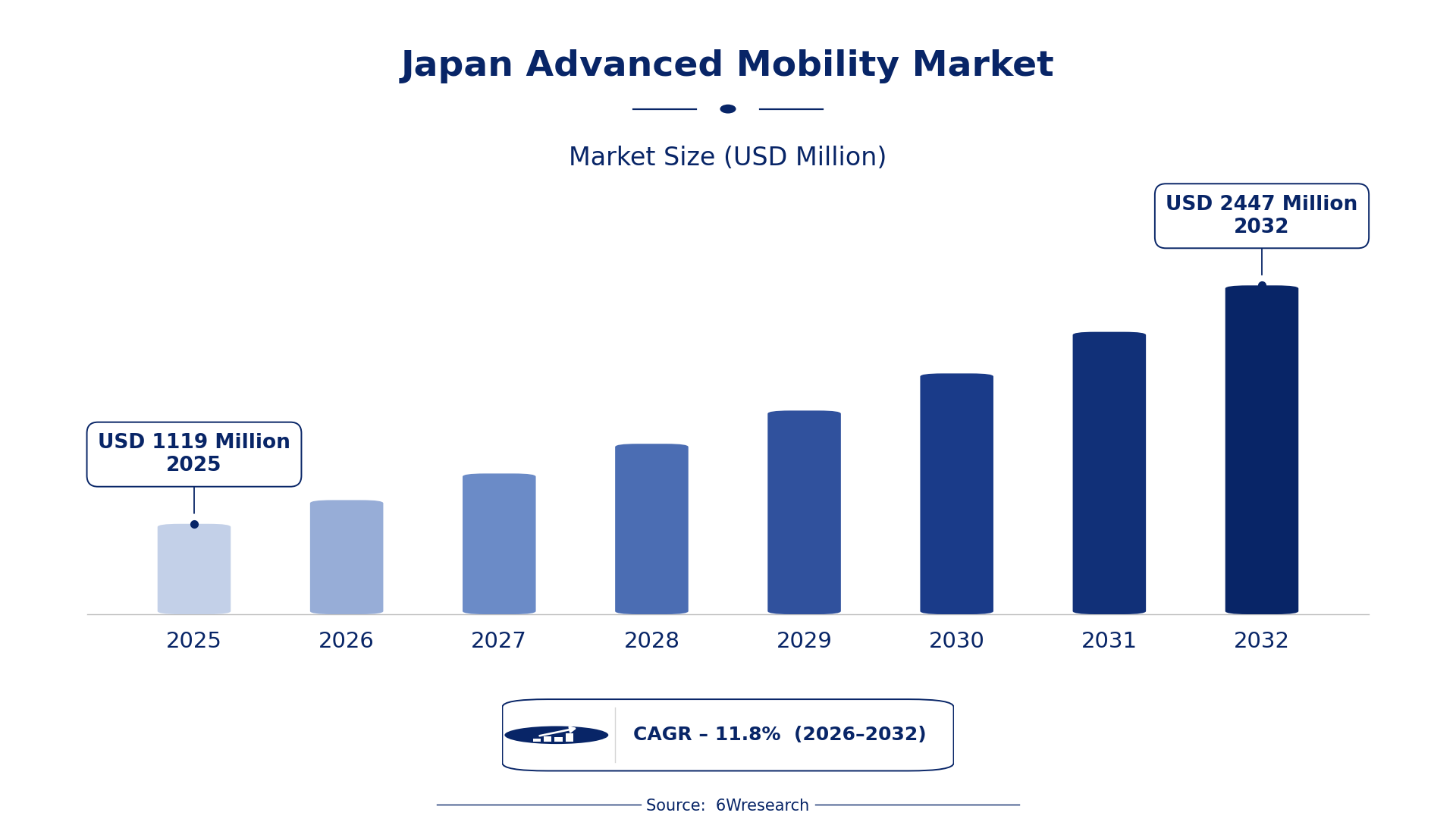
According to 6Wresearch internal database and industry insights, the Japan Advanced Mobility Market was valued at USD 1,119 Million in 2025 and is projected to reach USD 2,447 Million by 2032, growing at a CAGR of approximately 11.8% during 2026–2032.
Japan Advanced Mobility Market Highlights
| Report Metric | Details |
| Report Name | Japan Advanced Mobility Market (2026-2032) |
| Market Size 2025 | USD 1,119 Million |
| Market Size 2032 | USD 2,447 Million |
| Absolute Growth 2025–2032 | USD 1,328 Million |
| CAGR 2026–2032 | 11.8% |
| Peak Annual Growth | 13.6% in 2027 |
| Forecast Period | 2026–2032 |
| Historical Data | 2022–2025 |
| Base Year | 2025 |
| Leading Advanced Mobility Market, 2025 | Electric Mobility (eMobility) (43% share) |
| Leading Solution Type, 2025 | Battery Electric (42% share) |
| Leading Technology Used, 2025 | Lithium-Ion Batteries (39% share) |
| Leading Vehicle Type, 2025 | Electric Cars (41% share) |
| Leading End User, 2025 | Urban Commuters (37% share) |
| Fastest-Growing Advanced Mobility Market | Shared Mobility Solutions (15.4% CAGR) |
| Fastest-Growing Solution Type | Ride Sharing (16.3% CAGR) |
| Fastest-Growing Technology Used | Mobile Platforms (17.0% CAGR) |
| Fastest-Growing Vehicle Type | Four-Wheelers (16.6% CAGR) |
| Fastest-Growing End User | Mobility Startups (15.3% CAGR) |
| Growing Sector | Electric Mobility |
| Key End Users | Urban Commuters, Mobility Startups, Smart Cities, Last-Mile Delivery Firms |
Japan Advanced Mobility Market Year-wise Growth Rate and Key Drivers (2022–2032)
This graph illustrates the annual growth rates of the market from 2022 to 2032, highlighting a steady upward trajectory and projected market expansion over the forecast period.
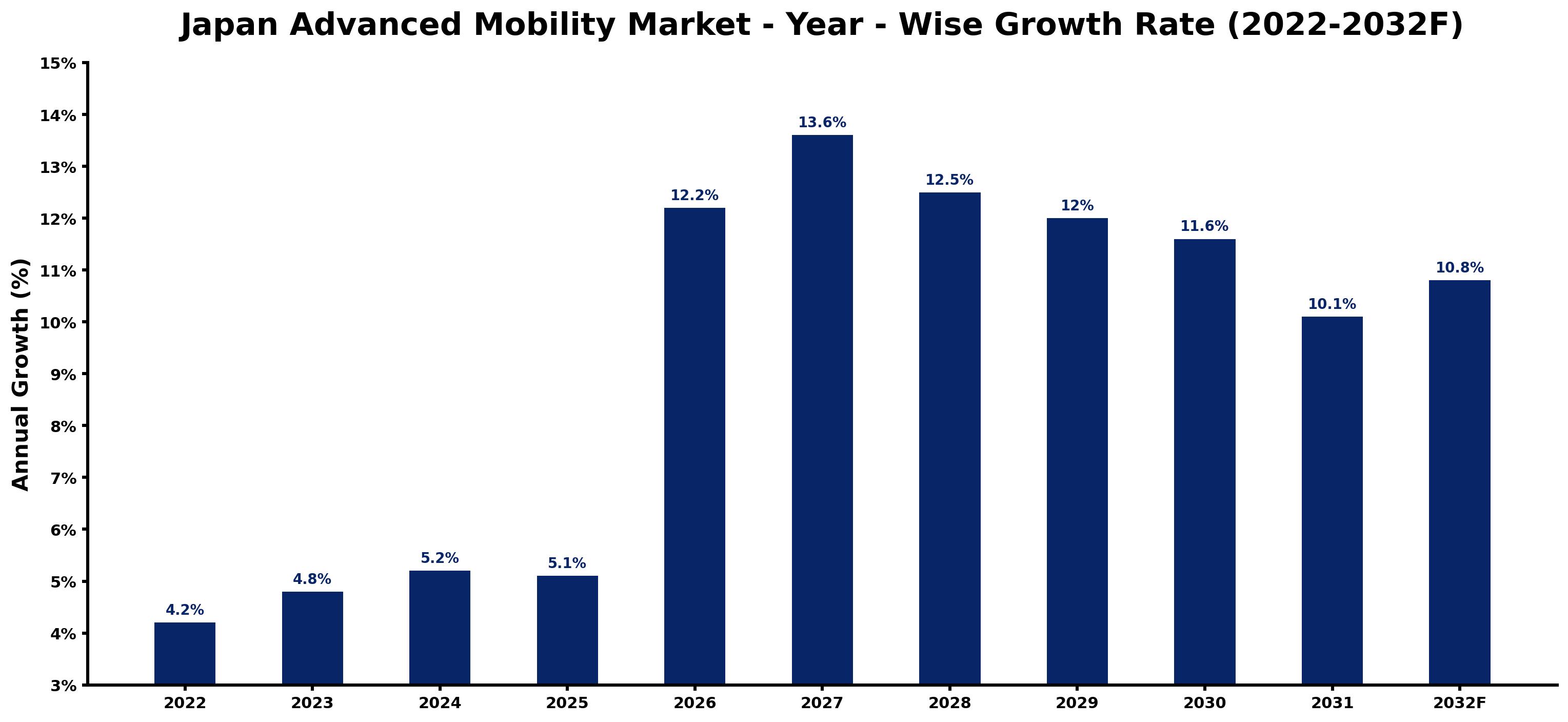
Year by year, the estimates below pair each growth rate with the development that shaped it.
| Year | Estimated Annual Growth (%) | Market Rationale |
| 2022 | 4.2 | The market experienced steady growth, driven by urbanisation and increasing environmental awareness. |
| 2023 | 4.8 | Demand for electric vehicles surged as urban areas expanded their mobility initiatives. |
| 2024 | 5.2 | The adoption of electric mobility solutions accelerated, supported by government incentives. |
| 2025 | 5.1 | Growth slowed slightly due to market saturation in certain urban segments. |
| 2026 | 12.2 | Investment in smart city projects is expected to boost demand for advanced mobility solutions. |
| 2027 | 13.6 | The market is projected to peak with heightened interest in electric vehicles and shared mobility. |
| 2028 | 12.5 | Growth is expected to moderate as the market adjusts to previous high levels of demand. |
| 2029 | 12.0 | The market will continue to grow, driven by ongoing urbanisation and technological advancements. |
| 2030 | 11.6 | Growth is expected to slow as the market matures and competition intensifies. |
| 2031 | 10.1 | The market will maintain positive growth, supported by ongoing government initiatives. |
| 2032 | 10.8 | Demand for advanced mobility solutions is projected to increase as electric vehicle adoption reaches new heights. |
Note: Market size estimations and growth projections presented in this report are based on 6Wresearch's proprietary forecasting methodology, utilizing the latest available industry data, government publications, and primary research inputs.
Japan Advanced Mobility Market Synopsis
Advanced mobility encompasses technologies and services aimed at improving transportation efficiency and sustainability, including electric vehicles and shared mobility solutions. In Japan, urban commuters and mobility startups drive demand, supported by government initiatives promoting smart cities. The Japan Advanced Mobility Market is poised for substantial growth, with electric vehicle sales projected to reach 100% by 2035, reflecting a strong commitment to sustainability and progress in transportation.
Market Dynamics Impact Analysis (2026–2032)
| Factor | Type | Impact | Primary Segment Affected |
| Urbanisation and population density in major cities drive demand for efficient transport solutions. | Driver | High | Electric Mobility (eMobility) |
| Government initiatives, such as the Smart Mobility Challenge, promote innovative transport solutions. | Driver | High | Shared Mobility Solutions |
| The need for last-mile connectivity creates opportunities for micro-mobility solutions. | Opportunity | High | Micro-Mobility |
| Urban commuters increasingly seek flexible transport options, boosting ride-sharing services. | Opportunity | High | Shared Mobility Solutions |
| Market saturation in urban areas may limit growth potential for new entrants. | Restraint | Medium | Electric Mobility (eMobility) |
| High initial costs of electric vehicles can deter potential buyers from adoption. | Restraint | Medium | Electric Mobility (eMobility) |
| Limited infrastructure for charging stations poses challenges for electric vehicle users. | Challenge | High | Electric Mobility (eMobility) |
| Technological barriers in autonomous mobility hinder widespread adoption. | Challenge | Medium | Autonomous Mobility |
Evaluation of Drivers in Japan Advanced Mobility Market (2026–2032)
The main growth drivers and the segments they affect most are set out below.
| Drivers | Primary Segment Affected | Why It Matters (Evidence) |
| Urbanisation in Tokyo increases demand for electric mobility solutions. | Electric Mobility (eMobility) | With urban areas driving the need for efficient transport, the population density creates significant demand. |
| Government support for electric vehicle adoption boosts market growth. | Electric Mobility (eMobility) | The government aims for 100% electric vehicle sales by 2035, encouraging consumer adoption. |
| Increasing environmental awareness drives demand for sustainable transport options. | Shared Mobility Solutions | Urban commuters seek eco-friendly alternatives to traditional vehicles, influencing market trends. |
| Investment in smart city initiatives improves infrastructure for advanced mobility. | Micro-Mobility | The government allocated ¥10 billion for smart city projects in 2023, enhancing mobility services. |
| Growing number of charging stations facilitates electric vehicle usage. | Electric Mobility (eMobility) | With over 1,000 charging stations available, accessibility for electric vehicle users is improving. |
Spending rises as urbanisation in Tokyo fuels demand for electric mobility solutions, with urban areas driving the need for efficient transport. Support for electric vehicle adoption, targeting 100% sales by 2035, further propels market growth. A growing number of charging stations, exceeding 1,000 in 2023, facilitates electric vehicle usage and encourages more purchases.
Evaluation of Restraints in Japan Advanced Mobility Market
The table below lists the restraints and the evidence behind each.
| Market Restraint | Primary Segment Affected | Why It Matters (Evidence) |
| Market saturation in urban areas limits growth potential for new entrants. | Electric Mobility (eMobility) | As urban markets become saturated, new companies may struggle to gain traction. |
| High initial costs of electric vehicles deter potential buyers from adoption. | Electric Mobility (eMobility) | The average cost of electric vehicles remains a barrier for many consumers. |
| Limited infrastructure for charging stations poses challenges for electric vehicle users. | Electric Mobility (eMobility) | Insufficient charging infrastructure can lead to range anxiety among potential buyers. |
| Technological barriers in autonomous mobility hinder widespread adoption. | Autonomous Mobility | Many autonomous systems are still in testing phases, limiting commercial viability. |
| Regulatory hurdles can slow down the introduction of new mobility solutions. | Shared Mobility Solutions | Compliance with local regulations may delay the launch of new services. |
Japan Advanced Mobility Market Challenges
Japan's regulatory framework imposes strict compliance standards on electric vehicle safety, creating delays in product launches for producers. This complexity can extend development timelines by up to six months, hindering market entry for new technologies. Competition intensifies among mobility startups, as many struggle to secure funding amidst rising operational costs, leading to reduced innovation and fewer viable products for buyers. The high cost of charging infrastructure, with installation fees averaging ¥2 million per station, burdens producers and limits service expansion, resulting in limited access to charging stations for buyers and impacting their adoption of electric vehicles.
Trends in the Japan Advanced Mobility Market
The following changes are redrawing the Japan Advanced Mobility Market.
- Shift from Private Ownership to Shared Mobility: Since 2023, urban commuters have increasingly favoured shared mobility solutions over private vehicle ownership, as evidenced by Tokyo's ride-sharing usage, which has grown by 20%. This trend encourages suppliers to focus on flexible transport options.
- Transition from Traditional Vehicles to Electric Cars: The Smart Mobility Challenge 2023 has accelerated the transition to electric cars, with the adoption rate reaching 15% in 2023. This trend highlights the growing market for electric vehicles and the need for supporting infrastructure.
- Urban Commuters Prioritising Eco-Friendly Transport: The demand for eco-friendly transport options among urban commuters has surged, with 37% of users opting for electric mobility solutions in 2023. This trend indicates a shift towards sustainable transportation practices.
- Emergence of Mobile Platforms in Advanced Mobility: Mobile platforms have gained prominence since 2023, with a 17% increase in usage among urban commuters. This change reflects the growing importance of technology in facilitating mobility services.
Investment Opportunities in the Japan Advanced Mobility Market
The opportunities below stand out in the Japan Advanced Mobility Market for new entrants and existing suppliers.
- Investment in Charging Infrastructure: Tokyo's urban areas require more charging stations, with over 1,000 currently available. Investing in charging infrastructure can meet the growing demand for electric vehicles, especially among urban commuters.
- Expansion of Ride-Sharing Services: Mobility startups are increasingly seeking ride-sharing solutions, with a market gap of 15% in urban areas. Suppliers can enter by partnering with local startups to provide transport options.
- Development of Autonomous Mobility Solutions: The pilot program for autonomous shuttles in 2023 indicates a growing interest in this technology. Suppliers can invest in R&D to support the development of autonomous systems for urban areas.
- Growth of Electric Two-Wheeler Market: Japan's electric two-wheeler market is expanding, with new models introduced annually. Suppliers can capitalise on this trend by providing electric bikes and scooters for urban commuting.
Government Initiatives in the Japan Advanced Mobility Market
The Electrical Appliance and Material Safety Act regulates the safety of electric vehicles and their components, ensuring compliance for producers. This law mandates rigorous testing and certification processes, which can delay product launches but ultimately builds consumer trust in advanced mobility solutions. Additionally, the Economic Security Promotion Act supports supply-chain resilience for critical materials, benefiting the advanced mobility sector by ensuring a stable supply of essential components for electric vehicles and related technologies.
In 2023, the government allocated ¥10 billion for smart city initiatives, administered by the Ministry of Land, Infrastructure, Transport and Tourism. This funding aims to enhance urban mobility infrastructure, including the expansion of electric vehicle charging stations and the promotion of shared mobility services. The Digital Agency also oversees the implementation of common system standards, facilitating the integration of advanced mobility solutions into urban planning.
Future Insight of the Japan Advanced Mobility Market
By 2032, government initiatives will drive a shift towards electric mobility, prompting suppliers to improve production capabilities. The government aims for 100% electric vehicle sales by 2035, which will stimulate infrastructure development. With the total number of registered electric cars exceeding 500,000 in 2023, the demand for charging stations is expected to double, enhancing accessibility for buyers. New standards like ISO 26262 will ensure higher safety levels, building consumer confidence and encouraging greater adoption of advanced transport solutions.
Market Segmentation Analysis
Japan Advanced Mobility Market report covers a detailed analysis of the following market segments:
By Advanced Mobility Market – Electric Mobility (eMobility) Leads, Shared Mobility Solutions Expected to Grow Fastest
According to Saurav Kr Singh, Senior Research Analyst at 6Wresearch, in 2025, Electric Mobility (eMobility) led the advanced mobility market split with a 43% share. Electric Mobility holds the largest share due to its widespread adoption among urban commuters, with over 500,000 registered electric cars in Japan as of 2023. This segment benefits from government initiatives promoting electric vehicle sales, particularly the goal of achieving 100% electric vehicle sales by 2035. The quickest growth will come from Shared Mobility Solutions, forecast to expand at a CAGR of 15.4% between 2026 and 2032. Shared Mobility Solutions is experiencing rapid growth as urban populations increasingly seek efficient transport options, exemplified by the Tokyo Metropolitan Government's subsidies for these services. This trend indicates a shift towards more flexible transportation solutions in urban settings, further driving the segment's expansion. Suppliers should prioritise enhancing shared mobility offerings to align with rising urban transportation demands.
By Solution Type – Battery Electric Leads, Ride Sharing Expected to Grow Fastest
Battery Electric held 42% of the Japan Advanced Mobility Market by solution type in 2025. Battery Electric solutions dominate the market as they are essential for powering electric vehicles, which are increasingly popular among consumers. The adoption of these technologies is critical for achieving environmental goals in urban settings. Ride Sharing is set to record the highest CAGR in this split, 16.3% over 2026–2032. Ride Sharing is the fastest-growing segment, driven by the need for flexible transport solutions, particularly in densely populated areas. The rise in urban commuting patterns is accelerating the demand for ride-sharing platforms. Suppliers must invest in ride-sharing technologies to capitalise on this growth opportunity.
By Technology Used – Lithium-Ion Batteries Lead, Mobile Platforms Expected to Grow Fastest
With 39% of technology used revenue in 2025, Lithium-Ion Batteries was the largest category. Lithium-Ion Batteries are the leading technology due to their crucial role in energy storage for electric vehicles, which are central to advanced mobility solutions. Their efficiency and reliability make them the preferred choice among manufacturers, ensuring a robust installed base. Over 2026–2032, Mobile Platforms are expected to post the fastest growth, at a CAGR of 17.0%. Mobile Platforms are witnessing significant growth as they enable the operation of various mobility services, reflecting the increasing reliance on digital solutions for transportation. This trend underscores the necessity for integration of these platforms in service offerings to meet market needs. Investing in mobile platform technologies will be crucial for suppliers to maintain a competitive edge.
By Vehicle Type – Electric Cars Lead, Four-Wheelers Expected to Grow Fastest
Electric Cars took 41% of vehicle type revenue in 2025, more than any other category. Electric Cars dominate the market as they are a major component of advanced mobility, appealing to environmentally conscious consumers. Their adoption is supported by government initiatives that promote electric vehicle usage, solidifying their position in the market. Four-Wheelers are projected to grow fastest, at a CAGR of 16.6% during 2026–2032. Four-Wheelers are the fastest-growing segment, encompassing both electric and autonomous vehicles, which are gaining popularity among urban commuters. The demand for versatile vehicle options is significantly contributing to this segment's rapid growth, indicating a shift in consumer preferences. Suppliers should concentrate on developing versatile four-wheeler solutions to cater to changing consumer preferences.
By End User – Urban Commuters Lead, Mobility Startups Expected to Grow Fastest
The largest end user category in 2025 was Urban Commuters, at 37% of revenue. Urban Commuters represent the primary users of advanced mobility solutions, underscoring the demand for efficient transport in densely populated areas. Their increasing adoption of electric vehicles and shared mobility services is reshaping the market landscape, highlighting their importance. The quickest growth will come from Mobility Startups, forecast to expand at a CAGR of 15.3% between 2026 and 2032. Mobility Startups are driving rapid innovation in the sector, as they seek to address urban transportation challenges with novel solutions. Their agility and focus on technology are pivotal in propelling their growth and reshaping the market. Suppliers should engage with mobility startups to leverage innovative approaches and broaden their market reach.
Key Attractiveness of the Report
- 10 Years of Market Numbers
- Historical Data Starting from 2022 to 2025
- Base Year 2025
- Forecast Data until 2032
- Key Performance Indicators Impacting the Market
- Major Upcoming Developments and Projects
Key Highlights of the Report:
- Japan Advanced Mobility Market Outlook
- Market Size of Japan Advanced Mobility Market, 2025
- Forecast of Japan Advanced Mobility Market, 2032
- Historical Data and Forecast of Japan Advanced Mobility Revenues & Volume for the Period 2022-2032F
- Japan Advanced Mobility Market Trend Evolution
- Japan Advanced Mobility Market Drivers and Challenges
- Japan Advanced Mobility Price Trends
- Japan Advanced Mobility Porter's Five Forces
- Japan Advanced Mobility Industry Life Cycle
- Historical Data and Forecast of Japan Advanced Mobility Market Revenues & Volume By Advanced Mobility Market for the Period 2022-2032F
- Historical Data and Forecast of Japan Advanced Mobility Market Revenues & Volume By Electric Mobility (eMobility) for the Period 2022-2032F
- Historical Data and Forecast of Japan Advanced Mobility Market Revenues & Volume By Shared Mobility Solutions for the Period 2022-2032F
- Historical Data and Forecast of Japan Advanced Mobility Market Revenues & Volume By Autonomous Mobility for the Period 2022-2032F
- Historical Data and Forecast of Japan Advanced Mobility Market Revenues & Volume By Micro-Mobility for the Period 2022-2032F
- Historical Data and Forecast of Japan Advanced Mobility Market Revenues & Volume By Solution Type for the Period 2022-2032F
- Historical Data and Forecast of Japan Advanced Mobility Market Revenues & Volume By Battery Electric for the Period 2022-2032F
- Historical Data and Forecast of Japan Advanced Mobility Market Revenues & Volume By Ride Sharing for the Period 2022-2032F
- Historical Data and Forecast of Japan Advanced Mobility Market Revenues & Volume By Self-Driving Tech for the Period 2022-2032F
- Historical Data and Forecast of Japan Advanced Mobility Market Revenues & Volume By E-Scooters & Bikes for the Period 2022-2032F
- Historical Data and Forecast of Japan Advanced Mobility Market Revenues & Volume By Technology Used for the Period 2022-2032F
- Historical Data and Forecast of Japan Advanced Mobility Market Revenues & Volume By Lithium-Ion Batteries for the Period 2022-2032F
- Historical Data and Forecast of Japan Advanced Mobility Market Revenues & Volume By Mobile Platforms for the Period 2022-2032F
- Historical Data and Forecast of Japan Advanced Mobility Market Revenues & Volume By Lidar, AI for the Period 2022-2032F
- Historical Data and Forecast of Japan Advanced Mobility Market Revenues & Volume By IoT-Enabled for the Period 2022-2032F
- Historical Data and Forecast of Japan Advanced Mobility Market Revenues & Volume By Vehicle Type for the Period 2022-2032F
- Historical Data and Forecast of Japan Advanced Mobility Market Revenues & Volume By Electric Cars for the Period 2022-2032F
- Historical Data and Forecast of Japan Advanced Mobility Market Revenues & Volume By Four-Wheelers for the Period 2022-2032F
- Historical Data and Forecast of Japan Advanced Mobility Market Revenues & Volume By Autonomous Shuttles for the Period 2022-2032F
- Historical Data and Forecast of Japan Advanced Mobility Market Revenues & Volume By Two-Wheelers for the Period 2022-2032F
- Historical Data and Forecast of Japan Advanced Mobility Market Revenues & Volume By End User for the Period 2022-2032F
- Historical Data and Forecast of Japan Advanced Mobility Market Revenues & Volume By Urban Commuters for the Period 2022-2032F
- Historical Data and Forecast of Japan Advanced Mobility Market Revenues & Volume By Mobility Startups for the Period 2022-2032F
- Historical Data and Forecast of Japan Advanced Mobility Market Revenues & Volume By Smart Cities for the Period 2022-2032F
- Historical Data and Forecast of Japan Advanced Mobility Market Revenues & Volume By Last-Mile Delivery Firms for the Period 2022-2032F
- Japan Advanced Mobility Import Export Trade Statistics
- Market Opportunity Assessment By Advanced Mobility Market
- Market Opportunity Assessment By Solution Type
- Market Opportunity Assessment By Technology Used
- Market Opportunity Assessment By Vehicle Type
- Market Opportunity Assessment By End User
- Japan Advanced Mobility Top Companies Market Share
- Japan Advanced Mobility Competitive Benchmarking By Technical and Operational Parameters
- Japan Advanced Mobility Company Profiles
- Japan Advanced Mobility Key Strategic Recommendations
Market Covered
Coverage by segment is as follows.
By Advanced Mobility Market
- Electric Mobility (eMobility)
- Shared Mobility Solutions
- Autonomous Mobility
- Micro-Mobility
By Solution Type
- Battery Electric
- Ride Sharing
- Self-Driving Tech
- E-Scooters & Bikes
By Technology Used
- Lithium-Ion Batteries
- Mobile Platforms
- Lidar
- AI
- IoT-Enabled
By Vehicle Type
- Electric Cars
- Four-Wheelers
- Autonomous Shuttles
- Two-Wheelers
By End User
- Urban Commuters
- Mobility Startups
- Smart Cities
- Last-Mile Delivery Firms































