Japan Advanced Nanomaterials for Environmental Detection and Remediation Market Size & Growth Rate
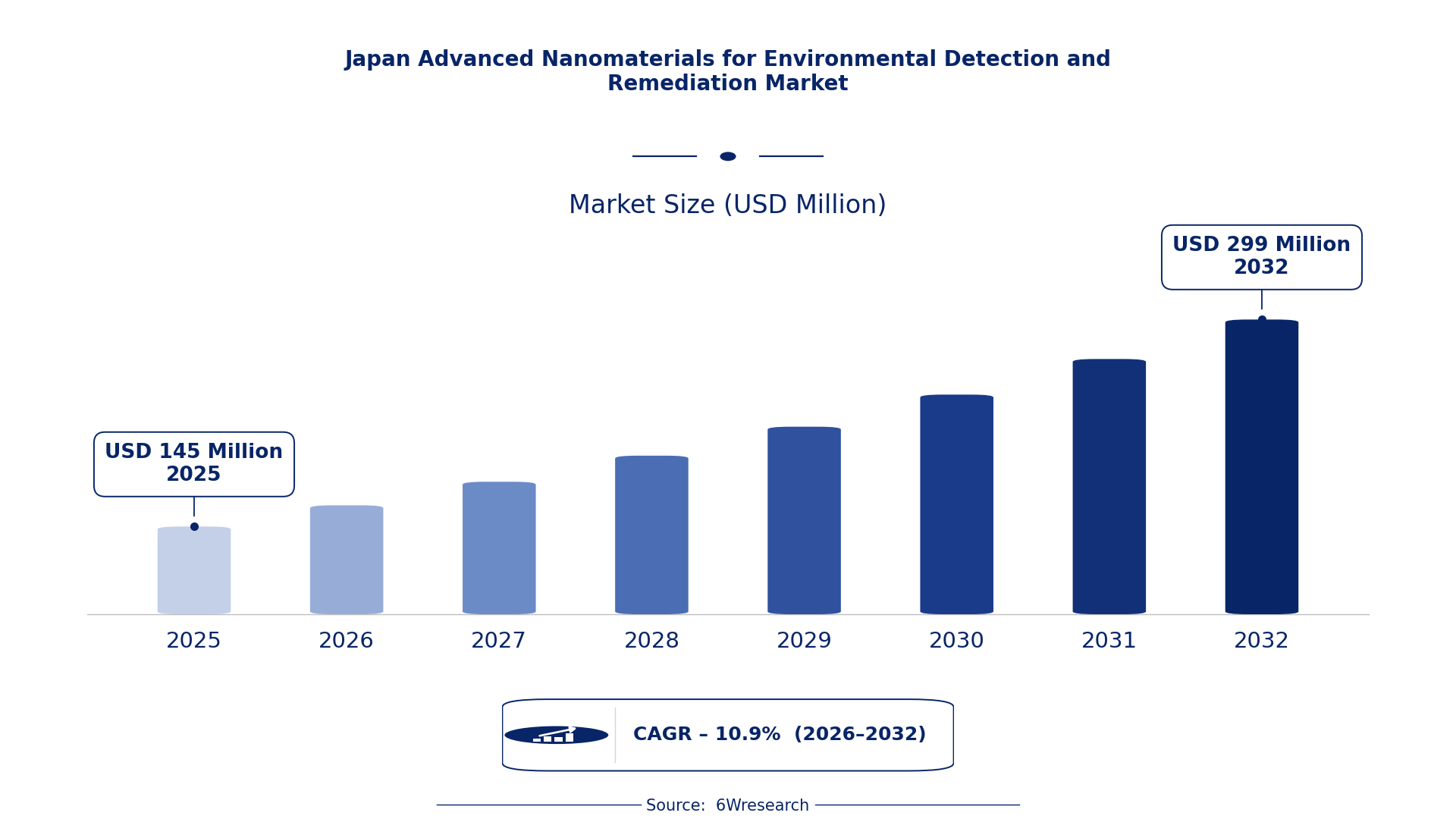
According to 6Wresearch internal database and industry insights, the Japan Advanced Nanomaterials for Environmental Detection and Remediation Market was valued at USD 145 Million in 2025 and is projected to reach USD 299 Million by 2032, growing at a CAGR of approximately 10.9% during 2026–2032.
Japan Advanced Nanomaterials for Environmental Detection and Remediation Market Highlights
| Report Metric | Details |
| Report Name | Japan Advanced Nanomaterials for Environmental Detection and Remediation Market (2026-2032) |
| Market Size 2025 | USD 145 Million |
| Market Size 2032 | USD 299 Million |
| Absolute Growth 2025–2032 | USD 154 Million |
| CAGR 2026–2032 | 10.9% |
| Peak Annual Growth | 15.0% in 2032 |
| Forecast Period | 2026–2032 |
| Historical Data | 2022–2025 |
| Base Year | 2025 |
| Leading Medium, 2025 | Air (54% share) |
| Leading Type, 2025 | Metal-based (43% share) |
| Leading Application, 2025 | Waste Water & Industrial Effluent Treatment (44% share) |
| Leading End-use Industry, 2025 | Agriculture (43% share) |
| Fastest-Growing Medium | Water (14.1% CAGR) |
| Fastest-Growing Type | Carbon-based (15.4% CAGR) |
| Fastest-Growing Application | Environmental Monitoring (16.2% CAGR) |
| Growing Sector | Environmental Monitoring |
| Key End Users | Waste Water & Industrial Effluent Treatment, Environmental Monitoring, Soil & Land Management, Sustainable Agriculture |
Japan Advanced Nanomaterials for Environmental Detection and Remediation Market Year-wise Growth Rate and Key Drivers (2022–2032)
This graph illustrates the annual growth rates of the market from 2022 to 2032, highlighting a steady upward trajectory and projected market expansion over the forecast period.
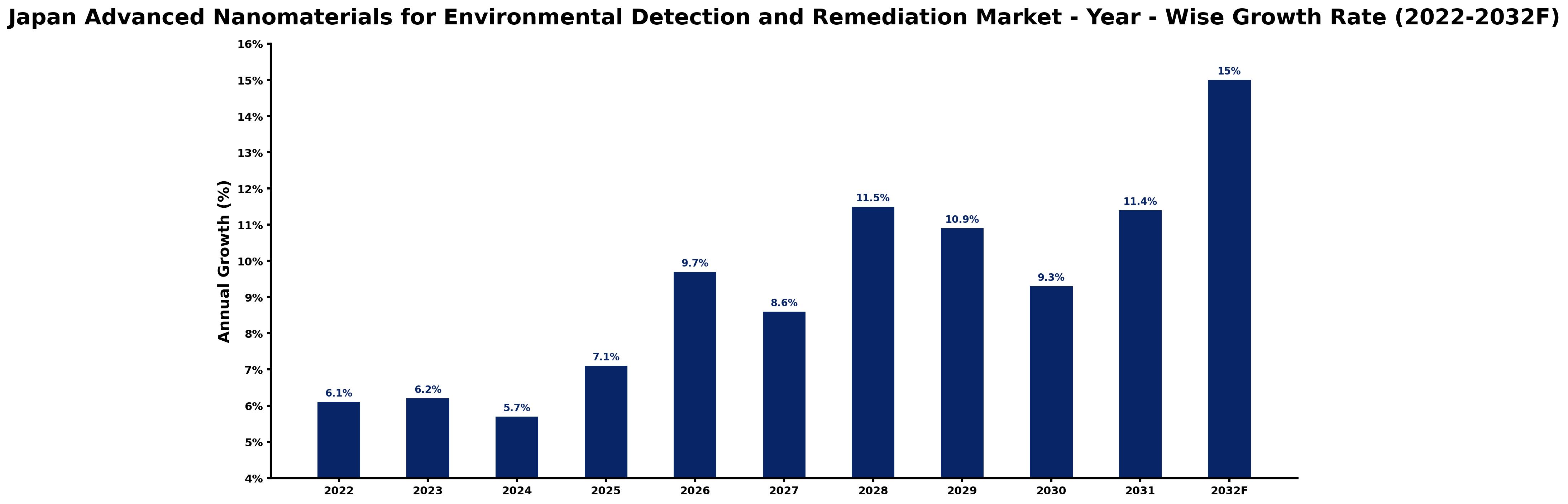
The following figures match every annual growth estimate with the main market development of that year, giving the reasoning behind each rise or slowdown.
| Year | Estimated Annual Growth (%) | Market Rationale |
| 2022 | 6.1 | The market showed steady demand with increasing awareness of environmental issues. |
| 2023 | 6.2 | Growth was supported by heightened investments in environmental technologies and monitoring. |
| 2024 | 5.7 | Demand growth slowed slightly as market adjustments occurred amid rising competition. |
| 2025 | 7.1 | The market rebounded with strong investments in wastewater treatment technologies. |
| 2026 | 9.7 | Demand surged as new projects focusing on air quality monitoring are initiated. |
| 2027 | 8.6 | Growth moderated due to saturation in specific applications. |
| 2028 | 11.5 | The market expanded rapidly with increased adoption of advanced nanomaterials in remediation. |
| 2029 | 10.9 | Growth slowed slightly as the market matured and competition intensified. |
| 2030 | 9.3 | Demand continued to rise with ongoing investments in sustainable practices. |
| 2031 | 11.4 | The market experienced renewed growth driven by new applications in agriculture. |
| 2032 | 15.0 | Demand peaked as advanced nanomaterials became essential for environmental solutions. |
Note: Market size estimations and growth projections presented in this report are based on 6Wresearch's proprietary forecasting methodology, utilizing the latest available industry data, government publications, and primary research inputs.
Japan Advanced Nanomaterials for Environmental Detection and Remediation Market Synopsis
Advanced nanomaterials for environmental detection and remediation are engineered materials at the nanoscale used for identifying and mitigating pollutants. Their applications include water treatment, air purification, and soil remediation. The Japan Advanced Nanomaterials for Environmental Detection and Remediation Market is growing due to rising demand from domestic users, investments in decarbonisation, and international collaborations. The government's commitment to reducing greenhouse gas emissions by 46% by 2030 is driving the adoption of these technologies, with a target of JPY 150 trillion in investments over the next decade.
Market Dynamics Impact Analysis (2026–2032)
| Factor | Type | Impact | Primary Segment Affected |
| Increased investment in environmental technologies | Driver | High | Water |
| Growing focus on air quality monitoring | Driver | High | Air |
| Rising demand for wastewater treatment solutions | Opportunity | High | Waste Water & Industrial Effluent Treatment |
| Expansion of environmental monitoring stations | Opportunity | High | Environmental Monitoring |
| Competition from alternative materials | Restraint | Medium | Metal-based |
| Regulatory compliance costs for producers | Restraint | Medium | Carbon-based |
| High initial investment for advanced technologies | Challenge | High | Silica-based |
| Limited awareness among potential users | Challenge | Medium | Polymer-based |
Evaluation of Drivers in Japan Advanced Nanomaterials for Environmental Detection and Remediation Market (2026–2032)
Below are the drivers that matter most for revenue growth, with supporting evidence.
| Drivers | Primary Segment Affected | Why It Matters (Evidence) |
| Rising investments in decarbonisation | Water | Japan's GX Basic Policy targets JPY 150 trillion for decarbonisation over 10 years, boosting demand for advanced water treatment solutions. |
| Increased focus on air quality | Air | The Tokyo metropolitan area leads in air quality monitoring technologies, driving demand for advanced nanomaterials. |
| Government initiatives for wastewater reduction | Waste Water & Industrial Effluent Treatment | The government aims to reduce industrial wastewater by 20% by 2025, promoting advanced treatment technologies. |
| Expansion of environmental monitoring infrastructure | Environmental Monitoring | In 2022, Japan reported over 1,000 environmental monitoring stations utilizing advanced technologies, increasing demand. |
| Research advancements in nanotechnology | Soil | The Tohoku region is known for its research in nanotechnology applications for soil remediation, boosting demand. |
Behind the steady rise in orders sits increasing investments in decarbonisation, with Japan targeting JPY 150 trillion for environmental projects over the next decade. The Tokyo metropolitan area leads in air quality monitoring, driving demand for advanced nanomaterials. Efforts to reduce industrial wastewater by 20% by 2025 promote advanced treatment technologies. In 2022, Japan reported over 1,000 environmental monitoring stations, increasing the need for effective solutions. Research in the Tohoku region is also boosting demand for soil remediation applications, further supporting market growth.
Evaluation of Restraints in Japan Advanced Nanomaterials for Environmental Detection and Remediation Market
These are the pressures that could keep growth below its potential.
| Market Restraint | Primary Segment Affected | Why It Matters (Evidence) |
| Competition from alternative materials | Metal-based | The presence of alternative materials may limit market share for metal-based nanomaterials, affecting pricing and adoption. |
| Regulatory compliance costs | Carbon-based | Producers face high compliance costs under the Chemical Substances Control Law, impacting profitability. |
| Limited awareness of advanced technologies | Polymer-based | Many potential users lack knowledge about the benefits of polymer-based nanomaterials, hindering market penetration. |
| High initial investment requirements | Silica-based | The need for substantial upfront investment in advanced technologies can deter smaller companies from entering the market. |
| Market saturation in certain applications | Air | As air quality technologies mature, growth potential may diminish, leading to increased competition. |
Japan Advanced Nanomaterials for Environmental Detection and Remediation Market Challenges
In 2022, Japan reported over 1,000 environmental monitoring stations, yet a shortage of skilled professionals in nanotechnology hampers effective implementation, delaying projects for buyers in environmental sectors. Strict adherence to ISO 14001 standards complicates the integration of new nanomaterials, increasing costs for suppliers who must navigate rigorous certification processes. Rapid technological advancements in nanomaterials create a gap, as many producers struggle to keep pace, resulting in outdated solutions that fail to meet market demands. Intense competition among local manufacturers drives prices down, forcing clinics and hospitals to compromise on quality for affordability.
Trends in the Japan Advanced Nanomaterials for Environmental Detection and Remediation Market
The shifts below are changing how Japan Advanced Nanomaterials for Environmental Detection and Remediation Market products are bought and supplied.
- Shift from Traditional to Advanced Water Treatment: In 2023, Japan's Ministry of the Environment launched a program to improve water quality monitoring using advanced nanomaterials, reflecting a shift towards more effective treatment solutions.
- Transition from Conventional to Nanotechnology in Air Quality: The Tokyo metropolitan area is increasingly adopting advanced nanomaterials for air quality monitoring, resulting in improved detection methods and public health outcomes.
- Emergence of Nanomaterials in Soil Remediation: The Tohoku region is seeing a rise in research focused on nanotechnology applications for soil remediation, enhancing environmental restoration efforts.
- Growth in Environmental Monitoring Applications: The increase in environmental monitoring stations indicates a demand for advanced nanomaterials, providing opportunities for suppliers to enter this expanding market.
Investment Opportunities in the Japan Advanced Nanomaterials for Environmental Detection and Remediation Market
The following opportunities in the Japan Advanced Nanomaterials for Environmental Detection and Remediation Market pair current demand with a clear way in.
- Investment in Advanced Water Treatment Solutions: With a target to reduce industrial wastewater by 20% by 2025, there is a growing need for advanced treatment technologies in Japan's industrial sector.
- Supply of Nanomaterials for Air Quality Monitoring: The Tokyo metropolitan area requires advanced nanomaterials for air quality monitoring, presenting opportunities for suppliers to meet this demand.
- Development of Nanotechnology for Soil Remediation: Research institutions in the Tohoku region are seeking advanced nanomaterials for soil remediation, creating investment opportunities for developers.
- Expansion of Environmental Monitoring Applications: The increase in environmental monitoring stations indicates a demand for advanced nanomaterials, providing opportunities for suppliers to enter this expanding market.
Government Initiatives in the Japan Advanced Nanomaterials for Environmental Detection and Remediation Market
The PRTR Law of 1999 requires businesses to report releases of designated chemical substances, ensuring transparency and accountability in environmental practices. This law influences producers to adopt advanced nanomaterials for compliance and sustainability, impacting their operational costs and market strategies. The Chemical Substances Control Law mandates evaluation and control of new and existing chemical substances, compelling manufacturers to invest in safer alternatives and advanced technologies to meet regulatory standards.
The Ministry of the Environment and the Ministry of Economy, Trade and Industry oversee the implementation of various environmental regulations, approving projects that align with Japan's decarbonisation goals. They fund initiatives that promote the use of advanced nanomaterials, facilitating research and development efforts that enhance environmental protection and compliance for producers.
Future Insight of the Japan Advanced Nanomaterials for Environmental Detection and Remediation Market
The launch of new water quality monitoring initiatives in 2023 will enhance detection capabilities, benefiting buyers seeking effective remediation solutions. By 2032, Japan's ambitious JPY 150 trillion decarbonisation investment will stimulate innovation in nanomaterials, enabling suppliers to develop advanced technologies. The government's goal to reduce industrial wastewater by 20% by 2025 will create new opportunities for treatment technologies. Increased collaboration between research institutions in the Tohoku region and environmental sectors will further accelerate the adoption of nanomaterials in remediation efforts.
Market Segmentation Analysis
Japan Advanced Nanomaterials for Environmental Detection and Remediation Market report covers a detailed analysis of the following market segments:
By Medium – Air Leads, Water Expected to Grow Fastest
According to Sumit Sagar, AM at 6Wresearch, in 2025, Air led the medium split with a 54% share. The air segment holds the largest share due to its critical role in air quality monitoring and purification, particularly in urban areas like Tokyo. With over 1,000 environmental monitoring stations in Japan, the demand for air-related solutions is substantial. Water is set to record the highest CAGR in this split, 14.1% over 2026–2032. The water segment is experiencing rapid growth driven by the government's goal to reduce industrial wastewater by 20% by 2025, highlighting the need for advanced treatment technologies. This focus on improving water quality monitoring will further accelerate adoption. Suppliers should prioritise innovations in water treatment technologies to meet increasing regulatory demands.
By Type – Metal-based Leads, Carbon-based Expected to Grow Fastest
With 43% of type revenue in 2025, Metal-based was the largest category. Metal-based nanomaterials dominate the market due to their essential role in effective pollutant adsorption, particularly in water treatment applications. Their established usage in the Tokyo metropolitan area highlights their critical importance in environmental remediation efforts. Carbon-based is projected to grow fastest, at a CAGR of 15.4% during 2026–2032. Carbon-based nanomaterials are witnessing rapid growth, particularly in filtration and sensing applications, as the demand for advanced environmental monitoring solutions escalates. This growth is expected to continue as awareness of pollution issues rises among stakeholders. Suppliers need to focus on developing carbon-based materials to address the increasing demand for innovative environmental solutions.
By Application – Waste Water & Industrial Effluent Treatment Leads, Environmental Monitoring Expected to Grow Fastest
The largest application category in 2025 was Waste Water & Industrial Effluent Treatment, at 44% of revenue. Waste water and industrial effluent treatment leads the application segment as it is vital for reducing contaminants from industrial discharges, ensuring compliance with environmental standards. The government's goal to decrease industrial wastewater further reinforces this segment's prominence. Over 2026–2032, Environmental Monitoring is expected to post the fastest growth, at a CAGR of 16.2%. Environmental monitoring is the fastest-growing application, driven by its critical role in assessing pollution levels, especially following government initiatives to improve water quality monitoring. The rise in environmental monitoring stations will further accelerate growth in this area. Suppliers must focus on advancing monitoring technologies to leverage the growing market for environmental assessment solutions.
By End-use Industry – Agriculture Leads and Records the Fastest Growth
Agriculture took 43% of end-use industry revenue in 2025, more than any other category. Agriculture is the leading end-use industry as it significantly benefits from advanced nanomaterials that promote sustainable farming practices, which are increasingly prioritised in Japan. The sector's dedication to environmental sustainability ensures its ongoing leadership in the market. The same category is also set to grow fastest, at a CAGR of 14.3% during 2026–2032. Agriculture is also the fastest-growing segment, as the emphasis on sustainable practices aligns with national environmental goals. This dual role of agriculture as both leader and fastest indicates a strong commitment to sustainable solutions within the market. Suppliers should align their offerings with agricultural sustainability initiatives to seize emerging market opportunities.
Key Attractiveness of the Report
- 10 Years of Market Numbers
- Historical Data Starting from 2022 to 2025
- Base Year 2025
- Forecast Data until 2032
- Key Performance Indicators Impacting the Market
- Major Upcoming Developments and Projects
Key Highlights of the Report:
- Japan Advanced Nanomaterials for Environmental Detection and Remediation Market Outlook
- Market Size of Japan Advanced Nanomaterials for Environmental Detection and Remediation Market, 2025
- Forecast of Japan Advanced Nanomaterials for Environmental Detection and Remediation Market, 2032
- Historical Data and Forecast of Japan Advanced Nanomaterials for Environmental Detection and Remediation Revenues & Volume for the Period 2022-2032
- Japan Advanced Nanomaterials for Environmental Detection and Remediation Market Trend Evolution
- Japan Advanced Nanomaterials for Environmental Detection and Remediation Market Drivers and Challenges
- Japan Advanced Nanomaterials for Environmental Detection and Remediation Price Trends
- Japan Advanced Nanomaterials for Environmental Detection and Remediation Porter's Five Forces
- Japan Advanced Nanomaterials for Environmental Detection and Remediation Industry Life Cycle
- Historical Data and Forecast of Japan Advanced Nanomaterials for Environmental Detection and Remediation Market Revenues & Volume By Medium for the Period 2022-2032
- Historical Data and Forecast of Japan Advanced Nanomaterials for Environmental Detection and Remediation Market Revenues & Volume By Air for the Period 2022-2032
- Historical Data and Forecast of Japan Advanced Nanomaterials for Environmental Detection and Remediation Market Revenues & Volume By Soil for the Period 2022-2032
- Historical Data and Forecast of Japan Advanced Nanomaterials for Environmental Detection and Remediation Market Revenues & Volume By Water for the Period 2022-2032
- Historical Data and Forecast of Japan Advanced Nanomaterials for Environmental Detection and Remediation Market Revenues & Volume By Type for the Period 2022-2032
- Historical Data and Forecast of Japan Advanced Nanomaterials for Environmental Detection and Remediation Market Revenues & Volume By Metal-based for the Period 2022-2032
- Historical Data and Forecast of Japan Advanced Nanomaterials for Environmental Detection and Remediation Market Revenues & Volume By Carbon-based for the Period 2022-2032
- Historical Data and Forecast of Japan Advanced Nanomaterials for Environmental Detection and Remediation Market Revenues & Volume By Silica-based for the Period 2022-2032
- Historical Data and Forecast of Japan Advanced Nanomaterials for Environmental Detection and Remediation Market Revenues & Volume By Polymer-based for the Period 2022-2032
- Historical Data and Forecast of Japan Advanced Nanomaterials for Environmental Detection and Remediation Market Revenues & Volume By Application for the Period 2022-2032
- Historical Data and Forecast of Japan Advanced Nanomaterials for Environmental Detection and Remediation Market Revenues & Volume By Waste Water & Industrial Effluent Treatment for the Period 2022-2032
- Historical Data and Forecast of Japan Advanced Nanomaterials for Environmental Detection and Remediation Market Revenues & Volume By Environmental Monitoring for the Period 2022-2032
- Historical Data and Forecast of Japan Advanced Nanomaterials for Environmental Detection and Remediation Market Revenues & Volume By Soil & Land Management for the Period 2022-2032
- Historical Data and Forecast of Japan Advanced Nanomaterials for Environmental Detection and Remediation Market Revenues & Volume By Sustainable Agriculture for the Period 2022-2032
- Historical Data and Forecast of Japan Advanced Nanomaterials for Environmental Detection and Remediation Market Revenues & Volume By Energy Storage for the Period 2022-2032
- Historical Data and Forecast of Japan Advanced Nanomaterials for Environmental Detection and Remediation Market Revenues & Volume By Others for the Period 2022-2032
- Historical Data and Forecast of Japan Advanced Nanomaterials for Environmental Detection and Remediation Market Revenues & Volume By End-use Industry for the Period 2022-2032
- Historical Data and Forecast of Japan Advanced Nanomaterials for Environmental Detection and Remediation Market Revenues & Volume By Pharmaceuticals for the Period 2022-2032
- Historical Data and Forecast of Japan Advanced Nanomaterials for Environmental Detection and Remediation Market Revenues & Volume By Chemicals for the Period 2022-2032
- Historical Data and Forecast of Japan Advanced Nanomaterials for Environmental Detection and Remediation Market Revenues & Volume By Agriculture for the Period 2022-2032
- Historical Data and Forecast of Japan Advanced Nanomaterials for Environmental Detection and Remediation Market Revenues & Volume By Construction for the Period 2022-2032
- Historical Data and Forecast of Japan Advanced Nanomaterials for Environmental Detection and Remediation Market Revenues & Volume By Others for the Period 2022-2032
- Japan Advanced Nanomaterials for Environmental Detection and Remediation Import Export Trade Statistics
- Market Opportunity Assessment By Medium
- Market Opportunity Assessment By Type
- Market Opportunity Assessment By Application
- Market Opportunity Assessment By End-use Industry
- Japan Advanced Nanomaterials for Environmental Detection and Remediation Top Companies Market Share
- Japan Advanced Nanomaterials for Environmental Detection and Remediation Competitive Benchmarking By Technical and Operational Parameters
- Japan Advanced Nanomaterials for Environmental Detection and Remediation Company Profiles
- Japan Advanced Nanomaterials for Environmental Detection and Remediation Key Strategic Recommendations
Market Covered
The report covers the following segments.
By Medium
- Air
- Soil
- Water
By Type
- Metal-based
- Carbon-based
- Silica-based
- Polymer-based
By Application
- Waste Water & Industrial Effluent Treatment
- Environmental Monitoring
- Soil & Land Management
- Sustainable Agriculture
- Energy Storage
- Others
By End-use Industry
- Pharmaceuticals
- Chemicals
- Agriculture
- Construction
- Others































