Japan Advanced Packaging Materials Market Size & Growth Rate
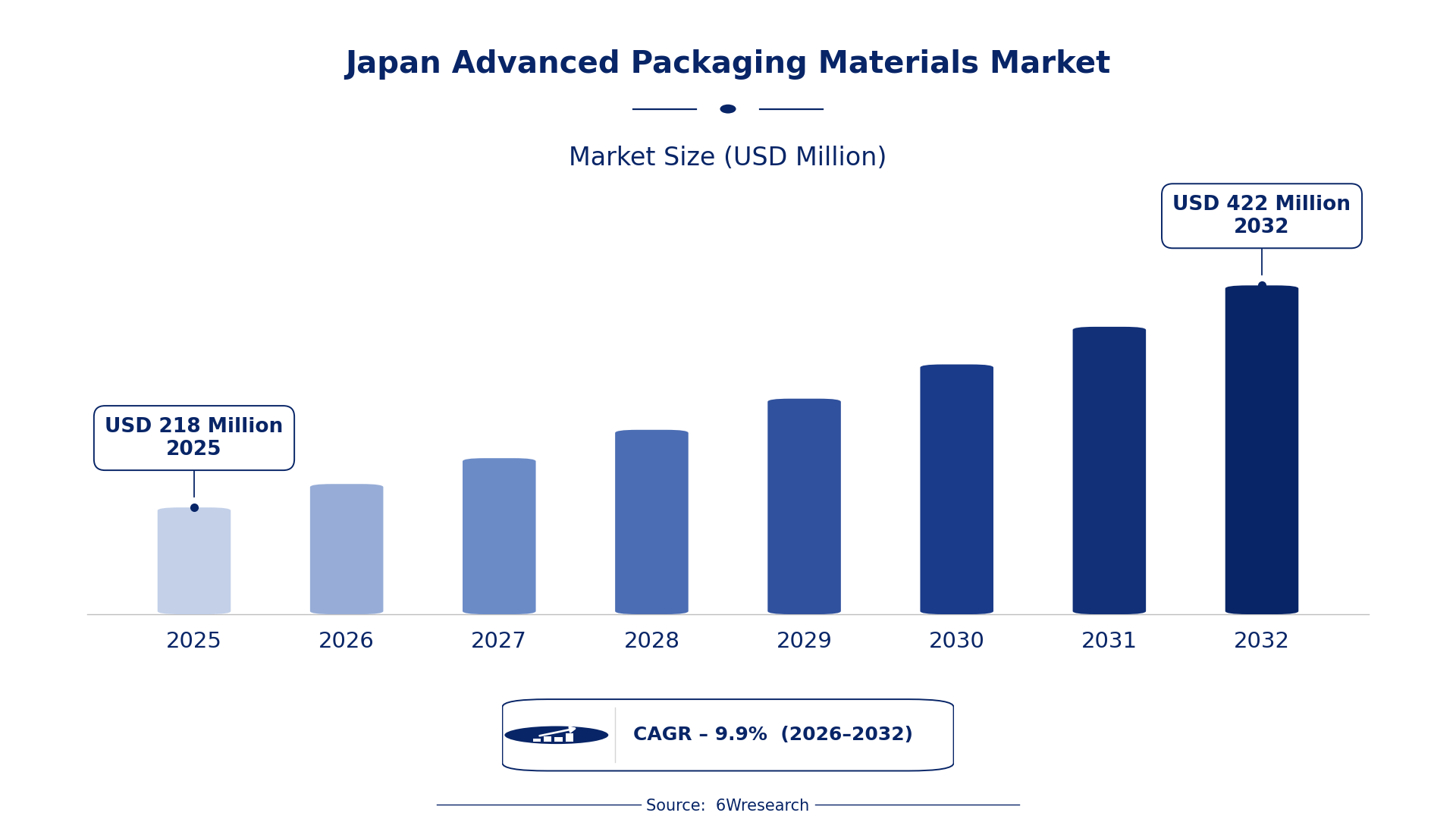
According to 6Wresearch internal database and industry insights, the Japan Advanced Packaging Materials Market was valued at USD 218 Million in 2025 and is projected to reach USD 422 Million by 2032, growing at a CAGR of approximately 9.9% during 2026–2032.
Japan Advanced Packaging Materials Market Highlights
| Report Metric | Details |
| Report Name | Japan Advanced Packaging Materials Market (2026-2032) |
| Market Size 2025 | USD 218 Million |
| Market Size 2032 | USD 422 Million |
| Absolute Growth 2025–2032 | USD 204 Million |
| CAGR 2026–2032 | 9.9% |
| Peak Annual Growth | 10.6% in 2027 |
| Forecast Period | 2026–2032 |
| Historical Data | 2022–2025 |
| Base Year | 2025 |
| Leading Advanced Packaging Materials Market, 2025 | Barrier Films (40% share) |
| Leading Material Type, 2025 | Multilayer Films (33% share) |
| Leading Application Area, 2025 | Food Packaging (34% share) |
| Leading Feature Type, 2025 | Moisture Resistance (45% share) |
| Leading End User, 2025 | FMCG Sector (42% share) |
| Fastest-Growing Advanced Packaging Materials Market | Biodegradable Polymers (14.5% CAGR) |
| Fastest-Growing Material Type | PLA (14.7% CAGR) |
| Fastest-Growing Application Area | Retail & Grocery Packs (12.0% CAGR) |
| Fastest-Growing Feature Type | Eco-Friendly (13.8% CAGR) |
| Fastest-Growing End User | Sustainable Brands (13.4% CAGR) |
| Growing Sector | Food Packaging |
| Key End Users | FMCG Sector, Healthcare Suppliers, Sustainable Brands |
Japan Advanced Packaging Materials Market Year-wise Growth Rate and Key Drivers (2022–2032)
This graph illustrates the annual growth rates of the market from 2022 to 2032, highlighting a steady upward trajectory and projected market expansion over the forecast period.
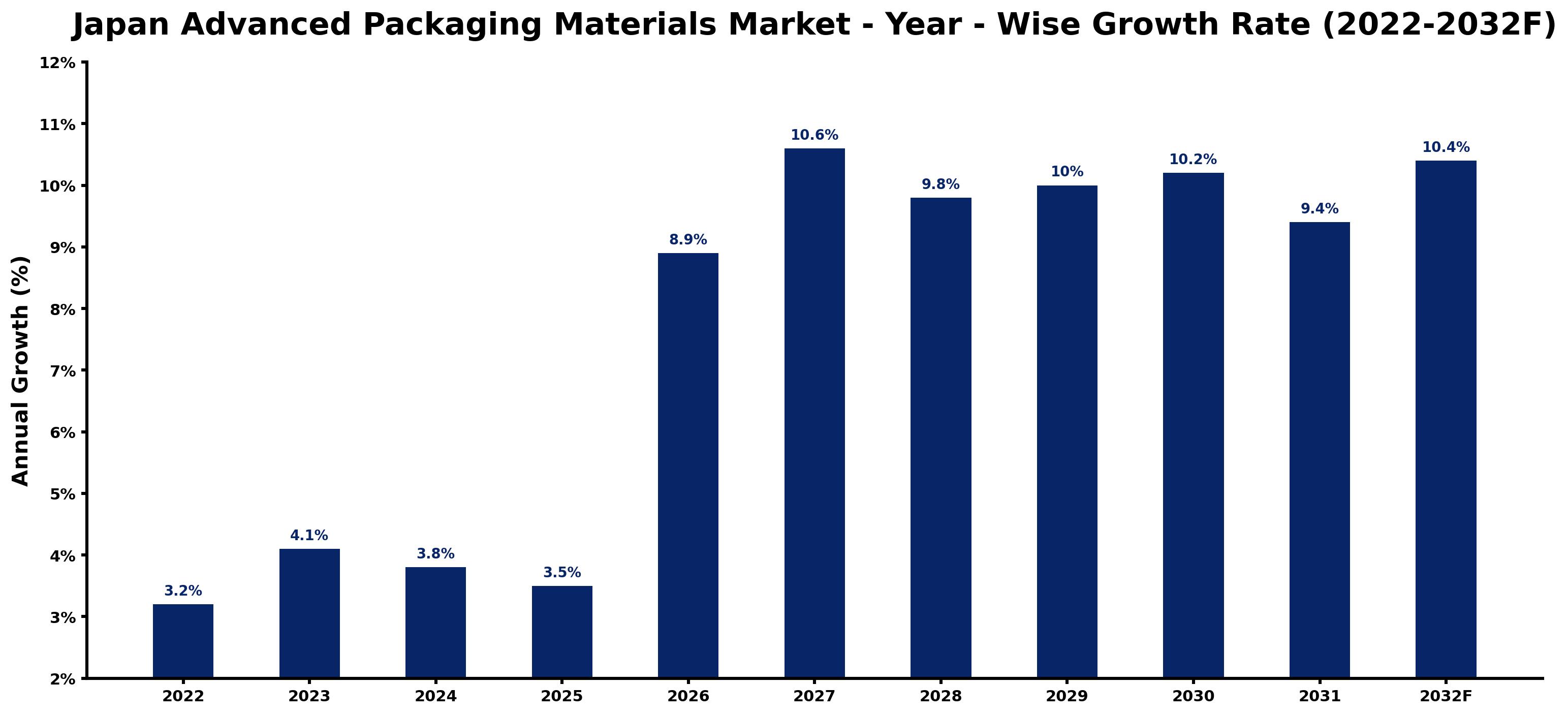
Year by year, the estimates below pair each growth rate with the development that shaped it.
| Year | Estimated Annual Growth (%) | Market Rationale |
| 2022 | 3.2 | The market showed steady growth, driven by increasing demand for sustainable packaging solutions. |
| 2023 | 4.1 | Demand rose due to heightened focus on eco-friendly materials and innovations in packaging technology. |
| 2024 | 3.8 | Growth slowed as manufacturers adjusted to new regulations and market conditions. |
| 2025 | 3.5 | Market expansion continued, supported by investments in advanced packaging technologies and materials. |
| 2026 | 8.9 | Growth is expected to accelerate as the FMCG sector increases its reliance on advanced packaging solutions. |
| 2027 | 10.6 | The peak growth year will be driven by substantial investments in sustainable packaging initiatives. |
| 2028 | 9.8 | Growth is projected to slow slightly as market saturation begins to impact new product introductions. |
| 2029 | 10.0 | Demand is expected to surge again as consumer preferences shift towards eco-friendly packaging options. |
| 2030 | 10.2 | Continued growth will be bolstered by the aging population's needs in healthcare packaging. |
| 2031 | 9.4 | Market growth will decelerate as competition intensifies among packaging material suppliers. |
| 2032 | 10.4 | Demand is expected to rise again, driven by advancements in nanotechnology for packaging. |
Note: Market size estimations and growth projections presented in this report are based on 6Wresearch's proprietary forecasting methodology, utilizing the latest available industry data, government publications, and primary research inputs.
Japan Advanced Packaging Materials Market Synopsis
Advanced Packaging Materials protect and preserve products through the use of advanced polymers and coatings. The Japan Advanced Packaging Materials Market is set to expand, driven primarily by the food packaging segment, which constitutes around 40% of the market. Japan's goal to reduce plastic waste by 25% by 2030 and the rising investment in sustainable packaging solutions are key factors supporting this growth. With a population of approximately 126 million, the demand for creative packaging solutions remains robust across multiple sectors.
Market Dynamics Impact Analysis (2026–2032)
| Factor | Type | Impact | Primary Segment Affected |
| Growing focus on sustainability and eco-friendly materials | Driver | High | Biodegradable Polymers |
| Increased demand from the FMCG sector for advanced packaging solutions | Driver | High | FMCG Sector |
| Rising investments in R&D for innovative packaging technologies | Opportunity | High | Nanomaterials for Packaging |
| Expansion of the healthcare sector requiring reliable packaging solutions | Opportunity | High | Pharma Packaging |
| Challenges in sourcing sustainable raw materials | Restraint | Medium | Biodegradable Polymers |
| Regulatory pressures on plastic usage and waste management | Restraint | High | Barrier Films |
| High production costs for advanced materials | Challenge | High | Nanomaterials for Packaging |
| Intense competition among packaging suppliers | Challenge | Medium | Barrier Films |
Evaluation of Drivers in Japan Advanced Packaging Materials Market (2026–2032)
The table below links each growth driver to the segment it affects and the evidence for it.
| Drivers | Primary Segment Affected | Why It Matters (Evidence) |
| Investment in sustainable packaging technologies | Biodegradable Polymers | Japan's GX Basic Policy targets JPY 150 trillion in decarbonisation investment, driving demand for eco-friendly materials. |
| Rising demand from the FMCG sector | FMCG Sector | The FMCG sector accounts for 42% of the market, increasing purchases of advanced packaging solutions. |
| Growing healthcare sector needs | Pharma Packaging | The healthcare sector's growth leads to increased demand for reliable and safe packaging solutions. |
| Technological advancements in packaging materials | Nanomaterials for Packaging | Nanomaterials improve protection, with increasing use in electronics packaging for sensitive components. |
| Regulatory support for sustainable practices | Barrier Films | Japan's Green Growth Strategy promotes the use of eco-friendly materials in packaging. |
Most of the extra volume comes from Japan's packaging industry, valued at over 1 trillion yen, which is seeing increased demand for sustainable solutions. The healthcare sector, projected to grow, necessitates reliable packaging for medical products. Investment targeting JPY 150 trillion supports the shift towards eco-friendly options. The FMCG sector, accounting for 42% of the market, drives purchases of advanced packaging materials. Technological advancements in nanomaterials improve protection for electronics packaging, further boosting demand.
Evaluation of Restraints in Japan Advanced Packaging Materials Market
These are the pressures that could keep growth below its potential.
| Market Restraint | Primary Segment Affected | Why It Matters (Evidence) |
| High production costs for advanced materials | Nanomaterials for Packaging | Production costs remain high, limiting accessibility for smaller manufacturers in the market. |
| Sourcing challenges for sustainable raw materials | Biodegradable Polymers | Limited availability of eco-friendly materials affects production capabilities and pricing. |
| Regulatory pressures on plastic usage | Barrier Films | Regulations on plastic waste management impose additional compliance costs on manufacturers. |
| Market saturation in certain packaging segments | Barrier Films | Increased competition has led to price wars, affecting profit margins for suppliers. |
| Technological limitations in material performance | Nanomaterials for Packaging | Some advanced materials may not meet performance standards, hindering market growth. |
Japan Advanced Packaging Materials Market Challenges
Advanced Packaging Materials encounter a notable technology gap, as numerous producers find it challenging to implement advanced polymers, resulting in product launches being delayed by up to six months for suppliers. Supply chain disruptions frequently occur, particularly in sourcing biodegradable polymers, leading to a cost increase of about 15% for manufacturers. Competition intensifies as new entrants explore alternative materials, compelling established players to lower prices, which may reduce profit margins by 10% for producers. Skills shortages in material science hinder innovation, causing missed opportunities for hospitals to adopt improved packaging solutions that enhance product safety.
Trends in the Japan Advanced Packaging Materials Market
Several trends are reshaping the Japan Advanced Packaging Materials Market; the most important are set out below.
- Shift towards Eco-Friendly Packaging Solutions: Beginning in 2023, a clear shift towards eco-friendly packaging materials has emerged, driven by consumer preferences. Japan's initiatives to reduce plastic waste by 25% by 2030 are prompting manufacturers to embrace sustainable practices.
- Transition from Conventional to Advanced Materials: In 2023, the uptake of advanced polymers and coatings in packaging has risen, enhancing product protection. This trend is particularly evident in the food packaging segment, which comprises around 40% of the market.
- Emergence of Biodegradable Polymers: The adoption of biodegradable polymers such as PLA and PHA has gained momentum, with a projected CAGR of 14.5% from 2026 to 2032. This transition aligns with Japan's sustainability objectives, drawing investment into eco-friendly packaging.
- Growing Demand for Nanomaterials in Electronics Packaging: The electronics packaging market is increasingly integrating nanomaterials for enhanced protection, with substantial growth anticipated. This trend is propelled by the semiconductor industry, which requires specialised packaging solutions.
Investment Opportunities in the Japan Advanced Packaging Materials Market
Where to invest in the Japan Advanced Packaging Materials Market: the main openings are set out below.
- Partnerships for Sustainable Packaging Solutions: Exploring joint ventures with local suppliers to develop biodegradable packaging is essential. The FMCG sector is actively seeking sustainable options, presenting a timely opportunity for collaboration.
- Investment in Advanced Packaging Technologies: With a focus on innovation, suppliers can invest in R&D for nanomaterials. The healthcare sector's growth offers a substantial market for advanced packaging solutions, making it a prime target for investment.
- Supply of Eco-Friendly Packaging Materials: Now is the time to supply biodegradable polymers to meet increasing demand. Sustainable brands are increasingly looking for eco-friendly packaging solutions, creating a valuable opportunity for suppliers.
- Certification for Sustainable Practices: Obtaining certifications like ISO 14001 can enhance market credibility. The Japan Packaging Institute supports advancements in packaging standards, making it easier for suppliers to enter the market.
Government Initiatives in the Japan Advanced Packaging Materials Market
The Green Growth Strategy Through Achieving Carbon Neutrality in 2050, revised in 2021, builds on earlier environmental laws by setting clear targets for reducing greenhouse gas emissions. This strategy promotes the adoption of advanced packaging materials that align with sustainability objectives, encouraging innovation in the sector.
The Japan Packaging Institute plays a crucial role in enforcing the Food Sanitation Act by guiding manufacturers. This agency aids businesses in adopting eco-friendly practices, ensuring compliance with regulations and boosting market competitiveness.
Future Insight of the Japan Advanced Packaging Materials Market
Nanotechnology will transform demand for Advanced Packaging Materials by 2032, improving product protection and sustainability. Japan's ambitious decarbonisation investments will accelerate the transition to eco-friendly packaging solutions, supporting the target to reduce plastic waste by 25%. The healthcare sector will see an increase in packaging requirements due to the aging population, with the pharmaceutical packaging market expected to grow steadily. Regulatory frameworks will increasingly favour sustainable practices, compelling suppliers to innovate and align with emerging market standards.
Market Segmentation Analysis
Japan Advanced Packaging Materials Market report covers a detailed analysis of the following market segments:
By Advanced Packaging Materials Market – Barrier Films Lead, Biodegradable Polymers Expected to Grow Fastest
According to Saurav Kr Singh, Senior Research Analyst at 6Wresearch, Barrier Films took 40% of advanced packaging materials market revenue in 2025, more than any other category. Barrier Films hold the largest market share due to their essential role in protecting products from moisture and oxygen, which is critical for maintaining product integrity. The food packaging sector exemplifies their importance, as it heavily relies on these films to ensure freshness and safety. The quickest growth will come from Biodegradable Polymers, forecast to expand at a CAGR of 14.5% between 2026 and 2032. The Biodegradable Polymers segment is experiencing rapid growth as consumers and businesses increasingly prefer sustainable packaging solutions, particularly with Japan's target to reduce plastic waste by 25% by 2030. This shift reflects a significant change towards environmentally responsible practices in the market. Suppliers must focus on developing biodegradable options to meet the rising consumer demand for sustainable packaging.
By Material Type – Multilayer Films Lead, PLA Expected to Grow Fastest
The largest material type category in 2025 was Multilayer Films, at 33% of revenue. Multilayer Films lead the market because they provide superior protection across various applications, making them essential in industries like food and electronics. Their versatility ensures they are widely used throughout the packaging sector, catering to diverse needs. PLA is projected to grow fastest, at a CAGR of 14.7% during 2026–2032. PLA is gaining momentum as it serves as a biodegradable alternative, aligning with Japan's environmental goals and the increasing demand for sustainable packaging. This trend is evident as more businesses strive to comply with eco-friendly regulations. Buyers should prioritise sourcing multilayer films and PLA to enhance their product offerings and meet sustainability standards.
By Application Area – Food Packaging Leads, Retail & Grocery Packs Expected to Grow Fastest
With 34% of application area revenue in 2025, Food Packaging was the largest category. Food Packaging is the leading application area, accounting for approximately 40% of the market, as it is critical for preserving food quality and safety. The high demand for fresh and safe food products drives this segment's dominance. Retail & Grocery Packs are set to record the highest CAGR in this split, 12.0% over 2026–2032. Retail & Grocery Packs are growing rapidly, driven by the increasing need for efficient packaging solutions in consumer goods. This trend is supported by the rise in e-commerce and the demand for convenient packaging options. Suppliers need to innovate in retail and grocery packaging to capture the expanding market opportunities.
By Feature Type – Moisture Resistance Leads, Eco-Friendly Expected to Grow Fastest
Moisture Resistance accounted for 45% of the market by feature type in 2025. Moisture Resistance is the top feature type, vital for extending the shelf life of products in sectors such as food and pharmaceuticals. This characteristic is crucial for maintaining product quality during storage and distribution, ensuring consumer satisfaction. Over 2026–2032, Eco-Friendly is expected to post the fastest growth, at a CAGR of 13.8%. Eco-Friendly features are increasingly in demand as both consumers and businesses seek sustainable packaging solutions that align with environmental objectives. This trend is reinforced by regulatory frameworks encouraging the adoption of eco-friendly materials in packaging. Suppliers need to concentrate on developing moisture-resistant and eco-friendly materials to meet market expectations.
By End User – FMCG Sector Leads, Sustainable Brands Expected to Grow Fastest
FMCG Sector held 42% of the Japan Advanced Packaging Materials Market by end user in 2025. The FMCG Sector is the largest end user, being a major consumer of advanced packaging materials due to the high volume of products that require effective packaging solutions. The sector's continuous growth ensures sustained demand for these materials. The quickest growth will come from Sustainable Brands, forecast to expand at a CAGR of 13.4% between 2026 and 2032. Sustainable Brands are the fastest-growing end user, as they drive demand for eco-friendly packaging solutions in response to consumer preferences for sustainability. This trend is likely to accelerate as more brands commit to environmental responsibility. Suppliers must adapt to the needs of sustainable brands to remain competitive in the market.
Key Attractiveness of the Report
- 10 Years of Market Numbers
- Historical Data Starting from 2022 to 2025
- Base Year 2025
- Forecast Data until 2032
- Key Performance Indicators Impacting the Market
- Major Upcoming Developments and Projects
Key Highlights of the Report:
- Japan Advanced Packaging Materials Market Outlook
- Market Size of Japan Advanced Packaging Materials Market, 2025
- Forecast of Japan Advanced Packaging Materials Market, 2032
- Historical Data and Forecast of Japan Advanced Packaging Materials Revenues & Volume for the Period 2022-2032F
- Japan Advanced Packaging Materials Market Trend Evolution
- Japan Advanced Packaging Materials Market Drivers and Challenges
- Japan Advanced Packaging Materials Price Trends
- Japan Advanced Packaging Materials Porter's Five Forces
- Japan Advanced Packaging Materials Industry Life Cycle
- Historical Data and Forecast of Japan Advanced Packaging Materials Market Revenues & Volume By Advanced Packaging Materials Market for the Period 2022-2032F
- Historical Data and Forecast of Japan Advanced Packaging Materials Market Revenues & Volume By Barrier Films for the Period 2022-2032F
- Historical Data and Forecast of Japan Advanced Packaging Materials Market Revenues & Volume By Biodegradable Polymers for the Period 2022-2032F
- Historical Data and Forecast of Japan Advanced Packaging Materials Market Revenues & Volume By Anti-Counterfeit Labels for the Period 2022-2032F
- Historical Data and Forecast of Japan Advanced Packaging Materials Market Revenues & Volume By Nanomaterials for Packaging for the Period 2022-2032F
- Historical Data and Forecast of Japan Advanced Packaging Materials Market Revenues & Volume By Material Type for the Period 2022-2032F
- Historical Data and Forecast of Japan Advanced Packaging Materials Market Revenues & Volume By Multilayer Films for the Period 2022-2032F
- Historical Data and Forecast of Japan Advanced Packaging Materials Market Revenues & Volume By PLA, PHA for the Period 2022-2032F
- Historical Data and Forecast of Japan Advanced Packaging Materials Market Revenues & Volume By Security Inks for the Period 2022-2032F
- Historical Data and Forecast of Japan Advanced Packaging Materials Market Revenues & Volume By Nano-Coatings for the Period 2022-2032F
- Historical Data and Forecast of Japan Advanced Packaging Materials Market Revenues & Volume By Application Area for the Period 2022-2032F
- Historical Data and Forecast of Japan Advanced Packaging Materials Market Revenues & Volume By Food Packaging for the Period 2022-2032F
- Historical Data and Forecast of Japan Advanced Packaging Materials Market Revenues & Volume By Retail & Grocery Packs for the Period 2022-2032F
- Historical Data and Forecast of Japan Advanced Packaging Materials Market Revenues & Volume By Pharma Packaging for the Period 2022-2032F
- Historical Data and Forecast of Japan Advanced Packaging Materials Market Revenues & Volume By Electronics Packaging for the Period 2022-2032F
- Historical Data and Forecast of Japan Advanced Packaging Materials Market Revenues & Volume By Feature Type for the Period 2022-2032F
- Historical Data and Forecast of Japan Advanced Packaging Materials Market Revenues & Volume By Moisture Resistance for the Period 2022-2032F
- Historical Data and Forecast of Japan Advanced Packaging Materials Market Revenues & Volume By Eco-Friendly for the Period 2022-2032F
- Historical Data and Forecast of Japan Advanced Packaging Materials Market Revenues & Volume By Tamper-Proof for the Period 2022-2032F
- Historical Data and Forecast of Japan Advanced Packaging Materials Market Revenues & Volume By Heat Dissipation for the Period 2022-2032F
- Historical Data and Forecast of Japan Advanced Packaging Materials Market Revenues & Volume By End User for the Period 2022-2032F
- Historical Data and Forecast of Japan Advanced Packaging Materials Market Revenues & Volume By FMCG Sector for the Period 2022-2032F
- Historical Data and Forecast of Japan Advanced Packaging Materials Market Revenues & Volume By Sustainable Brands for the Period 2022-2032F
- Historical Data and Forecast of Japan Advanced Packaging Materials Market Revenues & Volume By Healthcare Suppliers for the Period 2022-2032F
- Historical Data and Forecast of Japan Advanced Packaging Materials Market Revenues & Volume By Semiconductor Companies for the Period 2022-2032F
- Japan Advanced Packaging Materials Import Export Trade Statistics
- Market Opportunity Assessment By Advanced Packaging Materials Market
- Market Opportunity Assessment By Material Type
- Market Opportunity Assessment By Application Area
- Market Opportunity Assessment By Feature Type
- Market Opportunity Assessment By End User
- Japan Advanced Packaging Materials Top Companies Market Share
- Japan Advanced Packaging Materials Competitive Benchmarking By Technical and Operational Parameters
- Japan Advanced Packaging Materials Company Profiles
- Japan Advanced Packaging Materials Key Strategic Recommendations
Market Covered
Coverage by segment is as follows.
By Advanced Packaging Materials Market
- Barrier Films
- Biodegradable Polymers
- Anti-Counterfeit Labels
- Nanomaterials for Packaging
By Material Type
- Multilayer Films
- PLA
- PHA
- Security Inks
- Nano-Coatings
By Application Area
- Food Packaging
- Retail & Grocery Packs
- Pharma Packaging
- Electronics Packaging
By Feature Type
- Moisture Resistance
- Eco-Friendly
- Tamper-Proof
- Heat Dissipation
By End User
- FMCG Sector
- Sustainable Brands
- Healthcare Suppliers
- Semiconductor Companies































