Japan Advanced Radiotherapy Market Size & Growth Rate
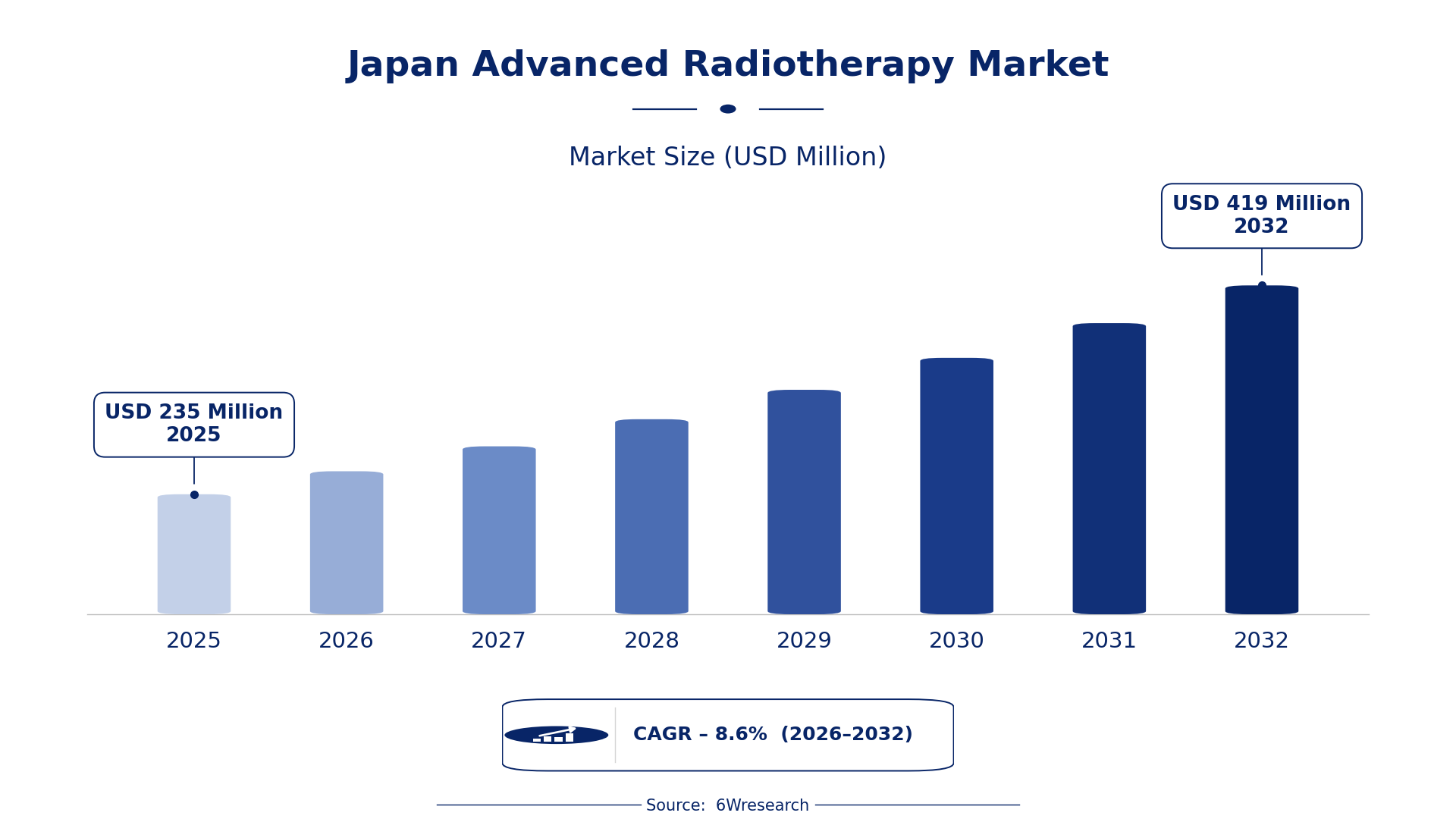
According to 6Wresearch internal database and industry insights, the Japan Advanced Radiotherapy Market was valued at USD 235 Million in 2025 and is projected to reach USD 419 Million by 2032, growing at a CAGR of approximately 8.6% during 2026–2032.
Japan Advanced Radiotherapy Market Highlights
| Report Metric | Details |
| Report Name | Japan Advanced Radiotherapy Market (2026-2032) |
| Market Size 2025 | USD 235 Million |
| Market Size 2032 | USD 419 Million |
| Absolute Growth 2025–2032 | USD 184 Million |
| CAGR 2026–2032 | 8.6% |
| Peak Annual Growth | 9.8% in 2028 |
| Forecast Period | 2026–2032 |
| Historical Data | 2022–2025 |
| Base Year | 2025 |
| Leading Advanced Radiotherapy Market, 2025 | Proton Beam Therapy (39% share) |
| Leading Therapy Type, 2025 | Particle Therapy (36% share) |
| Leading Technology Used, 2025 | Cyclotron Accelerator (38% share) |
| Leading Delivery Method, 2025 | External Beam (39% share) |
| Leading End User, 2025 | Oncology Hospitals (36% share) |
| Fastest-Growing Advanced Radiotherapy Market | Image-Guided Radiotherapy (IGRT) (11.4% CAGR) |
| Fastest-Growing Technology Used | Real-Time Imaging (12.1% CAGR) |
| Fastest-Growing Delivery Method | Precision Mapping (11.9% CAGR) |
| Fastest-Growing End User | Cancer Treatment Centers (10.7% CAGR) |
| Growing Sector | Oncology Hospitals |
| Key End Users | Oncology Hospitals, Cancer Treatment Centers, Specialized Clinics |
Japan Advanced Radiotherapy Market Year-wise Growth Rate and Key Drivers (2022–2032)
This graph illustrates the annual growth rates of the market from 2022 to 2032, highlighting a steady upward trajectory and projected market expansion over the forecast period.
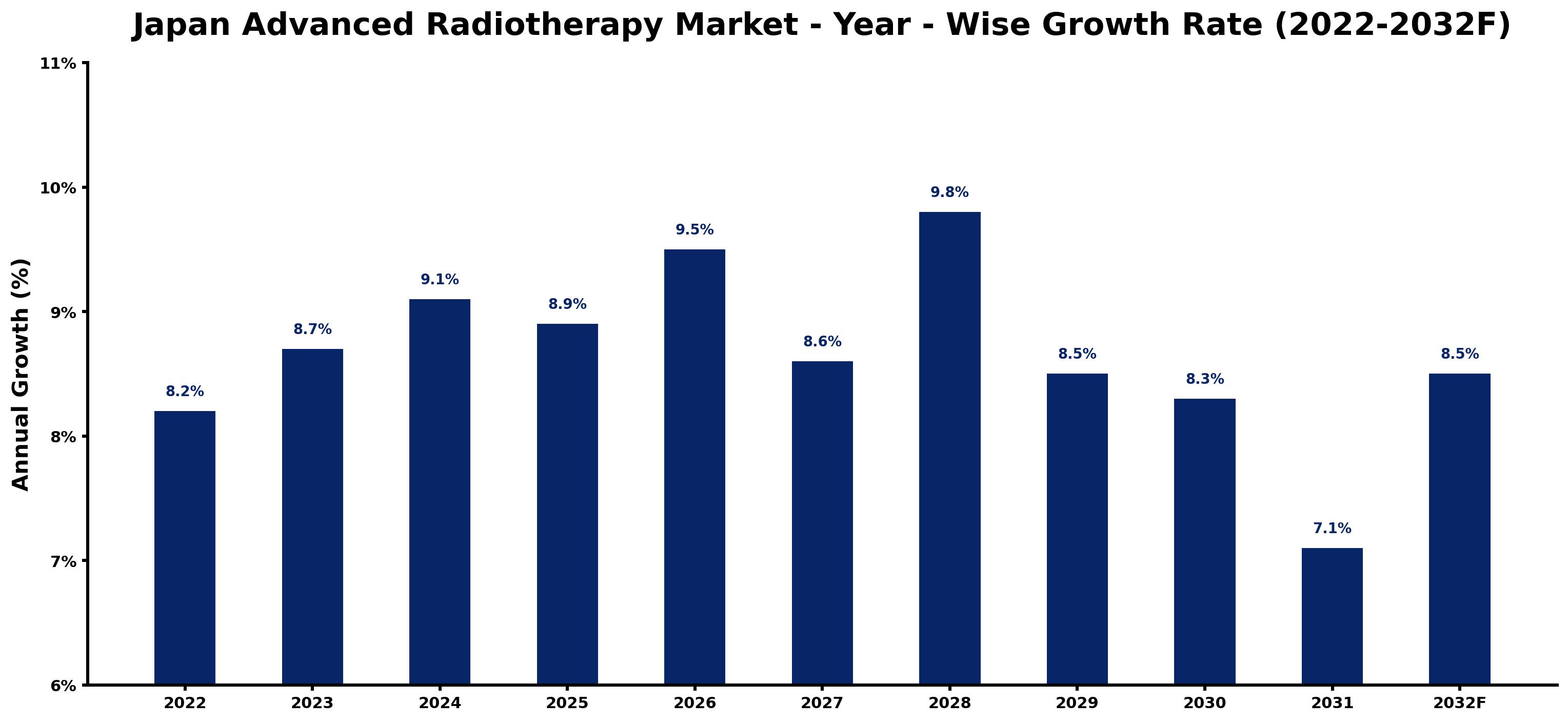
The table below sets out the estimated growth rate for each year and the main factor behind it.
| Year | Estimated Annual Growth (%) | Market Rationale |
| 2022 | 8.2 | The market showed steady growth with increasing healthcare investments and technological advancements. |
| 2023 | 8.7 | Demand rose as oncology hospitals adopted advanced technologies for cancer treatment. |
| 2024 | 9.1 | Growth accelerated due to heightened awareness and improved treatment protocols across facilities. |
| 2025 | 8.9 | A slight slowdown occurred as market expansion began to stabilise following rapid increases. |
| 2026 | 9.5 | Investment in new technologies and facilities is expected to drive growth faster than the previous year. |
| 2027 | 8.6 | Growth is projected to slow again as the market adjusts to increased capacity and competition. |
| 2028 | 9.8 | A peak in growth is anticipated as advanced techniques gain traction among healthcare providers. |
| 2029 | 8.5 | The market is expected to experience a slowdown as saturation in some regions begins to set in. |
| 2030 | 8.3 | Continued growth will persist, but at a slower rate as the market stabilises further. |
| 2031 | 7.1 | Growth is projected to slow as the market matures and competition intensifies among providers. |
| 2032 | 8.5 | An uptick in demand is expected as new treatment facilities come online and technology evolves. |
Note: Market size estimations and growth projections presented in this report are based on 6Wresearch's proprietary forecasting methodology, utilizing the latest available industry data, government publications, and primary research inputs.
Japan Advanced Radiotherapy Market Synopsis
Advanced radiotherapy employs high-energy radiation to treat cancer, utilising technologies like cyclotron accelerators and imaging systems. The Japan Advanced Radiotherapy Market is expanding due to rising cancer rates, with a substantial portion of patients undergoing radiotherapy. Key drivers include increased investments in healthcare facilities and the implementation of the JIS Z 8401 standard for radiation safety, which improves treatment quality and accessibility across oncology hospitals and cancer treatment centers.
Market Dynamics Impact Analysis (2026–2032)
| Factor | Type | Impact | Primary Segment Affected |
| Increasing investments in healthcare infrastructure | Driver | High | Proton Beam Therapy |
| Growing adoption of advanced technologies in cancer treatment | Driver | High | Proton Beam Therapy |
| Expansion of oncology hospitals and treatment centers | Opportunity | High | Oncology Hospitals |
| Rising patient population requiring advanced treatment options | Opportunity | High | Cancer Treatment Centers |
| High initial costs of advanced radiotherapy equipment | Restraint | Medium | Proton Beam Therapy |
| Limited availability of trained professionals for advanced procedures | Restraint | Medium | Stereotactic Radiosurgery (SRS) |
| Competition among healthcare providers | Challenge | High | Oncology Hospitals |
| Technological obsolescence of existing equipment | Challenge | Medium | Image-Guided Radiotherapy (IGRT) |
Evaluation of Drivers in Japan Advanced Radiotherapy Market (2026–2032)
These are the developments adding the most demand over the forecast period.
| Drivers | Primary Segment Affected | Why It Matters (Evidence) |
| Investment in healthcare infrastructure | Oncology Hospitals | Japan has over 100 oncology hospitals equipped with advanced radiotherapy technologies, increasing treatment capacity. |
| Technological advancements in radiotherapy | Cyclotron Accelerator | The installed base of cyclotron accelerators is estimated at 30 units, improving treatment precision. |
| Growing cancer patient population | Cancer Treatment Centers | Approximately 40% of cancer patients in Japan receive radiotherapy, driving demand for advanced treatment options. |
| Implementation of radiation safety standards | Proton Beam Therapy | The JIS Z 8401 standard for radiation safety boosts confidence in treatment efficacy and safety. |
| Increased funding for cancer research | Oncology Hospitals | In 2023, ¥5 billion was allocated for cancer research and treatment initiatives, supporting advanced technologies. |
Much of the new demand traces back to increased investments in healthcare infrastructure, with over 100 oncology hospitals equipped with advanced radiotherapy technologies. The implementation of the JIS Z 8401 standard for radiation safety boosts confidence among healthcare providers. The growing cancer patient population, with a significant percentage receiving radiotherapy, drives demand for efficient treatment options.
Evaluation of Restraints in Japan Advanced Radiotherapy Market
These restraints slow adoption and weigh on supplier margins.
| Market Restraint | Primary Segment Affected | Why It Matters (Evidence) |
| High initial costs of advanced equipment | Proton Beam Therapy | Advanced radiotherapy systems require substantial upfront investments, limiting access for some facilities. |
| Limited availability of trained professionals | Stereotactic Radiosurgery (SRS) | A shortage of specialists trained in advanced techniques hampers the growth of treatment options. |
| Regulatory hurdles for new technologies | Image-Guided Radiotherapy (IGRT) | Stringent regulations can delay the introduction of new radiotherapy solutions in the market. |
| Market saturation in urban areas | Oncology Hospitals | High competition in metropolitan regions leads to diminished growth potential for existing facilities. |
| Technological obsolescence of existing systems | Proton Beam Therapy | Rapid advancements in technology may render older systems less effective, impacting purchasing decisions. |
Japan Advanced Radiotherapy Market Challenges
Buyers in oncology hospitals encounter delays due to outdated imaging systems, which can extend treatment times by 20%, thereby reducing patient throughput. Technology gaps remain as many facilities lack access to the latest cyclotron accelerators, resulting in procurement costs that can exceed ¥500 million for timely upgrades. Supply chain limitations arise from reliance on imported components, leading to equipment delivery delays that can postpone treatments for weeks. Competition among treatment centres intensifies as they allocate funds to marketing instead of service improvements, diverting resources from critical patient care initiatives.
Trends in the Japan Advanced Radiotherapy Market
The trends below show where the Japan Advanced Radiotherapy Market is heading.
- Shift towards Real-Time Imaging Technologies: Tokyo and Osaka are leading the adoption of real-time imaging technologies, with 70% of treatment centers implementing these systems to improve accuracy in tumor localization.
- Increase in Proton Beam Therapy Facilities: In 2023, Japan saw a rise in proton beam therapy facilities, with 30 units installed, reflecting a growing preference for precise tumor targeting.
- Expansion of Brachytherapy for Prostate Cancer: Brachytherapy is increasingly used in specialized clinics for prostate cancer treatment, showcasing a shift towards localized treatment methods.
- Adoption of Precision Mapping Techniques: With a growing focus on treatment accuracy, precision mapping technologies are being integrated into 39% of external beam delivery methods.
Investment Opportunities in the Japan Advanced Radiotherapy Market
Investors looking at the Japan Advanced Radiotherapy Market should consider the following areas.
- Oncology Hospitals seeking advanced treatment options: With a growing patient population, oncology hospitals require more advanced radiotherapy solutions, presenting a market opportunity worth ¥5 billion in funding for new technologies.
- Cancer Treatment Centers expanding service offerings: The increasing number of cancer patients creates a gap for advanced treatment options, encouraging investment in new facilities and technologies.
- Partnerships for advanced technology integration: Local partnerships can facilitate the introduction of new technologies in treatment centers, improving service delivery and patient outcomes.
- Supply of cyclotron accelerators and imaging systems: The demand for cyclotron accelerators is rising, driven by the need for precise treatment, providing opportunities for suppliers in this niche.
Government Initiatives in the Japan Advanced Radiotherapy Market
The AI Promotion Act, established in 2025, aims to create a national framework for AI in healthcare, improving the efficiency of advanced radiotherapy systems. This complements existing laws like the JIS Z 8401 standard, which ensures radiation safety in medical applications.
In 2023, the Ministry of Health allocated ¥5 billion for cancer research initiatives, administered by the Japanese Society for Therapeutic Radiology and Oncology, which promotes advancements in radiotherapy technologies and improves treatment accessibility across the country.
Future Insight of the Japan Advanced Radiotherapy Market
Policy-driven shifts will transform cancer treatment accessibility, prompting hospitals to invest in advanced imaging technologies by 2032. The government’s allocation of ¥5 billion for cancer research will stimulate innovation in treatment methods, improving patient outcomes. As facilities upgrade their equipment, approximately 30 cyclotron accelerators will be operational, enhancing treatment precision. This evolution will create opportunities for suppliers to provide advanced radiotherapy equipment and training programmes, aligning with the growing demand from healthcare providers.
Market Segmentation Analysis
Japan Advanced Radiotherapy Market report covers a detailed analysis of the following market segments:
By Advanced Radiotherapy Market – Proton Beam Therapy Leads, Image-Guided Radiotherapy (IGRT) Expected to Grow Fastest
According to Saurav Kr Singh, Senior Research Analyst at 6Wresearch, with 39% of advanced radiotherapy market revenue in 2025, Proton Beam Therapy was the largest category. Proton Beam Therapy holds the largest share due to its precision in targeting tumours while minimising damage to surrounding tissues, making it a preferred choice in over 100 oncology hospitals across Japan. This technology aligns with the country's commitment to high-quality cancer care, as evidenced by the recent government initiatives to enhance treatment accessibility. The quickest growth will come from Image-Guided Radiotherapy (IGRT), forecast to expand at a CAGR of 11.4% between 2026 and 2032. Image-Guided Radiotherapy (IGRT) is experiencing rapid growth as it significantly improves accuracy in tumour localisation during treatment, which is crucial for effective cancer management. The increasing adoption of real-time imaging technologies in 70% of treatment centres supports this trend, ensuring better patient outcomes. Suppliers should focus on developing advanced imaging technologies to meet the growing demand for precision in radiotherapy.
By Therapy Type – Particle Therapy Leads and Records the Fastest Growth
In 2025, Particle Therapy led the therapy type split with a 36% share. Particle Therapy dominates the market as it utilises charged particles for targeted cancer treatment, which is particularly effective for various tumour types. With a strong installed base and increasing clinical applications, this method is becoming a standard in oncology practices across Japan. Particle Therapy is also forecast to expand faster than any other category, at a CAGR of 11.3% over 2026–2032. Particle Therapy is also the fastest-growing segment, driven by advancements in technology and increasing recognition of its effectiveness in treating complex cancers. The ongoing research and government funding for cancer treatment initiatives further bolster its expansion in the market. Buyers will benefit from enhanced treatment options as suppliers innovate in particle therapy technologies.
By Technology Used – Cyclotron Accelerator Leads, Real-Time Imaging Expected to Grow Fastest
The largest technology used category in 2025 was Cyclotron Accelerator, at 38% of revenue. Cyclotron Accelerator leads the segment as it provides protons essential for advanced radiotherapy, ensuring high-quality treatment in oncology hospitals. Its established presence in the market, with an estimated 30 units installed, reinforces its critical role in cancer care. Real-Time Imaging is projected to grow fastest, at a CAGR of 12.1% during 2026–2032. Real-Time Imaging is witnessing the fastest growth due to its ability to track tumour movement during treatment, which is vital for improving treatment accuracy. The integration of this technology into 70% of treatment centres indicates a strong shift towards more precise radiotherapy methods. Suppliers must invest in real-time imaging solutions to remain competitive in the advanced radiotherapy market.
By Delivery Method – External Beam Leads, Precision Mapping Expected to Grow Fastest
External Beam held 39% of the Japan Advanced Radiotherapy Market by delivery method in 2025. External Beam remains the leading delivery method for advanced radiotherapy, widely used in oncology hospitals for its effectiveness in delivering radiation from outside the body. Its established protocols and familiarity among healthcare providers contribute to its dominant position in the market. Over 2026–2032, Precision Mapping is expected to post the fastest growth, at a CAGR of 11.9%. Precision Mapping is rapidly gaining traction as it enhances targeting accuracy of radiation delivery, which is crucial for effective treatment outcomes. The increasing emphasis on personalised medicine and tailored treatment plans supports the growth of this delivery method. Buyers should seek out facilities that implement precision mapping to ensure optimal treatment efficacy.
By End User – Oncology Hospitals Lead, Cancer Treatment Centers Expected to Grow Fastest
Oncology Hospitals accounted for 36% of the market by end user in 2025. Oncology Hospitals are the primary end users of advanced radiotherapy technologies, serving as the main facilities where cancer patients receive treatment. Their extensive resources and specialised staff make them pivotal in the delivery of advanced cancer care across Japan. The quickest growth will come from Cancer Treatment Centers, forecast to expand at a CAGR of 10.7% between 2026 and 2032. Cancer Treatment Centers are the fastest-growing end user segment, as they offer comprehensive cancer care tailored to patient needs. The increasing number of these specialised facilities reflects the rising demand for targeted cancer treatments in the healthcare system. Suppliers should target cancer treatment centres to capture the growing market for specialised cancer care.
Key Attractiveness of the Report
- 10 Years of Market Numbers
- Historical Data Starting from 2022 to 2025
- Base Year 2025
- Forecast Data until 2032
- Key Performance Indicators Impacting the Market
- Major Upcoming Developments and Projects
Key Highlights of the Report:
- Japan Advanced Radiotherapy Market Outlook
- Market Size of Japan Advanced Radiotherapy Market, 2025
- Forecast of Japan Advanced Radiotherapy Market, 2032
- Historical Data and Forecast of Japan Advanced Radiotherapy Revenues & Volume for the Period 2022-2032F
- Japan Advanced Radiotherapy Market Trend Evolution
- Japan Advanced Radiotherapy Market Drivers and Challenges
- Japan Advanced Radiotherapy Price Trends
- Japan Advanced Radiotherapy Porter's Five Forces
- Japan Advanced Radiotherapy Industry Life Cycle
- Historical Data and Forecast of Japan Advanced Radiotherapy Market Revenues & Volume By Advanced Radiotherapy Market for the Period 2022-2032F
- Historical Data and Forecast of Japan Advanced Radiotherapy Market Revenues & Volume By Proton Beam Therapy for the Period 2022-2032F
- Historical Data and Forecast of Japan Advanced Radiotherapy Market Revenues & Volume By Image-Guided Radiotherapy (IGRT) for the Period 2022-2032F
- Historical Data and Forecast of Japan Advanced Radiotherapy Market Revenues & Volume By Stereotactic Radiosurgery (SRS) for the Period 2022-2032F
- Historical Data and Forecast of Japan Advanced Radiotherapy Market Revenues & Volume By Brachytherapy for the Period 2022-2032F
- Historical Data and Forecast of Japan Advanced Radiotherapy Market Revenues & Volume By Therapy Type for the Period 2022-2032F
- Historical Data and Forecast of Japan Advanced Radiotherapy Market Revenues & Volume By Particle Therapy for the Period 2022-2032F
- Historical Data and Forecast of Japan Advanced Radiotherapy Market Revenues & Volume By X-Ray/MRI Integration for the Period 2022-2032F
- Historical Data and Forecast of Japan Advanced Radiotherapy Market Revenues & Volume By High-Dose Radiation for the Period 2022-2032F
- Historical Data and Forecast of Japan Advanced Radiotherapy Market Revenues & Volume By Internal Radiation for the Period 2022-2032F
- Historical Data and Forecast of Japan Advanced Radiotherapy Market Revenues & Volume By Technology Used for the Period 2022-2032F
- Historical Data and Forecast of Japan Advanced Radiotherapy Market Revenues & Volume By Cyclotron Accelerator for the Period 2022-2032F
- Historical Data and Forecast of Japan Advanced Radiotherapy Market Revenues & Volume By Real-Time Imaging for the Period 2022-2032F
- Historical Data and Forecast of Japan Advanced Radiotherapy Market Revenues & Volume By Robotic Arm Systems for the Period 2022-2032F
- Historical Data and Forecast of Japan Advanced Radiotherapy Market Revenues & Volume By Radioactive Seeds for the Period 2022-2032F
- Historical Data and Forecast of Japan Advanced Radiotherapy Market Revenues & Volume By Delivery Method for the Period 2022-2032F
- Historical Data and Forecast of Japan Advanced Radiotherapy Market Revenues & Volume By External Beam for the Period 2022-2032F
- Historical Data and Forecast of Japan Advanced Radiotherapy Market Revenues & Volume By Precision Mapping for the Period 2022-2032F
- Historical Data and Forecast of Japan Advanced Radiotherapy Market Revenues & Volume By One-Time Focused Dose for the Period 2022-2032F
- Historical Data and Forecast of Japan Advanced Radiotherapy Market Revenues & Volume By Catheter Implantation for the Period 2022-2032F
- Historical Data and Forecast of Japan Advanced Radiotherapy Market Revenues & Volume By End User for the Period 2022-2032F
- Historical Data and Forecast of Japan Advanced Radiotherapy Market Revenues & Volume By Oncology Hospitals for the Period 2022-2032F
- Historical Data and Forecast of Japan Advanced Radiotherapy Market Revenues & Volume By Cancer Treatment Centers for the Period 2022-2032F
- Historical Data and Forecast of Japan Advanced Radiotherapy Market Revenues & Volume By Neurosurgical Units for the Period 2022-2032F
- Historical Data and Forecast of Japan Advanced Radiotherapy Market Revenues & Volume By Specialized Clinics for the Period 2022-2032F
- Japan Advanced Radiotherapy Import Export Trade Statistics
- Market Opportunity Assessment By Advanced Radiotherapy Market
- Market Opportunity Assessment By Therapy Type
- Market Opportunity Assessment By Technology Used
- Market Opportunity Assessment By Delivery Method
- Market Opportunity Assessment By End User
- Japan Advanced Radiotherapy Top Companies Market Share
- Japan Advanced Radiotherapy Competitive Benchmarking By Technical and Operational Parameters
- Japan Advanced Radiotherapy Company Profiles
- Japan Advanced Radiotherapy Key Strategic Recommendations
Market Covered
Coverage by segment is as follows.
By Advanced Radiotherapy Market
- Proton Beam Therapy
- Image-Guided Radiotherapy (IGRT)
- Stereotactic Radiosurgery (SRS)
- Brachytherapy
By Therapy Type
- Particle Therapy
- X-Ray/MRI Integration
- High-Dose Radiation
- Internal Radiation
By Technology Used
- Cyclotron Accelerator
- Real-Time Imaging
- Robotic Arm Systems
- Radioactive Seeds
By Delivery Method
- External Beam
- Precision Mapping
- One-Time Focused Dose
- Catheter Implantation
By End User
- Oncology Hospitals
- Cancer Treatment Centers
- Neurosurgical Units
- Specialized Clinics































