Japan Advanced Sensing Market Size & Growth Rate
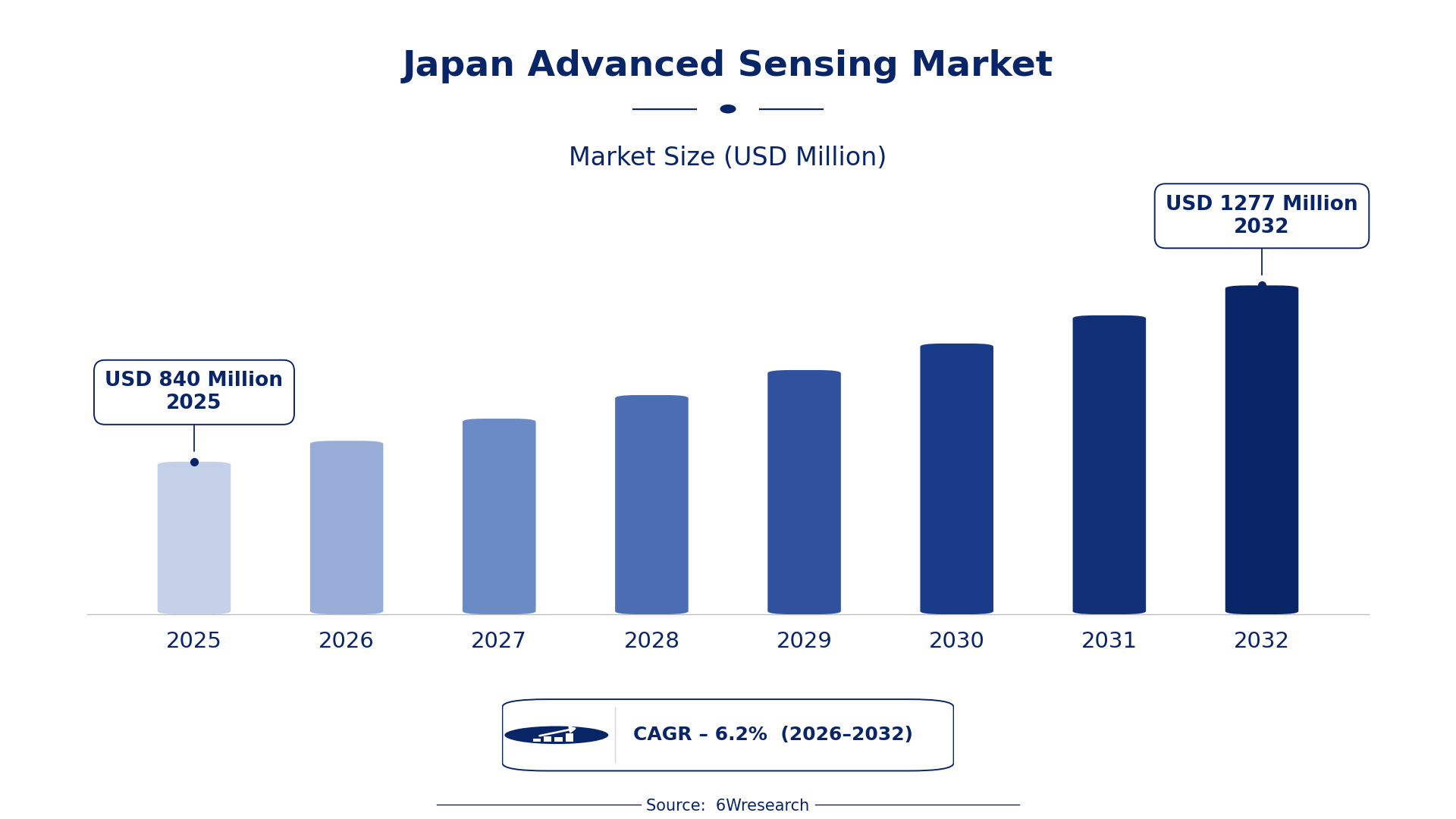
According to 6Wresearch internal database and industry insights, the Japan Advanced Sensing Market was valued at USD 840 Million in 2025 and is projected to reach USD 1,277 Million by 2032, growing at a CAGR of approximately 6.2% during 2026–2032.
Japan Advanced Sensing Market Highlights
| Report Metric | Details |
| Report Name | Japan Advanced Sensing Market (2026-2032) |
| Market Size 2025 | USD 840 Million |
| Market Size 2032 | USD 1,277 Million |
| Absolute Growth 2025–2032 | USD 437 Million |
| CAGR 2026–2032 | 6.2% |
| Peak Annual Growth | 6.9% in 2032 |
| Forecast Period | 2026–2032 |
| Historical Data | 2022–2025 |
| Base Year | 2025 |
| Leading Advanced Sensing Market, 2025 | LiDAR Sensors (39% share) |
| Leading Sensor Type, 2025 | Optical Distance Sensors (49% share) |
| Leading Sensing Mechanism, 2025 | Pulsed Laser Measurement (48% share) |
| Leading Application Area, 2025 | Autonomous Navigation (37% share) |
| Leading End User Sector, 2025 | Automotive & Robotics (46% share) |
| Fastest-Growing Advanced Sensing Market | Bio-Sensors (8.8% CAGR) |
| Fastest-Growing Sensor Type | Enzyme/Antibody-Based (9.3% CAGR) |
| Fastest-Growing Sensing Mechanism | Electrochemical/Optical (8.5% CAGR) |
| Fastest-Growing Application Area | Healthcare Diagnostics (7.7% CAGR) |
| Fastest-Growing End User Sector | Medical Device Companies (8.6% CAGR) |
| Growing Sector | Healthcare Diagnostics |
| Key End Users | Automotive Sector, Healthcare Providers, Industrial Manufacturers, Environmental Agencies |
Japan Advanced Sensing Market Year-wise Growth Rate and Key Drivers (2022–2032)
This graph illustrates the annual growth rates of the market from 2022 to 2032, highlighting a steady upward trajectory and projected market expansion over the forecast period.
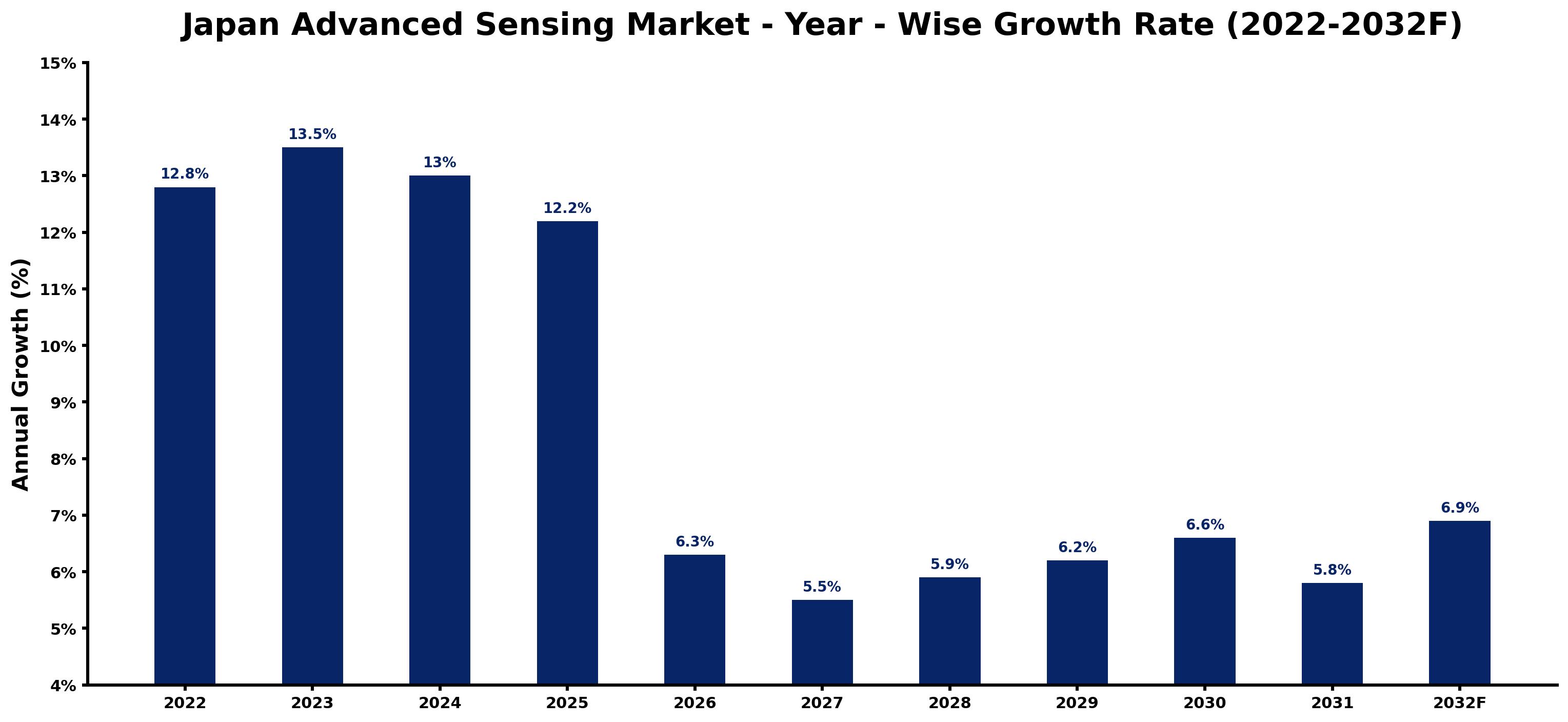
The yearly estimates that follow link every growth rate to its principal driver, so readers can see why the pace changed in each period.
| Year | Estimated Annual Growth (%) | Market Rationale |
| 2022 | 12.8 | The market experienced strong growth due to rising demand from the automotive sector. |
| 2023 | 13.5 | Increased adoption of advanced sensing technologies in healthcare diagnostics drove market expansion. |
| 2024 | 13.0 | The growth rate slowed as the market began to stabilise after a peak in the previous year. |
| 2025 | 12.2 | Demand remained steady, supported by ongoing investments in smart manufacturing initiatives. |
| 2026 | 6.3 | Growth is expected to slow further as the market adjusts to previous high levels of activity. |
| 2027 | 5.5 | The market will continue to grow, but at a reduced pace as demand stabilises. |
| 2028 | 5.9 | An uptick in demand from the healthcare sector is projected to contribute to a slight growth increase. |
| 2029 | 6.2 | Rising investments in autonomous navigation systems will lead to a further growth acceleration. |
| 2030 | 6.6 | The market will benefit from increased adoption of MEMS-based sensors in various applications. |
| 2031 | 5.8 | A slight slowdown is expected as the market adjusts to the previous growth surge. |
| 2032 | 6.9 | The market is projected to grow faster due to heightened demand for bio-sensors. |
Note: Market size estimations and growth projections presented in this report are based on 6Wresearch's proprietary forecasting methodology, utilizing the latest available industry data, government publications, and primary research inputs.
Japan Advanced Sensing Market Synopsis
Advanced sensing technology encompasses various sensor types that detect and respond to environmental stimuli, manufactured using advanced materials and fabrication techniques. The Japan Advanced Sensing Market is expanding, driven by strong demand from automotive, healthcare, and industrial sectors. The automotive sector is a major user of LiDAR sensors for autonomous vehicles, while healthcare diagnostics is supported by over 8,000 hospitals requiring bio-sensors. Ongoing investments in smart technologies and initiatives like 'Society 5.0' are propelling market growth.
Market Dynamics Impact Analysis (2026–2032)
| Factor | Type | Impact | Primary Segment Affected |
| Growing investments in smart technologies | Driver | High | LiDAR Sensors |
| Increased adoption of bio-sensors in healthcare diagnostics | Driver | High | Bio-Sensors |
| Rising demand for advanced diagnostics in healthcare | Opportunity | High | Bio-Sensors |
| Expansion of autonomous navigation systems in automotive | Opportunity | High | LiDAR Sensors |
| High competition among sensor manufacturers | Restraint | Medium | Gas Sensors |
| Regulatory compliance costs for sensor manufacturers | Restraint | Medium | Pressure Sensors |
| Supply chain disruptions affecting sensor production | Challenge | High | Gas Sensors |
| Technological advancements requiring constant upgrades | Challenge | High | Bio-Sensors |
Evaluation of Drivers in Japan Advanced Sensing Market (2026–2032)
The table below links each growth driver to the segment it affects and the evidence for it.
| Drivers | Primary Segment Affected | Why It Matters (Evidence) |
| Increased investment in autonomous vehicles | LiDAR Sensors | The automotive sector's focus on self-driving technology drives demand for LiDAR sensors, with a projected growth of 20% in the coming years. |
| Growing healthcare sector investments | Bio-Sensors | The healthcare diagnostics market is projected to see a 15% increase in bio-sensor adoption by 2025, leading to higher purchases from medical device companies. |
| Rising urbanisation and environmental concerns | Gas Sensors | Air quality control is critical in urban areas, with sensors deployed in over 50 cities, increasing demand from environmental monitoring agencies. |
| Advancements in MEMS technology | MEMS-Based | The manufacturing sector is investing heavily in MEMS-based sensors for precision applications, boosting demand from industrial monitoring systems. |
| Support from government initiatives | Pressure Sensors | The Ministry of Economy, Trade and Industry promotes smart manufacturing initiatives, encouraging investments in pressure sensors for industrial applications. |
Buyers are adding capacity as the automotive sector invests heavily in autonomous vehicles, driving demand for advanced sensing technologies. The healthcare sector is increasing bio-sensor adoption by 15% by 2025, prompting medical device companies to purchase more advanced diagnostics tools. Urbanisation is pushing demand for gas sensors, with over 50 cities deploying them for air quality control. Manufacturing investments in MEMS-based sensors are rising, improving industrial monitoring capabilities.
Evaluation of Restraints in Japan Advanced Sensing Market
The key brakes on demand, and where they bite hardest, are shown below.
| Market Restraint | Primary Segment Affected | Why It Matters (Evidence) |
| Intense competition among sensor manufacturers | Gas Sensors | High competition creates pricing pressures, which can reduce profit margins for manufacturers in the gas sensor market. |
| Regulatory compliance costs for sensor manufacturers | Pressure Sensors | Manufacturers must invest in meeting regulatory standards, which increases operational costs and affects pricing strategies. |
| Supply chain disruptions impacting production | Bio-Sensors | Delays in supply chains can hinder the availability of bio-sensors in the market, affecting timely delivery. |
| Rapid technological advancements requiring upgrades | LiDAR Sensors | Manufacturers must continuously innovate to keep up with advancements, resulting in increased R&D expenditures. |
| Market saturation in certain sensor categories | MEMS-Based | As the market matures, growth rates may decline due to saturation, impacting new investments. |
Japan Advanced Sensing Market Challenges
Japan's limited number of domestic suppliers for advanced sensors creates supply bottlenecks, delaying production timelines for manufacturers. Material costs have surged due to global shortages, resulting in a 20% increase in sensor prices this year for producers. Insufficient investment in R&D hampers technological progress, causing suppliers to lag in innovation and delaying the rollout of next-generation sensors. Buyers in the healthcare sector face challenges in meeting stringent regulatory standards, which can extend product approval timelines by six months, hindering their ability to introduce new diagnostic tools.
Trends in the Japan Advanced Sensing Market
The following changes are redrawing the Japan Advanced Sensing Market.
- Shift from Traditional to Smart Sensors: Since 2020, Japan has seen a shift towards smart sensors with advanced capabilities, driven by the Society 5.0 initiative, which aims to integrate technology across sectors. This has led to a notable increase in smart sensor deployments in urban areas.
- Transition from Conventional to Advanced Healthcare Diagnostics: The healthcare sector is moving towards advanced diagnostics, with a projected 15% increase in bio-sensor adoption by 2025, driven by the need for improved patient outcomes and efficiency in hospitals.
- Emergence of Autonomous Navigation Systems: The automotive industry is increasingly adopting autonomous navigation systems, with advanced sensing technologies becoming essential. The Tokyo metropolitan area is leading this trend, with a notable increase in autonomous vehicle testing.
- Prioritisation of Environmental Monitoring: Air quality control has gained priority, especially in urban areas. Over 50 cities have deployed gas sensors to monitor air quality, reflecting a growing commitment to environmental sustainability.
Investment Opportunities in the Japan Advanced Sensing Market
Below are the investment opportunities with the strongest case in the Japan Advanced Sensing Market.
- Supply advanced bio-sensors: With a projected 15% increase in bio-sensor adoption by 2025, medical device companies require advanced diagnostics. Collaborating with local healthcare providers can facilitate market entry.
- Invest in autonomous navigation systems: The automotive sector is rapidly expanding its use of advanced sensing technologies, with notable demand in the Tokyo metropolitan area. Partnerships with automotive manufacturers can enhance market presence.
- Provide MEMS-based sensors for manufacturing: Japan's manufacturing sector is investing heavily in MEMS-based sensors for precision applications, with a projected investment of 200 billion yen by 2025. Establishing joint ventures with local manufacturers can facilitate entry.
- Develop gas sensors for urban areas: With over 50 cities deploying gas sensors for air quality control, there is a growing demand for these products. Local partnerships can help navigate regulatory requirements and market entry.
Government Initiatives in the Japan Advanced Sensing Market
The Economic Security Promotion Act (2022) supports supply-chain resilience for critical products, building on earlier legislation that obliges large energy users to improve efficiency. This act impacts sensor manufacturers by promoting energy-efficient technologies in production processes.
The Japan Electronics and Information Technology Industries Association approves funding for smart manufacturing initiatives, supporting projects that integrate advanced sensing technologies. This association also plays a role in promoting sensor technology development.
Future Insight of the Japan Advanced Sensing Market
The launch of smart manufacturing facilities will enhance the adoption of advanced sensing technologies by 2032, improving operational efficiency. Increased funding for R&D will lead to advancements in sensor functionalities, benefiting both buyers and suppliers. The Society 5.0 initiative will promote collaboration across sectors, encouraging the use of sensors in diverse applications. By 2025, the healthcare sector is projected to invest 200 billion yen in advanced diagnostics, driving demand for innovative sensing solutions.
Market Segmentation Analysis
Japan Advanced Sensing Market report covers a detailed analysis of the following market segments:
By Advanced Sensing Market – LiDAR Sensors Lead, Bio-Sensors Expected to Grow Fastest
According to Saurav Kr Singh, Senior Research Analyst at 6Wresearch, LiDAR Sensors took 39% of advanced sensing market revenue in 2025, more than any other category. LiDAR sensors dominate the market as they are essential for autonomous navigation systems, particularly in Japan's automotive sector. The substantial investments in autonomous vehicle technology have resulted in a robust installed base of these sensors nationwide. Bio-Sensors are projected to grow fastest, at a CAGR of 8.8% during 2026–2032. Bio-sensors are experiencing rapid growth due to an expected 15% increase in adoption within the healthcare sector by 2025. The pressing requirement for advanced diagnostic tools in over 8,000 hospitals is propelling this trend. Suppliers should focus on advancing bio-sensor technologies to seize opportunities in the expanding healthcare market.
By Sensor Type – Optical Distance Sensors Lead, Enzyme/Antibody-Based Expected to Grow Fastest
The largest sensor type category in 2025 was Optical Distance Sensors, at 49% of revenue. Optical distance sensors lead the segment as they are integral to various robotics applications, particularly in the automotive industry. Their widespread adoption in Japan's advanced robotics initiatives solidifies their market position. The quickest growth will come from Enzyme/Antibody-Based, forecast to expand at a CAGR of 9.3% between 2026 and 2032. Enzyme/antibody-based sensors are growing quickly due to their critical role in medical diagnostics, reflecting the increasing demand for precise healthcare solutions. This trend is expected to accelerate as healthcare technology continues to advance. Buyers in the medical sector should prioritise sourcing enzyme/antibody-based sensors to stay ahead in diagnostics.
By Sensing Mechanism – Pulsed Laser Measurement Leads, Electrochemical/Optical Expected to Grow Fastest
Pulsed Laser Measurement accounted for 48% of the market by sensing mechanism in 2025. Pulsed laser measurement is the leading mechanism, primarily used in LiDAR systems for autonomous navigation. This technology's effectiveness in providing accurate distance measurements makes it essential in the automotive sector. Over 2026–2032, Electrochemical/Optical is expected to post the fastest growth, at a CAGR of 8.5%. Electrochemical/optical sensing mechanisms are rapidly gaining traction, particularly in healthcare diagnostics, due to their ability to provide real-time data. The increasing emphasis on timely medical responses is propelling this growth. Suppliers must invest in electrochemical/optical technologies to meet the rising demand in healthcare.
By Application Area – Autonomous Navigation Leads, Healthcare Diagnostics Expected to Grow Fastest
Autonomous Navigation held 37% of the Japan Advanced Sensing Market by application area in 2025. Autonomous navigation is the leading application area, driven by the automotive sector's substantial demand for advanced sensing technologies. Japan's commitment to developing smart transportation solutions reinforces the significance of this application. Healthcare Diagnostics are set to record the highest CAGR in this split, 7.7% over 2026–2032. Healthcare diagnostics is the fastest-growing application area, reflecting the rising demand for advanced diagnostic tools in the medical sector. The projected investment of 200 billion yen in healthcare diagnostics by 2025 underscores the urgency of this trend. Suppliers must strategically target healthcare diagnostics technologies to leverage growth opportunities in this sector.
By End User Sector – Automotive & Robotics Lead, Medical Device Companies Expected to Grow Fastest
In 2025, Automotive & Robotics led the end user sector split with a 46% share. The automotive and robotics sector leads in end-user demand, propelled by substantial investments in autonomous technologies and advanced sensing solutions. This sector's commitment to innovation ensures a strong and growing market for sensors. Medical Device Companies are projected to grow fastest, at a CAGR of 8.6% during 2026–2032. Medical device companies represent the fastest-growing end-user sector, driven by the escalating demand for advanced diagnostics solutions. This trend reflects a broader shift towards personalised healthcare and efficient medical practices. Suppliers need to align their offerings with the specific requirements of medical device companies to effectively tap into this growth.
Key Attractiveness of the Report
- 10 Years of Market Numbers
- Historical Data Starting from 2022 to 2025
- Base Year 2025
- Forecast Data until 2032
- Key Performance Indicators Impacting the Market
- Major Upcoming Developments and Projects
Key Highlights of the Report:
- Japan Advanced Sensing Market Outlook
- Market Size of Japan Advanced Sensing Market, 2025
- Forecast of Japan Advanced Sensing Market, 2032
- Historical Data and Forecast of Japan Advanced Sensing Revenues & Volume for the Period 2022-2032F
- Japan Advanced Sensing Market Trend Evolution
- Japan Advanced Sensing Market Drivers and Challenges
- Japan Advanced Sensing Price Trends
- Japan Advanced Sensing Porter's Five Forces
- Japan Advanced Sensing Industry Life Cycle
- Historical Data and Forecast of Japan Advanced Sensing Market Revenues & Volume By Advanced Sensing Market for the Period 2022-2032F
- Historical Data and Forecast of Japan Advanced Sensing Market Revenues & Volume By LiDAR Sensors for the Period 2022-2032F
- Historical Data and Forecast of Japan Advanced Sensing Market Revenues & Volume By Bio-Sensors for the Period 2022-2032F
- Historical Data and Forecast of Japan Advanced Sensing Market Revenues & Volume By Pressure Sensors for the Period 2022-2032F
- Historical Data and Forecast of Japan Advanced Sensing Market Revenues & Volume By Gas Sensors for the Period 2022-2032F
- Historical Data and Forecast of Japan Advanced Sensing Market Revenues & Volume By Sensor Type for the Period 2022-2032F
- Historical Data and Forecast of Japan Advanced Sensing Market Revenues & Volume By Optical Distance Sensors for the Period 2022-2032F
- Historical Data and Forecast of Japan Advanced Sensing Market Revenues & Volume By Enzyme/Antibody-Based for the Period 2022-2032F
- Historical Data and Forecast of Japan Advanced Sensing Market Revenues & Volume By MEMS-Based for the Period 2022-2032F
- Historical Data and Forecast of Japan Advanced Sensing Market Revenues & Volume By Semiconductor-Based for the Period 2022-2032F
- Historical Data and Forecast of Japan Advanced Sensing Market Revenues & Volume By Sensing Mechanism for the Period 2022-2032F
- Historical Data and Forecast of Japan Advanced Sensing Market Revenues & Volume By Pulsed Laser Measurement for the Period 2022-2032F
- Historical Data and Forecast of Japan Advanced Sensing Market Revenues & Volume By Electrochemical/Optical for the Period 2022-2032F
- Historical Data and Forecast of Japan Advanced Sensing Market Revenues & Volume By Piezoresistive/Capacitive for the Period 2022-2032F
- Historical Data and Forecast of Japan Advanced Sensing Market Revenues & Volume By Catalytic/Oxide Sensing for the Period 2022-2032F
- Historical Data and Forecast of Japan Advanced Sensing Market Revenues & Volume By Application Area for the Period 2022-2032F
- Historical Data and Forecast of Japan Advanced Sensing Market Revenues & Volume By Autonomous Navigation for the Period 2022-2032F
- Historical Data and Forecast of Japan Advanced Sensing Market Revenues & Volume By Healthcare Diagnostics for the Period 2022-2032F
- Historical Data and Forecast of Japan Advanced Sensing Market Revenues & Volume By Industrial Monitoring for the Period 2022-2032F
- Historical Data and Forecast of Japan Advanced Sensing Market Revenues & Volume By Air Quality Control for the Period 2022-2032F
- Historical Data and Forecast of Japan Advanced Sensing Market Revenues & Volume By End User Sector for the Period 2022-2032F
- Historical Data and Forecast of Japan Advanced Sensing Market Revenues & Volume By Automotive & Robotics for the Period 2022-2032F
- Historical Data and Forecast of Japan Advanced Sensing Market Revenues & Volume By Medical Device Companies for the Period 2022-2032F
- Historical Data and Forecast of Japan Advanced Sensing Market Revenues & Volume By Manufacturing Sector for the Period 2022-2032F
- Historical Data and Forecast of Japan Advanced Sensing Market Revenues & Volume By Smart Building Integrators for the Period 2022-2032F
- Japan Advanced Sensing Import Export Trade Statistics
- Market Opportunity Assessment By Advanced Sensing Market
- Market Opportunity Assessment By Sensor Type
- Market Opportunity Assessment By Sensing Mechanism
- Market Opportunity Assessment By Application Area
- Market Opportunity Assessment By End User Sector
- Japan Advanced Sensing Top Companies Market Share
- Japan Advanced Sensing Competitive Benchmarking By Technical and Operational Parameters
- Japan Advanced Sensing Company Profiles
- Japan Advanced Sensing Key Strategic Recommendations
Market Covered
Segments analysed in this report are listed below.
By Advanced Sensing Market
- LiDAR Sensors
- Bio-Sensors
- Pressure Sensors
- Gas Sensors
By Sensor Type
- Optical Distance Sensors
- Enzyme/Antibody-Based
- MEMS-Based
- Semiconductor-Based
By Sensing Mechanism
- Pulsed Laser Measurement
- Electrochemical/Optical
- Piezoresistive/Capacitive
- Catalytic/Oxide Sensing
By Application Area
- Autonomous Navigation
- Healthcare Diagnostics
- Industrial Monitoring
- Air Quality Control
By End User Sector
- Automotive & Robotics
- Medical Device Companies
- Manufacturing Sector
- Smart Building Integrators































