Japan Advanced Sensor Materials Market Size & Growth Rate
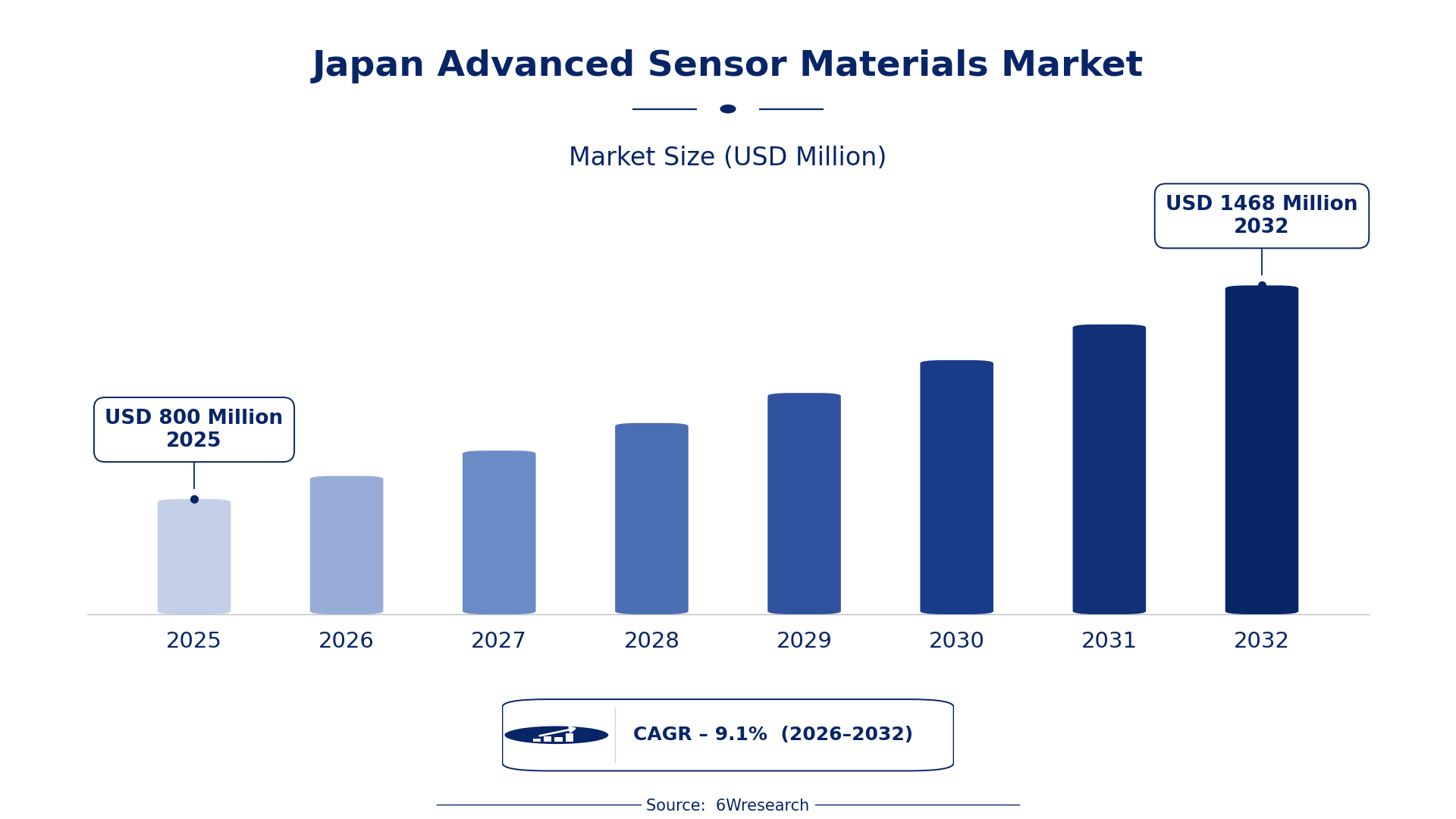
According to 6Wresearch internal database and industry insights, the Japan Advanced Sensor Materials Market was valued at USD 800 Million in 2025 and is projected to reach USD 1,468 Million by 2032, growing at a CAGR of approximately 9.1% during 2026–2032.
Japan Advanced Sensor Materials Market Highlights
| Report Metric | Details |
| Report Name | Japan Advanced Sensor Materials Market (2026-2032) |
| Market Size 2025 | USD 800 Million |
| Market Size 2032 | USD 1,468 Million |
| Absolute Growth 2025–2032 | USD 668 Million |
| CAGR 2026–2032 | 9.1% |
| Peak Annual Growth | 10.6% in 2029 |
| Forecast Period | 2026–2032 |
| Historical Data | 2022–2025 |
| Base Year | 2025 |
| Leading Advanced Sensor Materials Market, 2025 | Graphene-Based Materials (49% share) |
| Leading Material Type, 2025 | Nanomaterial (54% share) |
| Leading Sensor Application, 2025 | Pressure & Strain Sensors (40% share) |
| Leading Distribution Channel, 2025 | Direct Sales (47% share) |
| Leading End User Sector, 2025 | Automotive (52% share) |
| Fastest-Growing Advanced Sensor Materials Market | Metal Oxides (13.0% CAGR) |
| Fastest-Growing Material Type | Semiconductor Material (13.2% CAGR) |
| Fastest-Growing Sensor Application | Gas Sensors (13.5% CAGR) |
| Fastest-Growing Distribution Channel | Online Platforms (11.9% CAGR) |
| Fastest-Growing End User Sector | Smart Building Systems (12.1% CAGR) |
| Growing Sector | Healthcare |
| Key End Users | Automotive, Healthcare, Consumer Electronics, Smart Building Systems |
Japan Advanced Sensor Materials Market Year-wise Growth Rate and Key Drivers (2022–2032)
This graph illustrates the annual growth rates of the market from 2022 to 2032, highlighting a steady upward trajectory and projected market expansion over the forecast period.
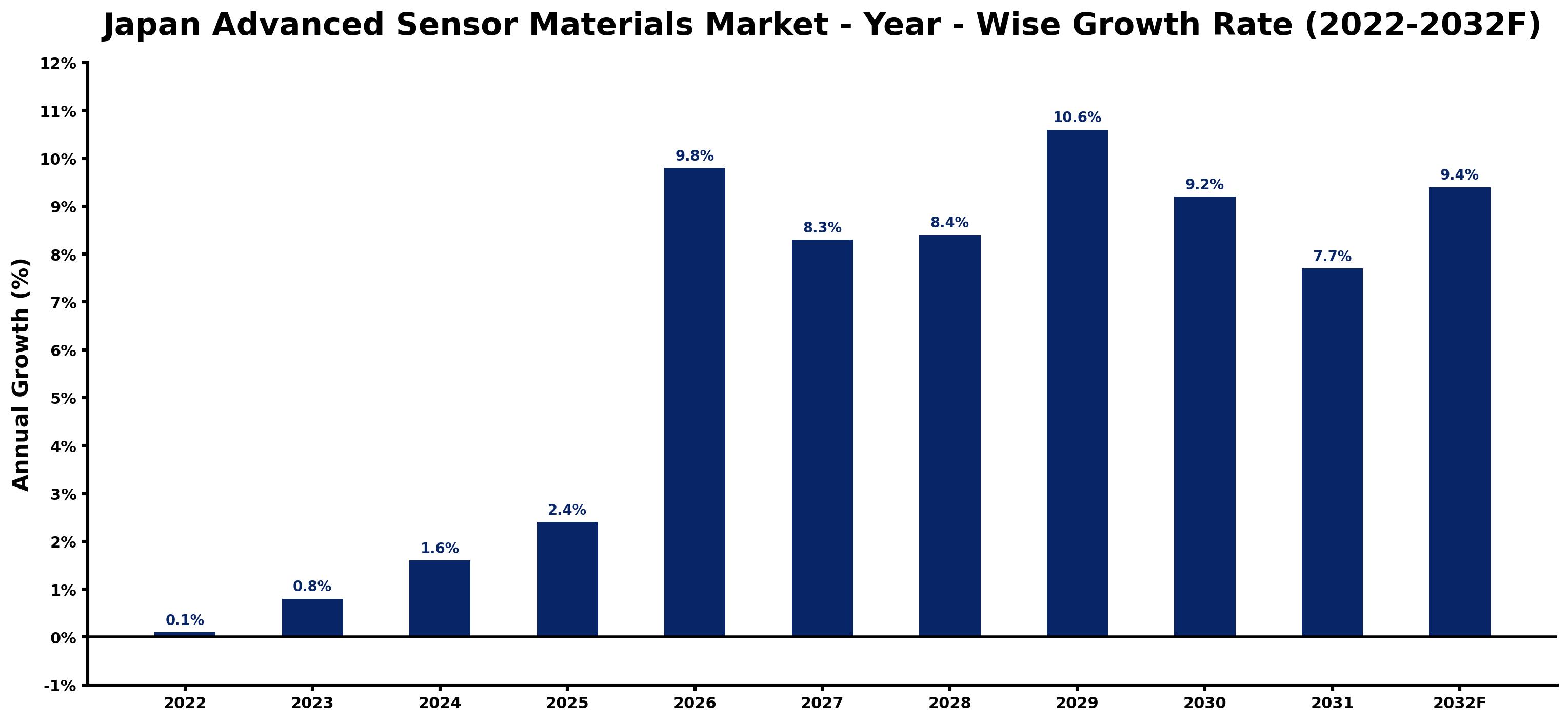
Each row of the following table gives one year's estimated growth and the event or demand shift that explains it.
| Year | Estimated Annual Growth (%) | Market Rationale |
| 2022 | 0.1 | The market showed minimal growth due to limited technological advancements. |
| 2023 | 0.8 | Growth accelerated as automotive manufacturers increased sensor integration for safety features. |
| 2024 | 1.6 | Demand rose further with healthcare innovations driving biosensor applications. |
| 2025 | 2.4 | Growth peaked as the automotive sector expanded its sensor technology investments. |
| 2026 | 9.8 | The market is expected to grow as new nanomaterials improve sensor performance. |
| 2027 | 8.3 | Growth slows slightly as market saturation begins in established sectors. |
| 2028 | 8.4 | Demand is projected to rise again as smart building systems gain traction. |
| 2029 | 10.6 | Growth peaks due to heightened investments in environmental monitoring technologies. |
| 2030 | 9.2 | The market is expected to grow at a slower rate as competition intensifies. |
| 2031 | 7.7 | Growth slows further as buyers focus on cost efficiency and sustainability. |
| 2032 | 9.4 | Demand is projected to rise as new applications for advanced sensors emerge. |
Note: Market size estimations and growth projections presented in this report are based on 6Wresearch's proprietary forecasting methodology, utilizing the latest available industry data, government publications, and primary research inputs.
Japan Advanced Sensor Materials Market Synopsis
Advanced Sensor Materials are high-performance materials used in sensor fabrication, including graphene-based materials and conductive polymers. The Japan Advanced Sensor Materials Market is expanding due to substantial investments in decarbonisation, targeting JPY 150 trillion over ten years, and a growing emphasis on sensor technologies, driven by the need for safety and efficiency across various applications.
Market Dynamics Impact Analysis (2026–2032)
| Factor | Type | Impact | Primary Segment Affected |
| Increased investments in decarbonisation technologies | Driver | High | Graphene-Based Materials |
| Growing demand for healthcare diagnostics and monitoring | Driver | High | Biosensors |
| Rising demand for advanced sensors in automotive applications | Opportunity | High | Pressure & Strain Sensors |
| Expansion of smart building systems integrating advanced sensors | Opportunity | Medium | Smart Building Systems |
| High production costs for advanced materials | Restraint | High | Conductive Polymers |
| Limited awareness of advanced sensor capabilities among SMEs | Restraint | Medium | Metal Oxides |
| Supply chain disruptions affecting material availability | Challenge | High | Nanomaterial |
| Technological obsolescence due to rapid advancements | Challenge | Medium | Semiconductor Material |
Evaluation of Drivers in Japan Advanced Sensor Materials Market (2026–2032)
Key forces behind demand, with the segment each one moves most, are listed below.
| Drivers | Primary Segment Affected | Why It Matters (Evidence) |
| Investment in decarbonisation initiatives | Graphene-Based Materials | Japan's GX Basic Policy targets JPY 150 trillion in investments, driving demand for advanced materials. |
| Increased healthcare spending on diagnostics | Biosensors | The healthcare sector is projected to grow, boosting demand for biosensors. |
| Automotive safety regulations mandating advanced sensors | Pressure & Strain Sensors | The automotive industry invests heavily in sensor technology to meet safety standards. |
| Technological advancements in smart building systems | Smart Building Systems | The market is expected to grow by 15% annually through 2025, increasing sensor integration. |
| Rising consumer electronics demand for motion sensors | Motion Sensors | Japan's population of approximately 125 million drives significant consumer electronics demand. |
The healthcare sector's growth further fuels demand for biosensors, with the patient population projected to reach 40 million by 2025. As smart building systems expand, the need for advanced sensor materials continues to rise, supported by Japan's large population, which increases the demand for advanced devices.
Evaluation of Restraints in Japan Advanced Sensor Materials Market
The table below lists the restraints and the evidence behind each.
| Market Restraint | Primary Segment Affected | Why It Matters (Evidence) |
| High production costs for advanced sensor materials | Conductive Polymers | Production costs are elevated due to the complexity of manufacturing processes, limiting market growth. |
| Limited awareness of advanced sensor capabilities among SMEs | Metal Oxides | Small and medium enterprises often lack knowledge of advanced materials, hindering adoption. |
| Supply chain disruptions affecting material availability | Nanomaterial | Global supply chain issues have led to shortages, impacting production schedules and costs. |
| Technological obsolescence due to rapid advancements | Semiconductor Material | Fast-paced technological changes can render existing materials outdated, affecting market stability. |
| Regulatory compliance costs for new materials | Graphene-Based Materials | Manufacturers face high costs to meet compliance standards, which can deter investment. |
Japan Advanced Sensor Materials Market Challenges
High competition among suppliers creates intense price pressure, forcing producers to cut corners on quality, which ultimately compromises reliability for buyers in the automotive sector. Rising costs due to Japan's minimum wage increase to JPY 1,055 per hour in October 2024 squeeze profit margins for buyers, making it challenging to invest in advanced technologies. Stricter environmental regulations lead to longer product approval times for suppliers, causing delays that hinder their ability to meet market demand. A shortage of skilled workers in advanced material fabrication slows innovation, extending product development timelines for manufacturers.
Trends in the Japan Advanced Sensor Materials Market
These developments are changing demand patterns in the Japan Advanced Sensor Materials Market.
- Shift towards Sustainable Sensor Technologies: Japan is increasingly adopting sustainable sensor technologies, particularly in automotive applications. The automotive industry is investing heavily in advanced materials, with over 1,000 tons of graphene produced in 2022, improving sensor performance.
- Transition from Traditional to Smart Building Systems: The Tokyo region is leading the shift towards smart building systems, integrating advanced sensors for energy management. This market is projected to grow by 15% annually through 2025, reflecting increased demand for efficiency.
- Emergence of Biosensors in Healthcare: Healthcare diagnostics are increasingly relying on biosensors, driven by the need for rapid and accurate health monitoring solutions. This growth is supported by the increasing patient population, which is expected to reach 40 million by 2025.
- Growing Integration of Motion Sensors in Consumer Electronics: Consumer electronics are seeing a rise in motion sensor integration, particularly in security systems. This trend is supported by Japan's population of approximately 125 million, creating a large market for advanced devices.
Investment Opportunities in the Japan Advanced Sensor Materials Market
Several openings in the Japan Advanced Sensor Materials Market merit attention from investors.
- Gap in Advanced Sensor Material Production: Japan's target for a 46% cut in greenhouse-gas emissions by 2030 highlights the need for advanced sensor materials. Suppliers can focus on graphene-based materials, partnering with automotive manufacturers to improve safety features.
- Investment in Healthcare Biosensors: With the healthcare sector expanding, there is a growing need for biosensors. Suppliers can enter this market through collaborations with healthcare providers and technology firms to meet rising demand.
- Demand for Smart Building Systems: The smart building systems market is projected to grow by 15% annually through 2025, creating opportunities for advanced sensor suppliers. Collaborating with construction firms can facilitate entry into this expanding sector.
- Expansion of Online Distribution Channels: The rise of online platforms for sensor materials presents an opportunity, with a projected growth rate of 11.9%. Suppliers should consider establishing partnerships with e-commerce platforms to reach a broader audience.
Government Initiatives in the Japan Advanced Sensor Materials Market
The Semiconductor and Digital Industry Strategy, launched by METI in June 2021, focuses on securing domestic semiconductor manufacturing, which is vital for advanced sensor materials. This strategy encourages local production and innovation, ensuring a stable supply chain for manufacturers, with a target of increasing domestic output by 20% by 2025 and supporting 100 projects.
The Economic Security Promotion Act, enacted in 2022, supports supply-chain resilience for critical products. This act enables funding for projects that improve the availability of advanced sensor materials, benefiting both producers and buyers, with an allocation of JPY 50 billion for related initiatives.
Future Insight of the Japan Advanced Sensor Materials Market
Japan's policy-driven shift towards decarbonisation will stimulate investment in advanced sensor materials, with a projected increase in the healthcare sector reaching 40 million patients by 2025. By 2032, the integration of nanomaterials in over 30% of new sensor designs will enhance performance and reliability for buyers and suppliers. The automotive sector's focus on safety features will drive demand for advanced sensors, while government initiatives will support ongoing material innovation. These factors will reshape the market, driving technological advancements.
Market Segmentation Analysis
Japan Advanced Sensor Materials Market report covers a detailed analysis of the following market segments:
By Advanced Sensor Materials Market – Graphene-Based Materials Lead, Metal Oxides Expected to Grow Fastest
According to Saurav Kr Singh, Senior Research Analyst at 6Wresearch, Graphene-Based Materials accounted for 49% of the market by advanced sensor materials market in 2025. Graphene-based materials hold the largest share due to their exceptional conductivity and performance in high-performance sensors. Their widespread application in automotive safety systems illustrates their importance in the Japanese market. Metal Oxides are set to record the highest CAGR in this split, 13.0% over 2026–2032. Metal oxides are rapidly gaining traction as they are extensively utilised in gas sensors for environmental monitoring, which is increasingly critical in urban areas. This growth will continue as air quality regulations become stricter. Suppliers should prioritise advancements in metal oxides to meet the rising demand in environmental applications.
By Material Type – Nanomaterial Leads, Semiconductor Material Expected to Grow Fastest
Nanomaterial held 54% of the Japan Advanced Sensor Materials Market by material type in 2025. Nanomaterials hold the largest share due to their vital role in improving sensor sensitivity and performance across various applications. For instance, their use in automotive sensors enhances safety features, making them indispensable in Japan's automotive sector. Over 2026–2032, Semiconductor Material is expected to post the fastest growth, at a CAGR of 13.2%. The growth of semiconductor materials is driven by their critical function in electronic sensors, particularly for signal processing. As sensor systems become more complex, the demand for these materials is expected to increase significantly. Suppliers should prioritise the development of semiconductor materials to meet the rising demand in advanced sensor applications.
By Sensor Application – Pressure & Strain Sensors Lead, Gas Sensors Expected to Grow Fastest
With 40% of sensor application revenue in 2025, Pressure & Strain Sensors was the largest category. Pressure and strain sensors are critical for monitoring structural integrity in engineering, leading to their dominance in the market. Their application in various infrastructure projects highlights their importance in Japan. Gas Sensors are projected to grow fastest, at a CAGR of 13.5% during 2026–2032. Gas sensors are rapidly growing in popularity due to their importance in air quality monitoring and safety applications, especially in urban environments. This growth is expected as public awareness of environmental issues increases. Suppliers should prioritise gas sensor technologies to meet the rising demand for environmental safety.
By Distribution Channel – Direct Sales Leads, Online Platforms Expected to Grow Fastest
In 2025, Direct Sales led the distribution channel split with a 47% share. Direct sales are the leading distribution channel as they provide industrial customers with direct access to high-quality materials from manufacturers. This approach allows for customised solutions that align with specific industrial needs, particularly in sectors like automotive and healthcare. The quickest growth will come from Online Platforms, forecast to expand at a CAGR of 11.9% between 2026 and 2032. Online platforms are gaining traction as a distribution channel, reflecting the growing interest in consumer electronics and hobbyist markets. This shift indicates a significant change in purchasing preferences, with more customers opting for digital transactions. Suppliers need to enhance their online strategies to capture the increasing number of customers who prefer purchasing through digital platforms.
By End User Sector – Automotive Leads, Smart Building Systems Expected to Grow Fastest
The largest end user sector category in 2025 was Automotive, at 52% of revenue. The automotive sector is a major user of advanced sensors, focusing on safety and efficiency, which solidifies its leading position. The industry's substantial investment in sensor technology further reinforces this trend. Smart Building Systems are set to record the highest CAGR in this split, 12.1% over 2026–2032. Smart building systems are increasingly being integrated for energy management and automation, driving their rapid growth in the market. This trend aligns with Japan's commitment to sustainability and energy efficiency. Suppliers should consider expanding their offerings to smart building technologies to align with market growth.
Key Attractiveness of the Report
- 10 Years of Market Numbers
- Historical Data Starting from 2022 to 2025
- Base Year 2025
- Forecast Data until 2032
- Key Performance Indicators Impacting the Market
- Major Upcoming Developments and Projects
Key Highlights of the Report:
- Japan Advanced Sensor Materials Market Outlook
- Market Size of Japan Advanced Sensor Materials Market, 2025
- Forecast of Japan Advanced Sensor Materials Market, 2032
- Historical Data and Forecast of Japan Advanced Sensor Materials Revenues & Volume for the Period 2022-2032F
- Japan Advanced Sensor Materials Market Trend Evolution
- Japan Advanced Sensor Materials Market Drivers and Challenges
- Japan Advanced Sensor Materials Price Trends
- Japan Advanced Sensor Materials Porter's Five Forces
- Japan Advanced Sensor Materials Industry Life Cycle
- Historical Data and Forecast of Japan Advanced Sensor Materials Market Revenues & Volume By Advanced Sensor Materials Market for the Period 2022-2032F
- Historical Data and Forecast of Japan Advanced Sensor Materials Market Revenues & Volume By Graphene-Based Materials for the Period 2022-2032F
- Historical Data and Forecast of Japan Advanced Sensor Materials Market Revenues & Volume By Metal Oxides for the Period 2022-2032F
- Historical Data and Forecast of Japan Advanced Sensor Materials Market Revenues & Volume By Piezoelectric Ceramics for the Period 2022-2032F
- Historical Data and Forecast of Japan Advanced Sensor Materials Market Revenues & Volume By Conductive Polymers for the Period 2022-2032F
- Historical Data and Forecast of Japan Advanced Sensor Materials Market Revenues & Volume By Material Type for the Period 2022-2032F
- Historical Data and Forecast of Japan Advanced Sensor Materials Market Revenues & Volume By Nanomaterial for the Period 2022-2032F
- Historical Data and Forecast of Japan Advanced Sensor Materials Market Revenues & Volume By Semiconductor Material for the Period 2022-2032F
- Historical Data and Forecast of Japan Advanced Sensor Materials Market Revenues & Volume By Functional Material for the Period 2022-2032F
- Historical Data and Forecast of Japan Advanced Sensor Materials Market Revenues & Volume By Organic Material for the Period 2022-2032F
- Historical Data and Forecast of Japan Advanced Sensor Materials Market Revenues & Volume By Sensor Application for the Period 2022-2032F
- Historical Data and Forecast of Japan Advanced Sensor Materials Market Revenues & Volume By Pressure & Strain Sensors for the Period 2022-2032F
- Historical Data and Forecast of Japan Advanced Sensor Materials Market Revenues & Volume By Gas Sensors for the Period 2022-2032F
- Historical Data and Forecast of Japan Advanced Sensor Materials Market Revenues & Volume By Motion Sensors for the Period 2022-2032F
- Historical Data and Forecast of Japan Advanced Sensor Materials Market Revenues & Volume By Biosensors for the Period 2022-2032F
- Historical Data and Forecast of Japan Advanced Sensor Materials Market Revenues & Volume By Distribution Channel for the Period 2022-2032F
- Historical Data and Forecast of Japan Advanced Sensor Materials Market Revenues & Volume By Direct Sales for the Period 2022-2032F
- Historical Data and Forecast of Japan Advanced Sensor Materials Market Revenues & Volume By Online Platforms for the Period 2022-2032F
- Historical Data and Forecast of Japan Advanced Sensor Materials Market Revenues & Volume By Industrial Suppliers for the Period 2022-2032F
- Historical Data and Forecast of Japan Advanced Sensor Materials Market Revenues & Volume By Specialty Stores for the Period 2022-2032F
- Historical Data and Forecast of Japan Advanced Sensor Materials Market Revenues & Volume By End User Sector for the Period 2022-2032F
- Historical Data and Forecast of Japan Advanced Sensor Materials Market Revenues & Volume By Automotive for the Period 2022-2032F
- Historical Data and Forecast of Japan Advanced Sensor Materials Market Revenues & Volume By Smart Building Systems for the Period 2022-2032F
- Historical Data and Forecast of Japan Advanced Sensor Materials Market Revenues & Volume By Consumer Electronics for the Period 2022-2032F
- Historical Data and Forecast of Japan Advanced Sensor Materials Market Revenues & Volume By Healthcare for the Period 2022-2032F
- Japan Advanced Sensor Materials Import Export Trade Statistics
- Market Opportunity Assessment By Advanced Sensor Materials Market
- Market Opportunity Assessment By Material Type
- Market Opportunity Assessment By Sensor Application
- Market Opportunity Assessment By Distribution Channel
- Market Opportunity Assessment By End User Sector
- Japan Advanced Sensor Materials Top Companies Market Share
- Japan Advanced Sensor Materials Competitive Benchmarking By Technical and Operational Parameters
- Japan Advanced Sensor Materials Company Profiles
- Japan Advanced Sensor Materials Key Strategic Recommendations
Market Covered
The following segment groups are covered in the report.
By Advanced Sensor Materials Market
- Graphene-Based Materials
- Metal Oxides
- Piezoelectric Ceramics
- Conductive Polymers
By Material Type
- Nanomaterial
- Semiconductor Material
- Functional Material
- Organic Material
By Sensor Application
- Pressure & Strain Sensors
- Gas Sensors
- Motion Sensors
- Biosensors
By Distribution Channel
- Direct Sales
- Online Platforms
- Industrial Suppliers
- Specialty Stores
By End User Sector
- Automotive
- Smart Building Systems
- Consumer Electronics
- Healthcare































