Japan Advanced Space Garment Market Size & Growth Rate
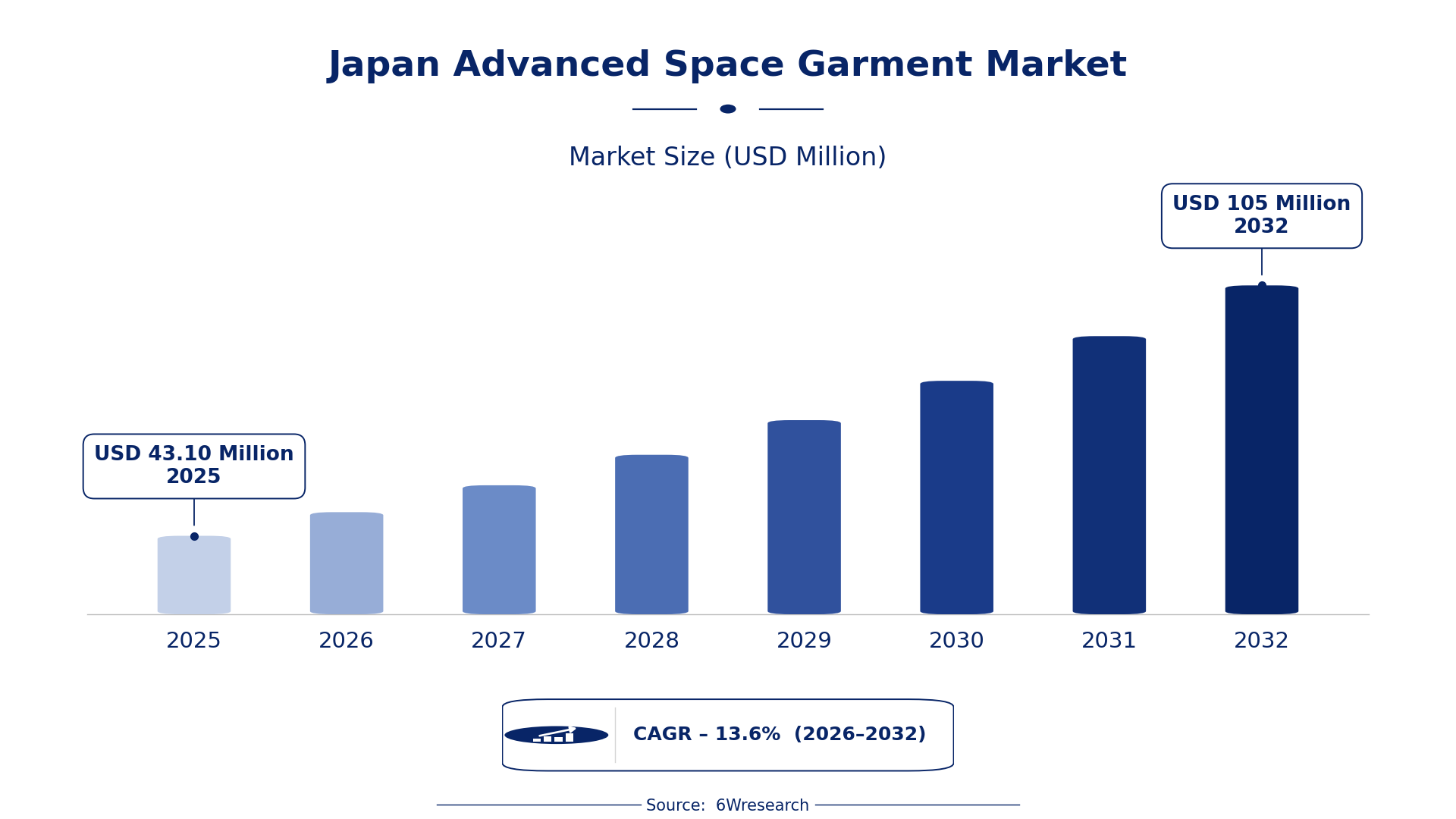
According to 6Wresearch internal database and industry insights, the Japan Advanced Space Garment Market was valued at USD 43.10 Million in 2025 and is projected to reach USD 105 Million by 2032, growing at a CAGR of approximately 13.6% during 2026–2032.
Japan Advanced Space Garment Market Highlights
| Report Metric | Details |
| Report Name | Japan Advanced Space Garment Market (2026-2032) |
| Market Size 2025 | USD 43.10 Million |
| Market Size 2032 | USD 105 Million |
| Absolute Growth 2025–2032 | USD 61.90 Million |
| CAGR 2026–2032 | 13.6% |
| Peak Annual Growth | 15.3% in 2026 |
| Forecast Period | 2026–2032 |
| Historical Data | 2022–2025 |
| Base Year | 2025 |
| Leading Advanced Space Garment Market, 2025 | Extravehicular Mobility Units (42% share) |
| Leading Garment Type, 2025 | Multi-Layered Suits (51% share) |
| Leading Material Composition, 2025 | Kevlar (34% share) |
| Leading Application Area, 2025 | Spacewalk Protection (48% share) |
| Leading End User, 2025 | Space Agencies (39% share) |
| Fastest-Growing Advanced Space Garment Market | Intravehicular Suits (18.1% CAGR) |
| Fastest-Growing Garment Type | Lightweight Apparel (19.4% CAGR) |
| Fastest-Growing Material Composition | Teflon (19.1% CAGR) |
| Fastest-Growing Application Area | In-Cabin Wear (16.7% CAGR) |
| Fastest-Growing End User | Astronauts (17.0% CAGR) |
| Growing Sector | space exploration |
| Key End Users | space agencies, astronauts, aerospace health units |
Japan Advanced Space Garment Market Year-wise Growth Rate and Key Drivers (2022–2032)
This graph illustrates the annual growth rates of the market from 2022 to 2032, highlighting a steady upward trajectory and projected market expansion over the forecast period.
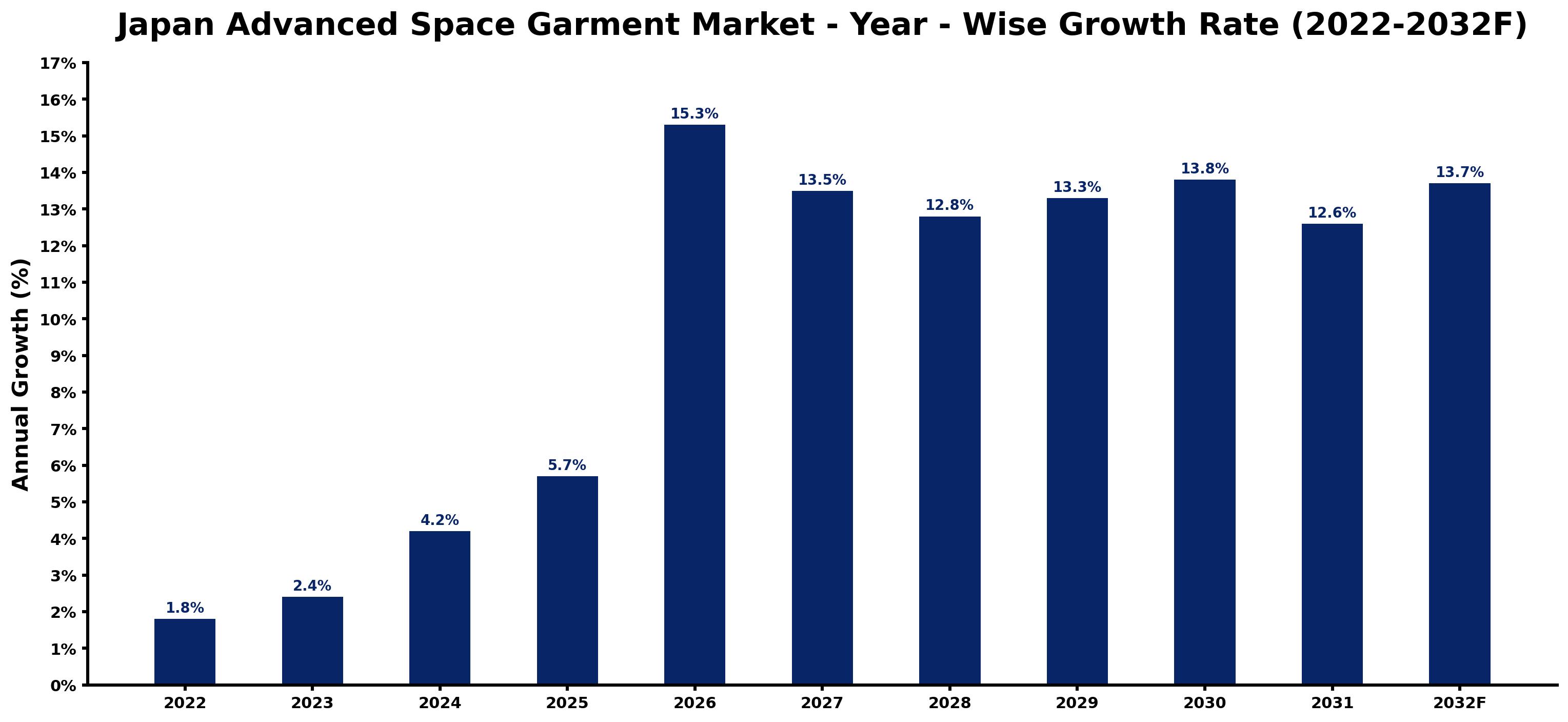
For each year, the table pairs the estimated growth rate with the leading influence on demand, showing how the drivers changed across the period.
| Year | Estimated Annual Growth (%) | Market Rationale |
| 2022 | 1.8 | The market showed initial growth as space agencies ramped up astronaut training. |
| 2023 | 2.4 | Growth accelerated due to increased funding for advanced garment technologies. |
| 2024 | 4.2 | Demand rose as new projects in space exploration were announced. |
| 2025 | 5.7 | The market expanded further with successful tests of new garment prototypes. |
| 2026 | 15.3 | Growth peaked as international collaborations intensified in space missions. |
| 2027 | 13.5 | The growth rate slowed slightly as production stabilised after peak demand. |
| 2028 | 12.8 | Demand continued to grow, driven by advancements in smart textiles. |
| 2029 | 13.3 | The market saw renewed interest with new space missions planned. |
| 2030 | 13.8 | Growth remained strong as health monitoring technologies gained traction. |
| 2031 | 12.6 | A slowdown occurred as the market adjusted to production capacities. |
| 2032 | 13.7 | Demand surged again as new space exploration initiatives were launched. |
Note: Market size estimations and growth projections presented in this report are based on 6Wresearch's proprietary forecasting methodology, utilizing the latest available industry data, government publications, and primary research inputs.
Japan Advanced Space Garment Market Synopsis
Advanced Space Garments are specially designed clothing for use in space environments, utilising high-performance materials like Kevlar and Nomex. These garments protect astronauts during extravehicular activities and in-cabin operations, while also integrating smart textiles for health monitoring.
Market Dynamics Impact Analysis (2026–2032)
| Factor | Type | Impact | Primary Segment Affected |
| Increased funding for garment technology development | Driver | High | Extravehicular Mobility Units |
| Growing international collaborations in space missions | Driver | High | Intravehicular Suits |
| Emerging demand for health monitoring in space | Opportunity | High | Smart Garments for Monitoring |
| Expansion of astronaut training programs | Opportunity | High | Thermal Micrometeoroid Garments |
| High costs associated with advanced material production | Restraint | Medium | Multi-Layered Suits |
| Limited domestic manufacturing capacity for advanced textiles | Restraint | Medium | Kevlar |
| Competition from alternative garment technologies | Challenge | Medium | E-Textiles |
| Challenges in meeting international standards | Challenge | Medium | Radiation-Resistant Foils |
Evaluation of Drivers in Japan Advanced Space Garment Market (2026–2032)
These are the developments adding the most demand over the forecast period.
| Drivers | Primary Segment Affected | Why It Matters (Evidence) |
| Increased investment in space exploration | Extravehicular Mobility Units | Japan's space agency allocated approximately ¥500 million for garment technology development in 2023, boosting demand for advanced suits. |
| Technological advancements in smart textiles | Smart Garments for Monitoring | The integration of E-Textiles for real-time health monitoring is driving purchases from space agencies focused on astronaut safety. |
| Rising astronaut population and training programs | Intravehicular Suits | With around 12 astronauts in Japan, ongoing training increases the need for in-cabin wear. |
| International partnerships in space missions | Thermal Micrometeoroid Garments | Collaborations increase demand for protective garments against micrometeoroid impacts during missions. |
| Development of new space missions | Spacewalk Protection | Planned spacewalks for upcoming missions create a surge in demand for protective suits. |
With around 12 astronauts in Japan, ongoing training increases the need for in-cabin wear. New projects in space exploration are boosting demand for protective garments, ensuring astronaut safety in extreme environments. As international collaborations grow, the need for advanced protective apparel continues to rise, improving overall market prospects.
Evaluation of Restraints in Japan Advanced Space Garment Market
The main factors holding the market back are set out below.
| Market Restraint | Primary Segment Affected | Why It Matters (Evidence) |
| High production costs for advanced materials | Multi-Layered Suits | The production of Multi-Layered Suits involves expensive materials, limiting affordability for buyers. |
| Limited domestic manufacturing capacity for advanced textiles | Kevlar | Japan faces challenges in scaling up production of high-performance textiles like Kevlar, affecting supply. |
| Competition from alternative garment technologies | E-Textiles | Emerging technologies pose a threat to traditional garment offerings, impacting sales. |
| Challenges in meeting international standards | Radiation-Resistant Foils | Stricter international standards complicate compliance for producers, delaying market entry. |
| Slow adoption of smart garment technologies | Smart Garments for Monitoring | Buyers are cautious in adopting new technologies, affecting overall market growth. |
Japan Advanced Space Garment Market Challenges
Producers incur high development costs, with JAXA's budget for garment technology reaching approximately ¥500 million in 2023, which strains resources and limits innovation. Importers face supply chain disruptions due to reliance on advanced textile materials, causing delays in production timelines for manufacturers. Buyers experience increased competition as international collaborations expand, making it challenging for local producers to secure contracts and driving up prices. Compliance with ISO 14644 standards imposes strict requirements, prolonging manufacturing processes and increasing costs for suppliers.
Trends in the Japan Advanced Space Garment Market
Four trends stand out in the Japan Advanced Space Garment Market.
- Shift towards Smart Textiles in Space Garments: The integration of smart textiles is becoming prevalent in advanced space garments, improving monitoring capabilities. JAXA's Space Exploration Innovation Hub is leading this change, with a budget of ¥500 million for garment technology development.
- Transition to Multi-Layered Suits: The focus is shifting towards Multi-Layered Suits, which provide superior thermal protection. As of 2025, these suits will account for 51% of the garment market share, reflecting their importance in astronaut safety.
- Emergence of Lightweight Apparel: Lightweight Apparel is gaining traction, driven by the need for comfort during missions. This segment is projected to grow at a CAGR of 19.4% from 2026 to 2032, indicating a notable shift in design priorities.
- Increased Focus on Health Monitoring: Space agencies are prioritising health monitoring technologies within space garments. With the integration of E-Textiles, demand for these garments is expected to rise significantly in upcoming missions.
Investment Opportunities in the Japan Advanced Space Garment Market
Investors looking at the Japan Advanced Space Garment Market should consider the following areas.
- Space Agencies requiring advanced garments: Space Agencies in Japan are looking for advanced space garments to improve astronaut safety, with a projected market growth of USD 105 million by 2032. Collaborating with local manufacturers could facilitate market entry.
- Smart Garments for Monitoring: The demand for Smart Garments for Monitoring is increasing, driven by health monitoring needs in space. Investing in this technology will attract space agencies focused on astronaut health.
- Expansion of astronaut training facilities: New astronaut training facilities are being established, creating a need for advanced space garments. Partnering with these facilities can provide a direct route to market entry.
- Development of Thermal Micrometeoroid Garments: Investing in Thermal Micrometeoroid Garments is essential as demand grows for protection against micrometeoroid impacts. Collaborating with space agencies will strengthen market presence.
Government Initiatives in the Japan Advanced Space Garment Market
The Building Energy Efficiency Act, amended in 2022, mandates that all new buildings must meet specific energy standards by April 2025. This law impacts producers of advanced space garments by ensuring that manufacturing facilities adhere to energy efficiency requirements, promoting sustainable practices in garment production.
The Japan Aerospace Exploration Agency, with a budget of approximately ¥500 million for 2023, supports garment technology development. This funding allows producers to innovate and meet the increasing demand for advanced space garments.
Future Insight of the Japan Advanced Space Garment Market
The launch of JAXA's Space Exploration Innovation Hub will facilitate advancements in smart textiles for advanced garments. By 2032, the incorporation of real-time health monitoring technologies will enhance safety and performance during missions. Collaborations with universities will produce lightweight materials, reducing overall garment weight and improving mobility for users. Projects aimed at developing thermal micrometeoroid protection will better equip astronauts for long-duration missions.
Market Segmentation Analysis
Japan Advanced Space Garment Market report covers a detailed analysis of the following market segments:
By Advanced Space Garment Market – Extravehicular Mobility Units Lead, Intravehicular Suits Expected to Grow Fastest
According to Saurav Kr Singh, Senior Research Analyst at 6Wresearch, in 2025, Extravehicular Mobility Units led the advanced space garment market split with a 42% share. Extravehicular Mobility Units are essential for astronauts during spacewalks, providing necessary protection against harsh space conditions. JAXA's extensive experience in developing these units has established a strong foundation for their use in Japanese space missions. Intravehicular Suits are projected to grow fastest, at a CAGR of 18.1% during 2026–2032. The demand for Intravehicular Suits is increasing due to a heightened focus on comfort and functionality during in-cabin activities. With approximately 12 astronauts in training, the need for these suits is expected to rise significantly. Suppliers should prioritise the development of Intravehicular Suits to meet the growing requirements of astronauts.
By Garment Type – Multi-Layered Suits Lead, Lightweight Apparel Expected to Grow Fastest
With 51% of garment type revenue in 2025, Multi-Layered Suits was the largest category. Multi-Layered Suits are vital for thermal protection, enabling astronauts to withstand extreme temperatures encountered in space. Their robust design meets the stringent requirements set by space agencies, making them the preferred choice. The quickest growth will come from Lightweight Apparel, forecast to expand at a CAGR of 19.4% between 2026 and 2032. Lightweight Apparel is rapidly gaining traction as it offers enhanced comfort, allowing astronauts greater mobility during missions. As mission durations increase, the demand for this type of apparel is projected to rise. Buyers will benefit from more comfortable garment options, which can lead to improved performance in space.
By Material Composition – Kevlar Leads, Teflon Expected to Grow Fastest
Kevlar held 34% of the Japan Advanced Space Garment Market by material composition in 2025. Kevlar is extensively utilised in advanced space garments due to its outstanding durability and protective capabilities, establishing itself as a key material in the sector. Its proven effectiveness in safeguarding astronauts solidifies its leading position. Over 2026–2032, Teflon is expected to post the fastest growth, at a CAGR of 19.1%. Teflon's usage is on the rise because of its water-resistant properties, essential for maintaining garment integrity under various conditions. As the demand for adaptable materials increases, Teflon's market share is expected to grow. Suppliers should explore including Teflon in their material offerings to align with changing garment needs.
By Application Area – Spacewalk Protection Leads, In-Cabin Wear Expected to Grow Fastest
The largest application area category in 2025 was Spacewalk Protection, at 48% of revenue. Spacewalk Protection is critical for astronaut safety, establishing it as a primary focus for advanced space garments. This emphasis has resulted in the development of highly specialised suits that comply with rigorous safety standards. In-Cabin Wear is set to record the highest CAGR in this split, 16.7% over 2026–2032. In-Cabin Wear is becoming increasingly significant as it directly influences astronaut comfort, thereby enhancing overall mission performance. With longer missions anticipated, the demand for these garments is likely to grow. Suppliers must ensure the availability of In-Cabin Wear options to enhance astronaut comfort.
By End User – Space Agencies Lead, Astronauts Expected to Grow Fastest
Space Agencies took 39% of end user revenue in 2025, more than any other category. Space Agencies serve as the main users of advanced space garments, driving demand through their stringent requirements for astronaut safety and performance. Their substantial investments in garment technology development highlight their critical role in the market. Astronauts are projected to grow fastest, at a CAGR of 17.0% during 2026–2032. Astronauts, as the end users of these garments, are increasingly shaping design and functionality preferences, resulting in a rise in customised offerings. Their direct input is vital for future advancements in garment technology. Suppliers should actively engage with astronauts to better comprehend their needs and preferences.
Key Attractiveness of the Report
- 10 Years of Market Numbers
- Historical Data Starting from 2022 to 2025
- Base Year 2025
- Forecast Data until 2032
- Key Performance Indicators Impacting the Market
- Major Upcoming Developments and Projects
Key Highlights of the Report:
- Japan Advanced Space Garment Market Outlook
- Market Size of Japan Advanced Space Garment Market, 2025
- Forecast of Japan Advanced Space Garment Market, 2032
- Historical Data and Forecast of Japan Advanced Space Garment Revenues & Volume for the Period 2022-2032F
- Japan Advanced Space Garment Market Trend Evolution
- Japan Advanced Space Garment Market Drivers and Challenges
- Japan Advanced Space Garment Price Trends
- Japan Advanced Space Garment Porter's Five Forces
- Japan Advanced Space Garment Industry Life Cycle
- Historical Data and Forecast of Japan Advanced Space Garment Market Revenues & Volume By Advanced Space Garment Market for the Period 2022-2032F
- Historical Data and Forecast of Japan Advanced Space Garment Market Revenues & Volume By Extravehicular Mobility Units for the Period 2022-2032F
- Historical Data and Forecast of Japan Advanced Space Garment Market Revenues & Volume By Intravehicular Suits for the Period 2022-2032F
- Historical Data and Forecast of Japan Advanced Space Garment Market Revenues & Volume By Thermal Micrometeoroid Garments for the Period 2022-2032F
- Historical Data and Forecast of Japan Advanced Space Garment Market Revenues & Volume By Smart Garments for Monitoring for the Period 2022-2032F
- Historical Data and Forecast of Japan Advanced Space Garment Market Revenues & Volume By Garment Type for the Period 2022-2032F
- Historical Data and Forecast of Japan Advanced Space Garment Market Revenues & Volume By Multi-Layered Suits for the Period 2022-2032F
- Historical Data and Forecast of Japan Advanced Space Garment Market Revenues & Volume By Lightweight Apparel for the Period 2022-2032F
- Historical Data and Forecast of Japan Advanced Space Garment Market Revenues & Volume By Insulated Outer Layer for the Period 2022-2032F
- Historical Data and Forecast of Japan Advanced Space Garment Market Revenues & Volume By Sensor-Embedded Fabric for the Period 2022-2032F
- Historical Data and Forecast of Japan Advanced Space Garment Market Revenues & Volume By Material Composition for the Period 2022-2032F
- Historical Data and Forecast of Japan Advanced Space Garment Market Revenues & Volume By Kevlar, Teflon, Nomex for the Period 2022-2032F
- Historical Data and Forecast of Japan Advanced Space Garment Market Revenues & Volume By Fire-Resistant Fabrics for the Period 2022-2032F
- Historical Data and Forecast of Japan Advanced Space Garment Market Revenues & Volume By Radiation-Resistant Foils for the Period 2022-2032F
- Historical Data and Forecast of Japan Advanced Space Garment Market Revenues & Volume By E-Textiles for the Period 2022-2032F
- Historical Data and Forecast of Japan Advanced Space Garment Market Revenues & Volume By Application Area for the Period 2022-2032F
- Historical Data and Forecast of Japan Advanced Space Garment Market Revenues & Volume By Spacewalk Protection for the Period 2022-2032F
- Historical Data and Forecast of Japan Advanced Space Garment Market Revenues & Volume By In-Cabin Wear for the Period 2022-2032F
- Historical Data and Forecast of Japan Advanced Space Garment Market Revenues & Volume By Space Radiation Shielding for the Period 2022-2032F
- Historical Data and Forecast of Japan Advanced Space Garment Market Revenues & Volume By Biometric Tracking for the Period 2022-2032F
- Historical Data and Forecast of Japan Advanced Space Garment Market Revenues & Volume By End User for the Period 2022-2032F
- Historical Data and Forecast of Japan Advanced Space Garment Market Revenues & Volume By Space Agencies for the Period 2022-2032F
- Historical Data and Forecast of Japan Advanced Space Garment Market Revenues & Volume By Astronauts for the Period 2022-2032F
- Historical Data and Forecast of Japan Advanced Space Garment Market Revenues & Volume By Defense Contractors for the Period 2022-2032F
- Historical Data and Forecast of Japan Advanced Space Garment Market Revenues & Volume By Aerospace Health Units for the Period 2022-2032F
- Japan Advanced Space Garment Import Export Trade Statistics
- Market Opportunity Assessment By Advanced Space Garment Market
- Market Opportunity Assessment By Garment Type
- Market Opportunity Assessment By Material Composition
- Market Opportunity Assessment By Application Area
- Market Opportunity Assessment By End User
- Japan Advanced Space Garment Top Companies Market Share
- Japan Advanced Space Garment Competitive Benchmarking By Technical and Operational Parameters
- Japan Advanced Space Garment Company Profiles
- Japan Advanced Space Garment Key Strategic Recommendations
Market Covered
The study includes the following segmentation.
By Advanced Space Garment Market
- Extravehicular Mobility Units
- Intravehicular Suits
- Thermal Micrometeoroid Garments
- Smart Garments for Monitoring
By Garment Type
- Multi-Layered Suits
- Lightweight Apparel
- Insulated Outer Layer
- Sensor-Embedded Fabric
By Material Composition
- Kevlar
- Teflon
- Nomex
- Fire-Resistant Fabrics
- Radiation-Resistant Foils
- E-Textiles
By Application Area
- Spacewalk Protection
- In-Cabin Wear
- Space Radiation Shielding
- Biometric Tracking
By End User
- Space Agencies
- Astronauts
- Defense Contractors
- Aerospace Health Units































