Japan Advanced Surveillance Radar Market Size & Growth Rate
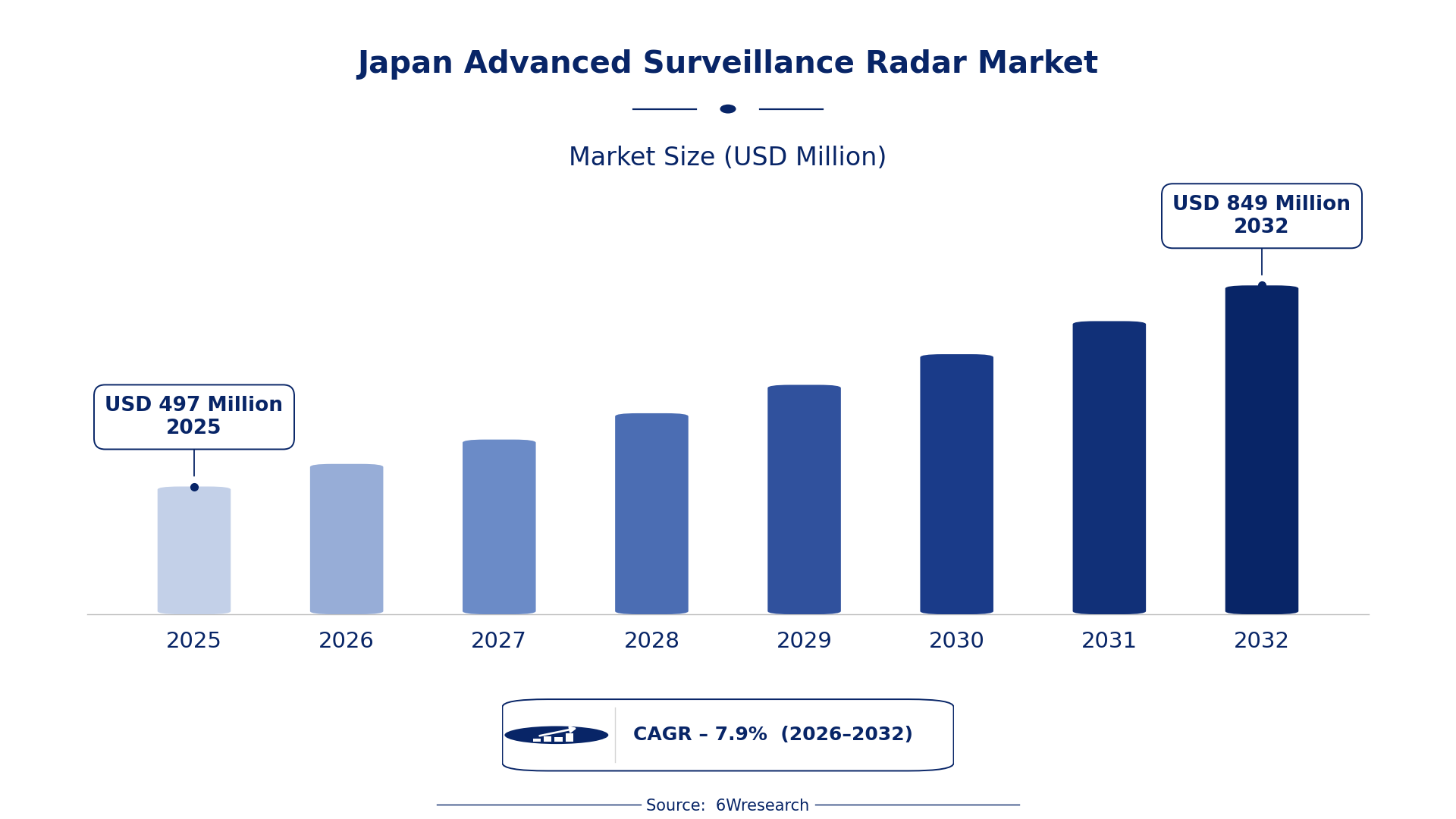
According to 6Wresearch internal database and industry insights, the Japan Advanced Surveillance Radar Market was valued at USD 497 Million in 2025 and is projected to reach USD 849 Million by 2032, growing at a CAGR of approximately 7.9% during 2026–2032.
Japan Advanced Surveillance Radar Market Highlights
| Report Metric | Details |
| Report Name | Japan Advanced Surveillance Radar Market (2026-2032) |
| Market Size 2025 | USD 497 Million |
| Market Size 2032 | USD 849 Million |
| Absolute Growth 2025–2032 | USD 352 Million |
| CAGR 2026–2032 | 7.9% |
| Peak Annual Growth | 9.5% in 2030 |
| Forecast Period | 2026–2032 |
| Historical Data | 2022–2025 |
| Base Year | 2025 |
| Leading Advanced Surveillance Radar Market, 2025 | Ground Surveillance Radar (47% share) |
| Leading Radar Type, 2025 | Surface Movement (40% share) |
| Leading Frequency Band, 2025 | X-Band (41% share) |
| Leading Application Area, 2025 | Border Monitoring (37% share) |
| Leading End User, 2025 | Military Forces (47% share) |
| Fastest-Growing Advanced Surveillance Radar Market | Airborne Surveillance Radar (10.8% CAGR) |
| Fastest-Growing Radar Type | Airborne Platforms (11.1% CAGR) |
| Fastest-Growing Frequency Band | C-Band (10.3% CAGR) |
| Fastest-Growing Application Area | Airspace Monitoring (9.5% CAGR) |
| Fastest-Growing End User | Defense Agencies (10.2% CAGR) |
| Growing Sector | Military Surveillance |
| Key End Users | Military Forces, Defense Agencies, Navy, Defense Infrastructure |
Japan Advanced Surveillance Radar Market Year-wise Growth Rate and Key Drivers (2022–2032)
This graph illustrates the annual growth rates of the market from 2022 to 2032, highlighting a steady upward trajectory and projected market expansion over the forecast period.
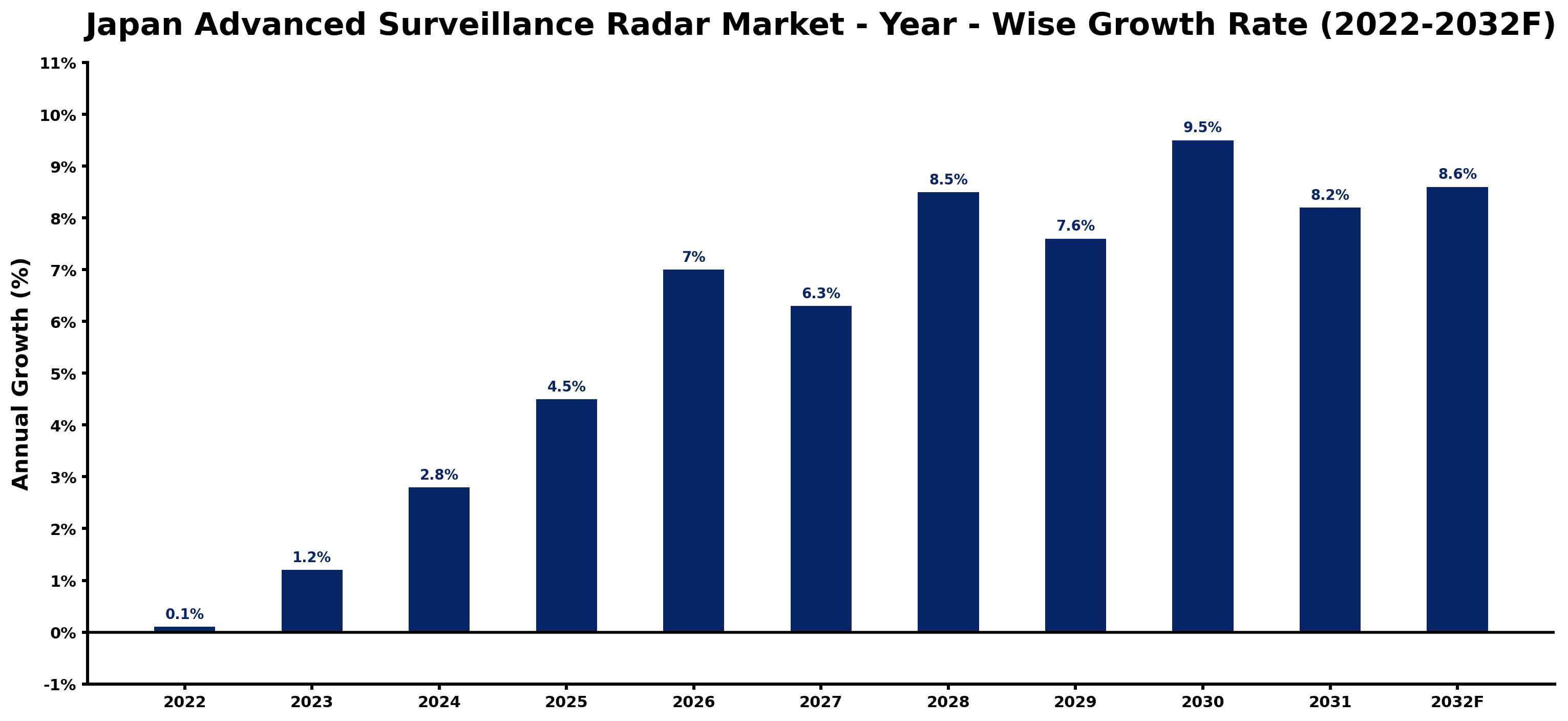
The yearly estimates that follow link every growth rate to its principal driver, so readers can see why the pace changed in each period.
| Year | Estimated Annual Growth (%) | Market Rationale |
| 2022 | 0.1 | The market experienced minimal growth due to limited investments in advanced technologies. |
| 2023 | 1.2 | Increased focus on national security prompted higher demand for surveillance systems. |
| 2024 | 2.8 | The introduction of new defense strategies led to greater procurement of radar technologies. |
| 2025 | 4.5 | The budget allocation for defense reached ¥5.3 trillion, boosting market activity. |
| 2026 | 7.0 | Growing investment in advanced radar systems is expected to drive demand. |
| 2027 | 6.3 | Demand growth slows as the market adjusts to increased supply capabilities. |
| 2028 | 8.5 | Technological advancements in radar systems are anticipated to enhance market growth. |
| 2029 | 7.6 | Market growth slows as competition among suppliers intensifies. |
| 2030 | 9.5 | The peak growth rate is driven by heightened military readiness and modernization efforts. |
| 2031 | 8.2 | Growth decelerates slightly as market saturation begins to take effect. |
| 2032 | 8.6 | Continued investment in surveillance technology is projected to sustain growth. |
Note: Market size estimations and growth projections presented in this report are based on 6Wresearch's proprietary forecasting methodology, utilizing the latest available industry data, government publications, and primary research inputs.
Japan Advanced Surveillance Radar Market Synopsis
Advanced Surveillance Radar is a sophisticated technology designed for detecting and tracking objects across various environments, primarily used in military surveillance, air traffic control, and maritime monitoring. The Japan Advanced Surveillance Radar Market is expanding due to a budget allocation of ¥5.3 trillion for defense in 2023 and a strong emphasis on enhancing national security capabilities. Collaboration between the Japan Aerospace Exploration Agency and defense agencies drives demand for radar systems, ensuring continuous technological advancements and integration into existing infrastructures.
Market Dynamics Impact Analysis (2026–2032)
| Factor | Type | Impact | Primary Segment Affected |
| Increased defense budget allocations are driving demand for advanced surveillance radar systems. | Driver | High | Ground Surveillance Radar |
| Technological advancements in radar systems are creating new opportunities for enhanced capabilities. | Driver | High | Ground Surveillance Radar |
| Growing emphasis on border security is creating demand for advanced surveillance solutions. | Opportunity | High | Border Monitoring |
| The need for enhanced air traffic control systems is driving investments in radar technologies. | Opportunity | High | Airspace Monitoring |
| High costs associated with advanced radar system integration may limit market growth. | Restraint | Medium | Ground Surveillance Radar |
| Regulatory hurdles in frequency allocation can delay radar system deployment. | Restraint | Medium | Ground Surveillance Radar |
| Competition among suppliers can lead to price wars, affecting profitability. | Challenge | High | Ground Surveillance Radar |
| Technological obsolescence poses risks for suppliers in maintaining market relevance. | Challenge | Medium | Ground Surveillance Radar |
Evaluation of Drivers in Japan Advanced Surveillance Radar Market (2026–2032)
The main growth drivers and the segments they affect most are set out below.
| Drivers | Primary Segment Affected | Why It Matters (Evidence) |
| Increased defense spending | Ground Surveillance Radar | The Ministry of Defense allocated ¥5.3 trillion for defense in 2023, prompting higher procurement of radar systems. |
| Technological advancements | Airborne Surveillance Radar | Innovations in radar technology improve capabilities, leading to increased demand from military forces. |
| Focus on border security | Border Monitoring | Heightened national security concerns drive the need for advanced surveillance solutions in border areas. |
| Air traffic control improvements | Airspace Monitoring | The X-Band radar is widely used in major airports, increasing demand for advanced air traffic management systems. |
| Collaborations in radar technology | Coastal Surveillance Radar | Partnerships with allied nations improve capabilities and increase demand for advanced maritime security systems. |
Volumes grow on the back of increased defense spending, with ¥5.3 trillion allocated for 2023, prompting heightened procurement of advanced surveillance systems. Technological advancements in radar systems improve capabilities, driving demand from military forces. The focus on border security has intensified, prompting investments in advanced monitoring solutions. Major airports increasingly rely on X-Band radar for air traffic control, further boosting demand. Partnerships with allied nations are enhancing capabilities and increasing demand for coastal surveillance systems.
Evaluation of Restraints in Japan Advanced Surveillance Radar Market
These restraints slow adoption and weigh on supplier margins.
| Market Restraint | Primary Segment Affected | Why It Matters (Evidence) |
| High integration costs | Ground Surveillance Radar | The substantial costs associated with integrating advanced radar systems can deter potential buyers, limiting market growth. |
| Regulatory hurdles | Ground Surveillance Radar | Strict regulations on frequency allocations can delay the deployment of radar systems, affecting market growth. |
| Supplier competition | Ground Surveillance Radar | Intense competition among suppliers can lead to price wars, impacting profitability and market stability. |
| Technological obsolescence | Ground Surveillance Radar | Rapid advancements in technology can render existing systems obsolete, posing risks for suppliers. |
| Limited domestic production capacity | Ground Surveillance Radar | Dependence on imports for advanced technologies can constrain local production capabilities and market growth. |
Japan Advanced Surveillance Radar Market Challenges
High complexity in advanced surveillance radar technology delays procurement for defense agencies. This complexity arises from the sophisticated electronics and software algorithms required, extending project timelines by up to 20%. Rising manufacturing costs, driven by advanced materials, are expected to increase production budgets for suppliers by 15% over the next five years. Stringent regulations on radar frequency allocations complicate compliance for manufacturers, resulting in delays that can extend timelines by several months. Skills shortages in specialised radar fields limit production capabilities, constraining output for buyers in the defense sector.
Trends in the Japan Advanced Surveillance Radar Market
Four trends stand out in the Japan Advanced Surveillance Radar Market.
- Shift towards Enhanced Border Security: Japan is prioritising border security enhancements, as seen in increased investment in advanced surveillance systems. The budget for defense reached ¥5.3 trillion in 2023.
- Transition from C-Band to X-Band for Air Traffic Control: The shift towards X-Band radar for air traffic control is evident in major airports, improving operational efficiency. This transition is supported by technological advancements and increased demand for high-resolution imaging.
- Military Forces Emphasising Advanced Surveillance Capabilities: Military Forces are increasingly adopting advanced surveillance technologies to improve operational readiness. The Self-Defense Forces of Japan are leading this trend, utilising advanced radar systems for comprehensive situational awareness.
- Growing Demand for Multi-Dimensional Tracking: The need for multi-dimensional tracking is rising, particularly in naval operations. The Japan Maritime Self-Defense Force employs advanced radar systems to improve maritime situational awareness.
Investment Opportunities in the Japan Advanced Surveillance Radar Market
Where to invest in the Japan Advanced Surveillance Radar Market: the main openings are set out below.
- Gap in Advanced Surveillance Technology: With a projected market size of USD 849 million by 2032, there is an opportunity for suppliers to invest in advanced surveillance technologies. Military Forces are actively seeking solutions to enhance operational capabilities.
- Demand for Airspace Monitoring Solutions: The airspace monitoring sector requires advanced radar systems, with a projected growth rate of 9.5%. Defense agencies are looking to procure these technologies to improve air traffic management.
- Investment in Coastal Surveillance Systems: The coastal surveillance sector presents opportunities for suppliers, driven by the need for enhanced maritime security. The Japan Maritime Self-Defense Force is investing in advanced radar systems to bolster coastal monitoring capabilities.
- Focus on Multi-Dimensional Tracking Technologies: The growing emphasis on multi-dimensional tracking creates investment opportunities in radar technologies. Defense agencies are seeking suppliers that can provide advanced solutions for comprehensive situational awareness.
Government Initiatives in the Japan Advanced Surveillance Radar Market
The Digital Agency leads government digital transformation, impacting advanced surveillance radar producers by establishing common system standards. The Industrial Standardization Act governs product and test standards, ensuring compliance for radar manufacturers in Japan, with a focus on quality assurance and safety protocols.
The Japan Defense Agency oversees the procurement of advanced surveillance technologies, with a focus on national security. The agency has approved funding for various radar technology projects, ensuring that advanced surveillance radar systems meet operational requirements and improve defense capabilities.
Future Insight of the Japan Advanced Surveillance Radar Market
The Self-Defense Forces will transform their surveillance capabilities by 2032 as advancements in radar systems emerge alongside increased budget allocations of ¥5.3 trillion. Enhanced collaboration with allied nations will drive rapid innovation, benefiting both suppliers and buyers. Ongoing projects by the Japan Aerospace Exploration Agency will likely yield breakthroughs that improve military and civilian applications. The integration of next-generation radar systems will streamline operations and improve the effectiveness of surveillance efforts.
Market Segmentation Analysis
Japan Advanced Surveillance Radar Market report covers a detailed analysis of the following market segments:
By Advanced Surveillance Radar Market – Ground Surveillance Radar Leads, Airborne Surveillance Radar Expected to Grow Fastest
According to Saurav Kr Singh, Senior Research Analyst at 6Wresearch, Ground Surveillance Radar took 47% of advanced surveillance radar market revenue in 2025, more than any other category. Ground Surveillance Radar holds the largest share due to its critical role in monitoring land borders and troop movements, essential for national security. The consistent demand from the Self-Defense Forces of Japan underlines its importance in the defence landscape. The quickest growth will come from Airborne Surveillance Radar, forecast to expand at a CAGR of 10.8% between 2026 and 2032. Airborne Surveillance Radar is experiencing rapid growth as it is indispensable for aerial reconnaissance and threat detection, with increased investments in advanced technology driving this trend. The collaboration with research agencies is likely to further enhance its capabilities and adoption. Suppliers should prioritise the development of airborne systems to align with the increasing demand in the market.
By Radar Type – Surface Movement Leads, Airborne Platforms Expected to Grow Fastest
Surface Movement held 40% of the Japan Advanced Surveillance Radar Market by radar type in 2025. Surface Movement radar leads the market as it provides vital data for military operations and security applications, effectively supporting ground operations. Its integration into national defence strategies ensures its ongoing relevance and necessity. Over 2026–2032, Airborne Platforms are expected to post the fastest growth, at a CAGR of 11.1%. Airborne Platforms are witnessing the fastest growth as they are increasingly utilised alongside other systems for comprehensive surveillance solutions. This trend underscores the rising demand for advanced aerial monitoring capabilities. Buyers should consider investing in integrated radar systems that combine various types for enhanced operational effectiveness.
By Frequency Band – X-Band Leads, C-Band Expected to Grow Fastest
With 41% of frequency band revenue in 2025, X-Band was the largest category. X-Band radar dominates the market as it is widely employed for high-resolution imaging, making it indispensable for detailed surveillance tasks. Its applications in military operations and air traffic control reinforce its leading position. C-Band is projected to grow fastest, at a CAGR of 10.3% during 2026–2032. C-Band radar is witnessing rapid growth due to its preference for long-range detection capabilities, essential for thorough surveillance operations. The focus on enhancing detection ranges aligns with national security priorities. Suppliers should focus on advancing C-Band technologies to capture the growing segment of the market.
By Application Area – Border Monitoring Leads, Airspace Monitoring Expected to Grow Fastest
In 2025, Border Monitoring led the application area split with a 37% share. Border Monitoring is the leading application area as it is crucial for national security and immigration control, ensuring the protection of the nation's borders. The emphasis on improving surveillance capabilities in this area drives its demand. Airspace Monitoring is set to record the highest CAGR in this split, 9.5% over 2026–2032. Airspace Monitoring is the fastest-growing segment, vital for managing air traffic and preventing incursions, particularly with the increase in air traffic. The need for effective airspace management solutions is fuelling its growth. Investments in airspace monitoring technologies will be vital for suppliers to meet both regulatory and operational requirements.
By End User – Military Forces Lead, Defense Agencies Expected to Grow Fastest
The largest end user category in 2025 was Military Forces, at 47% of revenue. Military Forces represent the largest user group of advanced surveillance technology, directly relying on these systems for operational effectiveness. The ongoing budget allocations for defence ensure a consistent demand from this sector. The quickest growth will come from Defense Agencies, forecast to expand at a CAGR of 10.2% between 2026 and 2032. Defense Agencies are the fastest-growing end user as they play a key role in procurement and operational deployment of advanced surveillance technologies. Their increasing involvement reflects the strategic importance of surveillance in national security. Suppliers should engage with defense agencies to align their offerings with procurement strategies.
Key Attractiveness of the Report
- 10 Years of Market Numbers
- Historical Data Starting from 2022 to 2025
- Base Year 2025
- Forecast Data until 2032
- Key Performance Indicators Impacting the Market
- Major Upcoming Developments and Projects
Key Highlights of the Report:
- Japan Advanced Surveillance Radar Market Outlook
- Market Size of Japan Advanced Surveillance Radar Market, 2025
- Forecast of Japan Advanced Surveillance Radar Market, 2032
- Historical Data and Forecast of Japan Advanced Surveillance Radar Revenues & Volume for the Period 2022-2032F
- Japan Advanced Surveillance Radar Market Trend Evolution
- Japan Advanced Surveillance Radar Market Drivers and Challenges
- Japan Advanced Surveillance Radar Price Trends
- Japan Advanced Surveillance Radar Porter's Five Forces
- Japan Advanced Surveillance Radar Industry Life Cycle
- Historical Data and Forecast of Japan Advanced Surveillance Radar Market Revenues & Volume By Advanced Surveillance Radar Market for the Period 2022-2032F
- Historical Data and Forecast of Japan Advanced Surveillance Radar Market Revenues & Volume By Ground Surveillance Radar for the Period 2022-2032F
- Historical Data and Forecast of Japan Advanced Surveillance Radar Market Revenues & Volume By Airborne Surveillance Radar for the Period 2022-2032F
- Historical Data and Forecast of Japan Advanced Surveillance Radar Market Revenues & Volume By Coastal Surveillance Radar for the Period 2022-2032F
- Historical Data and Forecast of Japan Advanced Surveillance Radar Market Revenues & Volume By 3D Surveillance Radar for the Period 2022-2032F
- Historical Data and Forecast of Japan Advanced Surveillance Radar Market Revenues & Volume By Radar Type for the Period 2022-2032F
- Historical Data and Forecast of Japan Advanced Surveillance Radar Market Revenues & Volume By Surface Movement for the Period 2022-2032F
- Historical Data and Forecast of Japan Advanced Surveillance Radar Market Revenues & Volume By Airborne Platforms for the Period 2022-2032F
- Historical Data and Forecast of Japan Advanced Surveillance Radar Market Revenues & Volume By Marine Radar Systems for the Period 2022-2032F
- Historical Data and Forecast of Japan Advanced Surveillance Radar Market Revenues & Volume By Rotating Array Systems for the Period 2022-2032F
- Historical Data and Forecast of Japan Advanced Surveillance Radar Market Revenues & Volume By Frequency Band for the Period 2022-2032F
- Historical Data and Forecast of Japan Advanced Surveillance Radar Market Revenues & Volume By X-Band for the Period 2022-2032F
- Historical Data and Forecast of Japan Advanced Surveillance Radar Market Revenues & Volume By C-Band for the Period 2022-2032F
- Historical Data and Forecast of Japan Advanced Surveillance Radar Market Revenues & Volume By S-Band for the Period 2022-2032F
- Historical Data and Forecast of Japan Advanced Surveillance Radar Market Revenues & Volume By L-Band for the Period 2022-2032F
- Historical Data and Forecast of Japan Advanced Surveillance Radar Market Revenues & Volume By Application Area for the Period 2022-2032F
- Historical Data and Forecast of Japan Advanced Surveillance Radar Market Revenues & Volume By Border Monitoring for the Period 2022-2032F
- Historical Data and Forecast of Japan Advanced Surveillance Radar Market Revenues & Volume By Airspace Monitoring for the Period 2022-2032F
- Historical Data and Forecast of Japan Advanced Surveillance Radar Market Revenues & Volume By Naval Observation for the Period 2022-2032F
- Historical Data and Forecast of Japan Advanced Surveillance Radar Market Revenues & Volume By Multi-Dimensional Tracking for the Period 2022-2032F
- Historical Data and Forecast of Japan Advanced Surveillance Radar Market Revenues & Volume By End User for the Period 2022-2032F
- Historical Data and Forecast of Japan Advanced Surveillance Radar Market Revenues & Volume By Military Forces for the Period 2022-2032F
- Historical Data and Forecast of Japan Advanced Surveillance Radar Market Revenues & Volume By Defense Agencies for the Period 2022-2032F
- Historical Data and Forecast of Japan Advanced Surveillance Radar Market Revenues & Volume By Navy for the Period 2022-2032F
- Historical Data and Forecast of Japan Advanced Surveillance Radar Market Revenues & Volume By Defense Infrastructure for the Period 2022-2032F
- Japan Advanced Surveillance Radar Import Export Trade Statistics
- Market Opportunity Assessment By Advanced Surveillance Radar Market
- Market Opportunity Assessment By Radar Type
- Market Opportunity Assessment By Frequency Band
- Market Opportunity Assessment By Application Area
- Market Opportunity Assessment By End User
- Japan Advanced Surveillance Radar Top Companies Market Share
- Japan Advanced Surveillance Radar Competitive Benchmarking By Technical and Operational Parameters
- Japan Advanced Surveillance Radar Company Profiles
- Japan Advanced Surveillance Radar Key Strategic Recommendations
Market Covered
The study includes the following segmentation.
By Advanced Surveillance Radar Market
- Ground Surveillance Radar
- Airborne Surveillance Radar
- Coastal Surveillance Radar
- 3D Surveillance Radar
By Radar Type
- Surface Movement
- Airborne Platforms
- Marine Radar Systems
- Rotating Array Systems
By Frequency Band
- X-Band
- C-Band
- S-Band
- L-Band
By Application Area
- Border Monitoring
- Airspace Monitoring
- Naval Observation
- Multi-Dimensional Tracking
By End User
- Military Forces
- Defense Agencies
- Navy
- Defense Infrastructure































