Japan Advanced Vehicle Collision Avoidance Technologies Market Size & Growth Rate
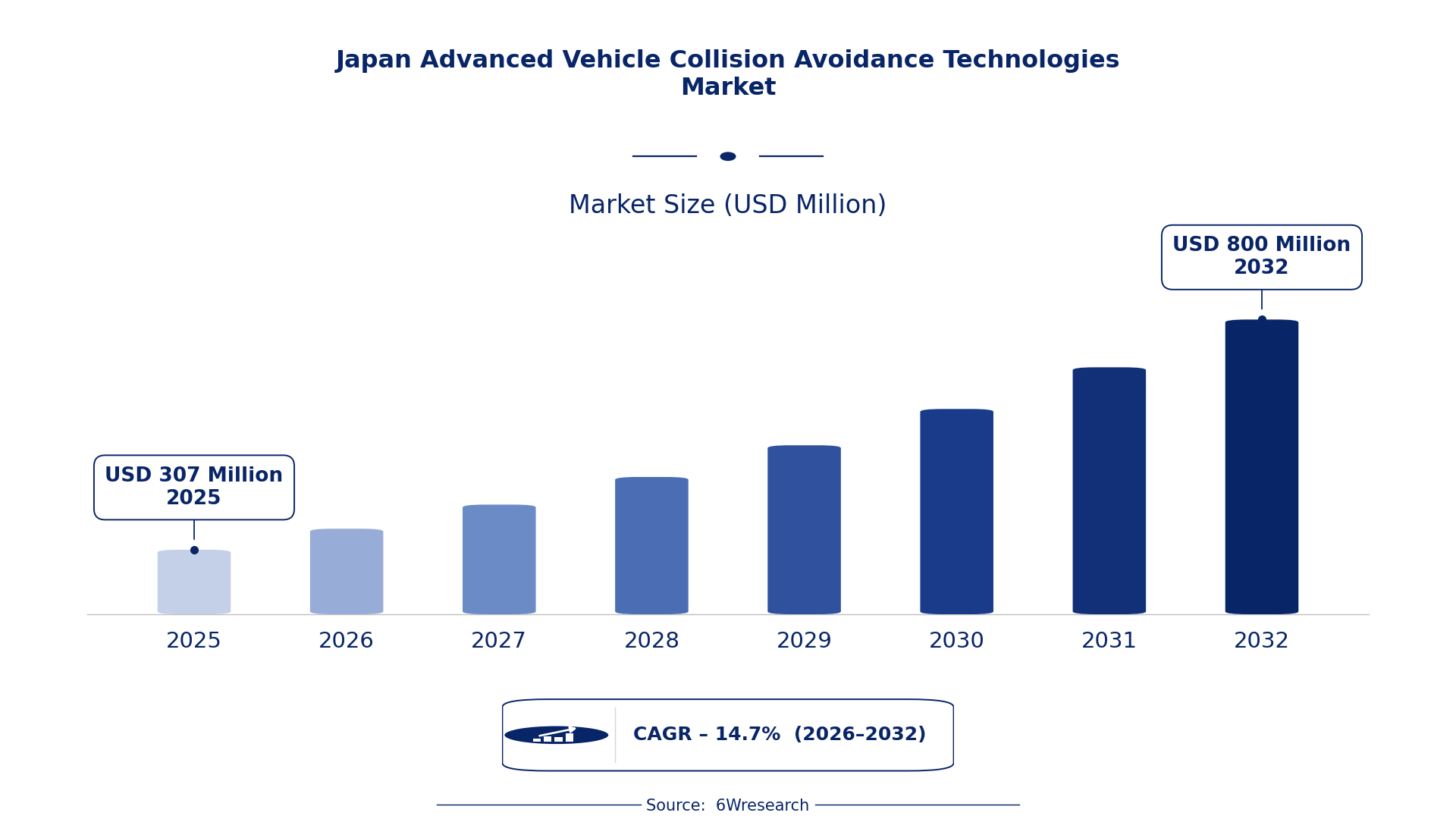
According to 6Wresearch internal database and industry insights, the Japan Advanced Vehicle Collision Avoidance Technologies Market was valued at USD 307 Million in 2025 and is projected to reach USD 800 Million by 2032, growing at a CAGR of approximately 14.7% during 2026–2032.
Japan Advanced Vehicle Collision Avoidance Technologies Market Highlights
| Report Metric | Details |
| Report Name | Japan Advanced Vehicle Collision Avoidance Technologies Market (2026-2032) |
| Market Size 2025 | USD 307 Million |
| Market Size 2032 | USD 800 Million |
| Absolute Growth 2025–2032 | USD 493 Million |
| CAGR 2026–2032 | 14.7% |
| Peak Annual Growth | 16.3% in 2026 |
| Forecast Period | 2026–2032 |
| Historical Data | 2022–2025 |
| Base Year | 2025 |
| Leading Advanced Vehicle Collision Avoidance Technologies Market, 2025 | Automatic Emergency Braking (AEB) (42% share) |
| Leading Technology Type, 2025 | AI-Based (52% share) |
| Leading Detection Method, 2025 | Camera + Radar (40% share) |
| Leading Integration Type, 2025 | OEM-Integrated (51% share) |
| Leading Vehicle Segment, 2025 | Passenger Cars (48% share) |
| Fastest-Growing Advanced Vehicle Collision Avoidance Technologies Market | Lane Departure Warning Systems (20.4% CAGR) |
| Fastest-Growing Technology Type | LIDAR/GPS Enabled (20.5% CAGR) |
| Fastest-Growing Detection Method | Sensor Fusion (17.2% CAGR) |
| Fastest-Growing Integration Type | Aftermarket & OEM (20.1% CAGR) |
| Fastest-Growing Vehicle Segment | Luxury Vehicles (18.7% CAGR) |
| Growing Sector | Luxury Vehicles |
| Key End Users | Passenger Cars, SUVs & Sedans, Luxury Vehicles, Commercial Fleets |
Japan Advanced Vehicle Collision Avoidance Technologies Market Year-wise Growth Rate and Key Drivers (2022–2032)
This graph illustrates the annual growth rates of the market from 2022 to 2032, highlighting a steady upward trajectory and projected market expansion over the forecast period.
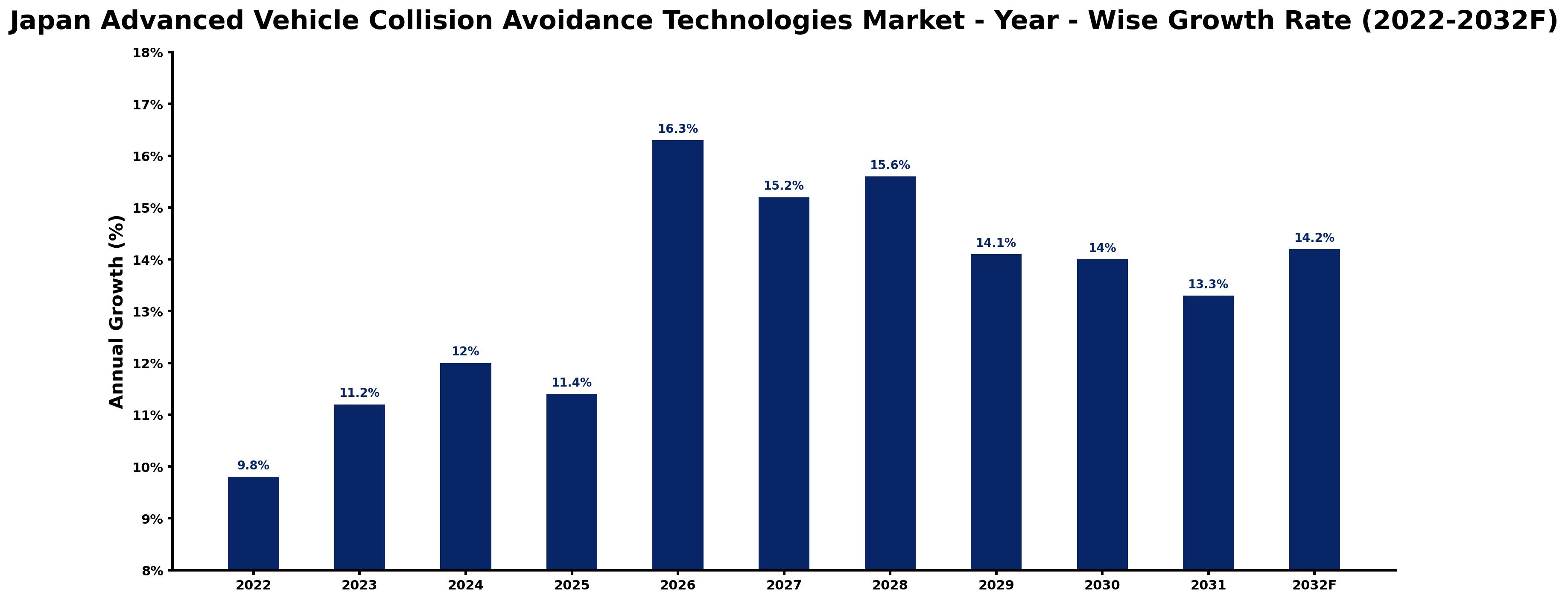
Below, each year's estimated growth is shown next to the factor that most influenced it.
| Year | Estimated Annual Growth (%) | Market Rationale |
| 2022 | 9.8 | The market showed steady growth due to increasing awareness of vehicle safety. |
| 2023 | 11.2 | Demand rose as more vehicles were equipped with advanced technologies. |
| 2024 | 12.0 | Growth accelerated with the introduction of new safety standards. |
| 2025 | 11.4 | The market experienced a slowdown as saturation began in some segments. |
| 2026 | 16.3 | Growth surged with heightened investments in safety technologies. |
| 2027 | 15.2 | A slight slowdown occurred as the market stabilised after rapid growth. |
| 2028 | 15.6 | Demand increased again due to new technological advancements. |
| 2029 | 14.1 | The market slowed as competition intensified among suppliers. |
| 2030 | 14.0 | Growth moderated as the market reached maturity in several areas. |
| 2031 | 13.3 | A further slowdown was noted as the market stabilised. |
| 2032 | 14.2 | Demand is expected to rise again with new innovations in safety. |
Note: Market size estimations and growth projections presented in this report are based on 6Wresearch's proprietary forecasting methodology, utilizing the latest available industry data, government publications, and primary research inputs.
Japan Advanced Vehicle Collision Avoidance Technologies Market Synopsis
Advanced Vehicle Collision Avoidance Technologies are systems designed to prevent accidents by alerting drivers or automatically controlling vehicles. In 2022, over 70 million registered vehicles in Japan were equipped with such systems, primarily driven by domestic manufacturers and aftermarket installations. The Japan Advanced Vehicle Collision Avoidance Technologies Market is growing due to rising safety standards, with investments in R&D exceeding ¥1 trillion by 2025, and government initiatives like the 'Safety Vision 2025' programme, which aims for a 50% reduction in traffic fatalities by 2030.
Market Dynamics Impact Analysis (2026–2032)
| Factor | Type | Impact | Primary Segment Affected |
| Increasing vehicle registrations in urban areas drive demand for safety technologies. | Driver | High | Automatic Emergency Braking (AEB) |
| Growing consumer preference for advanced safety features enhances market growth. | Driver | High | Lane Departure Warning Systems |
| The push for retrofitting older vehicles with modern safety technologies creates opportunities. | Opportunity | High | Blind Spot Detection Systems |
| The rising demand for luxury vehicles equipped with advanced safety features presents growth potential. | Opportunity | High | Luxury Vehicles |
| High development costs for advanced technologies may limit market entry for smaller firms. | Restraint | Medium | Forward Collision Warning (FCW) |
| The complexity of integrating multiple technologies can hinder adoption rates. | Restraint | Medium | Sensor Fusion |
| Competition among suppliers can lead to price wars, affecting profitability. | Challenge | High | OEM-Integrated |
| Rapid technological advancements may outpace regulatory frameworks, causing uncertainty. | Challenge | Medium | Aftermarket & OEM |
Evaluation of Drivers in Japan Advanced Vehicle Collision Avoidance Technologies Market (2026–2032)
Demand rests on the following drivers, each shown with the segment it touches most.
| Drivers | Primary Segment Affected | Why It Matters (Evidence) |
| Increased investment in R&D for safety technologies drives demand. | Automatic Emergency Braking (AEB) | The automotive sector in Japan is expected to invest over ¥1 trillion in safety technologies by 2025. |
| Rising consumer awareness of road safety boosts technology adoption. | Lane Departure Warning Systems | The initiative 'Safety Vision 2025' promotes advanced safety systems. |
| Government targets for traffic fatality reduction encourage manufacturers to innovate. | Blind Spot Detection Systems | The Japanese government aims for a 50% reduction in traffic fatalities by 2030. |
| Growing urbanisation increases the need for collision avoidance technologies. | Forward Collision Warning (FCW) | The Tokyo metropolitan area has over 10 million vehicles, influencing demand. |
| The introduction of new safety standards accelerates market growth. | Sensor Fusion | ISO 26262 is a key standard for functional safety in automotive systems. |
Buyers are adding capacity as the automotive sector invests over ¥1 trillion in safety technologies by 2025, reflecting a commitment to vehicle safety. Urban areas, particularly Tokyo, with high vehicle density, increase the need for collision avoidance systems. The push for a 50% reduction in traffic fatalities by 2030 drives innovation across various technologies. The introduction of new safety standards accelerates development in the sector, leading to more advanced systems being integrated into vehicles. Demand for LIDAR technology is rising, as manufacturers focus on improving vehicle safety features.
Evaluation of Restraints in Japan Advanced Vehicle Collision Avoidance Technologies Market
These are the pressures that could keep growth below its potential.
| Market Restraint | Primary Segment Affected | Why It Matters (Evidence) |
| High retrofitting costs limit the adoption of advanced technologies in older vehicles. | Automatic Emergency Braking (AEB) | The average retrofitting cost can exceed ¥200,000 per vehicle. |
| Complexity of existing vehicle systems delays integration of new technologies. | Lane Departure Warning Systems | Aftermarket suppliers face challenges in adapting advanced systems to older models. |
| Regulatory compliance can prolong the certification process for new technologies. | Blind Spot Detection Systems | Meeting ISO 26262 standards can delay market entry for producers. |
| Limited consumer awareness hinders the adoption of advanced safety features. | Forward Collision Warning (FCW) | Many buyers are unaware of the benefits of collision avoidance technologies. |
| Intense competition among suppliers can lead to price wars, affecting profitability. | Sensor Fusion | As more players enter the market, margins may decrease. |
Japan Advanced Vehicle Collision Avoidance Technologies Market Challenges
In urban areas like Tokyo, integrating advanced collision avoidance technologies often encounters delays due to the complexity of existing vehicle systems, raising installation costs for aftermarket suppliers. The average retrofitting cost can exceed ¥200,000 per vehicle, affecting affordability for consumers. Regulatory hurdles arise from the need to comply with ISO 26262 standards, which can prolong the certification process for new technologies, delaying market entry for producers. Buyers face frustration as the government aims for a 50% reduction in traffic fatalities by 2030, yet many vehicles still lack critical safety features, limiting their options.
Trends in the Japan Advanced Vehicle Collision Avoidance Technologies Market
These developments are changing demand patterns in the Japan Advanced Vehicle Collision Avoidance Technologies Market.
- Integration of LIDAR Technology: LIDAR technology is becoming more prevalent in urban areas, particularly in the Kanagawa Prefecture, which has implemented smart traffic management systems. This shift improves the accuracy of collision avoidance systems.
- Growing Demand for Aftermarket Solutions: The aftermarket for collision avoidance technologies is expanding, with a projected growth rate of 20.1% for Aftermarket & OEM integration. This is driven by increasing consumer demand for vehicle safety enhancements.
- Focus on Urban Safety Initiatives: The 'Smart Mobility Challenge' program encourages innovation in vehicle safety technologies, aiming to improve urban safety. This initiative is part of a broader strategy to reduce traffic fatalities in metropolitan areas.
- Shift towards AI-Based Technologies: The adoption of AI-based systems in vehicles is increasing, with over 30% of new vehicles sold in Japan including such technologies. This trend is driven by the need for improved decision-making capabilities in collision avoidance.
Investment Opportunities in the Japan Advanced Vehicle Collision Avoidance Technologies Market
Investors looking at the Japan Advanced Vehicle Collision Avoidance Technologies Market should consider the following areas.
- Supply Advanced Collision Avoidance Systems: With over 70 million vehicles registered in Japan, there is a significant opportunity to supply advanced collision avoidance systems. The Tokyo metropolitan area, with its high vehicle density, presents a prime market for these technologies.
- Invest in Retrofitting Technologies: The average retrofitting cost can exceed ¥200,000 per vehicle, indicating a gap in affordable solutions. Targeting aftermarket suppliers in urban areas can help meet this demand.
- Develop LIDAR-Enabled Systems: The increasing use of LIDAR technology in urban environments presents opportunities for suppliers. Focusing on regions like Kanagawa can improve market entry strategies.
- Enhance Safety Features for Luxury Vehicles: Luxury vehicles, projected to grow at a rate of 18.7%, represent a promising opportunity. Suppliers can partner with manufacturers to integrate advanced safety features.
Government Initiatives in the Japan Advanced Vehicle Collision Avoidance Technologies Market
The GX Promotion Act (2023) establishes a legal framework for promoting advanced vehicle safety technologies. This act complements existing regulations by providing incentives for manufacturers to innovate and comply with safety standards, ultimately broadening the market for collision avoidance technologies. The government aims for all new vehicles to be equipped with collision avoidance technologies by 2025, which will significantly impact production and sales.
The Japan Automobile Manufacturers Association (JAMA) actively supports the adoption of advanced safety features through various initiatives. By collaborating with the government, JAMA facilitates the implementation of safety standards and promotes consumer awareness, benefiting both producers and buyers in the market. The association has reported that over 30% of new vehicles sold include Automatic Emergency Braking systems, reflecting the growing emphasis on safety.
Future Insight of the Japan Advanced Vehicle Collision Avoidance Technologies Market
Japan's policy shift towards mandatory collision avoidance technologies will reshape the automotive market by 2032. The automotive sector plans to invest over ¥1 trillion in safety technologies by 2025, prompting suppliers to innovate. The 'Smart Mobility Challenge' program will stimulate the development of advanced systems, improving vehicle safety. As LIDAR technology gains traction, buyers will experience greater safety in urban settings, contributing to a notable decrease in accident rates.
Market Segmentation Analysis
Japan Advanced Vehicle Collision Avoidance Technologies Market report covers a detailed analysis of the following market segments:
By Advanced Vehicle Collision Avoidance Technologies Market – Automatic Emergency Braking (AEB) Leads, Lane Departure Warning Systems Expected to Grow Fastest
According to Saurav Kr Singh, Senior Research Analyst at 6Wresearch, Automatic Emergency Braking (AEB) held 42% of the Japan Advanced Vehicle Collision Avoidance Technologies Market by advanced vehicle collision avoidance technologies market in 2025. Automatic Emergency Braking systems are widely adopted in Japan, with over 30% of new vehicles featuring this technology. The government's initiatives, such as 'Safety Vision 2025', create a strong demand from both manufacturers and consumers for these systems. Lane Departure Warning Systems are set to record the highest CAGR in this split, 20.4% over 2026–2032. Lane Departure Warning Systems are gaining traction, particularly in urban areas like Tokyo, where road safety is a pressing concern. The government's goal to halve traffic fatalities by 2030 significantly propels the growth of this segment. Suppliers should focus on enhancing lane departure warning systems to meet the rising market demand.
By Technology Type – AI-Based Leads, LIDAR/GPS Enabled Expected to Grow Fastest
The largest technology type category in 2025 was AI-Based, at 52% of revenue. AI-Based technologies lead the market due to their ability to improve decision-making in vehicles, making them essential for modern collision avoidance systems. Substantial investments in R&D within Japan's automotive sector reinforce the dominance of this technology. The quickest growth will come from LIDAR/GPS Enabled, forecast to expand at a CAGR of 20.5% between 2026 and 2032. LIDAR/GPS Enabled systems are rapidly growing as they provide precise location and distance measurements, vital for navigating urban environments. The increasing complexity of traffic scenarios in cities drives the adoption of these advanced technologies. Suppliers need to invest in LIDAR and GPS technologies to satisfy the increasing demand for precise collision avoidance solutions.
By Detection Method – Camera + Radar Leads, Sensor Fusion Expected to Grow Fastest
Camera + Radar took 40% of detection method revenue in 2025, more than any other category. Camera + Radar systems dominate the market as they effectively combine two technologies for improved detection, making them a preferred choice among manufacturers. This integration is essential for ensuring safety in densely populated regions of Japan. Sensor Fusion is projected to grow fastest, at a CAGR of 17.2% during 2026–2032. Sensor Fusion is emerging as the fastest-growing detection method, integrating data from multiple sensors to enhance accuracy and reliability. The need for sophisticated detection methods in complex driving environments propels this segment forward. Suppliers should prioritise the development of sensor fusion technologies to remain competitive in the market.
By Integration Type – OEM-Integrated Leads, Aftermarket & OEM Expected to Grow Fastest
In 2025, OEM-Integrated led the integration type split with a 51% share. OEM-Integrated solutions are the leading integration type as they are incorporated into vehicles during manufacturing, ensuring seamless functionality and reliability. This approach aligns with the industry's focus on advanced safety features in new vehicle models. Over 2026–2032, Aftermarket & OEM is expected to post the fastest growth, at a CAGR of 20.1%. Aftermarket & OEM integration is experiencing rapid growth as consumers increasingly seek to enhance safety in existing vehicles. The government's subsidy programme for retrofitting older vehicles with modern safety technologies significantly boosts this segment's expansion. Suppliers should explore aftermarket opportunities to address the growing demand for safety upgrades in older vehicles.
By Vehicle Segment – Passenger Cars Lead, Luxury Vehicles Expected to Grow Fastest
With 48% of vehicle segment revenue in 2025, Passenger Cars was the largest category. Passenger Cars represent the largest segment, accounting for approximately 75% of the market for collision avoidance technologies in Japan. This high share reflects the widespread use of these technologies in personal vehicles, highlighting consumer prioritisation of safety features. Luxury Vehicles are set to record the highest CAGR in this split, 18.7% over 2026–2032. Luxury Vehicles are the fastest-growing segment as they frequently come equipped with advanced safety technologies as standard features. The rising consumer preference for high-end models with enhanced safety capabilities drives this growth. Suppliers should target the luxury vehicle market to capitalise on the increasing demand for advanced safety technologies.
Key Attractiveness of the Report
- 10 Years of Market Numbers
- Historical Data Starting from 2022 to 2025
- Base Year 2025
- Forecast Data until 2032
- Key Performance Indicators Impacting the Market
- Major Upcoming Developments and Projects
Key Highlights of the Report:
- Japan Advanced Vehicle Collision Avoidance Technologies Market Outlook
- Market Size of Japan Advanced Vehicle Collision Avoidance Technologies Market, 2025
- Forecast of Japan Advanced Vehicle Collision Avoidance Technologies Market, 2032
- Historical Data and Forecast of Japan Advanced Vehicle Collision Avoidance Technologies Revenues & Volume for the Period 2022-2032F
- Japan Advanced Vehicle Collision Avoidance Technologies Market Trend Evolution
- Japan Advanced Vehicle Collision Avoidance Technologies Market Drivers and Challenges
- Japan Advanced Vehicle Collision Avoidance Technologies Price Trends
- Japan Advanced Vehicle Collision Avoidance Technologies Porter's Five Forces
- Japan Advanced Vehicle Collision Avoidance Technologies Industry Life Cycle
- Historical Data and Forecast of Japan Advanced Vehicle Collision Avoidance Technologies Market Revenues & Volume By Advanced Vehicle Collision Avoidance Technologies Market for the Period 2022-2032F
- Historical Data and Forecast of Japan Advanced Vehicle Collision Avoidance Technologies Market Revenues & Volume By Forward Collision Warning (FCW) for the Period 2022-2032F
- Historical Data and Forecast of Japan Advanced Vehicle Collision Avoidance Technologies Market Revenues & Volume By Automatic Emergency Braking (AEB) for the Period 2022-2032F
- Historical Data and Forecast of Japan Advanced Vehicle Collision Avoidance Technologies Market Revenues & Volume By Lane Departure Warning Systems for the Period 2022-2032F
- Historical Data and Forecast of Japan Advanced Vehicle Collision Avoidance Technologies Market Revenues & Volume By Blind Spot Detection Systems for the Period 2022-2032F
- Historical Data and Forecast of Japan Advanced Vehicle Collision Avoidance Technologies Market Revenues & Volume By Technology Type for the Period 2022-2032F
- Historical Data and Forecast of Japan Advanced Vehicle Collision Avoidance Technologies Market Revenues & Volume By Vision-Based for the Period 2022-2032F
- Historical Data and Forecast of Japan Advanced Vehicle Collision Avoidance Technologies Market Revenues & Volume By AI-Based for the Period 2022-2032F
- Historical Data and Forecast of Japan Advanced Vehicle Collision Avoidance Technologies Market Revenues & Volume By LIDAR/GPS Enabled for the Period 2022-2032F
- Historical Data and Forecast of Japan Advanced Vehicle Collision Avoidance Technologies Market Revenues & Volume By Radar-Based for the Period 2022-2032F
- Historical Data and Forecast of Japan Advanced Vehicle Collision Avoidance Technologies Market Revenues & Volume By Detection Method for the Period 2022-2032F
- Historical Data and Forecast of Japan Advanced Vehicle Collision Avoidance Technologies Market Revenues & Volume By Camera + Radar for the Period 2022-2032F
- Historical Data and Forecast of Japan Advanced Vehicle Collision Avoidance Technologies Market Revenues & Volume By Sensor Fusion for the Period 2022-2032F
- Historical Data and Forecast of Japan Advanced Vehicle Collision Avoidance Technologies Market Revenues & Volume By Road Edge Detection for the Period 2022-2032F
- Historical Data and Forecast of Japan Advanced Vehicle Collision Avoidance Technologies Market Revenues & Volume By Side Monitoring Sensors for the Period 2022-2032F
- Historical Data and Forecast of Japan Advanced Vehicle Collision Avoidance Technologies Market Revenues & Volume By Integration Type for the Period 2022-2032F
- Historical Data and Forecast of Japan Advanced Vehicle Collision Avoidance Technologies Market Revenues & Volume By OEM-Integrated for the Period 2022-2032F
- Historical Data and Forecast of Japan Advanced Vehicle Collision Avoidance Technologies Market Revenues & Volume By Aftermarket & OEM for the Period 2022-2032F
- Historical Data and Forecast of Japan Advanced Vehicle Collision Avoidance Technologies Market Revenues & Volume By In-Vehicle Module for the Period 2022-2032F
- Historical Data and Forecast of Japan Advanced Vehicle Collision Avoidance Technologies Market Revenues & Volume By Mirror Integration for the Period 2022-2032F
- Historical Data and Forecast of Japan Advanced Vehicle Collision Avoidance Technologies Market Revenues & Volume By Vehicle Segment for the Period 2022-2032F
- Historical Data and Forecast of Japan Advanced Vehicle Collision Avoidance Technologies Market Revenues & Volume By Passenger Cars for the Period 2022-2032F
- Historical Data and Forecast of Japan Advanced Vehicle Collision Avoidance Technologies Market Revenues & Volume By SUVs & Sedans for the Period 2022-2032F
- Historical Data and Forecast of Japan Advanced Vehicle Collision Avoidance Technologies Market Revenues & Volume By Commercial Fleets for the Period 2022-2032F
- Historical Data and Forecast of Japan Advanced Vehicle Collision Avoidance Technologies Market Revenues & Volume By Luxury Vehicles for the Period 2022-2032F
- Japan Advanced Vehicle Collision Avoidance Technologies Import Export Trade Statistics
- Market Opportunity Assessment By Advanced Vehicle Collision Avoidance Technologies Market
- Market Opportunity Assessment By Technology Type
- Market Opportunity Assessment By Detection Method
- Market Opportunity Assessment By Integration Type
- Market Opportunity Assessment By Vehicle Segment
- Japan Advanced Vehicle Collision Avoidance Technologies Top Companies Market Share
- Japan Advanced Vehicle Collision Avoidance Technologies Competitive Benchmarking By Technical and Operational Parameters
- Japan Advanced Vehicle Collision Avoidance Technologies Company Profiles
- Japan Advanced Vehicle Collision Avoidance Technologies Key Strategic Recommendations
Market Covered
This report examines the market across the segments below.
By Advanced Vehicle Collision Avoidance Technologies Market
- Forward Collision Warning (FCW)
- Automatic Emergency Braking (AEB)
- Lane Departure Warning Systems
- Blind Spot Detection Systems
By Technology Type
- Vision-Based
- AI-Based
- LIDAR/GPS Enabled
- Radar-Based
By Detection Method
- Camera + Radar
- Sensor Fusion
- Road Edge Detection
- Side Monitoring Sensors
By Integration Type
- OEM-Integrated
- Aftermarket & OEM
- In-Vehicle Module
- Mirror Integration
By Vehicle Segment
- Passenger Cars
- SUVs & Sedans
- Commercial Fleets
- Luxury Vehicles































