Japan Advanced Wireless Technology Market Size & Growth Rate
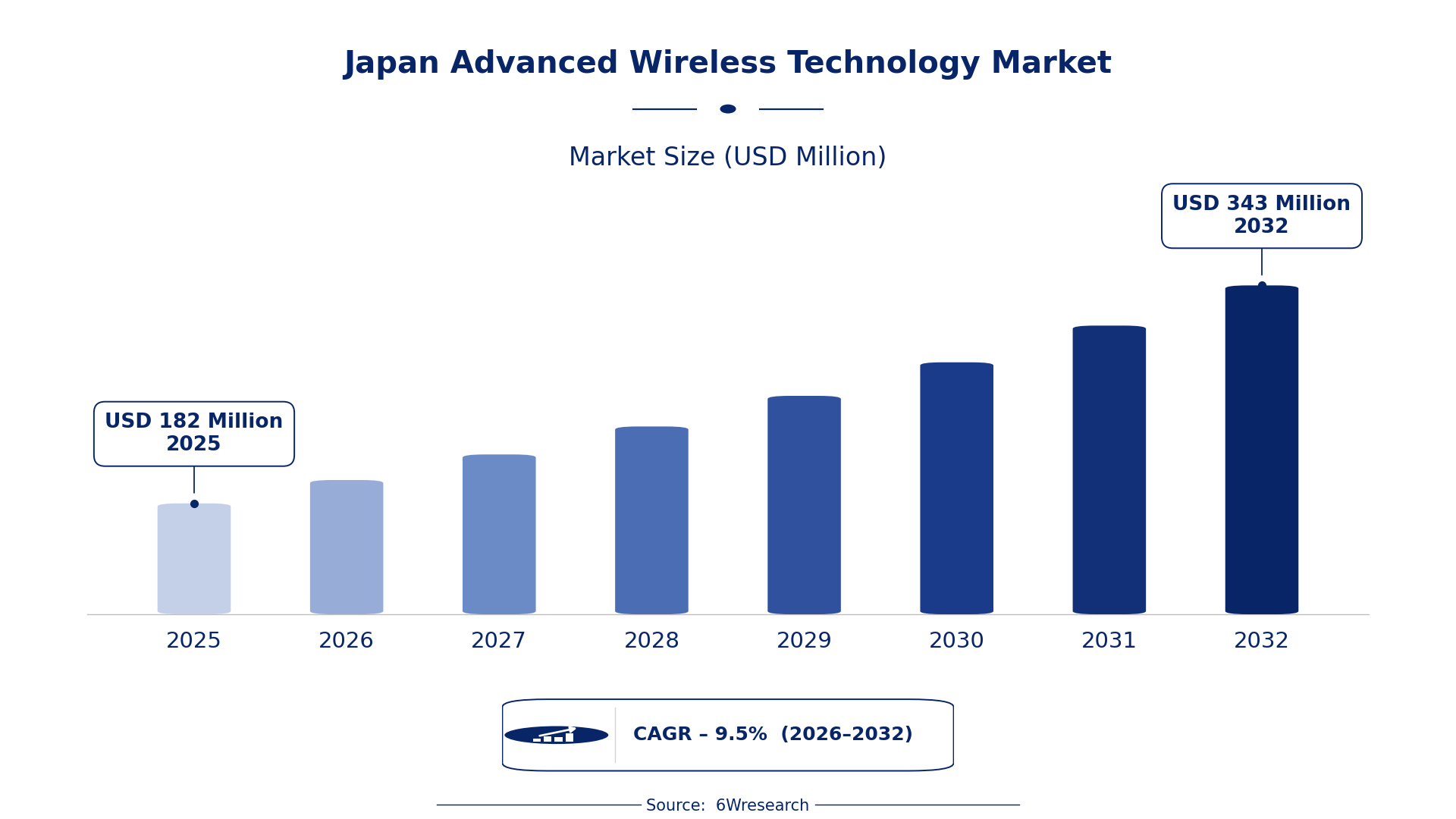
According to 6Wresearch internal database and industry insights, the Japan Advanced Wireless Technology Market was valued at USD 182 Million in 2025 and is projected to reach USD 343 Million by 2032, growing at a CAGR of approximately 9.5% during 2026–2032.
Japan Advanced Wireless Technology Market Highlights
| Report Metric | Details |
| Report Name | Japan Advanced Wireless Technology Market (2026-2032) |
| Market Size 2025 | USD 182 Million |
| Market Size 2032 | USD 343 Million |
| Absolute Growth 2025–2032 | USD 161 Million |
| CAGR 2026–2032 | 9.5% |
| Peak Annual Growth | 10.6% in 2028 |
| Forecast Period | 2026–2032 |
| Historical Data | 2022–2025 |
| Base Year | 2025 |
| Leading Advanced Wireless Technology Market, 2025 | 5G Communication Systems (46% share) |
| Leading Technology Type, 2025 | Cellular (50% share) |
| Leading Frequency Band, 2025 | mmWave/Sub-6 GHz (46% share) |
| Leading Application Area, 2025 | Mobile Networks (45% share) |
| Leading End User Sector, 2025 | Telecom Operators (35% share) |
| Fastest-Growing Advanced Wireless Technology Market | Wi-Fi 6 & 7 (13.7% CAGR) |
| Fastest-Growing Technology Type | WLAN (12.9% CAGR) |
| Fastest-Growing Frequency Band | 2.4GHz/5GHz/6GHz (13.0% CAGR) |
| Fastest-Growing Application Area | Home & Enterprise (11.8% CAGR) |
| Fastest-Growing End User Sector | Smart Device Companies (12.6% CAGR) |
| Growing Sector | Home & Enterprise |
| Key End Users | Mobile Networks, Home & Enterprise, IoT Connectivity, Industrial Monitoring |
Japan Advanced Wireless Technology Market Year-wise Growth Rate and Key Drivers (2022–2032)
This graph illustrates the annual growth rates of the market from 2022 to 2032, highlighting a steady upward trajectory and projected market expansion over the forecast period.
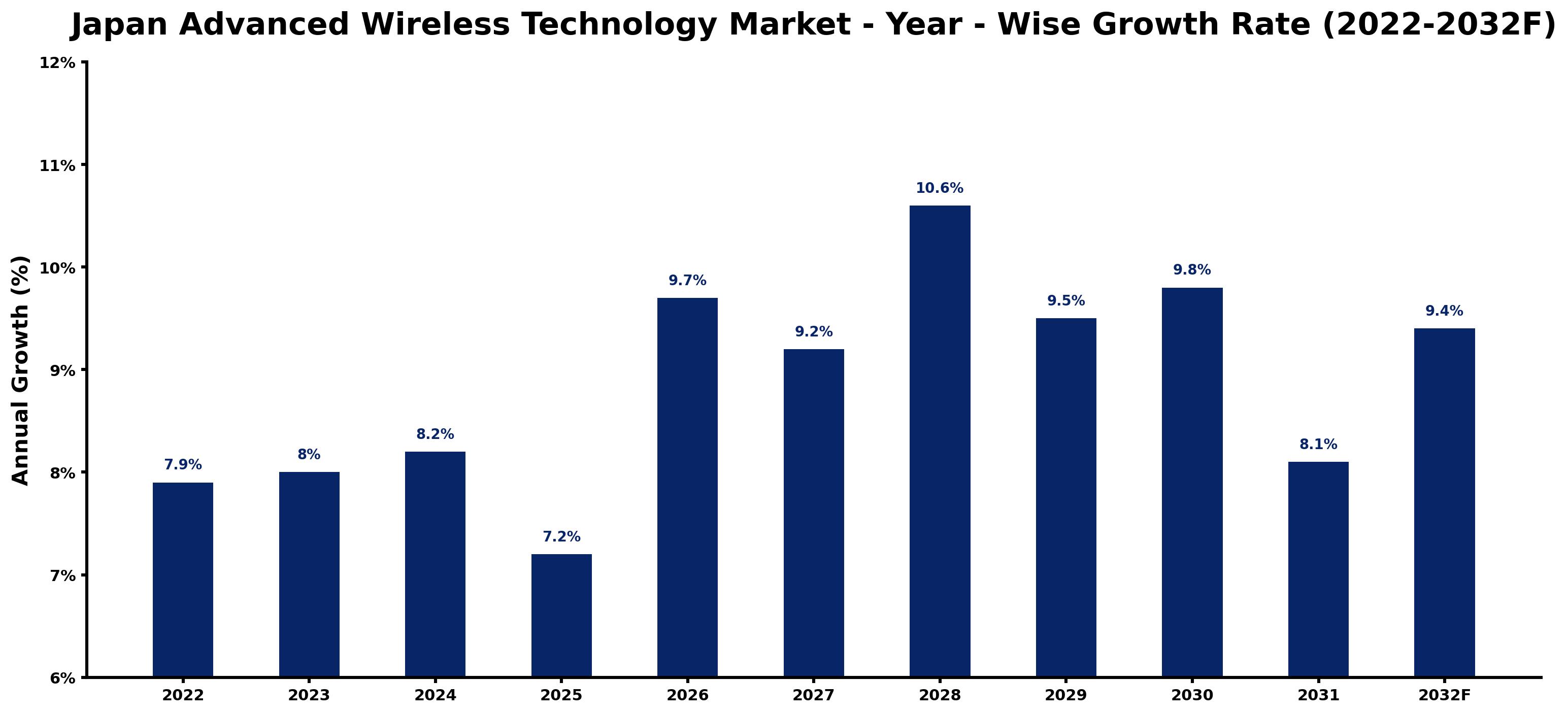
Year by year, the estimates below pair each growth rate with the development that shaped it.
| Year | Estimated Annual Growth (%) | Market Rationale |
| 2022 | 7.9 | The market was characterised by steady growth in advanced wireless technology applications. |
| 2023 | 8.0 | Demand increased as urban areas expanded their connectivity infrastructure. |
| 2024 | 8.2 | Growth accelerated due to rising adoption of 5G communication systems. |
| 2025 | 7.2 | Growth slowed as market saturation began to affect new subscriber rates. |
| 2026 | 9.7 | Demand surged with substantial investments in IoT connectivity initiatives. |
| 2027 | 9.2 | A slight slowdown occurred as competition intensified among telecom operators. |
| 2028 | 10.6 | Growth peaked as major urban infrastructure projects adopted advanced technologies. |
| 2029 | 9.5 | Market expansion slowed slightly as the focus shifted to improving existing networks. |
| 2030 | 9.8 | Demand increased as Wi-Fi 6 adoption in homes reached higher levels. |
| 2031 | 8.1 | A slowdown was observed as the market stabilised after rapid growth. |
| 2032 | 9.4 | Growth accelerated again as smart infrastructure projects gained traction. |
Note: Market size estimations and growth projections presented in this report are based on 6Wresearch's proprietary forecasting methodology, utilizing the latest available industry data, government publications, and primary research inputs.
Japan Advanced Wireless Technology Market Synopsis
Advanced Wireless Technology includes various high-speed communication technologies such as 5G, Wi-Fi 6 & 7, and LPWAN, essential for mobile connectivity and supporting IoT applications. The Japan Advanced Wireless Technology Market is expanding due to rising demand from urban areas and notable investments in smart city initiatives. By 2023, 5G subscribers reached 40 million, while Wi-Fi 6 adoption in enterprises surpassed 30%, illustrating the increasing reliance on these solutions.
Market Dynamics Impact Analysis (2026–2032)
| Factor | Type | Impact | Primary Segment Affected |
| Rising urbanisation drives demand for advanced connectivity solutions. | Driver | High | 5G Communication Systems |
| Increased investment in smart city projects enhances wireless infrastructure. | Driver | High | Wi-Fi 6 & 7 |
| Growing IoT applications create new market opportunities for wireless technology. | Opportunity | High | LPWAN Technologies (NB-IoT, LoRa) |
| High demand for enhanced home connectivity solutions presents investment potential. | Opportunity | Medium | Home & Enterprise |
| Market saturation in urban areas limits new subscriber growth. | Restraint | High | Mobile Networks |
| Intense competition among telecom operators may restrict profit margins. | Restraint | Medium | Telecom Operators |
| High infrastructure costs can delay project implementations. | Challenge | High | Smart Infrastructure Firms |
| Technological advancements require continuous investment in R&D. | Challenge | Medium | Smart Device Companies |
Evaluation of Drivers in Japan Advanced Wireless Technology Market (2026–2032)
The table below links each growth driver to the segment it affects and the evidence for it.
| Drivers | Primary Segment Affected | Why It Matters (Evidence) |
| Increased urbanisation leads to higher demand for 5G connectivity. | 5G Communication Systems | Japan's population of approximately 125 million drives the need for enhanced mobile networks. |
| Significant investments in smart city projects boost Wi-Fi 6 adoption. | Wi-Fi 6 & 7 | The government allocated ¥10 billion for smart city projects in 2023. |
| Growing number of smart devices fuels LPWAN technology demand. | LPWAN Technologies (NB-IoT, LoRa) | The total number of smart devices in Japan is projected to exceed 200 million by 2025. |
| Increased focus on industrial IoT applications drives demand for connectivity. | Industrial Monitoring | The total number of IoT devices in industrial applications is estimated at 30 million by 2025. |
| Telecom operators expand networks to meet rising consumer expectations. | Mobile Networks | The total number of telecom operators in Japan is around 10 as of 2023. |
Much of the new demand traces back to the rapid urbanisation of Japan, where the population exceeds 125 million, leading to a heightened need for 5G connectivity. Investments in smart city projects, with ¥10 billion allocated in 2023, are driving Wi-Fi 6 adoption, which is already over 30% in enterprises. The growing number of smart devices, projected to surpass 200 million by 2025, is increasing demand for connectivity solutions, particularly in urban infrastructure. The industrial sector's focus on IoT applications, with an estimated 30 million devices expected by 2025, is further boosting connectivity requirements.
Evaluation of Restraints in Japan Advanced Wireless Technology Market
These are the pressures that could keep growth below its potential.
| Market Restraint | Primary Segment Affected | Why It Matters (Evidence) |
| Market saturation in urban areas limits new subscriber growth. | Mobile Networks | As urban infrastructure matures, growth in new 5G subscribers has begun to slow. |
| Intense competition among telecom operators may restrict profit margins. | Telecom Operators | With around 10 telecom operators, pricing pressure is affecting profitability. |
| High infrastructure costs can delay project implementations. | Smart Infrastructure Firms | Investments in advanced wireless technology require substantial capital, impacting timelines. |
| Rapid technological advancements necessitate ongoing R&D investments. | Smart Device Companies | Companies must continuously innovate to stay competitive, increasing operational costs. |
| Regulatory compliance can complicate deployment processes. | Telecom Operators | The Telecommunications Bureau oversees compliance, adding layers of complexity to operations. |
Japan Advanced Wireless Technology Market Challenges
Producers face intense competition from both domestic and international markets, which drives down prices and squeezes profit margins. Buyers encounter limited access to advanced wireless technologies in rural areas, restricting their ability to implement IoT solutions effectively. Importers incur substantial costs when upgrading infrastructure to meet JIS X 5070 standards, with expenses potentially reaching ¥10 billion, which delays project timelines. Skills shortages in advanced wireless technology hinder producers' ability to recruit qualified engineers, resulting in increased operational costs and project delays for manufacturers.
Trends in the Japan Advanced Wireless Technology Market
Below are the shifts with the largest effect on the Japan Advanced Wireless Technology Market.
- Telecom Operators Adopting Advanced Wireless Solutions: Telecom operators are increasingly adopting advanced wireless technologies to improve service offerings, with 5G subscribers reaching 40 million by 2023. This trend indicates a shift towards high-speed connectivity in Japan.
- Urban Areas Leading Wi-Fi 6 Adoption: Tokyo and Osaka are at the forefront of Wi-Fi 6 adoption, with enterprise usage exceeding 30% as of 2023. This shift highlights the growing demand for faster and more reliable connectivity solutions.
- Smart Cities Driving IoT Connectivity: The government allocated ¥10 billion for smart city projects in 2023, pushing for improved IoT connectivity. This initiative is expected to increase the number of smart devices significantly.
- Industrial Monitoring Applications Expanding: Industrial sectors are rapidly adopting advanced wireless technologies for monitoring, with an estimated 30 million IoT devices projected by 2025. This trend reflects the increasing reliance on real-time data collection.
Investment Opportunities in the Japan Advanced Wireless Technology Market
The opportunities below stand out in the Japan Advanced Wireless Technology Market for new entrants and existing suppliers.
- Telecom Operators Seeking Advanced Solutions: With 40 million 5G subscribers by 2023, telecom operators are in search of advanced wireless solutions to enhance service quality. This creates opportunities for suppliers to deliver necessary technologies.
- Smart Infrastructure Firms Investing in Connectivity: The government allocated ¥10 billion for smart city projects in 2023, generating demand for advanced wireless technologies. Suppliers can collaborate with local firms to address this growing need.
- Industrial Monitoring Firms Expanding IoT Capabilities: With 30 million IoT devices anticipated in industrial applications by 2025, there is a strong demand for advanced wireless technologies. Suppliers can penetrate this market by partnering with industrial manufacturers.
- Home Users Adopting Wi-Fi 6 Solutions: As Wi-Fi 6 adoption in homes is projected to reach 50% by 2025, there exists a substantial opportunity for suppliers to offer compatible devices and solutions. Engaging with home electronics retailers can facilitate market entry.
Government Initiatives in the Japan Advanced Wireless Technology Market
The Electrical Appliance and Material Safety Act (1961) mandates that producers comply with safety standards for electrical appliances and materials, affecting advanced wireless technology producers who must follow specific safety regulations to market their products effectively. The Act necessitates thorough testing and certification processes, which contribute to consumer safety and product reliability.
The Telecommunications Bureau supervises regulatory compliance for wireless technologies, approving new devices and ensuring they meet established standards. This agency plays a crucial role in facilitating the deployment of advanced wireless technologies, impacting both producers and buyers by ensuring adherence to regulations.
Future Insight of the Japan Advanced Wireless Technology Market
The rollout of Wi-Fi 6 will transform demand for advanced wireless technology, with home adoption expected to reach 50% by 2025. By 2032, the integration of NB-IoT in urban infrastructure will support a projected 30 million IoT devices in industrial applications, improving connectivity across sectors. Government investments in smart city projects will enhance urban living conditions, creating new opportunities for suppliers. Ongoing initiatives for IoT connectivity will enable buyers to access reliable and efficient solutions.
Market Segmentation Analysis
Japan Advanced Wireless Technology Market report covers a detailed analysis of the following market segments:
By Advanced Wireless Technology Market – 5G Communication Systems Lead, Wi-Fi 6 & 7 Expected to Grow Fastest
According to Saurav Kr Singh, Senior Research Analyst at 6Wresearch, the largest advanced wireless technology market category in 2025 was 5G Communication Systems, at 46% of revenue. The 5G Communication Systems segment holds the largest share due to its critical role in mobile networks, with Japan's 5G subscribers reaching 40 million by 2023. Urban regions like Tokyo and Osaka are pivotal for this technology's deployment, ensuring strong demand. The quickest growth will come from Wi-Fi 6 & 7, forecast to expand at a CAGR of 13.7% between 2026 and 2032. Wi-Fi 6 & 7 is experiencing rapid growth as enterprises increasingly adopt these technologies, with over 30% adoption in businesses as of 2023. This trend is expected to continue, especially as home adoption is projected to reach 50% by 2025, further expanding the market. Suppliers should focus on both enterprise and residential sectors to capitalise on the growing demand for advanced wireless technologies.
By Technology Type – Cellular Leads, WLAN Expected to Grow Fastest
Cellular accounted for 50% of the market by technology type in 2025. Cellular technology leads the market as it is fundamental for mobile communications, serving as the backbone for various wireless services. The presence of around 10 telecom operators in Japan ensures robust demand for cellular solutions. Over 2026–2032, WLAN is expected to post the fastest growth, at a CAGR of 12.9%. WLAN technology is growing rapidly due to its key role in wireless local area networks, particularly in urban settings where connectivity is essential. The increasing number of smart devices, projected to exceed 200 million by 2025, drives this growth. Buyers should consider investing in WLAN solutions to enhance connectivity in both home and enterprise environments.
By Frequency Band – mmWave/Sub-6 GHz Leads, 2.4GHz/5GHz/6GHz Expected to Grow Fastest
mmWave/Sub-6 GHz held 46% of the Japan Advanced Wireless Technology Market by frequency band in 2025. The mmWave/Sub-6 GHz frequency band dominates the market as it enables high-speed data transfer, essential for advanced wireless applications. This capability is particularly crucial in urban areas where demand for fast connectivity is high. 2.4GHz/5GHz/6GHz is set to record the highest CAGR in this split, 13.0% over 2026–2032. The 2.4GHz/5GHz/6GHz frequency band is growing quickly due to its widespread use in consumer Wi-Fi, facilitating connectivity for a growing number of devices. This trend is supported by the increasing number of smart devices expected in households. Suppliers need to ensure compatibility with the 2.4GHz/5GHz/6GHz bands to meet the rising demand for consumer Wi-Fi solutions.
By Application Area – Mobile Networks Lead, Home & Enterprise Expected to Grow Fastest
With 45% of application area revenue in 2025, Mobile Networks was the largest category. Mobile Networks are the leading application area as they form the backbone of telecommunications, supporting essential services for millions of users. The emphasis on advanced wireless technology in Japan's National Telecommunications Policy reinforces this segment's significance. Home & Enterprise is projected to grow fastest, at a CAGR of 11.8% during 2026–2032. The Home & Enterprise application area is experiencing rapid growth as connectivity solutions become critical for both residential and business environments. The increasing adoption of smart devices in these sectors further fuels this expansion. Suppliers should target home and enterprise markets to align with the growing need for robust connectivity solutions.
By End User Sector – Telecom Operators Lead, Smart Device Companies Expected to Grow Fastest
Telecom Operators took 35% of end user sector revenue in 2025, more than any other category. Telecom Operators are the primary users of advanced technologies, relying on these systems to provide services to millions of subscribers. Their significant investment in infrastructure and technology ensures a strong demand for advanced wireless solutions. The quickest growth will come from Smart Device Companies, forecast to expand at a CAGR of 12.6% between 2026 and 2032. Smart Device Companies are rapidly integrating advanced wireless technologies into their products, reflecting the growing trend towards connectivity in consumer electronics. This surge is driven by the projected increase in smart devices in the market. Suppliers should engage with smart device companies to leverage the integration of advanced wireless technologies in new products.
Key Attractiveness of the Report
- 10 Years of Market Numbers
- Historical Data Starting from 2022 to 2025
- Base Year 2025
- Forecast Data until 2032
- Key Performance Indicators Impacting the Market
- Major Upcoming Developments and Projects
Key Highlights of the Report:
- Japan Advanced Wireless Technology Market Outlook
- Market Size of Japan Advanced Wireless Technology Market, 2025
- Forecast of Japan Advanced Wireless Technology Market, 2032
- Historical Data and Forecast of Japan Advanced Wireless Technology Revenues & Volume for the Period 2022-2032F
- Japan Advanced Wireless Technology Market Trend Evolution
- Japan Advanced Wireless Technology Market Drivers and Challenges
- Japan Advanced Wireless Technology Price Trends
- Japan Advanced Wireless Technology Porter's Five Forces
- Japan Advanced Wireless Technology Industry Life Cycle
- Historical Data and Forecast of Japan Advanced Wireless Technology Market Revenues & Volume By Advanced Wireless Technology Market for the Period 2022-2032F
- Historical Data and Forecast of Japan Advanced Wireless Technology Market Revenues & Volume By 5G Communication Systems for the Period 2022-2032F
- Historical Data and Forecast of Japan Advanced Wireless Technology Market Revenues & Volume By Wi-Fi 6 & 7 for the Period 2022-2032F
- Historical Data and Forecast of Japan Advanced Wireless Technology Market Revenues & Volume By Bluetooth Low Energy (BLE) for the Period 2022-2032F
- Historical Data and Forecast of Japan Advanced Wireless Technology Market Revenues & Volume By LPWAN Technologies (NB-IoT, LoRa) for the Period 2022-2032F
- Historical Data and Forecast of Japan Advanced Wireless Technology Market Revenues & Volume By Technology Type for the Period 2022-2032F
- Historical Data and Forecast of Japan Advanced Wireless Technology Market Revenues & Volume By Cellular for the Period 2022-2032F
- Historical Data and Forecast of Japan Advanced Wireless Technology Market Revenues & Volume By WLAN for the Period 2022-2032F
- Historical Data and Forecast of Japan Advanced Wireless Technology Market Revenues & Volume By Personal Area Network for the Period 2022-2032F
- Historical Data and Forecast of Japan Advanced Wireless Technology Market Revenues & Volume By Low-Power WAN for the Period 2022-2032F
- Historical Data and Forecast of Japan Advanced Wireless Technology Market Revenues & Volume By Frequency Band for the Period 2022-2032F
- Historical Data and Forecast of Japan Advanced Wireless Technology Market Revenues & Volume By mmWave/Sub-6 GHz for the Period 2022-2032F
- Historical Data and Forecast of Japan Advanced Wireless Technology Market Revenues & Volume By 2.4GHz/5GHz/6GHz for the Period 2022-2032F
- Historical Data and Forecast of Japan Advanced Wireless Technology Market Revenues & Volume By 2.4GHz for the Period 2022-2032F
- Historical Data and Forecast of Japan Advanced Wireless Technology Market Revenues & Volume By Sub-GHz for the Period 2022-2032F
- Historical Data and Forecast of Japan Advanced Wireless Technology Market Revenues & Volume By Application Area for the Period 2022-2032F
- Historical Data and Forecast of Japan Advanced Wireless Technology Market Revenues & Volume By Mobile Networks for the Period 2022-2032F
- Historical Data and Forecast of Japan Advanced Wireless Technology Market Revenues & Volume By Home & Enterprise for the Period 2022-2032F
- Historical Data and Forecast of Japan Advanced Wireless Technology Market Revenues & Volume By IoT Connectivity for the Period 2022-2032F
- Historical Data and Forecast of Japan Advanced Wireless Technology Market Revenues & Volume By Industrial Monitoring for the Period 2022-2032F
- Historical Data and Forecast of Japan Advanced Wireless Technology Market Revenues & Volume By End User Sector for the Period 2022-2032F
- Historical Data and Forecast of Japan Advanced Wireless Technology Market Revenues & Volume By Telecom Operators for the Period 2022-2032F
- Historical Data and Forecast of Japan Advanced Wireless Technology Market Revenues & Volume By Smart Device Companies for the Period 2022-2032F
- Historical Data and Forecast of Japan Advanced Wireless Technology Market Revenues & Volume By Consumer Electronics for the Period 2022-2032F
- Historical Data and Forecast of Japan Advanced Wireless Technology Market Revenues & Volume By Smart Infrastructure Firms for the Period 2022-2032F
- Japan Advanced Wireless Technology Import Export Trade Statistics
- Market Opportunity Assessment By Advanced Wireless Technology Market
- Market Opportunity Assessment By Technology Type
- Market Opportunity Assessment By Frequency Band
- Market Opportunity Assessment By Application Area
- Market Opportunity Assessment By End User Sector
- Japan Advanced Wireless Technology Top Companies Market Share
- Japan Advanced Wireless Technology Competitive Benchmarking By Technical and Operational Parameters
- Japan Advanced Wireless Technology Company Profiles
- Japan Advanced Wireless Technology Key Strategic Recommendations
Market Covered
Segments analysed in this report are listed below.
By Advanced Wireless Technology Market
- 5G Communication Systems
- Wi-Fi 6 & 7
- Bluetooth Low Energy (BLE)
- LPWAN Technologies (NB-IoT, LoRa)
By Technology Type
- Cellular
- WLAN
- Personal Area Network
- Low-Power WAN
By Frequency Band
- mmWave/Sub-6 GHz
- 2.4GHz/5GHz/6GHz
- 2.4GHz
- Sub-GHz
By Application Area
- Mobile Networks
- Home & Enterprise
- IoT Connectivity
- Industrial Monitoring
By End User Sector
- Telecom Operators
- Smart Device Companies
- Consumer Electronics
- Smart Infrastructure Firms































