Japan Aerodynamic Winglets Market Size & Growth Rate
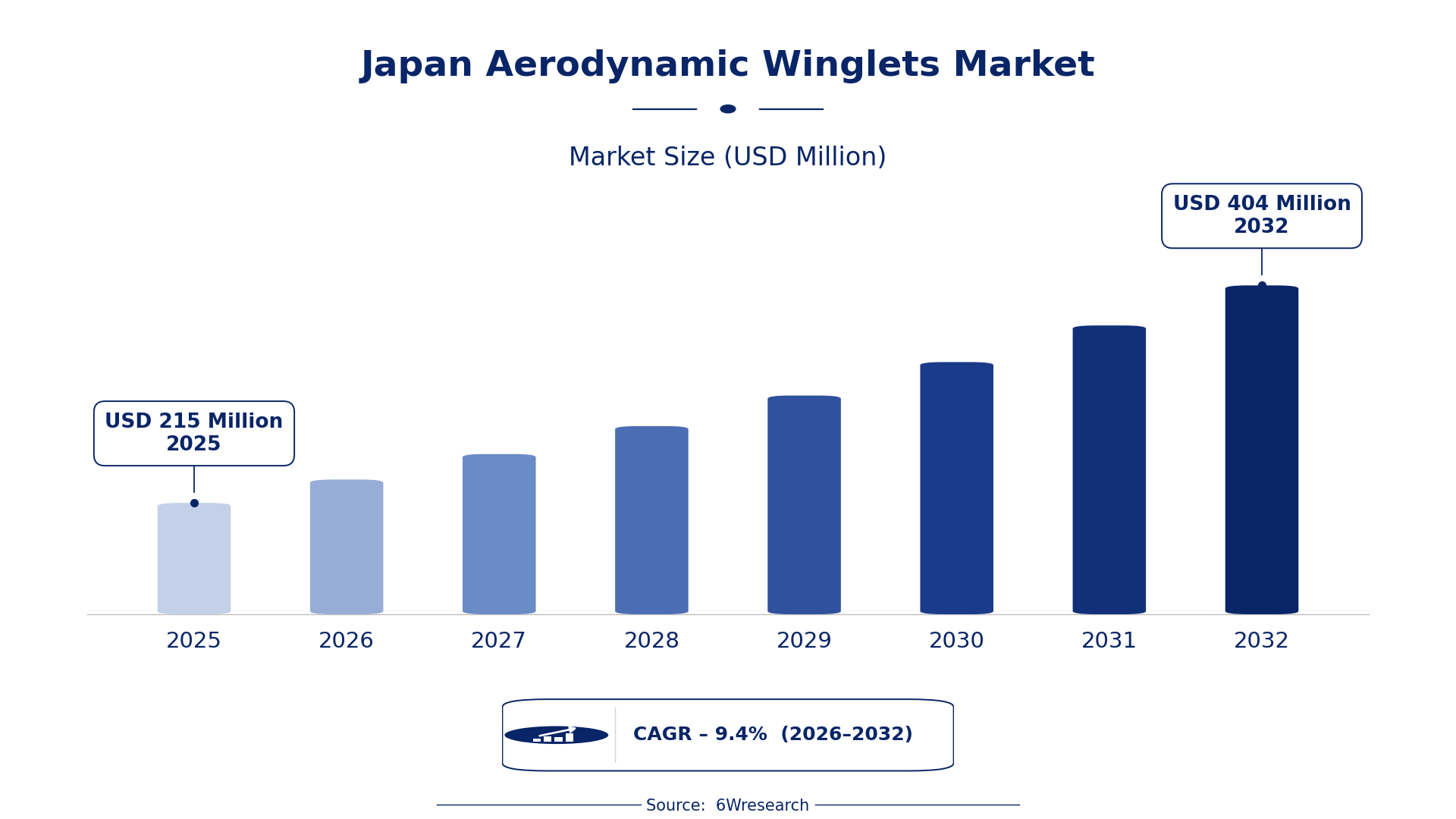
According to 6Wresearch internal database and industry insights, the Japan Aerodynamic Winglets Market was valued at USD 215 Million in 2025 and is projected to reach USD 404 Million by 2032, growing at a CAGR of approximately 9.4% during 2026–2032.
Japan Aerodynamic Winglets Market Highlights
| Report Metric | Details |
| Report Name | Japan Aerodynamic Winglets Market (2026-2032) |
| Market Size 2025 | USD 215 Million |
| Market Size 2032 | USD 404 Million |
| Absolute Growth 2025–2032 | USD 189 Million |
| CAGR 2026–2032 | 9.4% |
| Peak Annual Growth | 10.8% in 2028 |
| Forecast Period | 2026–2032 |
| Historical Data | 2022–2025 |
| Base Year | 2025 |
| Leading Product Type, 2025 | Blended Winglets (44% share) |
| Leading Design Type, 2025 | Curved Design (42% share) |
| Leading Platform, 2025 | Commercial Aircraft (49% share) |
| Leading Distribution Channel, 2025 | OEMs (43% share) |
| Leading End User, 2025 | Aircraft Manufacturers (37% share) |
| Fastest-Growing Product Type | Split Scimitar (12.9% CAGR) |
| Fastest-Growing Platform | UAVs and Drones (13.3% CAGR) |
| Fastest-Growing Distribution Channel | Government Contracts (12.2% CAGR) |
| Fastest-Growing End User | Drone Manufacturers (11.9% CAGR) |
| Growing Sector | Drone Manufacturers |
| Key End Users | Aircraft Manufacturers, Defense Aerospace, Cargo Airlines, Drone Manufacturers |
Japan Aerodynamic Winglets Market Year-wise Growth Rate and Key Drivers (2022–2032)
This graph illustrates the annual growth rates of the market from 2022 to 2032, highlighting a steady upward trajectory and projected market expansion over the forecast period.
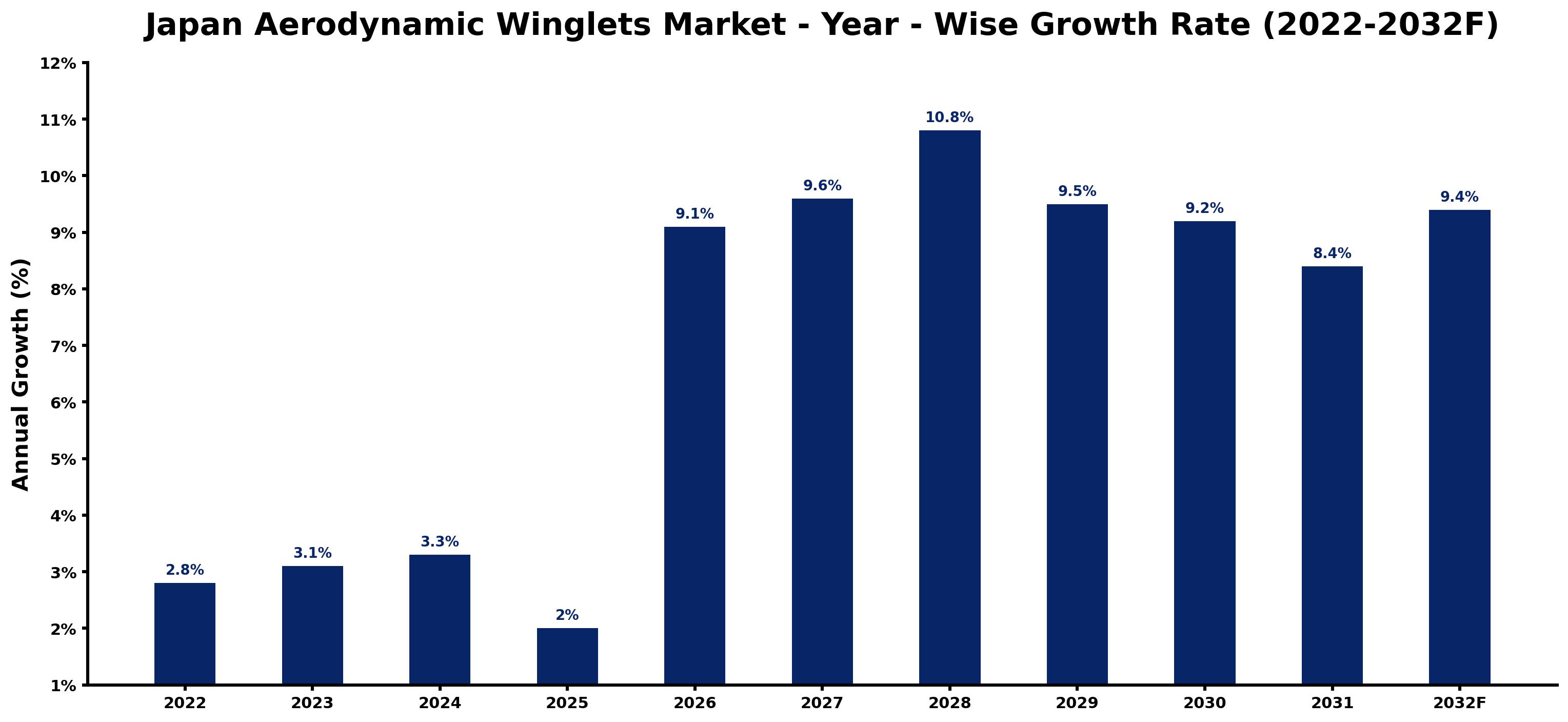
The yearly estimates that follow link every growth rate to its principal driver, so readers can see why the pace changed in each period.
| Year | Estimated Annual Growth (%) | Market Rationale |
| 2022 | 2.8 | The market exhibited steady growth, benefiting from ongoing aerospace activities. |
| 2023 | 3.1 | Growth accelerated due to increased investments in fuel-efficient technologies. |
| 2024 | 3.3 | Demand continued to rise as manufacturers adopted advanced aerodynamic designs. |
| 2025 | 2.0 | Growth slowed as the market adjusted to previous high levels of demand. |
| 2026 | 9.1 | A surge in defense spending is expected to revitalise interest in advanced winglet designs. |
| 2027 | 9.6 | The market is projected to expand further as UAV technology gains traction among manufacturers. |
| 2028 | 10.8 | The peak growth year will see heightened investments in commercial aircraft efficiency. |
| 2029 | 9.5 | Growth is expected to moderate as market saturation begins to influence purchasing patterns. |
| 2030 | 9.2 | Demand will continue to slow as manufacturers focus on optimising existing designs. |
| 2031 | 8.4 | The market is projected to experience a further slowdown as competition intensifies among suppliers. |
| 2032 | 9.4 | Growth will rebound as new technologies emerge, driving renewed buyer interest. |
Note: Market size estimations and growth projections presented in this report are based on 6Wresearch's proprietary forecasting methodology, utilizing the latest available industry data, government publications, and primary research inputs.
Japan Aerodynamic Winglets Market Synopsis
Aerodynamic winglets are devices attached to aircraft wingtips that improve efficiency by reducing drag and increasing lift. The Japan Aerodynamic Winglets Market is expanding due to rising investments in fuel-efficient technologies and increased defense spending, with the government aiming to boost domestic aircraft production by 20% by 2025. This growth is reflected in the Tokyo region's strong aerospace industry, which employs over 200,000 people and is supported by advancements in UAV technology and composite materials.
Market Dynamics Impact Analysis (2026–2032)
| Factor | Type | Impact | Primary Segment Affected |
| Increased focus on fuel efficiency | Driver | High | Blended Winglets |
| Growing defense budgets | Driver | High | Military Jets |
| Emerging applications in UAVs | Opportunity | Medium | UAVs and Drones |
| Growing demand for cargo aircraft | Opportunity | Medium | Cargo Aircraft |
| High production costs of advanced materials | Restraint | High | Raked Winglets |
| Limited domestic suppliers for specialized designs | Restraint | Medium | Split Scimitar |
| Supply chain disruptions affecting material availability | Challenge | High | Curved Design |
| Intense competition among manufacturers | Challenge | Medium | Commercial Aircraft |
Evaluation of Drivers in Japan Aerodynamic Winglets Market (2026–2032)
The following drivers explain most of the expected growth.
| Drivers | Primary Segment Affected | Why It Matters (Evidence) |
| Rising fuel prices | Blended Winglets | This compels airlines to invest in fuel-efficient technologies, resulting in increased purchases of winglets. |
| Government defense initiatives | Military Jets | Increased funding for defense projects boosts demand for advanced winglet designs in military applications. |
| Technological advancements in aerospace | Curved Design | Innovations in design lead to improved performance, attracting more buyers in the commercial sector. |
| Expansion of cargo operations | Cargo Aircraft | Growing logistics demands prompt airlines to invest in fuel-efficient solutions, including aerodynamic winglets. |
| Increased focus on UAV technology | UAVs and Drones | The rise of UAV applications drives demand for efficient winglet designs to improve performance. |
Much of the new demand traces back to rising fuel prices, compelling airlines to invest in fuel-efficient technologies, resulting in increased purchases of aerodynamic winglets. Funding for military projects has also boosted interest in advanced designs for military applications. The expansion of cargo operations has prompted airlines to invest in aerodynamic solutions, while the focus on UAV technology drives further interest in efficient winglet designs. With the Tokyo region being a major aerospace hub, over 200,000 people are employed in the industry, contributing to the market's growth.
Evaluation of Restraints in Japan Aerodynamic Winglets Market
The key brakes on demand, and where they bite hardest, are shown below.
| Market Restraint | Primary Segment Affected | Why It Matters (Evidence) |
| High production costs of advanced materials | Raked Winglets | These costs limit the ability of manufacturers to invest in new designs and technologies. |
| Limited domestic suppliers for specialized designs | Split Scimitar | This constraint affects the availability of tailored solutions for specific aircraft models. |
| Supply chain disruptions affecting material availability | Curved Design | Disruptions can delay production schedules and increase lead times for buyers. |
| Regulatory compliance costs | Blended Winglets | Meeting industry standards can increase operational costs for manufacturers. |
| Market saturation in certain segments | Commercial Aircraft | Saturation can limit growth opportunities for new entrants and existing players. |
Japan Aerodynamic Winglets Market Challenges
Local manufacturers in Japan's aerospace sector face intense competition from international firms, compelling them to lower prices, which may affect product quality for buyers. Suppliers encounter a shortage of skilled workers as the ageing workforce in aerospace is not being replenished, leading to project delays for manufacturers. Buyers struggle with sourcing advanced materials, as limited domestic production of composite materials can cause extended lead times, impacting project schedules. Rising compliance costs with ISO 9001 and JIS standards impose financial strain on suppliers, potentially raising prices for end users.
Trends in the Japan Aerodynamic Winglets Market
The trends below show where the Japan Aerodynamic Winglets Market is heading.
- Shift towards UAV Integration: The Japanese government has established targets for UAV integration by 2026, encouraging advancements in winglet designs to improve efficiency. This shift is reflected in the increasing number of companies involved in UAV technology, with over 50 firms actively participating.
- Increased Investment in Fuel Efficiency: Aerospace industry associations in Japan advocate for investments in fuel-efficient technologies, with Japan's cargo airlines making substantial investments in these advancements. This trend is crucial for operational cost savings in a competitive market.
- Adoption of JIS Standards: The adoption of Japanese Industrial Standards (JIS) in aircraft component production has become a primary focus since the Industrial Standardization Act was amended in 2019. Compliance ensures quality and safety in aerospace manufacturing.
- Focus on Composite Materials: The Tokyo Metropolitan Government promotes aerospace innovation programs that emphasise the use of composite materials in winglet production. This focus supports advancements in aerodynamic efficiency and weight reduction.
Investment Opportunities in the Japan Aerodynamic Winglets Market
The following opportunities in the Japan Aerodynamic Winglets Market pair current demand with a clear way in.
- Gap in Fuel-Efficient Technologies: With Japan's cargo airlines investing heavily in fuel-efficient technologies, there is a growing opportunity for suppliers to offer advanced aerodynamic winglets. Collaborating with local manufacturers can facilitate market entry.
- Demand for UAV Solutions: The increasing focus on UAV technology presents an opportunity for investment in specialised winglet designs. Engaging with defense contractors in the Tokyo region can strengthen market presence.
- Need for Regulatory Compliance Solutions: As regulatory compliance costs rise, suppliers can provide solutions to streamline certification processes. Partnering with aerospace manufacturers can effectively address these challenges.
- Expansion of Cargo Operations: The rising logistics demands create a need for aerodynamic winglets in cargo aircraft. Suppliers can penetrate this market by forming joint ventures with local airlines.
Government Initiatives in the Japan Aerodynamic Winglets Market
The Industrial Standardization Act, amended in 2019, governs Japanese Industrial Standards (JIS) for aerospace products, ensuring manufacturers meet quality and safety requirements. Compliance with JIS standards is essential for producers to maintain market competitiveness and meet buyer expectations.
The Japan Aerospace Exploration Agency (JAXA) funds research and development initiatives focused on winglet technology. This support encourages innovation and collaboration among aerospace manufacturers, improving the overall capabilities of the industry.
Future Insight of the Japan Aerodynamic Winglets Market
By 2032, cargo airlines will increasingly adopt fuel-efficient technologies, driven by rising logistics demands and government support. The Ministry of Defense's ¥1 trillion funding will accelerate aerospace advancements, particularly in UAV integration, benefiting both operators and suppliers. The presence of over 30 aerospace-related universities in the Tokyo area will produce a new generation of skilled professionals, addressing workforce challenges. The government's goal of a 20% increase in domestic aircraft production by 2025 will further stimulate innovation and collaboration across the sector.
Market Segmentation Analysis
Japan Aerodynamic Winglets Market report covers a detailed analysis of the following market segments:
By Product Type – Blended Winglets Lead, Split Scimitar Expected to Grow Fastest
According to Saurav Kr Singh, Senior Research Analyst at 6Wresearch, Blended Winglets accounted for 44% of the market by product type in 2025. Blended winglets are extensively utilised in Japan's commercial aviation sector, primarily because they significantly improve fuel efficiency. Their widespread adoption among airlines illustrates their importance in reducing operational costs and enhancing overall aircraft performance. The quickest growth will come from Split Scimitar, forecast to expand at a CAGR of 12.9% between 2026 and 2032. The Split Scimitar design is gaining traction due to its superior aerodynamic capabilities, with airlines increasingly recognising its potential for additional fuel savings. This trend is evident as more aircraft undergo retrofitting to incorporate this advanced technology, further solidifying its market position. Suppliers should prioritise the development of advanced winglet designs to cater to the rising demand for fuel-efficient aviation solutions.
By Design Type – Curved Design Leads and Records the Fastest Growth
Curved Design took 42% of design type revenue in 2025, more than any other category. Curved designs lead the market as they effectively aid in lift generation, making them highly favoured by aircraft manufacturers. Their established performance in enhancing flight efficiency solidifies their dominant position in the industry, ensuring consistent demand. The same category is also set to grow fastest, at a CAGR of 13.1% during 2026–2032. The strong preference for curved designs indicates that their market share will not only remain stable but also expand as more manufacturers adopt this design for new aircraft models. This trend underscores the ongoing need for optimised aerodynamic solutions in aviation. Manufacturers must focus on curved design technologies to align with market preferences and maintain competitiveness.
By Platform – Commercial Aircraft Leads, UAVs and Drones Expected to Grow Fastest
In 2025, Commercial Aircraft led the platform split with a 49% share. Commercial aircraft represent the largest segment in Japan's aviation industry, driving considerable demand for aerodynamic winglets. The extensive fleet of commercial jets necessitates ongoing improvements in fuel efficiency and overall performance, ensuring a robust market for these products. UAVs and Drones are projected to grow fastest, at a CAGR of 13.3% during 2026–2032. UAVs and drones are rapidly emerging, with increasing applications across various sectors leading to heightened interest in aerodynamic enhancements. This growth is supported by advancements in UAV technology and rising investments, indicating a promising future for this segment. Suppliers should explore opportunities within the UAV market to capitalise on the growing demand for aerodynamic improvements.
By Distribution Channel – OEMs Lead, Government Contracts Expected to Grow Fastest
OEMs held 43% of the Japan Aerodynamic Winglets Market by distribution channel in 2025. OEMs are the primary distribution channel for aerodynamic winglets, ensuring that manufacturers can seamlessly integrate these components into new aircraft. Their established relationships with aircraft builders facilitate efficient supply chains. Government Contracts are set to record the highest CAGR in this split, 12.2% over 2026–2032. Government contracts are becoming increasingly important, particularly for defence projects that necessitate advanced aerodynamic solutions. This shift underscores the need to secure contracts that address the specific requirements of government-funded aerospace initiatives. Suppliers should strengthen their connections with government entities to secure contracts and broaden their market presence.
By End User – Aircraft Manufacturers Lead, Drone Manufacturers Expected to Grow Fastest
With 37% of end user revenue in 2025, Aircraft Manufacturers was the largest category. Aircraft manufacturers are the primary end users of aerodynamic winglets, relying on these components to enhance aircraft performance. Their focus on fuel efficiency drives a steady demand for advanced winglet designs, reinforcing their market leadership. The quickest growth will come from Drone Manufacturers, forecast to expand at a CAGR of 11.9% between 2026 and 2032. Drone manufacturers are increasingly recognising the importance of aerodynamic efficiency, seeking to enhance the performance of their UAVs. As the drone market continues to expand, this interest is expected to grow, presenting new opportunities for suppliers. Suppliers should consider targeting drone manufacturers to tap into the burgeoning market for aerodynamic solutions.
Key Attractiveness of the Report
- 10 Years of Market Numbers
- Historical Data Starting from 2022 to 2025
- Base Year 2025
- Forecast Data until 2032
- Key Performance Indicators Impacting the Market
- Major Upcoming Developments and Projects
Key Highlights of the Report:
- Japan Aerodynamic Winglets Market Outlook
- Market Size of Japan Aerodynamic Winglets Market, 2025
- Forecast of Japan Aerodynamic Winglets Market, 2032
- Historical Data and Forecast of Japan Aerodynamic Winglets Revenues & Volume for the Period 2022-2032F
- Japan Aerodynamic Winglets Market Trend Evolution
- Japan Aerodynamic Winglets Market Drivers and Challenges
- Japan Aerodynamic Winglets Price Trends
- Japan Aerodynamic Winglets Porter's Five Forces
- Japan Aerodynamic Winglets Industry Life Cycle
- Historical Data and Forecast of Japan Aerodynamic Winglets Market Revenues & Volume By Product Type for the Period 2022-2032F
- Historical Data and Forecast of Japan Aerodynamic Winglets Market Revenues & Volume By Blended Winglets for the Period 2022-2032F
- Historical Data and Forecast of Japan Aerodynamic Winglets Market Revenues & Volume By Split Scimitar for the Period 2022-2032F
- Historical Data and Forecast of Japan Aerodynamic Winglets Market Revenues & Volume By Raked Winglets for the Period 2022-2032F
- Historical Data and Forecast of Japan Aerodynamic Winglets Market Revenues & Volume By Wingtip Fences for the Period 2022-2032F
- Historical Data and Forecast of Japan Aerodynamic Winglets Market Revenues & Volume By Design Type for the Period 2022-2032F
- Historical Data and Forecast of Japan Aerodynamic Winglets Market Revenues & Volume By Curved Design for the Period 2022-2032F
- Historical Data and Forecast of Japan Aerodynamic Winglets Market Revenues & Volume By Extended Design for the Period 2022-2032F
- Historical Data and Forecast of Japan Aerodynamic Winglets Market Revenues & Volume By Angled Design for the Period 2022-2032F
- Historical Data and Forecast of Japan Aerodynamic Winglets Market Revenues & Volume By Dual-Surface Design for the Period 2022-2032F
- Historical Data and Forecast of Japan Aerodynamic Winglets Market Revenues & Volume By Platform for the Period 2022-2032F
- Historical Data and Forecast of Japan Aerodynamic Winglets Market Revenues & Volume By Commercial Aircraft for the Period 2022-2032F
- Historical Data and Forecast of Japan Aerodynamic Winglets Market Revenues & Volume By Military Jets for the Period 2022-2032F
- Historical Data and Forecast of Japan Aerodynamic Winglets Market Revenues & Volume By Cargo Aircraft for the Period 2022-2032F
- Historical Data and Forecast of Japan Aerodynamic Winglets Market Revenues & Volume By UAVs and Drones for the Period 2022-2032F
- Historical Data and Forecast of Japan Aerodynamic Winglets Market Revenues & Volume By Distribution Channel for the Period 2022-2032F
- Historical Data and Forecast of Japan Aerodynamic Winglets Market Revenues & Volume By OEMs for the Period 2022-2032F
- Historical Data and Forecast of Japan Aerodynamic Winglets Market Revenues & Volume By Government Contracts for the Period 2022-2032F
- Historical Data and Forecast of Japan Aerodynamic Winglets Market Revenues & Volume By Direct Sales for the Period 2022-2032F
- Historical Data and Forecast of Japan Aerodynamic Winglets Market Revenues & Volume By Online Platforms for the Period 2022-2032F
- Historical Data and Forecast of Japan Aerodynamic Winglets Market Revenues & Volume By End User for the Period 2022-2032F
- Historical Data and Forecast of Japan Aerodynamic Winglets Market Revenues & Volume By Aircraft Manufacturers for the Period 2022-2032F
- Historical Data and Forecast of Japan Aerodynamic Winglets Market Revenues & Volume By Defense Aerospace for the Period 2022-2032F
- Historical Data and Forecast of Japan Aerodynamic Winglets Market Revenues & Volume By Cargo Airlines for the Period 2022-2032F
- Historical Data and Forecast of Japan Aerodynamic Winglets Market Revenues & Volume By Drone Manufacturers for the Period 2022-2032F
- Japan Aerodynamic Winglets Import Export Trade Statistics
- Market Opportunity Assessment By Product Type
- Market Opportunity Assessment By Design Type
- Market Opportunity Assessment By Platform
- Market Opportunity Assessment By Distribution Channel
- Market Opportunity Assessment By End User
- Japan Aerodynamic Winglets Top Companies Market Share
- Japan Aerodynamic Winglets Competitive Benchmarking By Technical and Operational Parameters
- Japan Aerodynamic Winglets Company Profiles
- Japan Aerodynamic Winglets Key Strategic Recommendations
Market Covered
This report examines the market across the segments below.
By Product Type
- Blended Winglets
- Split Scimitar
- Raked Winglets
- Wingtip Fences
By Design Type
- Curved Design
- Extended Design
- Angled Design
- Dual-Surface Design
By Platform
- Commercial Aircraft
- Military Jets
- Cargo Aircraft
- UAVs and Drones
By Distribution Channel
- OEMs
- Government Contracts
- Direct Sales
- Online Platforms
By End User
- Aircraft Manufacturers
- Defense Aerospace
- Cargo Airlines
- Drone Manufacturers































