Japan Aeromedical Transport Service Market Size & Growth Rate
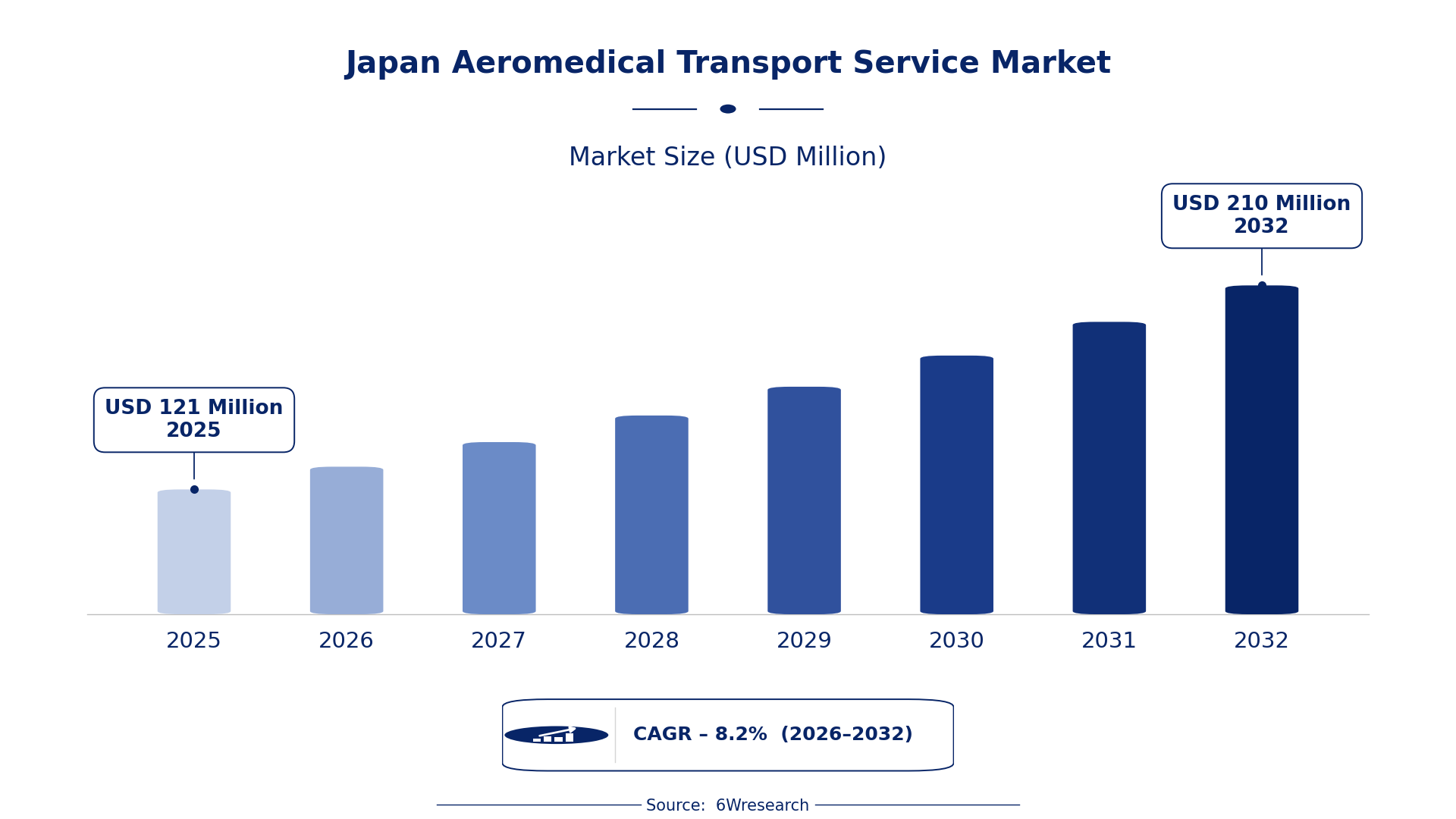
According to 6Wresearch internal database and industry insights, the Japan Aeromedical Transport Service Market was valued at USD 121 Million in 2025 and is projected to reach USD 210 Million by 2032, growing at a CAGR of approximately 8.2% during 2026–2032.
Japan Aeromedical Transport Service Market Highlights
| Report Metric | Details |
| Report Name | Japan Aeromedical Transport Service Market (2026-2032) |
| Market Size 2025 | USD 121 Million |
| Market Size 2032 | USD 210 Million |
| Absolute Growth 2025–2032 | USD 89 Million |
| CAGR 2026–2032 | 8.2% |
| Peak Annual Growth | 9.0% in 2028 |
| Forecast Period | 2026–2032 |
| Historical Data | 2022–2025 |
| Base Year | 2025 |
| Leading Service Type, 2025 | Emergency Medical Flights (43% share) |
| Leading Aircraft Type, 2025 | Helicopters (53% share) |
| Leading Operation Model, 2025 | On-Demand (35% share) |
| Leading Distribution Channel, 2025 | Direct Sales (43% share) |
| Leading End User, 2025 | Hospitals & Clinics (37% share) |
| Fastest-Growing Service Type | Critical Care Transport (11.0% CAGR) |
| Fastest-Growing Aircraft Type | Fixed-Wing Aircraft (11.3% CAGR) |
| Fastest-Growing Operation Model | Scheduled (11.4% CAGR) |
| Fastest-Growing Distribution Channel | Government Contracts (10.6% CAGR) |
| Fastest-Growing End User | Trauma Centers (10.7% CAGR) |
| Growing Sector | Emergency Medical Flights |
| Key End Users | Hospitals & Clinics, Trauma Centers, Transplant Centers, Pediatric Hospitals |
Japan Aeromedical Transport Service Market Year-wise Growth Rate and Key Drivers (2022–2032)
This graph illustrates the annual growth rates of the market from 2022 to 2032, highlighting a steady upward trajectory and projected market expansion over the forecast period.
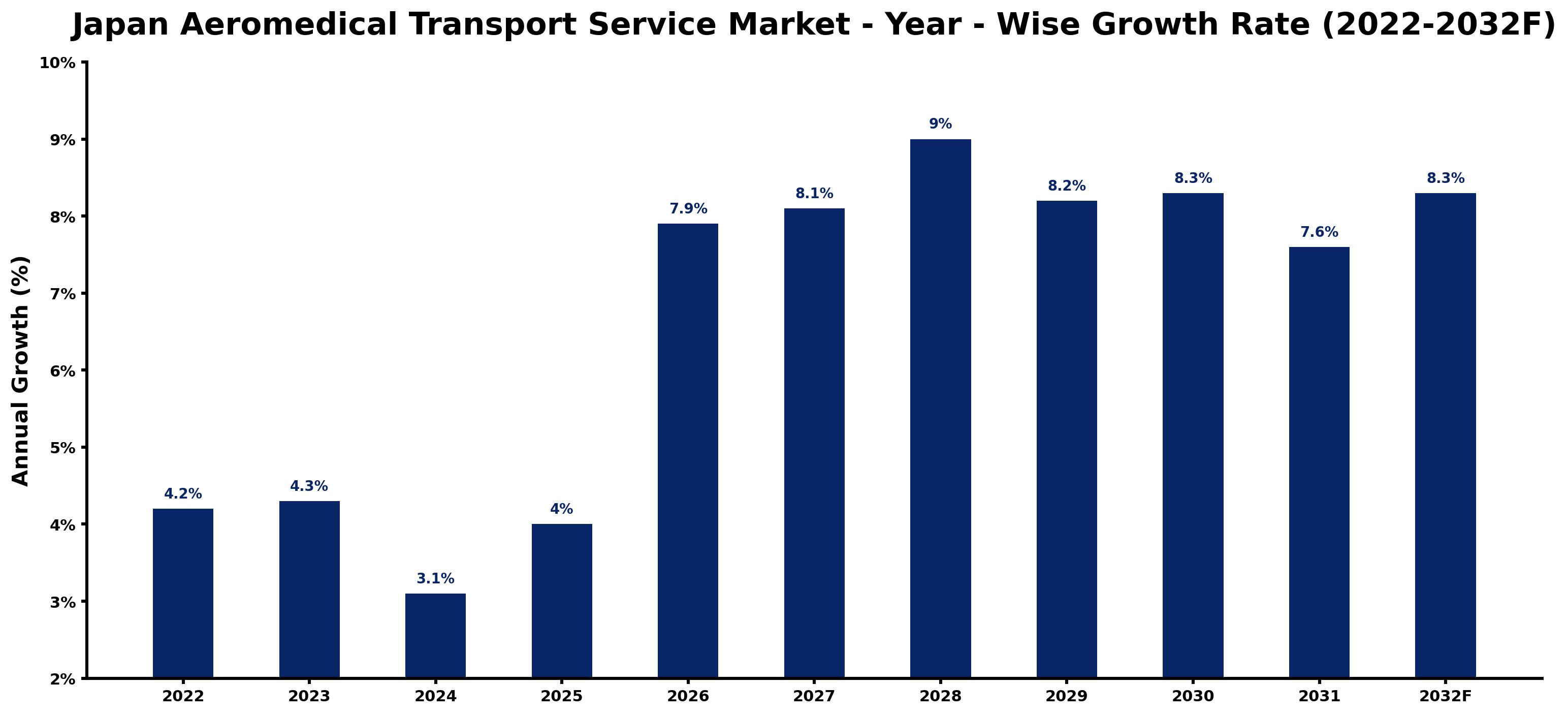
Each row of the following table gives one year's estimated growth and the event or demand shift that explains it.
| Year | Estimated Annual Growth (%) | Market Rationale |
| 2022 | 4.2 | The market experienced steady growth due to increasing healthcare demands. |
| 2023 | 4.3 | Growth accelerated as hospitals expanded their aeromedical capabilities. |
| 2024 | 3.1 | Growth slowed slightly as operational challenges emerged in urban areas. |
| 2025 | 4.0 | Demand rose again as the need for emergency medical flights increased. |
| 2026 | 7.9 | Growth is expected to pick up with more government contracts for aeromedical services. |
| 2027 | 8.1 | Demand will continue to rise as healthcare networks expand their reach. |
| 2028 | 9.0 | The market is projected to peak as urban centres increase their aeromedical operations. |
| 2029 | 8.2 | Growth is expected to slow due to market saturation in major metropolitan areas. |
| 2030 | 8.3 | Demand will increase again as technology improves service efficiency. |
| 2031 | 7.6 | Growth is projected to slow as competition intensifies among service providers. |
| 2032 | 8.3 | The market will rebound as new healthcare initiatives are launched. |
Note: Market size estimations and growth projections presented in this report are based on 6Wresearch's proprietary forecasting methodology, utilizing the latest available industry data, government publications, and primary research inputs.
Japan Aeromedical Transport Service Market Synopsis
Aeromedical transport services utilise specialised aircraft to provide urgent medical care and patient transport, primarily through helicopters and fixed-wing aircraft. The Japan Aeromedical Transport Service Market is expanding due to rising demand from hospitals and trauma centres, alongside government contracts and healthcare network integration. With over 100 licensed services and a growing focus on emergency medical flights, the market is driven by the need for timely patient transfers and organ transportation.
Market Dynamics Impact Analysis (2026–2032)
| Factor | Type | Impact | Primary Segment Affected |
| Increasing number of trauma cases requiring urgent transport | Driver | High | Emergency Medical Flights |
| Rising demand for specialized patient care during transport | Driver | High | Critical Care Transport |
| Growing urban population density necessitating rapid medical response | Opportunity | High | Organ Transport Services |
| Expansion of healthcare networks integrating aeromedical services | Opportunity | Medium | Neonatal & Pediatric Transport |
| High operational costs limiting service expansion | Restraint | High | Critical Care Transport |
| Regulatory compliance challenges affecting service delivery | Restraint | Medium | Emergency Medical Flights |
| Limited availability of qualified aeromedical personnel | Challenge | High | Critical Care Transport |
| Intense competition among service providers impacting pricing | Challenge | Medium | Emergency Medical Flights |
Evaluation of Drivers in Japan Aeromedical Transport Service Market (2026–2032)
Below are the drivers that matter most for revenue growth, with supporting evidence.
| Drivers | Primary Segment Affected | Why It Matters (Evidence) |
| Rising elderly population increasing healthcare needs | Emergency Medical Flights | 29.3% of Japan's population was aged 65 or older in September 2024, leading to more trauma cases requiring urgent transport. |
| Government funding for healthcare infrastructure improvements | Organ Transport Services | The Japanese government allocated ¥2 billion in 2023 for improving aeromedical transport infrastructure, boosting service availability. |
| High number of trauma cases annually driving service demand | Critical Care Transport | Emergency medical flights handle over 50,000 trauma cases annually, increasing the need for specialized transport. |
| Growth in on-demand service models attracting new users | Neonatal & Pediatric Transport | On-demand services saw a 30% rise in usage in 2023, appealing to hospitals needing flexible transport solutions. |
| Collaboration between hospitals and trauma centers improving service integration | Emergency Medical Flights | Pediatric hospitals often collaborate with trauma centers for critical care transport, enhancing patient outcomes. |
Orders keep climbing as 29.3% of Japan's population aged 65 or older increases healthcare needs, particularly for emergency medical flights. The ¥2 billion allocated in 2023 for improving aeromedical infrastructure supports the growth of organ transport services. The high incidence of over 50,000 trauma cases annually drives demand for critical care transport. On-demand service models are gaining traction, with a reported 30% rise in usage in 2023, appealing to hospitals needing flexible transport solutions. Collaboration between pediatric hospitals and trauma centers improves service integration, further boosting demand for emergency medical flights.
Evaluation of Restraints in Japan Aeromedical Transport Service Market
The following restraints limit how fast demand can grow.
| Market Restraint | Primary Segment Affected | Why It Matters (Evidence) |
| High operational costs limiting service expansion | Critical Care Transport | The average costs associated with maintaining aeromedical services can restrict the number of operational flights. |
| Regulatory compliance challenges affecting service delivery | Emergency Medical Flights | Compliance with strict aviation and medical regulations can delay service implementation and increase operational complexity. |
| Limited availability of qualified aeromedical personnel | Critical Care Transport | A shortage of trained professionals in the field can hinder the ability to provide timely and effective transport. |
| Intense competition among service providers impacting pricing | Emergency Medical Flights | Increased competition can lead to price wars, affecting profitability for many service providers. |
| Infrastructure limitations in rural areas affecting service reach | Organ Transport Services | Limited access to necessary facilities in remote regions can restrict timely organ transport. |
Japan Aeromedical Transport Service Market Challenges
Emergency medical flights handle over 50,000 trauma cases annually, yet competition among over 100 licensed aeromedical transport services leads to delays for hospitals needing urgent care. High operational costs arise from compliance with regulations, consuming about 60% of revenue for providers, which restricts their ability to expand services. A shortage of trained aeromedical personnel reduces operational efficiency, resulting in longer response times for patients in critical conditions. Supply chain disruptions related to aircraft maintenance can delay operations, impacting timely patient transfers for clinics and hospitals across the country.
Trends in the Japan Aeromedical Transport Service Market
Several trends are reshaping the Japan Aeromedical Transport Service Market; the most important are set out below.
- Rise in On-Demand Aeromedical Services: On-demand services are increasingly popular, reflecting the growing need for flexible transport solutions. The Tokyo metropolitan area has seen a 30% rise in usage in 2023, highlighting the urgency for rapid response in crowded urban settings.
- Adoption of Fixed-Wing Aircraft for Longer Distances: Fixed-wing aircraft are gaining traction for inter-island organ transport due to their efficiency over longer distances. This shift is essential for improving delivery times, especially for critical organ transplants, with 12 major transplant centers facilitating these services.
- Focus on Improved Safety Standards: The Japan Helicopter Association is promoting safety standards for air ambulance operations, improving service reliability. This focus aligns with the increasing need for high-quality aeromedical transport services across the country.
- Integration of Healthcare Networks: Healthcare networks are increasingly integrating aeromedical services to streamline patient transfers. This change is vital for improving operational efficiency and patient outcomes across the healthcare system.
Investment Opportunities in the Japan Aeromedical Transport Service Market
Investors looking at the Japan Aeromedical Transport Service Market should consider the following areas.
- Hospitals seeking efficient patient transport solutions: With the increasing number of trauma cases, hospitals need more aeromedical services. The market gap is clear, presenting a chance for investment in emergency medical flights, especially in densely populated areas like Tokyo.
- Growing need for organ transportation services: The demand for timely organ delivery is critical, with 12 major transplant centres facilitating services. Investment in organ transport capabilities can address this urgent demand effectively, particularly in regions with high transplant rates.
- Healthcare networks expanding service integration: The timing is right as healthcare networks seek to improve service offerings. Investing in partnerships with hospitals can facilitate better integration of aeromedical services, enhancing overall patient care.
- Rising interest in neonatal and pediatric transport: The demand for specialised transport for vulnerable patients is increasing. Supplying dedicated aeromedical services for paediatric hospitals can meet this growing need, particularly in urban areas.
Government Initiatives in the Japan Aeromedical Transport Service Market
The Medical Care Act of 1948 established standards for hospitals and clinics, including staffing and facilities necessary for aeromedical transport services. Following this, the PMD Act, renamed in 2014, regulates the approval and quality of medical devices, ensuring that aeromedical services meet high safety standards and operate effectively.
The Ministry of Health, Labour and Welfare oversees aeromedical transport regulations, ensuring compliance with established laws. The agency also funds initiatives to improve aeromedical infrastructure, including the allocation of ¥2 billion in 2023 for service improvements, which directly benefits hospitals and clinics relying on these services.
Future Insight of the Japan Aeromedical Transport Service Market
Hospitals will increasingly depend on aeromedical transport services by 2032 as Japan's ageing population drives demand for urgent care. The introduction of drone-assisted transport will streamline operations and improve service delivery. Government initiatives will support infrastructure upgrades, benefiting both suppliers and buyers in the sector. Enhanced training programmes for aeromedical personnel will improve service quality, ensuring better patient outcomes and fostering greater trust among healthcare providers.
Market Segmentation Analysis
Japan Aeromedical Transport Service Market report covers a detailed analysis of the following market segments:
By Service Type – Emergency Medical Flights Lead, Critical Care Transport Expected to Grow Fastest
According to Saurav Kr Singh, Senior Research Analyst at 6Wresearch, the largest service type category in 2025 was Emergency Medical Flights, at 43% of revenue. Emergency medical flights are crucial for urgent patient transport, particularly in densely populated areas like Tokyo, where quick response times are essential. With over 50,000 trauma cases annually requiring immediate care, this segment holds a commanding position in the market. Critical Care Transport is projected to grow fastest, at a CAGR of 11.0% during 2026–2032. The increasing complexity of patient conditions in urban areas is fuelling the demand for critical care transport services. As hospitals seek to provide specialised medical attention, this segment is expected to experience rapid growth. Providers must focus on enhancing their emergency medical flight services to meet the rising demand for urgent patient transport.
By Aircraft Type – Helicopters Lead, Fixed-Wing Aircraft Expected to Grow Fastest
In 2025, Helicopters led the aircraft type split with a 53% share. Helicopters are predominantly used for emergency medical flights due to their ability to access urban areas quickly. Their operational efficiency in delivering urgent care makes them the preferred choice among service providers. Fixed-Wing Aircraft is set to record the highest CAGR in this split, 11.3% over 2026–2032. Fixed-wing aircraft are experiencing rapid growth as they are increasingly favoured for longer distances, particularly in organ transport. Their capacity to cover greater distances efficiently is attracting more investments into this segment. Suppliers must consider expanding their fixed-wing aircraft offerings to capture the growing market segment.
By Operation Model – On-Demand Leads, Scheduled Expected to Grow Fastest
On-Demand held 35% of the Japan Aeromedical Transport Service Market by operation model in 2025. On-demand services provide a flexible model that meets urgent medical needs, making it the most utilised operation model in Japan. The increasing reliance on immediate service underscores its dominant position in the market. The quickest growth will come from Scheduled, forecast to expand at a CAGR of 11.4% between 2026 and 2032. Scheduled operations are gaining traction as they cater to regular patient transfers, reflecting a shift towards more systematic transport solutions. This model's growth is indicative of the stabilising demand for routine services. Suppliers should develop both on-demand and scheduled service capabilities to cater to diverse client needs.
By Distribution Channel – Direct Sales Leads, Government Contracts Expected to Grow Fastest
Direct Sales accounted for 43% of the market by distribution channel in 2025. Direct sales represent the primary method for acquiring aeromedical services, enabling strong relationships between service providers and healthcare facilities. This approach allows for tailored solutions that meet specific needs, ensuring effective service delivery. Over 2026–2032, Government Contracts are expected to post the fastest growth, at a CAGR of 10.6%. Government contracts are becoming the fastest-growing distribution channel, significantly impacting revenue streams. The government's commitment to improving aeromedical transport infrastructure is driving this segment's rapid expansion. Suppliers should prioritise government contracts to secure stable revenue and improve their service offerings.
By End User – Hospitals & Clinics Lead, Trauma Centers Expected to Grow Fastest
Hospitals & Clinics took 37% of end user revenue in 2025, more than any other category. Hospitals and clinics represent the largest user group of aeromedical services, relying on these transport solutions for timely patient care. Their substantial demand for rapid medical transport reinforces their position as the leading end user category. Trauma Centers are projected to grow fastest, at a CAGR of 10.7% during 2026–2032. Trauma centers are experiencing the fastest growth due to their critical function in emergency medical responses, which necessitates immediate access to aeromedical services. The rising number of trauma cases further fuels this demand. Suppliers should focus on building strong partnerships with trauma centers to improve service delivery and response times.
Key Attractiveness of the Report
- 10 Years of Market Numbers
- Historical Data Starting from 2022 to 2025
- Base Year 2025
- Forecast Data until 2032
- Key Performance Indicators Impacting the Market
- Major Upcoming Developments and Projects
Key Highlights of the Report:
- Japan Aeromedical Transport Service Market Outlook
- Market Size of Japan Aeromedical Transport Service Market, 2025
- Forecast of Japan Aeromedical Transport Service Market, 2032
- Historical Data and Forecast of Japan Aeromedical Transport Service Revenues & Volume for the Period 2022-2032F
- Japan Aeromedical Transport Service Market Trend Evolution
- Japan Aeromedical Transport Service Market Drivers and Challenges
- Japan Aeromedical Transport Service Price Trends
- Japan Aeromedical Transport Service Porter's Five Forces
- Japan Aeromedical Transport Service Industry Life Cycle
- Historical Data and Forecast of Japan Aeromedical Transport Service Market Revenues & Volume By Service Type for the Period 2022-2032F
- Historical Data and Forecast of Japan Aeromedical Transport Service Market Revenues & Volume By Emergency Medical Flights for the Period 2022-2032F
- Historical Data and Forecast of Japan Aeromedical Transport Service Market Revenues & Volume By Critical Care Transport for the Period 2022-2032F
- Historical Data and Forecast of Japan Aeromedical Transport Service Market Revenues & Volume By Neonatal & Pediatric Transport for the Period 2022-2032F
- Historical Data and Forecast of Japan Aeromedical Transport Service Market Revenues & Volume By Organ Transport Services for the Period 2022-2032F
- Historical Data and Forecast of Japan Aeromedical Transport Service Market Revenues & Volume By Aircraft Type for the Period 2022-2032F
- Historical Data and Forecast of Japan Aeromedical Transport Service Market Revenues & Volume By Helicopters for the Period 2022-2032F
- Historical Data and Forecast of Japan Aeromedical Transport Service Market Revenues & Volume By Fixed-Wing Aircraft for the Period 2022-2032F
- Historical Data and Forecast of Japan Aeromedical Transport Service Market Revenues & Volume By Charter Jets for the Period 2022-2032F
- Historical Data and Forecast of Japan Aeromedical Transport Service Market Revenues & Volume By Private Jets for the Period 2022-2032F
- Historical Data and Forecast of Japan Aeromedical Transport Service Market Revenues & Volume By Operation Model for the Period 2022-2032F
- Historical Data and Forecast of Japan Aeromedical Transport Service Market Revenues & Volume By On-Demand for the Period 2022-2032F
- Historical Data and Forecast of Japan Aeromedical Transport Service Market Revenues & Volume By Scheduled for the Period 2022-2032F
- Historical Data and Forecast of Japan Aeromedical Transport Service Market Revenues & Volume By Contract-Based for the Period 2022-2032F
- Historical Data and Forecast of Japan Aeromedical Transport Service Market Revenues & Volume By Subscription Model for the Period 2022-2032F
- Historical Data and Forecast of Japan Aeromedical Transport Service Market Revenues & Volume By Distribution Channel for the Period 2022-2032F
- Historical Data and Forecast of Japan Aeromedical Transport Service Market Revenues & Volume By Direct Sales for the Period 2022-2032F
- Historical Data and Forecast of Japan Aeromedical Transport Service Market Revenues & Volume By Government Contracts for the Period 2022-2032F
- Historical Data and Forecast of Japan Aeromedical Transport Service Market Revenues & Volume By Online Bookings for the Period 2022-2032F
- Historical Data and Forecast of Japan Aeromedical Transport Service Market Revenues & Volume By Healthcare Networks for the Period 2022-2032F
- Historical Data and Forecast of Japan Aeromedical Transport Service Market Revenues & Volume By End User for the Period 2022-2032F
- Historical Data and Forecast of Japan Aeromedical Transport Service Market Revenues & Volume By Hospitals & Clinics for the Period 2022-2032F
- Historical Data and Forecast of Japan Aeromedical Transport Service Market Revenues & Volume By Trauma Centers for the Period 2022-2032F
- Historical Data and Forecast of Japan Aeromedical Transport Service Market Revenues & Volume By Pediatric Hospitals for the Period 2022-2032F
- Historical Data and Forecast of Japan Aeromedical Transport Service Market Revenues & Volume By Transplant Centers for the Period 2022-2032F
- Japan Aeromedical Transport Service Import Export Trade Statistics
- Market Opportunity Assessment By Service Type
- Market Opportunity Assessment By Aircraft Type
- Market Opportunity Assessment By Operation Model
- Market Opportunity Assessment By Distribution Channel
- Market Opportunity Assessment By End User
- Japan Aeromedical Transport Service Top Companies Market Share
- Japan Aeromedical Transport Service Competitive Benchmarking By Technical and Operational Parameters
- Japan Aeromedical Transport Service Company Profiles
- Japan Aeromedical Transport Service Key Strategic Recommendations
Market Covered
The report covers the following segments.
By Service Type
- Emergency Medical Flights
- Critical Care Transport
- Neonatal & Pediatric Transport
- Organ Transport Services
By Aircraft Type
- Helicopters
- Fixed-Wing Aircraft
- Charter Jets
- Private Jets
By Operation Model
- On-Demand
- Scheduled
- Contract-Based
- Subscription Model
By Distribution Channel
- Direct Sales
- Government Contracts
- Online Bookings
- Healthcare Networks
By End User
- Hospitals & Clinics
- Trauma Centers
- Pediatric Hospitals
- Transplant Centers































